Movie Review: Jessica Rothe shines — as usual — in “Tater Tot & Patton”

tater.jpeg

She had a choice — “Rehab, or my sister’s farm!”

That’s what put Andie in South Dakota, a turbo-prop airport her last connection to what this Angelino coed might have seen as “the civilized world.”

She lets Mom know she arrived with a “Landed in the sh—–e” text.

And the uncle passed out, beer-drunk in his ancient Silverado in the parking lot? He’s not much for conversation on the ride back to the dump of a ranch on the rolling, treeless prairie.

“It’s kind of flat…” Nothing.

“Can we listen to some music?”

“Nawww.”

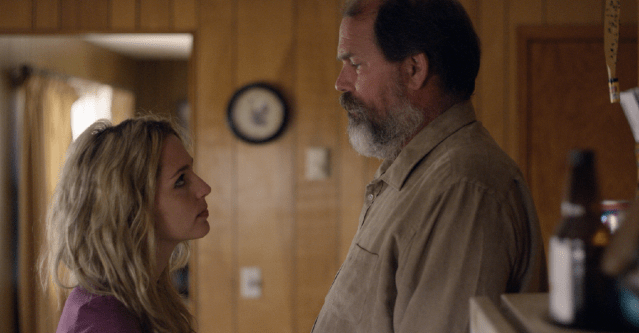
He hasn’t seen her since she was an oft-naked toddler, “Tater Tot” he called her. She has no memories of him, but his drinking and sullen hostility at her every query — Cell service? Wifi? Air conditioning? — set us up for a grimly comical war of wills.

“No AC, Princess,” he sniffs, before thundering about he is “King, Queen,” God and “George S. Patton” on this piece of land. And whatever she was going to get out of rehab, she’s REALLY in for it here.

“Tater Tot & Patton” is a quiet fish-out-of-water dramedy in mourning, a simple movie lifted by the compact performances of its leads — Jessica Rothe and Bates Wilder.

Rothe has upped her quote since this indie prairie idyll was filmed, thanks to the “Happy Death Day” movies. This could be her last turn as a college girl, and she makes a great case for why any actress who can still pull it off should play women that age.

She gives subtle shadings to a “spoiled brat” coping with pain that she starts to recognize in her always-tipsy Uncle Erwin. And she’s worked long enough (she’s over 30) to have the timing that makes the lighter moments and their one-liners pay off.

Meeting the lone farmhand Erwin leans on (Forrest Weber) is a breathless delight — for him. He’s trying to learn French, plans to travel but lacks polish in every imaginable way.

“You’ve got some soft ass skin,” he says, a tad too directly. “Welcome to the suck!”

“Hardcore criiiinge,” Andie mutters, half-aloud in her best SoCal vocal fry.

Writer-director Andrew Kightlinger’s debut foray in character study is an immersive experience, a myopic and unsurprising drama that revels in its sense of place. The details are South Dakota sharp, the grasp of small-time ranching — a little hard work, here and there, a lot of time to mope — is on the money.

Because Erwin mopes. His wife, Andie’s Aunt Tillie? She’s in “Rochester” (Mayo Clinic). “She’s got the cancer.”

Wilder, a veteran bit player (“Joy,””Detroit”) lets it all hang out as Erwin, a performance built on gruff exchanges and a whole series of “Not a good look for you” moments. Erwin swills his morning after beer after his morning tidy whitey whiz, showing off the ugliest pot-bellied belly button this side of science fiction.

The one thing Erwin can still manage is lord it over the estranged niece — dumping water on her to wake her up, force-feeding her franks and beans and dropping chores on her because a ranch he’s let go, aside from daily “ride the line” drives the check his fencing, has plenty to do that he’s not bothered doing.

But after the “tough love” labor, the fright of seeing her first rattler (which he beats to death with his belt) and the introduction to the dog he keeps, unloved and chained-up out front — “‘At dog there, he’s named ‘Little Bastard.’ Watch out for’em. He’s a humper.” — there’s time for each to pick up on the hurt the other’s dealing with.
tater2

Rothe underplays the “brat,” and gives a low-key sheen to the story of how she got there, the sorts of chemical things college kids do to “party” these days.

“You kids should drink more beer.”

Wilder is similarly subtle. Mostly he just “is,” a kind of forlorn acknowledgement of what this solitary life in a solitary place — the Lariat Lanes Bowling Alley & Honky Tonk is the only real entertainment outlet — can do to a person. He’s emotionally flat, lonely and depressed. Surviving.

There aren’t many surprises here. The big revelations aren’t revelations at all.

But as Kightlinger no doubt figured out, you cast your picture well and there’s a lot that the players will make understood, secrets that their demeanor and screen presence give away, sentences that only confirm what we already know after we’ve been told why the movie’s called “Tator Tot & Patton.”

2half-star6

MPAA Rating: unrated, alcohol and substance abuse, profanity, lots of bathroom breaks

Cast:Jessica Rothe, Bates Wilder, Forrest Weber

Credits: Written and directed by Andrew Kightlinger. A Giant Interactive release.

Running time: 1:32

Posted in Reviews, previews, profiles and movie news | Comments Off on Movie Review: Jessica Rothe shines — as usual — in “Tater Tot & Patton”

“Shaft” and “Rosewood” director John Singleton in coma after stroke

Hollywood Reporter (@THR) Tweeted:
Director #JohnSingleton in coma following “major stroke” https://t.co/hE3H5v0jjd https://t.co/hP5dFitKGo https://twitter.com/THR/status/1121513297491243008?s=17

Posted in Reviews, previews, profiles and movie news | Comments Off on “Shaft” and “Rosewood” director John Singleton in coma after stroke

An Accidental Studio review – the brief, brilliant life of HandMade Films

Used to love this early “boutique” studio’s films. https://www.theguardian.com/film/2019/apr/26/an-accidental-studio-review-handmade-films-george-harrison-monty-python

Posted in Reviews, previews, profiles and movie news | Comments Off on An Accidental Studio review – the brief, brilliant life of HandMade Films

BOX OFFICE: “Avengers” blow up Thursday night — a record weekend ahead?

end3

The all-time Thursday night “preview” record is
$57 million, pulled in by a recent “Star Wars” sequel.

Last night, “Avengers: Endgame” blew that away. A $60 million Thursday night.

AMC theaters in certain parts of the country have scheduled round the clock screenings to accomodate pre-0release demand.

What’s that going to add up to, in the end? Midnight Sunday, I mean?

“The Force Awakens” used to hold that Thursday night record, and the single day — a Friday — record at $119.

With “Endgame” already over $169 million overseas, could the much speculated about $300  opening weekend that Variety and others have predicted be  within reach? Box Office Mojo seems to think so.

Some of that will depend on the final tally ($43 million currently banked) for Thursday night. But as a 3 hour long movie, that could drag the numbers down. Lack of 3D will figure in, too.

But it’s a long weekend, the “final” film in a beloved franchise, so sure. I wasn’t dazzled by it, and find these movies in general quite forgettable. Reviews have ranged from good to ecstatic. I do wonder about repeat business. There’s a lot to take in, so maybe people with the time will burn off a big block of time twice. I’m guessing not.

Sold out showings won’t slow down the train, as a dozen releases are surrendering screens to this behemoth.

“The Curse of La Llorona” should pick up the scraps, maybe $10 million this weekend.


Posted in Reviews, previews, profiles and movie news | Comments Off on BOX OFFICE: “Avengers” blow up Thursday night — a record weekend ahead?

Catch-22 Trailer (Official) • A Hulu Original

A bit more of the proper dark comic tone is evident in this second trailer to George Clooney’s Hulu version of “Catch-22.” Now it’s the casting that makes you wonder if it’ll amuse and appall. May 22 we find out

Posted in Reviews, previews, profiles and movie news | Comments Off on Catch-22 Trailer (Official) • A Hulu Original

“Oh no, there goes Tokyo!” “Godzilla” by BOC…as interpreted by Serj Tankian

Nice use of a fun metal song from the late 70s by one of the best bands of that era NOT in the Rock and Roll Hall of Fame — Blue Öyster Cult.

I haven’t been that worked up about this coming release — seen WAY too many Gojiras over the decades, I fear. Hell, I forgot I interviewed Ken Watanabe for the 2014 “Godzilla,” even though I remembered the Matthew Broderick one (can’t find that interview).

Plainly, what this “Godzilla: King of the Monsters” needed was “more cowbell.”

Posted in Reviews, previews, profiles and movie news | 1 Comment

Documentary Review — “Asbury Park: Riot Redemption Rock n’Roll” visits Springsteen’s history and his old haunts

asbury2

It begins with a Langston Hughes quote about letting “America be” what it has not yet become and the tinkling of the piano that opens Bruce Springsteen’s “Growin’ Up.”

A parade of testimonials follow, about a “honky tonk town” with a sound borrowed from soul, pop, rock and “the west side of the tracks,” music formed in a tiny corner of the Jersey Shore, where future musicians were exposed to the greats of jazz, blues and rock and went on to form a seminal rock act and the ensemble long labeled “the best bar band in America.

“Something happened here that wasn’t happening any place else,” Bruce Springsteen intones, “and that mattered.”

Like the postcard and the E-Street Band album title say, “Greetings from Asbury Park,” a square mile of New Jersey that became a musical melting pot which, to this day, has supplanted whatever image this hard-luck town had before.

“Asbury Park: Riot Redemption Rock’n Roll” recounts that history, from the town’s founding and resort-community heyday to the day the racial fissures there opened up and changed it forever.

Documentary filmmaker Tom Jones rounded up every legendary musician to ever call the place home, historians, musicians who never got famous, civil rights leaders, developers and even a former mayor to tell this story of the ferment that gave Asbury Park its musical moment.

Many cities over the decades have taken their place at the podium — from New Orleans and Memphis, to Nashville, Seattle and Athens, Ga. to Minneapolis.

But none were as tiny as this one, and few have made it as much a part of their musical identity.

It’s a town that long ago split into an “East Side” (of the tracks) and a “West Side,” where once Italian immigrant and African labor for the resort hotels lived, where jazz and blues clubs held sway and where a still largely-segregated city’s 40% African American population mostly lives.

Historians talk about the town’s sanctified founding in the 1870s, and its slow turn towards entertainment, hotels and bars to make itself a favorite summer getaway for New Yorkers and Philadelphians, and a favorite concert stop from the jazz age to the 1960s.

“You’d go to Ocean Grove to pray and Asbury Park to party,” Southside Johnny Lyons remembers. He fronted the great bar band Southside Johnny and the Asbury Jukes.

Little Steven Van Zandt, cradling a cuddly Papillon in his arms, walks us upstairs to the abandoned bar that was the Upstage Club, where every musician in a music-crazy town met and jammed after hours.

He met Bruce Springsteen there, and the future “Boss” first heard several members of his band in jam sessions on that stage, sessions the very young Springsteen (mop-topped and shirtless in still photographs, heard on tape) would often lead into the wee hours of the morning.

He had a thing for Alvin Lee’s song “Coming Home,” which they’d play in 30 minute-long jams at the end of the long night as it bled into the dawn.

Springsteen is interviewed in the Upstage (long closed) as well, and he and assorted bandmates, past and present — David Sancious, Garry Tallent, Edward Carter and Max Weinberg — press hard the point that being an integrated blues rock band in a slow-to-integrate town was no big deal to them.

White musicians had long thought nothing of ducking into The Orchid Lounge to hear jazz or B.B. King or Howlin’ Wolf. The phrase “white privilege” might creep into your mind as you hear this.

On July 4, 1970, they got a rude awakening, one the town hasn’t shaken off to this day. Asbury Park erupted into a riot and huge chunks of it were burned to the ground.

“It got weird for a minute there,” Little Steven says.

But “a minute there” grew into decades as the city slowly got its musical mojo back, as affluent gays adopted neighborhoods and gentrified them after coming in to see the acts at a new, wildly popular drag queen club. The African American “West Side” of town? Still mostly vacant lots, empty storefronts and limited horizons.

It turns out, the burgeoning music scene of the late ’60s had no African American element. Opportunities to play and hear music in that vital underprivileged half of the city dried-up and was another part of why the populace rioted.

So there’s just enough here on that “riot” and “redemption” part of the story to let us know there’s a LOT that’s being left out or sugar-coated, that musicians talking up color-blindness weren’t really privy to the real tensions in “My Hometown,” and haven’t done a whole lot to change that in the decades since. Yes, African American music brought African American culture into the pop mainstream. And?

“Riot Redemption Rock’n Roll” is mainly about Springsteen & Co. and Southside Johnny and is built for their fans. And that material, the early days of The Stone Pony beachside music club, the colorful figures backing the local music scene, including a couple of hairdressers who opened The Upstage Club, one a proto-punk singer named Margaret, front woman for Margaret and the Distractions — the Upstage’s house band.

The optimistic film gives us a celebratory concert at its climax and reasons to hope the city is on the mend, with hope creeping even into its blighted West Side.

But its real value is as an oral and visual history of Springsteen, where he met his bandmates and the musical milieu he was fortunate enough to grow up in.

“Asbury Park: Riot Redemption Rock’n Roll” opens May 22 and 29 in select cinemas (hit the link for theaters and ticket info).

2half-star6

MPAA Rating: unrated

Cast: Bruce Springsteen, Little Steven Van Zandt, Southside Johnny Lyon, narrated by Big Joe Henry

Credits:Directed by Tom Jones. A Trafalgar release.

Running time: 1:28


Posted in Reviews, previews, profiles and movie news | Comments Off on Documentary Review — “Asbury Park: Riot Redemption Rock n’Roll” visits Springsteen’s history and his old haunts

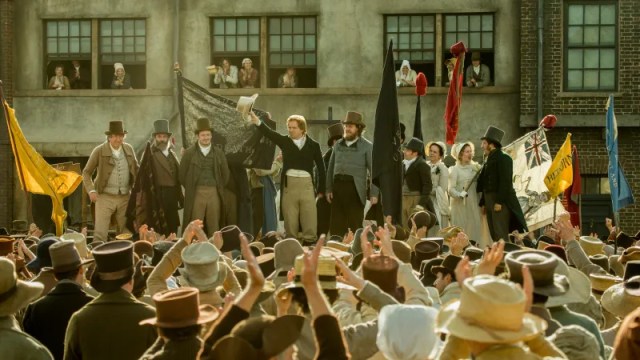
Movie Review: Mike Leigh meets his “Peterloo”

peter1

His politics make “Peterloo” a natural subject for Mike Leigh. British cinema’s champion of the working classes has celebrated their pluck and plight in films from “High Hopes” and “Life is Sweet” to “Vera Drake” and “Career Girls.”

“Peterloo,” about an infamous British massacre of the working poor by the same redcoats who’d just defeated Napoleon, a slaughter carried out at the behest of factory owners, callous upperclass judges, a judgemental preacher and others of the Manchester ruling classes, fits right into Leigh’s worldview.

And his “Mr. Turner” and “Topsy Turvy” show a love of period detail that blends in with his lifelong obsession with almost unfathomable British accents through the ages.

But the sweep of this great tragedy and epic injustice all but overwhelms a director known for more intimate stories. He does the audience no favors, not identifying characters, rarely casting known-names in key roles and not using cinematic crutches like inter-titles to take us through the events leading up to that fateful day in August of 1819.

As the British have been slow to learn this horrid moment of their own history as well, he’s not leaning on “a story we/they all know” and needed to give us a hand. That can make the two and a half hours of “Peterloo” punishing, a school assignment that will require outside reading to wholly grasp.

That so much of the dialogue is in a spoken “English” so dense and archaic that even the English may wish was subtitled doesn’t help, either.

But a bravura opening sets the scene and a sweeping, heart-breaking finale punches its point home. If we don’t remember this, we should, and just a sketched impression of the principals is all that’s necessary to make its case.

A shellshocked young bugler (David Moorst) staggers to his feet on the field at Waterloo, and has to make his own way home to England, to Manchester. Home is welcoming, but crowded. The newly-industrialized city has the smoke of factories, the deafening roar of cotton looms, and a populace struggling to earn enough to feed, clothe and shelter itself.

There was no “peace dividend” after the Napoleonic Wars, just debts and a new set of “corn laws,” tariffs designed to keep British grain producers (merchants) fat and happy.

The poor start to starve. And agitate.

Leigh’s screenplay takes us into pubs and meeting halls, where middle class moderates try to temper the rising fury of young radicals who call for the “mad king” (George III) and his “fat Prince Regent” (Tim McInnerny, hilarious) to be cut off from the public treasury, or have their heads put on pikes.

The franchise is what they all can agree that they want, first and foremost. From radical leader Samuel Bamford (Neil Bell) to the Manchester Female Reform Society, “One man, one vote!” was common cause.

“Taxation without representation is tyranny,” speakers such as Bamford, John Knight (Philip Jackson) and John Thacker Saxton (John-Paul Hurley) bellowed to every crowd, echoing a cry from their American cousins’ revolution just 40 years before.

“Give me liberty, or give me death!” the younger firebrands thundered.

Joseph Johnson (Tom Gill) and his fellow middle class radicals called for all these things, and the repeal of the Corn Tax, from the pages of their Manchester Observer newspaper. Johnson and the others call for Henry Hunt (Rory Kinnear), “The Orator Hunt,” the famed London speaker on behalf of such causes, to come north to address the public.

Watching this with naked contempt, fear and spittle-spewing fury were the magistrates (Martin Savage, Al Weaver, David Bamber, Fine Time Fontayne, Vincent Franklin, Jeff Rawle, Philip Witchurch and David Fielder) of the city, whom we’ve seen hurl abuse and cruelty at the starving, excessive sentences handed down for petty theft and “idleness.” They may have preachers in their ranks, but they have their “rank” to protect, so no wondering “What would Jesus do?” They fear a repeat of the more recent French Revolution, so they petition the Home Secretary (Karl Johnson) for the right to read “The Riot Act,” and for troops. And so troops are sent.

Spies identify the rabble rousers, letters are intercepted and read and the  threat of violence looms, even as The Orator Hunt insists on keeping calm and not having armed citizens there to protect the crowd from the brutish constable (Victor McGuire) and his minions, or from the local horse militia or the Army itself.

The nation’s press is coming, from London, Liverpool and Leeds. Surely nothing will happen with witnesses present.

What Leigh was shooting for here was a modern “Battleship Potemkin,” a filmic polemic about injustice, the haves slaughtering the have-nots, a parable for a world where nothing’s changed. It’s just that Leigh has never been that kind of kinetic, visceral filmmaker.

The actual “Peterloo Massacre” — a term coined by the journalists the soldiers and drunken “yeomanry” (militia) rode down on — is delivered in a string of body blows, blunt strokes and vignettes of murder intercut with the terror of those experiencing it and the smug, sherry-sipping satisfaction of the magistrates, especially Rev. Mallory (David Bamber, a villain’s villain) who brought “the iron fist” down upon them.


Leigh takes so long to get to this point, taking pains to show us lots and lots of background — the famed General Byng (Alastair McKenzie), leader of the troops, preferring to be at the horse track instead of on duty, restraining his troops– that some of the effect of this wrenching finale is muted.

But the slow buildup to the climax allows the viewer to ponder how little has changed in 200 years, how many times “The People” have come close to having a “real” revolution here, there and everywhere else. And how often the military, built on working class backs and populated with working class recruits, is brought in to carry out the will of those with money.

In America, we had the Textile strikes of 1934 and The Battle of Blair Mountain in America’s “Coal Wars,” when America’s armed forces used planes to bomb and strafe miners battling to organize and strike for better working conditions. West Virginia to Colorado, Manchester to Glasgow, the have-nots always seem to fall just short of Bastille Day/St. Petersburg in the English-speaking world.

In “Peterloo,” Leigh reminds us how wars, and anti-labor massacres, are forgotten in the “history is written by the winners” rules of the game. And even if the film gets away from him, here and there, it’s good to have him remind us the game isn’t actually over. Yet.

2half-star6

MPAA Rating: PG-13 for a sequence of violence and chaos

Cast:  Rory Kinnear, Tom Gill, Rachel Finnegan, David Moorst, Maxine Peake, John-Paul Hurley, Karl Johnson, Neil Bell, Philip Jackson and Tim McInnerny

Credits: Written and directed by Mike Leigh.  An Amazon release.

Running time: 2:34

Posted in Reviews, previews, profiles and movie news | 2 Comments

Movie Review: Denis goes down and dirty for “High Life”

high2

It’s worth remembering that there’s no hard and fast rule that says science fiction cinema has to be entertaining. Thought provoking and challenging are intellectually defensible paths to pursue.

That’s the aim of “High Life,” a science fiction exploration of the fundamental inhumanity of humans, who might be at our best when we’re dealing with our own offspring.

It’s not entertaining. It’s discomforting at times, and at others obtuse and downright icky. But it does leave you with a little to chew on, if somewhat less that its creator presumes.

It was co-written and directed by Claire Denis, that queen of acquired taste among her generation of French filmmakers. She peaked for me with “Chocolat,” NOT the one you’re thinking about, and with another film in Africa, “White Material.”

She’s provocative and thought provoking, although “High Life” aims more for the former and flails away at the latter.

Robert Pattinson stars as Monte. When we meet him, he’s in a low-bid contractor’s idea of a space suit effecting repairs on a block-shaped, no frills spaceship. And he’s cooing at a baby in a DIY crib that he’s left inside but is monitoring via com-link.

It’s adorable, and little Scarlett Lindsey, as baby Willow, may be the cutest infant ever to have a co-starring role in a movie.

The ship has a name, stenciled on its corrugated hull and on every rough-hewn article of fabric Monte wears on board — “7.” Everything about it is similarly spare. It’s grungy, lived-in and breaking down. The on-board garden, intended to help feed them, clean the air and water, is overgrown. Lights flicker, things leak and clutter is piling up.

What happened here?

As Monte files his daily online report, which earns the response that “prolongation of life support systems for 24 hours” is his reward for doing this, we piece things together. There were others. They had a mission. All the others are dead.

In flashbacks, Monte takes us back to his rural childhood and his wayward, impulsive, hop-a-freight-with-stoner-friends teens.

Nothing, not even his doting on this not-walking-yet tyke in his care, says “astronaut” about him. Because he isn’t.

The last piece of plot you need to know is that the others were, like Monte, “sentenced” to be on board this ship, that Juliette Binoche plays Dibs, the on-board physician monitoring their health and their mission, and that other flashbacks will fill in some of the blanks about what happened, if not exactly why.

Denis sets up this mission itself as an act of societal cruelty, and expands on that aspect of human nature with most of those on board — impulsive, violent, medicated to tamp down their psychoses and their tempers. André Benjamin of one-hit wonders OutKast may be the mellowest, sanest one there. Mia Goth’s “Boyse,” young, rash and perpetually enraged, is more typical.

And remember, I’ve already identified Binoche’s Marlene Dietrich turn, Dibs, as a “doctor.”

Violence and a generous spattering of bodily fluids ensues. There’s a notoriously sadomasochistic solo sex scene celebrated by some critics (Brits, mostly) in the film’s version of Woody Allen’s “Orgasmatron” in “Sleeper” sex module.

Characters aren’t so much motivated as driven by instincts, which may be an interesting point to make but guts the film of any emotional connection. Pattinson, making a string of arty choices after cashing his last “Twilight” check, gives us nothing as this blank-faced, emotionally-remote “hero” and narrator.

“She’s mine. I’m hers,” he says of the baby, in a heartless monotone.

The warehouse furnished by Harbor Freight and Home Depot settings weren’t a turn-off to me. That’s my favorite gripe about space-travel movies — the ships are all inefficiently roomy, too shiny for their own good. Not even making an effort to simulate zero gravity (one image) is just lazy and makes the enterprise seem malnourished and theatrical — as in community theater.

But if that’s not a turnoff, the film’s obsession with semen, blood and viscera are. And as it lacks anything remotely like a “turn on” (I’m NOT British) or point of connection, I found the over-praised “High Life” haunting, but mercifully forgettable.

And messy to the point of sticky.

2stars1

MPAA Rating: R for disturbing sexual and violent content including sexual assault, graphic nudity, and for language

Cast: Robert Pattinson, Juliette Binoche and Andre Benjamin

Credits: Directed by Claire Denis, script by Geoff Cox, Claire Denis and Jean-Pol Fargeau. An A24 release.

Running time: 1:53

Posted in Reviews, previews, profiles and movie news | Comments Off on Movie Review: Denis goes down and dirty for “High Life”

Chris Hemsworth and Scarlett Johansson Insult Each Other — on a BBC radio dare

I love this Brit radio gimmick. Even when it isn’t as good as J Law and Pratt, it’s funny.

Chris? Make fun of her “vocal fry,” which grows more pronounced by the hour.

ScarJo? Got to be a “When they told me, I thought I was going to work with the ‘Talented’ Hemsworth brother.”

Come on kids, step it up!

Posted in Reviews, previews, profiles and movie news | Comments Off on Chris Hemsworth and Scarlett Johansson Insult Each Other — on a BBC radio dare