
Dennis Quaid as the creepy old guy who never quite “moves on” after selling his house to Meegan Good and Michael Ealy.
Looks sinister enough. “The Intruder,” directed by Deon Taylor (“Traffik,” “Meet the Blacks”) opens Friday.
Dennis Quaid as the creepy old guy who never quite “moves on” after selling his house to Meegan Good and Michael Ealy.
Looks sinister enough. “The Intruder,” directed by Deon Taylor (“Traffik,” “Meet the Blacks”) opens Friday.
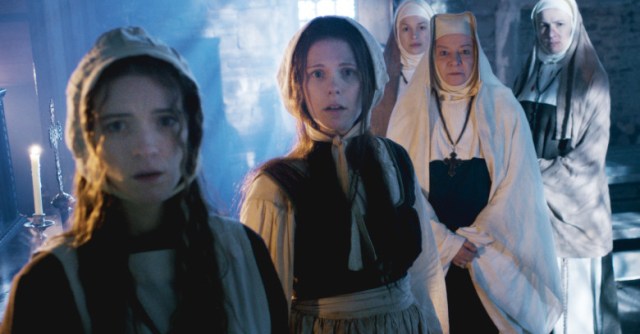
Let’s not bury the glories of “The Convent” deep in the review, lost in the credits.
Production designers Maria Dagher, Tony Noble and Julian Luxton should take a bow for this beautifully conceived period piece ghost story.
And let’s not leave out art director Hattie Gent, whose color schemes bring the drab, superstitious and bloody 16th century of Britain to life, or cinematographer Neil Oseman, who paints this world in pools of darkness pierced by smoky-spooky beams of filtered sun or unfiltered moonlight.
The story may be horror-movie simple — novitiate nuns stuck in a “cursed” convent, hounded and slaughtered by…well, something. Or someone. Someones?
But makeup and prosthetic designer turned co-writer/director Paul Hyett‘s ghoulish stroll through the nasty nunnery is lifted by its detail, its grim in-your-face intimacy and very good performances.
No, legendary Canadian character actor Michael Ironside may not even attempt a British accent in his lone scene, a cameo as “The Magistrate” when sentences our heroine, “another necromancer,” to be “lashed to the stake and put to the blaze.” Everybody else picks up the slack.
And he manages the one thing his character must possess — loathsome cruelty.
Persephone, she is called. Named for the “Queen of the Underworld,” she (Hannah Arterton, yes the younger sister of Gemma Arterton) is to be burned as a witch, only to be “saved” by an outspoken, no-nonsense nun.
” I provide purpose to the fallen,” Sister Margaret (Katie Sheridan) of The Sisters of the Eucharist declares. “A penitent soul holds more value than kindling for a fire.”
Persephone and her “HEATHEN name, one that has no place here,” move in. But there’s something seriously off about this place. And not just the creepy Margaret or monstrous Mother Superior (Claire Higgins), the gloomy lighting that penetrates its cells, chapel and kitchen, day and night.
The infirmary is insanely busy. A fever? The villager Ellis (Freddy Carter), who pines for Catherine (Emily Tucker) is asking a lot of questions. All he gets is a warning from the scary Sister Margaret.
“A greater infection than their faith draws close!”
Hyett and cinematographer keep the camera even closer; tight shots for interiors, capturing the fright in close-ups and medium shots, even tighter shots outdoors (limiting how much 1659 production you have to “design” and decorate.
The dialogue has the tone of incantations — “Praise be! We have been blessed with a new soul!” “I have found only doubt between these walls!” “Must you find Perdition so…tempting?”
Yes, “There is a wretchedness here. Something lurks between these walls.” Persephone may be just the one, the “new soul” to figure out what it is.
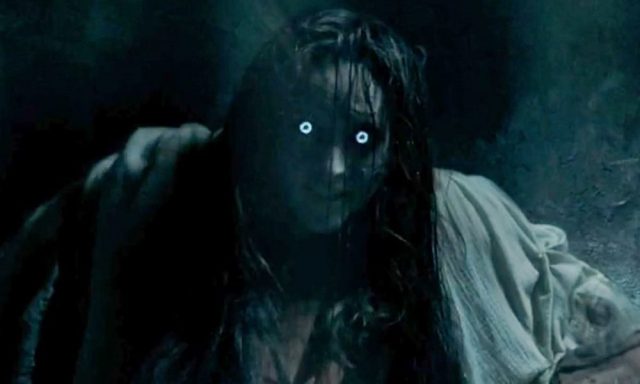
I can’t say it was all that scary, and that’s a major shortcoming for a horror movie.
But that’s not all we drop in on these fright-fests for, is it? The effects — fiery/blurry nightmares, gathering blackness that suggests “an entity,” gore and blood and knives that draw such blood — are as good as a dimly-lit picture like this needs them to be.
And the eyes, the EYES!
Like most movies of this genre, you find yourself wishing it was better, more horrific or more despairing, maybe with a message of some sort, ANY sort.
We really only get to know Persephone, and can only fear for the other characters by type-casting — winsome, cute and cosseted young English roses, caught up in “a higher calling,” fated to be bloodied, doomed unless Persephone can figure out a way to save them.
Still, this cast gives fair value and the production team is punching WAY above its budget. Not bad.

MPAA Rating: unrated, graphic violence, blood and gore
Cast: Hannah Arterton, Katie Sheridan, Rosie Day, Clare Higgins, Dilan Gwyn, Ania Marson and Michael Ironside
Credits:Directed by Paul Hyett, script by Conel Plamer and Paul Hyett. A Vertical Entertainment release.
Running time: 1:21
Chickens, ducks, maybe our heroine Kathy loves her birds too much and can’t see the problems that have come from filling her life with feathered friends .
A lot of us can watch this trailer and think “I’ve seen this movie.” It might have been about the scores of Americans, mostly disabled, who feel the need to keep big, dangerous cats — tigers and lions — in their care.
Then there was “The Pig Lady of Bunnel” (Florida), whose life and mission and legal battles were captured in “When Pigs Fly.”
“For the Birds” opens June 14.

It’s a disservice to refer to the documentary, “Hesburgh,” about the longtime president of the University of Notre Dame and American Catholic hero Theodore Hesburgh as a “hagiography.” But when a filmmaker cannot find anybody to say a bad thing about the man he’s profiling, the natural tendency is to wonder “Did he try?”
Patrick Creadon’s film still captures a complicated figure, a “liberal” only by the Catholic Church’s standards of the day, an “activist” in an almost forgotten forgotten use of the word, who hobnobbed with the rich and powerful and worked — always from the inside — for social justice, peace and progress from the Eisenhower 1950s to the Reagan Era ’80s.
Hesburgh died in 2015, had retired from Notre Dame in 1987 and his peak years in the public eye were half a century ago. Calling him “forgotten” outside of Catholic and Notre Dame circles isn’t entirely unfair. But few public figures carried the weight of his imprint on history more lightly and who was a role model not just for his ideals, but for how he embodied them.
They don’t make them like Father Ted Hesburgh any more. In a time when any news story that begins with “Catholic priest” brings an almost reflexive cringe, here was a “philosopher,” educator, visionary and priest who said Mass almost every day of his life and who represented a brand of tolerance that was rare “back then,” and is even rarer today.
Creadon (“I.O.U.S.A.” and “All Work All Play” were his) uses archival footage, old TV interviews, an early “60 Minutes” profile and the like, as well as interviews with colleagues, former students, relatives and contemporaries to paint an overwhelmingly flattering picture of a man who seemed to be in the thick of most of the great debates of America from the 1950s into the ’80s.
An actor (Maurice LaMarche) reads Hesburgh’s words from his memoirs, telling us he’d wanted to be a priest since age six, that the Church ordered him to pursue a Phd instead of becoming a military chaplain during World War II, a priest and academic groomed to take over the presidency of the University of Notre Dame in his late 30s.
We see how Father Ted asserted the school’s independence from the Vatican, fighting to make Notre Dame famous for something more than “Touchdown Jesus.” He cast off the free speech restrictions of the Catholic Church to build a great university.
He had to be an educator, an administrator and a fundraiser at Notre Dame. That put him in the company of big names in oil, the CEOs of airlines and Coca-Cola. And that, in turn, put him on the radar of the Eisenhower Administration, which appointed him to the first President’s Commission on Civil Rights back in 1957.
Much of the film is about the efforts of that commission — mostly older white men with an African American labor attorney member as well — to visit, investigate and when necessary subpoena officials in the Deep South (Judge and later Governor George Wallace among them) and elsewhere to find out why America was becoming, as Hesburgh noted at the time, “two societies, one white and the other black.”
Eisenhower had to intervene, at times, to get the Commission (which had African Americans on its staff) accommodations in places like Montgomery, Alabama. Even the commanding at the local military base refused to welcome them.
A telling TV moment? We see Hesburgh quietly challenging the racist Montgomery County, Alabama sheriff with “Has there ever been, in history, a good society built on fear?”
It’s sobering to see this GOP presidential commission digging into issues like segregation and voter suppression, and know which political party has been striving to bring back those days in the states of the former Confederacy today.
It still startles, 60 years later, seeing someone articulate “the problem” as bluntly as Hesburgh did, noting the “thousand times a day” a person of color dealt with discrimination in 1950s America, and how laughable the counter-arguments sounded to him.
“It’s like holding a man underwater and asking, ‘Why don’t you SWIM?'”
He was on stage with Rev. Martin Luther King Jr., deeply involved in the pursuit of nuclear disarmament (also dating from the Eisenhower years), a glad-hander who enjoyed cigars and bourbon with those he was trying to bring together at peace conferences or Civil Rights Commission meetings.
As Vatican envoy to nuclear disarmament talks in 1957, he started to see the avocation life was adding to his priesthood vocation — that of “a mediator.”
The Latin word for “priest” is “bridge builder,” the former religion editor at Newsweek remarks. That was Hesburgh.

Creadon presents all this in a brisk, lively film, with lots of topical music underscoring the archival footage, and interviews with everyone from former students who became journalists or members of Congress to Ted Koppel and former Senator Alan Simpson.
The director only hints at the self-described “imperfect” side of Hesburgh, a man who like the Protestant Billy Graham was entirely too cozy with great power, — calling in favors from his old friend, Pope Paul VI, Jimmy Carter and others, living modestly enough on campus but recipient of many a “gift,” and more often ensconced in limos or jets on his way here or there, generally put up in fine hotels.
The film’s real “negatives” are reserved for the Vatican, which tried repeatedly to reign in Notre Dame and censor who the campus invited to speak or teach there, for JFK who “slow-walked” the recommendations of the Civil Rights Commission (Eisenhower didn’t even slow-walk them), for LBJ who “blackmailed” members of Congress to push through the landmark Civil Rights legislation of his presidency, and Richard Nixon, who is heard on tape sniping about Hesburgh (who turned on Nixon and the War in Vietnam, eventually).
But the portrait that emerges hasn’t been rendered inaccurate by history, and the film corrects the crime that such a noble public figure should be forgotten, especially in a time when “noble public figure” is almost an oxymoron.

MPAA Rating: unrated
Cast: Theodore Hesburgh, Nancy Pelosi, Tim Roemer, Ted Koppel
Credits: Patrick Creadon. Written by Nick Andert, Jerry Barca, William Neal. An O’Malley/Creadon release.
Running time: 1:46
Scientists are always so much more magnetic and articulate, have much more of a flare for the dramatic, in the movies.
But when they finally confirm there’s life, even intelligent life, elsewhere in the universe, you have to hope their spokesperson has a sense of occasion and finds the words that seem to come easily to actors performing as scientists in a screenplay written with drama in mind.
“Clara” is a movie with more than a few drama queens — and kings — in its scientists. It’s a science fiction love story ostensibly about a young astronomer so lost in the cosmos that he “can’t see the life happening right in front of” his eyes.
The love story falls a little short, but the scientific sense of “the moment” is often spot-on in this mixed-bag of a debut from Canadian writer-director Akash Sherman.
In a world on the brink, seemingly, of discovering life on other worlds, suggested by the film’s satellite launch prologue, Dr. Isaac Bruno (Patrick J. Adams) is consumed with being The Guy. As in, the person who finds proof first.
He is lost in the probabilities, seemingly broken-hearted and impatient that it hasn’t happened before now. He can’t even get through the college course he teaches or do the subservient work of assisting a lead scientist on another project without wandering off subject and into the search for planets that might support alien life.
What others things could be more important to humanity than answering the question. ‘Are we alone?'”
It gets him put on administrative leave. He’s barely got the time to be bitter about it. He’s that wrapped up in this hunt.
He advertises for an assistant, and is in the act of puffing up his chest to dismiss her out of hand, when she pulls a little saleswomanship to play the pity card.
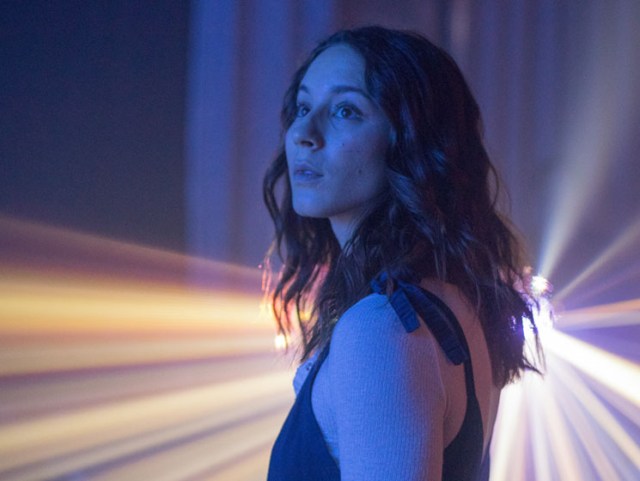
He’s seen Clara (Troian Bellisario) painting the helix/black hole mural at the entrance to the space sciences building where he teaches. She has no real tech or science qualifications for the job. But “this is Eva,” she says, introducing her collie. “Could we get her a drink of water?”
Even Isaac can’t resist a cute dog. And once in the door, Clara’s more spiritual, more about “feeling” her “connection” to the universe, which is “too beautiful to just be random,” disarms him. Just a little.
“You can’t prove something based on a feeling.”
So even though they don’t see eye-to-eye about much, with her all moony about love and romantic connection and him “chemicals in the brain…serotonin,” they get to work and get to know each other.
Adams, of TV’s “Suits,” manages the distracted impatience hiding a big hurt that is Isaac’s MO with skill if not a lot of charisma.
Bellasario, of TV’s “Pretty Little Liars,” has more of that built into her character, a woman who collects unusual stones from all the strange and exotic places she’s been, a life lived on-the-fly — rootless.
As her past comes out, he picks up on the things she’s avoided because they were “not the right version of my life.” Isaac’s Big Secret is more predicable, but more slowly revealed.
There’s a lot of him turning his eyes away from the skies long enough to learn the right way to pronounce her name — “CLAH-ra.”
For her, there’s a steep learning curve.
“So, is that a planet there?”
“No.”
The “cute” moments romances typically serve up are few and far between, but there’s one electric one when they sneak into the computer lab where they can dial up a telescope after hours. Clara’s charms may be obvious, but her language skills when dealing with a Chilean astronomer reluctant to give up telescope time isn’t.
Novice writer-director Sherman seems hellbent on making the anti-“Big Bang Theory,” never doing much with the romance or the dog, always turning back to “The Fermi Paradox,” “The Drake Equation” that “life should be common in our galaxy.”
The script seems most fascinated by the fact that there’s a new space telescope — TESS (Transiting Exoplanet Survey Satellite) — that makes the hunt for new planets easier. And the urgency everybody here seems to feel about this hunt is the impending launch of the space telescope that could “prove” intelligent life exists on some of those planets, the James Webb Space Telescope.


All of that is just as fascinating to me (I once interviewed SETI’s founder, Frank Drake, of “The Drake Equation.”) as it apparently is to Sherman.
But man, losing the love story — tossing it aside? That’s a fatal mistake, here. Bellasario is the most interesting character, the connection between the man of science and the woman of empathy (They both love Bob Dylan, at least.) may be a cliche, but it gives the picture heart and soul.
And without serving that promising part of the story more equally, without giving your most sympathetic actress her fair share of the story, the picture’s third act payoffs don’t pay off.
MPAA Rating: unrated
Cast: Troian Bellasario, Patrick J. Adams, Will Bowes, Jennifer Dale, Ennis Esmer
Credits: Written and directed by Akash Sherman. A Screen Media/Serendipity release.
Running time: 1:45
Otherwise, your movie doesn’t exist. Otherwise, there’s no point in reviewing it.
Yes, this is a lecture on when it’s time for you to ask critics to review your film. Because a lot of you need to have that explained to you and I can’t keep interrupting my days to respond, question you and look up whether or not you’ve taken the steps you must take BEFORE asking for coverage.
Can people actually see your movie somewhere? The benchmark for most of us in the reviewing business used to be “Do you have distribution?” But that business model has changed, even though I always prioritize movies that have a studio backing them and not movies that every distributor you have approached had turned down.
Think about it. Maybe they’re telling you something. And as much as you want people to rent it on Amazon via your self distribution, the titles that are picked up by even the bottom feeders of film distribution are more likely to find an audience, an audience that might read my review before renting it.
I do not write reviews just for myself, any more than you make your movie just for yourself, no matter how cute you think that might be to say in an interview.
Conversely, writing reviews that no one will FIND unless they worked on the production, have a Google alert chasing their name or are your RELATIVE who is so so proud of you or put money in your movie, is useless to me and people like me.
I have spent a staggering amount of time these past couple of years instructing movie-makers who want to send me links, or get me to show up at screenings of their movie and review that movie. As more and more kids are pumped out by film schools, it’s become obvious that these very basic pre-marketing MARKETING efforts are not being covered in college.
If you haven’t done the most basic things to prove your film exists in the cinema cosmos, why should I or anybody else be bothered?
You haven’t gone on imdb to enter the title, its credits, a poster. Virtually anybody involved with a film can log it into IMDb (subject to the site’s approval). Many films never have anybody officially assigned to do this.
Here’s a tip. Getting distribution, even in the streaming Brave New World, is hard. Getting your movie acknowledged as something that actually exists by listing it on IMDB, a widely used, searchable website that is the repository for most things cinematic, is EASY.
If you haven’t let Rotten Tomatoes, Metacritic, MRQE.com know that you’ve spent all your money and other’s people’s money on getting a movie made, and more money on THE POSTER, you’re still invisible to the people who can shout your message (advertise it) to the World…via the worldwide web.
This basic internet profile work should be done BEFORE the film shows up at its first festival. No, making your own website doesn’t cut it. And that costs money. IMDb is free (unless you go for IMDb Pro, not a bad bit of money to spend). FIRST STEP, IMDb.com.
Your film was accepted in a festival? NEXT STEP, get it on RT and Metacritic and MRQE.
The IMDB page you should get up there BEFORE that, while it’s IN PRODUCTION. It’s not difficult, but it does take a little time. It’s your movie, why should I be spending MY time doing this for you?
If you’ve spent money on a publicist, GET THEM TO DO IT. Specify this. “Do you know how to get my movie on IMDb, RT, Metacritic, MRQE?” If they don’t (it’s not hard, it just takes time), hire another publicist.
I have run into a couple of publicists this week who literally have no idea what that’s about. Fire them. Get somebody better.
It’s all part of the same ecosystem, and the end goal of all involved is the same — to get your movie noticed, get it an audience and by extension, get traffic to these aggregator websites and to review websites. Like this one — MovieNation.
I have helped and helped and helped and while it doesn’t take a whole lot of extra time to for me to get you on Metacritic and RT, that time adds up. This is your job, not mine. And I have NO time to do your IMDb placement for you.
BEFORE you send a movie to critics, somewhere around the time you build and pay for your “official site” (still useful, though not as useful as you might think, unless you have merch/downloads/DVDs/tickets for sale on it), for the love of Pete get it on IMDb and use that link to ask RT and Metacritic and MRQE to create pages for it. THEN send it to critics.
Carry on, then.


Here’s a hunk of horror as slow as MO-lasses on a cold day in Natchez.
Slow of foot, slow to get going, slowly-delivered violence, slow of speech in that Deep South sort of vernacular, that’s “Hallowed Ground,” a nakedly obvious piece of Cracker Gothic horror exploitation.
It’s about a blood sacrifice cult kept barely at bay by Native American spirits in the Bad Dentistry Belt of the Deep South — rural Mississippi.
And it’s about a lesbian couple that runs afoul of said cult on a make-up/make-out weekend in the backwoods. Haven’t these two love birds (Lindsay Anne Williams, Sheri Eakin) seen “Duck Dynasty?” Not where they should be going.
Alice (Williams) cheated on Vera (Eakin), and now they need a little quiet time…SLOW quiet time — to get back to where they once belonged.
But the solemn, self-serious greeting of Nita (Mindy Van Kuren) at the lodge where they’re to stay should be a warning.
“You’ve entered a sacred place…Listen to the silence. It can bring you….peace.” Walk to the ancient burial mound. Enjoy serenity in the woods. But be very careful about the property line, and not crossing it. The neighbors? They’re “vehemently” protective of it.
Alice gets it. “None of the reviews mentioned the creep factor about” the lodge. Vera, a college professor and “expert” on Native customs, is more respectful. But she’s the one who injures herself as they, of course, cross that property line.
And that’s when the trouble really begins. A kid with a freshly-killed cat warns them away, and his dad (writer-director Miles Doleac) may be seem more forgiving, but we know better. We’ve seen and heard from Sandy, the caretaker (Ritchie Montgomery).
“I have smoked marijuana…enJOYED it…I’m a, what they call it? Progressive!”
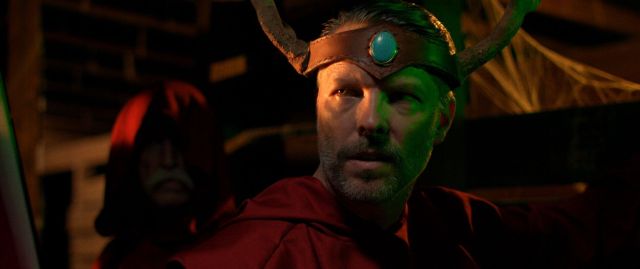
Still, it takes AN HOUR before the dudes in the scarlet robes and deer antlers show up and all this hooey about “blood sacrifice” pushes the romantic problems of Vera and Alice out of the picture. Sure, the photographer Alice slept with (Jeremy Sande) has shown up and is vile, in a makes-your-skin-crawl way. But they’ve got REAL problems, now.
A prologue tells us how long this local “dragon” cult has held sway, since at least 1889. There’s a hint of the Klan about this crowd, from their costumes and Latin (ish) incantations and intolerance of homosexuality. The group isn’t exactly integrated, either.
There are hints of horror picture elements that might have worked, here. But every scene is hobbled by inane dialogue delivered by the stiffest cast this side of the cemetery.
It’s hard to get a laugh out of even the most exaggerated Southernisms, delivered at a funereal pace.
“Y’all GIRLfriends, huh? Romantically enTWINED? Dang me to Hay-ell!”
And it’s not just blood and gore that take “Hallowed Ground” into the real of cheap (cheaper/cheapest) exploitation. The whole good-looking-actresses-making-out business is as obvious as a 70s porno. Not that I’d know that much about such things.
Writer-director Doleac pads what could have been a streamlined plot with flashbacks to Alice’s cheating (nude modeling with the photographer) to goose up the titillation factor. He even throws in a bare-bottom caning.
Doleac makes a good villain, Montgomery a potentially fun elderly “explainer,” but he talks so slowly the jokes don’t land. The leading ladies flirt with competence, here and there, and the third actress topping the cast is just dreadful.
A good director can cover up a lot of performance sins, but Doleac’s shoot/editing lets every take go on too long, spotlighting the acting ineptitude, sucking the energy out of performances. He’s apparently never heard that classic stage direction, “Again, but FASTER.”
Still he got his nude scenes in, and a bare-bottomed “caning.” So there’s that.

MPAA Rating: unrated, violence, nudity
Cast:Lindsay Anne Williams , Sheri Eakin, Ritchie Montgomery, Miles Doleac, Jeremy Sande
Credits: Written and directed by Miles Doleac. An UnCork’d release.
Running time: 1:57
Satanic rituals and softcore lesbian porn.
This version of “Hallowed Ground” is from actor turned director Miles Doleac promises to be a money-making machine when it opens in early June.
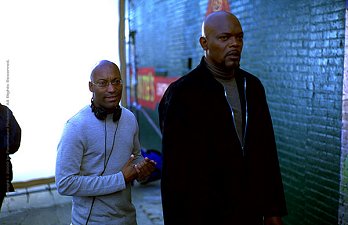
John Singleton broke out with “Boyz N The Hood,” for which he was nominated for the best director Oscar. He was the first African American filmmaker so nominated.
He built a career out of action films (“Shaft”) and movies about the black experience (“Beloved,” “Rosewood,” “Baby Boy,” “Poetic Justice”) and for a time had to wear the label “The Important Black Director Who ISN’T Named Spike Lee” with as much grace as he could summon.
His family just shut off life support for him as he won’t recover the “massive stroke” he suffered last week.
He made a “Fast and Furious” sequel, backed “Hustle & Flow” and like a lot of filmmakers over 40, struggled to get much traction and get projects made in recent years.
I think we may have chatted about “Rosewood” when it came out.
But the memory that sticks out is being in New York and watching him direct a scene from his 2000 remake of “Shaft” in Times Square. He was positively giddy, dancing around the set. A later account in I believe “Premiere Magazine” had producer Joel Silver suggesting he “dance your ass over behind the camera and get me a take.”
Damned killjoy.
He never did become “The Next Spike Lee.” Tastes ran a little too close to say, Brett Ratner, for that. He did some good work and will be remembered for it, launched important careers and can be forgiven for that run of bad pun African American drama titles that followed “Poetic Justice” (named for Janet Jackson’s poet-character in it, “Justice”).
He had more movies and projects in him, more life to live. And 51 is a ridiculously young age to die. RIP.
Any doubt these two have moved on from mainstream cinema — permanently — is answered and underlined with this trailer.
Not a laugh in it.
Gemma Arterton and Luke Evans also star in “Murder Mystery,” which streams June 14.

 Movie Nation