
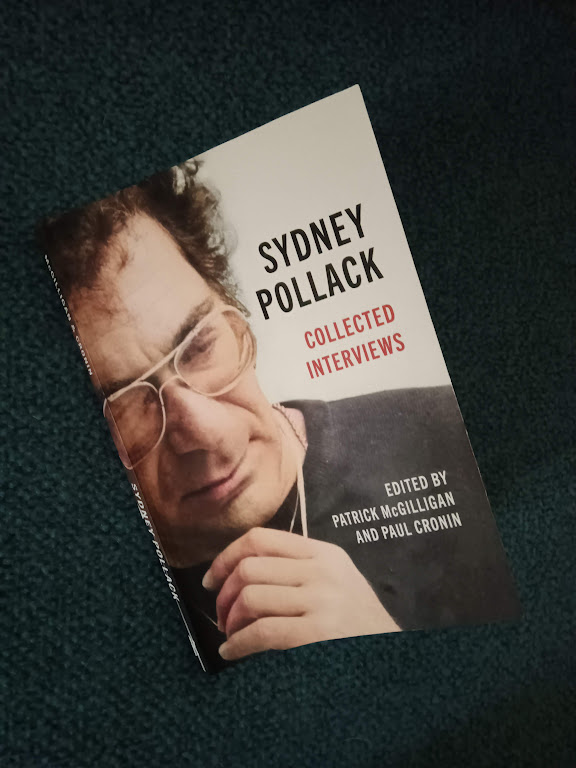
I’m really enjoying and learning a lot about the celebrated, Oscar-winning director Sydney Pollack through the assorted journalist interviews, public Q & As and filmmaker-to-filmmaker chats gathered in “Sydney Pollack: Collected Interviews. “
This University Press of Kentucky publication reminds us that Pollack was never just a filmmaker who had a way with actors and a feel for stories that would become hits. He was, as he might have put it, a smart cookie — an articulate craftsman who was not just a throwback to the entertainer/directors of Hollywood’s first Golden Age. He could wax theoretical and philosophical about his medium, his art form and what his movies said about his business, his art form and his country.
Some professor I once had, almost certainly quoting Pollack-punisher Pauline Kael, labeled the South Bend Indian native, Sanford Meisner acting protege and Oscar winner mister “middlebrow” way back when. And that’s the way a lot of critics who followed Kael regard Pollack.
He settled into making pop hits in the ’70s and on into the ’80s and ’90s — “Three Days of the Condor,” “Jeremiah Johnson,” “The Electric Horseman,” “The Way We Were,” “Tootsie,” “The Firm.” He hitched his wagon to Robert Redford, a lifelong friend he made when they acted together in Redford’s first film — 1962’s “War Hunt” — and they made each other’s careers, from “This Property is Condemned” to the enduring classic filmed in great difficulty on Redford’s piece of Utah, “Jeremiah Johnson,” to the blockbuster “The Way We Were” all the way through “Out of Africa” to “Havana.”
And he went back to acting once he became a famous director, delivering a handful of performances that captured his voice, his wit (he was Dustin’s Hoffman’s agent in “Tootsie”) and his unsentimental bluntness in his own films and movies by Robert Altman, Stanley Kubrick and Woody Allen among others.
The Pollack-on-Making-Movies chats assembled in this book go back as far as 1970, and remind us and of the sexism of that age, of the lingering influence of Great European Auteur Filmmakers on the directors of Hollywood’s last Golden Age — the ’70s.
The director of “They Shoot Horses, Don’t They” could name drop Italian and French directors who influenced him, and assuredly declare “The era of big studios is over…There aren’t really Hollywood films any more.”
Because “Jaws” hadn’t happened, Coppola’s “The Conversation” hadn’t yet flopped and “big Hollywood studios” hadn’t discovered the pop culture allure of “Star Wars,” comic book adaptations, cheap horror blockbusters and the like.
Nobody “got” Redford like Pollack, a director who recognized underacting and making the viewer come to you as a strategy that helped turn his friend into an enduring matinee idol.
I had to laugh at his repeated references to The New Yorker critic Kael, who eviscerated most of his films and whom he described as “smart” but “hysterical,” never moreso than when he corrected her blundering take on the last scenes of “Jeremiah Johnson.”
Sure, she was an ardent fan of some filmmakers and witheringly dismissive of others. Her biases were well-known and her blind spots well documented and laughed over. But Pollack, who got his share of good to great reviews over the decades, bluntly called her out way back when for not knowing much about how movies are made or how actors act.
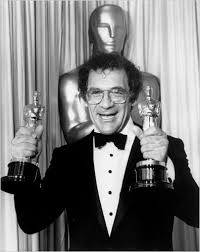
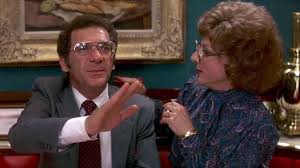
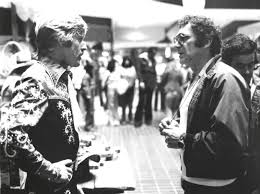
Most of these conversations date before the oversaturation of film-obsessed media — the explosion of critics and film journalists that reached full flower in the ’80s and hasn’t abated in the online age. Not every question he considered was worth asking, but every Q & A produces insights and revelations, and not just how excited he was to be making a statement on “police brutality” with “my next picture, ‘Dirty Harry.'” No, he didn’t make it. No, his ardent fan Burt Lancaster didn’t star in it.
Among the filmmakers Pollack was interviewed by was the great British action auteur John Boorman, whom Pollack championed from “Deliverance” onward.
The limitations of the Q&A interview format — awkward, clumsy, dead-end questions not edited out — stand out. It can be lazy journalism if you don’t do enough homework, relying on your subject’s glib gift of gab, her or his expertise, anecdotes and ability to summon them on the spot. But someone as articulate as Pollack was a natural at collecting his thoughts and expressing them, remembering the messaging of one of his personal favorites among his films — “Castle Keep” — the difficulty of mastering his beloved “helicopter shots” and hand-editing and matching music to suit the tone, mood and point of a sccene in the decades before drones and digital filmmaking.
I gained a deeper appreciation for those films of his that remain among my favorites — “Jeremiah Johnson” and “Three Days of the Condor.” The former film captured the zeitgeist of the Earth Day counterculture via a 19th century drop-out who ventures into the mountains and goes native. The latter was a movie that came out just as CIA lawlessness took over the headlines in the last throes of the malignant Nixon presidency.
But I could never sit through “The Way We Were” with a straight face. And I remember how washed-out and ugly “Out of Africa” looked on the big screen, a product of the passionate photographer and lifelong celluloid technician’s mania for messing with film in the processing stage.
Casual fans will find new titles to hunt down. I never got through the “extremely talkative” “Castle Keep,” and Pollack’s deconstruction of “They Shoot Horses, Don’t They” makes me want to give that another try. And hardcore cineastes might revel in the fact that “middlebrow” or not, a director often compared to the master movie craftsmen of the ’40s and ’50s finally gets his turn to have his say, nearly 20 years after his death.
Sydney Pollack: Collected Interviews, edited by Patrick McGilligan and Paul Cronin. 293 pages. University Press of Kentucky. $35.



