
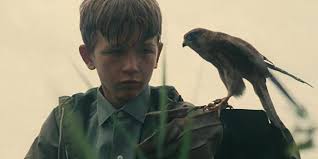
“Kes,” the break-out feature of Ken Loach, is an unblinking, unsentimental coming-of-age tale about a boy and his kestrel. It’s a Yorkshire “Yearling” from one of the greatest “kitchen sink realists” the British cinema produced, and one of the last.
This 1970 dramedy hangs on one of the cinema’s greatest child performances and offers a grim snapshot of the last years of working class coal-mining and the inflexible class system that kept most from ever escaping it.
Loach, the socialist filmmaker who’d go on to direct “The Wind That Shakes the Barley,” “I, Daniel Blake,” “Jimmy’s Hall” and “Sorry We Missed You,” and only recently retired with “The Old Oak,” was a stickler for authenticity and a filmmaker who made mostly working class movies that had something to say about class and work even if that wasn’t ostensibly what they were about.
So “Kes,” adapted from a Barry Hines novel, is about a boy who steals a kestrel chick from its nest and teaches it falconry. But it’s more about a lower-class latchkey child in a fatherless home, brutally bullied by an older stepbrother, neglected by his mother and judged by the system then in place to be best-suited for dropping out and learning a trade.
Billy (David Bradley, raw and real) is an almost Dickensian urchin, 16 and rail-thin and looking much younger when the film was shot, a veritable Artful Dodger in 1960s Barnsley, Yorkshire. He’s a thick-accented Yorkie determined to “not go down pit” into the mines, like generations before him and his bitter, brutish stepbrother Jud (Freddie Fletcher).
He’s got a pre-school paper route and a habit of swiping milk and cheese from the milkman, whom he’s cheerfully befriended, and pilfering from others, no matter how much he swears “I haven’t been nicking for ages” to his boss.
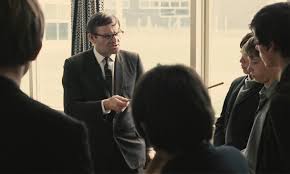
Sleepy, distracted and probably a little hungry at school, he’s an indifferent student where a short-tempered headmaster (Bob Bowes) and punishment-crazed teachers can’t cane him enough to change his attitude.
But he’s got this idea about catching and training a baby kestrel. And once he does, his whole life revolves around the care and education of the bird. He swipes a book on training birds in falconry, needs meat to feed it and doesn’t care how he gets it or the money to pay for it.
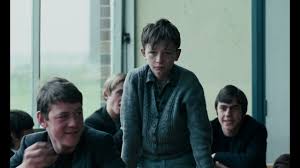
Loach tells that story but makes it just one element of this award-winning classic. We get a heavy dose of school life, how the problems hanging out with the wrong crowd (the kids who smoke) helps circumscribe one’s future, the drudgery of low-expectation classes with berating/name-calling and quick-to-punish teachers doubling down on giving up on the kids who can’t make themselves care.
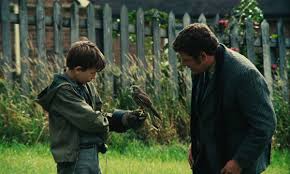
Actor and screenwriter Colin Welland (“Chariots of Fire”) plays a cinematic cliche, that “one teacher who cares.” The other kids rat out Billy’s real obsession, and Mr. Farthing indulges himself and everybody in class by letting the kid with that word-dropping/archaic accent hold forth on terminology, methodology of connecting with these wondrous trained-but-untamed raptors.
Loach finds chuckles in local club entertainment — off-color novelty sing-alongs and the like — and laughs in an extended soccer game in which the childish physical education teacher (Brian Glover) picks the teams, puts himself on one as its “Manchester United” star, coaches while playing and cheats in his other role as the game’s biased, bullying and vain referee.
Billy seems hapless at this, climbing the goal posts that hold no net in this school, and aside from that kestrel recitation, seems doomed to menial jobs in a future that the school and system are anxious to shove him into any day now. But he’s cleverer than that. He wants to check out a falconry book, but the librarian wants him to get a parent to fill out a card (Billy can’t be bothered) and points out how grubby his hands are, and how he’ll dirty any book he checks out.
“But I don’t read dirty books,” he protests
His accent and speech and low birth sentence Billy to the future he isn’t clever enough to delay or avoid. “Kes,” his name for his female kestrel, is all that matters and he never thinks to mention his way with animals to people who might be able to arrange a more useful and perhaps meaningful future.
But the point of it all is that generations of people of his class have been pigeonholed and limited by a system that is so stunningly hidebound and unfair that it’s a wonder Britain has been able to avoid open class revolts.
People like Billy are trapped, trained and kept under the thumb of their betters — fed just enough to keep them hungry and eager to please — if ou’re looking for kestrel metaphors.
Loach gets a marvelously unaffected performance out of his star, a working class child from mining country as natural the speech as he is at learning how to train a bird as he is helpless in mastering anything useful in school, on the soccer pitch or enlisting anyone to help change his fate.
Although the film is quite dated in some of ways, it remains fresh and vital and poignant in all the best ones. “Kes” a hard-nosed look at growing up in a place where that wasn’t easy, where “growing up” came too soon and where choosing the future life you wanted to lead was out of the question if you didn’t have family, teachers and peers to help you find your dream and figure out how to pursue it.

Rating: PG-13, violence, bullying, corporal punishment, nudity, alcohol abuse, teen smoking and profanity
Cast: David Bradley, Freddie Fletcher, Lynn Perrie, Bob Bowes, Brian Glover and Colin Welland.
Credits: Directed by Ken Loach, scripted by Barry Hines, Tony Garnett and Ken Loach, based on a novel by Hines. A United Artists release on Tubi, Amazon, etc.
Running time: 1:51



