
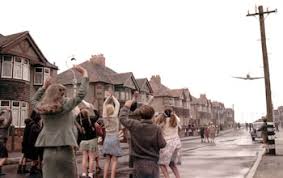
There’s a glorious nostalgia to the great British director John Boorman’s World War II memoir, “Hope and Glory.” The sentiment is what sticks with you, a naive child’s memories of not the fear, violence and loss, but of the freedom, togetherness and adventure of this high-stakes do-or-die fight against fascism.
I remember coming out of the theater positively giddy when this semi-autobiographical epic came out.
But the director of “Deliverance,” “Point Blank” and “Excalibur” only appears to be letting us, himself and his generation off easily. There are hints of the world and culture that gave birth to “Lord of the Flies,” the melodramatic trials of domestic life, the trauma of loss and the shifting mores of a generation shaped by the live-for-the-moment for tonight you may die immediacy of “their finest hour.”
Britain’s 75 year cultural obsession with “The War” is summed up in 113 minutes that only brush on the passing events on the continent. This was how a child too young to be terrified of “carpet bombing” and homemade bomb shelters and shrapnel and fears of a fascist takeover experienced that time.
The director of “The Emerald Forest” ensures that these memories are vivid, backlit and gorgeous — even the fireworks spectacle of a deadly night time air raid. And the filmmaker who gave us “Excalibur” ties his personal story into British myth, the one his generation created, burnished and embraced, if only in whitewashed brush strokes.
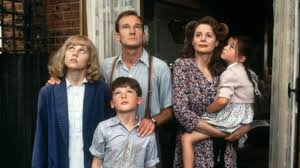
“Hope and Glory” — which takes its title from that most Brit-beloved passage of Elgar’s “Pomp & Circumstance” — is about the Rowan family, middle-class row-house Brits who ride out the war at home, and then with relatives.
Dad Clive (David Hayman) is 40something, patriotic and allowing himself the romance of “doing my bit” one more time. He will enlist after the fall of France. Mother Grace (Sarah Miles) isn’t keen about that idea, which Clive plunges into over her objections. He’s leaving her with three kids — including dizzy Dawn (Sammi Davis), reckless, a self-absorbed and boy crazy teen, and a very little girl Sue (Geraldine Muir) — to face the trials of “total war” at home on a soldier’s salary.
We see this fateful decision and the lives it leads to through the eyes of the middle child, little Bill (Sebastian Rice-Edwards), a strong-willed schoolboy who earns constant punishment from his head master, and who is quick to judge his dad’s decision to leave his family and his mother’s inability to prevent it.
There’s just enough movie newsreel introduction and snippets of radio news and speeches (Chamberlain, Churchill) to keep us apprised of this pre-D-Day “end of the beginning” era chronicle. This isn’t a WWII chronology.
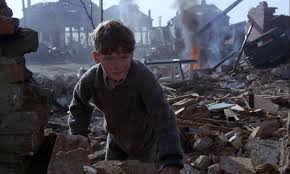
“The war” is dramatized in theaters, visible in this distant contrails of dogfights in The Battle of Britain, present in the ever-wailing air raid sirens, hustled into the air raid shelter or below the stairs, the routine of counting the thumb of explosions to gauge one’s odds of the next bomb hitting close to home.
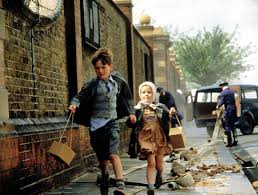
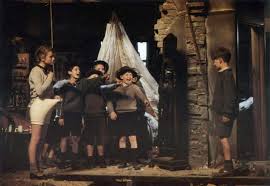
For Bill, it’s the magic of finding shrapnel shards in the family fence, scattered on the street, the bombed-out ruins that a gang of neighborhood pre-tween punks invade to smash anything not already destroyed.
Those kids, led by the mouthy ring-leader Roger (there’s one in every mob) set the tone for how the youngest approach what’s happening around them.
“D’ye know any SWEAR words?” is Roger’s (Nick Taylor) initiation test. “SAY them!”
But gathered in a mob, the children are distanced from the risks, and from empathy at each other’s losses. A child (Sara Langton) loses her home and her mother in a raid. She can’t even weep in her shock, has no way to process what’s happening. The boys all but taunt her, tactless in their curiosity. And the most compassionate words offered come from the littlest, Sue.
“Do you want to play?”
Dawn, running out into the street mid-air raid just to “see” and dance at the colors in the night sky, finding her first love in a GI (Jean-Marc Barr) when the Yanks join the conflict, seems as disconnected from the horrors as the younger kids.
“Nothing will ever be the same again,” she declares, because this is the most liberating thing she’s ever experienced.
Marriages will be tested and fail, prudish sexual mores are gone with the wind and the kids see all this and are shaped by it every day the conflict goes on.
And then the Rowans lose their house.
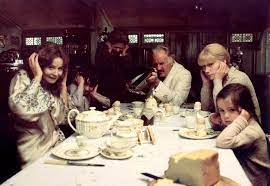
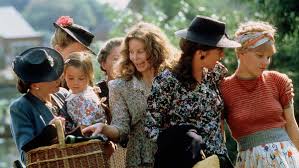
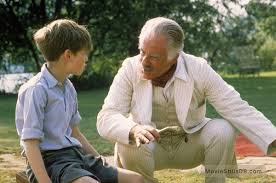
They’ll move in with irrascible Grandpa George (Ian Bannen), given to drunken toasts “to all the girls I’ve loved before” every Christmas, right in front of his wife (Annie Leon) and the daughters he named Grace, Faith, Hope and Charity. They’ll live in the suburbs, on the river. And it’s there that the tale’s tone turns even lighter.
“You want to know why they’re called Faith, Hope, Grace and Charity?”
“Why?”
“Your GRANDMOTHER! She named them after the virtues I lack. That’s marriage for you!”
Bannen kind of takes over the picture, as a summer idyll of cricket, punting and fishing on the river lets the war become even more distant in the children’s eyes, with a few comical exceptions.
Boorman’s tone here is sweet and safe, with Britain well into its “How I Won the War” sentimentalizing and sending up of the conflict. “Nothing” ever was “the same” after that, and while the filmmaker couldn’t have known how the country would change as that generation died out, that message he certainly got right.
His family film about his family included performances by daughter Katrine Boorman (as Charity, one of Grace’s sisters) and son Charley Boorman, who adds a dash of elan to a silent, lights-up-a-smoke, downed German fighter pilot who winds up in neighbor’s garden.
“Mind those Brussels sprouts, you!”
Katrine would go on to produce “Marie Antoinette.” Charley would turn his love of motorcycles and friendship with Ewan McGregor into a series of terrific long-distance travelogues.
Writer-director John was in his 50s when he made “Hope and Glory,” which was nominated for five Oscars. He’d do the Brendan Gleeson tour de force “The General” and a delightful take on Le Carre’s “The Tailor of Panama” with Geoffrey Rush before announcing his retirement (to me) when the equally autobiographical “Queen and Country” came out ten years ago.
For a filmmaker saddled with a few flops (“Zardoz,””Exorcist II: The Heretic”) he somehow managed to get three or four true “passion projects” on the screen, and rewarded his backers and film fans with the results, undeniable “classics” no matter how they were received (“Excalibur”) on release.
“Hope and Glory” beautifully and nostalgically lays out what formed this child of World War II, the generational experiences and the point of view that shaped his storytelling and informed his cinema for all the decades that followed.

Rating: PG-13, sexual situations, profanity, war’s violence and loss
Cast: Sarah Miles, David Hayman, Sebastian Rice-Edwards, Sammi Davis, Geraldine Muir, Derrick O’Connor, Jean-Marc Barr, Annie Leon and Ian Bannen, narrated by John Boorman.
Credits: Scripted and directed by John Boorman. A Columbia Pictures release streaming on Tubi, Amazon, et al
Running time: 1:53


 Movie Nation