


“September 5” is a tense and fascinating deep dive into an infamous moment in world history and TV the way it used to be made, back in the olden days of analog, “coming to you live” and “film at 11.”
Swiss director Tim Fehlbaum’s Oscar-nominated historical thriller is about the terrorist attack on the 1972 Munich Olympics and ABC Sports and its legend-in-the-making president Roone Arledge’s handling of this grim event in the middle of a sports competition.
America watched as ABC broadcast a terrorist attack and the response to it “live,” for the first time in history. The then-struggling ABC News took a back seat as a TV sports tproduction eam, improvising on the fly, found ways to get the story and the pictures that would shock the world.
Co-writer Fehlbaum’s Oscar-nominated script circles around the mercurial TV genius Arledge, given an edge and an ego by the magnetic performance by Peter Sarsgaard. Arledge’s “Wide World of Sports” and Olympics coverage became cultural touchstones, and whose instincts — “It’s not about politics. It’s about emotions.” — led him to popularize the phrase “the thrill of victory, the agony of defeat” and make the sprawling Olympics “Up Close and Personal” with video portraits of competitors that humanized sporting events and shrank the world as we met great athletes from many cultures.
How would that man and his approach work when a commando team of Arab terrorists stormed the Israeli Olympic Team’s apartments in the Munich Olympic Village that fateful September?
“‘News’ will tell us what it means afterward, and I’m sure they’re gonna try. But this is our story, and we’re keeping it.”
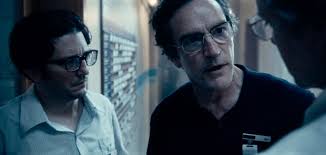
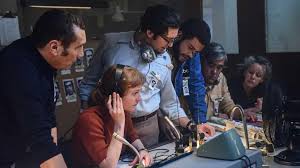
Much of that would be determined by “first day on the A-unit” TV director Geoffrey Mason, portrayed by the script and John Magaro (“The Big Short,” “First Cow,” TV’s “The Agency”) as a pressed-but-never-overwhelmed professional who solved problems, made mistakes and tried to make his voice heard amid the philosophical, moral and journalistic debates that broke out in the control room as this tragedy unfolded.
“What do I tell the cameras? …I mean, can we show someone being shot on ‘live television?'”
Ben Chaplin plays Marvin Bader, the Jewish TV sports exec who talks Mason into the job and has to spend that long night and day and night serving as the moral, ethical compass for the way a “live” disaster is covered — with cameras giving away a blundered German police raid which the members of the militant Palestinian group Black September could watch on a set in the Israeli team’s quarters.
“Black September, they know the whole world is watching. If- I’m saying if– they kill a hostage on live television, whose story is it? Is it ours, or is it theirs?”
Fehlbaum (“The Colony,” “Hell”) and his fellow nominated screenwriters take pains to take us back to West Germany’s efforts to show a less menacing face to the world, to atone for the guilt associated with the last “German Olympics.” Production assistant and translator Marianne Gebhardt (Leonie Benesch) is the German “conscience” of the story — eager to be useful, embarassed about her country’s past and apalled at what all this means to her country, as well as the kidnapped athletes and the world.
The film’s strong suit is in its attention to detail. Younger viewers will be slack-jawed at the hand-made “graphics” and how they were inserted into scenes during the last years of analog, pre-computer-assisted, pre-digital TV.
Fehlbaum & Co do a good job of inserting archival footage of unflappable ABC Sports anchor Jim McKay into the proceedings, and give us an actor (Benjamin Walker) playing the young, eager and imperious Peter Jennings, who both rose to the occasion as a “Middle East Expert” reporter on site, and a nagging presence at how these folks were handling a “news” event.
“You’re in sports. You’re in way over your heads.”
The film can make older viewers nostalgic for the way ABC broadcast the Olympics, even as it fails to contrast the spectacle and majesty and “fun” of the games they were covering with the tragedy that would befall them.
Fehlbaum opens “September 5” with a promo video of ABC Sports boasting of how it broadcast the games, with behind-the-scenes clips of cameras, control rooms and interviewers. He’d have been better served simply repurposing or recreating ABC’s “the network of the Olympics” opening credits coverage and the network’s use of the triumphant Leo Arnaud “Bugler’s Dream” as its theme.
And blame it on the film’s slow pacing, its control room myopia or its unfortunate timing — much of the world and American politics have been roiled by Israel’s genocidal pariah state status — but for a movie about a tragedy and the struggle to cover it with professionalism and compassion, “September 5” is more historically intriguing than compelling and in the end, an emotionally hollow experience.

Rating:, R, profanity
Cast: Peter Sarsgaard, John Magaro, Leonie Benesch, Zinedine Soualem, Georgina Rich, Benjamin Walker, Daniel Adeosun and Ben Chaplin,
Credits: Directed by Tim Fehlbaum, scripted by Moritz Binder, Tim Fehlbaum and Alex David. A Paramount release.
Running time: 1:35


 Movie Nation