
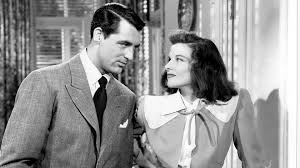

It begins with a screwball tease — a couple, wordlessly breaking up, climaxing with the husband maniacally grabbing the wife by the forehead and shoving her back through the door and onto the floor.
But even though the wife is played by the fiesty fury Katharine Hepburn and the guy doing the over-the-top shoving is Cary Grant, a “tease” is as “screwball” as this gets.
This is “The Philadelphia Story”(1940), dear, not “Bringing Up Baby” (1938). And while more’s the pity that it isn’t, it’s still a shimmering, stately statement on “class” in Depression Era America, and the movie that won James Stewart his Oscar.
George Cukor’s film is a romance that just reeks of old money and Eastern “sophistication,” built around the actress who embodied those traits on and off the screen.
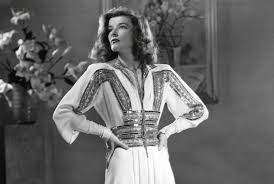
Sparkling wit that transcends one-liners, three big names heading the cast, lush sets and stunning costumes may heighten the sense of theatricality of MGM’s lavish film of the popular Philip Barry stage play of the day.
“Stately” here can stand for “classy” and a tad staid and slow. But Hepburn, Stewart and an underplaying (mostly) Grant and the cream of MGM’s supporting players animate and enliven this romance that keeps us guessing “Who gets the girl?” right up to the nuptials of the finale.
Stewart plays Macaulay “Mike” Connor, a short story writer making the rent by reporting for Spy Magazine and its unscrupulous scoop-obsessed Brit editor (Henry Daniell).
Connor resents being “a society snooper.” “Doggone it, it’s degrading, unDIGnified!”
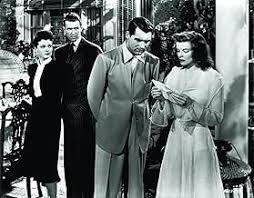
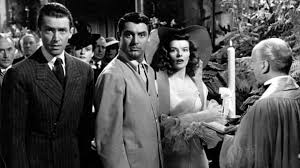
But Mike and fashionable photographer Liz (Ruth Hussey) have drawn the assignment of crashing the elite nuptials of Tracy Lord (Hepburn) and coal magnate George Kittredge (John Howard). This will be the second marriage for the old money/old family Philadelphian Lord, and editor Sidney Kidd wants to give readers a sordid peek inside this world of extreme, entitled, inherited wealth.
He’s got an “in.” That would be Lord’s ex-husband, C.K. Dexter Haven, played by Grant. He’s to lie their way into the wedding party, and if he’s “getting even with” his ex-wife, he’s picked a fine way to do it.
In that long lost age, old money like the Lords eschewed publicity, “the very idea” of someone “coming into our house with a CAMERA.” Tracy resents any notion that she’s “to be examined, undressed and humiliated…at 15 cents a copy!” But she has no choice.
The class-conscious writer Mike insults everything he sees in these entitled inbreds.
What kind of name is “C.K.Dexter Haven,” anyway? “What’s this room? I forgot my compass!” And don’t let him get on the in-house telephone lines.
“This is the voice of DOOM calling. Your days are numbered!”
Tracy decides to give in and give the reporter and his photographer a caricature of chattering, dithering, dizzy wealth. With her little sister (Virginia Weidler) enlisted, they’ll present a parody of “a rich American female” with an eccentric family throwing a lavish, exclusive wedding.
And if that doesn’t fool them, she’ll try bribery.
“Class” comes up every time we hear the phrase “front entrance,” as in the way only non servants and aristocrats are allowed to enter the mansion. Limos and roadsters and endless changes of clothes and a limitless supply of booze adorn this world. Even divorce was a luxury only the rich seemed able to afford back then.
“The prettiest sight in this fine pretty world is the privileged class enjoying its privileges.”
But liquor was what did in “the ghost of husband’s past,” so Tracy avoids the drink and never misses a chance to put-down Dexter’s biggest failing. His obvious effort to sabotage her wedding with reporters has her wondering if he’s gone off the deep end.
“You haven’t switched from liquor to dope, by any chance, have you Dexter?”
The men refer to Tracy as some sort of “goddess,” a “queen” who can’t let herself be human. With a fiance, an ex and a cynical reporter who might fall under her spell, what IS a girl to do, and who WILL she choose, seeing as how she’s the richest one with all the choices?
It’s enough to drive a body to drink.
“The Philadelphia Story” is a comedy of cute touches and funny scenes interrupted by lectures on Tracy’s personality and personal shortcomings and little intrigues that aren’t all that intruguing.
The “screwball” elements — play-acting wealth, pretending one’s tippling, womanizing (“A PINCHER!”) Uncle Willie (Roland Young) is her scandalized, cheating father (John Halliday), the endless dips in the pool after drinking, the competing agendas and withering insults — tend to come in bursts.
While one wouldn’t call the complications that come up between the best scenes “filler,” the picture shows its age and MGM “gravitas” by lurching along from one ornate setting to the next.
My favorite character and to me the most ingenious touch is having young miss Weidler play Tracy’s sister Dinah as a 13 year-old Hepburn clone — tomboyish attire, brash and witty/wise beyond her years.
“I think that dress hikes up a little behind…”
“No, it’s ME that does.”
Listen to her tear through a Groucho Marx favorite, “Lydia the Tattooed Lady,” at the piano. She almost steals the picture.
What I find clunky in seeing this film again after many years is the mechanical nature of the many possible romantic “pairings,” with Hussey playing a passive wild card to all the men reaching for Hepburn’s Tracy, some for reasons that seem undermotivated.
That which is obvious — the dude with the mustache NEVER gets the girl, unless he’s William Powell — seems too obvious, and the clockwork plotting needs winding as the pace is altogether too stolid for my tastes.
There’s one very romantic scene, and several than are meant to be and just aren’t.
But Hepburn crackles and Stewart blusters and drawls. And Grant consents to be a less amusing third wheel, hectoring Hepburn with serious criticism that doesn’t play as particularly fun, droll or astute, allowing himself to be photographed with lean, lanky Stewart towering over him at times.
They’re all in top form in what is widely acknowledged as one of the comic classics of its era, but a comedy that is more pretty and polished than laugh-out-loud rambunctious.
Perhaps its most telling criticism is the unfairest. “Philadelphia Story” suffers mainly in comparison with the most lauded rom-coms of its day. It’s no “Ninotchka,” “The Awful Truth,” “His Girl Friday” and especially “Bringing Up Baby.” But MGM at its wittiest is at least deservedly in their company.

Rating:”approved,” TV-14
Cast: Cary Grant, Katharine Hepburn, James Stewart, Ruth Hussey, Mary Nash, John Howard, Virginia Weidler and Roland Young.
Credits: Directed by George Cukor, scripted by Donald Ogen Stewart (and Waldo Salt), based on the play by Philip Barry. An MGM release on Tubi, Amazon, etc.
Running time: 1:53


 Movie Nation