


It takes some getting used to the idea of Paul Henreid, icon of indomitable Europe in “Casablanca,” in a Gestapo uniform.
But in “Night Train to Munich,” filmed a couple of years before “Everybody Comes to Rick’s,” he’s billed as “Paul von Hernreid,” the shortest version of his Viennese birth name — Paul Georg Julius Hernreid Ritter von Wassel-Waldingau. So…it didn’t count?
The trains are mostly models, as are a Prague factory, Hitler’s “Berghof” lair and a model ship in a not-foggy-enough sea. The sets are mostly soundstage constructions, blended in with lots of documentary footage of events happening in Europe in the months leading up to the movie’s July 1940 release.
The uniforms are of a “That’ll do” variety, as the film was shot during “The Phony War,” just after the invasion of Poland, just before the fall of France. German officers wave pistols about, but only one Luger was available, so it went to co-star Henreid. And the revolvers were of the “almost never need reloading” variety.
Of course they sent Rex Harrison, playing a British agent disguised as a Wehrmacht major, traipsing around the offices of Nazi Berlin wearing a ceremonial sword.
All the Brits — including actors playing Germans — refer to the Kriegsmarine (German navy) command as “The Admiralty.” Old habits die hard.
And the plot borrowed so heavily from Hitchcock’s comic mystery “The Lady Vanishes” that director Carol Reed & Co. re-enlisted that film’s new screen comic duo, those cricket-obsessed fops Caldicott and Charters (Naunton Wayne and Basil Radford) as a couple of Old School alumni golfers who picked precisely the worst moment in history to have a spot of golf in Berlin.
“I bought a copy of ‘Mein Kampf.’ Occurred to me it might shed a spot of light on all this… how d’ye do. Ever read it?”
“Never had the time.”
“I understand they give a copy to all the bridal couples over here.”
“Oh, I don’t think it’s that sort of book, old man.”
For a movie that takes us inside a “concentration camp,” for perhaps the first time in a mainstream motion picture, a film packed with newsreel footage of Nazi domination’s near inevitability, the future director of “The Third Man” manages a to serve up a fun and lightly frightening rail-bound romp.
It’s a film that makes its Czech heroine’s claim that Britain is still a place “where people can laugh and be happy” its ethos. That the Nazi Germans were the era’s villains and humorless “sauerkrauts” to boot is left unsaid.
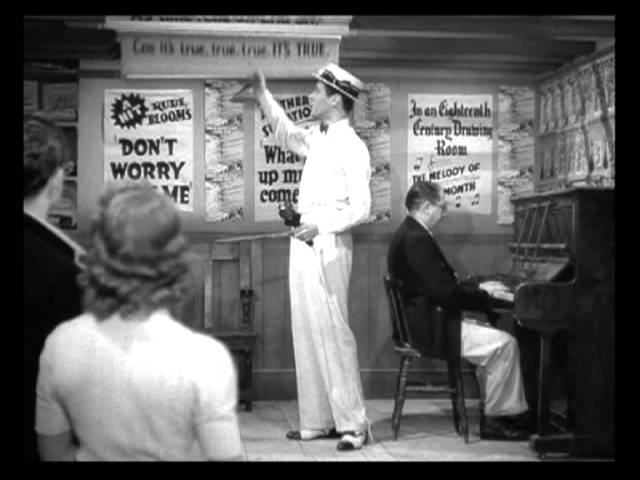
But from the moment Harrison’s vain, cocksure singing secret agent shows up — he’s posing as a sheet-music plugger in a seaside British resort town — most thoughts of the “real” war going so badly outside the cinema had to recede into the background.
“You know, if a woman ever loved you like you love yourself, it would be one of the great romances of history!”
It takes several alarming scenes for this tale of a Czech expert in armor plating (James Harcourt) struggling to escape the Germans with his daughter (Margaret Lockwood), complete with a Hitler stand-in smashing his fist down on a map every time he covets another piece of Europe, to turn into a comedy of Gestapo jokes, sexual innuendo and cricket obsession. But it gets there.
The greatest propaganda picture of the era was “The 49th Parallel,” but whatever “Night Train” lacks in pathos and “Keep calm and carry on” patriotism it more than makes up with suspense and gamesmanship and a generous helping of chuckles.
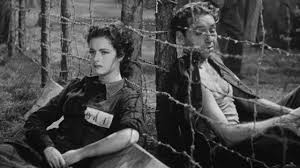
Set in the months leading up to the Germans invading Poland, it opens with scenes of our armor expert and his well-turned-out (a beauty in furs) daughter trying to flee as the Germans occupy Czechoslovakia. He is hustled out, she is captured and tossed in a camp.
Luckily, Anna Bomasch (Lockwood, also borrowed from “The Lady Vanishes”) manages to escape this concentration camp with the help of a too-helpful fellow inmate (Henreid, Victor Lazlo in “Casablanca”) a brave voice of freedom figure whom she sees the Germans torture.
The escape is skipped-over, their rowing ashore in pre-war Britain is not. But handsome escapee Karl Marsen, who insists on laying low, not letting the authorities know they’re here, is not who he seems. He can “Sieg HEIL!” with the worst of them.
Harrison’s seemingly dizzy, self-absorbed singing sheet music salesman is who Anna is sent to in order to track down her expat father. Gus Bennett — not his real name we learn — is in this resort town next to a naval port to “look after” her father for the British government as Mr. Bomasch consults on British armor and ways to improve it.
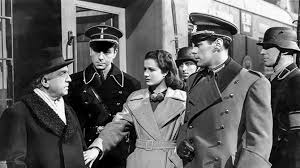
Marsen’s spies foil those efforts by nabbing father and daughter, taking them aboard a U-Boat and back to Germany.
Agent Gus, aka Dickie Randall, gets permission from the relaxed, distracted professionals of the British Secret Service to “have a go” at getting them back out.
Dressed as a Wehrmacht engineer and armor expert “from the Siegfried Line,” Dickie will play a former paramour of Anna and “seduce” her into persuading her father to work for the Germans. What he really has in mind is getting them out — by plane, train or automobile.
The Germans are portrayed as officious, almost inept thought police, fussing over the way a Good German should avoid turns of phrase that can be misinterpreted.
“This is a FINE COUNTRY to live in” could be heard as “This is a FINE country to live in,” or “This is a bloody AWFUL country to live in!”
Nazi double-speak is ridiculed for the lie that it is.
“We don’t hate Czechs! We only want to PROTECT them!”
“As you’re protecting the Poles?”
Harrison is in fine form, fresh off the Orient Express thriller “Continental Express” and never-missing a rail travel beat. Lockwood is sexy, intrepid and properly put-out about all of Dickie’s “spend the night together” espionage innuendo.
And Henreid, an Austrian Jew working his way west to Hollywood and screen immortality, makes a perfectly refined, perfectly vile Nazi, an archetype that was chiseled in stone by the time Conrad Veidt played Major Strasser hunting Victor Lazlo all the way to “Casablanca.”
“Night Train to Munich” isn’t one of the great films of its day. Its effects, characters and situations can seem quaint, hasty and cut-rate. There’s an air of “artifact” about it, thanks to its production and release timing.
But Reed showed Britain that he could manage a Hitchcock thriller almost as well as the master. The framing, editing and conspicuous use of shadows sampled here would be put to great use on the streets of Vienna, and below them, in his “perfect thriller,” “The Third Man.”
What makes this an early classic on his resume is his sure hand with comedy and the graceful way he begs, borrows and steals from Hitchcock and even shoehorns in characters from “The Lady Vanishes” into a version that lands bigger laughs as it aims its barbs at the Nazi menace, even as a backs-against-it Britain braced to face that menace alone.

Rating: “approved,” violence, innuendo
Cast: Rex Harrison, Margaret Lockwood, Paul Henreid, James Harcourt, with Basil Radford and Nauton Wayne.
Credits: Directed by Carol Reed, scripted by Sidney Gilliat and Frank Launder. A 20th Century Fox release streaming on Tubi, Criterion, Amazon, etc.
Running time: 1:33


 Movie Nation