
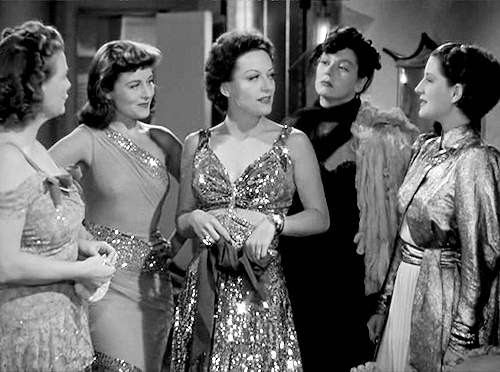
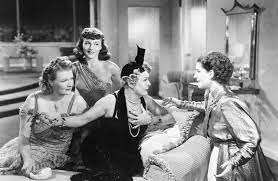
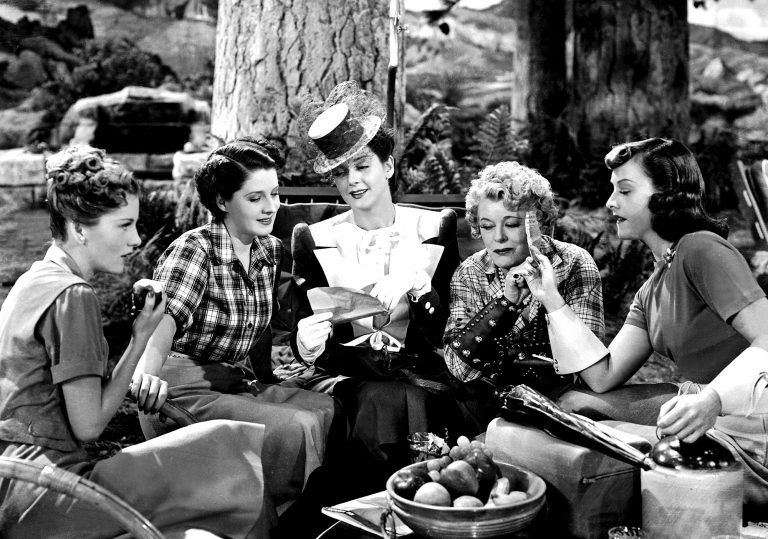
It’s impossible to overstate the cat-fighting delights of George Cukor’s all-star adaptation of “The Women,” a title that often gets lost in the gilded glory of classic cinema’s greatest year — 1939.
Consider the protagonists on offer. Rosalind Russell vs. Joan Crawford. Joan Crawford vs. Rosalind Russell. Joan Crawford teamed UP with Rosalind Russell against Norma Shearer, Paulette Goddard, Joan Fontaine, Phyllis Povah and Mary Boland.
Recall the war of withering wit this gaggle of gossips engage in.
“Oh, you remember the awful things they said about what’s-her-name before she jumped out the window? There. You see? I can’t even remember her name so who cares?”
Forget the canine association that Crawford’s Crystal Allen serves up, one of the great put-downs of that PG-rated cinema age.
“There’s a name for you ladies, but it isn’t used in high society… outside of a kennel.“
Bitchiness this extreme could only come from a catfight to end all catfights.
What former liberal suffragette turned rich conservative Clare Booth, as she billed herself as a playwright, was getting at with this oft-revived and oft-filmed (in 2008, for instance) play is the ways women hold each other back and hurt one another — especially in the entitled and monied classes Clare Booth married into, more than once, most famously with rich magazine publisher Henry Luce.
Women are victims and victimizers, pawns and people with agency. Booth’s play and this script leave the testosterone at the office, as this entire cast of 130 backbiters, battlers, stoic survivors and their servants is female.
It’s a comedy about class — Booth cast a jaded eye on her fellow society doyennes — and gossip culture, already spilling over into the media of the 1930s. And famed “women’s director” and Cukor proved to be the perfect chap behind the camera to referee this catfight.
Happy, entitled and married-well Mary (Norma Shearer), mother of Little Mary (Virginia Weidler), is the very last to learn that her rich engineer husband Steven is cheating on her with a perfume salesclerk.
Her fellow-clothes horse Sylvia (Russell) got the lowdown from her breathless chatterbox manicurist (Mimi Olivera, a hoot for the ages). Sylvia cannot/will not keep a secret. Their whole married “ladies who lunch” gang is in the know, including Peggy (Fontaine) and Edith (Povah).
Sylvia goads Mary into confronting the scarlet woman named Crystal (Crawford). Helpful blabbermouth Edith tips a gossip columnist (Hedda Hopper). A scandal is born. There’s nothing for it but to take the train to Reno for a quickie divorce, despite the “do nothing” advice of Mary’s mother.
“It’s being together at the end that matters!”
On the train, Mary meets Miriam (Paulette Goddard), the elderly and rich Countess de Lave (Mary Boland) and is shocked to find her pal Peggy with them, all of them on the railroad to a Reno divorce.
The infidelity and ensuing divorce has a loser, Mary, and a primary victim, Little Mary. And it has a winner. That would be Crystal, whom Crawford plays with a lip-smacking delight in her unabashed man-eating.
“Can the sob story. You ‘noble wives’ and mothers bore the brains outta me!”
Other infidelities come into play. The battle lines are drawn, “friends” take sides and make alliances. Let the fur fly and the quips cut to the bone.
“Well, heaven be praised, I’m on to my husband, I wouldn’t trust him on Alcatraz, the mouse.”
“I made him pay for what he wanted. You made him pay for what he didn’t want.”
“Oh, cheap Chinese embroidery! You know, I’ll bet Peggy gave her these.”
“It’s marvelous,” being single again and able “to spread out on the bed like a swastika!”
Russell and Crawford tear into this script and into each other with a sort of game-respects-game glee. Fontaine shows off comic chops that she’d rarely get to use once she became famous. “Modern Times” Goddard, at the time married to Charlie Chaplin, elbows her was to center stage, and literally scores of bit players land a laugh in a single scene, sometimes a single line.
Butterfly McQueen, in “Gone with the Wind” the same year, plays a housekeeper who has the temerity to comically bicker over how much she’ll be paid to do the cooking for Crystal when she wines and dines her married man.
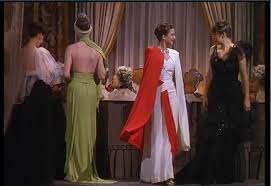
The sets are MGM over-designed, the clothes jaw-dropping in a “Look what they’re wearing” way, some of them quite racy. And the saucy dialogue is matched with scenes that are vamped into something unlike anything else the movies were showing America in 1939.
Sylvia and Peggy’s regimen with a personal trainer of the day is archaic and sassy and comically vulgar in all the exercising contortions these women who dieted to stay thin manage to pretzel themselves into.
But “The Women” gives away its stagebound origins in a couple of important regards. It is deliriously, absurdly dialogue-centric. And it is groaningly long, with a sparkling, brisk opening followed by grinding middle acts leading into a lulu of a finale, which is somewhat spoiled by meandering on past its climax/drop the mike moment.
It’s still a laugh-out-loud screwball comedy from an era when everybody produced a few of those, but few did with the style, sass and panache of the classiest, richest film studio of them all, MGM.

Rating: Quite racy for its time, but still “approved”
Cast: Norma Shearer, Rosiland Russell, Paulette Goddard, Mary Boland, Phyllis Povah, Joan Fontaine and Joan Crawford, with Hedda Hopper and Butterfly McQueen.
Credits: Directed by George Cukor, scripted by Anita Loos and Jane Murfin, based on the play by Clare Booth Luce. An MGM release on Tubi, Amazon, etc.
Running time: 2:13



