
The knock on early sound movies has become ingrained in Hollywood lore and immortalized in films about the transition from silent cinema to “talkies” such as “Singing in the Rain” all the way to “Babylon.”
The sound gear was cumbersome and touchy, and the techniques for mixing sound were being invented as they went along. Films transformed from being kinetic, artfully-shot with ever-moving cameras and increasingly complex tableaux back to more primitive, static affairs, often shot in close-up, with fewer actors on set and fewer physical bits of business to avoid muddying up the sound mix.
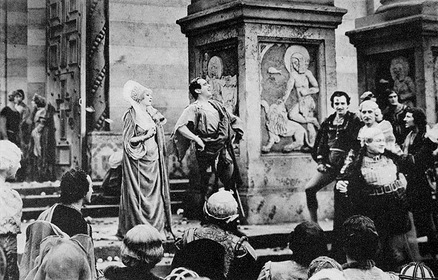
The notorious 1929 Mary Pickford and Douglas Fairbanks version of Shakespeare’s knockabout farce “The Taming of the Shrew” gives the lie to some of that reputation. It opens with striking, heavily-populated tracking shots, immersing us in Renaissance Era Padua and its noisy street life. It is packed with pratfalls, as that was forever the way of treating this “battle of the sexes” comedy.
There’s little evidence of any limitations imposed on this United Artists production thanks to the advent of sound. A mid-1960s restoration, with improved sound mix, sound effects and tidied-up musical score as part of the bargain explains some of that. Producer and co-star Pickford, the Canadian-born actress and silent cinema star who was the first to wear the label “America’s Sweetheart,” owned the rights, financed that restoration and rather inexplicably cut seven minutes from what was always a brisk and Big Scenes Only version of “Shrew,” an hour or more shorter than any other screen adaptation.
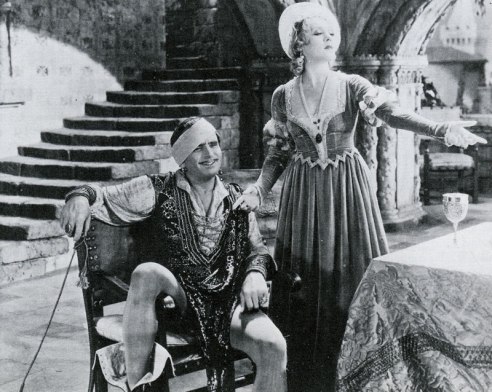
I approached watching this classic with limited expectations on a variety of levels. Many veteran screen actors making the leap to sound took a while to shed some of their silent “art” — broader gestures, exaggerated laughs and leers and the like. There’s evidence of that here, in the way Pickford, as “curst Kate,” holds a pose or a scowl, in the way her off-screen husband Fairbanks, the great action star of his era, throws his head back with every oversized laugh.
Fairbanks is all headscarf, big grin, broad strides and grand gestures, the exaggerated way one sees the character in community theater and high school productions pretty much to this day. Watch the old Britcom “Blackadder” and you can see Rick Mayall sending Fairbanks up in his various incarnations of Flashheart.
But all things considered, this shortened “Shrew” works well enough on a bare bones/mostly-laughs level. The “abuse” scenes which productions of the play leaned into, on screen and off, until the early ’70s, are here mostly Pickford’s ill-tempered Katherine slapping the boorish, overbearing but irresistable Petruchio — repeatedly.
Chances for supporting player mugging — Joseph Cawthorn, Clyde Cook and Charles Stevens are Gremio, Grumio and a servant — are vastly reduced when you simplify the plot and eliminate pages and pages of wordplay, the puns and general bawdiness. This “Shrew” even loses a couple of suitors for old Baptista’s (Edwin Maxwell) sweeter and “fairer” younger daughter, Bianca (Dorothy Jordan), which can’t help but feel like less-funny filler in most productions I’ve seen.
The plot? Men pine for young Bianca, but her father Baptista will not allow her to be courted and married until his mouthy, ill-tempered older daughter Katherine is married. A plot to find her a suitor brings Petruchio into the picture, a bluff and blustery braggart with very specific needs and desires.
“I come to wive it wealthily in Padua;
If wealthily, then happily in Padua.”
Fairbanks brings every bit of bravado the talking pictures will allow to this rogue, so determined to marry money that he will not be warned off from “cur-sed Kate.”
“Think you a little din can daunt mine ears?
Have I not in my time heard lions roar?
Have I not heard the sea, puffed up with winds,
Rage like an angry boar chafèd with sweat?
Have I not heard great ordnance in the field
And heaven’s artillery thunder in the skies?
Have I not in a pitchèd battle heard
Loud ’larums, neighing steeds, and trumpets clang?
“And do you tell me of a woman’s tongue?”
Pickford, never cast as “larger than life” in her life, does her damnedest to make Katherine a formidable and unwilling match. And when she’s figured out Petruchio’s game, because the tipsy blowhard can’t help but brag to his dog, she lets us feel “The game’s afoot” in her final big speech.
“Fie, fie! Unknit that threat’ning unkind brow,
And dart not scornful glances from those eyes
To wound thy lord, thy king, thy governor.”
Fairbanks gives us a few tastes of physical shtick, hoisting a servant up over a small wall by the seat of his pants, exaggerating his infamously long strides, deftly kicking a chair across the floor right underneath her when he insists Kate have a seat (a pretty cool effect, even today).
The 1929 “Shrew” is an ancient film shrouded in legend and mystery. The legend is that screenwriter and director Sam Taylor, who made classic comedies of the silent era with Harold Lloyd and Pickford, who later wrote for Broadway and novels, had the cheek to take an “additional dialogue by” credit on a film based on Shakespeare. No prints containing this comical outrage exist, so as far as we know, it may not have happened.
And the “mystery” about Taylor is why that rumor exists, and why his career — which percolated over from silent into sound without a falloff in quality — abruptly wound down and ended. He worked with Harold Lloyd, John Barrymore, Pickford and Will Rogers. And then, around 1935, the credits stopped. His “comeback” was a very late Laurel and Hardy outing in 1944, which was his final film. He was only 49 when it came out.
He had turned to Broadway, writing a flop in the late 1930s, and then to novel writing where he enjoyed some success. But what happened to his movie career?
Was there a scandal? Was he closeted? Was he widely disliked for being arrogant, which that rumor-turned-“legend” suggests? Did he deem himself too good for movies at some point?
As to that “additional dialogue” kerfuffle, yes there is some. Fairbanks/Petruchio is denied most of the whole “tail” and “tongue” bawdy puns business,.but he does declare his lust and impatience for “grappling” with Kate to the menfolk a few times, lines not in the play.
Everybody who trims, nips and tucks a Shakespeare play to get it onto the stage or screen is confronted with transitions that still need to be made even if pages of dialogue and characters are sliced away. That’s hardly a cardinal sin, and certainly not grounds for condemning Sam Taylor to Hollywood exile via rumor and “legend.”
Edits and additions accepted, Taylor’s “Taming of the Shrew” remains an engaging artifact of the way this venerable comedy used to be treated and performed, and one of the most watchable “birth of sound” era comedies, one that gives the lie to some of the constraints faced by filmmakers then and underscores the adjustment some actors would make, and many others wouldn’t when the movies learned to talk.

Rating: unrated, slapstick
Cast: Mary Pickford, Douglas Fairbanks, Edwin Maxwell, Joseph Cawthorn, Geoffrey Wardwell, Clyde Cook and Dorothy Jordan.
Credits: Scripted and directed by Sam Taylor, adapted from the Shakespeare play. A United Artists release on Tubi, Amazon, etc.
Running time: 1:04



