
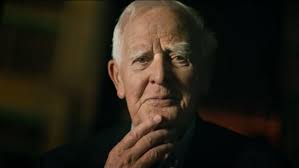
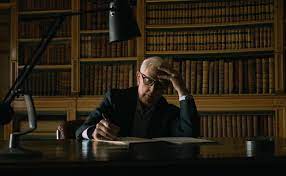
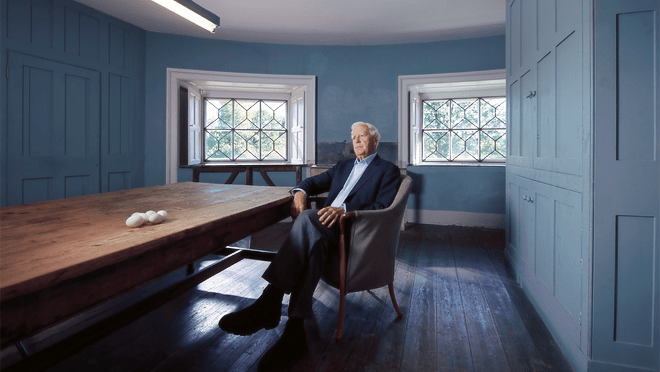
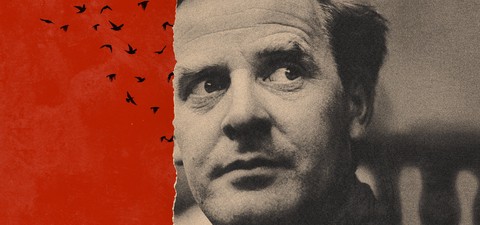
“The Pigeon Tunnel,” a documentary built around the dark but playful the 2016 memoir and consisting of the last and longest interview the greatest spy fiction novelist David Cornwell, aka John le Carré, ever gave, isn’t an expose, a confrontation between interviewer and subject.
That’s the way Errol Morris, perhaps at Apple TV+’s direction, edited trailers for the film. It would be the British spy, wise in the ways of interrogation matching wits with the documentary cinema’s foremost “interrogator.”
The film turns out to be collegial, a long chat via Morris and his famed look-straight-at-the-camera-and-see-me-ask-questions “Interrotron.” Some issues are pressed, big themes — “betrayal” chief among them — are visited and revisited.
But Cornwell knew the films of Morris, famous for getting something like straight answers out of the likes of disgraced former Defense Secretaries Robert McNamara (“The Fog of War”) and Donald Rumsfeld (“The Unknown Known”) and sized him up.
And Morris? He’s plainly a fan. The Oscar-winning documentarian and master “interrogator” (“The Thin Blue Line”) takes a moment between questions, clips of le Carré movies and TV series and recreations from the life of the spy novelist to tell his interview subject that he sees Cornwell as “an exquisite poet of self-hatred.”
“The Pigeon Tunnel” was a title Cornwell slapped on many a work in progress. As he expands on his autobiography early on on the film, and Morris recreates for the screen, it comes from the practice of a Monte Carlo casino, how it released pigeons trapped on its roof through tunnels for the rich swells, “gentlemen,” to shoot as they fled to the sea in a more barbaric age.
Even the escaped pigeons, Cornwell notes, returned to the same roof where they were first trapped. Saving themselves accomplished nothing. There’s a spy game metaphor in that.
Young Cornwell witnessed the pigeon tunnels with his “confidence trickster,” gun runner, larcenist, politician, debt and rent dodger and general scofflaw father, Ronald “Ronnie” Cornwell. The film, with Morris pushing follow-up questions on occasion, is mostly content to simply stage — with actors — incidents from Cornwell’s troubled upbringing, college years and early days in “the spy game” set to the music of Philip Glass and Paul Leonard Morgan.
But Cornwell’s life – he died in 2020, shortly after these interviews were completed — is fascinating fodder for a documentary. He was a literary man and teacher recruited to assorted spy agencies at the height of the Cold War, eyewitness to the building of the Berlin Wall, the betrayals of Soviet moles into Britain’s spy agencies, an “outsider” with a few ideals who brought a lovely cynicism to the Game of Nations as he saw it once he started writing novels like “The Spy Who Came in From the Cold,” “Russia House” and “The Tailor of Panama.”
He talks about being abandoned by his mother, his father’s many prison sentences, the “betrayal” he felt at having to bail the old man out after he became famous. And he remembers the infamous Kim Philby defection to the U.S.S.R., offering his considered analysis of what drove “one of us,” as the British upper class regarded Philby (not Cornwell) to sell out his country for the murderous monster Stalin.
That “joy of self-imposed schizophrenia,” Cornwell reckons, “the very pleasure of being in the secret world” and being bored at the risks an entitled and protected figure like Philby never really faced is what drove Britain’s most infamous Cold War traitor.
Cornwell’s big admissions are no shocks. He includes some of himself, his own career — teaching and as a “very junior” agent, “not very successful,” “not told very much” — in every novel, which he labels “credible fables out of the worlds I visited, or visited me.”
His father’s unsavory scammer’s background put them both “on the run” early on. Even at “posh boarding schools,” young David never fit in even as he mastered the manners, speech and affectations of the class he didn’t belong to.
That contributed to his jaded view of the Cold War, when he found himself stationed in Cold War West Germany, wading through unrepentant, unpunished “Nazis” there and in East Germany.
He didn’t “do any of the dering do” of his novelistic spies. But then, they didn’t do much of that either. Writing “antedotes” to the James Bond fantasies of Ian Fleming, Cornwell kept things perfuntory, by the book, intimate, low key no matter how high the stakes.
Morris offers no “gotcha” moments here, seemingly content to let Cornwell retell his life story, embellishing and reinforcing the “beytrayal” theme, letting us in on the scarred and testing autobiography of a creative person.
“The Pigeon Tunnel” is a good book, a memoir, “illustrated” with archival interviews — Merv and “60 Minutes” — fresh interviews, recreations of events, people, places and times in Cornwell’s life. And in this case, that’s enough.

Rating: PG-13, suggested violence, smoking and some profanity.
Cast: David Cornwell, aka John le Carré, Jake Dove, Charlotte Hamblin, Alan Mehdizadeh and Errol Morris.
Credits: Scripted and directed by Errol Morris. An Apple TV+ release.
Running time: 1:33


 Movie Nation