
Context is everything when it comes to “political thrillers,” especially “controversial” ones.
“The Prisoner” is a war-of-wills tale set and filmed in the early days of The Cold War. Lauded by the British Film Academy (BAFTAs), banned at Cannes and the Venice Film Festivals, it serves up old fashioned British anti-communism and even older fashioned British Catholic bashing in basically a two person “talking heads” story of a Catholic Cardinal facing official denunciation and trial in an unnamed communist country.
Let me guess, in Venice they resented the Catholic bashing and in Cannes they fretted over the way communist totalitarianism was depicted.
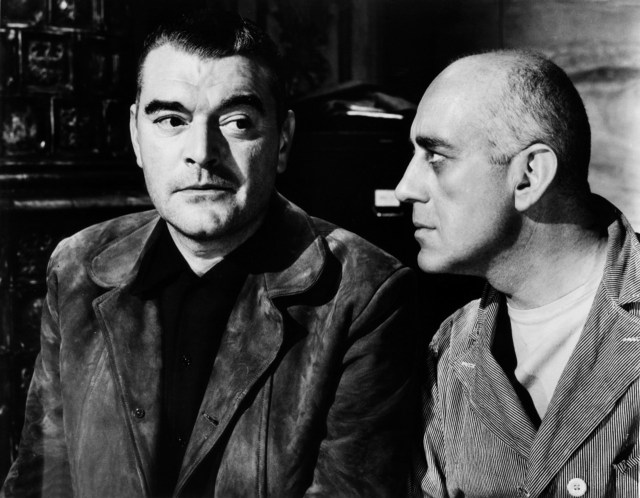
What recommends this film, based on a play by Bridgette Boland and reduced to something of an historical artifact today, is the two actors locked in that idealogical/psychological struggle — Alec Guinness and Jack Hawkins. They are subtle actors taking a shot at humanizing archetypes.
What works against the film is almost everything else — the staginess, the arch speech making, the political/religious archetypes, and the exceptionally corny not-quite “love story” tacked onto it, between a guard (Ronald Lewis) and a woman (Jeanette Sterke) desperate to escape West to reunite with her husband, who fled.
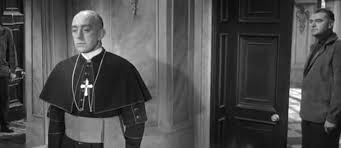
The Cardinal (Guinness) is about to say mass, in Latin, when a note is passed into his open prayerbook.
“The police are here to arrest you.”
The crowded cathedral has spies in it. But this cardinal is unshaken. He worked with “The Resistance” in the war. He was tortured by Nazis. He is a major public figure. Communist goons don’t scare him.
But he is arrested after mass, and this doctor turned lawyer (Hawkins) is to be his official interrogator, the one handing him a confession to sign.
“I imagine this is more awkward for you than it is for me,” he tells his persecutor. “I am difficult to trap and impossible to persuade.”
He knows why he is here, but it is articulated for him. Priests are “more dangerous than politicians….You represent a religion which provides an organization outside The State.”
This confession, this interrogation, this show trial and this process are about a “monument” that “must be defaced,” in the eyes of the communist state.
The “enemy of society” is to be prodded, cajoled, debated and interrogated — because the Cardinal is “tolerably” immune “to physical pain.”
Hawkins’ Interrogator is feeling the pressure of the party general secretary (Kenneth Griffth) as this ordeal drags on and method after method is tried to “break” the man. A somewhat sympathetic guard (Wilfrid Lawson) can’t do much of anything to make the Cardinal’s imprisonment more tolerable.
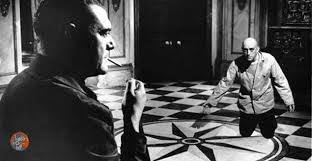
And time passes as the two men struggle, play semantic games and look for lapses in each other’s logic, moral authority and human decency. We see people outside the prison, sitting in cafes reading the “wrong” newspaper, which was “just banned” and shuttered “this morning.”
I’m a big fan of the leads, and Guinness and Hawkins do what they can with it. But the heavy-handedness of the parable, the obvious and unsatisfying finale and that not-entirely-pointless-but-close “love story” beat “The Prisoner,” and the viewer into submission.
And by “beat” I mean “bore.”
There have been much better interview/interrogation thrillers this rather stagebound, flatly-directed, unemotional “message” wrapped in black and white celluloid.
But in its day…

Rating: “approved”
Cast: Alec Guinness, Jack Hawkins, Wilfrid Lawson, Jeanette Sterke, Ronald Lewis and Kenneth Griffith.
Credits: Directed by Peter Glenville, scripted by Bridgitte Boland, based on her play. A Columbia release on Tubi, Youtube, Amazon, etc.
Running time: 1:31



