
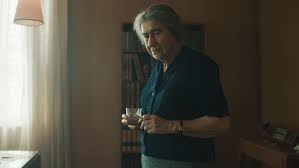
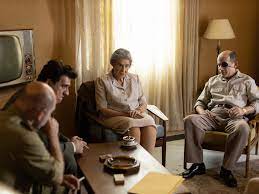
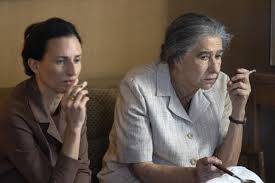
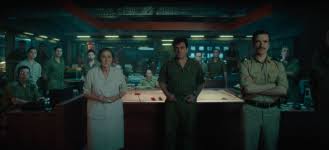
A solid Helen Mirren turn in the title role gets lost in a choppy narrative and haze of cigarette smoke in “Golda,” a bio-pic about Israel’s controversial but (apparently) far-sighted prime minister during the 1973 Yom Kippur War.
The film is a “Thirteen Days/Darkest Hour” dramatic thriller treatment of those few weeks in Oct. of 1973, when blunders, miscalculations and geopolitics allowed Russian-armed Egyptian and Syrian forces to almost reverse the results of the much-longer-than-its-name-“Six Day War” of 1967 with a sneak attack.
It’s a top-down “command decisions” story of maps and meetings, generals and crackling radio transmissions overheard from combat, a leader’s visits to the morgue and a sick old woman coping with the stresses of a situation as dire as “They’ll never take me alive.”
But more glibly put, “Golda” is the best damned 100 minute anti-smoking ad you’ve ever seen.
The film is (kind of) framed within the post-war Agranat Commission hearing (Henry Goodman is the chair) on Israel’s lack of preparedness for the surprise attack that most saw coming. Meir testifies, owns up to her mistakes and those of others.
Mirren’s Meir is motherly amd matronly, blunt and fatalistic, aware of her failing health (cigarettes are bad for you) and willing to take the fall for the CYA missteps of others. And as is in the case in your more old-fashioned screenplays, she can see the future.
“Just remember, all political careers end in failure,” she tells the showboating glory hound officer and future prime minister Ariel Sharon (Ohad Knoller).
She is a philospher and a prophet — “The Russians. They’ve brought nothing but misery to the world…Let me TELL you about the Russians. When I was a child in Ukraine…”
And she is eminently quotable.
“Knowing when you’ve lost is easy,” she says of the Eygptians, about to snatch defeat from the jaws of victory. “But it’s knowing when you’ve won that’s hard.”
The film’s interesting historical takes include showing Six Day War hero Moshe Dyan (Rami Heuberger), Israel’s iconic eyepatched Defense Minister, throwing up as he flies to survey the Syrian combat zone, and all but cracking up with panic, authorizing a nuclear response which Meir would never approve. Meir has to send him home and tell him to “snap out of it.”
Military and intelligence chiefs are named as being behind the intelligence failures, Israeli reservists are heard in radio traffic flailing and weeping in panic at the onslaught, not exactly the image the hard-nosed Israeli Defense Force (IDF) projects to the world.
Liev Schreiber makes a dashing, perfectly-calculating U.S. Secretary of State Henry Kissinger, bemoaning the Arab Oil Embargo that is already beginning, trying to convince Meir that all the U.S. wants is to prevent Russian (Soviet) intervention and World War III from starting, playing down his Jewishness in this life-or-death emergency involving the Jewish State.
But the film clumsily uses archival news footage of the real Kissinger and the real Meir, which — whatever prostethics (the practical shoes and fake-bloated legs covered by practical stockings stand out) they give Mirren — don’t flatter the actors. These aren’t mere impersonations, they’re performances. If you can’t pay to digitally insert the actors into those real scenes, don’t use the doc footage until the closing credits.
Camille Cotton plays the devoted personal aide who is there for her prime minister to unburden herself to, to bathe her and light her next smoke. Attempts to personalize a tragedy that struck almost every Israeli family by having a government office pool typist weeping at the keyboard over a son missing in action is as old fashioned as almost everything else.
But Mirren’s unapologetic turn overcomes much, including a narrative that never flows thanks to the episodic nature of the various meetings, insertion of news footage, Golda’s nightmares (phones ringing with staticky calls from the front, etc) and the top down nature of point of view. Her performance compares favorably to Ingrid Bergman’s definitive small-screen take on the character in the early ’80s TV movie (in two parts) “A Woman Called Golda.”
“Golda” might have had awards season potential, but the finished product wiped away that dream and rendered this tale of Israel’s darkest October a classic “August” movie, dumped where it won’t attract attention because it just isn’t worthy of it.

Rating: PG-13 (Pervasive Smoking|Thematic Material)
Cast: Helen Mirren, Camille Cotton, Lior Ashkenazi, Rami Heuberger,
Henry Goodman, Ohad Knoller and Liev Schreiber
Credits: Directed by Guy Nattiv, scripted by Nicholas Martin. A Bleecker St. release.
Running time: 1:40



