
Long title, longish movie. Hoping for the best.
Long title, longish movie. Hoping for the best.
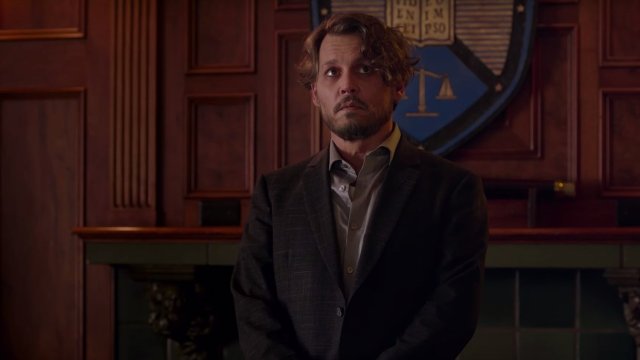
I can’t recall ever truly hating a Johnny Depp star vehicle, and I’m not going to start with “The Professor.”
But I’m tempted.
It flirts with being offensive, but falls short. It’s not entirely maudlin, not wholly misogynistic, but close enough.
And he’s mildly diverting in the part, playing a coasting-on-tenure/drifting through marriage college English professor who gets a cancer diagnosis in the opening scene and takes the same attitude towards his life that he abruptly hurls at his class.
“From here on out, we’re going to be doing things differently.”
Professor Richard Brown is going to drink. He’s going to womanize, when practical. He probably ran out of you-know-whats to give sometime before. But getting that news on the same day his wife (Rosemarie DeWitt) tells him she’s having an affair with the college president, a “nutless sack” (Ron Livingston), was kind of the last straw.
And he’s only starting with muttering the f-bomb at faculty meetings (Danny Huston is the department chair and his best friend), later wading into the duck pond bellowing that same word at the heavens.
No. Routine won’t do.
Richard’s journey is tracked through cutesy interludes — “Chapter I: I have something to say,” “Chapter IV: It’s really starting to kick in.”
He weeds his class of drones, slackers, future “government workers,” “corporate whores” and the like. The few left are to pick one book they haven’t read, a classic, analyze and do an oral report on it. But first, Richard must make time for “an emotional bender for 72 hours.”
He doesn’t tell his unfaithful wife and college-age daughter (Odessa Young of “High Life”), because each is caught up in her own thing. Daughter Olivia has picked this very moment to come out. Mom dismisses it as just a phase, but Dad is the very picture of seen-the-light/concerned-supportive parent.
And his class teeters on the edge of degenerating into chaos, as he asks them to procure weed for him and he takes them out drinking, all part of a flailing last ditch attempt to “reach into our lives and try to extract some sort of wisdom” from it all.
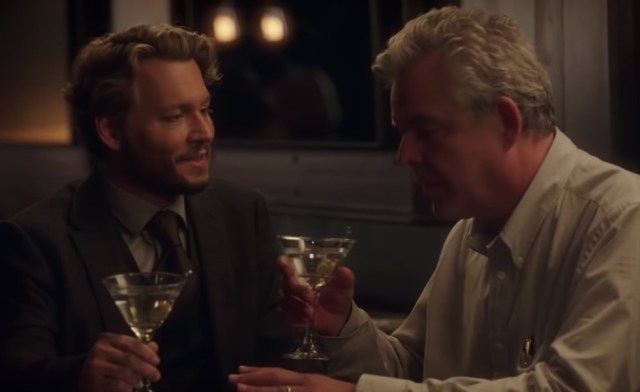
Richard is a fairly tedious character — sexist, intolerant of feminist/lesbian lit and that one feminist student whose “co-op lifestyle” his assignment is shaking up.
He has little more to confide to this best friend other than “I’m only mildly disappointed in myself…Just let me die alone. Let me die in peace, ride this thing out.”
Depp, who has finally taken to showing up for roles appropriately groomed, cuts a fine figure as a college prof on a Life’s End bender. He’s had far too much practice playing drunks for this to be a strain.
But Richard is singularly undeveloped and uninteresting. Why would a coed like the one played by the sassy starlet Zoey Deutsch remain in his class, much less pursue his company and/or guidance after hours?
His dictum that they all remember that “each and every moment, we are composing the story of our lives” and are thus obligated to “make it an amiable read, or at least an interesting one” is not advice he’s ever followed or ever will.
The women are singularly dull in this contrivance by the director of “Katie Says Goodbye” (which starred Olivia Cooke). Sculptor-cheater wife, female students as objects of scorn, shallow wives and harridan colleagues (Siobhan Fallon Hogan), they’re a sorry lot in writer-director Wayne Roberts’ eyes.
Depp’s charming way with Richard taking his leave to “explore a smidgen of infidelity” doesn’t go far enough (having sex with a barmaid in the bathroom) toward making him loathsome. Because that, at least, would be more intriguing, given the character and the movie more edge. He never quite achieves that.
The few one-liners that land are a pallid assemblage, too.
“I have cancer. It’s all right. Everyone my age has cancer.”
“We’re well-to-do middle-aged WASPs, we can get prescriptions for anything.”
Writer-director Wayne Roberts shows little imagination in any character, any situation, any academic cliche. He has Richard drive a 1980 Mercedes diesel because, I guess, nobody thinks college professors drive Saabs any more.
At least Roberts didn’t get his way in titling “The Professor.” The director of “Katie Says Goodbye” was sure he’d get to call this “Richard Says Goodbye” (the print I saw was so-titled). That’s enough to make anybody plunge into a duck pond and hurl a few f-bombs at the heavens.

MPAA Rating: R for language, sexual content and some drug use
Cast: Johnny Depp, Rosemarie DeWitt, Zoey Deutch, Danny Huston, Siobhan Fallon Hogan
Credits: Written and directed by Wayne Roberts. A Saban Films release.
Running time: 1:30
This is the July 3 horror tale from the director of “Hereditary,” Ari Aster.
A little “Wicker Man,” a little “The Witch,” a bit of Scandinavia isn’t all that inviting, eh?
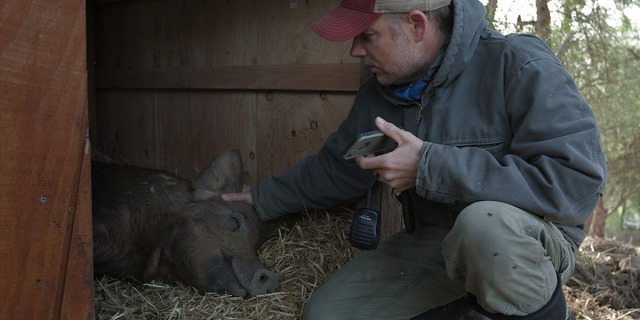
You need to see “The Biggest Little Farm,” and not because that many of us have the energy, gumption and chutzpah to emulate what we see here.
Everybody needs to see this lovely little documentary because of its optimism, a bracing island of hope in a tidal wave of news about the slow motion environmental disaster unfolding around us.
Here’s a movie about the pursuit of balance in nature, the infallibility of biodiversity and the glories of compost.
What cameraman and filmmaker John Chester and chef, blogger and “eat local” advocate Molly Chester did was restore a barren, neglected farm in Moorpark, California, leading by example as they launched an experiment in biology, labor and market-driven farm-to-table capitalism.
And what Chester did was document that with his camera, explaining the changes, reveling in the learning curve and marveling at how land, nature, animals and people can be healed by getting back to the farming we used to know how to do, almost by instinct.
He’s made an informative, inspiring film, joyous in its intimacy, fraught in its various crises, one filled with love, adorable critters, challenges, tragedy and triumph.
In more ways than a mere review can recount, it is the most American movie of 2019, wearing its optimism in every gilded, rain-speckled, sun-flecked frame.
The Chesters were plugging along in their personal and professional lives until the day this rescue dog they took in got them evicted from their Santa Monica apartment.
Their plans to “build a life of purpose together” changed, and Molly led the way. Her “infectious” enthusiasm for food, raised with love and care, and her idealistic notion of a farm, “like something out of a children’s book,” pulled them towards rounding up investors and setting out to launch Apricot Lane Farm, 200 acres that would be tended “in harmony with nature, like a traditional farm from the past.”
Farming has radically changed in the past 150 years, and that created skeptics all around them (quoted, but rarely seen) as the couple took on a foreclosed, arid and dead orchard, with a house on property, surrounded by factory farms.
“Biggest Little Farm” recounts the years it took them to turn it into something that worked. They did some homework, but more importantly, they found themselves a sensei, a guru in this “farming the way it was” ethos.
John narrates the film and his skepticism about this eccentric hippy “back to nature” prophet, Alan York, is evident and repeated, time and again.
York’s “It’ll take care of itself,” like “a flywheel” — self-sustaining so that “it’ll be like surfing” once the place it on its feet, seem delusional, pie-in-the-sky pollyanna-ism.
“Diversify! Diversify! Diversify!” York preaches. There’s “never enough time to do it right, but always enough time to do it over,” if they get something wrong or nature provides unhappy surprises.
But Molly’s all about this sunny York, and John buys in. They put in scores of stone-fruit trees, from peaches to cherries, endless varieties.
They plant “cover crops,” grass and clover, to heal the soil around the trees.
They buy chickens and cows, goats and sheep, to produce revenue but more importantly, to poop.
“Compost was our gold!”
The idea, as pitched by York, was to “emulate how natural ecosystems work,” to let nature find its equilibrium in a farm with a pond for ducks, a house for hens and sheep and cattle grazing amidst the orchards, rebuilding dead soil into something rich and productive.
Worm farming for “compost tea,” putting catfish in their pond, adding herding dogs to help, it all fits together.
Until the predators and “pests” start showing up. The Chesters are tested by snails and starlings, maggots and gophers and worst of all — coyotes, the spree killers of many a henhouse or duck colony.


Chester uses animation and gorgeous natural photography to capture nature returning to this near-desert corner of Southern California. The bees swarm in, and soon all creatures great and small gravitate to their tiny Garden of Eden — gophers to marmots, badgers to bobcats.
There’s a rich tradition, perhaps unique to the United States, in books on this sort of transformation, all harking back to Aldo Leopold’s “A Sand County Almanac.”
Every generation, it seems, has to be re-introduced to this lesson of “letting nature heal” our scarred land, because every generation needs it. Farming has turned industrial, monocultural and chemically dependent.
Maybe the swelling population of the country and the planet demands this scale and efficiency. But maybe there’s another way, “Biggest Little Farm” says.
Granted, not everybody will find the dogged work, sometimes solitary lifestyle and grimmer aspects of dealing with food on such close, life-and-death terms appealing.
And I’d love to see the ledger books on this place, from the investors who got them started to the labor force the Chesters recruit online (“Learn to farm” interns? Volunteers?), which makes one wonder about their actual bottom line.
But “The Biggest Little Farm” is so touching it’ll make you cry, so inviting it’ll make you yearn for something in your life as fulfilling as the healing power of making the barren green, from tiny plots of backyard to a warming and drying planet.

MPAA Rating: PG for mild thematic elements.
Cast: John Chester, Molly Chester
Credits: Directed by John Chester, script by John Chester and Mark Munroe. A Neon release.
Running time: 1:31
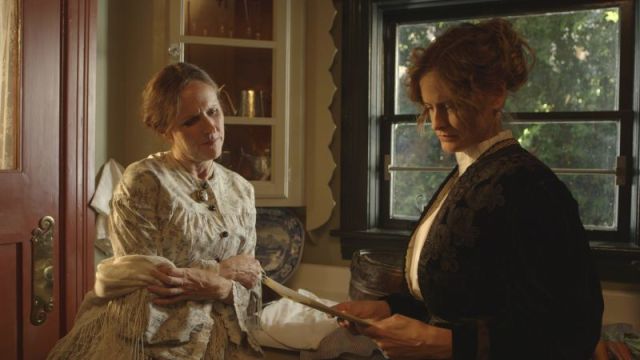
“Wild Nights with Emily” is a makeover of the image of legendarily “sad,” “loveless,” “reclusive” “spinster” poet Emily Dickinson.
It’s “Drunk History” without the alcohol. It re-examines the “legend,” and tears holes in it with laughs based on rock solid scholarship.
Have I mentioned how much I love “Drunk History?” It can come as no surprise to anyone familiar with the Comedy Central show seeing this movie that writer-director Madeleine Olnek (“Countertransference”) has cited the comic “History” as a big influence on this queer reclamation of Dickinson’s reputation from the erasures of a presumptuous dunderhead who established the “myth” of “The Belle of Amherst” that has endured despite a rising mountain of evidence debunking it.
“Wild Nights” has Molly Shannon as the adult Emily, a frustrated poet who has a devil of a time getting her hundreds upon hundreds of poems published in her lifetime.
“They don’t rhyme!”
Yes, one and all agree, especially Atlantic Monthly publisher and literary critic Thomas Wentworth Higginson (Brett Gelman of TV’s “Another Period”). “The rhymes are a bit…off. She could…work on them, perhaps?”
Two myths die hard in that meeting, that Dickinson was a longtime recluse and that she was obsessed with “posthumous recognition” for her 1800 or so poems. She got poems published, and she tried, all her life, to get more published. She met publishers in order to accomplish that.
The other myth that “Wild Nights with Emily” concerns itself with is her sexuality. She wasn’t some repressed, loveless spinster who missed her chance at “happiness,” thus inspiring the sadness of much of her writing.
Emily was in love, from her teens onward, with her friend and later sister-in-law Susan (veteran character actress Susan Ziegler of “Hello, My Name is Doris” and many, many TV roles).
We’re shown how that romance flowered when they were teens — Dana Melanie plays the curious Emily, crushing on Susan Huntington Gilbert (Sasha Frolova), who eventually reciprocates.
We hear from Susan’s daughter, who wrote and spoke of this love which her teenage self could see with her own eyes as she passed thousands of notes between the women, who lived next door to each other in Amherst. We hear and see (every poem is subtitled to make the words and meter stand out) the poems and passionate letters that buttress this view of Dickinson as America’s most famous lesbian poetess.
That we haven’t known this about her until recently is explained, too.
As narrator, giving a “women’s club” talk about “Emily,” whom she never actually met, we meet the woman who literally ERASED Susan’s name from poems and those letters. Mabel Loomis Todd is given a smiling, dopey certitude by Amy Seimetz (“Alien: Covenant,” “Stranger Things”) who plays her as delusional about her intelligence and the validity of her interpretation of “Emily,” and villainous in a self-righteous way one often sees in lady TV preachers.
She’s right, because, well, she just is!
Imagine having this fraudulent expert, even though she was plainly a fan, in charge of Dickinson’s legacy.


Susan married Emily’s brother Austin (Kevin Seal), had two children by him and insisted they build a house next door to Emily and her dotty sister Lavinia (Jackie Monahan) because her true love dwelt there.
Seal’s Austin is a complex blend of indulgent sibling and husband, and clueless cad. He had a years-long affair with Todd that mirrored his wife’s romance with his sister.
Olnek doesn’t have much in the line of kinky fun with the sordid goings on in Amherst. The picture reaches for a jokey tone in its casting, the odd situation or one liner.
“Your sideburns are in my eye!”
There’s a light mockery of other figures of the day, including some of her contemporaries in poetry — the mumbling Emerson, etc.
But the poems, many of which are sampled here, deflate most of the film’s efforts at deadpan lightness.
Because I could not stop for Death – He kindly stopped for me –
And even though the film is period-perfect, using actual locations and accurate costumes (hoop skirts are good for a laugh), “Wild Nights” suffers from a cell-phone video flatness in its cinematography, a little too “Drunk History” for its own good in that regard.
Shannon’s Dickinson is sharp and smart and a little exhausting (those her knew her vouch for that), Ziegler’s Susan devoted, aware of what’s going on if not entirely sure of how to characterize it and Seimetz’s Todd daffy in her wrongheadedness.
So it’s the players and the historical rewrite that recommend “Wild Nights with Emily,” not the wildness, not the nights nor the days, all of which are shot so flatly as to resemble a local PBS station’s production of “The Belle of Amherst,” circa 1985.

MPAA Rating: PG-13 for sexual content
Cast: Molly Shannon, Susan Ziegler, Amy Seimetz, Kevin Seal, Brett Gelman
Credits : Written and directed by Madeleine Olnek. A Greenwich Entertainment release.
Running tine: 1:24

There isn’t a whole lot to “A Violent Separation,” a B-movie that reaches for “thriller” and never quite shakes “melodrama” in the process.
But it has tension and mild suspense built into its bones, and a topicality that you wonder if co-directors Michael and Kevin Goetz or screenwriter Michael Arkoff wholly appreciated.
It’s predicated on a set of anecdotal evidence truisms that a lot of us carry around with us. The first is that rural America’s gun culture consists of a lot of careless people, something that every weekend’s “accidental shooting” count bears out. And the second is that if anybody knows what it takes to get away with something, it’s a cop.
Ray and Norman Young (Ben Robson and Brenton Thwaites) are rural Missouri siblings who remain close despite the fact that one’s a cop and the other has more than his share of scrapes with the law on his record.
Ray’s a drinker, a brawler and a womanizer, which Abbey Campbell (Claire Holt) has to shrug off, if she harbors any thoughts of permanent attachment. She had a child with another man, so Ray figures “cheating begets cheating” and all’s fair in honky tonk romances.
Norman’s a boyish sheriff’s deputy who can never quite get around to sparking Abbey’s sister Frances (Alycia Debnam-Carey). She makes a joke about his handcuffs, and he’s too clueless to catch on. It’s like that.
The sisters and Abbey’s son live with their sickly dad (Gerald McRaney), keeping him going through his emphysema.
Like Ray, they have no visible means of support.
Then, after a night of drinking and boot-scooting at the Whisperin’ Pig Roadhouse, Abbey distracts Ray from the barmaid he’s been carrying on with (an Eastwood daughter, Francesca) and the bar fight he’s just gotten into over insults aimed at Abbey.
“I want you to teach me to shoot!”
That’s how “the accident” happens. That’s how “the cover-up” begins.
Norman’s boss, the sheriff (the great Ted Levine of “Monk” and “Silence of the Lambs”) isn’t the sort you can easily pull one over on. But Norman, knowing what he knows, does.
He’s at the sheriff’s elbow as the “timeline” is established, Frances and her Dad answer questions and things point just enough towards Ray that the sheriff feels the need to ask his deputy, “You OK with this?” Eventually, even the sheriff figures out “You’re too close and this don’t look right.”
And as the trail goes cold, the seasons change and the words of “Old Bob” (Cotton Yancey) shift the narrative’s gears.
“Sometimes you just gotta let time do its thing.”
The Goetzes make good use of the Louisiana-subbing-for-Missouri locations, the “Miller’s Crossing” pines without the overcast and Coen Brothers guiding sensibility to help them.
The dialogue can be chicken fried or hard boiled, but it’s generally of the predictable “I f—-d up, f—-d up bad!” variety.


There’s not a lot of urgency here, little sense that the walls are closing in on the brothers even as the clues start to point their way and you know and I know and they suspect that the sheriff must know, Frances might know and her old man sure as hell knows.
But “A Violent Separation” almost sustains itself with the understated performances, especially by Robson (TV’s “Animal Kingdom”), Debnam-Carey (“Fear the Walking Dead”), Holt (“Pretty Little Liars”) and Levine, the rare American in this mostly Aussie and British cast.
And there are some nice moments of routine but skilled parallel constructions — the first interrogation begins and we see cut-aways of the tracking dogs, who figure this thing out before anybody else does; one brother engages in a little carnal escape, and the other likewise manages the same.
You get what the filmmakers were going for, even if they can’t quite bring themselves to trimming this down to the leaner, less cluttered neo noir it wants to be.
MPAA Rating: unrated, graphic violence, explicit sex, alcohol abuse, profanity.
Cast: Brenton Thwaites, Ben Robson, Alycia Debnam-Carey, Ted Levine, Gerald McRaney and Francesca Eastwood
Credits: Directed by Kevin Goetz and Michael Goetz, script by Michael Arkof A Screen Media release.
Running time: 1:48
This one-day romance, with an anti-“wall” American melting pot subtext, opens Friday.
Looks sweet. Or bittersweet. Depending on how it breaks.
“The Sun is Also a Star” opens Thursday night.
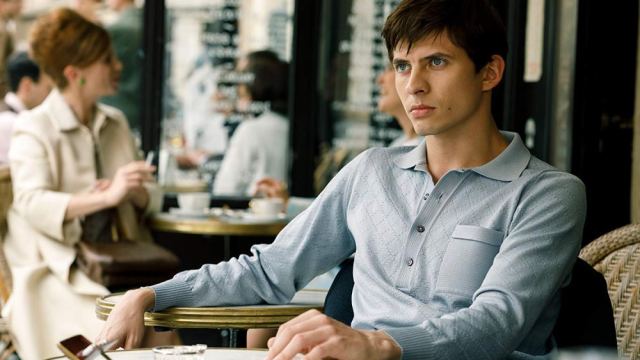
“The White Crow” is director Ralph Fiennes and screenwriter David Hare‘s stately and stolid screen biography of the great Soviet ballet dancer Rudolph Nureyev, zeroing in on events that led to his defection to the West in 1961.
It captures the graceful athleticism of this groundbreaking star of the modern ballet, and his personality — defiant, narcissistic, resentful and downright rude, an egomaniac who used that ego as his shield against Soviet repression and Russian classism.
The great ones always figure the sun rises and sets on their glory, and that’s the Nureyev (played by Ukrainian dancer Oleg Ivenko) we see here — mercurial, impulsive, inclined to answer a question with as much arrogance as he could muster, even in his earliest years as a professional.
“Did you dance tonight?”
“If I had danced, you would remember.”
Hare, who adapted “The Hours” and “The Reader” for the big screen, builds a conventional movie narrative out of this life, framing it with scenes in Paris in May of 1961, when the dancer was star of the Kirov Ballet and on his first trip to the West — the first trip of any Soviet dance company to the West since the end of WWII and the beginning of the Cold War.
Flashbacks, filmed in washed-out grey, black and white, show the hard times Nureyev grew up under, the grungy train where his mother gave birth, the pedantic martinets of Soviet era ballet schools. And in these scenes, some of them shown out of order, we see the artist emerge from “the system,” fighting it — complaining when none complain, defying where none defy.
As a teen starting his professional training late, he had no time for ordinary teachers. He insists on Pushkin (Fiennes, in a quiet and beautifully economical performance). And he gets him.
We meet Pushkin at his 1961 interrogation by the KGB, which wants to know what he knew and when he knew it.
“This is an attack on the Soviet Union!” they thunder.
“He had an explosion of character…he knows nothing of politics. It is about dance.”
In the fictive present, “Rudi” soaks up everything he can of Paris, taking up with a French dancer (Raphaël Personnaz), seeing the city with a well-connected Chilean woman (Adèle Exarchopoulos), leaning on her one minute, insulting her the next — as is his due.
He bristles at every KGB “minder” restraint on his movements as he waits for the Louvre to open, just so he can gaze up “The Raft of the Medusa,” the famous painting about an early 19th century shipwreck that turned survivors against each other in a dog-eat-dog battle for life.
A metaphor, you think? How Nureyev saw life in the USSR?
Ivenko looks a bit like Nureyev, lacking the beautiful angularity of his sharp features. He’s a fine approximation of “Rudi” in the dance as well, if not quite managing the star’s legendary leaps, the “hang time” that even Michael Jordan would have found hard to match.
“Belaya vorona,” we’re told, is an old Russian expression — “white crow,” as in the perpetual outsider. That was Nureyev, a homosexual in the state where the Socialist Man was no such thing.
We see the trauma of a childhood where his soldier-father finally shows up, years after his birth, and decides to toughen him up by leaving him in the snowy woods.
We only get a scene or two of his sexual tastes, about as many as we get of him being seduced by Pushkin’s savior/micro-managing wife (Chulpan Khamatova).
Ivenko is best in extreme closeups, Rudi waiting for his moment on stage — wholly realizing the stakes, craving the fame that might let him escape the drab, washed-out colors of Russia and his past, confident that such success — maybe even his coming defection (Planned? Or an impulse?) — is inevitable, fated.
“It’s not going to take long…until everyone knows who I am!”
How’re you going to keep’em down on the farms of the Union of Soviet Socialist Republics when they’ve seen the lights of Gay Paree?
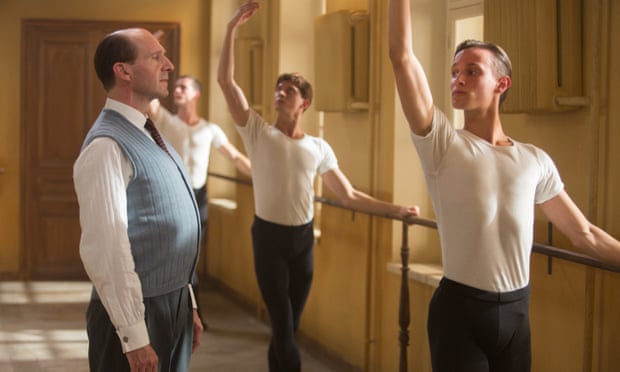
He stared down The State, which wanted to put him in his place, found his own means of improving his art (a colleague secretly filmed performances so he could see the errors in his line) and learned English (the film is in Russian, French and English, with English subtitles). Who knows? That might come in handy some day.
“The White Crow” has problems with pacing, and Fiennes, three films into his directing career, steps all over his films climax as if he can’t tell that’s what he’s doing.
But he gets good performances out of one and all, stages and shoots the dance sequences well enough and gives a nice grace note to the whole proceedings with his own performance — sentimental, dignified but without the “twinkle” that a lesser actor would have over-reached for.
And he reminds us of the natural, default mode of Czarist turned Soviet turned Putinesque Russia — a boot heel grinding down on freedom, bullying and control at every turn. It’s helpful for movie audiences to remember that, how much courage it took people like Nureyev to find a way out and to take it.
We remember even if the current colluding, cozying up to Russia “leader of the Free World” does not.
Nureyev certainly never forgot.

MPAA Rating: R for some sexuality, graphic nudity, and language.
Cast: Oleg Ivenko, Ralph Fiennes, Adèle Exarchopoulos, Raphaël Personnaz, Calypso Valois
Credits: Directed by Ralph Fiennes, script by David Hare, based on the Julie Kavanagh biography of Rudolph Nuryev. A Sony Pictures Classics release.
Running time: 2:07
This is an interesting tour, and I guess Cusack is of an age when it is appropriate. Show one of your best films, do a q & a afterwards, a victory lap for a beloved actor interacting with his fans. https://amp.local10.com/entertainment/movies/ask-john-cusack-anything-about-say-anything-in-fort-lauderdale
He should be collecting these on a weekly basis. https://www.hollywoodreporter.com/news/werner-herzog-receive-lifetime-honor-european-film-academy-1209983

 Movie Nation