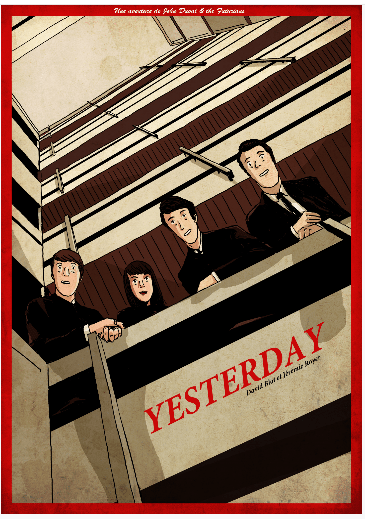
A 2011 graphic novel, “Yesterday,” about a guy who takes credit for writing every Beatles song?

yestid

Oh snap. Sounds a LOT like the Richard Curtis screenplay to the 2019 Danny Boyle movie.

The author has published it online, for free, to let viewers of both make up their own minds, I guess?

From Variety.

“Graphic Novel ‘Yesterday’ From 2011, Similar to Danny Boyle Film, Posted Online for Free https://t.co/GxfsiythaM https://twitter.com/Variety/status/1143865120826830848?s=17

Posted in Reviews, previews, profiles and movie news | Comments Off on A 2011 graphic novel, “Yesterday,” about a guy who takes credit for writing every Beatles song?

Movie Review: Boyle’s latest doesn’t make one long for “Yesterday”

yes4.jpeg

If you’re of a certain age, the first few notes of a particular Beatles song can bring you to tears, summoning up a memory of a love affair, a time in your life, that poignant “last appearance” on “The Ed Sullivan Show” or of crowds gathering in front of New York’s Dakota apartment house.

Generations of music fans can get just as choked up with totally different associations.

Which is a way of assuring you that yes, I wanted to love “Yesterday.” And a way of warning you that I didn’t.

Danny Boyle has made movies spanning many genres over his career, and almost added a James Bond title to his storied resume. Instead, he’s made a Richard Curtis romantic comedy. And although I adore “Four Weddings and a Funeral” and “Notting Hill” as much as any Hallmark Channel subscriber, Curtis is very much a hit or miss screenwriter, always trying for movies that wear their hearts on their sleeves, often let down by his own earnestness, clumsy direction or lack of commitment from his stars.

“Yesterday” is about a young busker/pub singer (Himesh Patel) who wakes up in a world where The Beatles never happened, with only him remembering their songs and thus able to pass them off as his own and thus achieve John/Paul/George/Ringo level stardom in an instant, just relying on his memory of the lyrics. It’s a fascinating concept worth mulling over, but a film that fails in concept, and in execution.

It has a romance (Lily James of “Downton Abbey”) that is that rarest of Richard Curtis rarities — a non-starter. It has lots of jokes, about other foods, cultural phenomena and other bands that disappeared from history the same night The Beatles were erased. But not enough jokes.

Kate McKinnon’s in it, a “Saturday Night Live” legend who is a non-kosher butcher shop in every big screen appearance — all ham, all the time, someone who wears out we welcome by her third scene.

And the very concept’s fatal flaw is obvious several times the talented British TV actor Patel launches into song. He’s a good guitarist and singer, but the script and editing undercuts some “big” moments — never letting him get into “Let It Be,” for instance. And while some songs stand apart and endure his solo guitar treatment — the title tune especially — others land flatter than a Bon Jovi cover. Stripped of George Martin’s production and the charming harmonies and simplicity of those original recordings, “Help” wouldn’t likely create “Beatlemania” all over again.

Or “Malikmania,” even though nobody ever calls it that. Jack Malik (Patel) has just given up on his one-last-shot at breaking out, a festival where he flopped at the end of years of playing to empty street corners and disinterested pub-goers. His pal, fellow teacher and “manager” Ellie (Lily James) may be his biggest booster since childhood, the one who stayed in teaching while encouraging Jack to take his shot.

But that shot has missed the mark, and while we can see the love in Ellie’s eyes suggesting ulterior motives, all Jack sees is failure.

One “magical” global power outage, which causes Jack’s “accident,” one “Give us a song on your new guitar” moment with friends, and Jack figures out what he’s been getting hints of from Ellie and others about.

In this alternate history, the Beatles never happened.

He tries out tunes on Ellie and friends, on his distracted family (Meera Syal of “Doctor Strange,” Sanjeev Bhaskar of the funny Britcom “The Kumars at No. 42”). “Leave it Be,” they think it’s called.

Some listeners swoon, others compare “this new song I’ve just written” to Cold Play. Jack’s tirades, defending the Lennon/McCarthy (and George Harrison) songbook to philistines, are a hoot. But it sounds like he’s comparing himself to Leonardo Da Vinci.

It being 2019, there’s a “viral” element to his sudden exposure, a fantastical courtship by “the ginger geezer,” pop star Ed Sheeran, and everybody predicts instant fame and riches for this singer-songwriter “composing” a decade’s worth of collaborative Beatles classics in mere weeks.

One great running gag is the movie’s “taking the piss out of,” as the Brits say, Sheeran. He knocks off a tune, or floats one of his songs up to compare it to Jack’s, and Ed realizes he’s “number two, now.” False modesty is the funniest.

To be fare, his tunes hold up nicely here. They’re just of their time.

As indeed The Beatles were of theirs. Whether or not “Hey Jude” et al would make the Fab Four fab all over again in 2019 is a fascinating argument to have on the way home from the cinema. I love The Beatles and seriously doubt it.

You’ll recognize goofy, borderline incompetent “roadie” pal Rocky (Joel Fry) as a character we’ve seen in most every Richard Curtis script, most famously played by Rhys Ifans in “Notting Hill” and Bill Nighy in “Love, Actually.”

McKinnon, playing a predatory agent with her usual over-the-top gusto, lands laughs in sizing up, to his face, her new client as “Very…unattractive. Skinny, but somehow round.” She still offers him “the poison chalice of money and fame.”

And as in every movie, she runs out of gags and mugs her way out of the movie. Quickly.

It’s not an awful film, just one that only tugs at the heart a couple of times when plainly the intent was for this to happen, start to finish. It is James’ job to sell this romance, and she doesn’t. Patel handles the one liners, the umbrage Jack takes at all these dolts who can’t remember “the greatest songs/songwriters who ever lived.” But he hasn’t a clue about drumming up romantic longing.

Another trait of Curtis scripts is the way he lets us see “Damn, I cannot for the LIFE of me figure out how to get from here to (his often glorious) the finale.” “Yesterday” founders and wallows, a 95 minute movie trapped in a 116 minute one.

A James Corden cameo just reminds one that he got in a car with Paul McCartney and gave us a better version of Jack’s “discovery” of the Liverpool of The Beatles in just a short, sentimental and warmly touching TV sketch.

As Danny Boyle movies go, I’d still rather see him get his shot at James Bond.

As Beatles tributes go, I have to say I prefer Julie Taymor’s “Across the Universe,” which re-set the songbook in thrilling and inventing ways. “Yesterday” just makes me long for that unjustly maligned flop.

2stars1

MPAA Rating: PG-13 for suggestive content and language

Cast: Himesh Patel, Lily James, Kate McKinnon, Ed Sheeran, Sanjeev Bhaskar, James Corden

Credits: Directed by Danny Boyle, script by Richard Curtis. A Universal release.

Running time: 1:56

Posted in Reviews, previews, profiles and movie news | 1 Comment

China blocks release of WWII film that celebrates the “wrong” Chinese heroes

The movie is called “The 800,” and is about a legendary battle in which Chinese Nationalists, NOT Mao’s communists, stopped the Japanese.
No matter what the date is elsewhere on planet Earth, in Beijing it’s always 1984. https://t.co/DD1h38a7O3 https://t.co/74FZwj2SjT https://twitter.com/THRGlobal/status/1143755806610878464?s=17

Posted in Reviews, previews, profiles and movie news | Comments Off on China blocks release of WWII film that celebrates the “wrong” Chinese heroes

Saudi Arabia gets its first “art house” cinema

paris

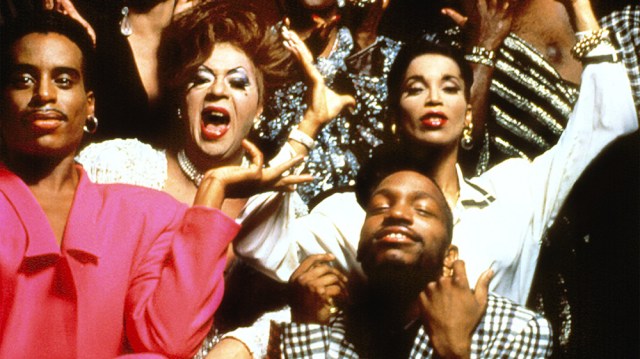
“Paris is Burning” has been re-released. Seems like a natural place to book it.

https://t.co/Bx1dP1DJXC https://t.co/LpuU8XnyQ6 https://twitter.com/THR/status/1143828680155832320?s=17

Posted in Reviews, previews, profiles and movie news | Comments Off on Saudi Arabia gets its first “art house” cinema

Preview, Cumberbatch, Holland, Shannon and Hoult fight “The Current War”

Yes, this popped up in festivals a couple of years back. It’s a can’t miss project with an all star cast that had to be recut and picked up by a distributor I’ve never heard of for October release.

Still looking forward to it. Tesla, Edison and Westinghouse, AC vs DC.

Posted in Reviews, previews, profiles and movie news | Comments Off on Preview, Cumberbatch, Holland, Shannon and Hoult fight “The Current War”

Next screening? “Yesterday”

Early reviews have been mixed for Danny Boyle’s latest.

But as early reviewers are often youngish junket journalists who have little connection to the music of The Beatles, well…

Boyle’s love of other cultures, the “Non Anglo Saxon” of England, is evident in this tale of a busker who wakes up as the only man on Earth who remembers The Beatles songbook.

Would “Help!” be a hit if re-released today? “I Wanna Hold Your Hand?” “Yesterday?”

Curious to see if this concept works.

“Yesterday” opens Friday.

Posted in Reviews, previews, profiles and movie news | Comments Off on Next screening? “Yesterday”

Documentary Review: “Maiden” takes female sailors on a race around the world

maiden1.jpeg

Back in the Golden Age of Sail, the ships were of wood and the men made of iron. In those days, when Britannia Ruled the waves, women on a boat were regarded as bad luck.

It’s a notion that died hardest in yacht racing, especially in “The World’s Longest Race.”

They named the original round the world sailboat race for its original sponsor, Whitbread — a brewery. There’s nothing more butch than that.

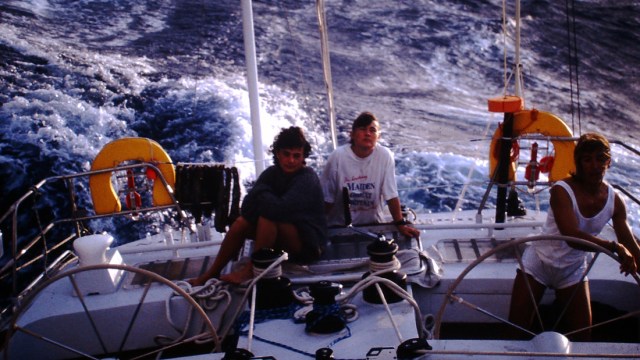
But a British sailor, whose chief experience had been as a yacht steward and cook, set out to change that in the 1980s. Tracy Edwards was 24 years old, and she and her crew’s entry in the 1989-90 Whitbread (now called the Volvo) Race is the subject of BAFTA winning British filmmaker’s inspiring documentary, “Maiden.”

Edwards and her crew (Amanda Swan Neal), Mikaela Von Koskull, Claire Warren, Michele Paret, Tanja Visser, Sally Creaser, Dawn Riley, Nancy Hill, Jeni Mundy, Jo Gooding, Sarah Davies , Kristin Harris and Angela Farrell) had to overcome financial obstacles, a boat that required rebuilding, sexism and the formidable Southern Ocean in order to make history.

The Maiden’s crew heard “You’re not strong enough. You’re not skilled enough.” And when you see what sailors must endure on this months-long stage race, crawling out on the boom or bowsprit, hauled up the mast by bosun’s chair on a heaving, rolling and bucking 58 foot boat, you’re going to have your doubts.

And besides, everybody knows it’s bad luck to rename a yacht.

Holmes — he did “Stop at Nothing: The Lance Armstrong Story” and cut his teeth on the British “World in Action” documentary TV series — interviews the crew, other sailors in the race and the journalists covering it, using lots of footage from the race itself to tell teh story of how the Maiden made her way into this ultimate sailing challenge.

Her mother was a rally driver and motorbike and go-cart racer, so there’s a daredevil strain in that gene pool. Edwards lost her father young, left home after her mother remarried and traveled and sailed as a stewardess and then a cook on assorted yachts cruising the Med and the Atlantic.

She didn’t decide to gather a crew, buy a boat and race around the world until she had a hard time signing on to a crew in a previous race.

“They didn’t want a woman on board.

Nobody wanted her, and when they gave in, it was only to hire her as a cook. She wasn’t allowed to do much outside of the galley.

But she was determined to get a boat, find a crew, line up sponsors and raise the £1,000,000 pounds it would take to enter the Whitbread.

A happy coincidence? One person she befriended in her gypsy yacht crewman days was the progressive-minded King Hussein of Jordan. He’d buy provide a big chunk of the backing that it took to buy and refit a ten year-old aluminum sloop and race it around the world.

Holmes’ film recounts how the crew Edwards rounded up did the rebuilding themselves to save money — Duchess Fergie christened it — how they bonded despite personality conflicted and early debacles, and how they faced the ultimate tests, racing through icebergs in the aptly-named aptly-named “Roaring 40s” of The Southern Ocean.

Journalists and sailors betting on how far as they’d get as they left port. One sexist, who owns up to it today, was journalist Bob Fisher, who referred to the aluminum yacht with an all woman crew as “a tin full of tarts.”

maiden2.jpeg

Edwards comes off as salty but sentimental, remembering the support she got from the crew and that the crew got from the world’s ports as they dashed from stop to stop — Uruguay, Australia, Auckland and Fort Lauderdale among them.

“Maiden” is a straightforward film in which the subjects look straight at the camera for interviews, where the emphasis is on British pluck and women who would never call themselves feminists — until after they realized they were. No sense spending too much time thinking of the big money it takes to partake in this sport, and the economic backgrounds of everybody on board to even get their feet wet in the sport.

Here’s a hint. Every time I talked to Disney scion and Disney heir Roy Disney over the years, the conversation would eventually turn to his ocean racing team and latest efforts to win the Trans Pac.

Yeah, it’s a rich man’s sport.

But “Maiden” still makes for an inspiring story about beating the odds and surviving an arduous and dangerous race, and a reminder that barriers facing women always seem insurmountable right up to the moment they surmount them.

3stars2

MPAA Rating: PG for language, thematic elements, some suggestive content and brief smoking images

Cast: Tracy Edwards

Credits: Written and directed by Alex Holmes. A Sony Pictures Classics release.

Running time: 1:37

Posted in Reviews, previews, profiles and movie news | Comments Off on Documentary Review: “Maiden” takes female sailors on a race around the world

Movie Review: Prince Hamlet doesn’t get the last word in “Ophelia”

ophelia1.jpeg

Strip the poetry out of “Hamlet,” and the soliloquies.

Retell the tale from a tragic character’s point of view.

Yes, it’s been done before. And Tom Stoppard’s “Rosencrantz and Guildenstern Are Dead” had more zing to it than “Ophelia,” Clare McCarthy’s film version of the Lisa Klein novel.

But sumptuous settings, a good cast and some clever if not exactly genius back-engineering and re-imagining make this bastardized Bard at least worth a look.

It gives us the chance to see if Daisy Ridley’s “Star Wars” grimace is her go-to move, and lets us reconsider Queen Gertrude’s culpability and ponder the mechanics of Shakespeare’s play by rearranging them in a single exercise in changing the focus.

Ridley has the title role, seen in the opening as we remember her, lovely, pale and drowned in a pond.

But “I was always a willful girl, who followed my heart and spoke my mind.”

Ophelia grew up in Helsingør, a commoner who lost her mother early but was raised to be a lady in waiting for Queen Gertrude (Naomi Watts). She never lost the urge to be outdoors and on her own, never shed her fondness for dips in the pond.

The Mean Girls of Court keep her in her place — “She smells of garden soil…Ophelia, you dance like a goat.”

But doting on the queen, running secret errands and interpreting Medieval tapestries, she becomes the favorite. Fret not about the Mean Girls, the Queen counsels.

“Have you seen how the hens in the yard peck at each other?”

Standing in the shadows, sneaking into banquets, overhearing confidences, Ophelia hears much and sees much, before and after she falls under the gaze of Prince Hamlet (George MacKay).

She hears the first come-on Claudius aims at Gertrude — “In law, I am your brother. I was never much for law.

What Ophelia knows and hears will come in handy. Eventually.

Claudius (Clive Owen) is the long-haired brother to the king, the life of the party, given to insulting the heir to the throne (the “Prince of Denmark”).

“To the prince, may he someday rise from his mother’s lap.”

Hamlet first spies the pale but fiery Ophelia having one of her dips. Their banter is clever if not witty enough to quote at length.

“Beauty turns men to beasts.”

“You are a lady in waiting. Learn to ‘wait.'”

“For what?”

“A husband, of course.”


Australian director Claire McCarthy (“The Waiting City”) delivers us to the familiar plot points and action beats in a Middle Ages of stone and steel, wood and leather, garlands and brocade with white peacocks wandering the courtyard of these gorgeous Czech locations. Courtiers like Ophelia’s dad Polonius (Dominic Mafham) and brother Laertes (Tom Felton, a stand-out in this cast) haunt the interiors.

This Ophelia is the first to see the ghost on the battlements, and no delicate flower submitting to Hamlet’s flirting.

“Do not play with me.”

Still, she ignores Laertes’ heartfelt warning — “Ophelia, be afraid, afraid of all he can take from you!”

There’s a tin-eared recreation of the father-son “Neither a borrower nor lender be” lecture that Polonius gives Laertes, with lots of familiar action staged here offstage. The origins of Hamlet’s plan to be “mad North-northwest” (faking it), Ophelia’s ulterior motives and the poison brewing witch (Watts, again) never seen in the play have their day.

The swordfights are properly fraught, and every so often a lovely line makes its way into generally pedestrian dialogue.

“You’re a very bad girl, to be so good.”

To Horatio (Deven Terrell), who has just expressed the desire to become a doctor.

“I have no interest in becoming some man’s anatomy lesson.

And director McCarthy stages a red shadow pantomime that’s the best filmed version of “the play within a play.” Ever.

Every new pale English rose of the theater or cinema wants her shot at playing Shakespearean women, and Ridley makes this re-interpretation of the character confident but unpolished, and unlike Mr. “To be, or not to be” is decisive. It’s a reassuring if not career-making performance, as I’ve been underwhelmed by her work “a long time ago, in a galaxy far far away.”

I can’t say this was dazzling, as it goes rather wrong here and there, and completely off the rails in the epilogue. And MacKay, last seen in the WWII misfire “Where Hand’s Touch,” seems representative of a generation of skilled but colorless British leading men (Taron Egerton is their poster lad).

But when Hamlet, feigning madness, tries one last time to warn his beloved, Ridley’s “Ophelia” is assertive and fascinating enough that we’re glad she ignored that demand.

“I told you to get to a nunnery!”

2half-star6

MPAA Rating: PG-13 for a scene of violence/bloody images, some sensuality, and thematic elements

Cast: Daisy Ridley, Naomi Watts, George Mackay, Tom Felton and Clive Owen

Credits: Directed by Claire McCarthy,  script by Semi Challas, based on a novel by Lisa Klein .  An IFC release.

Running time: 1:46

Posted in Reviews, previews, profiles and movie news | 1 Comment

Movie Review: Wrestling with Swedish cultists in “Midsommar”

mid3.jpeg

“Midsommar,” the latest horror experiment by Ari Aster, the director of “Hereditary,” is a disturbing, patience-testing, rule-bending and frustrating film, one more to be contended with than passively enjoyed.

And that appears to be the point. It’s about passivity.

It’s a cult tale of the “Wicker Man” school, in which those set up to be victims take no active role in their fates.

Very anti-Hollywood, almost un-American in that regard. “American Exceptionalism” in the movies often takes that tack. We don’t take things lying down, we tell ourselves.

Characters’ “special skills,” foreshadowed with care, don’t have a bearing on how they cope with what’s coming.

We and they trust Scandinavian strangers. What harm could come from the country that gave us “ABBA?” They observe at what we think is a dispassionate remove, that isn’t removed at all. That horror trope that characters’ flaws — addictions, narcissism, cruelty, etc. — ensure they “get what they deserve” are almost upended. Unless you believe we all get what we have coming to us in the end.

Dani (Florence Pugh) is the neediest girlfriend ever. We meet her on a wintry night as she’s frantically calling and texting everybody she knows.

She’s in a panic over a cryptic, menacing email from her sister. Long-suffering boyfriend Christian (Jack Reynor) talks her off the ledge with another “It’s just her trying to get attention” that is almost helpful. He seems well-meaning, then we hear him griping to his friends. Dani and her family dramas are maddening.

But Dani’s intuition is spot on. She loses her entire family that night. In “Midsommar’s” most wrenching scene, Pugh shows us the gulping, gasping, inconsolable grief of the truly crushed.

Months later, guilt-ridden Christian still hasn’t found an exit strategy for this years-long co-dependent relationship. He’s planned on joining his fellow anthropology doctoral student Josh (William Jackson Harper) and their partying pal Mark (Will Poulter) at Swedish student Pelle’s (Vilhelm Blomgren) primitivist Swedish commune.

Christian didn’t want to tell Dani. Dani winds up guilting him into coming along.

At Hälsingland, the inhabitants live, work and worship together, a religion they document in ancient runes and base on ancient traditions of humans and Earth in harmony.

And when the four Americans and two young Brits arrive as guests, they’re given magic mushrooms, which only Dani resists taking.

Don’t get your hopes up, because it’s just for a minute. Peer pressure is a dangerous thing.

There are signs things are a bit off there — the oddly (sexually, violently) graphic embroidered sheets, the many drugged snuffs, teas, etc. they partake in, the games they play when they’re not line dancing.

“Skinning the fool.”

Josh, the expert on these sorts of shared cultural rituals worldwide, seems clued in on what’s going on and what’s to come, but is only here to smugly, self-servingly observe, not intervene.

Christian is out of his anthropological league, as are the rest.

What follows is predictable, but still by turns quaint, bizarre and shocking. And the reactions, “It’s just a tradition/cultural thing” are straight out of apologia for everything from Islamic stonings and beheadings to Inuit seal pup head bashing and Whoopi Goldberg’s infamous defense of footballer Michael Vick’s brutish dog-fighting ring.

“It’s their culture!”

The passivity of one and all is more gullibility than drug related. If they don’t have their suspicions, they should. The events to come are just so far outside what their upbringing, culture and stereotypical view of Swedes are that their instincts don’t work.

That human/American opiate that such tales traffic in, “There’s always hope” and the view “I/We could never fall for THAT” or “take THAT lying down” is missing. We’re all exceptional. Except, we aren’t.

Yeah, this could be about Trump. And Brexit. And crimes against humanity, what people will quickly start to regard as “normal” and what tolerating the intolerable will get you.

Poulter (of “The Revenent”) provides the sole comic relief, though some of what we’re shown has a certain head-slapping laugh at grim surprise quality.

Aster’s film, not unlike “Hereditary,” has a pitiless quality that keeps it at arm’s length. “Abandon hope, all ye who enter here” is his ethos.

I can’t say I enjoyed it, but “Midsommar” did what the Midnight Sun does to anybody who first experiences it. It kept me up all night.

2half-star6

MPAA Rating: R (graphic violence, nudity, hallucinogens, profanity)

Cast: Florence Pugh, Jack Reynor, William Jackson Harper, Vilhelm Blomgren, Gunnel Fred, Isabelle Grill and Will Poulter

Credits: Written and directed by Ari Aster. An A24 release.

Running time: 2:20

Posted in Reviews, previews, profiles and movie news | Comments Off on Movie Review: Wrestling with Swedish cultists in “Midsommar”

Documentary Review: Ron Howard’s adoring portrait of a legend, “Pavarotti”

pav3.jpeg

There’s no mistaking that sound, the crisp tone, “clear as a photograph,” the super-human range and otherworldly musicality that could be no one but Luciano Pavarotti.

Seeing him in concert or in an opera could be, even for a casual fan, a transformative experience. It was if he himself was shocked at the music emanating from his mouth — that little pause after every aria, before the explosion of applause, would catch just a hint of “I can’t believe I just did that, can you?” in his eyes.

Marry that voice to that ever-beaming face, hair and beard dyed Elvis/Reagan black, a beaming, huggable Italian teddy bear, and you had a singular star, a giant among mere mortals who loved freely, embraced warmly, laughed with ease and lit up a dressing room, a concert hall, a stadium or TV show — so many TV shows.

Ron Howard’s documentary “Pavarotti” is a celebration of a life lived to its fullest, a man who loved singing and generously passed on what he learned and even founded schools and competitions to further that aim, a superstar who spent a good portion of his latter career giving himself and a chunk of his fortune away, and a man who loved his family — and other women — as much as he loved pasta, a guy who almost always looked like he was having the time of his life.

“Life’s too short,” a record company exec remembers him shrugging off some fresh legal tangle the tenor had gotten himself into. That ethos was contagious.

He knew, he said many times in a thought echoed by those closest to him, that what he had was “a gift from God.” And far be if for him not to appreciate that, to give it to the masses, and to enjoy himself as he did.

I interviewed him once, and saw him in concert a couple of times. But oh, to have been a fly on the wall for his first (already a star) big recital tour, to small U.S. cities in the early 1970s, “The King of the High Cs” enjoying seconds and thirds at buffets with his tour manager at America’s Holiday Inns.

Documentaries are wholly reliant on their subjects for broad appeal, and in the charismatic Luciano, Howard has a winner. The Oscar-honored filmmaker captures the emotional highs that seemed to follow Pavarotti like his very essence, his lack of self-seriousness and gregarious, that liberating sense of play.

Howard knocks this can’t-miss subject right out of the park.

Start with all the singing, the vocal gymnastics of his most demanding roles, the hilarious playfulness he brought to “showing off” while breezing through “O Sole Mio” with other, competitive tenors on stage with him.

As Luciano’s first wife, Adua, jokes (in Italian, with English subtitles), “Who would not fall in love with the voice of Pavarotti?”

Drawing on decades of Pavarotti documentaries and interviews, weaving in rare footage of him starting out, the son of a baker and choral tenor in Modena, Italy, and gathering his two widows, two best-known mistresses, a couple of daughters, concert promoters, critics and peers to tell his story, Howard gives us a Smithsonian-archivable film portrait that’s entertaining, start to finish.

The barrel-chested kid, born before World War II, won competitions, made startling debuts (“La Boheme”) and sang his way to the top in about a dozen years.

The schoolteacher’s life he began in young adulthood only came back to him after he’d made it, when he applied himself and that big, loving personality to master classes — often filmed and preserved for posterity.

And at some point, right around the time he started booking recitals and concert tours — just Luciano, a pianist, a tie and tails and white handkerchief — he transcended opera and became just “Pavarotti.”

Decades later, he topped even that with a one-off night with “Three Tenors,” a simple show of the three great tenors of the age that mushroomed into a supergroup –Pavarotti, Domingo and Carreras, “the biggest band in the world,” Bono of U2 marvels.

Placido Domingo says “The voice is a very jealous and demanding woman,” and Pavarotti chuckles that “She is the prima dona of my body!”

Phil Donahue tried to resist Luciano’s cooking on TV in the ’70s.

Bono tried to fend off his charm offensive, to get him and U2 to write a song for charity that they could perform at one of his endless “Pavarotti and Friends” benefit concerts. Bono failed.

Spike Lee looks intimidated, for maybe the first and last time in his life, as they unveil a charity school bus Pavarotti has paid for.

He was perpetually homesick, and packed mountains of Italian food and a whole entourage up with him when he traveled.

Amusingly, the Pavarotti depicted here is uncannily like the one feature film he starred in. “Yes, Giorgio” cast him as a beloved, world-famous tenor, a womanizer who (unlike Pavarotti, most of the time) referred to himself in the third person (“Fini”) as he propositioned the ladies.

You are a thirsty plant. Fini can water you.”

Howard cannily begins his film with grainy home video footage of Pavarotti taking a detour from a Brazilian tour date, dragging his posse with him up the Amazon to visit a remote but storied theater where the great Enrico Caruso once sang.

It’s locked, and they track down somebody with the key. There, with no stage crew, no lighting, just his traveling accompanist and an audience that started to gather, walking in from the street, he sings — an egoist, sure, but reverent for the tradition he is carrying on, singing on the same stage as Caruso, and effortlessly unleashing an aria out of sheer, unrehearsed joy.

There’s never been a career like Pavarotti’s.

No singer, no actor, no artist in any field has ever come to embody that field, envelope it, popularize it and make his name as synonymous as the art form itself.

“The King of the High Cs” he was named. “King of Superlatives” is more fitting.

Ron Howard has made a sublime movie that shows just why that was, and what a rare talent and rarer figure was in our midst until 2007.

3half-star

MPAA Rating: PG-13 for brief strong language and a war related image

Cast: Luciano Pavarotti, Adua Veroni, Placido Domingo, Bono, Jose Carreras, Nicoletta Mantovani, Lorenza Pavarotti, Madelyn Renée Monti, Zubin Mehta

Credits: Directed by Ron Howard, script by Mark Monroe and Cassidy Hartmann. A CBS Films release.

Running time: 1:54

Posted in Reviews, previews, profiles and movie news | Comments Off on Documentary Review: Ron Howard’s adoring portrait of a legend, “Pavarotti”