Preview, John Travolta is. “The Fanatic”

I love the way Travolta keeps at it, keeps taking at bats, stays in the game and does what he loves.

He is at that making-movies-almost-no-one sees stage of his career. Even I can’t get my hands on most of them.

This one may be one I miss, as I have no contacts at this studio startup.

But Fred Durst directed it, Devon Sawa is in the cast. Sooooo…

Posted in Reviews, previews, profiles and movie news | Comments Off on Preview, John Travolta is. “The Fanatic”

Netflixable? “Girls with Balls” face (French) rednecks with guns

girls2.jpeg

You judge a splatter/slasher film on its own merits, at a comfortable remove from the polite society of the rest of cinema. They operate on a different wavelength and can’t be compared to any other genre, only to other films in theirs.

And one with vengeful volleyball players, hunted and then hunting their hunters in the wilds of France? “Girls with Balls?” That’s a totally different animal.

Because, you know, it’s a splatter film with subtitles!

Director/co-writer Olivier Afonso’s gonzo French comedy takes an unruly, foul-mouthed and sexually active volleyball team of competitive, sometimes back-biting French girls and drops them in the Pyrenees, hunted by cultists, “inbred hunters.”

He slaps a “Something About Mary” styled French troubadour (Orleson), dressed in cowboy singer-wear, as a Greek chorus — teasing the plot, singing about this “sport like tennis, where the rackets are your hands,” warning the viewer to “turn off your cell you bastards, this is a cinema!”

And to those volleyball “Girls with Balls,” the Falcons? They’d better get some sleep when they get lost in Coach’s (Victor Artus Solaro) team RV,”Cow-Boy” sings, “for tomorrow, you will DIE!”

The Falcons, especially tall bombshell Morgane (Manon Azem), aren’t beyond cheating to win — on the court. Captain Hazuki (Anne-Solenne Hatte) tries to keep the peace. But Morgane picks on nerdy M.A. (Louise Blachère) and cheats with star player Jeanne’s (Tiphaine Daviot) beau. Tatiana (Margot Dufrene) and Dany (Dany Verissimo-Petit) are an item, so don’t try coming between them.

How will they respond when they get lost, camp out and wake up to a gang of local redneck cultists who marked their RV with blood symbols the day before, and greet them with hoods, guns and torches at dawn?

“Inbred hunters are old news…you need to find something new!”

Gum-snapping contempt for gun-nuts is fun.

Shots are fired, motorbikes are fired up, and legions, it seems, of costumed murderous rural rubes scatter the girls into the woods for chasing and killing, leaving portly Coach to flee and mutter how “I DIDN’T abandon them” to himself in a breathless, nonstop rant.

Can they be a “team” that’s cohesive enough to survive the day?

girls1.jpeg

The spatter/splatter tone is set early on, lots of “road kill” covering the windshield as Coach drives them into the wilderness.

Afonso sustains the exploitation by keeping the girls in their “coochie cutter” shorts — lots of butt shots, twerking, a striptease (sort of) or two — anything to let them escape their armed, pitiless pursuers.

It’s not exactly an acting showcase, but the ladies look frightened and defiant when necessary. A crotch-grabbing chihuahua and a beheaded attacker wandering off after his epic fail are among the highlights.

It’s the sort of movie that’s all about attitude, about giving the audience exactly what it wants — gore and empowered cute girls in jeopardy.

Can’t say it’s great, can’t say I didn’t laugh, more than once.

If splatter is your kind of thing, this is your kind of movie. Not bad for what it is, in other words.

And don’t forget the subtitles!

2stars1

MPAA Rating: TV-MA, graphic violence, sexual content, profanity

Cast: Anne-Solenne Hatte, Camille Razat, Manon Azem, Dany Verissimo-Peti, Margot Dufrene

Credits: Directed by Olivier Afonso, written by Jean-Luc Cano, Olivier Afonso. A Netflix release.

Running time: 1:17

Posted in Reviews, previews, profiles and movie news | Comments Off on Netflixable? “Girls with Balls” face (French) rednecks with guns

John Cusack in Jacksonville, another black baseball cap

He’s touring the country in between movies, showing “High Fidelity” and doing a Q & A afterwards.

John Cusack came to Jacksonville last night, and my girlfriend went with a friend — fangirls, Cusack’s got a million of them.

I had to catch “Once Upon a Time…” because Sony didn’t preview it in my market (they know I gave up the Quentin Kool-Aid several movies back). But I asked a friend to note if he was wearing a black baseball cap (which he is wearing in EVERY movie these days that isn’t a Western) and dared her to ask him about this sartorial obsession on Mr. “Better Off Dead” now in his 50s.

She didn’t. But still…it’s a funny affectation to take on.

IMG_1358

Posted in Reviews, previews, profiles and movie news | Comments Off on John Cusack in Jacksonville, another black baseball cap

Regal Cinemas Goes full Movie Pass

It’s an “Unlimited Movie Ticket Subscription Plan,” and as theaters evolve into small workforce upscale venues, it makes perfect sense. They’re rolling it out fast, too. By the end of the month it will be in place.

Just saw a trailer promoting it before a screening. $21 a month for Unlimited movie going? Hmmm.

From THR

https://t.co/bHZVK4KIMV https://twitter.com/THRmovies/status/1154579117800472576?s=17

Posted in Reviews, previews, profiles and movie news | Comments Off on Regal Cinemas Goes full Movie Pass

Movie Review: “Once Upon a Time…in Hollywood”

once1.jpeg

It’s indulgent.

But we knew that. It’s Tarantino. We come for the indulgence.

“Once Upon a Time…in Hollywood” might be his most self-aware picture yet, a time-burning wallow in 1960s pop culture, fashions and the “magic of the movies.”

It’s also misshapen and meandering, a self-indulgent Inglourious Basterdization of the infamous Manson Family murders. It rarely settles into a style or a tone that works.

And someday, the ghost of Bruce Lee is going to rise up and kick Quentin Tarantino’s ass from here to Hialeah.

What he’s going for here is a drunken, violent mytho-poetic celebration of “The Hollywood Version” of the era and its history, which has informed his films since the beginning. For those of us who show up for “the cool parts,” he provides them, mostly in the form of two old-fashioned, old school movie stars — Brad Pitt and Leonardo DiCaprio.

And I went along with this cable mini-series-length saunter through movies and classic bad TV, the long appreciations of the theme to TV’s “Mannix,” Pitt’s drawn out and tame “stunt-driving” through recreations of 1969 LA traffic, the craft of TV acting and the best damned Sam Wannamaker impersonation (Nicholas Hammond from “The Sound of Music”) the movies will ever see.

Tarantino always rewards movie-buffs and junk culture history fans, and he lovingly recreates Cineramadome Era LA, its vintage cars and vintage cinemas, backlots and over-filmed sets and locations from the bitter end of the Golden Age of TV Westerns.

He comically slanders Bruce Lee (Mike Moh) composes a leering love poem to the late Sharon Tate, keeping Margot Robbie’s legs and derriere in the frame (and her dirty feet, the perv) for a lot of scenes which paint her as the very essence of a sweet starlet who might not have ever made it, but would probably have never made an enemy had the Manson cult not slaughtered her, her friends and her unborn child.

But at some point, it’s got to hit you. This movie is a bit of a mess. It certainly did me, and that was a ways before its atonal goof of a third act.

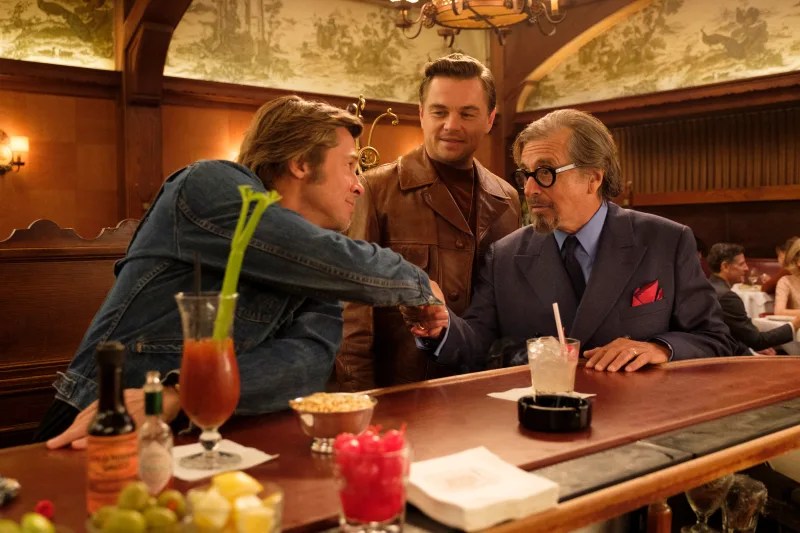
DiCaprio plays Rick Dalton, onetime star of TV’s “Bounty Killer,” now reduced to drinking and taking an endless succession of episodic work on other people’s TV shows. A meeting with a producer/talent scout for Italian “Spaghetti Westerns” (Al Pacino) just confirms to Rick, stammering more and losing confidence by the day, that “I’m a has-been, ol’buddy…Washed up.”

“Ol’buddy” here is Cliff Booth (Pitt), a grizzled stunt double who acts as driver, handyman and boon companion to Rick, who has too many DUIs to drive his own Caddy to the set. Cliff is Old Hollywood at its rough and ready best — nimble, skilled, confident, a man with a dark past and a reputation he can’t shake. Ask his old stunt coordinator boss (Kurt Russell) and the boss’s wife (stunt woman and “Deathproof” star Zoe Bell) about that.

Cliff waits on Rick to score him work, bucking up his struggles with self-confidence, his good moments and stumbles on the set of the pilot to a new Western, “Lancer.” Timothy Olyphant and the late Luke Perry play the show’s stars, Hammond’s Wannamaker is the actor-turned-director (and great Shakepearean) who wants to bring out Rick’s very best. He’s not a TV cowboy, Wannamaker assures him. “You’re better than that.

Flitting around the periphery of this post Summer of Love LA movie scene are the stoner/stone-killer butterflies of Charles Manson’s cult — underclad, undergroomed and uninhibited young women — mostly — hitchhiking, hooking, with one waif in particular (Margaret Qualley) getting Cliff’s attention.

Tate and her husband, director Roman Polanski, have moved in next door to Rick in the tony Hollywood Hills, and tool around town in Polanski’s 1950s MG-TF. Cliff drives the wheels off a battered VW Karmann Ghia on his way to and from his ruined travel trailer behind the Van Nuys Drive-In, an oil well in his “yard,” an adorable pit-bull his only company.

We’re shown the Spahn Movie Ranch, a favorite location for Westerns, where the Manson Family (Dakota Fanning plays Squeaky Fromme, Bruce Dern is old man Spahn) have set up shop. The film’s few moments of suspense come from the authentic dread of remembering even snippets of this piece of history. There were bodies buried there that no one ever found.

Flashbacks give us Cliff’s troubled “history,” a black and white on-set interview with Rick and Cliff doing “Bounty Killer” “eight years” earlier opens the film. And every so often, an ill-conceived voice-over narration (Kurt Russell, again) pipes up to set the scene, or jump us forward in time to the third act.

The first act is filled with long driving sequences that don’t advance the plot, lingering shots of the items in the kitchen pantry, the comfort foods and products and images of Young Quentin Tarantino — who needs a more ruthless editor.

Fake Sharon Tate sits in a cinema to watch her performance in the godawful Dean Martin Bond spoof, “The Wrecking Crew.” And even though we’ve seen DiCaprio injected into a scene from “The Great Escape” in place of Steve McQueen (impersonated by Damien Lewis in an early Playboy Mansion party scene), Robbie’s Tate watches the REAL Sharon Tate in these clips, showing little of the promise Tarantino seems to suggest she had.

For all the detail, this is no more historical than a Marvel movie.

What we can relish here is a relaxed, offhand star turn by DiCaprio, freed from the burden of never winning an Oscar and letting us see a 40something, sweaty “has-been” who goes to pieces when he blows his lines, or is complimented in a whisper by a screen-veteran child star (Julia Butters), wise beyond her eight years.

“That was the best acting I have ever seen!”

Pitt doesn’t need a shirtless moment to summon up a career of easygoing cool leading men, but as he strips it off for a flashback, we can only hope Cliff’s swagger will be enough to get him through the fairytale alive.

once2.jpeg

As pleasant as their every scene — together or apart — is, the movie is formless, even for a Tarantino picture. The narrative advances like a Netflix series in mid-binge — lurching, stumbling, dragging on and on.

The trailer for “Once Upon a Time…” is far more coherent.

Tarantino may call “Easy Rider,” “The Wrecking Crew” and “Arizona Raiders” his movie inspirations for “Once Upon a Time…” I’d say he was much more into the mass production Westerns and detective shows of the day, the leaden and ironically stilted “F.B.I.”

Tarantino has been unusually thin-skinned about this (mostly over-praised) “ninth film by Quentin Tarantino.” He’s making noises about this, or maybe the next picture, being his last.

Beware actors or filmmakers who threaten “This could be my last movie” before their next one comes out. They’re just inoculating themselves against serious criticism.

“Once Upon a Time…in Hollywood” isn’t his masterpiece any more than it’s his curtain call.

2stars1

(Ten Things I Hated about “Once Upon a Time…in Hollywood”)

MPAA Rating: R for language throughout, some strong graphic violence, drug use, and sexual references

Cast: Leonardo DiCaprio, Brad Pitt, Margot Robbie, Al Pacino, Dakota Fanning, Luke Perry, Timothy Olyphant and Kurt Russell

Credits: Written and directed by Quentin Tarantino. A Sony release.

Running time: 2:41

Posted in Reviews, previews, profiles and movie news | 6 Comments

Documentary Review: For Women in Hollywood, “This Changes Everything”

changes3

Damned data.

You can sit back — if you’re say, Hollywood — and claim that gender discrimination on the screen, behind the screen, writing the stories that fill the screen and signing off on the checks that feed the entertainment beast, “went away” with the culture-shifting movements and legislation of the past 50 years.

And then the hard, naked numbers stare you in the face and show you that’s just not true.

In 2018, 85% of the top 100 movies were scripted by men, 92% of the directors of the top 250 films were male.

Go on down the filmdom food chain — four of five narrators of TV and film are male, one in four lead characters in your typical movie are female.

Put down the data and watch those movies and TV shows. The vast majority of female characters are peripheral. On film and on TV, “the women are in orbit around the men.”

There has been progress. A few years of pro-active hiring practices raised the number of female members of the Directors Guild of America from one or two percent, to 15 percent. A burst, here and there, of “Let’s get more female screenwriting voices on the screen,” more women directors, etc., may last a year or three.

A movie like “Thelma & Louise” comes along, or a “Wonder Woman,” TV shows like “Grey’s Anatomy” and “Scandal” blow up, and the media covering Hollywood use the magic phrase.

“This Changes Everything.” Only it almost never does.

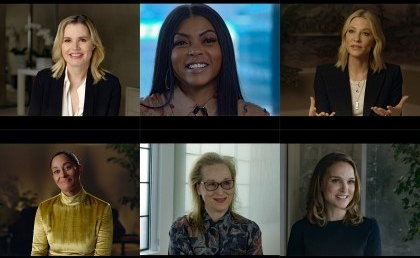
Here’s a documentary that lays the whole problem out, from identifying the injustice to suggesting “action” steps that could rectify it. “This Changes Everything” features a sea of female faces and voices, Oscar winners in front of the camera, shakers and movers behind it, and many, many women who say their careers were curtailed because of the sexism that relegated them to second class citizens in a business that, in turn, passes that status on in the on-screen role models it serves up for America and the world to emulate.

Geena Davis, a president on TV, an Oscar winner and a driving force in gathering much of the data we have on the vast scope of this problem, opens Tom Donahue’s movie by remembering her first big screen break. She was up for a part where “She had to look good in her underwear” and Davis had been in Victoria’s Secret catalog.

That landed her in “Tootsie.” “”The very first thing I shot was in my underwear, with Dustin (Hoffman).”

Taraji P. Henson notes how she kept her mouth shut at the sort of subservient “in the hood” roles she was offered at the beginning of her career, how she’s never met a female cinematographer on the set.

Meryl Streep breaks down and critiques her somewhat self-scripted turn in “Kramer vs. Kramer,” trying to make more of a believable character out of someone who didn’t have the same gender as the writer, director or anybody else with authority on the set.

Actress turned #MeToo activist Rose McGowan notes how she can’t watch much of the work she was offered, and wouldn’t advise little girls to, either. She figured out, “This movie is not MADE for you…You see yourself through the eyes of the male camera operator…When I think I’m acting, it’s really the camera just panning across my ass.”

Natalie Portman acknowledges being turned into an object onscreen while footage of her first film, “The Professional,” plays over her complaint.

Reese and Marisa, Tiffany and Cate, Sandra Oh and many, many others echo the sentiment, “We have been ‘otherized’ by men.”

And on and on “This Changes Everything Goes,” a mountain of evidence presented that Hollywood has both had a huge hand in objectifying and marginalizing women in America, and that it practices that marginalization off-camera as well.

Most people will be shocked to discover that it wasn’t always this way. Women writers, directors and stars were consigned largely to the background, beginning with the very expensive advent of sound, when Eastern and Western bankers — all male — provided the money to convert the studios and got both a piece of the action and a big role in providing the direction the movie business went in.

The Depression Era rise of guilds and unions closed more doors, as those who were still working balked at letting women dilute their hiring pool.

But all that data and that history — a 1980s lawsuit to force change is remembered — takes a back seat to the tidal wave of women on and off camera who hammer home the point that as Davis puts it, “If she can see it, she an be it.”

Putting women in meatier roles provides role models for young women to look up to. Why are half the forensic pathologists in America female? Marg Helgenberger played the hell out of one in a big role on TV’s original “C.S.I.”

Davis recalls her archery instructor telling her about how business for teachers like him, and bow and arrow sellers, blew up when the Disney cartoon “Brave” and “The Hunger Games” movies burst on the scene.

You probably don’t need this film to remind you that women have been so thoroughly marginalized or sexualized, even in children’s TV and animated films, that little girls have become “self-sexualized” as early as six by being exposed to this, since birth.

“This Changes Everything” asserts that sexual harassment culture is built on this, and not just in Hollywood — McGowan declares that “there is no human resources department” when it comes to “protecting yourself on the set.”

The gargantuan disparity between male characters’ screen time and lines can be measured, now, film by film, TV show by TV show. There’s an algorithm that can apply the Bechdel-Wallace Test to any film or TV series, proving without a doubt, how included or excluded female characters are in a given project.

Donahue’s film goes down the rabbit hole on a few subjects, which cause the film to drift a bit, almost to the point of mission creep. It tends to lean most heavily on the directing ranks, even though actresses are the vast bulk of its eyewitnesses.

But then we’re forced to consider the careers circumscribed by talented filmmakers simply not being able to get work because the default mode of every network, studio and production house was to not give a Julie Dash or Kimberly Peirce a thought.

I watched Patty Jenkins direct the Oscar-winning “Monster” here in Orlando, got the sense that the producers were doing their utmost to limit her power, and wondered, for years, if she’d ever get another shot at big screen glory. Then “Wonder Woman” came along.

Examples of this have been out there in the open, all along. Maybe this moment and this movie about it will make being ignored or passed over for reasons that have nothing to do with experience and craft rare.

Maybe “This Changes Everything.” One can only hope.

3stars2

MPAA Rating: unrated

Cast: Taraji P. Henson, Marisa Tomei, Meryl Streep, Sandra Oh, Tiffany Haddish, Natalie Portman, Cate Blanchett, Rosario Dawson, Mira Nair, Reese Witherspoon, Rashida Jones, Catherine Hardwicke, Heather Graham

Credits: Directed by Tom Donahue  A Good Deeds release.

Running time: 1:35

Posted in Reviews, previews, profiles and movie news | Comments Off on Documentary Review: For Women in Hollywood, “This Changes Everything”

Preview, one last “Angel has Fallen” trailer

Here we go. Again?

Butler and Jada, Morgan and Piper and Nolte.

You think Danny Huston’s the villain? Maybe?

Posted in Reviews, previews, profiles and movie news | Comments Off on Preview, one last “Angel has Fallen” trailer

Preview, “Zombieland: Double Tap”

Was this sequel really necessary?

They’ve all moved on, Emma’s won an Oscar, and so on and so forth.

Doesn’t seem as gritty and “out there” the second time around.

But hey, who knows? A few new cast members — Rosario, Luke Wilson, etc.

Oct 18, we see what we see.

Posted in Reviews, previews, profiles and movie news | Comments Off on Preview, “Zombieland: Double Tap”

Netflixable? “Fatal Fashion”

A soap star of some standing lets her psycho flag fly as a murderously obsessive fashion photographer in “Fatal Fashion,” which was orphaned and homeless as “Deadly Runway” before Netflix took it in.

It’s a chance for Linsey Godfrey (“The Young and the Restless,” “The Bold and the Beautiful,” “Days of Our Lives”) to lose the “neck-up acting” and um, subtlety of daytime drama for a little over-the-top nut-with-a-knife/pistol-packing mama/shove-a-model-over-a-railing mayhem.

Gosh, if only it was that much fun.

Godfrey plays Jennifer Higgens, introduced in a wordless opening as a top New York fashion photographer whose lip-biting and salivating over her latest toy-boy “creation” ends wither her waving a knife at him and his paramour — in the middle of a photo shoot.

How DO you bounce back from that? Well, the California Public School System just might have a job for you! Jennifer winds up running the new “Fashion and Photography” class at Palm Vista High.

And in a flash, she’s “creating” her next obsession. David Doolittle (TV actor Joshua Hoffman) is the bespectacled nerd the bullies pick on. Until he signs up for Jennifer’s class, where she teaches runway walking and photography, with the kids thrift-shopping and reworking clothes for their runway moments.

Except for Caitlyn (Ellen Michelle Monohan). She’s happy doing the clothes, which mean girl clothes-horse Brittany (Heather Hopkins) will throw tantrums over.

David just wants to be a photographer, but Jennifer picks’em for their low self-esteem.

We see variations on this routine — a makeover montage, Jennifer cooing “The camera LOVES you.” And then, something happens.

Maybe it’s the prettiest mean girl in school taking an interest in you. Maybe it’s a modeling manager (Maria Pallas) interested in poaching talent.

“I am NOT obsessed with him!”

That’s a sure sign somebody’s about to get cut. Or shot. Or pushed. Or…

Director Doug Campbell (“The Surrogate,” “Stalked by My Doctor”) tries to tease out Jennifer’s game, running through the basic cable level titillation — she undresses and “lights” her subjects — like an old pro.

Yawn.

Even as we see Jennifer exert some positive influence on wallflowers’ lives, we don’t have to ponder “What are teacher’s motives?” because we didn’t forget the nut-with-a-knife prologue. That prologue also strips away the mystery and seriously dings any chance “Fatal Fashion” has at suspense.

There’s always a little pleasure in seeing a killer plan or improvise her way into covering her tracks, but we only get a tiny dose of that.

When, we wonder, will some parent, model-kid, school administrator or COP get curious enough to do a little Internet search on Teacher Jennifer?

The players aren’t the most charismatic lot, but look at who they’re playing.

Only Godfrey has any fun at all, and even that’s fairly drab, even by TV movie standards.

“I know I can be a little dramatic sometime.”

“‘A little?'”

1star6

MPAA Rating: TV-14

Cast:Linsey Godfrey, Joshua Hoffman, T.J. Hoban, Heather Hopkins, Ellen Michelle Monohan

Credits: Directed by Doug Campell, script by David Chester. A Netflix release.

Running time: 1:28

Posted in Reviews, previews, profiles and movie news | Comments Off on Netflixable? “Fatal Fashion”

Movie Review: Lying family ensures that granny doesn’t know that this is “The Farewell”

fare1.jpeg

Sweet and ever-so-slight, “The Farewell” is a Chinese culture-clash comedy built on melancholy, driven by sentiment.

A family matriarch has lung cancer. But the doctors haven’t told her, just alerted the family. And the family, in China and in America, join ranks to keep the news from her.

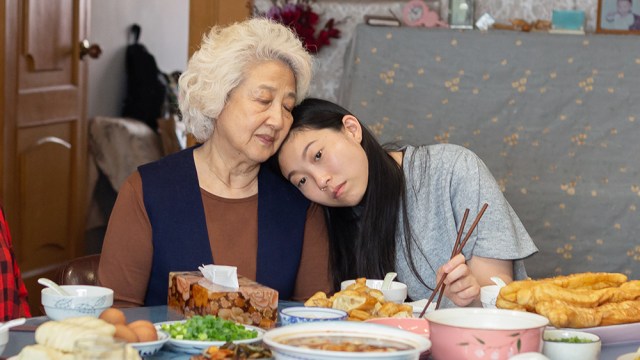
Aspiring (and failing) New York writer, Billi (Awkwafina, aka Nora Lum) doesn’t see “Nai Nai” (Shuzhen Zhao) very often. But they’re constantly on the phone, and she’s appalled at what “the family has agreed” to do — lie.

“Chinese people have saying,” her brusque, flinty mother (Diana Lin) explains. “When people get cancer, they die.”

That’s the tone of the picture in a phrase. It’s about death. It’s about the lie. And keeping the first out of your mind while adhering to the second is where the comedy will come from.

A marriage has been hastily “arranged” for a cousin, as an excuse for everyone to gather around their widowed mother/grandmother and say “Goodbye” without letting her know they’re saying their farewells.

And nobody wants Billi to come. Dad (veteran character actor Tzi Ma) is “drinking again.” Mom seems bitterly resigned. But everybody in family diaspora is SURE Billi will be the one who cracks. She’s emotional, tight with Nai Nai and seriously assimilated.

“In America, you couldn’t do this,” she says, in English, and later in Chinese. “It’s ILLEGAL.”

Needless to say, Billi goes to the “wedding” anyway, the family holds its breath and her uncle takes her aside when they decree she cannot stay in Nai Nai’s flat, and lectures her.

“Be careful,” he says (in Chinese, with English subtitles). No matter what, “You cannot tell her,” he adds. And on and on.

Billi’s endlessly repeated reply (in Chinese, with English subtitles), is “I knowwwww.”

Writer-director Lulu Wang (“Posthumous) lets us know in an opening credit, that this is “based on an actual lie.” The shape of that lie, bending and folding, and on occasion causing the person telling the latest version of the lie to wilt with regret, is the substance of “The Farewell.”

But its values come elsewhere.

There’s Nai Nai herself, an amusing scold, calling her adored Billi “Stupid girl” at every turn, backhanding her weight, matchmaking for her because she seems to need it, insisting on arranging this faux “wedding,” insulting the Japanese bride (Aoi Mizuhara) that young Haohao (Han Chen) is to marry, totally missing the expression in both bride and groom’s eyes.

Think “deer in headlights.”

I adopted the bride, Aiko, as my guide into the movie. Speaking no Chinese, hustled into something that may not be formalized when they get back in Japan, where Haohao’s parents settled, she is the Queen of Good Sports and her reactions to the bickering, the drinking, the weeping and the lying is priceless.

Lin’s embittered mother figure is the soul of the picture; not that sentimental about Nai Nai’s passing, increasingly disappointed in her daughter (Billi has a big lie she’s living, too), resigned to going through all this rigamarole because that’s what “the family” wants.

Awkwakina has a tricky part to play, a woman suffering a sort of post traumatic separation anxiety. She is far more at home giving us sarcasm, sass and laughs than at getting across the subtler shades of grief and regret. The arc her character traverses is more interesting than her performance of it.

fare2.jpeg

“The Farewell” is winning justly-earned praise for its moments (just a couple) discussing the immigrant experience (“You’re still Chinese.”) and one touching anecdote that explains America to those who have never been there.

The film’s real value, I think, is its vivid, fully rounded, warts-and-all portrait of Chinese family life — in America among the expats, and back home. There’s also an East-West comparison that gets at the difference between “family” here and there that is eye-opening.

This family has many fault lines. The city (Changchun) is ugly, dingy and grey. “New” hotels aren’t any better than timeworn ones. People drink too much and smoke too much. Service sector folks are often bored, disinterested and unbending. Too many relatives and strangers want you to compare China and America, even though nobody wants to get into which “war” Nai Nai is supposedly a veteran of (there’s a reunion of comrades scene).

And like the 1993 film this one most resembles, Ang Lee’s “The Wedding Banquet,” we see a lot of food — some cooking, and much eating.

There’s a lot of hype surrounding this movie, some of it warranted due to its relative novelty, and some of the “OK, take a deep breath” variety.

What Wang gives us is an engagingly sentimental story with warmth, compassion and wit, peopled by relatives who, for all their cultural differences, are universal and yet enviable in their devotion to “the good lie” and the quality of life they see as worth protecting with it.

3stars2

MPAA Rating: PG for thematic material, brief language and some smoking.

Cast: Awkwafina, Diana Lin, Shuzhen Zhao, Tzi Ma, Han Chen and Aoi Mizuhara

Credits: Written and directed by Lulu Wang.  An A24 release.

Running time: 1:40

Posted in Reviews, previews, profiles and movie news | Comments Off on Movie Review: Lying family ensures that granny doesn’t know that this is “The Farewell”