Period piece? Accents? British football? Collectible British cars in the background?
Come on. You had me at “Bromley.”
Period piece? Accents? British football? Collectible British cars in the background?
Come on. You had me at “Bromley.”
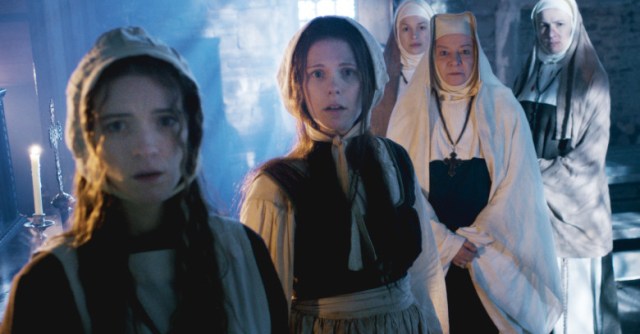
Donovan’s classic is remade for this horror movie, produced by Guillermo del Toro and not previewed for critics.
It opens Friday.
https://variety.com/2019/music/news/lana-del-rey-season-of-the-witch-guillermo-del-toro-1203292435/

Whatever virtues it displayed on the printed page, “The Art of Racing in the Rain” makes a movie of modest, melodramatic pleasures, mainly homey aphorisms about motor racing and the hidden life of dogs.
As these are growled out by our narrator — Oscar winner Kevin Costner is the voice of Enzo the Golden Retriever belonging to race car driver Denny (Milo Ventimiglia) — they have the raspy gravitas of Great Truths about the human condition, racing and a dog’s lot.
“I could smell the day on him,” Enzo narrates when Denny gets home. “Motor oil and gas…and roast chicken.”
It’s a movie you either go with or injure yourself, rolling your eyes over. As I love dogs, cars and am a lifelong Costner fan, tally me in the former category. But the thin charms of this script and a charisma-starved leading man turn make that vote a close call.
Enzo, as he tells it, “was meant to be his dog.” His reasoning has to do with Mongolian beliefs about dogs eventually reincarnating into the sort of human they are destined to be.
Enzo? He was named for the founder of Ferrari, was meant to drive fast, win trophies and shake bottles of champagne in the winner’s circle. As he’s seen a documentary on TV about this Mongolian dog-to-human reincarnation, he makes it his life to watch Denny’s races, review the cockpit camera and TV coverage of his performances, and learn.
“I will remember.”
Enzo passes on insights about how “the car goes where the eye goes,” about a what makes a great racing driver, how when it rains on the road courses where Denny drives IMSA sports cars (Porsches, BMWs, etc), working his way toward Formula 1, it’s the driver who takes chances, who skids through the turns by choice and not by accident brought on by the conditions, that wins.
Truthfully, though, it’s not about the racing. “Art of Racing” is about a dog’s life, and a few human ones. That part of the tale begins when Eve (Amanda Seyfried) bumps into them, and Enzo figures out what’s happening almost before Denny does.
“Denny was clearly taken with her grooming.”
Eve doesn’t win him over quickly, but Seyfried sells the film’s most romantic line with all the warmth you’d expect.
“You don’t mind if I love him, too?” is just a whispered aside to Enzo, but it’s perfect and perfectly touching.
As they court and marry, Enzo makes his peace with the pairing and all that comes with that, using it to learn more about human behavior.
“I never really grasped the concept of money and why humans have such a need for it.”
A smattering of observations like that are mixed with a few on-point survival facts about dogs that Enzo passes on when he’s left behind in a locked house for days, and how dogs age, along with the usual anthropomorphized nonsense about what a dog “is really thinking.”
Screenwriter Mark Bomback, who has a resume peppered with action film credits — “The Wolverine,” Unstoppable,” “Total Recall” — was an odd choice to adapt Garth Stein’s best seller. He doesn’t quite “get” it. A lot of “cute” is blundered, even though Costner’s reliably droll way with a line makes “deadpan” work.

The arc of career intersects with the arcs of human lives and dog’s lives (Kathy Baker and Martin Donovan play Eve’s parents) here, and that’s really the meat of “Racing in the Rain.” That plays as pure melodrama on the screen.
And Ventimiglia, of TV’s “This Is Us,” doesn’t deliver the pathos we’d expect from the sadness, tragedy and trials Denny motors through. As he’s not asked to do comedy, romantic or dog-owning, either, Denny becomes a blank page on his resume.
Can’t say he’s a subtle actor or a bad one, as there’s virtually no data here to make the call.
That leaves it all up to the dog and the dog’s story, and the pathos of that makes this weeper on wheels a winner. Barely.

MPAA Rating: PG for thematic material
Cast: Milo Ventimiglia, Amanda Seyfried, Kathy Baker, Martin Donovan, Gary Cole and the voice of Kevin Costner
Credits: Directed by Simon Curtis, script by Mark Bomback based on the Garth Stein novel. A 20th Century Fox release.
Running time: 1:49

The opening to “Dora and the Lost City of Gold” will give anybody who parented in the early 2000s flashbacks, and any kid who grew up then the warm fuzzies.
We’re treated to that catchy theme song, a real-not-animated little girl (Madelyn Miranda) and her six year-old cousin (Malachi Barton) just bubbling with that relentless optimism, turning to the camera and teaching.
“Can you say…African Pygmy Elephant?”
Yes we can, Dora the Explorer!
It is, as it ever was — What’s the word I’m hunting for? ADORAble.
But that was Dora “then.” “Lost City of Gold” is set ten years later. She’s still got that singing backpack, and a map that sings “I’m the MAP,” and Boots her monkey pal. She’s still living in the jungle with her parents (Eva Longoria and Michael Peña, reminding us he’s one funny hombre). But they’ve let Dora grow up. It’s just that the business with her turning to an invisible camera is still going on — at 16.
“Can you say…neurotoxicity?”
Dad’s “She’ll grow out of it” never happened.
Isabela Moner of “The Last Knight” transformers sequel and TV’s “100 Things to Do Before High School” is a cheek-pinching delight as this adolescent Dora, packaged in a candy-colored comic fantasy that’s like a half-animated version of “Tomb Raider.”
“Half animated” because Boots is still not a “real” monkey, and that darned thieving fox Swiper, Dora’s nemesis, just won’t stop swiping.
Boots virtually never talks, and Swiper virtually never stops trash-talking. You might recognize the voices that take on those roles.
For “Lost City of Gold,” Dora is packed off for a little culture clash, moving to Los Angeles where Diego (Jeff Wahlberg) has been living for years. Naive, still-childish/still-trusting Dora is about to be eaten alive at the high school they’ll now attend together.
Her parents think they’ve found a map to this lost Inca city in the Andes, and want track it down without their “supercool exploradora.”
Dora has just enough time to make a fool of herself on the dance floor, make a smarty-pants nuisance of herself in class (“Dorka,” they call her, the meanies!) and some friendemies at school (Madeleine Madden, Nicholas Coombe) when she, they and Diego are nabbed and sent to Peru by a bunch of toughs (Temuera Morrison plays the leader) who also want to find that lost city.
That’s where they run into a friend of the family, their jungle-phobic “guide” Alejandro, vamped up by Eugenio Derbez of “Overboard” and “How to Be a Latin Lover.”
The quartet-turned-quintet need to avoid the bad guys, including Swiper, and get to Dora’s parents before they do.

Anybody over the age of 10 will have an idea of what challenges they face — quicksand, blow darts from angry natives, a curse and an Indiana Jones booby-trapped temple, for starters.
But that age of 10 proviso is key, here. This is a childish adventure film, deliberately so.
What the screenwriters went for is that “Brady Bunch Movie” approach — a little nostalgia, a bit of fish-out-of-water/character-out-of-her-time comic displacement.
Dora looks at her world with childish wonder, and darned if she doesn’t sing about it.
“Maybe a song will help!”
Nobody does that at 16, not if they don’t want to be called “Dorka.”
“I have to be myself,” she insists. And Diego, sweet as he is on Mean Smart Girl Sammy (Madden), embarrassed as he is, has to respect that.
I was iffy on the whole “Let Dora grow up a little” idea, and darned if some cringe-worthy critic hasn’t wondered why we aren’t treated to a more hormonal Dora.
But that’s not a concern here. I was far more bugged by the admittedly comical presence of Boots and Swiper. Keep her six, and they’re “imaginary friends.” They could even be imaginary at 16. Not if everybody else sees them, though.
So what? It’s still as charming as a ham-fisted Hollywood treatment of a kids’ cartoon can be. I don’t see why any ten year-old wouldn’t adore Dora.

MPAA Rating: PG for action and some impolite humor
Cast: Isabel Moner, Jeff Wahlberg, Eva Longoria, Madeleine Madden, Temuera Morrison, Q’orianka Kilcher, Eugenio Derbez and Michael Peña.
Credits: Directed by James Dobbin, script by Matthew Robinson and Nicholas Stoller, based on the Nickeloden TV series. A Paramount release.
Running time: 1:42
|
|

It’s like panning for gold, this business of rummaging through a summer’s indie releases, looking for a nugget in a cinema season that produces blockbusters, and little else.
But here’s one. “Every Time I Die” is the best no-budget thriller of the summer, moody, cerebral drama about a guy who carries his guilt about a childhood loss through multiple soon-to-be-murdered bodies in search of redemption.
Tensely-plotted, sharply and sympathetically-acted, nerve-wracking and touching, this supernatural tale arrives a startling delight in a summer packed with pyrite at the bottom of the gold miner’s pan.
We meet Sam (Drew Fonteiro), dazed and in bed with Mia. He is smitten, but staring into the bathroom mirror before his shower, he is further confused.
Sam is a paramedic who spends his days with the world-weary Jay (Marc Menchaca), a beery, seemingly happy go-lucky guy with the dark cloud of a suicide attempt and the medication meant to stave off another on his person.
Jay senses something forlorn and broken in Sam, but Sam won’t hear it.
“I never actually wanted to die…”
“There’s more ways to kill yourself than actually committing suicide,” Jay counters.
“I’m not like you…a different kind of crazy.”
“Semantics!”
Jay is married to Poppy (Michelle Macedo), and with Mia (Melissa Macedo, yes they’re sisters) they’ve planned a weekend at a lake house. They insist Sam come along.
Well, not Mia. Her soldier/husband Tyler (Tyler Dash White, fierce) is back from duty overseas. She’s been cheating on him with Sam, and if Tyler figures this out, there could be trouble. Mia wants Sam to not show up. But he does.
Hazy, time-bending flashbacks let us drift with Sam back to the events that haunted his youth — a beloved little sister he promised to “always protect,” a failure to keep that promise, the shattered family, the probing questions of what we assume is a child psychologist.
Sam still carries around a Three Little Pigs tin box with childhood mementos and photos. To say he’s “haunted” undersells what he’s going through.
That weekend get-away is going to bring everything to a head, his past and Mia’s present, and that’s when the dying in “Every Time I Die” raises the stakes and lifts a pretty smart movie into the realm of a thriller that plays.
It’s not a chatty movie. Director and co-writer Robi Michael is more interested in gauzy camera effects, snatches of overheard conversation forcing us to fill in between the blanks, keeping it cryptic.
The “mystery” here has a surreal feel as the film maintains, after a fashion, its opening gimmick — seeing all this through Sam’s eyes.
Fontiero (TV’s “The Last Ship”) plays Sam as introverted, introspective, not sure what he can reveal about himself, not sure which “reality” he trusts.
When you’re a guy who counts his fingers to see if the moment he’s in, or thinks he’s in, is just a dream, your disconnect is strong.
The Macedo sisters (from “Girlboss”) have less to play, but sell the film’s big conceit — that Sam isn’t himself, especially when he turns up in another body.
Menchaca has a soulful vibe he taps into here and that softens Jay into somebody we can believe would be barely hanging on, but still desperate to help his paramedic partner. And Tyler Dash White may be playing a stereotype — the combat vet with the hair-trigger psyche — but he plays the hell out of it.
It’s simple. It’s artful without overreaching, gloomy and brooding by default, suspenseful only when it needs to be.
Maybe you won’t get to see it in a theater, but remember the title — “Every Time I Die.” You’ll want to find this gold nugget on some weekend when Netflix is serving up more pyrite.

MPAA Rating: unrated, violence
Cast: Drew Fonteiro, Michelle Macedo, Melissa Macedo, Marc Menchaca, Tyler Dash White
Credits: Directed by Robi Michael, script by Gal Katzir, Robi Michael. A Gravitas Ventures release.
Running time: 1:37
An August period piece crime gang wars thriller?
That’s good counter programming, I say.
Good trip of leading ladies && Melissa McCarthy, Tiffany Haddish and Elisabeth Moss.
A woman directed it, so Domhnall Gleeson is the potential underworld love interest. Sensitive gingers are the best!
“The Kitchen” opens Friday.
This has 4chan/incel insensate corner of horror fandom written all over it.
Torture porn? Monstrous male Hunter/killers going after women, one at a time, until the womenwork together?
That’s the sales pitch for “The Furies,” at least in this trailer.

Contrary to the T-shirt slogan, sometimes finding “your tribe” is just a baby step.
The hard work of figuring out how you fit into it, how much of its practices and dogma you embrace, has just begun.
“This is Not Berlin” is an immersive Mexican drama about being young, creative and not knowing where you belong. Hari Sama’s fourth film is about sexual awakening, drugs, the underground club scene and homosexuality in 1986 World Cup-mad Mexico City.
Unpredictably plotted — no, it’s not your standard issue “coming of age/coming out” gay romance — and subtly acted, it’s an engaging excursion in the “fluid” or “on the spectrum” sexuality as we understand it today, as experienced by a teen 33 years ago.
Carlos (Xabiani Ponce de León) is an electronics and engineering whiz, bored by his private school and not quite settled in, even with his pals.
We meet him in the middle of a slow motion schoolboys’ brawl he is removed from, above it all and refusing to take a swing. His reaction to these high school vs. high school riots is to faint.
His friends, quick as they are to pepper their conversation with gay bashing, don’t make a lot of it. But they could, if they gave it a thought.
Carlos is tall, thin, with girlishly long curly hair and delicate features. His fainting, he insists (in Spanish, with English subtitles), is because “my highly intelligent brain” tells him “these beatings no sense.”
Musical cues about what’s going on in that car he, his best friend Gera (José Antonio Toledano) and several others pile into include Judas Priest’s “Breaking the Law” blasting out of the car stereo and Carlos insisting to Gera, later, that this Ten Years After tune, “I’d Love to Change the World,” is “one of the most kick-ass songs ever!”
Rob Halford, lead singer of Judas Priest, came out some years after the movie is set, and “I’d Love to Change the World” has lyrics about “dykes and fairies.” Subtle.
Carlos tinkers inventing battery powered gadgets — robot dolls and the like — and can fix anything electronic. And he insists the only thing that keeps him from professing his love for Gera’s punk poetess older sister (Ximena Romo, in Chrissie Hynde bangs) is the fact that she’s “my best friend’s sister.”
But when her band (Manifesto) needs its keyboard fixed, that is Carlos and Gera’s entré to the clubs where Rita and her crew party and perform. That rocks our curious hero’s world — gay men dancing and making out, artists debating the boundaries of art and politics, creative folks creating all around him.
And lots of drugs and nudity, to boot.
Nico (Mauro Sanchez Navarro), their ring leader, takes an interest in Carlos even as Gera is worried about the stigma of “gay nightclub” following them back to school.
As his widowed mother (Marina de Tavira) has crawled into a bottle (booze and prescription pills), Carlos is free to explore this world, with or without Gera or Rita’s help.
“This is Not Berlin” — the title comes from an art dealer’s furious dismissal of art/performance mashup “style” of Nico & Co. — is about that journey.

While this Hari Sama (“The Dream of Lu,” “Awakening Dust”) film is no “Y Tu Mamá También,” it features understated performances that capture the figuring-it-out-as-we-go nature of “confused” youth, and an absolutely fascinating milieu.
Carlos may crank out toys and stage effects for Manifesto as his ticket in, but soon he’s swept up in orgiastic body painting “happenings” shot on grainy video for other, bigger works to come.
Rita and Nico and Maud (Klaudia Garcia), who supervises the makeover/transformation that we and his classmates see in Carlos’s hair, makeup, etc., are political because they absolutely have to be.
“They’re KILLING us!” is a frequent refrain of their protest pieces. A couple of those are dazzling stunts that would stop traffic and make headlines, even today.
Sama plays Carlos’s “cool” uncle, guiding his engineering enterprise, riding a motorbike and giving the kid his first joint. As a co-writer/director, Sama gives Carlos’s coming of age not so much a burning-the-candle-as-both-ends urgency as a thirsty curiosity. Carlos is lapping up everything around him like a kid finding a new candy store.
The film’s third act surprises are fascinating post Golden Age of Queer Cinema choices.
No, this may NOT be “Berlin,” legendary for its sexual, artistic and cinematic “freedom” at various times in its history. But “This is Not Berlin” bracingly suggests that the same searching and exploring was going on in places far afield from the city that inspired Christopher Isherwood and later, “Cabaret.” The young people of 1980s Catholic Mexico City, like the post-Franco Spain of Pedro Almodóvar, had their own run of making up for lost time.

MPAA Rating: violence, drug abuse, alcohol abuse, nudity
Cast: Xabiani Ponce de León, José Antonion Toledano, Klaudia Garcia, Ximena Romo, Maura Sanchez Navarro
Credits: Directed by Hari Sama, script by Rodrigo Ordoñez, Max Zunino and Hari Sama. A Samuel Goldwyn release.
Running time: 1:52
Because it’s Mexico City, 1986, as if any gay men of that time and place would confuse the two capitals.

Your first thought is, “That could never happen today, the country’s too polarized,”and then a montage showing how violently divided America was back then makes you wonder.
Watching “Woodstock: Three Days that Defined a Generation” the weekend after another blast of American mass shootings is the ultimate disconnect. How DID they do that without cops, metal detectors, without some hippie-hating gun-nut goaded into shooting the place up?
You remember the music. But no other film has ever immersed itself in the logistical disaster turned into humanitarian miracle that this seminal event was.
And it’s taken 50 years, but perhaps the culture is ready to move beyond grinning at the event’s court jester Wavy Gravy (Hugh Romney), and look at him as the hero of Woodstock, its patron saint, the embodiment of what separated it and every other major outdoor concert of its era, especially Altamont.
This PBS film, airing Monday night, does not displace Michael Wadleigh’s 1970 Oscar-winning classic of the genre, it complements it — provides context, treats it as the ancient history it now is.
“Three Days” is much more about an era, of “The Generation Gap,” the Vietnam War, protests and assassinations. It dwells on the backstage life, the grand moments of humanity displayed by concertgoers, concert promoters, conservative townsfolk and New York’s hippie-hating Republican oligarch of a governor.
It’s an oral history, with plenty of archival footage (Wadleigh’s crew included young Martin Scorsese, and shot MILES of film) and period TV interviews underscored by the key team that made the show happen, a few who performed and legions of those who went, “pilgrims, on a pilgrimage” — some identified, others not — their voices painting an aural memory of a signal event in their young lives.
One thinks of Henry’s V’s “St. Crispin’s Day” speech from Shakespeare, of those of us who didn’t get to go holding “their manhoods cheap” whenever one of the chosen few who did speaks of Woodstock.
The word that sticks out, underlined and circled in my notes from watching the movie, is “LOGISTICS.” The footage assembled by PBS co-directors Barack Goodman and Jamila Ephron captures an unfolding disaster, where “everything that could possibly go wrong was happening,” from tiny, reactionary Wallkill, N.Y. pulling approval for the show at the last minute to the losing race to prep a site in bucolic Bethel, New York for the coming onslaught.
You may tear up, as I did, at a first glimpse of that “natural amphitheater” on Max Yasgur’s dairy farm. But a tidal wave of OSHA violations are here for us to marvel over, frantic crews building a stage, taking every safety shortcut imaginable as they do, giving up on building a fence so that the promoters could collect tickets and at least break even on the financial debacle they were presiding over.
The greatest traffic jam in history, rain turning an unhoused city of 400-450,000 into a mud bowl, running out of food, medical supplies — the drugs, the nudity — all footnotes in Wadleigh’s documentary that step front and center in “Three Days that Defined a Generation.”
The music has become a cultural cliche, so much so that mere samples of Richie Havens, Joan Baez, Crosby, Stills and Nash and Joe Cocker are enough to conjure up what we remember or have heard about the show over the past 50 years. They’re musical shorthand for “Woodstock.”
Snippets of footage capture the chaos created by the flood of people and everything that goes wrong and most-famous-promoter (one of four) Michael Lang’s sweet-spirited but out of his depth responses. A glimpse of the original super-promoter Bill Graham showing up, as a guest, and laying down the law about what was needed, on the spot, reminds us of what a near-disaster this all was.
“Helicopters!”
And then there’s Wavy Gravy and his merry, enterprising Hog Farm commune, the police force that regarded itself as a “please force,” as in “Please, would you do this,” please would you help with that. What Baby Boomers came to call “The Spirit of Woodstock” is embodied by this goofball’s canny grasp of the situation and what was necessary to keep things cool and mellow.
Drug trips by the tens of thousands were triaged at Hog Farm’s backstage encampment, holding hands with kids lost in an LSD haze. And when those stoners came down, “See that guy coming in the tent? That was you, three hours ago, man. Go help him the way we helped you.”
I was delighted by how funny this “Woodstock” is, the hilarious ailments listed on draft notice medical exams, the boys and girls “exposed” to more nudity than they’d ever seen in the pages of “Playboy.”
I was shocked at how emotional the film, covering familiar ground with a lot of familiar footage, could be. Revel in the thrilling singing of Baez, the stunning showmanship of Sly and the Family Stone, the lightning emanating from Jimi Hendrix’s Fender Stratocaster, a beatific Grace Slick, worn out and starting a Jefferson Airplane set at dawn, beaming like a consummate professional just doing a gig — in front of 400,000+ muddy, weary and sometimes strung-out American youth.
And the film sharply underscores why this strictly subcultural event — under 30, overwhelmingly white, drug-friendly and left-leaning — has cast such a broad shadow over American history. It didn’t “define a generation” by representing all of it, but by what it brought out in those touched by it, old and young, urban and rural, leftist or rightist, growing in legend as it fades into the haze of memory.

MPAA Rating: drug abuse, nudity
Cast: David Crosby, Richie Havens, Joan Baez, Joe Cocker, Michael Lang and Carol Green
Credits: Directed by Barak Goodman, Jamila Ephron. A PBS/”American Experience”
Running time: 1:46