Movie Review: Sexually confused in Mexico City? No, “This is Not Berlin,”

berlin1

Contrary to the T-shirt slogan, sometimes finding “your tribe” is just a baby step.

The hard work of figuring out how you fit into it, how much of its practices and dogma you embrace, has just begun.

“This is Not Berlin” is an immersive Mexican drama about being young, creative and not knowing where you belong. Hari Sama’s fourth film is about sexual awakening, drugs, the underground club scene and homosexuality in 1986 World Cup-mad Mexico City.

Unpredictably plotted — no, it’s not your standard issue “coming of age/coming out” gay romance — and subtly acted, it’s an engaging excursion in the “fluid” or “on the spectrum” sexuality as we understand it today, as experienced by a teen 33 years ago.

Carlos (Xabiani Ponce de León) is an electronics and engineering whiz, bored by his private school and not quite settled in, even with his pals.

We meet him in the middle of a slow motion schoolboys’ brawl he is removed from, above it all and refusing to take a swing. His reaction to these high school vs. high school riots is to faint.

His friends, quick as they are to pepper their conversation with gay bashing, don’t make a lot of it. But they could, if they gave it a thought.

Carlos is tall, thin, with girlishly long curly hair and delicate features. His fainting, he insists (in Spanish, with English subtitles), is because “my highly intelligent brain” tells him “these beatings no sense.”

Musical cues about what’s going on in that car he, his best friend Gera (José Antonio Toledano) and several others pile into include Judas Priest’s “Breaking the Law” blasting out of the car stereo and Carlos insisting to Gera, later, that this Ten Years After tune, “I’d Love to Change the World,” is “one of the most kick-ass songs ever!”

Rob Halford, lead singer of Judas Priest, came out some years after the movie is set, and “I’d Love to Change the World” has lyrics about “dykes and fairies.” Subtle.

Carlos tinkers inventing battery powered gadgets — robot dolls and the like — and can fix anything electronic. And he insists the only thing that keeps him from professing his love for Gera’s punk poetess older sister (Ximena Romo, in Chrissie Hynde bangs) is the fact that she’s “my best friend’s sister.”

But when her band (Manifesto) needs its keyboard fixed, that is Carlos and Gera’s entré to the clubs where Rita and her crew party and perform. That rocks our curious hero’s world — gay men dancing and making out, artists debating the boundaries of art and politics, creative folks creating all around him.

And lots of drugs and nudity, to boot.

Nico (Mauro Sanchez Navarro), their ring leader, takes an interest in Carlos even as Gera is worried about the stigma of “gay nightclub” following them back to school.

As his widowed mother (Marina de Tavira) has crawled into a bottle (booze and prescription pills), Carlos is free to explore this world, with or without Gera or Rita’s help.

“This is Not Berlin” — the title comes from an art dealer’s furious dismissal of art/performance mashup “style” of Nico & Co.  — is about that journey.
This is not Berlin - Still 2

While this Hari Sama  (“The Dream of Lu,” “Awakening Dust”) film is no “Y Tu Mamá También,” it features understated performances that capture the figuring-it-out-as-we-go nature of “confused” youth, and an absolutely fascinating milieu.

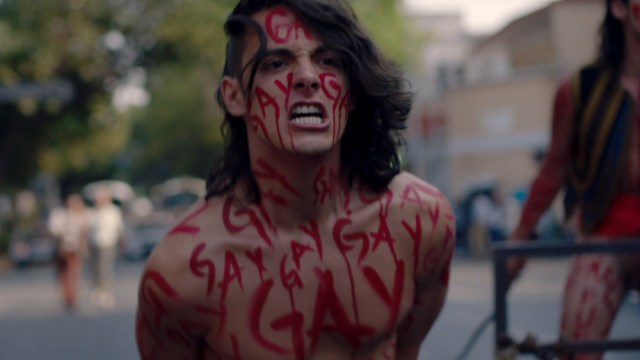
Carlos may crank out toys and stage effects for Manifesto as his ticket in, but soon he’s swept up in orgiastic body painting “happenings” shot on grainy video for other, bigger works to come.

Rita and Nico and Maud (Klaudia Garcia), who supervises the makeover/transformation that we and his classmates see in Carlos’s hair, makeup, etc., are political because they absolutely have to be.

“They’re KILLING us!” is a frequent refrain of their protest pieces. A couple of those are dazzling stunts that would stop traffic and make headlines, even today.

Sama plays Carlos’s “cool” uncle, guiding his engineering enterprise, riding a motorbike and giving the kid his first joint. As a co-writer/director, Sama gives Carlos’s coming of age not so much a burning-the-candle-as-both-ends urgency as a thirsty curiosity. Carlos is lapping up everything around him like a kid finding a new candy store.

The film’s third act surprises are fascinating post Golden Age of Queer Cinema choices.

No, this may NOT be “Berlin,” legendary for its sexual, artistic and cinematic “freedom” at various times in its history. But “This is Not Berlin” bracingly suggests that the same searching and exploring was going on in places far afield from the city that inspired Christopher Isherwood and later, “Cabaret.” The young people of 1980s Catholic Mexico City, like the post-Franco Spain of Pedro Almodóvar, had their own run of making up for lost time.

3stars2

MPAA Rating: violence, drug abuse, alcohol abuse, nudity

Cast: Xabiani Ponce de León, José Antonion Toledano, Klaudia Garcia, Ximena Romo, Maura Sanchez Navarro

Credits: Directed by Hari Sama, script by Rodrigo Ordoñez, Max Zunino and Hari Sama. A Samuel Goldwyn release.

Running time: 1:52

Posted in Reviews, previews, profiles and movie news | Comments Off on Movie Review: Sexually confused in Mexico City? No, “This is Not Berlin,”

Next screening? “This is Not Berlin”

Because it’s Mexico City, 1986, as if any gay men of that time and place would confuse the two capitals.

Posted in Reviews, previews, profiles and movie news | Comments Off on Next screening? “This is Not Berlin”

Documentary Review – “Woodstock: Three Days that Defined a Generation” on PBS’s “American Experience”

woodstock1

Your first thought is, “That could never happen today, the country’s too polarized,”and then a montage showing how violently divided America was back then makes you wonder.

Watching “Woodstock: Three Days that Defined a Generation” the weekend after another blast of American mass shootings is the ultimate disconnect. How DID they do that without cops, metal detectors, without some hippie-hating gun-nut goaded into shooting the place up?

You remember the music. But no other film has ever immersed itself in the logistical disaster turned into humanitarian miracle that this seminal event was.

And it’s taken 50 years, but perhaps the culture is ready to move beyond grinning at the event’s court jester Wavy Gravy (Hugh Romney), and look at him as the hero of Woodstock, its patron saint, the embodiment of what separated it and every other major outdoor concert of its era, especially Altamont.

This PBS film, airing Monday night, does not displace Michael Wadleigh’s 1970 Oscar-winning classic of the genre, it complements it — provides context, treats it as the ancient history it now is.

“Three Days” is much more about an era, of “The Generation Gap,” the Vietnam War, protests and assassinations. It dwells on the backstage life, the grand moments of humanity displayed by concertgoers, concert promoters, conservative townsfolk and New York’s hippie-hating Republican oligarch of a governor.

It’s an oral history, with plenty of archival footage (Wadleigh’s crew included young Martin Scorsese, and shot MILES of film) and period TV interviews underscored by the key team that made the show happen, a few who performed and legions of those who went, “pilgrims, on a pilgrimage” — some identified, others not — their voices painting an aural memory of a signal event in their young lives.

One thinks of Henry’s V’s “St. Crispin’s Day” speech from Shakespeare, of those of us who didn’t get to go holding “their manhoods cheap” whenever one of the chosen few who did speaks of Woodstock.

The word that sticks out, underlined and circled in my notes from watching the movie, is “LOGISTICS.” The footage assembled by PBS co-directors Barack Goodman and Jamila Ephron captures an unfolding disaster, where “everything that could possibly go wrong was happening,” from tiny, reactionary Wallkill, N.Y. pulling approval for the show at the last minute to the losing race to prep a site in bucolic Bethel, New York for the coming onslaught.

You may tear up, as I did, at a first glimpse of that “natural amphitheater” on Max Yasgur’s dairy farm. But a tidal wave of OSHA violations are here for us to marvel over, frantic crews building a stage, taking every safety shortcut imaginable as they do, giving up on building a fence so that the promoters could collect tickets and at least break even on the financial debacle they were presiding over.

The greatest traffic jam in history, rain turning an unhoused city of 400-450,000 into a mud bowl, running out of food, medical supplies — the drugs, the nudity — all footnotes in Wadleigh’s documentary that step front and center in “Three Days that Defined a Generation.”

The music has become a cultural cliche, so much so that mere samples of Richie Havens, Joan Baez, Crosby, Stills and Nash and Joe Cocker are enough to conjure up what we remember or have heard about the show over the past 50 years. They’re musical shorthand for “Woodstock.”

Snippets of footage capture the chaos created by the flood of people and everything that goes wrong and most-famous-promoter (one of four) Michael Lang’s sweet-spirited but out of his depth responses. A glimpse of the original super-promoter Bill Graham showing up, as a guest, and laying down the law about what was needed, on the spot, reminds us of what a near-disaster this all was.

“Helicopters!”

And then there’s Wavy Gravy and his merry, enterprising Hog Farm commune, the police force that regarded itself as a “please force,” as in “Please, would you do this,” please would you help with that. What Baby Boomers came to call “The Spirit of Woodstock” is embodied by this goofball’s canny grasp of the situation and what was necessary to keep things cool and mellow.

Drug trips by the tens of thousands were triaged at Hog Farm’s backstage encampment, holding hands with kids lost in an LSD haze. And when those stoners came down, “See that guy coming in the tent? That was you, three hours ago, man. Go help him the way we helped you.”

I was delighted by how funny this “Woodstock” is, the hilarious ailments listed on draft notice medical exams, the boys and girls “exposed” to more nudity than they’d ever seen in the pages of “Playboy.”

I was shocked at how emotional the film, covering familiar ground with a lot of familiar footage, could be. Revel in the thrilling singing of Baez, the stunning showmanship of Sly and the Family Stone, the lightning emanating from Jimi Hendrix’s Fender Stratocaster, a beatific Grace Slick, worn out and starting a Jefferson Airplane set at dawn, beaming like a consummate professional just doing a gig — in front of 400,000+ muddy, weary and sometimes strung-out American youth.

And the film sharply underscores why this strictly subcultural event — under 30, overwhelmingly white, drug-friendly and left-leaning — has cast such a broad shadow over American history. It didn’t “define a generation” by representing all of it, but by what it brought out in those touched by it, old and young, urban and rural, leftist or rightist, growing in legend as it fades into the haze of memory.

3half-star

MPAA Rating: drug abuse, nudity

Cast: David Crosby, Richie Havens, Joan Baez, Joe Cocker, Michael Lang and Carol Green

Credits: Directed by Barak Goodman, Jamila Ephron. A PBS/”American Experience”

Running time: 1:46

Posted in Reviews, previews, profiles and movie news | Comments Off on Documentary Review – “Woodstock: Three Days that Defined a Generation” on PBS’s “American Experience”

Next screening? “WOODSTOCK: THREE DAYS THAT DEFINED A GENERATION” before it comes to PBS

At the Timicua Arts Foundation in Orlando for a special showing of this new epic 50th anniversary doc.

I’ve had an abiding interest in Woodstock, tracking down fans who went and interviewing Baez and Arlo, Levon, Ravi Shankar and Richie Havens, Melanie and Graham Nash who performed there.

And there’s this unit publicist I used to work through whenever movies would film in Florida. It turns out, before she was the helpful PR person who got me on sets and interviews with directors and film stars, Carol Green was in Bethel, New York in the summer of ’69, cooking for the producers and crew who built the temporary venue that made history.

Who knew? She’s in the movie.

My REVIEW of “Woodstock: Three Days that Defined a Generation” is viewable via this link.

Here’s the trailer to the PBS film.

Posted in Reviews, previews, profiles and movie news | Comments Off on Next screening? “WOODSTOCK: THREE DAYS THAT DEFINED A GENERATION” before it comes to PBS

RIP D.A Pennebaker, great documentary filmmaker

He made it to 94, a long life and a seminal career. From the shape of docs to “reality TV,” it all harks back to cinema veritae, which Pennebaker perfected half a century ago.

“The War Room” and “Don’t Look Back” are (with partner Chris Hegedus) his big statement pictures, but there were others.

From THR “At a ‘Don’t Look Back’ screening, Dylan told him he would “write down all of the things we have to change” on a yellow pad. “At the end of the film, he held up the pad and there was nothing on it. He said, ‘That’s it.’” https://t.co/2bYE15alLj https://twitter.com/MikeBarnes4/status/1157762183712739329?s=17

Posted in Reviews, previews, profiles and movie news | Comments Off on RIP D.A Pennebaker, great documentary filmmaker

Next screening? “Dora and the Lost City of Gold”

The kids who grew up on TV’s “Dora the Explorer” are in college, now.

So selling the pre tween Dora to them in movie form was a non starter.

Make Dora more mature. Tween to teen. Turn her into a Tomb Raider?

Ok.

Still not sure who this movie is for.

Paramount is uncertain, too. They’re screening it and embargoing SOME reviews, with a few reviews already out.

Smells like teen spirit? Smells like fear.

Posted in Reviews, previews, profiles and movie news | Comments Off on Next screening? “Dora and the Lost City of Gold”

“Dope” director and Kevin Hart to remake “Uptown Saturday Night”

Once upon a time, in a much more segregated Hollywood, Sidney Poitier and Bill Cosby starred in a buddy comedy about two working Joes who lose a winning lottery ticket while out at an Uptown club.

An Odyssey through a world the movies never showed — hustlers and hoodlums and hotties and heaven knows who all and what all, all black — ensued and a classic was born.

Various African American Stars have looked into remaking “Uptown Saturday Night,” most famously Will Smith.

Now a “Blackish” writer, the director of “Dope,” Rick Famuyiwa, and superdooperstar Kevin Hart are on board.

Do you go older with casting the co star, maybe Anthony Anderson, or find somebody younger than Hart to pair up with him?

Hannibal Burress!

Will Smith is hanging on as a producer.

https://www.hollywoodreporter.com/news/rick-famuyiwa-direct-uptown-saturday-night-remake-1228766

Posted in Reviews, previews, profiles and movie news | Comments Off on “Dope” director and Kevin Hart to remake “Uptown Saturday Night”

Movie Review: On the road, after the Apocalypse, with the “Light of My Life”

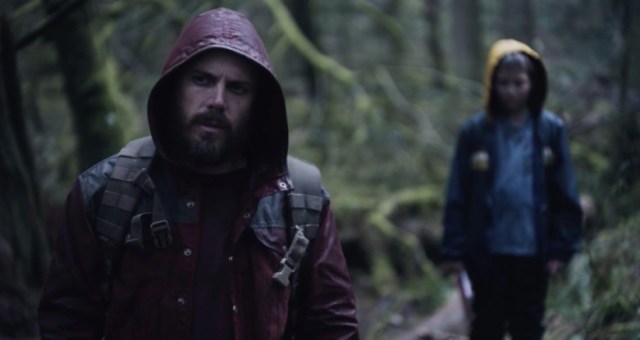
light1.jpeg

The timing of the indie drama “Light of My Life” has the ring of atonement about it.

It stars a recent Oscar winner, Casey Affleck, who also wrote and directed it. But a tiny studio is releasing it.

The writer-director-star was caught up in the tidal wave of #MeToo.

And here he is playing a fanatically-devoted father on “The Road” with his endangered daughter, taking care to “Leave No Trace” as he protects her from the world after the viral apocalypse, the one that killed almost all of the women.

So yeah, there’s a hint of the offscreen world making its way, symbolically, onto the screen with this dystopian flipside of “The Handmaid’s Tale.”

He calls the child Rag (Anna Pniowsky of TV’s “The Hot Zone”). And every night before dozing off in their tent, he tells Rag a story he makes up on the spot, stories that teach, about “listening to your inside voice,” about Noah and some foxes on the arc, borrowing a bit from the Old Testament when it suits his purposes.

Rag has short hair and dresses like a kid who has been camping with Dad ever since the disease struck (Elisabeth Moss plays the mother, seen in flashbacks). Rag is just entering her rebellious tweens, challenging Dad, and questioning him.

“Am I the only girl of my species?”

Probably not. But maybe. As they make their way through the depopulated anarchy of the rainy Pacific Northwest, everybody’s a stranger, everybody’s a loner, everybody’s a threat.

Some guy stumbles into their camp and gets the cold shoulder from Dad and “my son, Alex.”

“We’re not looking for any more company, sir.”

Keeping the child safe when she was younger was easier. She didn’t hesitate to hide when ordered to. She didn’t question his authority, his reasoning about every stranger.

“He’s a doddering old man.”

“Him, and everybody he knows.”

They’ve been on the run for a long time, we learn from their snatches of conversation as they evaluate whether to take shelter in an abandoned house

It’s “better than the barn,” she reasons.”Better than the greenhouse…the pond house.”

“I don’t think this is a safe place to be…I’m not going to be surprised by people like we were at the greenhouse.”

But they move inside out of the rain, and that’s where “Alex” or “Rag” makes her most rebellious decision, coming out as a straight girl, trying on girl’s pants and bedazzled jackets in the closets. She is getting too mature to keep her sexuality a secret from the world even if she’s still too immature to accept that maybe she should still heed her father’s fearful caution.

That conflict, within her and between her and her father, sets up the tense drama and confrontations to come.

Affleck ratchets up the suspense and raises the stakes with the film’s third act, but takes his sweet indulgent time getting us there. He establishes the relationship and the characters in a patience-testing twelve minute opening scene, almost a monologue — Dad telling Rag a story, her interrupting, correcting or questioning it as he does.

light2

Her questions get harder than the simple math and spelling he’s quizzed her about, something any parent will recognize.

“What’s the difference between morals and ethics?”

Or the big one, “When will (the world) be right again?”

“When it’s balanced.”

“When will it be balanced?”

“When there are more women.”

That has a hint of “Handmaid’s Tale” about it. But Affleck’s film leans most heavily on the Cormac McCarthy adaptation “The Road” as it shows the absent mother’s illness, the wrenching decisions that packed them off and sent them off the disintegrating “grid.”

Dystopias and the rainy falls and winters of this corner of the Pacific Northwest fit together easily — grey skies, drab colors made more drab by all the damp. Spray paint “All hail the mothers” on an abandoned building, and viola, you’ve got your sci-fi dystopia.

The kid is affecting, the various men they encounter — even the kindly looking ones — have the taint of villainy and guilt about them.

“But not all men are sad and alone and angry.” Not even here.

And Affleck takes his brooding introversion to new levels here, a man wracked by grief and burdened with responsibility, a “moral” man eschewing violence and guns facing men with no such qualms.

In “Light of My Life,” he’s made an mournful and strikingly slow movie, one that allows us to ponder his reasons for making it even while watching it. Maybe it doesn’t atone for the harassment he was accused of, but it’s fascinating to see it that way as we watch his aching, conflicted desperation — a non-violent man living for one purpose, forced to not just explain the difference between “morals and ethics,” but to act on it — sometimes with violence.

3stars2

MPAA Rating: R for some violence

Cast: Casey Affleck, Anna Pniowsky, Elisabeth Moss

Credits: Written and directed by Casey Affleck. A Saban Films release.

Running time: 1:59

Posted in Reviews, previews, profiles and movie news | Comments Off on Movie Review: On the road, after the Apocalypse, with the “Light of My Life”

“Hobbs & Shaw” subject cars to “inhumane working conditions”

jase.jpg


Thrashing, hooning, beating transmissions. Putting off desperately needed oil changes…that poor McLaren! From The Onion
“Learning that these beautiful cars were subjected to such inhumane working conditions made me sick to my stomach.”

https://t.co/TSGYFwcXFj https://twitter.com/TheOnion/status/1157443965702017024?s=17

Posted in Reviews, previews, profiles and movie news | Comments Off on “Hobbs & Shaw” subject cars to “inhumane working conditions”

Gal Gadot as Hedy Lamarr, for Showtime

Exotic and apt casting, I say.

As any Hedy fan knows, she died in relative isolation– media shy, anyway — and one of my first assignments at the Orlando newspaper was to write this fascinating woman’s obituary. Documentaries have come out since her death focusing on her inventive mind, patent fights, etc. A pre Code bombshell (nude in her breakthrough European film), a Hollywood mainstay for a brief period.

This should be interesting, although it being a Showtime limited series, we may see more skin than deep dives into her formidable brain. https://t.co/goPU8sQ5qK https://twitter.com/joblocom/status/1157414302736777222?s=17

Posted in Reviews, previews, profiles and movie news | Comments Off on Gal Gadot as Hedy Lamarr, for Showtime