BOX OFFICE: ‘Rise of Skywalker’ could have a huge second weekend. Maybe not.

“Little Women” and “Spies in Disguise” are all set to give that”last” “Star Wars” film a run for its ticket sales money this weekend.

LOL.

Those Christmas Day openers have done OK business since midweek.

But “The Rise of Skywalker” is set to own the box office well into the new year.

Box Office Mojo figures it’ll manage another $95 million or so this weekend. But Deadline.com is noting the depressed opening weekend take on this wanly reviewed finale and saying $70 million is more like it.

“Little Women” had a robust Wed. take of $6.4 million, another $17 is expected this weekend.

“Spies in Disguise” did a piddling $4-5 million on Xmas. It might manage $11-12 more this weekend.

“Jumanji” is still printing cash — another $35-38 projected.

“Cats” is still vomiting through Universal’s bottom line, maybe another $6 million weekend, which won’t help.

“Uncut Gems” is still in the top ten, as are “Bombshell” and “Richard Jewell.”

https://www.boxofficemojo.com/article/ed3429893124/?ref_=bo_hm_hp

Posted in Reviews, previews, profiles and movie news | Comments Off on BOX OFFICE: ‘Rise of Skywalker’ could have a huge second weekend. Maybe not.

Movie Review: If David Lynch had made “The Breakfast Club” “Knives and Skin” might be the result

knives3

Imagine “The Breakfast Club” set in “Twin Peaks.”

There’s a mysterious disappearance, adults misbehaving or just plain mentally ill and their kids acting out, toying with adult perversions, obsessed with menstruation and singing, in plaintive choral settings, the music of The Go Go’s, New Order and Cyndi Lauper.

In “Knives and Skin,” writer-director Jennifer Reeder (“Signature Move”) lays out a lifetime of obsessions in a moody, atmospheric period piece that isn’t a period piece. It’s uneven, frustrating here and there, icky there and here. And it’s a picture that, like a hormonal teen, puzzles through the uncertain emotions, observed hypocrisy and sexual/fashion experimentation as one makes up one’s mind about such things.

It begins with a hook-up, or near hook-up. Pretty marching band member Carolyn (Raven Whitley) gone for a ride with jock Andy (Ty Olwin) with certain expectations and demands. She doesn’t want her new glasses broken.

“I actually DON’T want to see what’s about to happen,” she buzzkills. I nasty love-scratch on his forehead. But no kissing on the mouth, and then…”I changed my mind!”

Andy ditches her, sans glasses, in the middle of nowhere. Carolyn never makes it home.

Her classmates — including friends who had a rock band with her as their drummer — are ill-equipped to deal with the shock. Her school chorus-leader mom (Marika Engelhardt) goes straight into denial.

“Can I have Renee (his wife) send over a casserole?” the sheriff (James Vincent Meredith) wants to know.

“I don’t think it’s time for a casserole, yet,” she intones. Time passes, and Mrs. Harper grows more deluded, speaking to the student body as if Carolyn is merely late, and assuming that she shares her mother’s musical priorities.

“She’s missed three marching band practices in a row,” she tells the kids. “She’s gonna get kicked out!”

Joanna (Grace Smith) used to be a friend. Now, she and her circle ponder Carolyn’s fate, judge her even though they’re not blind to the raving dysfunction in their own families. and in Joanna’s case toying with adults obsessed with teen sexuality. Carolyn?”

“I ignored her, like everybody else.”

Tampon gags, underwear sales to pervs, a grandma (Marilyn Dodds Frank) who gets her jollies from porn and nude-modeling for art student, an unemployed father who dresses in clown makeup to cheat on the madwoman (Audrey Francis) he is married to, fashion and makeup statements straight out of Madonna/Adam Ant-era MTV (Maybe it IS a period piece)  — there’s a lot to process here.

Perhaps the writer-director should have tried, you know, processing it.

That’s why “Knives and Skin” feels like a TV pilot, a “Twin Peaks” with music instead of lumber, no diner and no “damned good coffee.”

A stand-out moment, Carolyn’s mother smells her daughter’s scent in the car she was last seen alive in, smelling her even on the boy (Olwin) she was last seen with. Will she solve the disappearance with just her nose?

Reeder is better at landing a pithy line and maintaining a creepy tone than she is at pacing and the beginning-middle-end story story structure of a missing teenager tale.

She casts unknowns to little knowns, rarely identifying look-alike characters, leaving the viewer in the dark about who relates to whom, in some instances.

She had the makings for a cult film, a “midnight movie” as its distributor (IFC Midnight) no doubt hopes. But it’s entirely too scattered, sacrificing coherence, loaded down with characters who are more clutter than carriers of plot and substance.

2stars1

MPAA Rating: unrated, bloody violence, sexual situations, profanity

Cast: Grace Smith, Marika Engelhardt, Kate Arrington,  James Vincent Meredith, Kayla Carter,  Tom Hopper, Ty Olwin, Emma  Ladji and Ra, Robert T. Cunningham and Raven Whitley

Credits: Written and directed by Jennifer Reeder. An IFC Midnight release.

Running time: 1:48

Posted in Reviews, previews, profiles and movie news | Comments Off on Movie Review: If David Lynch had made “The Breakfast Club” “Knives and Skin” might be the result

RIP Peter Wollen: Godfather of Cinema Semiotics — 1938-2019

“Signs and Meaning in the Cinema” was the grad school textbook I got the most out of.

Iconic images freighted with symbolic meaning, layers of interpretation added to film beyond what dialogue, exposition and performance could carry — Wollen made it simple and obvious. Once he pointed out these extra layers, you couldn’t unsee them.

A genuine film scholar, one of the important ones.

signs

https://www.hollywoodreporter.com/news/peter-wollen-dead-author-signs-meaning-cinema-was-81-1264534

Posted in Reviews, previews, profiles and movie news | Comments Off on RIP Peter Wollen: Godfather of Cinema Semiotics — 1938-2019

Movie Review: Sentenced to Siberia, mere “Ashes in the Snow”

snow1

“Ashes in the Snow” is a game attempt at adding Stalin’s gulags to the horrors of Hitler’s Holocaust to our collective memory of the crimes of World War II.

The Russians beat the Germans in the institution of slave labor concentration camps where political prisoners, dissidents, those who “fell out of favor” and mistrusted nationalities were sentenced — often to be worked to death. And the first of them were carved out of the Siberian wilderness — by those imprisoned there — in 1930.

“Ashes” is the fictional story of a Lithuanian family headed by an activist academic (Sam Hazeldine) shipped to Siberia after the Russo-Soviet Empire occupied the Baltic countries, and half of Poland, in 1939-40. Father’s efforts to “help” people was noticed and they were arrested, hustled onto a train and separated in 1941.

Father was an art professor, and daughter Lina (Bel Powley) a talented teen portrait painter and sketch artist awaiting word on if she’d gotten into art school. The day she received her letter from the admissions office is the day they were taken. She vows to not open it and see if she was accepted until her dad is there to open it with her.

The sufferings of Lina, her mother (Lisa Loven Kongsli) and younger brother (Tom Sweet) are many, and straight out of the World War II catalog of the oppressed — packed into freight cars, starved and manhandled for the weeks it takes to cross the vastness of Mother Russia, prisoners dying, a woman losing her infant along the way.

It’s a sobering reminder of what happens when good people are helpless in the face of a state that thinks “putting them in camps” is something it should be doing in everyone’s name. The NKVD (pre-KGB) uniformed police were already indoctrinated and accustomed to the dehumanizing brutality they exercised over the helpless. Complain about your treatment and summary executions were the rule.

Except for young Ukrainian Kretzky (Martin Wallström). He has to be bullied into brutishness by his silky smooth sadist of a commander (Peter Franzén).

Lina’s art her lifeline to her humanity in this script. She scribbles maps, still-lifes and portraits on anything she can find to draw on, with any pencil or pen offered. The handsome young prisoner Andrius (Jonah Hauer-King) is a favorite subject. And once at the camp, he supplies her with paper and pencils.

The film’s catalog of atrocities is all too familiar. Its melodramatic touches — Andrius magically transforming into a master pilferer, other prisoners begging Lina to document their horrors — “People, they must know what is happening here.”

Lina has taken Papa’s “perception” lessons to heart — “I draw what I see.” So no, Commander. You might not want her to draw your portrait. She sees your ugliness.

The art drops into the background as lives narrow into the desperation of simply surviving the work — harvesting beets or herring — the bitter cold, disease sweeping the camps, starvation setting in. Kretzky must face tests of his humanity, like everyone else.

Starving people denounce each other to save their own skins.

Powley, a delight in “”Diary of a Teenage Girl” and “A Royal Night Out,” can be applauded for trying something darker, but the checkbox script and pedestrian direction Marius A. Markevicius, who produced Peter Weir’s escape from Siberia thriller “The Way Back,” let her down.

It’s hard for anybody to make much of an impression, although Kongsli (“Force Majeure,” “Wonder Woman”) has moments of pathos and defiance that stick with you.

I appreciate the film’s ambition and message, and the meticulous period detail, but there’s no getting around it all goes for naught in this, a dull tour of a grimly compelling historic subject.

1half-star

MPAA Rating: unrated, violence, nudity

Cast: Bel Powley, Jonah Hauer-King, Lisa Loven Kongsli, Martin Wallström, Sam Hazeldine and Peter Franzén.

Credits: Directed by Marius A. Markevicius, script by Ben York Jones, based on the novel by Ruta Sepetys. A Vertical Entertainment release

Running time: 1:38

Posted in Reviews, previews, profiles and movie news | Comments Off on Movie Review: Sentenced to Siberia, mere “Ashes in the Snow”

Documentary Review: Palestinians rely on the “Advocate” to battle Israeli justice system

adv1

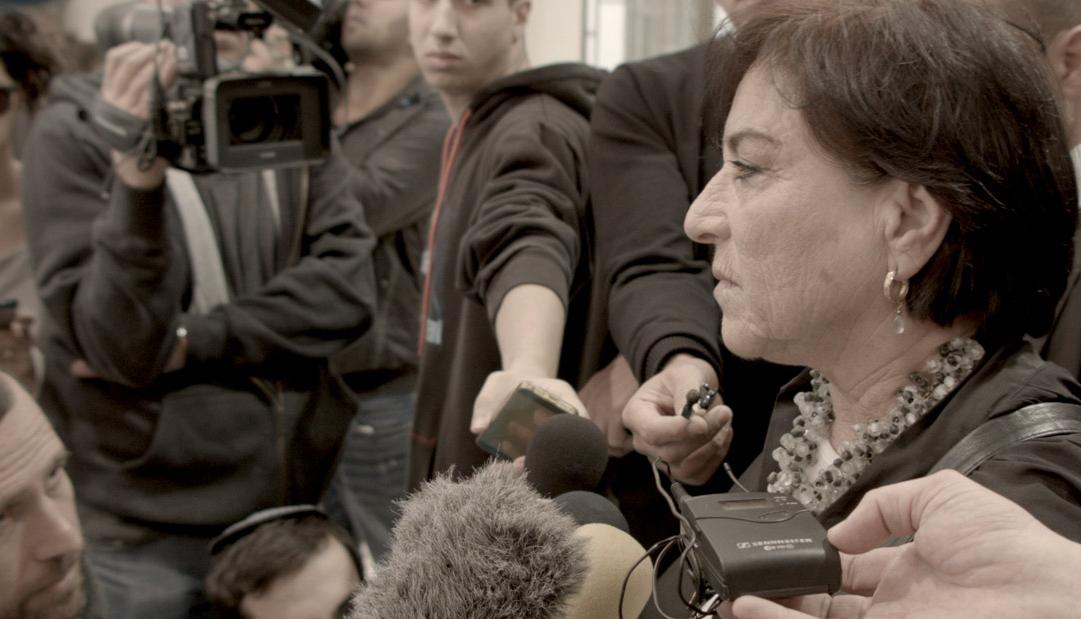
A photographer, obviously new to covering Israeli courts, asks the woman about to give a statement at the end of the trial for her name and title. The scrum of photographers are too busy to react, though you can hear a couple of shocked chuckles amidst the shutters clicking and mad shuffle for position.

“Lea TSEMEL,” the defense counsel barks. “Losing Lawyer!”

For close to half a century, she has been Israel’s legal gadfly, a thorn in the military “occupation” and legal system, an “Advocate,” the “Jew who defends terrorists.” She’s been labeled “traitor,” been spat upon and threatened at gunpoint. Her husband, an activist who works outside the court system, has been arrested.

Lea Tsemel’s other clients? Interrogated without counsel, tortured, run through courts where – even if their guilt is little in doubt, “due process” appears to be untranslatable into Hebrew.

An armed forces veteran from just after the 1967 “Six Day War” who turned to the law when she saw civil rights being trampled, violence against Palestinians brushed off or covered up, “confiscations” of property legalized and sweeping punishments routinely administered for whole families, neighborhoods and classes of citizens.

She became the public conscience of Israel as the state struggled to absorb conquered territories via a series of measures that collectively came to resemble a Middle Eastern Apartheid if not outright “ethnic cleansing.”

Decades of TV interviews are interspersed in this profile documentary by Philippe Bellaiche and Rachel Leah Jones, with the main story thread following her defense of a Palestinian minor caught taking part in one of the country’s frequent knife-attacks — this one on a public bus.

Chapters in that story shape the legal protocols of such a case — “plea,” “charge sheet changes,” “testimony,” “sentencing etc.

Her lonely quest through a maze of legalese and the shifting sands of Israeli jurisprudence is illustrated by sketch-animation inserting court documents behind her as outline as she’s followed into court.

The 70ish, matronly Tsemel bickers with Tareq, her co-counsel, meets with the parents of the 13 year old boy she’s defending as snippets of interviews from the ’70s, ’80s and today — and the cases that were closely linked to that period in time — underline her decades of dogged determination to case by case, turn the tide in the courts and through public opinion, even as she loses — pretty much constantly.

Here she is in the ’70s, declaring that “Israelis have no right to tell Palestinians how to resist.” Hunger strikers in the ’80s, bombings and shootings and slashings all divorced from the actions these “terrorists” are reacting to — land seizures, random air strikes, raids and sweeps and wall-building.

adv2

Her own children recall the difficulty of being associated with a high profile figure treated as “traitor” to her race by many Israelis. Not the easiest way to grow up.

But Talila Warschawski gets what her mother has been up to, starting a dialogue, pushing the idea of “equal justice for all” into the Israeli mainstream as something that doesn’t exist — yet — but should. Talia knows what to shout “whenever I find myself in trouble,” caught in a riot, trapped in a violence situation.

“I’m LEA TSEMEL’S DAUGHTER!”

At least the Palestinians would pay her heed. Palestinian feminist Hanan Ashrawi praises Tsemel’s stoicism in the face of terrible odds, her righteous sense of right and wrong.

And other activist lawyers note her impact, chipping away at a court system with inherent biases, forced to treat the occupied people fighting Israel as “combatants,” just to give them International Law standing, forced to consider juvenile defendants under different rules — eventually — a fierce “Advocate” and “losing lawyer” building a wall of case law, one painful loss at a time.

It’s hardly the most “balanced” documentary you’re going to see on the woman, who was the subject of a “60 Minutes” profile in the ’80s. None of her critics are put on camera.

But “Advocate” is a reminder to audiences everywhere of the importance of the rule of law, its equal application and appointing judges who understand that importance.

3stars2

MPAA Rating: unrated, news footage of violence, profanity, smoking

Cast: Lea Tsemel, Hanan Ashrawi, Michael Warschawski, Talia Warschawski, Nissan Warschawski,

Credits: Directed by Philippe Bellaiche, Rachel Leah Jones, script by Rachel Leah Jones. A Film Movement release.

Running time: 1:49

Posted in Reviews, previews, profiles and movie news | Comments Off on Documentary Review: Palestinians rely on the “Advocate” to battle Israeli justice system

Movie Preview: Deneuve, Binoche tell “The Truth”

An actress and her daughter have an amusing interaction upon reuniting in this French dramedy.
Ethan Hawke is also in the cast of this March 20 US release. https://youtu.be/LoNoOn6c0gA

Posted in Reviews, previews, profiles and movie news | Comments Off on Movie Preview: Deneuve, Binoche tell “The Truth”

Netflixable? “Holy Expectations” or “Embarazada por obra y Gracia” sets the Nativity in modern Colombia

Here’s one that should have come off, but doesn’t.

“Holy Expectations” or “Embarazada por obra y gracia” is a faith-based musical farce from Colombia that comically re-imagines the Nativity story in modern day Colombia.

It’s got sherbet-colored houses and Panama hats, hapless “wise men” and a Herod as a Bond villain. The script uses a “Wizard of Oz” structure, a sickly child (Isabella Sierra) is told the story of the birth of baby Jesus, imagining her doctor (Adriana Botina) as Mary, her pastor (Fernando Ramos) as Joseph, a soap opera star (José Manuel Ospina) as a playful, magical archangel Gabriel and three goofball orderlies as the “Three Kings” sent in search of the barn — because there’s no room at the clinic — where Christ is to be born.

Shepherds, as singing cowboys, serenade the family. But everybody sings, especially Gabriel — “In her belly, sitting tightly, is the son of the Almighty!” (in Spanish, with English subtitles).

But from the opening framing devise, little Gabriella dragging widowed dad (Joavany Alvarez) to church so she can perform with the “praise (singing) group,” fainting and then hospitalized, “Holy Expectations” dashes expectations.

Dad tells her the story, pre-surgery in the hospital, embellishing it with Colombian touches — the style of music, Joseph driving Mary in an aged Jeep to Belén, the disreputable and quarrelsome “kings” (Omar Murillo, Christian López, Nelson Purillo) bickering and mugging and piling into orange VW Beetle — foiled at every turn, because Herodine (Aida Morales) wants them to kill the baby before it can start trouble.

The songs are cute, but the performances — heavy on the jamón — cannot make the many light touches actually funny. Mary and Joseph come off well, but the kings don’t dive deep enough into slapstick to ever live up to their promise.

The only moments I laughed were when the shepherds showed up.

1half-star

MPAA Rating: TV-PG

Cast:  Adriana Botina, Fernando Ramos, Isabella Sierra, Joavany Alvarez, Omar Murillo, Christian López, Nelson Purillo, Aida Morales and José Manuel Ospina

Credits: Directed by  Fernando Ayllón, script by  Fernando AyllónÁngel Ayllón. A Netflix release.

Running time: 1:29

Posted in Reviews, previews, profiles and movie news | Comments Off on Netflixable? “Holy Expectations” or “Embarazada por obra y Gracia” sets the Nativity in modern Colombia

Movie Review: Group therapy might be just the thing for “Three Christs”

christs2.jpeg

It’s an odd niche, I’ll admit. But I’ve always been fascinated by the origin stories of professions.

The art of criminal investigation unfolding in “The Name of the Rose,” Medieval legal defense arising in “The Advocate,” medicine moving out of Dark Ages superstition in “The Physician” — all were absorbing period pieces with whose antagonists are, in various ways, poking around in the dark or making it up as they go along.

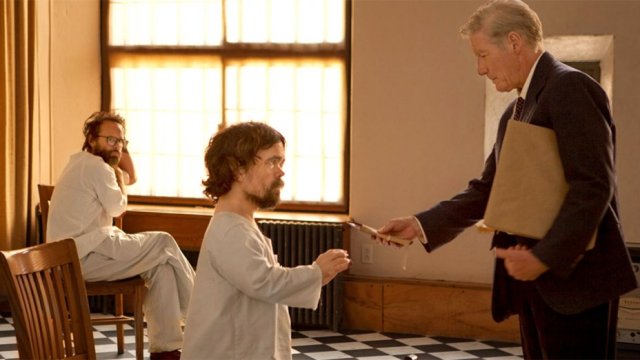
In “Three Christs,” group therapy was a new thing when an academic decided to try it out of three schizophrenic men whose delusions had them thinking they were Jesus at the Ypsilanti, Michigan mental hospital where they were housed.

But electro-shock therapy and drugs were getting them nowhere. And Dr. Alan Stone (Richard Gere) thinks a little empathy, from him and them to each other, might help. He is drawn to schizophrenia because of the overriding characteristic of those suffering from this illness — “because they’re so lonely.”

Director and co-writer Jon Avnet (“Fried Green Tomatoes,” “Red Corner”) conjures up a too-conventional treatment of this true story, one that devolves from quiet character study into full-blown, over-the-top “star vehicle” in its last act.

But very good casting, and committed work from the “Christs” in question — Peter Dinklage, Walton Goggins and Bradley Whitford — make this drama just uplifting enough to come off.

It’s a heavily-fictionalized version of the case-study “The Three Christs of Ypsilanti by Milton Rokeach. Gere plays a version of the psychotherapist, who takes a job at a state hospital to do some research and publish. As he’s already published criticisms of such institutions as “warehouses” or “bureaucratic, unfeeling conformity.”

The director of the place (Kevin Pollack) is not amused. The state director (Stephen Root) is willing to give Stone a little latitude.

Because Stone has stumbled into the fact that there are “three Cinderellas, two Eisenhowers (it’s 1960) and one Duke Ellington” among their 4100 patients. And the three fellows who think they’re Jesus have his attention.

Joseph (Dinklage) is “Jesus Christ, courageous one am I,” an opera buff who affects an English accent.

Clyde (Whitford) is “Christ, but I’m not from Nazareth.” He’s constantly singing TV commercial jingles, constantly showering, incessantly complaining about a stench only he smells.

Leon (Goggins) is the belligerent, scary one. “Address me by my RIGHTEOUS name, God!” He is oversexed and cannot stop talking about Dr. Stone’s new assistant, Becky (Charlotte Hope).

Stone figures he can “put the three of them in a room,” get them singing, talking and playing cards,” which might help them “give up their delusions.”

Is he delusional? Every time the lights dim in the place, “Shocky Boy,” a trigger happy therapist “managing” the unruly, has electro-shocked another victim.

The conventional touches — and there are many — are the problems his obsession creates for Dr. Stone at home (Julianna Margulies plays his chemist-wife), the tug of war over the patients with Dr. Orbus (Pollack) and the shortcuts that Stone takes to try and “speed up” the process.

It being 1960, dabbling in LSD-driven self-awareness is on the table.

And “progress” is measured in civility, calms of sanity, sort of “Awakenings” with schizophrenia.
christs1.jpeg

The big boss, the one who scares EVERYbody, is played by four-time Oscar nominee Jane Alexander.

Avnet never lets the picture lapse into “cute,” but there are moments, here and there, that seem off-key or gratuitous. And the third act’s heroics are so formulaic and old fashioned that you’d think they’d been banished by the ridicule they took in Robert Altman’s movie biz satire “The Player” 25 years ago.

But this cast never lets us feel that the story isn’t in the hands of seasoned pros, that what we understand and feel out of this story isn’t earned, even if it is often expected.

2half-star6

MPAA Rating: R for disturbing material, sexual content and brief drug use

Cast: Richard Gere, Peter Dinklage, Julianna Margulies, Charlotte Hope, Walton Goggins, Bradley Whitford, Kevin Pollack and Jane Alexander

Credits: Directed by Jon Avnet, script by Eric Nazarian and Jon Avnet, based on the book “The Three Christs of Ypsilanti by Milton Rokeach. An IFC release.

Running time: 1:50

Posted in Reviews, previews, profiles and movie news | Comments Off on Movie Review: Group therapy might be just the thing for “Three Christs”

Netflixable? “The Photographer of Mauthausen (El fotografo de Mauthausen)”

foto1.jpeg

Sometimes, it’s the cover-up, not the crime, the old political saying goes.

But sometimes, it’s the crime AND the cover-up.

That’s the thesis of “The Photographer of Mauthausen” (“El fotógrafo de Mauthausen”), a Catalan/Spanish story from the Holocaust. Because mass extermination of Jews, Gypsies, Slavs, homosexuals and others can be easily proven. Proving who did it requires eyewitnesses and hard evidence.

Francesc Boix (Mario Casas of “The 33” and “Witching & Bitching”) was one of several thousand Spanish exiles, refugees from the country’s bloody civil war, captured by the Germans when they overran France in 1940. Declared stateless by their fascist government, the Germans were free to make them among the first sent to concentration camps.

“We BUILT it,” Boix declares (in Spanish with English subtitles) in the voice-over narration, “it” being the Mauthausen camp in Austria. When we meet him, he is already a photographer, working for the camp officer (Richard van Weyden) in charge of photography, part of the meticulous record-keeping the Germans are famous for.

In the early days of the camp, they went to the trouble of sending condolence letters to the families of those murdered there, which is a bit of shock. But again, it was early in the war, mass extermination wasn’t necessarily on the horizon, and perhaps things were more Geneva Conventional in Austria at the time.

Boix and others, mostly his fellow communists, organized into “night and fog” resistance — altering the serial numbers on murdered prisoners’ in their photos, messing with that Nazi bookkeeping.

Boix is a trusty, and lies to a newly-arrived little boy (Adrià Salazar) who has been separated from his father, “to give him hope.” In a grim world of labor, privation and random, summary executions, it’s all any of them have to give.

Boix is dragged out to prisoner massacres in the forests, to document the deed, while his twisted boss, Ricken (van Weyden), concerns himself with the odd-looking; dwarves, one-legged prisoners, etc.

Stumbling across negatives in the dark room, Boix notices that the bookkeepers are keeping everything. Listening in to the camp radio his fellow inmates have conjured up, he hears the tide of the war turning in the East. What will their monstrous, murderous and “victorious” captors do when they realize the war is lost?

Saving that film becomes a mission.

foto2

Director Mar Taragona, better known a producer of Spanish films (“The Orphanage”), and the script immerse us in the nuts and bolts of mass extermination — an early model of the vans used to gas victims is assessed. And the boilerplate characters and ingredients of concentration camp/POW camp movies can’t help but make appearances.

The sadism and utter disregard for life, especially by the SS kommandant (Stefan Weinert, properly monstrous), the plucky inmates figuring out ways to fool “the very best people” put in charge of such camps, the ingenious “systems” devised for hiding contraband or planning escapes. There’s even an amusing Spanish stage revue they put on to cover an escape attempt (the Germans don’t realize the Spaniards are singing about Russians and Americans on their way to liberate them).

“The Photographer” reminds us how hard it is to say something new on this subject, to avoid third act melodrama, even when the tale is essentially true. A lot of luck and chance were involved in deciding who lived and who died.

More attention should probably have been paid the photographs, stark images of murder, victims lying on snow, dangling from fences, etc. Several scenes take on a far-fetched air, a dubious dinner party interrupted by teaching a child how to shoot his first “sub human.”

But “The Photographer of Mauthausen” does boast of a novel demographic — Spanish victims, communists — and Casas makes a sturdy lead, playing not just someone who endured a camp, not just someone who could bear witness, but a man who made saving the photographic evidence something he was willing to die for.

2half-star6

MPAA Rating: TV-MA, graphic violence, sexual situation, nudity

Cast: Mario Casas, Richard van Weyden, Alain Hernández, Adrià Salazar and Stefan Weinert

Credits: Directed by Mar Taragona, script by Roger Danès, Alfred Pérez Fargas. A Netflix release.

Running time: 1:50

Posted in Reviews, previews, profiles and movie news | Comments Off on Netflixable? “The Photographer of Mauthausen (El fotografo de Mauthausen)”

Documentary Review: Snowboarding’s elite challenge “Dark Matter”

Snowboarding ventures into the realm of the rich and giant-carbon-footprint classes with “Dark Matter,” a lovely “virgin powder” downhill documentary shot in the pristine peaks near Tordrillo Heli (helicopter) Skiing lodge way up north in Alaska.

Snowboarding icons Travis Rice and Elias Elhardt are captured riding down slopes so steep you’d need crampons just to cling to them, sitting still. Filmed via helmet cams and from the helicopter that dropped them (GIANT carbon footprint), in slo-mo and with the odd kaleidoscopic post-production effects by director Curt Morgan, we see snowboarding at its most graceful.

The guys seek ridgelines so narrow they’re like the stairway railings skateboarders shred, perform acrobatic jumps and spins off some mini-cliffs, and finish with such deep thoughts as “That is a thing of sheer beauty” and “I can’t believe we just rode that.”

The only clue to the film’s location is seeing them put up at the Tordrillo Lodge. There’s a bit of pretentious narration, but no geographic graphics ID’ing the range or the guys or what have you.

Just “We assign a meaning to everything we to everything we see…chaos, or harmony” intoned in voice-over.

It’s pretty to look at. Is it a movie? No, it is not.

2stars1

Cast: Travis Rice, Elias Elhardt

Credits: Directed by Curt Morgan. A 1091 release.

Running time: :27

Posted in Reviews, previews, profiles and movie news | Comments Off on Documentary Review: Snowboarding’s elite challenge “Dark Matter”