Movie Review: So who’s the “Parasite” here?

para1

The Korean director who first gained global fame with his wry creature feature “The Host” reconsiders that host-parasite relationship with his latest, “Parasite.”

Bong Joon Ho has a created a dark satire of haves and enterprising have-nots, a film that begins as a delightful “Big Con” comedy and probes deeper and turns more politically pointed — and more violent — the further it goes along.

Most cleverly, this skewering of global inequality and class warfare, at least as it pertains to his home peninsula, leaves unanswered the big question of an era when wealth has been callously and mercilessly redistributed upward to a rapacious few.

That question is, “Who will be first against the wall when the revolution comes?”

Bong’s muse, the hulking comic Song Kang-ho, plays the unemployed and broke patriarch of a family of four on the bottom rung of Seoul society — literally. They live in a smelly basement apartment where they’ve lost cell service, and on the evening we meet them, their free source of wi-fi — a neighbor — has just password-protected his router.

With his wife, Chung-sook (Jang Hye-jin) and two enterprising college age kids, Ki-jung  (Park So-dam) ) and Ki-woo (Choi Woo-sik), father Ki-taek folds pizza delivery boxes, the lone hustle they have that pays in this economy. And Youtube tutorials or not, they can’t even do that right.

How will they cling to this dump, where the toilet sits up on an interior ledge next to the window drunken bums pee on every night? Everybody wonders what Ki-taek’s “plan” is. Dad is big on “What’s your plan?”

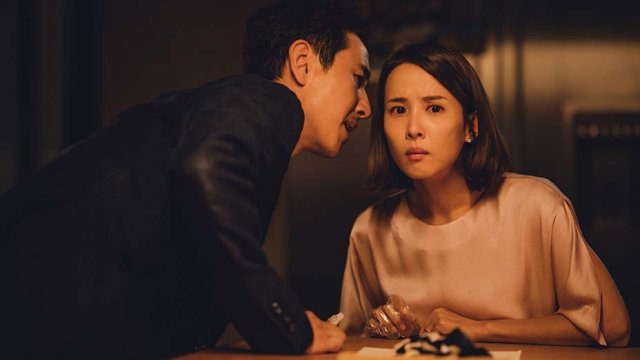
A windfall that he hasn’t planned for is their lifeline, it turns out. Ki-woo’s buddy, headed off to study abroad, recommends him as replacement for the rich teen girl he’s been tutoring. Sister Ki-jung forges Ki-woo some ace credentials as “Kevin,” which win over the girl (Jung Ji-so) and her frazzled, pampered mother (Jo Yeo-jeong).

Her father (Lee Sun-kyun)? He may get a clue. Will it be in time?

And all a “Parasite” needs, we see, if that first foot in the door.  “Kevin” is quick to recommend “a friend of a cousin” who studied in Illinois as an art tutor to the ADHD artist child in the house. “Jessica” is the name Ki-jung goes by.  Sizing the kid and his mother’s worries up, she improvises “art therapist” into her resume as well.

This scrawled, dark corner in all of little Da-song’s drawings? That’s “the schizophrenia zone,” she says, freaking Mom out. That ability to lie on the fly is a family gift, and it’s what puts all four of the Kims in the employ of the Parks, by hook or by crook.
para2

This 2019 Cannes Palme d’Or winner has fake tutors straight out of Shakespeare (“The Taming of the Shrew”). But I’d be surprised if Bong Joon ho didn’t see 2018’s Japanese Cannes Film Festival entry “Shoplifters,” and wasn’t inspired to whip up a funnier and more ambitious take on an underworld of low-rent grifters struggling to survive in the Golden Age of Income Inequality.

But here, there’s sympathy and even a modicum respect for their “marks.” In an economy where jobs are scarce and survival precarious, the Kims are grateful to have the jobs they finagle (and lie and cheat) their way into.

Ki-jung seems to be the most ruthless and cunning one, taking after her pitiless mother. Ki-jung is the one who surmises that the family driver can be unseated, and lets her folks know (in Korean, with English subtitles) “I set my trap in the Benz,” the family limo, a trap that will get that driver canned.

All these amusing machinations are just the table-setting for the confrontations to come. It turns out, the Kims aren’t the only ones desperate enough to prey on people like the Parks. And as they hustle them and deal with petty humiliations and bourgeois snobbery, they start to wonder, and make us wonder, just who is the host and who is the real parasite here?

Song Kang-ho has an oafish soulfulness that his director has tapped into, in film after film. He can let us feel pity for a character and laugh at him (a little) at the same time.

The laughs don’t dry up as things take a bloodier turn, but rather devolve into class warfare giggles. We know we should be shrinking from the mayhem, not chuckling. And yet, as in a horror movie where we figure “They have it coming,” we can’t help ourselves.

There’s something of a Great Leap Forward in Bong Joon Ho’s ambitions and skill at realizing them here, something that his failed Netflix satire “Ojkja” and the over-reaching sci-fi  “Snowpiercer” couldn’t manage.

With “Parasite” he transcends genre even as he sharpens his social satire skills, delivering a movie that will resonate from Seoul to Syracuse, Helsinki to Hong Kong, one of the great films of 2019.

4star4

MPAA Rating: R for language, some violence and sexual content

Cast: Song Kang-ho, Park So-dam, Jo Yeo-Jeong, Lee Sun-kyun, Choi Woo-sik, Jang Hye-jin, Lee Jeong-eun,  Jung Ji-so

Credits: Written and directed by Bong Joon Ho, co-written by Han Jin Won. A Neon release.

Running time: 2:12

Posted in Reviews, previews, profiles and movie news | Comments Off on Movie Review: So who’s the “Parasite” here?

Movie Review: A Pinkerton hunts Confederate war criminals in the Old West in “Badland”

bad2

Justin Lee, the new King of the B Movies, is back on the screen for his sixth movie in the past two years, a Western wearing the weary title, “Badland.”

The writer-director of “The Reckoning,” “Big Legend” and “Any Bullet Will Do” has lined up his most impressive cast yet — Oscar winner Mira Sorvino, 2020 Oscar honoree Wes Studi,  screen legend Bruce Dern, and veteran players such as Tony “Candyman” Todd, Amanda Wyss, James Russo and Jeff Fahey.

And yet the prolific Lee still has room for the hulking country music baritone Trace Adkins in a key role. And for his leading man, Lee is still leaning on his muse, a competent but colorless actor, Kevin Makely, whose chief virtues are that he looks a bit like Bradley Cooper, and he’s always available.

The result is the usual limp, long-winded lope through genre conventions, saddled to a leading man lacking the spark to make it compelling.

“Badland” follows the portentously-named Mathias Breecher (Makely), a Pinkerton detective turned into bounty hunter, prosecutor, judge, jury and executioner by a Reconstruction Era senator (Tony Todd) for purposes of rounding up ex-Confederate war criminals.

In a series of episodes given chapter headings — “Chapter One: The General,” etc. — Makely’s loner with a two six-shooters, a six day beard, a duster and a saddlebag full of warrants, hunts down men who carried out massacres in the Civil War.

Adkins, all presence and rumble (as opposed to acting skill) and sporting an eyepatch, is The General, intoning in a Foghorn Leghorn drawl, “May ah inquire as to whether or not you are a VETERAN, suh?”

He confesses that he has “cut the thoats of many a private,” before Breecher mentions his need for “an oak tree big enough to hold a man of your stature.”

The murderous good ol’boy barely has time to finish his drink and mutter “Damn those Yankees, damn them AND their ideals,” when Breecher has gunned down the general and his entire gang.

And so the movie goes, Breecher hunting down “The Sheriff” (Fahey) or whoever, facing down armed gangs protecting his suspect, leaving bodies crumpled in the dust wherever he goes.

I think my favorite chapter might be “The Cooke’s.” Yes, the chapter title has a typo in it. When you’re cranking them out as  fast as Lee, niceties like grammar and editing get shortchanged.

It’s not the cutting of the film that is the issue here, although everything shuffles along at an invalid’s pace, and at least some of that is due to pedestrian post production. No, the biggest flaws in Lee’s projects are the lack of fresh passes at the script, workshopping, story-editing. Judicious trimming would cut down on the eye-rolling dialogue, for starters.

Here’s an example. Breecher has shown up to confront “Captain Cooke,” played by Bruce Dern in yet another bed-bound performance. He’s a sickly old man, and rather than make the murderous bastard face justice, Breecher decides to just wait for him to die. Maybe he’s sweet on Cooke’s daughter (Sorvino).

“It is my job to watch men like you take their last breath,” Breecher intones. Good line. And then Lee has Makely ruin it with an anti-climax.

“This is the burden I must carry in this life.”

Groan.

Fahey is, as could be expected, the most impressive villain in the lot. Even his character is woefully underdeveloped, his crimes only cursorily mentioned. But he is silky smooth in his Sleepy Time Down South drawl.

“Sleep evaaaaades me,” he purrs, “for mah mind runs RAMpant with thoughts of the past!”

There are anachronism in the speech, and the private police force Pinkertons, post Civil War, were involved in tracking desperados who robbed trains (The James/Younger Gang) on behalf of the railroad companies, and trying to smother the newly-born labor movement in the crib on behalf of the Robber Barons. They never did anything so righteous as chase down war criminals.

But the shoot-outs are at least 1950s TV level sharp. The production values are solid. There’s more grit and grime than in earlier Justin Lee Westerns, even if he goes overboard with the buzzing flies sound effect.

We know it stank back then, hoss. We can SEE the smell.

And “Badland” was filmed on the same “studio ranch” that has been home to TV’s “Westworld.”

But until Lee finds himself a story editor and a more literate, genre-savvy group of readers to workshop his screenplays, until he figures out that hitching his wagon to a star who is more “available” than charismatic, these films are never going to hide their malnourished, rushed origins.

Quick and dirty, in other words.

1half-star

Cast: Kevin Makely, Mira Sorvino, Jeff Fahey, Tony Todd, Wes Studi, Trace Adkins, James Russo and Bruce Dern.

Credits: Written and directed by Justin Lee. A Cinedigm release.

Running time: 1:42

Posted in Reviews, previews, profiles and movie news | Comments Off on Movie Review: A Pinkerton hunts Confederate war criminals in the Old West in “Badland”

Movie Review: A grieving obsessive-compulsive falls under an Icelandic “Spell”

spell4

Benny staggers off the plane and makes his way to the parking lot.

“Welcome to Iceland,” a friendly cabbie says. Need a lift? Where do you want to go?

“Where do people go?”

What’s that?

“When they fly in…”

Hungover or in shock, dazed and/or confused, Benny seems lost. Something, or someone, has him under a “Spell.”

Here’s a darkly comic odyssey that abandons “comic” at some point, and reaches for “soul searching.” That turn away from funny almost stops “Spell” in its tracks, but the film is carried by one of the quirkier heroes the cinema has given us in a while.

Before we see Benny disembarking, we’ve seen what came before, a “morning after” to never forget. A woman we learn is his fiancée (Jackie Tohn) awakens amid discarded underwear and empties, staggers outside and drops into the pool.

Now, shaken and disoriented, this cartoonist/illustrator has boarded a plane for a trip he’d vowed to make with Jess, not packing, not even owning anything warm.

And here we are, a tourist above the Arctic Circle, hitting the museums, the restrooms, the streets and bars.

He’s also licking many things along the way. He’ll pause for an instant, maybe try to walk away from a public restroom faucet, or a penis sculpture in a museum. But he has to turn back around and stick his tongue on it.

Benny, played by Barak Hardley, who also scripted “Spell” and once starred in the TV series “Junketeers” (won’t hold THAT against him), has OCD — obsessive compulsive disorder. He is thousands of miles from home, with no luggage, his dead fiancée’s engagement ring as a talisman and one last pill in his prescription bottle. The OCD is about to get a lot worse.

Let’s SELF medicate! A night out at the bars of Reykjavik is how he meets Inga (Birna Rún Eiríksdóttir) and her pals, how he hears about this legendary old coot tour-guide, Steindór, who leads off-the-beaten-path explorations of Iceland.

It’s also how he ends up in a drunken dare as Inga offers to show him some of her tattoos if he gets one in a shop they stagger past. Game on!

“Spell” is broken into chapter headings, pieces of lore about this legendary sorcerer whose museum Benny visited. Getting the tattoo is chapter-headed as “The Stave,” which is a Rune-like stick-symbol, which it turns out, represents the sorcerer. Benny is following the path of Loftur the Sorceror after getting the dude’s “Stave” inked onto his chest.

His guide down this path? That would be that old coot Steindór (Magnús Jónsson).

Whatever the mystery of “Spell” is, this is the heart of the movie — cranky Steindór leading OCD cartoonist Benny on a tour “up north.”

Steindór can’t even bother to muffle his muttering at Benny’s oblivious reaction to the wonders all around him.

“Stupid Americans.”

He resists Benny’s urge to get a selfie at every scenic spot, an OCD trait shared by most of us cell-phone owners.

“Why would you want to spoil a beautiful (waterfall) photo by putting your big fat head in front of it?”

Well, then “take a picture of me on top of THIS!”

“No. Not everything is to be climbed…mocked.”

spell2.jpeg

Steindór is a philosopher whose musings are wasted on the bearded dork in mourning.

“What good is it to stand up to a glacier? It will go where it pleases.”

Something else is going on here, and not the “Benny starts to heal” thing we might expect from the story set-up. Something mysterious and dangerous and out of his control takes over the third act of “Spell.”

The quirky journey of self-discovery that the film seems to embrace, the convenient and conventional “Innocent Abroad” plot,  becomes the very thing “Spell” shuns as it grasps for something deeper.

That’s an overreach, I think, as the film — as mentioned earlier — shudders to a halt here. “Spell” is better as dark comedy than as dark night of the soul.

But Hardley has conjured up an interesting twist to this “journey of healing” narrative, abandoning laughs for metaphysical pathos.

And as an actor, he seems perfectly-suited to playing a dorky unsophisticate at war with his mind and his memories, but still taking the hero’s journey to get the answers he needs to carry on.

2half-star6

MPAA Rating: unrated, with violence, substance abuse, nudity and profanity

Cast:Barak Hardley, Jackie Tohn, Magnús Jónsson, Birna Rún Eiríksdóttir

Credits: Directed by Brendan Walter, screenplay by Barak Hardley.  . A Dark Star Pictures release.

Running time: 1:26

Posted in Reviews, previews, profiles and movie news | Comments Off on Movie Review: A grieving obsessive-compulsive falls under an Icelandic “Spell”

Netflixable? “The Awakening of Motti Wolkenbruch” isn’t ale vos

motti1

Never underestimate the value of “novelty” when it comes to romantic comedies. A “fish out of water” romance, where somebody from one culture falls for someone from an alien (to him or her) culture, that’s the sort of fresh take that gets our attention and holds our interest, if the leads are charismatic enough.

“The Awakening of Motti Wolkenbruch” almost certainly had more novelty in its native Switzerland than it does in North America. It’s not as if we have seen a lot of romantic treatments of the idea of an Orthodox Jew taking a tumble for a pretty Gentile. Still, it’s happened. And  when “Seinfeld” pounded the notion of Jewish fascination for “the other” as “shiksa appeal” some 25 years ago, and others followed suit, the bloom went off that rose on this side of the Atlantic.

“Awakening” is a comedy that traffics in stereoptypes and caricatures, that has its hero, college student and assistant in his father’s insurance business Motti Wolkenbruch (Joel Basman) turn to the camera, here and there, and translate Yiddish or explain Hebrew terms and comical customs of “my people” to us.

Why do Orthodox Jews (in Switzerland, at least) all drive Toyota Previa mini-vans?

It’s the “eytse,” Motti explains. You go to an optician for eyeglass advice, you listen to the car salesman’s pitch in the same way. And you buy a car for all the children you’ll be having, practical and ugly. TRUST me!

The turn to the camera and drolly narrate and “explain” yourself and your people to us shtick is worn. But in this case, “Awakening” could use a lot more of that. Yiddish  and Yiddish translations (which I put in the headline to this review) never get old.

When your story’s about “shiksa appeal,” the hidebound traditions of your community, and how every Jewish boy’s closest relationship is with his badgering, micro-managing and domineering mother, you need every laugh you can get. There aren’t many left in those cultural tropes.

Motti’s “Mame,” Judith (Inge Maux) is putting her son through a trial by shidduch. She and her kvetching coffee klatch are hell-bent on arranging Motti’s mate-for-life. He is dragged to one “set up” meeting with an eligible Jewish woman after another.

Complaining doesn’t help. “I want to marry a woman I really like,” he says (in German, with English subtitles).

“You can’t afford to be choosy,” his Mame counsels. Sizing up the meek, redheaded Motti, maybe we see her point. Still, he’s starting his rebellion. He’s shaved his beard. He’s bought new glasses, and not from the Orthodox community’s go-to optometrist.

“Woody Allen glasses,” Mame gripes during the big family Sunday dinners.

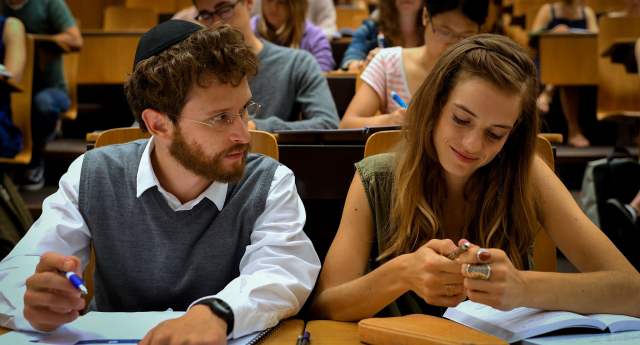
Two things conspire to buy him a little time. One of his shidduch set-ups agrees that they should “fake it” just to get their parents off their backs. And that’s at about the time Motti spies his shiksa ideal one day in class.

He’s not positive the striking blonde Emma Watson look-alike Laura (Noémie Schmidt) isn’t Jewish. But she’s outgoing enough to make the first overture, and he quickly finds out that she doesn’t know basic Hebrew or Yiddish phrases that most of planet has picked up — “L’Chaim,” “mazel tov,” etc.

She wants to know what “those little spaghetti strings” are that hang over his pants — “tzitzit.”

She wonders why he won’t shake her hand, even though he’s dying to do much more than that. Not permitted. But a bike ride where she figures out he’s staring at her bottom the whole time tips her off.

“This?” Motti turns to the camera in the worst Jackie Mason tradition and leers, “THIS is a toches.” Or “tuchus.”

Things are just getting interesting when Motti fantasizes what it’ll be like if he takes Laura home to Mame. Violence, perhaps comical, perhaps genuine, he decides.

“You’re KILLING the Jewish race!” or words to that effect, will be shouted between tears. Perhaps while holding a knife.

Fessing up to not actually planning to marry his fake-fiance shidduch set-up doesn’t make matters better. A shrieking tantrum about how her son is gay (“faygale”) ensues.

Let’s see the rabbi, for the rabbi is wise, if not all that funny. “Send him to Eretz Israel,” is his solution. Find one of those aggressive, sexy no-nonsense Israeli Jewish women.

So he does, in a Tel Aviv Orthodox yoga (“Ommmmmm shalooooooom”) studio. Jael (Meytal Gal) is exactly as advertised, Gal Gadot with curls and no interest in wasting time with a lot of foreplay. Motti’s tidy whiteys under his tzitzits? Sexy. 

Motti’s dilemma holds our interest, even if the screenwriter can’t figure out a way to make it more of a dilemma. Having him visit a dying client of his father’s insurance business might be designed to tug at his ethnic loyalty and the stakes of this big life decision, or even hint at a life circumscribed by tradition and arranged relationship. But  those scenes don’t deliver that.

His asides to the camera fade, and he doesn’t really confide in his dad (Udo Samel) or his best friend Yosi (Aaron Arens). There’s little narrative drive here, and even less comic momentum.  The cast makes this watchable, but nothing more.

“Awakening” is just that, a long, yawning start to the first day of the rest of Motti’s life. There’s a sense of fence-sitting in the film’s point of view, embracing free will, while waffling on “tradition” and arranged marriages within an insular culture.

It’s not unpleasant, just grating and in many instances, too familiar to be much fun. Kind of “meh,” overall.

That’s not going to satisfy anybody, either the characters in the movie or among those watching it.

1half-star

MPAA Rating: TV-MA, sex, nudity

Cast: Joel Basman, Inge Maux, Noémie Schmidt and Meytal Gal

Credits: Directed by Michael Steiner, script by  Thomas Meyer. A Netflix release.

Running time: 1:34

Posted in Reviews, previews, profiles and movie news | 1 Comment

Sorkin’s “The Trial of the Chicago Seven” adds Keaton and Hurt

The Oscar nominee and Oscar winner join Joseph Gordon Levitt, Sacha Baron Cohen and Mark Rylance, among others.

https://t.co/MvlFImjfyg https://t.co/1eOQAWWogb https://twitter.com/Variety/status/1187863419732541446?s=17

Posted in Reviews, previews, profiles and movie news | Comments Off on Sorkin’s “The Trial of the Chicago Seven” adds Keaton and Hurt

Netflixable? A “Rattlesnake” tests a mother’s love in this supernatural thriller


rat2

A mother and daughter with everything they own in their SUV move from Tuscon to Oklahoma, and rue the day Mom takes a shortcut through Tulia, Texas.

That’s where her tire blows, literally a moment after her cell phone has let her know there’s “no service.” That’s where little Clara (Apollonia Pratt) wanders away from the car, just far enough to stumble into a “Rattlesnake.”

Yeah, we knew it was coming. From the TITLE. But it’s what comes after that fuels this nightmare and makes it a horror movie.

Because desperate Mom (Carmen Ejogo, who played Coretta Scott King in “Selma,” and was in “Fantastic Beasts and Where to Find Them”) seeks help in a battered trailer she spies just after the bite. The Woman (Debrianna Mansini) may look Okie Goth scary, but she lets Clara lie down while Mom, Katrina, frantically changes the tire.

Katrina picks up the kid, who looks better, and dashes to the hospital. The doctors see no problem. They start asking Katrina questions, about how tired she is, how stressed.

Hey! I KNOW what I saw!

And then “The Suit” shows up. Bruce Davis conveys “no discounts” hospital administrator menace as he brings up Katrina’s “debt.” And then he turns scary.

“I’m not talking about hospital debt…Her little soul was spared.”

Satanic yadda yadda yadda, “She will suffer,” and we and Katrina learn the “debt” is a-soul-for-a-soul thing.

So Katrina’s trip to the trailer was an actual Deal with the Devil. Only she didn’t know it. Now, she’s got to go out and find somebody to kill so that her little girl can live.

Maybe she doesn’t need to leave the hospital, she reasons. Or maybe she’s going to need a gun. They have those in Texas, right?

Here’s what doesn’t work about “Rattlesnake.” As much as one hesitates to ever truly call out the person in front of the camera for being a movie’s reason for failing, Ejogo is just plain off here.

We get no sense of Mom’s mania, any notion of rising desperation as the sun moves across the Southwestern sky and the ticking clock ticks down towards sunset.

The moral dilemma of standing over a dying old man in a hospital, just after you’ve pulled the pillow out from under his head so that you can smother him with it? The ethically murky hunt for a victim, wondering how to answer the weaselly off-the-books gun dealer (David Yow) who offers her a Glock and asks, “Who’s the unlucky son of a bitch? He have it coming?”

Ejogo gives these moments all the fraught emotion of a mother in the market aisle, trying to decide between Peter Pan or Jif.

Writer-director Zak Hilditch serves up a gritty setting, and maybe the funniest continuity error I’ve ever seen in one of these quick-and-dirty “Netflix Originals.” A bullet riddled trucker chases Katrina swinging a tire iron, and when he stops of shoulder it — it’s an adjustable wrench instead.

There are also a couple of harrowing encounters with the Dead whose spectres now monitor Katrina’s progress, amping up the threats and even assaulting her — such as the dead tween who beats his head on her SUV window until it shatters and Katrina tumbles into the street and into the path of an oncoming truck, an assault only Katrina sees.

But Katrina never lets us feel the panic or appreciate the stakes, here. And whatever the director (he did the Netflix Stephen King adaptation, “1922”) didn’t push for in the performance, it’s the acting that lets the picture down most of all. And that’s all on Ejogo.

1half-star

MPAA Rating: TV-MA, violence, profanity

Cast: Carmen Ejogo, Theo Rossi, Emma Greenwell, Bruce Davis

Credits: Written and directed by Zak Hilditch.  A Netflix release.’

Running time: 1:26

Posted in Reviews, previews, profiles and movie news | Comments Off on Netflixable? A “Rattlesnake” tests a mother’s love in this supernatural thriller

Movie Preview: A first look at Guillermo del Toro’s “ANTLERS”

Posted in Reviews, previews, profiles and movie news | Comments Off on Movie Preview: A first look at Guillermo del Toro’s “ANTLERS”

Movie Review: There’s little to “Relish” in this “Breakfast Club” homage

relish1

If you wanted to remake and update that iconic ’80s comedy of teen angst, “The Breakfast Club,” here’s what you might try.

The “popular” girl, played by Molly Ringwald? Make her an Instagram star (Hana Hayes) and social media “influencer” — narcissistic and selfie-obsessed.

The Judd Nelson rebel, aware of everybody’s issues but mmore concerned with his own? Make him or her transgender (Tyler DiChiara).

“You have a serious PRONOUN problem, don’t you?”

Ally Sheedy’s quiet eccentric could be an OCD germaphobe with blue Princess Leia buns, convinced she was once abducted by aliens. And if we’re being more diverse than the famously monochromatic chronicler of white, suburban youth, John Hughes — make her AmerAsian (Chelsea Zhang).

Put Ally Sheedy’s hair on Michael Anthony Hall’s withdrawn, frightened-by-his-own-shadow nerd and make him a medicated, manic depressive (Rio Mangini).

The Emilio Estevez jock, who has frustrated his Dad’s expectations and is the least interesting character in the story? Give him anger management issues and a pain killer addiction (Mateus Ward).

Give them a chance to do that “Breakfast Club” library line dance.

Instead of weekend high school detention (School discipline? How ’80s!), park these misfits in a “treatment facility,” a private rehab/mental hospital for young people. And make the jerk in charge not a hardass assistant principal, but a mental health professional and administrator (James Morrison) with a #MeToo cringy creeper edge.

If nothing else, Justin Ward’s “Relish” checks off all the current culture boxes. It’s
woke.” He just leaves out the warmth, the wit, the pathos and the career-making charisma that everybody gathered for “Breakfast” had, back in the day.

They’re all in the Deacon facility in rural Southern California for good — or at least understandable — reasons.

And they all want to get out. There’s this Coachella-like concert, the Dreamland Gathering, that drives Kai (DiChaira) to want out of group therapy, where “our mantra,” per Dr. Harrison (Angela Parker) is progress, not perfection.”

Kai rubs EVERYbody the wrong way, but as Dr. Harrison explains, “not feeling at home in your own body” will do that.

Aspen (Hayes) is reluctant. She’s allegedly here by choice, Internet popular, “sponsored,” but miserable.

Levi (Mateus Ward) is impulsive, testosterony and ready for action, even if he dislikes Kai and wants the headcase he disdainfully calls “Split,” Theo (Mangini) left out.

Sawyer (Zhang)? She’s just along for the ride.

They break out, and have misadventures and a guy vintage clothing boutique makeover thanks to owner Nova Charisse (Brian Wallace, almost the only amusing performance in this), campouts in the facility van Levi hot-wired, pursued by the ineffectual minions of evil Mr. Stratton (Morrison).

Passing a beer-can bong around the campfire seems in character.

relish2

And despite pauses so that each character can share “my truth” and “big revelations” that aren’t that big, there’s not a lot of empathy here, and nothing the least bit amusing.

The opening scene, a brawl in a convenience store/restaurant, explains why. It’s a viscious, score-settling fist fight with rural homophobes. The breakout from Deacon involves pummeling and choking out a guard (Diane Delano).

Levi’s “conversion” to liking and appreciating Theo is abrupt and nonsensical.

Kai’s rants are delivered in a “I need enunciation exercises” slur, not that there are catch-phrases and memorable lines mixed in there.

Couples will form, epiphanies appear, the concert beckons, and hell, who cares?

Zhang is the stand-out among the cast, the lone performer with the charisma to have held her own with that original “Breakfast Club” cast. The script does nobody any favors, and DiChiara –whatever the actor’s biography — looks so little like a girl who identifies as a boy that the battle was lost before that Ace bandage was wrapped around her chest to hide breasts that aren’t actually there. It’s not shocking when an obviously (somewhat) buff male punches out his tormenter. It would be if he came off as more “she.”

I appreciate the attempt, understand the impossibility of trying to recapture lightning in a bottle, and could have done without the violence.

“Woke” this homage may be. But there’s nothing much to “Relish” here.

1half-star

MPAA Rating: unrated, profanity, sexual situations, teens smoking weed and drinking

Cast: Tyler DiChiara, Hana Hayes, Mateus Ward, Chelsea Zhang, Rio Mangini and James Morrison

Credits: Written and directed by Justin Ward.  An Manm release

Running time: 1:37

Posted in Reviews, previews, profiles and movie news | 2 Comments

Movie Review: What lies on the other side of those “Portals,” eh?

portals1.jpeg

Horror anthologies are nothing new, with “The ABCs of Death” and “VHS” series giving indie filmmakers in the genre a chance to pitch in on a collection of short films, connected by theme.

Calling “Portals” a science fiction anthology doesn’t reflect its true nature or genres of origin. It’s closer to horror.

At times resembling a zombie picture, with a “2001” prop as its centerpiece, it suffers the usual anthology issues of pacing, from short film to short film, even as it feels somewhat more cohesive in telling one basic story.

That story, though? Kind of a yawner.

The gist — a science project to create a “manmade black hole” has gone awry, a framing “mockumentary” debriefing a couple of Brits explains. The global power grid crashed, and these mysterious monolithic “doors” start popping up.

And what did rocker Ray Manzarek say? “There are things you know, and things you don’t…And in between are…The Doors!”

What’s on the other side of these “Portals?”

We follow a family (Neil Hopkins, Deanna Russo, Ruby O’Donnell) as they make a not-that-frightened evacuation. Cities are emptying the world over, for some reason.

Where are they fleeing to? Are they no portals in boondocks?

Adam has no sooner told their little girl (O’Donnell) that “As long as I can see your faces, we’re safe,” when this portal pops up in the middle of the highway through Joshua Tree National Monument, and they crash. “The Other Side,” directed and co-scripted by Liam O’Donnell, is about Adam’s post accident hospital stay, the weird thing that happened to his eye, and his “lone survivor” status, what he saw on “The Other Side.”

What happened to his wife and daughter? There’s something fishy about this “hospital.”

“Call Center,” directed by Eduardo Sanchez and Gregg Hale of “The Blair Witch Project,” goes to a 911 center just as this event is happening. Panicked callers want to know what’s going on, what they’re seeing and if they should be afraid.

When a portal opens in the center itself, some will be invited through, others blocked, and the more impressionable will hear voices and get instructions on forcing others through. The panic outside now comes into the center with them, as violence and desperation to reach their own loved ones puts employees in conflict.

And in “Sarah,” two sisters in Jakarta, Indonesia (Salvita Decorte, Natasha Gott) are bickering over who’s pregnant, who just lost a baby and who is having a rougher time of it when the lights flicker, the portals appear and SOME Indonesians go Full Zombie as a result.

This is the action-filled third of the film, although the head-exploding bit turns up in one of the other two threads of the story.

portals2,jpeg

Cutting back and forth between stories implies suspense will build in each story as the ramifications of this “event” unfold. There’s a little of that in the call center, a middling reach for paranoia in “The Other Side” and amped up action in “Sarah.”

But the choppy structure, different directors with seemingly no clear role of the function their segments should serve — each building on the one before, suspense-wise, would be nice — and the diffuse nature of “the threat” rob this anthology of urgency, menace and, well, coherence.

We can’t follow any story long enough to connect with the characters and invest in their plight.

A few challenging scenes, a cool “portal” effect, and some zombie (ish) mayhem result.

Hopkins makes an interesting, confused and increasingly dubious victim/hero/survivor.

But the whole doesn’t answer any questions, not that it asks any interesting ones in the first place.

1half-star

MPAA Rating: Unrated, graphic bloody violence, profanity

Cast: Neil Hopkins, Salvita Decorte, Natasha Gott, Gretchen Lodge, Shelye Broughton, Paul McCarthy-Boyington and Ptolemy Slocum

Credits: Directed by Liam O’Donnell , Gregg Hale, Eduardo Sanchez,Timo Tjahjanto. Script by Liam O’Donnell, Timo Tjahjanto, Sebastian Bendix, Christopher White. A Screen Media release.

running time: 1:27

Posted in Reviews, previews, profiles and movie news | Comments Off on Movie Review: What lies on the other side of those “Portals,” eh?

Movie Review: The grim reaper won’t stop the clock once the “Countdown” has begun

count1.jpeg

“Countdown” is for those horror fans who like their drinks straight, no chaser.

Nothing too fancy. Not too much “explaining,” none that has to make any sense, anyway.

Nice and cheap (a $6.5 million budget). Cast good-looking unknowns (Elizabeth Lail, Jordan Calloway), save for the creepy doctor (Peter Facinelli of “Nurse Jackie”).

Use comics in key supporting roles, for laughs — the cell phone repair whiz (Tom Segura), the geek priest who got into the Holy Catholic Church for the Latin and the demonology (P.J. Byrne).

Get your jolts, and this one is “jolty” in the extreme, the old-fashioned way –shrieking sound effects (including a ring tone), abrupt, shocking edits, and shadows.

Effects? Yank somebody out of the frame — across the floor, or up to the ceiling.

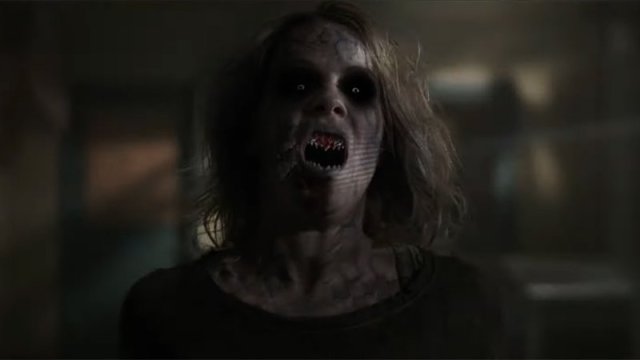
And hire the right master of the macabre to design your creature costumes, makeup and effects. Here, it’s Ehsan Bigloo, who conjures up assorted wraiths, demonic corpses and a genuinely chilling Grim Reaper, cape and cowl, Satanic hands, everything but the scythe.

First-time feature writer-and-director Justin Dec makes the jump from “miscellaneous crew” credits with this latest variation of “the killer app,” a horror subgenre involving the cell phone as harbinger of death (“One Missed Call,” “Cell,” etc.).

Here, it’s a new “Countdown” app that has all the kids abuzz.

“If you could know exactly when you’re going to die, would you WANT to know?”

You know “kids.” Sure. Download that bad boy. “Accept” that “User Agreement.” “Fine print?”  Who has time to read anything longer than a tweet?

Some get the good news of lives of great longevity. Others? Days. Hours. Tick tick tick tick…

“Countdown” doesn’t just count you down to your untimely demise. It all but takes over your phone. It’s malware you seemingly can’t delete — like MacAfee, only free.

And it hits you with these shrieking, insistent “alerts.” Especially when you try to alter your fate by cancelling a trip, ducking out of a car whose driver is drunk, etc.

If we learned nothing else from the “Final Destination” franchise, it’s that “death’s grand design” will not be thwarted. Dodge a drunk driver here, get yanked into the air and dropped on a tub there.

count2.jpeg

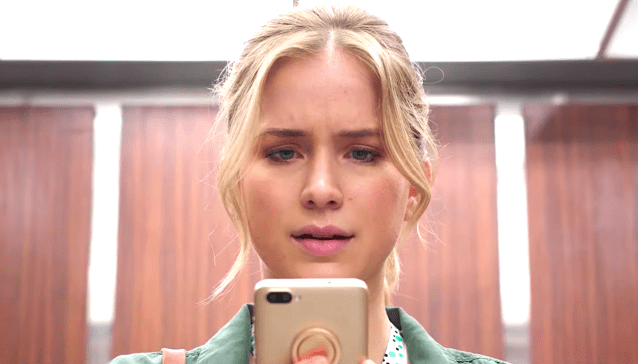
Elizabeth Lail is a nurse whose patient, grimly awaiting his “Countdown” clock to wind down, probably in surgery, convinces her to offhandedly add this new app and unthinkingly click “accept.”

When the patient dies — a prologue sets up”the app that decides when you die inevitability” — Nurse Quinn, Medicine Woman has a moment of doubt. She won’t reach “worry” and “panic” until later.

The tech-nerd cell phone “doctor” (Segura) is awfully droll about how Quinn, and another panicky customer (Jordan Calloway) have been suckered in to this obviously fake app designed to scare the life out of you. But Quinn and Matt are seeing things. And people are dying.

It takes two priests, one referring them to another, the demon “expert,” to get some answers.

“The Bible is like, the ULTIMATE graphic novel!” Father John (Byrne) enthuses. Best line of the movie. Demons in chapter after chapter, descriptions, myth and apocrypha thrown in.

There’s a #MeToo set up, with a creeper doctor (Facinelli), and attacks that the new couple, bound by the shared threat, face together, along with demonology-based “solutions” and an ending that isn’t the worst “How do we write a way out of this?” I’ve seen.

It’s not highbrow entertainment. Movies like this always feel “designed,” like a theme park ride — story beat, JOLT, exposition exposition JOLT, etc. But “Countdown” manages the bare minimum — the occasional shock, characters we root for, thanks to the actors playing them, and situations fraught enough that the audience is talking back to the screen.

2stars1


MPAA Rating:  PG-13 for terror, violence, bloody images, suggestive material, language and thematic elements

Cast:  Elizabeth Lail, Jordan Calloway, Talitha Eliana Bateman, Peter Facinelli, with P.J. Byrne and Tom Segura

Credits: Written and directed by Justin Dec.  An STX release.

Running time: 1:30

Posted in Reviews, previews, profiles and movie news | Comments Off on Movie Review: The grim reaper won’t stop the clock once the “Countdown” has begun