
Spreading himself pretty thin, but his track record speaks for itself…
Spreading himself pretty thin, but his track record speaks for itself…
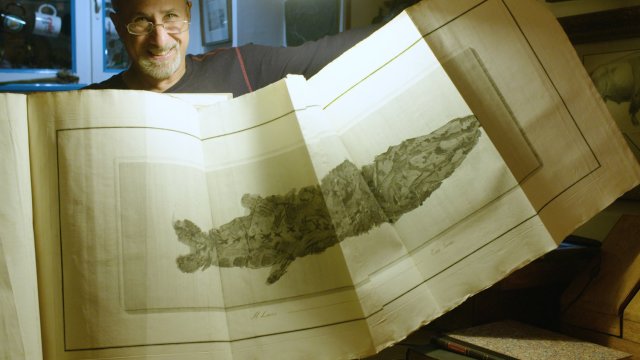
We carry around a picture of an antiquarian book dealer or obsessive book collector in our heads.
White. Male. Tweed.
And there isn’t a lot in D.W. Young’s New York-centric “The Booksellers” that tampers with that. There’s tweed, here and there, the odd overly-curled mustache. It’s a very Jewish world, especially when the film digs into the Anglo-American history of this specialty trade.
But there may be a change coming to the business of collectible books, which is a major thesis of Young’s lovely and lush if meandering, bookshelf browse of a movie. Is the sun setting on this esoteric obsession? Or is a big-city hipster-driven revival turning that around?
It starts at the The New York Antiquarian Book Fair at the Park Ave. Armory, wanders into auctions, digs through the history of the hobby, changes in what is “in vogue” with collectors (signed first editions, first editions with perfect dust jackets, etc.), drifts off message with the “ephemera” (posters, toys, things that belonged to authors) and makes its way into the monumental collections of a hand full of America’s most obsessive “women writers” “esoteric occult books” or “Hip Hop History” or “works of imagination” have filled their weighty wall-shelves with.
Fran Lebowitz, that quintessential New Yorker, remembers the famed “Book Row” of Park Ave. bookstores, dozens of them at one time “run by dusty Jewish men who were very irritated if you wanted to buy a book.”
Journalist/author and book-hound Susan Orlean (“The Orchid Thief,” “The Library Book”) talks about books’ meaning, and about cleaning up her notebooks and “ephemera” and passing them on to a college archive.
And book collecting expert Rebecca Romney of TV’s “Pawn Stars” speaks up, after many other older men in the trade lament “the passing of an era” and the “death of the profession” of book-hunting, book selling and book collecting, noting the hipster generation embrace of the printed page and the slow shift away from the “85-15” ratio of males to females in this world.


We see the auction where an anonymous phone bidder bought Leonardo’s “Codex Leicester (Hammer)” book of scientific writings and illustrations for $30 million+ in 1994.
And we scan the covers of leather bound historical volumes, printed on parchment or velum — as well as occult works bound in human skin. The idea of books as “objects” or art, quite aside from their printed pages, has never been presented with more clarity than here.
“The Booksellers” doesn’t take care to ID every talking head we see, and waits until the last half hour to show us the folks who drive this industry — the collectors. It’s still a bibliophile’s delight, a time trip back to bookstores long gone as well as the Argosy and Strand and Imperial, filled with people of the sentiment that “If books disappear, human beings disappear!”

MPAA Rating: unrated
Cast: Fran Lebowitz, Susan Orlean, David Bergman, William Reese, Rebecca Romney
Credits: Directed by D.W. Young. A Greenwich Entertainment release.
Running time: 1:39
The trailers for this Universal horror tale have been paranoid, overwrought and money in the bank.
And the movie Leigh Whannell delivered is earning terrific reviews.
That should translate for a boffo weekend at the box office, as Variety likes to say. The trade mag is saying “The Invisible Man” is sure to pull in $20, maybe as much as $30 million on the last weekend in this Leap Year February.
Star Elisabeth Moss, who is good in everything, has a shot at becoming the next bankable leading lady in the movies if this thing blows up. She gets to star in indie or lower budget fare like “Her Smell,” but is generally consigned to supporting roles on the big screen — “Us,” etc.
TV is another matter, where “Mad Man” made her a household name and “The Handmaid’s Tale” made her the go-to actress for edgy drama about underdogs.
“Sonic the Hedgehog” will surrender the top spot to “The Invisible Man,” but it’s already made bank —$115 million domestic,and counting . The REAL movie to watch is “The Call of the Wild,” on which 20th Century (no longer Fox) spent $125 million on CGI animals (real dogs would have been more time consuming, limiting in terms of dangerous stunts, more empathetic and CHEAPER). It’ll roll into the weekend with about $36 million in the bank, and they need a big weekend or three to have a prayer of breaking even with the monstrosity.


“Ride Like a Girl” is a feel-good tale of pluck, family and breaking gender barriers in the family business.
The “family business” here is jockeying, something every one of Paddy Payne’s ten offspring took up, under daddy’s supervision. A competitive profession in horse-racing mad modern-day Australia, that setting suggests risk in pursuit of glory, and in this case, triumphing over one of the most notoriously sexist cultures in the English speaking world.
It’s a sentimentalized biography of Michelle Payne, the first female jockey to win Australia’s most prestigious horse race, the two mile long Melbourne Cup, which has been around since 1861. And if it pulls its punches on the sexism thing, sanitizes the extreme measures undertaken by riders to “make weight” and burnishes horse racing by leaving out the unpleasant business of a horse dying in a race every three days, well, all good family fun, right?
Sam Neill plays Paddy the patriarch, a warm but stubborn widower who presides over a noisome riot of children after his wife’s death. He piles the brood into an old ambulance to deliver them to (Catholic) church, doesn’t get too bent about food fights at Sunday dinner, and raises one and (almost) all to be what he knows how to teach them to be — jockeys.
Of the two youngest siblings, Michelle “Shelley” and Stevie, only one will carry the family name into the saddle. Stevie has Down’s Syndrome. The two are thick as thieves, sneaking under the dinner table to devour all the dessert during the chaos of that food fight.
Shelley (Summer North) is as willful as her dad, and being disciplined sends her off in a huff. We see her dragging a shovel down the driveway.
“Where’re you going with that, Little Girl?”
“To dig up Mum,” because she’d treat her with more indulgence.
Years later, Dad’s still calling her “Little Girl,” and Michelle (Teresa Palmer of “Lights Out” and “Hacksaw Ridge”) has become a problem student at Catholic school, slipping out of the classroom several times each day. Sister Dominique (Magda Szubanski) suspects bulimia.
Dad shrugs that off with a “Sister, you’ve obviously never jockeyed” crack. But the good sister works on daddy’s “little girl,” trying to convince her there are options open to her other than the family business.
Her dad’s peers are dismissive of her dream (female jockeys aren’t rare at this point, especially in her family) — “Girls don’t ride in the Melbourne Cup!”
But Paddy is the sage, teaching her “patience,” that “when a gap (between other riders) appears, that’s God talking to you,” and that “a horse gallops with his lungs, perseveres with his heart and he wins with his character.”
Neill, like the real Paddy Payne, a New Zealander, is at his warm and crusty best in a role that gives him all of the movie’s best lines.
“How can a horse that was winning come in last, Dad?” his son Stevie asks.
“Because he was fast at the wrong end of the race!”
Actress turned director Rachel Griffiths gives her actors their moments and makes the most of the real Stevie Payne, playing himself in the adult scenes. A montage of “She got last, Dad” commentaries amusingly gets across Michelle’s struggles to master her craft.
Setting those struggles to The Cranberries’ “Dreams” is a tad on-the-nose, but that’s how the game is played in sentimental biopics like this.
There’s a father-daughter rift, Michelle faces the brunt of Oz sexism trying to make it on her own, tragedy, more struggles and triumph play out the hand this story gives us.
Palmer, who just turned 34, may never let us forget she’s a trifle too old and experienced to be playing the callow high school and college age Michelle. Those scenes pass, though (the real Payne came to fame at 30) and she makes the most of the limited drama the screenplay gives her.
She gets across the tomboy nature of the character best in a wedding moment, scrambling to get her shoes on as she stumbles into the church late, catching a bridesmaid’s bouquet on the fly as she stumbles to her place in line.
Director Griffiths, an actress who has given plenty of such “real” moments in a career spanning “Muriel’s Wedding” and “The Rookie,” finds a few places in the script to suggest that familiar rhythms of life-being-lived touch — Paddy’s fatherly way of helping her mount up, etc.
But playing down the gender barrier — which is the whole point of telling this story — Michelle had to overcome mutes the impact of the drama. We get only a glimpse of the bitching condescension of the male jockeys, barking and griping at her mid-race as well, the uncomfortably crowded unisex post-race whirlpool and the creepy come-ons of a trainer she wants to ride for, shortchanges “Ride Like a Girl.”
Big emotional moments play like teases, and Palmer is given no chance to show us the interior life of the rider. No, there’s no “love story” because the movie suggests she never so much as considered a social life.
The whole affair plays as muzzled, truncated and incomplete — a ten furlong dash through a two mile (16 furlong) race.

MPAA Rating: PG for some thematic elements, language and suggestive comments
Cast: Teresa Palmer, Sam Neill, Stevie Payne, Genevieve Morris, Sullivan Stapleton, Brooke Satchwell, Henry Nixon and Magda Szubanski
Credits: Directed by Rachel Griffiths, script by Andrew Knight and Elise McCredie. A Saban Films release.
Running time: 1:38


Movies about making movies are a favorite subject of first-time filmmakers. Yeah, it’s narcissistic. But if the rule of thumb is “write/direct what you know,” that’s the thing most obsessives who want to be in the film business know best.
Yes, most such movies only find a home in film festivals, where the cinema-savvy audience, like the crew, is “in on the joke.” But every now and then, a “Living in Oblivion,” “The Big Picture” or the like makes it into the mainstream. And sometimes a “Disaster Artist” makes one so bad it grows its own cult.
“Greenlight,” as you can guess from the title, is about getting the go-ahead (“green light”) to make your first movie. It’s an intriguing premise, not horribly executed. It just lacks the boldness to do something really “out there” with this idea, and it has an ending that reflects that loss of nerve.
It’s about an aspiring director, Jack Archer (Chase Williamson of “Camera Obscura” and the horror podcast “Video Palace”), so desperate to make that first feature that he weeps to the would-be C-list producer (veteran heavy Chris Browning of “Westworld,” “Ray Donovan,” etc.).
With the “Nobody’ll let me make a movie until I make a movie” Catch-22 that faces every film school graduate — and the staggering student loans that come with it, you’d weep too. Beautiful novelist girlfriend (Evanne Friedman) whose parents call him a “bum looking for another handout” to his face?
Thank heavens Moseby (Browning) has pity. Or something.
“This is your moment, man, your ‘Piranha II.'”
That’s the humor in movies about making movies. The set and the story it tells are about movie biz “types,” the dialogue is inside-baseball and jargonish.
“This is the martini, everyone!”
The flattery is empty “I love your work” lies.
And the goal in this corner of filmdom is to make a movie as famous and infamous as “Piranha II,” the no-budget mess than “made” James Cameron a movie-maker.
But at what cost? Jack gets a hint when his cast is presented to him. Nancy (Caroline Williams) is a B and C picture veteran. Turns out, she’s Moseby’s wife.
His DP pal (Shane Coffey) just says to suck it up and make this Deal with the Devil work. Which Jack does, until the day he’s told “I need you to make the last killing in the movie real.”
Yup. Moseby wants an actor killed on camera. And he will blackmail Jack to get this outcome, or kill a bunch of people Jack cares about, or Jack himself, if he doesn’t.
Digging into the production files to see what happened to the original director of “Sleep Experiment” isn’t encouraging.
For an 85 minute film, “Greenlight” takes too long to get started. Too many of those #whitefilmschoolgradproblems are passed on, and repeated ad naseum as they struggle to get Jack to that fateful meeting with Moseby.
The performers are accomplished enough to be diverting. But the viewers’ mind conjures up far more intriguing directions for this to go in from the moment an aspiring starlet (actress and producer Nicole Alexandra Shipley) says “I know someone looking for director.” There are much more sinister things one could be with Moseby, Faustian things.
Instead, they go for the most pedestrian motivation of all. And while there’s a modicum of suspense as Jack tries to reason/wriggle his way out of this upcoming “kill shot,” “Greenlight” blows the ending. Completely.
It’s a horror tale a little too good to be a “film festival only” movie, a little too promising to appreciate on its own pedestrian terms.

MPAA Rating: unrated, violence
Cast: Chase Williamson, Evanne Friedman, Chris Browning, Shane Coffey, Nicole Alexandra Shipley and Caroline Williams
Credits: Directed by Graham Denham, script by Patrick R. Young. An Entertainment Squad release.
Running time: 1:24
He’s the writer. Laura Linney’s who he ended up with. Elle Fanning is the result.
And Salma Hayek is, in some form, one of “The Roads Not Taken.”
Sally Potter directed this March 13 release.
This looks lovely and reaches an audience the major studios neglect.
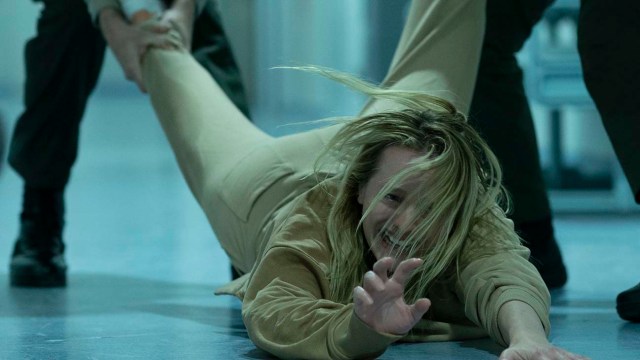
Elisabeth Moss has the best “resting tormented face” in the business. So she’s perfectly cast as a abused, haunted wife certain her dead control-freak husband is manipulating her life and attacking her and those close to her in “The Invisible Man.”
Leigh Whannell, screenwriter/actor of the “Saw” and “Insidious” movies, has written and directed a brilliantly-acted, thematically-simple, technically-adept thriller of genuine suspense, a movie where the faintest noise in dead silence chills you to the marrow.
And Moss is the EveryWoman on screen, terrified and shocked, and in her most haunted moments resigned to this terror that only she believes is being visited on her.
Cecilia is introduced in bed, staring at the clock that reads 3:42 a.m. This is her chance. She slips her sleeping husband’s arm away from her, quietly calls his name, and washes out the glass she used to drug him.
Grab the “bug out” bag with her ID, cash and a few clothes, redirect a security camera so she can be sure he hasn’t leapt up to chase her, try to get the dog to understand she’s not coming back, and then flee the modernist, remote, cliffside Northern California mansion. When you’re desperate, climbing a wall and scrambling through woods for a narrow escape is the price you’re willing to pay.
We get a taste of the abuser Adrian (Oliver Jackson-Cohen) is. A big taste.
It’s no wonder that Cecilia doesn’t stay with her sister (Harriet Dyer). She lays low with a friend of sis. James (Aldis Hodge) is a single-dad cop with a daughter (Storm Reid) ready for college. It’s all he can do to get her to open the door of this “safe” house.
His reassurances that “He’s not out there” are cold comfort. Even the news that Adrian killed himself days later isn’t reassuring. She knows him. And when she fled the house, we glimpsed its Tony Starke lab downstairs. Adrian’s source of wealth was optical technology.


If anybody could fake his death, it’d be him. And when weird stuff starts happening in the safe house — a stove turned up here, sheets pinned to the floor by an unseen foot there — she’s sure he’s back, stalking her in some Harry Potter cloak of invisibility.
Her sister all but rolls her eyes. James the cop can’t reason with her. “Don’t let him win by bringing him back to life.”
And the dead man’s lawyer-brother (Michael Dorman) can’t convince her that this tricky inheritance Adrian left her isn’t a trap, and that her late husband is in “that urn over there” in his office.
“The Invisible Man” is a true tour de force for Moss, who is starting to earn those (“Her Smell”) on the big screen as well as the small one. She lets us see Cecilia unravel, all but taking us through the stages of death and dying as Cecilia is assaulted, scared out of her wits and traumatized by the degree of “control” HE still exercises over her.
If there’s a big flaw in the film, it’s the common one of the genre. We aren’t given enough doubt about what she is experiencing — real “invisibility,” old-fashioned haunting or all in her medicated and increasingly-deranged head.
Whannell also slaps an anti-climactic coda on the tale that feels as unnecessary as as saying, “See, she looks SCARED!”
But with a lot of silence, some wonderful, minimalist effects doled out for maximum shock value, and a focused, fear-filled turn by Moss, Whannell has updated a timeless title with a genuinely horrific message. We’re never alone. We’re being watched and “controlled,” even if we were never said “Til death do us part” to the wrong spouse.
MPAA Rating: R for some strong bloody violence, and language.
Cast:Elisabeth Moss, Aldis Hodge, Storm Reid, Harriet Dyer, Michael Dorman and Oliver-Jackson-Cohen
Credits:Written and directed by Leigh Whannell. A Universal release.
Running time: 2:04

She is not stylish.
Quiet, demure, “mousie” we used to say, she is anonymous, invisible — barely noticed and when she is, it’s to slough off some unpleasant bit of personal or busy work.
She’s just been on the job five weeks, but she’s already proficient at the requirements of being “first in, last to leave” at this motion picture production company. She makes coffee, loads the mini-fridge with Fiji Water, empties trash, juggles schedules, prints out and binds scripts, balances her boss’s personal expenses ledger.
And she puts on rubber gloves, goes in and tidies up his office, hours before he arrives, scrubbing stains we never see, saving dropped earrings we do.
She is “The Assistant,” a minutely detailed character study in the drones — go-getters fresh out of college or entitled offspring hired as a favor to relatives and someone you may need a favor from — the faceless, mostly silent “entry level” folks who make the world work for the people who make movies.
And if Harvey Weinstein’s trial is the perfect context for this timely “#MeToo” era drama, they are the cowed eyewitnesses to Hollywood’s casting couch culture and its binding code of silence.
Julia Garner of TV’s “Ozark” is plain Jane — never named in the movie, new to the job and impassively accepting the low-woman on the totem pole off-loading of work that her two senior fellow assistants (Noah Robbins, Jon Orsini) leave her to deal with.
An irate, scratchy phone connection — “It’s the wife.”
“Why me?”
Shrug. Why indeed?
“How was YOUR weekend?” one who bothers to return her early morning pleasantry asks.
“I was here.”
Documentary filmmaker turned first-time feature writer/director Kitty Green shows us a day in this young woman’s life — up well before dawn, availing herself of the studio’s car service, dozing with binders in her lap at the start of the day, picking at yet another pastry at the darkened end of it.
Garner plays Jane as poker-faced, first scene to last. Except for those moments when she gets a half-overheard tongue lashing from The Boss, whom we never see and she probably doesn’t either. He’s the sort that brings her to silent tears over the fact that she’s not doing a good enough job of placating his irate wife. Her every transgression requires an emailed apology.
Her two semi-smug colleagues edit each mea culpa for her, standing over her shoulder. “Thank you for this opportunity you’ve given me. I won’t let you down again.”


Anybody expecting high drama or even a little righteous outrage and “Hollywood” melodrama may feel sorely let down by Green’s portrait.
This is a film of quiet, florescent gloom, conversations overheard, whispers, Jane always glanced at and then ignored. A favorite moment — she gets on an elevator with a movie star. He says nothing, she says nothing. She probably isn’t allowed. It’s Patrick Wilson.
Of course there has to be an arc to this character, this milquetoast Hollywood version of assistants we’ve seen in “The Devil Wears Prada,” “Swimming With Sharks,” “The Big Picture” and “30 Rock.” An even younger and prettier young thing (Makenzie Leigh) shows up, flown in from her waitress job in Idaho. She’s to be the fourth “assistant.” And Jane has to take her to the swank hotel where they–HE– are putting her up.
Matthew McFadyen, co-star with Keira K. in the big screen “Pride & Prejudice,” plays the sympathetic HR guy who hears her timid complaints, and we get a dazzling, understated dose of his transition from “You can tell me. That’s what I’m here for,” to “Do you like working here?”
That’s about as dramatic as “The Assistant” gets. There are a dozen ways Green could have goosed the script, even slightly, to give us a little more and make this movie more of a meal.
But there’s value in seeing the hierarchy at such studios, the endless meetings and the egos, the “wheels’ up” coast-to-coast juggling act, and the cavalier treatment of underlings and other people’s time.
Only “The Chairman” gets an office. Everybody else has a cubicle. Everybody else has to take it, to wait — in the limo, on the tarmac, in the conference room. And any “It gets better” can be grimly laughed off. Here’s that one long-suffering cubicle VP (Alexander Chaplin) who endures the worst of it, like Jane, forced to deal with every appointment blown off for a casting session, irate Chinese investors left hanging because The Boss is on “personal time.”
Somewhere. Somewhere with room service.

MPAA Rating: R for some language
Cast: Julia Garner, Matthew McFadyen, Noah Robbins, Makenzie Leigh, Jon Orsini, Alexander Chaplin and Patrick Wilson.
Credits: Written and directed by Kitty Green. A Bleecker Street release.
Running time: 1:27

The jokes and impersonations tip the hand of “Addicted to You.”
Cracks about “a modern day John Cusack” and Kate Hudson, “Never Been Kissed” and hearing “Helen Hunt’s voice in your head” (“What Women Want.” A stoned Matthew McConaughy impersonation. A character a little too INTO you too quickly?
“Does Aimee own ’27 Dresses?'”
Break it down for us sidekick David — “You’ve got yourself a classic rom-com.”
If only.
“Addicted to You” is a crude, laugh-starved and vulgar C-list copy-and-paste of “How to Lose a Guy in Ten Days,” and proof of the thesis that if you’re going to steal, you might want to aim higher than a movie nobody EVER called a “classic.”
It’s built on that rom-com staple since Shakespeare’s day, two people lying about who they really are meeting and falling for the dishonest version of each other.
Luke — played by Florida wrestler-turned-actor Shane Hartline — is a 30something meme generator at Buzz Story, working with his bros Jackson (Choni Francis), David (Garrett Mendez) and Wendy (Tara Erickson), living by the credo old Uncle Doug (Alex Walters) taught him as a lovesick tween.
“Follow my one rule! ‘Thou shalt NOT fall in love!'”
Uncle Doug’s dead now, just like Michael Douglas’s Uncle Wayne in McConaughey’s “Ghosts of Girlfriends Past.” Also not a classic.
The new flirt at work, Aimee (Cat Alter) hurls herself Luke, beds him, drops the “L” word the morning after, and blurts “I decided we could be good together, like Lucy and Ricky, or Sid & Nancy! Want to meet my MOM?”
That’s Luke’s trigger. He needs an out. What he and his pals come up with is “I’m a sex addict. I’m in recovery.” Funny thing, their boss (Warren Burke) is in “a group.” He understandingly drags Luke into it.
And another funny thing, Kara (Melissa Paulo) is a star writer at SNS Magazine, and her “Sorry Not Sorry” boss (Patricia Viletto) wants a story on dating a sex addict. Kara ends up undercover at that same support group.
I’ve used the phrase “funny thing” here hopefully, but that’s not accurate. The “meetings” are as artificial as their setting — on a high school theater stage (Hey, the lights were already hung, etc.). And the courtship that follows is just as contrived.
There’s a lot of riffing and comical crudity over everybody’s various shades of kink. The performers sound like improv veterans.
“I’m dating an emo. We’re working on penetrating…our FEELINGS.”
Everybody’s got a few go-to impersonations — Jack Black, Obama, Seth Rogen, Larry the Cable Guy. Team Luke gets messed up with an evening of 40 ouncers, “magic drops” and a five-apple bong. That turns them all into animated versions of themselves, Beavis and a lot of Buttheads.


Some players try WAY too hard (Francis co-wrote the script and hits his punchlines so hard he leaves a mark.). Others give us a taste of R-rated sitcom whimsy. David’s new hook-up (Ashley Crystal Hairston) is seduced with the old fake-wedding ring routine. And she’s all in.
“Brittany’s offering BUTT stuff,” David sings — improvising his own autotune as he does. “Buuuuuuuttttt stuff! It’s my ROSEBUD!”
As limp as the laugh lines are, when “Addicted to You” (“Addicted to Love” anyone?) turns sensitive and serious, the eye-rolling only gets worse.
Some of the “let’s fake how hot we are for each other” vamps are laugh out loud funny in a sort of over-the-top acting exercise way. Alter stands out in those moments.
Mostly though, this addiction is too easy to shake, a rom-com that’s content to reference “classic” rom-coms, without making the references funny or for that matter improving on them.

MPAA Rating: unrated, with frank sexual situations, drugs, profanity — mild violence.
Cast: Shane Hartline, Melissa Paulo, Cat Alter, Choni Francis, Ashleigh Crystal Hairston ,Garrett Mendez, Tory Devon Smith, Patricia Villetto
Directed by Mike Cochnar, script by Mike Cochnar, Choni Francis, SteevJBrown. A Leomark release.
Running time: 1:35

 Movie Nation