
A gritty, needy fever dream of New York “fame” comes our way Feb. 21.
A gritty, needy fever dream of New York “fame” comes our way Feb. 21.

“Airplane Mode” is a shiny little rom-com bauble from Brazil that strains and strains to find a laugh.
It’s about cell phone addicts, “influencers,” fashion, family and finding love where the pace of life is a lot slower than in the big city. So it’s an incredibly old-fashioned comedy dolled up in “this year’s fashion” accessories.
Larissa Manoela is Ana, who lives at home. Her life is a life-streamed/selfie-packed Instagrammed blur of fashion, makeup, staged events and staged romance.
She seems to live at home because who has the time to move?
“True Fashion” is her ethos and True Fashion is her Sao Paolo employer, a youthful clothing company ruthlessly run by Carola (Katiuscia Canoro), who has Ana under contract for a reason. She’s insanely popular on the web, and what she wears EVERYbody must wear.
Sure, Ana studied clothing design in school, but who has time to MAKE when just “showing” what others have made, and gushing over it in vlog posts, is so much easier?
She’s paired up, romantically, with a stylish and stylishly flaming designer — just to get the page-views. If a “break-up” is good for business, that can be staged, too.
But Ana’s phone is her undoing. How many wrecks can she have in one month? Her parents know about eight, from the DMV. That isn’t counting the one she has the morning we meet her, or the Fiat-flipping fiasco that ends her day.
“Court ordered” loss of license, and removal of her cell phone is all there is for it. And sending her off to her estranged grandfather’s house in the “no cell reception” hinterlands is just a way to remove temptation from her reach.


The country is where car-restorer, widowed Grandpa Germano (Erasmo Carlos) can teach her to wrench, to “make” instead of “show.” It’s where “hick” baker João, played by André Luiz Frambach, can show her the joys of being “geniune” — the simple pleasures of a country fair.
All of this sentimental crap is straight out of the 1940s, and the only people who buy into it — in Brazil, Britain or the U.S. — are old folks and those “left behind,” trapped in the villages and small towns everybody else has fled. As if the country is the only place you can “know yourself,” as Ana claims.
Nonsense, says the villainous Carola. “Oh sweetie, knowing yourself is the first step to self-loathing!” (In Portuguese, with English subtitles, unless you switch to the “dubbed into English” mode.)
That’s it, the only funny line in the entire movie. There’s a cute twist in the third act, and an utterly predictable “betrayal” or two, and “getting even” scheme.
Every action, event and character in the movie could be predicted by a tween who has seen more than four movies in her life. It’s “obvio,” as they say in Brazil.
Entirely too “obvious” to ever be funny.
Manoela is cute and perky and probably web-friendly. But as Ana learns in “Airplane Mode,” honey — that’s just not enough.

MPAA Rating: TV-PG
Cast: Larissa Manoela, Erasmo Carlos, André Luiz Frambach, Katiuscia Canoro
Credits: Directed by César Rodrigues, script by Alberto Bremer and Alice Name Bomtempo. A Netflix release.
Running time: 1:35

The Best International Feature Film Oscar, formerly titled “Best Foreign Language Film,” is going to Korea’s “Parasite” this year. Bong Joon Ho’s social satire is the closest this thing year’s Academy Awards have to a sure thing.
But Poland’s entry in the category, “Corpus Christi,” is a minor miracle in and of itself. Warm and faith-affirming, predictable — with just enough edge — it’s a bracing delight in the middle of decades of stories of Catholic Priests Behaving Badly.
Daniel (Bartosz Bielenia) is a hollow-eyed, hollowed-out young man finishing up his term in a Polish juvenile detention center. He goes along to get along with the awful routines there, standing watch while the prison toughs carry out sexual assaults, dreading the return of a thug who has a murderous grudge against him.
Sunday morning Mass is his break from routine. Father Tomasz (Lukasz Simlat) lets him help set up the service and relies on him to sing the Twenty-third Psalm every week.
But that dream Daniel has about the seminary is misguided, at best. He’s not the type, we think. Father Tomasz reminds him (in Polish, with English subtitles) that “no seminary takes ex-convicts” like him. No, the job at a distant sawmill is the best he can hope for upon release.
As if to make the good Father’s point, Daniel swipes a clergical collar, shirt and outfit when he checks out. He ducks into town long enough for a sex, drugs, punk-rock and booze binge, and boards the bus.
But his long walk from the bus to the mill lets us see his despair at this future. Everybody he meets guesses his story — ex-con, sawmill bound. His quick look-over the place firms his resolve that it’s not for him.
Becoming a fake priest? That happens by accident. He ducks into the local church, misses the final mass of the day, and when the pretty daughter (Eliza Rycembel) asks him what he does as he assures her he is NOT working in the mill, he improvises.
“I’m a priest.”
“And I’M a nun!”
Nothing impresses the ladies like a collar. Father uh, TOMASZ he calls himself, lying just well enough to pass muster with the aged vicar (Zdzislaw Wardejn), who basically invents his story with the questions he asks”Father Tomasz.”
He’s just out of seminary, and he’s on a wandering pilgrimage through the parishes of Poland. Come, help me with mass. Hey, I’m not feeling well, take confessions for me, wouldya?
Director Jan Komosa and screenwriter Mateusz Pacewicz trot Daniel and the viewer through a lot of predictably adorable “learn to be a priest on the fly” gags — Googling “How to take confession” on his smart phone, etc.
But Daniel, who won’t talk about why he was in prison, told this lie for a reason. You can’t call it a “calling,” but something about the robes, the responsibilities and the power of the position intoxicates him. As he’s parroting the last sermon we heard Father Tomasz give to the inmates in the prison, Daniel gets carried away.
And so does “Corpus Christi.”
Because for all the lighter touches, the predictable stations of the cross of such movies (fear of discovery, romantic temptation, “tests”), this is a town still in mourning for a terrible car accident that took several of its young people.
People are hurting, and hurting each other with blame. Daniel’s tossing common sense in the Confessional, and at Mass. How hard can healing this rift be?
Bielenia beautifully pitches his performance to match Daniel’s state — hollow-eyed and hollowed-out at first, with the ex-con’s avoid-eye-contact condition — beatific, self-righteous and cocky as the circles clear up under his eyes, he finds his purpose and starts to flex his priestly muscles.
He’s “the cool young priest” who can drink beer and smoke with “the kids,” and he’s noticing the lovely, sad Eliza (who lost friends in the wreck) noticing him.
I found the entire enterprise a touching, rough-hewn delight, never sparing us the explicit sex and violence of Daniel’s life “before,” moist-eyed in seeing how his “outside the collar” thinking is a tonic for a tortured town that needs to move on.

MPAA Rating: unrated, violence, strong sexual content, profanity, alcohol abuse and smoking.
Cast: Bartosz Bielenia, Aleksandra Konieczna, Eliza Rycembel
Credits: Directed by Jan Komosa, script by Mateusz Pacewicz
Running time: 1:55
Lisbon’s slums are the backdrop for a Pedro Costa’s acclaimed story of a woman from the Cape Verde Islands searching for traces of her late husband in this Feb. 20 release.

“The Gentlemen” is vintage Guy Ritchie, an old-fashioned/new-fangled mob tale of the “Snatch,” “Lock, Stock and Two Smoking Barrels” Cockney comedy with lots of killing thrown in.
None of this “Aladdin” nonsense. It’s “RocknRolla” — the entertaining but weak third film in his early gangland trilogy, and most apt comparison here — all the way.
Ritchie’s rounded up a lot of folks who can act tough and handle funny — Charlie Hunnam, Eddie Marsan, even Michelle Dockery (“Downton Abbey”), with an Irishman (Colin Farrell), an American (Matthew McConaughey) and a couple of reinventions. Hugh Grant tosses aside a lifetime of forelock-tossing, stuttering, posh romantic leads and turns amusingly sinister, or attempted sinister. And Henry Golding dodges the Hugh Grant bullet by ditching the “Crazy Rich Asians/This Christmas” fey romantic lead rep for a badass turn, playing a hothead named Dry Eye.
Oh yeah, there are some screwball street names — Lord George, The Coach, Trigger, Lord Snowball, Phuc and so on.
It’s built on slang and banter — pages and pages of plot and recitative, characters telling their portion of the story, making mob gorilla threats and introducing snippets of British street-speech to the larger world.
“When the Silverback gets more ‘silver’ than ‘back, he’d best move on. Before he gets moved on.”
All that speechifying slows down the works.
“Gentlemen” takes-an-entirely too-leisurely stroll through Brexiting Britainnia and the coming Legalization of Pot (“Bush,” over there, “cup of tea,” “white widow super cheese.”
It’s a marvel to listen to. But man, is there a lot of listening to do. And listening.
The story is framed in a blackmail pitch by sniveling private eye Fletcher (Grant), a verbose and probably-gay hireling of the UK’s notoriously vindictive print press. He’s strong-arming Ray (Hunnam) a top mob lieutenant to American-born/Oxbridge educated Pot King Mickey Pearson (McConaughey).
The third-year-film-student conceit to this “pitch” is that Fletcher presents his blackmail-worthy revelations as a screenplay he’s written that he expects Ray’s boss to pay a fortune to suppress.
Student filmmakers make movies about wanting to make a movie. Not that Fletcher is all hellbent to make it. The £20 million pounds he wants to NOT make it would work, too.
Fletcher, winking and flirting (Ray may be gay, too and UNinterested — adds some frisson to their scenes) through this pitch in Ray’s tony suburban designer house.
He knows Mickey is looking to sell out his Britain-wide pot network, lays out how Mickey has circumvented Britain’s land-shortage and land-“rambling” rights nationwide — Who could hide a grow farm in all that traffic? — and how he and his “Cockney Cleopatra” (Dockery) have their price and an American “Jew” buyer (Jeremy Strong).
But the Chinese mob run by Lord George (Tom Wu) and fronted by murderously ambitious Dry Eye (Golding) want in.
And then there are the brawling, boxing rapper-wannabes of the gym run by The Coach (Farrell). They’re black.


Ritchie has cooked up a racial stew of Cockney rhyming slang, spit-out rap lyrics, racist Chinese pidgin English wisecracks and veiled anti-Semitic jokes for this story of a rushed sale in “the puff game (pot)” before “the new gold rush” begins, with pot legalized with whoever controls Mickey’s empire having the leg up on the big, new market.
Landed gentry and their heroin addict kids, a boorish, crude and vengeful newspaper editor (Marsan), movie mogul, illegal firearms, from “paper weight” size to military-grade and lots and lots of funny lines dress up a story of social or underworld insults and the mob war that spins out of that.
So much bartering — “Unlike salt and pepper, it’s not on the table.” — much of performed by McConaughey, who drawls like an American who’s picked up the “you lot” affectations of Brit-speak.
And all this lawbreaking, with nary a bobby in sight.
“In France, it’s illegal to name a pig ‘Napoleon. But try and STOP me!”
It’s all so witty and quotable, with interruptions for the old Guy Ritchie ultra-violence and dark sexual kink, with shots aimed at the British press and British aristocracy and a whole lot of “foreign” people of color being fended off by white Brits and an American transplant.
Very “now,” in other words. Ritchie papers over a paper-thin story with artificial twists and very funny turns by the likes of Farrell, Grant, Marsan and Dockery.
He gives us a lot to chew on as text, and disturbing (Racist?) subtexts. And when the movie’s forward motion is as halting as a Hugh Grant stutter, we have entirely too much time, in mid-movie, to chew on it.

MPAA Rating: R for violence, language throughout, sexual references and drug content
Cast: Matthew McConaughey, Michelle Dockery, Charlie Hunnam, Henry Golding, Colin Farrell, Eddie Marsan, Jeremy Strong and Hugh Grant
Credits: Written and directed by Guy Ritchie. An STX release.
Running time: 1:53

Oh, how we’ve missed that Nic Cage. You know the one — bug-eyed and manic, screaming and profane, scary, unstable and violent.
The B-movie king is in rare form in “Color Out of Space,” a sci-fi thriller that might have been titled “How I Learned to Stop Worrying and Love Magenta” had horror icon H.P. Lovecraft been born a lot later, and — you know — had a sense of humor.
It’s a sci-fi/horror tale put in the hands of Richard Stanley, a horror icon in his own right, thanks to the 1990 cult classic “Hardware.” There are images, sequences and laughs from that one-man-against-a-cyborg in a tiny, dumpy future apartment that stick with you years after you see it.
“Color” is far grimmer going, a disturbing genre piece that might have felt ahead of its time as a 1927 story, but feels like over-familiar ground now. What this one leaves you — OK, ME — with is suffering, a horror of hopelessness with no chance of catharsis.
The shrieks and screams of humans and animals are as pervasive as that “color” emanating from the meteor that arrives on a remote farm and kills or absorbs all that come in contact with it.
Teenaged Goth Lavinia (Madeline Arthur of TV’s “The Family” and “The Magicians”) likes her Lovecraft, keeping a copy of his “Necronomicon” in her farmhouse bedroom. We meet her casting a spell to save her mother (Joely Richardson of “Red Sparrow”) from cancer.
Ward (Elliot Knight of “How to Get Away with Murder”) is the outsider who comes upon her, her artist-dad Nathan (Cage), stoner science-nerd brother (Brendan Meyer) and kid-brother (Julian Hilliard) on their farm sitting on a watershed hydrologist/narrator Ward is surveying.
Nathan has brought them back to the farm to raise livestock. It’s just the sort of livestock you’d expect Nic Cage to herd.
“Now, if you don’t mind, I think it’s time to milk the alpacas!”
The Gardiners are good and stressed before the magenta blob crashes in their yard. This being Lovecraft, that triggering event doesn’t bring good news, good times or a bright future to any involved.

Tommy Chong, in another bit of on-the-nose casting, plays the elderly hippy squatter Ezra, living on the edge of the property. He’s analog in a digital world, and he’s got tapes he’s making after the crash.
“What exactly am I supposed to be listening for?” Ward wants to know.
“The people under the floor, Dude. The aliens!”
Weird things start growing, that color turns up in the light, the fog and the eyeballs of people and critters. Awful things tend to happen to the nicest people after that. And Nathan — as mentioned earlier — goes off in that special Nic Cage way.
Stanley’s career never really recovered from his participation, as writer and uncredited co-director, in “The Island of Dr. Moreau” diva-fest debacle undone by Marlon Brando and Val Kilmer. We all love a comeback, but this one is grim going and something of a drag, when all is said and done.
But it captures the essence of Lovecraft in a couple of important ways. The unpleasantness grows and grows, and logical solutions and escapes are removed, one by one. That shows that the South African filmmaker should be welcomed back out of the wilderness, perhaps with Nicolas Cage as his new muse.
MPAA Rating: unrated, graphic violence, sexual situation, profanity
Cast: Nicolas Cage, Joely Richardson, Madeleine Arthur, Elliot Knight, Brendan Meyer, Q’orianka Kilcher and Tommy Chong
Credits: Directed by Richard Stanley, script by Scarlett Amaris and Richard Stanley, based on a story by H.P. Lovecraft. An RLJE release.
Running time: 1:51

I can’t be the only one who is over zombies. Totally.
Over-exposed, slow-walking or sprinting, George A. Romero “Living Dead” or TV “Walking Dead,” just enough already.
But if you see one zombie movie this year, here’s the one to catch — “Zombi Child.” It rips this Haitian curse out of Hollywood cultural appropriators and puts it back in Haiti, back in the realm of voodoo, where it belongs.
Writer-director Bertrand Bonello (“Saint Laurent”) conjures up a tale with Haitian history, European exploitation, ethnography, race, and voodoo. He weaves three storylines through two settings — Haiti and an exclusive French girls’ boarding school.
And while there are horrors — reserved for late in the third act — it’s everything that comes before that makes “Zombi Child” fascinating.
In 1962 Haiti, we see only a man’s hands as he guts a spiny blowfish, grinds up its entrails with herbs and dusts a powder into a pair of penny loafers.
We see a young man (Mackenson Bijou) wearing those loafers walk, stagger, collapse and “die.” And then damned if he isn’t dug up and hauled off as slave labor, cutting cane on a sugar plantation.
In the present day, Fanny (Louise Labeque) is a member of the French ruling class ensconced in an exclusive boarding school founded by Napoleon himself. All the girls wears red sashes and have this odd hands-crossed way of reverse bowing in respect to their teachers, et al. Napoleonic?
Fanny writes long, poetically purple and passionate letters to her amour, Pablo, a long-haired motorcycling teen she’s obsessed with. Among her classmates, she is most taken with the new girl, Mélissa (Wislanda Louimat). She is black, from Haiti, and she’s in this school because her mother won the Legion d’Honneur for service for France, Haiti and humanity.
Fanny likes that Mélissa dances “like Rihanna.”
“Walmart Rihanna,” one of the mean girls in her sorority snipes (in French, with English subtitles). Even in France, Walmart is a put-down.
But this club is “a literary sorority.” So “Who cares how she dances? Is she cool enough to hang with us?”
Can she pass the initiation? That involves sneaking off with the others, lighting a lot of candles, and reciting a piece of literature, from memory, that says a lot about her.
Mélissa isn’t all that “cool,” but she’s the very essence of “black girl magic.” She tears off a poem, “Captain Zombi” (a real poem) full of fire and fury for the “white world,” reminding it of African contributions to life, work and ethnicity. “Black blood runs through your veins!” Weird she may be (“Hear my zombi ROAR!”), the schoolgirls are suitably impressed.

Bonello shows us the rites and rituals of this exclusive school, including ones the “sorority” girls make up for their group, intercut with the funeral rituals of Haiti, and the commune-with-the-dead incantations of Mélissa’s aunt (Katiana Milfort), her lone surviving relative who tutors and does odd jobs to keep them afloat in France, and practices voodoo as a“mambo.”
And we follow the further adventures of the living dead man enslaved on a sugar plantation way back when.
It’s an utterly immersive Franco-Haitian gumbo, complete with flashbacks, “magic” as practiced by those who know “the old ways,” teen hormones and the zombi origin story.
That’s the point of entree for a horror fan — seeing where Haitian myth, magic and ritual were appropriated and twisted into the dead who feast on the living — lurching and rotting their way through half a century of movies and TV shows inspired by “Night of the Living Dead.”
It’s not the scariest zombi or “zombie” movie ever. But are any of them scary any more? Bonello uses the subject as his jumping off point for exploring what all this undead stuff is really about and how the “white world” has been messing around with it for cheap frights and corpse make-up entertainment.

MPAA Rating: unrated, violence, brief nudity, profanity
Cast: Louise Labeque, Wislanda Louimat, Katiana Milfort, Mackenson Bijou
Credits: Written and directed by Bertrand Bonello. A Film Movement release.
Running time: 1:43

Britain’s funniest comedy troupe just lost one of its most reliable laughs.
Comic, director, mustache-wearer, cross-dresser, Medievalist, history buff and wicked wit Terry Jones has died.
Time to rewatch “Monty Python and the Holy Grail,” which he decreed and directed and co-starred in with Eric Idle, John Cleese, Michael Palin,Terry Gilliam and the late Graham Chapman.
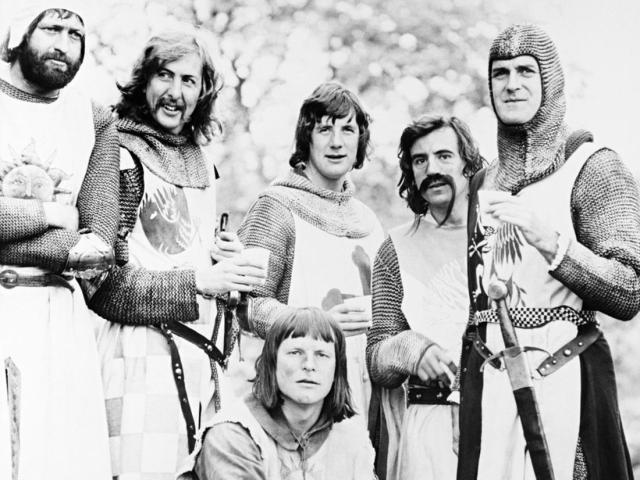
Lovely man. Got to interview him about “Life of Brian” when an anniversary edition DVD came out some years back. That interview is reprinted below.
A real polymath, curious about the world, remembered for his laugh, his lisp, his dresses and his many enthusiasms.
He died just days shy of his 78th birthday.
—————————————————————-
Mel Gibson chose 2004 to release The Passion of the Christ.
Coincidence?
“Some might see it that way,” Brian director Terry Jones says with a conspiratorial chuckle.
“Life of Brian,” you say to yourself. “Wait a minute. Wasn’t that the movie Gibson set out to spoof with his Passion? About a martyred prophet in ancient Judea, a real mama’s boy unjustly crucified?”
BLASPHEMY!
Well, you could see it that way. Pythonists certainly do.
“Life of Brian” returns to theaters (including the Enzian in Maitland on Friday) in all its hilarious, once-controversial glory.
And its director, Jones, now 62, couldn’t be more thrilled. Any connection between Brian’s re-release and the most popular movie of the spring?
“None a’tall,” he sniffs. Besides, he says, “We got there first.”
We believe him because Jones isn’t naked. For once. And he isn’t wearing a dress. Or so he says.
But we have no way of knowing. He’s on the phone from London. And you know how those Monty Python lads can be. Especially Jones.
“I was quite shy as a boy,” he huffs. “And I’ve used my adult life to compensate for that.”
And how. The cross-dressingest, buck-nakedest Python also played the “non-virgin” mother — OK, “mum” — of the martyred non-prophet Brian in the 1979 film. It’s about a lusty but hapless young Jewish, or maybe Roman, revolutionary (Graham Chapman) who gets mixed up with the anti-Roman politics and the messiah circuit in B.P. (Before Python) Jerusalem.
“A religious satire that targeted the corruption of Christ’s message rather than Christ himself,” as critic Leonard Maltin remembers it. But he was pretty much alone in making that distinction. A movie that ends with a singalong on the crosses of Calvary is going to stir some folks up.
The Roman Catholic Church condemned Brian. Rabbi Abraham Hecht of the Rabbinical Alliance of America declared that it was “produced in Hell.”
Brian was banned in some countries and didn’t play in some districts of the United Kingdom for years.
And in the United States, Robert E.A. Lee of the Lutheran Council called Life of Brian “a disgraceful assault on religious sensitivity.”
Well, some people thought it was funny. But in any case, an awful big stink for a $4 million movie made by a bunch of TV comics rather too fond of dressing up like ladies.
Brian came to life when some members of Monty Python had the idea of sending up early Christian history.
Pythoner Eric Idle suggested Jesus Christ, Lust for Glory, playing off the British title of Patton: Lust For Glory, Jones recalls.
“The more we worked on it, the more interesting and outrageous it became. We reread the Gospels, changed the story to Brian, a contemporary of Jesus. We realized, very quickly, that the real humor lay not in what Christ said, but in the fact that 2,000 years after Christ, you’ve got everybody still killing each other because we can’t get together on how we should worship and accept his message of peace and love.”
In other words, people were misunderstanding the message of Jesus, right from the start. “Blessed are the cheesemakers,” one character thinks he hears Jesus say off in the distance during the Sermon on the Mount.
Python and future Brazil director Terry Gilliam did the exceptional biblical production design, “but we lucked out in shooting in Monastir, Tunisia, the same place Franco Zeffirelli made Jesus of Nazareth,” Jones says. “A lot of the same sets were still there. Just had to dress them up a bit.
“Of course, it also meant that you could be shooting your version of the Sermon on the Mount, and some elderly Tunisian extra would say, ‘Well, that’s not the way Zeffirelli did it.’ ”
Just as the film was about to start shooting, the production company, EMI, lost its nerve and withdrew funding. Idle called on his friend George Harrison to help. Harrison backed the movie and made a second, post-Beatle fortune doing it.
“George is actually in the film, just after Brian appears in the window, naked,” Jones says of a famous, much-censored moment in Brian. “You go to an interior scene in the kitchen, like the backstage of a rock concert, everybody wants a piece of Brian, a moment of his time. And John says, ‘This is Mr. Papadopolous. He’s renting us the Mount.’ He pushed George Harrison into the shot. He says ‘Hello.’ But it wasn’t even George’s voice. Mike Palin did his George Harrison impression in the [sound] looping session.”
As with the TV show, Monty Python’s Flying Circus, the six main members of the troupe played multiple roles. The tall, thin “Minister of Silly Walks” John Cleese plays a revolutionary, a centurion who corrects Brian’s bad Latin grammar as he paints anti-Roman graffiti, and a Pharisee.
“John as a Pharisee, a role he was born to play.”
As director, Jones plays fewer characters, though of course, one is naked. He’s the hermit in the hole.
“When I was playing the hermit in the hole, I’d do my shots first.
“I got there, stripped, did my stuff. Graham got there, and we did his stuff with me.
“Then, the crowd arrived and we were moving them around through the afternoon. I was directing them, and Michael came up to me and said, ‘Uh, Terry, you do realize you’re stark naked, don’t you?’ I’d completely forgotten!”
Eventually, every Python winds up in a dress.
“We kind of reached our zenith in drag, I think, in the stoning scene. We didn’t think it would work. You’ve got us men playing women renting beards so that we can be disguised as men, because only men are allowed at stonings.
“We’d tried it with just women in the scene, but several of the guys said, ‘Nah nah nah. We really want to do it.’ ”
And the rest, as they say, is history — $20 million at the U.S. box office alone, to say nothing of millions more in late-night showings, video and DVD sales, and overseas earnings.
And the Pythons? Graham Chapman died in 1989, but may return to life in the form of a bio-film, Gin and Tonic. Idle, Palin, Gilliam, Cleese (Q in the James Bond movies) and Jones have remained active. Jones does books and TV series about knights, chivalry and assorted other matters medieval.
Idle is writing a stage-musical version of Monty Python and the Holy Grail that premieres this coming winter.
“It’s so hard getting us all together anymore that we were only able to manage to get me, Mike, Eric and Terry Gilliam. We had to hire Tom Hanks to be John Cleese for the night!”
Guy Ritchie directs a gangster picture. Sold. Hope it’s good, as it opens Friday. Or Thursday night.
The Valentine’s Day romance looks like “Valentine’s Day,” without the laughs and an all African American cast. Courtney B. Vance is one of the other big names in it.


