BOX OFFICE: “Invisible Man” leads the way — $27 million, anime “My Hero Academia” $9 million Wed-Sunday

invisible

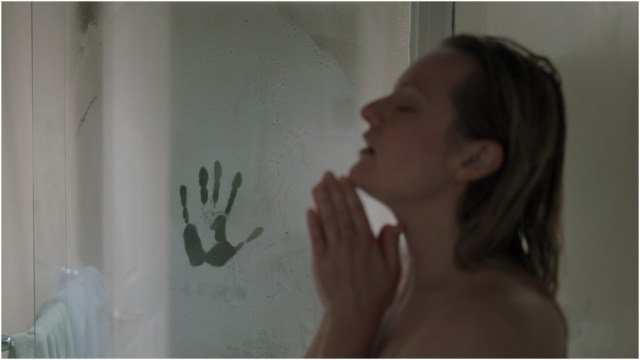
“The Invisible Man,” opening to strong reviews and a rising “Let’s not sit with crowds — ANYwhere” Corona (NOT the Beer) Virus fear, is falling right in the middle between low projections and its possible high water mark.

Last week, $20 was the safe bet for its opening, but as reviews flooded in late, expectations rose. Thursday night’s numbers pointed to a $33 million+ opening.

But the onslaught of bad news over this contagion and the growing sense of the incompetence of the Trump administration expected to contain it seems to be dampening its opening weekend take. A $27 million weekend isn’t bad, but people are already making informed decisions about risks they won’t take.And MAGAs have stopped drinking Corona beer.

The manga-based anime “My Hero Academia: Heroes Rising” sequel got a wide Wed. release and is doing quite well — a $9 million opening week and weekend. These aren’t typically of much interest outside their fan base, and dropping “in on it” expecting a movie that stands alone, impresses with its story, animation and novelty and, well — makes sense — is often an overreach.

I may try to get to it today. Most critics don’t bother.

“Bad Boys for Life” just crossed the $400 million mark worldwide. Looks like we have to pay attention to Martin Lawrence again. Will Smith just rebooted his previously fading career for another three years, at minimum.

“Sonic the Hedgehog” now looks like it will clear the $160 million mark before it fades away in March.

“The Call of the Wild” will clear $50 million before NEXT weekend ($46 by the end of this one).

All of which is predicated on how bad the virus news gets and how the public responds.

Yes, we’re living through “Contagion.” Yes, that film seems prophetic.


Posted in Reviews, previews, profiles and movie news | Comments Off on BOX OFFICE: “Invisible Man” leads the way — $27 million, anime “My Hero Academia” $9 million Wed-Sunday

Movie Review: Working and going under in the gig economy, “Sorry We Missed You”

sorry5

Ken Loach is the Scorsese of feature film realism, the Tarantino of naturalistic, lived-in dialogue, the Claire Denis of movies built on characters who show us life, as it happens.

His milieu is typically Britain’s working class, which he celebrates even as he shows its struggle and a system — capitalism — that has increasingly beaten it down since he first broke out with films such as “Poor Cow” and “Kes” in the ’60s, and in the decades since.

Unknown or inexperienced actors speaking thickly-accented working class argot, his movies sometimes come with subtitles — because they need them.

“Sorry We Missed You” is Loach’s intimate, scathing take on life in the “gig economy,” a family not getting ahead or even holding its own, but swimming as frantically as it can even as they spiral down the drain. It’s his best film in years, and with a resume that includes “My Name is Joe” and “The Angel’s Share,” that’s saying something.

Ricky Turner (Kris Kitchen) has worked in manual labor most of his life. Now, he’s ready to “be me own boss.” He’s hiring on as a parcel delivery “contractor” for PDF shipping. He gets the “owner-driver franchisee” from Maloney (Ross Brewster), but he has to flinch at every cost he’s expected to incur. Buy a van, or rent one (at extortionate rates) from PDF.

A hard talk with his home healthcare worker wife Abby (Debbie Honeywood). If they could just sell her car, he could get a van. “Just take the bus,” he pleads. And peacekeeper Abby agrees.

But with her working from 7:30 A.M. to 9 p.m., and him starting earlier and getting home almost as late, “family time” may be the ultimate sacrifice. Not a problem for studious tween Liza (Katie Proctor). Teenage Sebastian, Seb (Rhys Stone) is already lost, smart enough to do the math to see what little life holds to someone his age and refusing to buy in.

He’s cutting school so that he and his friends can tag the city with their graffiti, videoing their deeds as they do. So even as Ricky is being lectured on what everything costs, how his company-issued scanner will be his lifeblood, how “hit your ETAs,” prioritize “your precisors” (items like phones, etc., that have to be delivered at a specific time) and don’t take anything bathroom breaks (Here’s an empty water bottle, mate.), we can see the thin thread between the Turners and ruin stretching, with Seb blithely yanking at it for attention.

Abby’s compassion is captured in home visit after home visit, coping with the inform, the insane (feces flinging, scratching), the embittered and depressed even as her employer exploits her good heart and good nature in its pleading demands.

She’s made this home one where children are indulged and treated as adults, and Seb’s open rebellion seems a consequence. There’s no punishment meted out for disrespect, no corporal punishment for indifference, selfishness and endangering the entire family and not just his future.

Dad’s “Just give yourself some choices, mate” can’t even get the kid to look up from the phone.

Seb isn’t the best-drawn character here. He seems politically astute in sizing up the working class dream that was put on life support under Thatcher and has deteriorated ever sense. But the graffiti he risks all for isn’t political, and his myopic disregard for his family seems somewhat contrived, out of character.

Loach and his longtime screenwriting collaborator Paul Laverty give Darwinian capitalism its speech, coming from the mouth of Maloney, who explains — in the bluntest terms — how he keeps them all employed by working them until they doze off at the wheel. It’s because “the Patron Saint of Nasty Bastards” has to, or their clients will use another service.

Abby might be the first to see the cost their hours and thin finances are having on their lives, but Ricky voices the exhausted complaint against income inequality heard the world over when he mutters, “Everything is out of whack.”

The story’s predictable arc feels real when it is at its bleakest. Families disintegrate under these conditions. Check divorce filings in any town where big employers fail and folks grasp at “gig economy” straws to get by.

Loach and Laverty and their characters thrive when the margin of error is at its thinnest. Conversely, moments that force them appreciate the talent of the boy who is burning the family down in this their darkest hour seem melodramatic and naive.

But that “You never give up on your kid” ethos? That’s as real as rain.

From its pun title (the sticker you leave for a failed delivery) that really means the life the disenfranchised working class family is losing, to the gritty realism of working life in an economy that only “works” for the one-percent, “Sorry We Missed You” sounds an alarm — by turns desperate and simplistic. As Loach & Co. have been sounding it for decades, one wonders if anybody is still listening, as much as we should be.

3stars2

MPAA Rating: unrated, violence, profanity

Cast: Kris Hitchen, Debbie Honeywood, Rhys Stone, Katie Proctor and Ross Brewster

Credits: Directed by Ken Loach, scripted by Paul Laverty. A Zeitgeist release.

Running time: 1:41

Posted in Reviews, previews, profiles and movie news | Comments Off on Movie Review: Working and going under in the gig economy, “Sorry We Missed You”

Netflixable? “All the Bright Places” are where they store the schmaltz

ALL THE BRIGHT PLACES

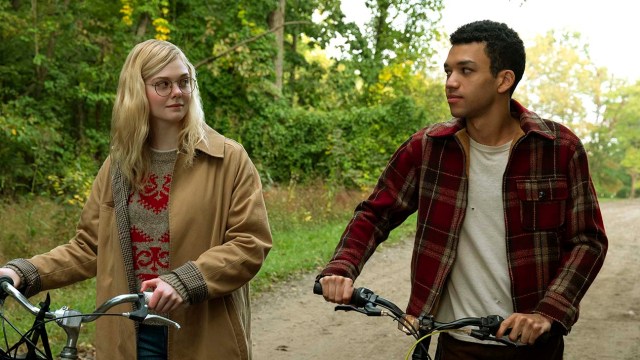
Elle Fanning and Justice Smith take a walk — and a bike ride — through love and death in “All the Bright Places,” a moon-eyed teen romance that never knows when to drop the mike.

It’s a movie that takes at least some of its prompts from one of the best young romances of the ’70s, “Breaking Away.” Novelist Jennifer Niven, taking her queue from the motto on Indiana’s license plates — “Wander” — throws two star-crossed and mentally struggling teens into each other’s path, and lets the sap flow until everything and everyone is sappy.

It’s not a bad film. Elle Fanning doesn’t make bad movies. But it crosses several “Give me a break” lines, and then goes on and on past its dramatic climax, grabbing you by the shoulders and shaking you until you get the point. As if it has one.

Theodore Finch (Smith), who goes by “Finch,” is jogging the day they meet. Violet Markey is standing on the railing of a bridge, contemplating something rash.

He talks her down. And from that moment on, he takes an interest, becomes a sort of protector even as he’s online stalking her to figure out her story.

Violet lost her older sister. She is off-the-scale depressed. Finch, for all his problems — his meetings with the guidance counselor (Keegan-Michael Key) confirm he’s not coping, either — figures he’s saved her life and he’s responsible.

Violet’s would-be beau, Roamer (Felix Mallard) is running out of patience.

“How much longer are you gonna ACT like this?”

Her BFF Amanda (Virginia Gardner) may warn her off Finch, reminding her that his nickname is “The Freak” for a reason.

And he’s alarmingly persistent. Posting a song he’s written for her online should get him visited by the cops and maybe expelled — “I met you standing on a ledge…Why don’t you come talk to ME instead?”

But he wears her down. Her parents (Nicole Forester, Luke Wilson) are at a loss about what to do to bring her back to the land of the living. Finch figures a lot of attention, a few Virginia Woolf quotes and a “partnered” class project where they visit the Great Attractions of Indiana will do the trick.

There’s a lot of arch, forced banter that writers figure is how writerly kids talk these days — “My young brain is plump with knowledge!” But truth be told, the funniest bit in “All the Bright Places” is the idea that there are “bright places” in the Hoosier state, places these two will visit — on foot, by bike, etc., “the Wonders of Indiana.”

Pancake flat Indiana’s “high point” elevation marker is one of those. “I can see my house from here! Come on, the view is incredible.”

They stand together on a hope chest sized stone marker together. That’s the closest connection “Bright Places” makes with “Breaking Away,” a romance worth renting and swooning over 40+ years later. Indiana is, by rep, boring, a place to escape from.

Bike rides through the flat country, a swim in a quarry (They filmed “Bright Places” in Ohio, which tells you something.), all borrowed from the earlier film.

The romance here is more perfunctory, less heartfelt. And that goes for several big twists in the tepid plot. Events are mandated by script requirements, never organic.

But as Netflix has had great luck with teen rom-coms, and teen romances, spending the money on landing this novel and this cast was a smart gamble.

Who would have guessed “Bright Places” could be this dull?

1half-star

MPAA Rating: TV-MA, suicide, sex, profanity

Cast: Elle Fanning, Justice Smith, Alexandra Shipp, Keegan-Michael Key, Luke Wilson, Nicole Forester and Virginia Gardner

Credits: Directed by Brett Haley, script by Liz Hannah and Jennifer Niven, based on Niven’s novel.  A Netflix original.

Running time: 1:48

Posted in Reviews, previews, profiles and movie news | Comments Off on Netflixable? “All the Bright Places” are where they store the schmaltz

BOX OFFICE: A Big Thursday pushes “Invisible Man” toward $30 million+ opening

man2“The Invisible Man” seems destined to break the horror losing streak that 2020 began with. Universal’s Leigh Whannell vehicle for Elisabeth Moss did $1.65 million Thursday night, per Deadline.com.

That suggests a boffo Friday and Sat and that early projections of a $20 million opening were lowballing it. As Deadline points out, “Get Out” and “Split” went from Thursday night’s in that range to $33-40 million+ openings.

And reviews will certainly give this one a boost. Moss is perfectly castand could be Big Box Office after this, upping her quote at least within the genre.

“Sonic the Hedgehog” is headed towards $17 million. It’s well over $100 million now, just padding its “best performing video game adaptation ever” resume.

“The Call of the Wild” will tally another $13-14, to go with the $32 million mark which it passed this week. $45 by all in by midnight Sunday?

The anime continuation “My Hero Academia: Heroes Rising” opened Wed. and looks as if it’s headed towards  healthy opening weekend plus 2 — $2.5 or so Wed., steep fall Thursday, big weekend ahead. Maybe $18 million since Wed. by midnight Sunday?

Hard to tell if it’ll hit “Dragonball Z” territory.


Posted in Reviews, previews, profiles and movie news | Comments Off on BOX OFFICE: A Big Thursday pushes “Invisible Man” toward $30 million+ opening

Movie Preview: Scotland remembers “Robert The Bruce” — Do you?

Another trip back to the “Braveheart” era.

Angus MacFadyen has the title role in this April 24 release.

Posted in Reviews, previews, profiles and movie news | Comments Off on Movie Preview: Scotland remembers “Robert The Bruce” — Do you?

Movie Review: Winterbottom and Coogan serve up a modern take on “Greed”

DSC_5362.NEF

If ever there was a time ripe for satirizing, sending up for its open corruption and crass celebrity, all consumed with unquestioning dimwittedness by a public distracted by “bread and circuses,” it is ours.

Idiots idolized for their innate skill at being “famous,” and nothing else, a gullible electorate consuming what they’re told, believing what they’re fed, voting for open expressions of their own ugly “id” in defiance of common sense, common purpose and common decency — these are “fall of Rome” days we’re living through.

For all the angst and despair that manifests, hell, it COULD be funny. Right?

The daring British filmmaker Michael Winterbottom and his muse, Steve Coogan tackle these times with the aptly-titled “Greed,” a tale of excess and cruelty, naked theft and thinly-disguised tax dodges all presided over by an entitled bully who is, every day and in every way, the poster boy for all that is wrong in British and American capitalism and public life.

This skewering likely to be the only punishment the retail hustler, tax dodger and con-artist Sir Philip Green, on whose shenanigans this tale of vulgar excess, naked narcissism and callousness it is based. And more’s the pity, because as angry as it is and as outrageously funny as it wants to be, “Greed” doesn’t quite come off.

Coogan is Sir Richard McReadie, billed as “the Da Vinci of Deal-making, the Monet of Money” as he is introduced at his big fashion retail company party. Let others call him “Sir Shifty” and “Greedy McReadie.” He’s hired a famous TV presenter to sing his praises, and that’s what his minions who make his millions hear.

There’s a double irony in that the vapid, beautiful celebrity doing the introduction — playing herself — is British TV “presenter” Caroline Flack, who just killed herself after a self-induced/tabloid-exploited fall from fame into infamy.

Winterbottom (“Welcome to Sarajevo,” “A Mighty Heart” and “The Trip” movies with Coogan and Rob Brydon) tells us the tale of McReadie’s “Greed” via his plans for an epic 60th birthday celebration. He’s building an amphitheater on a Greek island to stage the ultimate Roman toga party, complete with mock gladiatorial games.

Mixing up ancient Rome for ancient Greece is just the sort of thing gauche, rich dolts do, like confusing “Kansas Cities.”

As McReadie rants at his hapless builders, lion-renters and party organizers (Sara Solemani and Tim Key), he is shadowed by a well-traveled, thinks-he’s-witty hack writer (David Mitchell) who is writing his biography. He’s all “The Lion, the Witch and the Wardrobe” puns, which no one around him gets.

Through Nick the biographer, we meet the “classmates” and “colleagues” and old friends who take us through the “self-made man’s” entitled private school years — hustling, gambling and preying on his peers — to his breakthrough in fashion retail, first marriage (Isla Fisher), cheap foreign labor exploitation and a long Parliamentary inquest into his ruthless, self-enriching, predatory and illegal methods for making himself rich(er) and famous.

“He wasn’t somebody who loved clothing,” his ex and still business partner (she lives tax-free in Monaco, so his “empire” is in her name for that reason) admits. “He loved the deal.

His “art of the deal?” Lowballing every supplier he meets, storming out of meetings in the expectation that the other side will bail. And then bankrupting the company, displacing thousands of employees, and moving on to the next prey.

James Blackley makes a very convincing Young Richard, polishing his low-rent hustle back in school, taking what he’s gotten away with to Sri Lanka where he can undercut labor costs and undersell his more ethical competition.

“Envy and jealousy are incurable illnesses, my doctor tells me,” the older McReadie, playing the victim, complains to his government inquisitors. “I’ve done nothing wrong.”

Meanwhile, with ex-wife on board, “trophy” wife (Shanina Shaik) in tow, son who loathes him and openly wishes for his death (Asa Butterfield) and daughter (Sophie Cookson) “acting” for her scripted “reality” TV show about her famous life and misplaced love for Mr. Wrong (Ollie Lock), McReadie tries to rant his party into being.

There’s a lion involved. “He’s like a rescue cat who needs to be put down!”

A lifetime of berating underlings bears fruit — “This is not ‘banter.’ This is me ‘bollocking’ you.”

And feelings for the ex pop up, here and there. “Is that a push-up bra, or are ‘those’ new?”

There are Syrian refugees camped on the beach at Mikonos, spoiling the view for his “party.” Celebs left and right are turning him down. Stephen Fry does not. Once upon a time, he hired James Blunt to serenade he and his new wife outside their hotel. Everybody can be bought, we are reminded.

His always-fuming mother (Shirley Henderson) shows us where his “underdog” ethos came from, even though, as classmates complain, “He went to a PRIVATE school!” He was never an “underdog,” and “self-made” seems a stretch.

There’s a lot to chew on in this film, which resembles Winterbottom’s similarly chaotic Coogan vehicle “Tristram Shandy: A Cock and Bull Story” in every way save for the laughs.

There is no bigger Winterbottom fan than me, and Coogan’s long been at the top of my list of British comic actors. I laughed at his obligatory ABBA joke (obsessed with them, he is) and at many of his rants and a few amusing comic set-ups here.

Coogan is game and Fisher strikes the right tone. But there’s no much bad behavior to “expose” and complain about that there’s no room for fun.

Perhaps this plays better to British audiences who know the infamous retail cad it is based on. Or perhaps it is just missing that one ingredient that makes any Coogan/Winterbottom vehicle, satire or not, amusing — Rob Brydon.

2stars1

MPAA Rating: R for pervasive language and brief drug use

Cast: Steve Coogan, Isla Fisher, Shirley Henderson, Asa Butterfield, David Mitchell, Danita Gohill, Sophie Cookson and Stephen Fry.

Credits: Directed by Michael Winterbottom, script by Michael Winterbottom and Sean Gray. A Sony Pictures Classics release.

Running time: 1:44

Posted in Reviews, previews, profiles and movie news | Comments Off on Movie Review: Winterbottom and Coogan serve up a modern take on “Greed”

Movie Preview: Jordan Peele’s take on “Candyman” — The first trailer

Spreading himself pretty thin, but his track record speaks for itself…

Posted in Reviews, previews, profiles and movie news | Comments Off on Movie Preview: Jordan Peele’s take on “Candyman” — The first trailer

Documentary Review: Rare titles are the Holy Grail to “The Booksellers”


book3

We carry around a picture of an antiquarian book dealer or obsessive book collector in our heads.

White. Male. Tweed.

And there isn’t a lot in D.W. Young’s New York-centric “The Booksellers” that tampers with that. There’s tweed, here and there, the odd overly-curled mustache. It’s a very Jewish world, especially when the film digs into the Anglo-American history of this specialty trade.

But there may be a change coming to the business of collectible books, which is a major thesis of Young’s lovely and lush if meandering, bookshelf browse of a movie. Is the sun setting on this esoteric obsession? Or is a big-city hipster-driven revival turning that around?

It starts at the The New York Antiquarian Book Fair at the Park Ave. Armory, wanders into auctions, digs through the history of the hobby, changes in what is “in vogue” with collectors (signed first editions, first editions with perfect dust jackets, etc.), drifts off message with the “ephemera” (posters, toys, things that belonged to authors) and makes its way into the monumental collections of a hand full of America’s most obsessive “women writers” “esoteric occult books” or “Hip Hop History” or “works of imagination” have filled their weighty wall-shelves with.

Fran Lebowitz, that quintessential New Yorker, remembers the famed “Book Row” of Park Ave. bookstores, dozens of them at one time “run by dusty Jewish men who were very irritated if you wanted to buy a book.”

Journalist/author and book-hound Susan Orlean (“The Orchid Thief,” “The Library Book”) talks about books’ meaning, and about cleaning up her notebooks and “ephemera” and passing them on to a college archive.

And book collecting expert Rebecca Romney of TV’s “Pawn Stars” speaks up, after many other older men in the trade lament “the passing of an era” and the “death of the profession” of book-hunting, book selling and book collecting, noting the hipster generation embrace of the printed page and the slow shift away from the “85-15” ratio of males to females in this world.

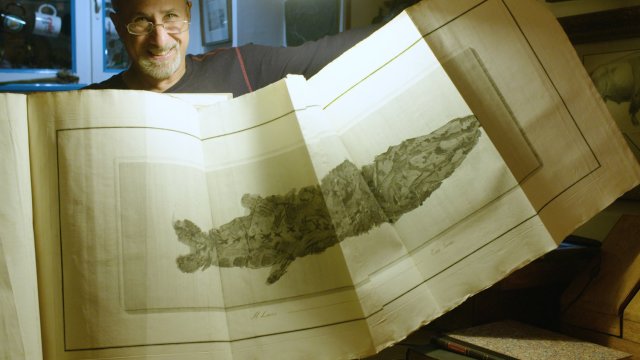
We see the auction where an anonymous phone bidder bought Leonardo’s “Codex Leicester (Hammer)” book of scientific writings and illustrations for $30 million+ in 1994.

And we scan the covers of leather bound historical volumes, printed on parchment or velum — as well as occult works bound in human skin. The idea of books as “objects” or art, quite aside from their printed pages, has never been presented with more clarity than here.

“The Booksellers” doesn’t take care to ID every talking head we see, and waits until the last half hour to show us the folks who drive this industry — the collectors. It’s still a bibliophile’s delight, a time trip back to bookstores long gone as well as the Argosy and Strand and Imperial, filled with people of the sentiment that “If books disappear, human beings disappear!”

3stars2

MPAA Rating: unrated

Cast: Fran Lebowitz, Susan Orlean, David Bergman, William Reese, Rebecca Romney

Credits: Directed by D.W. Young. A Greenwich Entertainment release.

Running time: 1:39

Posted in Reviews, previews, profiles and movie news | Comments Off on Documentary Review: Rare titles are the Holy Grail to “The Booksellers”

BOX OFFICE: Could “Invisible Man” make Moss “Bankable?”

Film Title: The Invisible Man

The trailers for this Universal horror tale have been paranoid, overwrought and money in the bank.

And the movie Leigh Whannell delivered is earning terrific reviews.

That should translate for a boffo weekend at the box office, as Variety likes to say. The trade mag is saying “The Invisible Man” is sure to pull in $20, maybe as much as $30 million on the last weekend in this Leap Year February.

Star Elisabeth Moss, who is good in everything, has a shot at becoming the next bankable leading lady in the movies if this thing blows up. She gets to star in indie or lower budget fare like “Her Smell,” but is generally consigned to supporting roles on the big screen — “Us,” etc.

TV is another matter, where “Mad Man” made her a household name and “The Handmaid’s Tale” made her the go-to actress for edgy drama about underdogs.

“Sonic the Hedgehog” will surrender the top spot to “The Invisible Man,” but it’s already made bank —$115 million domestic,and counting . The REAL movie to watch is “The Call of the Wild,” on which 20th Century (no longer Fox) spent $125 million on CGI animals (real dogs would have been more time consuming, limiting in terms of dangerous stunts, more empathetic and CHEAPER). It’ll roll into the weekend with about $36 million in the bank, and they need a big weekend or three to have a prayer of breaking even with the monstrosity.


Posted in Reviews, previews, profiles and movie news | Comments Off on BOX OFFICE: Could “Invisible Man” make Moss “Bankable?”

Movie Review: Teresa Palmer goes lightweight with “Ride Like a Girl”

“Ride Like a Girl” is a feel-good tale of pluck, family and breaking gender barriers in the family business.

The “family business” here is jockeying, something every one of Paddy Payne’s ten offspring took up, under daddy’s supervision. A competitive profession in horse-racing mad modern-day Australia, that setting suggests risk in pursuit of glory, and in this case, triumphing over one of the most notoriously sexist cultures in the English speaking world.

It’s a sentimentalized biography of Michelle Payne, the first female jockey to win Australia’s most prestigious horse race, the two mile long Melbourne Cup, which has been around since 1861. And if it pulls its punches on the sexism thing, sanitizes the extreme measures undertaken by riders to “make weight” and burnishes horse racing by leaving out the unpleasant business of a horse dying in a race every three days, well, all good family fun, right?

Sam Neill plays Paddy the patriarch, a warm but stubborn widower who presides over a noisome riot of children after his wife’s death. He piles the brood into an old ambulance to deliver them to (Catholic) church, doesn’t get too bent about food fights at Sunday dinner, and raises one and (almost) all to be what he knows how to teach them to be — jockeys.

Of the two youngest siblings, Michelle “Shelley” and Stevie, only one will carry the family name into the saddle. Stevie has Down’s Syndrome. The two are thick as thieves, sneaking under the dinner table to devour all the dessert during the chaos of that food fight.

Shelley (Summer North) is as willful as her dad, and being disciplined sends her off in a huff. We see her dragging a shovel down the driveway.

“Where’re you going with that, Little Girl?”

“To dig up Mum,” because she’d treat her with more indulgence.

Years later, Dad’s still calling her “Little Girl,” and Michelle (Teresa Palmer of “Lights Out” and “Hacksaw Ridge”) has become a problem student at Catholic school, slipping out of the classroom several times each day. Sister Dominique (Magda Szubanski) suspects bulimia.

Dad shrugs that off with a “Sister, you’ve obviously never jockeyed” crack. But the good sister works on daddy’s “little girl,” trying to convince her there are options open to her other than the family business.

Her dad’s peers are dismissive of her dream (female jockeys aren’t rare at this point, especially in her family) — “Girls don’t ride in the Melbourne Cup!”

But Paddy is the sage, teaching her “patience,” that “when a gap (between other riders) appears, that’s God talking to you,” and that “a horse gallops with his lungs, perseveres with his heart and he wins with his character.

Neill, like the real Paddy Payne, a New Zealander, is at his warm and crusty best in a role that gives him all of the movie’s best lines.

“How can a horse that was winning come in last, Dad?” his son Stevie asks.

“Because he was fast at the wrong end of the race!”

Actress turned director Rachel Griffiths gives her actors their moments and makes the most of the real Stevie Payne, playing himself in the adult scenes. A montage of “She got last, Dad” commentaries amusingly gets across Michelle’s struggles to master her craft.

Setting those struggles to The Cranberries’ “Dreams” is a tad on-the-nose, but that’s how the game is played in sentimental biopics like this.

There’s a father-daughter rift, Michelle faces the brunt of Oz sexism trying to make it on her own, tragedy, more struggles and triumph play out the hand this story gives us.

Palmer, who just turned 34, may never let us forget she’s a trifle too old and experienced to be playing the callow high school and college age Michelle. Those scenes pass, though (the real Payne came to fame at 30) and she makes the most of the limited drama the screenplay gives her.

She gets across the tomboy nature of the character best in a wedding moment, scrambling to get her shoes on as she stumbles into the church late, catching a bridesmaid’s bouquet on the fly as she stumbles to her place in line.

Director Griffiths, an actress who has given plenty of such “real” moments in a career spanning “Muriel’s Wedding” and “The Rookie,” finds a few places in the script to suggest that familiar rhythms of life-being-lived touch — Paddy’s fatherly way of helping her mount up, etc.

But playing down the gender barrier — which is the whole point of telling this story — Michelle had to overcome mutes the impact of the drama. We get only a glimpse of the bitching condescension of the male jockeys, barking and griping at her mid-race as well, the uncomfortably crowded unisex post-race whirlpool and the creepy come-ons of a trainer she wants to ride for, shortchanges “Ride Like a Girl.”

Big emotional moments play like teases, and Palmer is given no chance to show us the interior life of the rider. No, there’s no “love story” because the movie suggests she never so much as considered a social life.

The whole affair plays as muzzled, truncated and incomplete — a ten furlong dash through a two mile (16 furlong) race.

MPAA Rating: PG for some thematic elements, language and suggestive comments

Cast: Teresa Palmer, Sam Neill, Stevie Payne, Genevieve Morris, Sullivan Stapleton, Brooke Satchwell, Henry Nixon and Magda Szubanski

Credits: Directed by Rachel Griffiths, script by Andrew Knight and Elise McCredie. A Saban Films release.

Running time: 1:38

Posted in Reviews, previews, profiles and movie news | Comments Off on Movie Review: Teresa Palmer goes lightweight with “Ride Like a Girl”