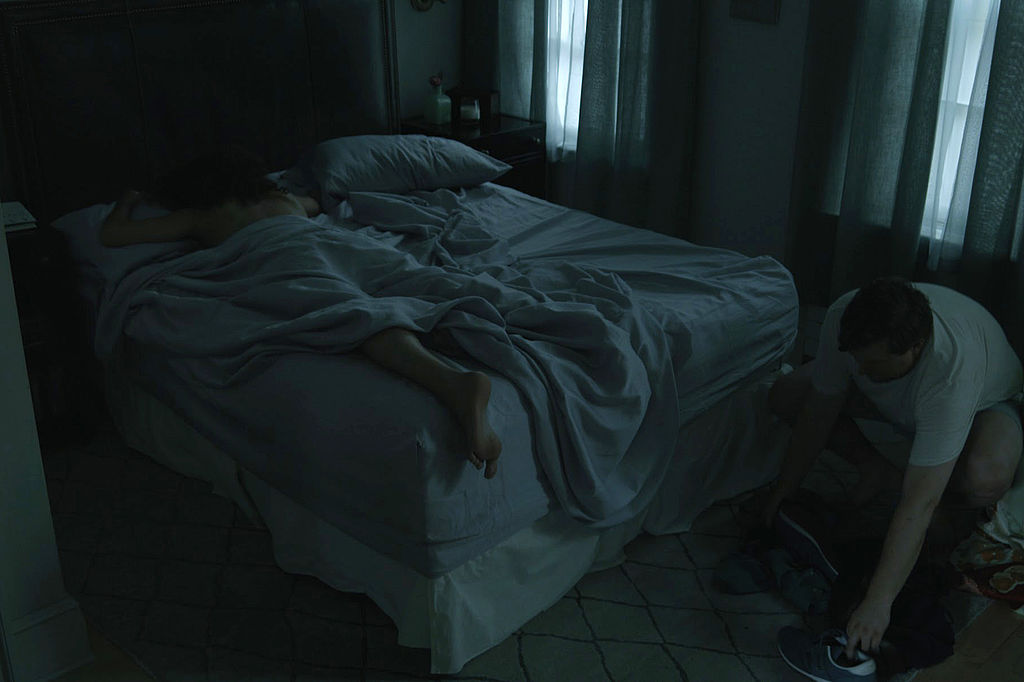
Classic Film Review: The “Most Restored Version” yet of Richard Wright’s “Native Son” (1951)

It was 1951, and nobody was making movies about racism and African American rage back then.

Much of the cast was local amateurs. As it was filmed in Argentina but set in Chicago, that makes for some odd accents.

The director was French, not exactly an expert on American race relations or African American voices. Sound was looped and dubbed to compensate for that.

The intended star, acclaimed in the Broadway production, was tied up in customs in South Africa and couldn’t make it to the set.

But “Native Son” isn’t just a troubled production of legend, and not just an artifact, a cinematic curiosity. Newly-restored to its most complete version ever, it has crackling moments and blasts of defiance and elevated rhetoric.

Richard Wright was 43 and too old to play his greatest creation, Bigger Thomas. He could act, but was never more than adequate in a part that demands charisma, seething resentment and menace. But he took on the daunting role and the film was made, a decade after Wright’s incendiary novel came out, seven years after becoming an Orson Welles Broadway play.

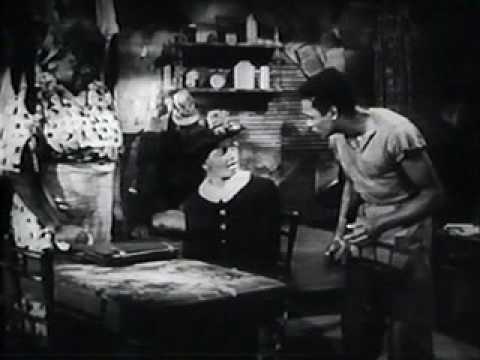
It’s a conventional story — young man with a police record gets a job as chauffeur for the local white slumlord and his family. He takes the rebellious daughter, at her request, to a Black nightclub where his girlfriend (Gloria Madison) happens to be singing. The daughter (Jean Wallace) and her leftist beau (Gene Michael) get drunk.

Bad things happens when Bigger takes her home, and he winds up killing her. He tries to cover his tracks as the cops close in, but we know how this is going to turn out.

Here’s what jumps off the screen 70 years later — cops dropping the “n-word” like they always have and figure they always will.

“I like n—–s. But I like’m in their place!”

Jan the leftist “white-splains” being Black to Bigger. “One day we’re gonna smash that Jim Crow system, and when we do it’ll STAY trashed!”

The tipsy daughter makes a request.

“Hey Bigger, can’t you sing? Aren’t all colored people supposed to sing?”

Her labor agitator/racial equality leftist date white-splains for her, too.

“Whites only let colored people sing the blues.”

There’s a gay snitch in Bigger’s neighborhood in the “Black Belt” of Chicago, with pool halls, theaters and bars catering to the African American Diaspora there.

Bigger’s already been in trouble with the law, and has hopes of pulling new heists when we meet him. But neither he nor his comrades have the nerve. As he stares off into space, it seems that life itself is an utter dead end.

“When you’re Black, it’s better to keep your dreams locked in your heart.”

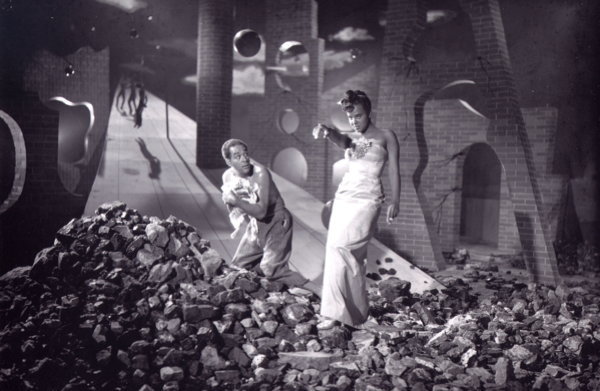
There’s nothing sentimental about the film or the novel it’s based on, little “Raisin in the Sun” pathos. Director Pierre Chenal keeps the lighting dark and shadowy and the tone grim.

Welles wanted to film “Native Son” himself, and never could. Wright probably figured this was his one chance to turn his book into the most popular art form of all. He was right. He died in 1960, just 52 years of age. And nobody else dared film the book until the ’80s.

But this early production, restored with its primitive, malnourished edges intact, is more than just a relic from an impoverished film shoot in the early 1950s. This “most complete version” has just enough film noir fury about it to hint at the classic it might have been, and plenty of B-movie pop to it even as it is.

MPAA Rating: unrated, violence, alcohol abuse, racial slurs

Cast: Richard Wright, Jean Wallace, Gloria Madison, Willa Pearl Curtis, Nicholas Joy, Charles Cane, George D. Green

Credits: Directed by Pierre Chenal, script by Pierre Chenal and Richard Wright, based on Wright’s novel. A Classic Pictures — Kino Lorber release.

Running time: 1:47

Posted in Reviews, previews, profiles and movie news | Comments Off on Classic Film Review: The “Most Restored Version” yet of Richard Wright’s “Native Son” (1951)

Movie Review: The tangled emotional web of “Inez & Doug & Kira”

There’s arguing — not loud, not heated — at the funeral reception.

It was a Jewish funeral, and the debate is over the deceased’s last wish — to be cremated.

But there is no arguing over why “she” killed herself. Inez was bipolar, an addict in and out of AA.

Still, there is a mystery to “Inez & Doug & Kira,” one the survivors will try to piece together in this somber and engrossing if not-wholly-satisfying drama. The connections were there, however tenuous and fragile. The hurt and guilt linger.

Because it’s hard to hear cries for help with new urgency when you’ve been hearing them for years.

The debut feature of editor-turned-director Julia Kots is shrouded in pain, grounded in addiction and suicide. The actors — save for Tawny Cypress (TV’s “The Blacklist”), who has to play the manic Inez — mimic a kind of exhaustion that a lot of people will recognize.

Because loving and caring about someone with problems at this level is as draining as relationships get.

“She had a talent for driving people apart,” might be the best description of our dead protagonist.

Michael Chernus of TV’s “Tommy” is Doug, a New York magazine writer. Talia Thiesfield is Kira, Doug’s partner and “baby momma.”

Inez was her twin sister, and flashbacks show us how tight they were. Doug was Inez’s reluctant but devoted sponsor. How that came to be is interesting. How he came to be with Kira even more so.

Kots takes us into these interwoven lives in baby steps. One of the most gripping and realistic AA meetings ever put on the screen is a highlight, but randy-frank sister chat about sex and men and circumcisions figure in, too.

Doug, for all his sponsorship sharing, has huge passages of Inez’s life he doesn’t know. He’s having nightmares with her in them.

Kira? She’s struggling to maintain calm through a difficult pregnancy. And she just buried her sister.

Kots, who also scripted “Inez & Doug & Kira” invents some marvelous details in everybody’s backstory, some of them seen in flashback, some glimpsed in dreams, others related in vivid word-portrait anecdotes.

The film has a tonal, visual and messaging consistently that honors the writer-director’s editing past. People from that film specialty know how difficult it is to keep the the whole in sync without maintaining it every single day in every shot and scene on the set.

The dialogue is unfussy, limited but rich. Telling a therapist he’s lost “my best friend” Doug wonders “if grownups even SAY that.”

“Cancer?” the shrink wants to know, getting him back on subject.

“Razor blades.”

The muted tone and funereal gloom that linger in the film gives it a mortician’s remove. We aren’t necessarily moved by this tragedy and the ways those who survived contributed to it or failed to avert it.

But suicide can be like that. Even in the “easy answers,” there’s little satisfaction and no comfort.

MPAA Rating: unrated, sex, substance abuse, profanity

Cast: Tawny Cypress, Michael Chernus and Talia Thiesfield

Credits: Written and directed by Julia Kots. A 1091 release.

Running time: 1:38

Posted in Reviews, previews, profiles and movie news | Comments Off on Movie Review: The tangled emotional web of “Inez & Doug & Kira”

A Spinal Tap reunion? On the screen?

Ok, none of the folks involved in making “This is Spinal Tap” way back when has had great demands on their time these past few years.

Yes, it would have been interesting if they’d taken a chance at reviving the band/screen comedy in 20 years ago.

Are their ironic laughs in guys KISS age “getting the band back together? Maybe.

The Hollywood Reporter says that ‘This is Spinal Tap’ co-creators Harry Shearer, Rob Reiner, Michael McKean and Christopher Guest have got a deal that could potentially revive the franchise https://t.co/I8zfzI5095 https://t.co/8wKWz9UH4n https://twitter.com/THR/status/1307371424596795397?s=20

Posted in Reviews, previews, profiles and movie news | Comments Off on A Spinal Tap reunion? On the screen?

Netflixable? Indonesian lads take classes in how not to be “Whipped (Bucin)”

The creators of the Indonesian romantic comedy “Whipped” play versions of themselves, which is the cleverest thing this film (“Bucin,” in Indonesian) has going for it.

To wit — Chandra Liow is ID’d in the opening credits as “single” and the director. He’s an arrogant doofus in the movie, bragging that “I am the MASTER of escape rooms” as he and his comrades must get out of one as part of their “extreme” course on “How not to be ‘whipped’ in relationships.”

Chandra isn’t “master” of anything except declaring his expertise and stealing credit. Repeat after me, “Just like a director.”

Andovi Da Lopez, an actor, plays a neurotic, romantic actor — given to singing to his too-beautiful girlfiend Kiki (Widika Sidmore), indulging her every whim or impulse purchase. He is a poster boy for “whipped.”

Tommy Limm is also an actor, haplessly engaged to Julia (Karina Salim) here, crushed under her weepy tantrums over all the wedding planning.

And “the smart one,” the guy who might get them out of the escape rooms their “course” throws at them? That would be Jovial “Jo” Da Lopez, who wears glasses (signaling “smart” in cinema-ese) and is at the stare-at-our-phones state of his four-year relationship with Cilla (Kezia Aletheia).

The guys wake up from being drugged in an escape room where a lit clock tells them how much time they have to master a task, and a sign that changes from “Patience is Key” to “Honesty is Key” to “Courage is Key.”

Course director Vania (Susan Sameh) barks out orders and clues via a PA system. She’s apparently a Phd candidate in psychology, which makes this “business” her rats-in-a-maze experiment. Beautiful sadist, anyone?

A grievous flaw in this script is Jovial’s sloppy sense of timeline. The “course” isn’t something the four contend with, all in one go. No, they leave, go back to their lonely or henpecked or checked-out-of-the-relationship lives, where shopping gags, yoga classes, karaoke, paintball and wedding planning is supposed to provide more humor and insight on why they’re “Whipped.”

That would have been better handled in flashbacks, streamlining the picture and adding urgency to the escape rooms.

Oh, and making the outside-the-course scenes funnier would have been a BIG help. The only amusing bits are in that escape room, to be honest. And attempts to give this nonsensical story a dark edge — suspense — fail utterly.

Without the sight gags, mugging and wordplay to goose it, “Whipped” just flails away, a lot of energy expended on nothing all that funny or particularly charming.

MPAA Rating: TV-14, innuendo

Cast: Andovi Da Lopez, Jovial Da Lopez, Tommy Limm, Chandra Liow, Susan Sameh, Widika Sidmore, Karina Salim and Kezia Aletheia

Credits: Directed by Chandra Liow, script by Jovial Da Lopez. A Netflix release.

Running time: 1:37

Posted in Reviews, previews, profiles and movie news | Comments Off on Netflixable? Indonesian lads take classes in how not to be “Whipped (Bucin)”

Classic Film Review: José Ferrer and Gore Vidal’s take on The Dreyfus Affair — “I Accuse” (1958_

One thing becomes obvious in this ambitious, star-studded yet staid version of France’s infamous “Dreyfus Affair.” The officious, patriotic family man this scandal centered around was far from being the most fascinating character in his own tragedy.

If the great José Ferrer, at his 1950s peak, and novelist/screenwriter Gore Vidal and this ensemble can’t wring more pathos of this crushing injustice than “I Accuse,” we’d all best stick to “The Life of Emile Zola (1937).”

The story of a Jewish staff officer unjustly accused, convicted and sentenced to Devil’s Island hangs heavy over French history. It was filmed three times in the 1930s alone (including Paul Muni’s “Zola” biopic). His name is invoked in “Papillon,” and his fate the object of much French soul-searching over Antisemitism and blind obedience of and trust in French institutions, most particularly the army, which railroaded this scapegoat and covered up the fact that they did.

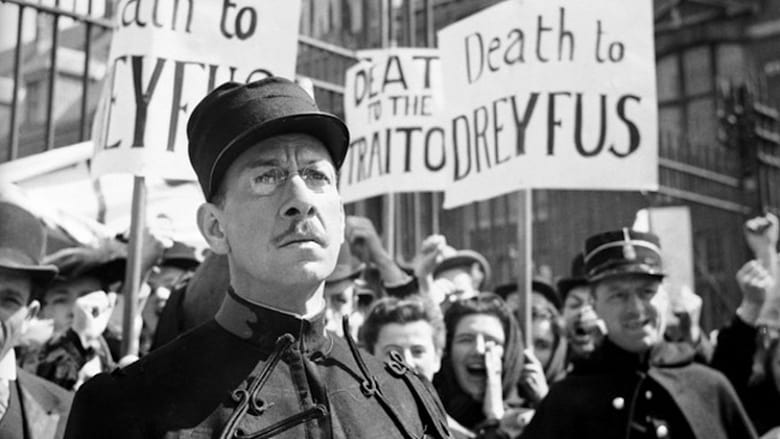
Ferrer’s film, somewhat fictionalized, captures the baying of the mob at Dreyfus’ public stripping of his rank. So it wasn’t just the army that had it in for Jews.

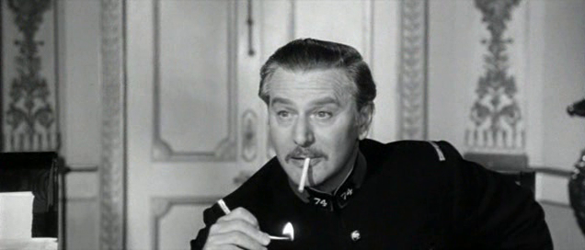
But everybody around Dreyfus, in history and in the film, is more colorful — colorfully corrupt, like the real traitor/officer who sold French military secrets to the Germans in the 1890s, Major Ferdinand Esterhazy, given a Devil-may-care narcissism by the great Anton Walbrook (“The Red Shoes,” The 48th Parellel”) , colorfully Antisemitic, like the Army officer (George Coulouris of “Citizen Kane”) who fingers Dreyfus as a spy, colorfully dogmatic like Major DuPaty de Clam, a handwriting “expert” played by Inspector Clouseau’s future nemesis — Herbert Lom.

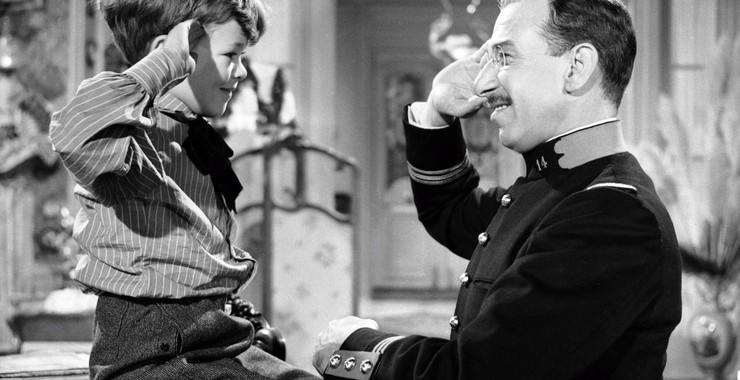
Against this, Ferrer’s Dreyfus is mere martyr, ramrod straight, defending his “honor” but broken by the tropical hell and isolation of Devil’s Island — dull.

Another drab hero is this film’s depiction of writer, philosopher and activist Emile Zola, whose famous screed “J’Accuse” has become shorthand for every person who rises up and shouts against a grave injustice. Emlyn Williams was cast in the part, and barely registers. And this is the most articulate, fiery, saintly-heroic figure in the tale.

“I accuse General Billot of having held in his hands absolute proof of Dreyfus’s innocence and covering it up, and making himself guilty of this crime against mankind and justice…”

Ferrer, who also directed, ensures that this is a perfectly serviceable summary of the affair, even with the odd liberty taken with the facts. Viveca Lindfors suffers modestly as Mrs. Dreyfus, Leo Genn plays the commanding officer who spotted the cover-up and legendary character actors Donald Wolfit and Harry Andrews dress up the proceedings.

But it’s as if Ferrer, or at least the snarky gadfly Vidal, recognized the REAL star and focus should be the sleazy, lazy, greedy and amoral Esterhazy. Casting the normally heroic Walbrook in the part pulls us into the character, and even the lines describing him (by Williams’ Zola) suggest this is the movie Vidal wanted Ferrer to make.

“This Esterhazy is one of the most glorious liars that ever drew breath. Why, the authority of it, the poise; the man’s a genius!”

MPAA Rating: Approved

Cast: José Ferrer, Anton Walbrook, Viveca Lindfors, Leo Genn, Donald Wolfit, Harry Andrews, Herbert Lom, George Coulouris and Emlyn Williams

Credits: Directed by José Ferrer, script by Gore Vidal. An MGM release.

Running time: 1:39

Posted in Reviews, previews, profiles and movie news | Comments Off on Classic Film Review: José Ferrer and Gore Vidal’s take on The Dreyfus Affair — “I Accuse” (1958_

Movie Preview: Liam Neeson tries to be an “Honest Thief”

Liam, playing yet another man “with very particular skills?” Even he should be tired of this by now.

Still, he always gives fair value, even in plots as far fetched as this one.

Oct. 9 “Honest Thief” opens.

Posted in Reviews, previews, profiles and movie news | Comments Off on Movie Preview: Liam Neeson tries to be an “Honest Thief”

Movie Review: “God of the Piano”

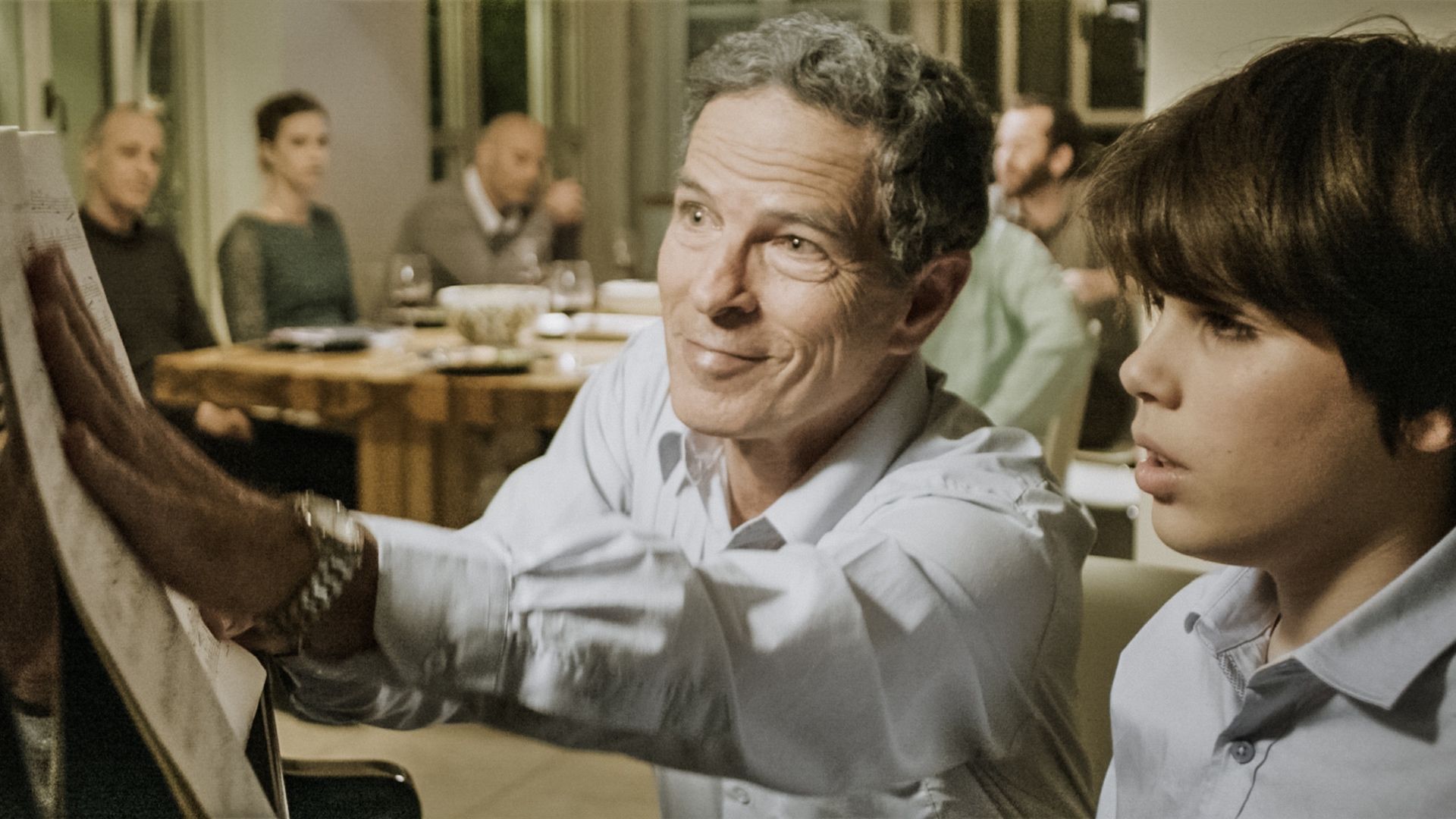
The mystery and the guilt associated with it drives the cryptic Israeli drama “God of the Piano,” a movie that gives away so little that the viewer is invited to fill in around the edges, early and often.

Anat (Naama Preis) looks like a ballerina and plays the piano like a rising star of Israeli classical music. She’s so committed to her instrument that when her water breaks, mid-concert, she toughs it out to the end. Her obligations are to the composer, the audience and her instrument. The baby? It can wait.

He is born before his father (Ron Bitterman) can make it to the hospital. There’s a suggestion Dad might not be faithful.

So she’s there, by herself, when she gets bad news. Anat will consider the unthinkable in “solving” this problem, and when we meet her family, we understand. Composers, performers and teachers, their expectations for every new member of the clan are formidable.

Can little Idan live up to the family legacy? As we watch him (Andy Levi) emerge as an ideal and seemingly enthusiastic student, a playing and composing prodigy, taught by the very best, we think we have the answer.

“God of the Piano” is a brisk drama, with a narrow focus that means that it skips by without providing every answer to every question it asks. Like its central character, Anat, it is enigmatic, furtive.

She has a secret she’s keeping from her husband, her son, her family and the world. Like the protagonist of Poe’s “Tell-tale Heart” the guilt has to eat at her, right? Especially when she keeps getting mail from a school the hospital once recommended for her son.

And even so, that first secret leads her to others.

First-time feature director Itay Tal touches on many themes and ideas in this Hebrew language (with English subtitles) story, from fierce interfamilial competition to professional jealousy of the “Those who can, do, those who can’t, teach” variety, to a whole “nature vs. nurture” prejudice that reveals, in just a scene or two, what that word really means — “pre-judging.”

Classical music isn’t usually about bloodlines. It’s about who taught you and who taught her, hopefully all the way back to Chopin or Liszt or one of the giants. Here, that’s twisted.

A telling scene, Anat’s father and revered teacher (Ze’ev Shimshoni) visibly pales when he gives the kid a piece he wrote when he was the same age as the boy (12). Inad sight-reads it, playing beautifully, and in an “Amadeus” touch, proceeds to “improve it.” Damn his eyes.

That whole dynamic, that the child is preordained to greatness or mediocrity by blood and birth, is undercut in the film. It’s either troubling or amusing to consider, seeing as how this story all takes place in a land whose dominant culture lives as self-described “chosen people.”

Tal has created a spare and provocative debut feature, one that sucks you in even as he introduces more challenging ideas than he could possibly address fully in 80 spare minutes.

MPAA Rating: unrated,sex

Cast: Naama Preis, Andy Levi, Ze’ev Shimshoni

Credits: Written and directed by Itay Tal.  A Film Movement release.

Running time: 1:21

Posted in Reviews, previews, profiles and movie news | Comments Off on Movie Review: “God of the Piano”

Netflixable? Nigerian diva gets knocked off her high horse in “Lara and the Beat”

“Lara and the Beat” is a shiny bauble of a Nigerian comeuppance comedy, a romp through Lagos affluence, pop stardom, conspicuous consumption and losing it all in a flash.

Well, that’s how it begins. It doesn’t go wholly wrong all at once, but damned if the filmmakers don’t lose the thread and stumble and lurch and pad this thing until their Nollywood film is Bollywood length, without the wit, warmth or content to justify it.

We’re introduced to privileged Giwa sisters Lara (Seyi Shay) and “baby sister” Dara (Somkele Iyamah-Idhalama) at their peak. Lara is the diva to end all divas, a singer, celebrity and free-spender, dismissive of all, ordering everybody around — servant, relative or “friend.” And Dara is some sort of film producer, far more polite and modest, and about to go to graduate school.

Dara’s the one trying to learn the family business, a media company they inherited. But the first board meeting we see her attend is the one the Nigerian IRS raids. Tax fraud. The family’s been pilfering while Lara’s been over-spending.

Nobody mentions how much Dara’s seriously non-commercial movies have been costing. That doesn’t fit our narrative, even though everything else, and then some, does.

Lara’s never bothered to learn the real names of her “servants.”

“Do I look like I care? Of COURSE not!”

She can’t believe the news, which she picks up on Twitter — #Giwagate, #Giwasbroke. Schadenfreude is big in Nigeria, and the country’s resident Kardarshians are getting their comeuppance.

Lara is hit the hardest by all this — the loss of the Mercedes, the house, “my 1,000 pairs of shoes and handbags.” Oh, that proposal she’s expecting from rich beau Jide? Don’t bank on that, either.

Dara’s just trying to figure out what happened, where they can stay the night (“Friends” are all-too-happy to turn Lara down.).

The sisters make mention of “the village” where their family is from, their last reliable relatives (The ones with the company are fleeing town.), but a place “that doesn’t even have WIFI,” Lara whines.

THIS is where “Lara and the Beats” could have gone. Rich, spoiled city slickers humbled and launching their comeback from BF Nigeria might be a trite, tried and true formula for a comedy about the rich who fall into poverty. But often as not, that formula works.

Nope. This script instead takes an equally predictable and far less interesting route, with Lara looking for glory from her travails through Sal, the driver (Vector the Viper) Lara never gave a thought to (or remembered his name) who just happens to be an aspiring writer and music producer himself.

At some point in the latter acts, I lost all interest in this. The forgivable sins of sloppy pacing — too many shots of people entering and exiting Bentleys and Porches, or polishing them, scenes pointlessly staged on a motor yacht to show how the idle rich idle — aren’t a bother when you’re throwing us into Lara’s meltdowns over her plight and her entourage’s’ evil smirks when she hits bottom.

We chuckle along with them.

It’s all the tedious things Dara must “discover” and Lara must figure out that bog “Lara and the Beat” down for the last 70 minutes of its 137 minute run time.

I’ve watched a number of Nigerian films these past few years, partly due to a growing interest, mostly to due to Netflix’s insidious “show you more like that” algorithms. Some were OK, some were “close” but near misses, and a few were indifferent.

“Lara and the Beat,” pretty and shiny as it is, was the first I felt was a serious waste of time.

MPAA Rating: TV-MA

Cast: Seyi Shay, Somkele Iyamah-Idhalama, Chioma Chukwuka Akpotha, Kemi Lala Akindoju and Vector the Viper

Credits: Directed by Tosin Coker, script by John-Arthur Ingram, Kay I. Jegede and 1pearl Osibu. A Netflix release.

Running time: 2:17

Posted in Reviews, previews, profiles and movie news | Comments Off on Netflixable? Nigerian diva gets knocked off her high horse in “Lara and the Beat”

Movie Review: Carrie and Jude shimmer in “The Nest”

Real life has precious little to do with the latest frights from Blumhouse.

The demons we battle come from within, the “haunting” of a house spins out of the stresses, betrayals and failings of those who live in it.

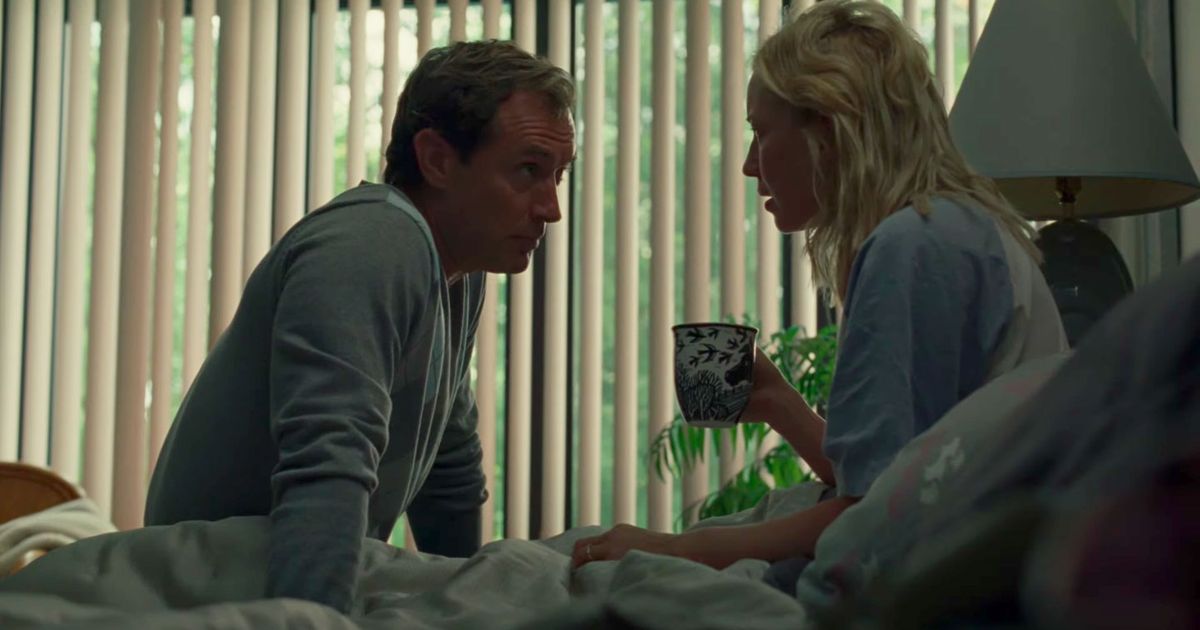
“The Nest” is a chilly domestic melodrama bathed in the tones of horror, a tale of greed, ambition, deceit and disappointment. Anyone choosing to see it as a parable of the “greed is good” go-go ’80s can do so without stretching to make the point. And for those of us who fret that this point in time is where the Western world went wrong can find hints of that here, as well.

Built on a powerhouse, brittle break-out performance by Carrie Coon (“Gone Girl,” “The Post” and TV’s “Fargo”), it recounts the final acts in an illusion that started to dim before the opening credits and a collapse that seemed destined before the 1987 Reagan stock market crash.

Jude Law, who has been playing working-class over-reachers since his arrival on the screen, is perfectly cast as Rory, smooth as an oil slick, and about as toxic. It’s the mid-80s, and we get just a glimpse of the life he’s provided for his family in New York.

Allison (Coon) gives riding lessons and runs a stable, their son Ben (Charlie Shotwell) seems happy and her teen daughter from an earlier relationship (Oona Roche) is content, near as we can tell. You know teenagers.

But Rory drops “I think we need to move,” on “Al” first thing one morning. Allison is an independent woman, not some “trophy” he plucked out of the American working class. She gives it all away in a single line responding to that entreaty.

“Go f— yourself.”

They’ve moved “four times in ten years,” but he insists that going back to his old firm in London is “the chance to make some real money.”

Even her mother nags her to be more traditional, “just go with it,” and leave the worrying about how this will work and pay-off “to your husband.” Next thing she knows, Rory’s showing them the estate he’s rented, the place he’ll “build you a stable,” the historic nature of the place.

“Led Zeppelin, Led ZEPPELIN stared here when they recorded one of their albums!”

So the bump-in-the-night noises some of them hear are…the ghost of John Bonham? Allison hears them, and Ben? “This place scares me.”

Writer-director Sean Durkin (“Martha Marcy May Marlene”) drops little hints of horror into the proceedings. But he uses that dread-what’s-coming tone to give grim weight to the domestic tragedy that plays out.

Rory’s dismissive of Allison’s desires and quick to throw money around. The seeds of mistrust were there before they ever got on the plane. Durkin lets his camera linger on Coon the moment she has her suspicions confirmed, and Coon lets us see Allison deflate, stagger and buck up for the test ahead with just her shoulders and her eyes.

And she plays the hell out of the nasty, cutting lashing-out scenes that follow.

Rory’s boss (Michael Culkin) might tolerate his swing-for-the-fences swagger, but that doesn’t mean he”ll indulge it.

Law can still make us smell the sweating his characters do when they’re gambling, striving and hoping like hell to keep all the balls they’re juggling in the air just a few moments longer.

“I don’t see markets. I see risk, reward and money!”

The period detail — from the British synth pop to the swank restaurants that still allowed the well-heeled to light up — is spot on.

And the movie itself isn’t bad, a tad circumscribed — limited aims, truncated character arcs. The hints of something less scientifically or psychologically explicable never quite reach the point where “The Nest” feels like a cheat.

This is a living nightmare, one anyone trapped in a situation they’re helpless to remedy will recognize, with a dread anybody living beyond his or her means will feel.

MPAA Rating: R for language throughout, some sexuality, nudity and teen partying

Cast: Jude Law, Carrie Coon, Oona Roche, Charlie Shotwell and Michael Culkin.

Credits: Written and directed by Sean Durkin. An IFC release.

Running time: 1:47
Posted in Reviews, previews, profiles and movie news | Comments Off on Movie Review: Carrie and Jude shimmer in “The Nest”

Movie Preview: It’s hard to kick an “Alien Addiction”

Gonzo rube comedy from Down Under. Kiwiland, I think.

Sept 29 this streams/opens. You KNOW I will be reviewing this one.

Posted in Reviews, previews, profiles and movie news | Comments Off on Movie Preview: It’s hard to kick an “Alien Addiction”