
Hey, whoa, the horror movies of August, amIright?
Hey, whoa, the horror movies of August, amIright?
Early August, the fun and the fear come to light.

You can’t grade movies on the curve, as much as filmmakers wish you would. It’s all about story, and characters and performance and entertainment value.
Budget, “degree of difficulty” getting it made don’t matter.
But if they did, that might be the tipping point for “Deany Bean is Dead.” It’s the sort of movie critics “root for,” a little no-budget affair of the type one can throw together in Los Angeles, just based on the available “idle” talent there.
Actress-writer Allison Marie Volk (she had a small part in “The Lone Ranger”) concocted a deadpan “cringe” comedy for herself, and it darned near comes off. And even though it never quite gets there, it passes the time lightly, if darkly.
Deanna (Volk) is stalking her ex-fiance’, in person and on Facebook. That’s a distraction she doesn’t need, as her harridan of a boss (Wendy Wilkins) is already riding her for being “an idiot.”
She tries to cope with her misery, grief and jealousy through a “spiritual meditation trauma support group.” It’s California, so it’s a thing. Not that it’s helping.
And maybe she shouldn’t be hooked on “The Murder Macabre” podcast, whose storyteller narrates our “scorned lover” tale, and quite luridly. HE’s the one seemingly giving her ideas about what “the vengeful knife” looks like as she’s shoving it “deep into the course of your greatest pain.”
That would be the ex, Tom (Christopher Glenn Cannon). Or maybe it’s the woman she’s nicknamed “Yahoo” (Sarah Siadat), whom Tom just ran off to Peru with and asked to marry him.
Her sassy officemate (Pauline Lule) is all “You should just get a dildo and move on with your life.” But before she even has a chance to do that, Deanna faces another chewing out by the harridan, and the temptation of the boss’s ever-growing list of “food allergies.”
Safety tip — never scream at and abuse the person you put in charge of your lunch every day if you have to keep an epi pen in your purse and hope somebody around you knows how to use it.
As our narrator podcasts about “What to do with the body,” Deanna — “Deany Bean” to her ex — decides to bury the woman in her trunk in her ex’s yard. Only he and “Yahoo” are back from Peru, throwing a little dinner party, and Angela, aka “Yahoo,” interrupts her. Not knowing who Deany is or her connection to her fiance (at first), she invites her in.
Let the awkward evening, which includes that ex, a “very rude” guy Deany met at meditation (Colin Taylor Martin) and other people who don’t want to see her any more than she wants to see them.


The script has coincidences and twists that just pretzel-up the awkwardness. The direction is perfunctory, lacking the extreme close-ups that deliver bigger laughs — the Coen Brothers/Barry Sonnenfeld Rule.
There’s enough here to provoke a smirk, here and there — maybe a chuckle. And one of the tiny surprises shows us how charming this all could have been.
But “Deany Bean is Dead” never quite lands a laugh the way it never quite lands a punch. It’s pleasant enough, but there’s not much substance, and none of the characters pulls you in.
We kind of watch every appalling thing happen at a distance, hoping we’ll get more than a giggle out of what comes next. And we never do.

MPAA Rating: unrated, violence
Cast: Allison Marie Volk, Colin Taylor Martin, Wendy Wilkins, Christopher Glenn Cannon, Sara Siadat and Paulina Lule.
Credits: Directed by Mikael Kreuzriegler, script by Allison Marie Volk. A Global Digital release.
Running time: 1:24

They don’t carry around that California fear of “The Big One” in Japan. Earthquakes have always been a fact of life, and what we see on the news and from experts there shows a resolve, an ability to live with the danger via social unity and preparedness.
“Japan Sinks: 2020” pokes holes in that image. Based on an acclaimed sci-fi novel by Sakyo Komatsu, it takes its handful of Tokyo survivors through the trauma of Japan’s “big one,” which sinks Okinawa in a flash and causes land masses to collapse along the eastern coast of the islands.
Within hours after the quake and tsunami, Japanese people recognize their plight from the silence. “I don’t hear sirens from ambulances or fire trucks.” Cell service may be back, Big Media isn’t. The power goes out.
Anarchy sets it, an every woman and man for himself — bickering over food and water, what course to take to safety — mistrust followed by social Darwinism of the ugliest kind.
“Trivial laws don’t matter any more,” laughs a tipsy truck driver as he tosses his latest bottle out the window.
The situations in this anime series are conventions of the genre — four members of the Mutoh family face “The Beginning of the End” separately, with their first frantic thoughts being to reunite to face this apocalypse together.
Mother Muri (Grace Lynn Kun) is on a flight, returning from the States. It ditches in Tokyo Bay, buffeted by the shock wave of the magnitude seven quake.
Her husband is a lighting contractor, temporarily dangling from his harness at a stadium work site. Little boy Go is finally distracted from his video game — having taken shelter under a table because he knows the drill — when the walls crash around him.
And track star Ayumu (voiced by Faye Mata), our narrator? She’s trapped with her team on a subway platform. When she leaves them there, bleeding, trapped and dying, in panic, we know we’re in for a grim ride.


The story jumps along in a not-quite-nonsensical travelogue. Dad (Billy Kametz) pushes them to go to higher ground, to the west, through emptied towns and up mountainsides where springs provide fresh water.
But don’t get too attached to any character. And don’t expect the teen narrator to be rational, altruistic or cope with survivor’s guilt with grace and dignity.
Death, when it comes, is sudden and often grisly. Some people behave with honor and compassion, most do not.
The plot, conventional as it is, may bring us to “Japan Sinks” and keep us watching, all the way through its ten episode story. The animation, however, is nothing to write home about.
It’s flat, faces and characters and locales with little definition or depth. The color palette is washed out and the action TV “on the cheap” jerky, far more pronounced than you see in high quality, more elaborately animated anime.
This is more a series, like most anime made for TV, that you listen to rather than watch closely. It has the look of a hastily-drawn comic book hastily flash-animated for TV.

MPAA Rating: TV-MA, violence, blood, attempted rape, profanity
Cast: Faye Mata, Grace Lynn Kung, Ryan Bartley, Aleks Le, Billy Kamatz
Credits: directed by Masaaki Yuasa and Pyeon Gang-ho, animated by by Science Saru, based on the novel by Sakyo Komatsu. A Netflix release.
Running time: 10 episodes @ 25 minutes each

Wide-eyed Lucy Hale takes her shot at a rom-com wrapped in a sex farce with “A Nice Girl Like You,” whose title gives away the game, and its central failing.
The “Pretty Little Liars” pixie, most recently seen in the not-her-fault bomb “Fantasy Island,” isn’t miscast as a Harvard alumnus/violinist abandoned by her boyfriend because “You’re not into sex.” Hale just can’t make that, or her, funny.
Lucy is a “make a list, do your research” type. She’s distracted during love-making, mentally compiling shopping lists and the like.
“Whole wheat waffles!” she blurts, and not out of passion.
Game-tester and porn-watcher Jeffrey (Stephen Friedrich) is out the door with barely a “Bye, girl.”
Lucy resolves to do her own twelve step program to “solve” her little shortcoming, her “sex ‘to do’ list.”
“Number one, ‘Watch 25 porn films.’ Two, ‘Go to a sex store.'” Visit a strip club, surf internet porn, drop in on a brothel, etc.
Isn’t that adorable?
Other members of her string quartet support this, among them, her fellow violinist, Priscilla. The fact that she’s played by Mindy Cohn (“The Facts of Life”) tells you how edgy all this will be.
Lucy’s misadventures take to a “better sex” class, a TV show hosted by a Phd (Skye P. Marshall) in a negligee who treats “Sexual Attention Deficit Disorder” (SADD) and subjects Lucy to a sex psychic “reading,” a brothel and the other stops on her sex tour.
Oh, here’s a blow-up man doll, “a feminist who doesn’t watch football or fart!”
“None of them do, at first,” long-married Priscilla complains.
The hazards of erection cream and Ben Wa balls are dissected for limp laughs.
All the while, there’s this hunky, stubble-faced Brit (Leonidas Gulaptis) she’s trying to make a love connection with, or at least drag to third base. He’s intrigued by this not-quite-virginal bore on a sex odyssey through “cliterature” and strip clubs.


I got a couple of chuckles out of Lucy’s interactions with bored strippers in a club.
The funniest character is her string-quartet’s cellist, Nessa (Jackie Cruz), sexually forward by her choice of instrument. Ask any lady cellist and they’ll repeat the zingers served up here, how much they enjoy “wood” or something “warm and vibrating” in the place where they hold it and bow it.
Hale has no chemistry with the male leads, which isn’t totally her fault. She can’t make this perky prissy miss’s search for sexual fulfillment funny, which is.
Or would be, if the script, based on a book called “Porn-ol-O-gy” (apparently) had anything fresh, sexy, naughty or remotely funny to say.
As sex farces go, “A Nice Girl Like You” is about as nasty, dirty and funny as a sitcom…on The Disney Channel.

MPAA Rating: R for sexual content throughout and language
Cast: Lucy Hale, Leonidas Gulaptis, Jackie Cruz, Stephen Friedrich and Mindy Cohn.
Credits: Directed by Chris Riedell, Nick Riedell, script by Andrea Marcellus, based on a book by Ayn Carillo Gailey. A Vertical release.
Running time: 1:34


World War II GIs are sent to hold a remote French chateau, and confront the ghosts of those the Nazis murdered there — and maybe a few demons of their own — in “Ghosts of War.”
The temptation is strong to just say “Not really my thing,” and leave it at that. It’s a mediocre mash-up of genres that leaves no cliche unspoken, no horror trope unturned.
We get a tip, about midway through it, from “the smart one” (naturally wearing glasses), Eugene. He’s been reading from this journal he found. He’s been explaining the pentangle found upstairs. He’s been leading the support group meetings of what “haunted house” really means, what agenda ghosts might follow and the like.
And then he plugs this famous short story, the inspiration for many a horror movie and TV war-horror episode. Just out of the blue, blurts it out.
And “OH,” we think. “This isn’t just grim going now, it’s going to turn WORSE.” And so it does.
The details here — a squad of five, including the “always gotta be a hero” Butchie (“Titans” cast member Alan Ritchson), Eugene (Skylar Astinof the “Pitch Perfect” movies), Kirk (Theo Rossi of TV’s “Like Cage”), the lieutenant, Chris (Brenton Thwaites, also of TV’s “Titans”), and the sharpshooter, who might be a psychopath (Kyle Gallner of TV’s “Interrogation”).
To be fair, it’s hard to remember who executed assorted survivors of a German command car they ambush, who used his bayonet to search for gold teeth fillings among the SS men.
They meet refugees, some in concentration camp stripes, before reaching the chateau. And the airborne troopers they relieve (Don’t look at anybody’s shoulder patches, it’ll just make you cringe.) are awfully skittish, look like they haven’t slept and that they’re keeping a secret.
“So, what’s wrong with the joint?”
They’re not saying. But as the sun goes down and the nightmares begin, well — a Nazi column headed their way seems like the last straw.
“Lookit, before the Nazis come, we should like 23 skiddoo!”
Of course they can’t. Something’s in the tub, in the attic, in the cellar. Something vengeful or something evil?
“Evil? Well, it’s what makes the violence so much fun!”
We’re not meant to pay any attention to the lax way these blokes go about their soldiering. They’re all inside, and instantly assume any threat they face is coming from within. It’s like they’ve read the script and know better than to waste time putting anybody on, you know, WATCH, when you’re behind enemy lines.
Why does every sniper-sharpshooter in a WWII movie look like Barry Pepper in “Saving Private Ryan?” Nobody else in the cast really stands out, even the chatty one with the eyeglasses. Did Billy Zane learn to speak German phonetically for this?
There are a couple of visions-of-hell moments that writer-director Eric Bress (He did “Butterfly Effect,” which he wishes we’d forget.). But there’s little here, spirits yanking people into the darkness, that we haven’t seen before and seen done better.
And then the movie switches gears for a drawn-out finale full of inane, nonsensical explanations and a whole other setting.
It doesn’t work, even if you invoke the name “Ambrose Bierce.”

MPAA Rating: R for strong bloody violence, disturbing and grisly images, language and brief nude images
Cast: Brenton Thwaites, Theo Rossi, Kyle Gallner, Skylar Astin, Alan Ritchson and Billy Zane.
Credits: Written and directed by Eric Bress. A Vertical release
Running time: 1:34
The South African novelist J.M Coetzee adapted his own allegorical novel for Colombian director Ciro Guerra.
Not a bad cast — Robert Pattinson, Johnny Depp, Greta Scacchi, Gana Bayarsaikhan and Mark Rylance.

Art, love, travel and mourning find their way into “The Sunlit Night,” a star vehicle that gives Jenny Slate her best showcase since “The Obvious Child.”
This indie film, stuffed with a colorful supporting cast that includes Gillian Anderson, Zach Galifianakis, Jessica Hecht, David Paymer and Alex Sharp, gives us Norwegian scenery and mockably earnest Viking Village re-enactors, a family breaking up, the tyranny of modern art’s gatekeepers and a Jewish Russian Viking funeral.
And whatever crucifixion the film was given at a certain film fest a year or two back, chopping over twenty minutes from it lets it skate by, turning it into a flippantly sweet story that benefits from lovely touches that seem delightfully random in this version.
Savaged at Sundance, saved in a re-edit. There’s your headline.
Slate is Frances, a failing artist from a family of frustrated artists. Dad ( Paymer) is a gifted painter reduced to turning out medical illustrations for textbooks. Mom (Hecht) works in fabric. Only sister Gabby (Elise Kibler) had the good sense to pursue a law degree, and a fiance her embittered dad doesn’t approve of.
Frances deals with one critical/faculty beat-down evaluation too many, breaks up with a rich beau who lives in the Hamptons, gets the news of her sister’s nuptials and her parents’ breakup to top that off, and does what any butterfly floating around the arts does. She takes a residency.
“This is NOT a residency,” reclusive Norwegian artist Nils (Fridtjov Såheim of “The Wave”) reminds her on her arrival in the far north. She was warned, after all. She’d be “painting a barn” for him. And while it’s a traditional barn that he’s turning, inside and out, into an “installation” in yellow, “This is just hard work. You’re going to hate it.”
Frosty Nils kind of insures that. Frances chatters away, he just points to the numbered beams in the barn, and the numbered buckets in various shades of yellow and turns a deaf ear to her waxing lyrical about the scenery, how “magical” it is that she’s “buried in the sun.”
Frances’s curiosity sends her next door to the Viking Village, where Cincinnatti’s own Holgar (Galifianakis) plays the “chief,” in the historic recreation itself and in its cheesy amphitheater video. She is intrigued by the local COOP Mix market, where one woman is stationed inside the dairy case, seemingly all day.
And Frances is struck by the oddball stranger (Alex Sharp of “The Hustle” and “To the Bone”), a seemingly distraught and standoffish young man from The States she keeps running into.


There are places where the film’s re-edit shows, and places where you sense a salvage job that in effect, saves the movie. Short shrift is given to Frances’s break-up, and to her family turmoil. GAnderson plays the mother of the stranger, slinging a Russian accent to boot. Her part is chewy but tiny, and Zach G’s isn’t much bigger.
But good actors get across what we need to know and what we’ll be entertained by. Scenes and gags aren’t around long enough to seem labored, and that suffices.
The heavy use of voice-over, with Frances comparing every face and scene she sees to a painting, might be an after-Sundance “patch,” or it might not. But it’s delightful. It works.
The Viking chief is Van Gogh’s “Dutch postman.” The morose young man, Yasha (Sharp) “looked like Caravaggio’s ‘Boy with a Basket of Fruit.'” Her family’s tiny New York apartment has a Mondrian lay out. “His eyes fall somewhere NOT on the blue spectrum,” and so on.
I just adore Slate, and director David Wnendt, who did that German Hitler comedy “Look Who’s Back,” lets her play to her strengths — vulnerable, lost and sarcastic.
“Sarcasm doesn’t suit you,” the grumpy Nils advises. Nils doesn’t know J. Slate.
As much as I agree with the Greatest Editor of them All, David Lean, that pretty much any film can be saved in post production, if the performances are there, I’m not going to go way overboard praising this salvage job. It isn’t “The Current War: Director’s Cut” level rescue. But whatever they edited out of “The Sunlit Night,” they made certain to keep the funny, sweet and sunny parts. And Slate makes the time pass like a late summer Green Flash — an enchanting moment or two or three, and gone.

Cast: Jenny Slate, Alex Sharp, Fridtjov Såheim, Jessica Hecht, David Paymer, Zach Galifianakis and Gillian Anderson
Credits: Directed by David Wnendt, script by Rebecca Dinerstein, based on her novel. A Quiver release.
Running time: 1:22
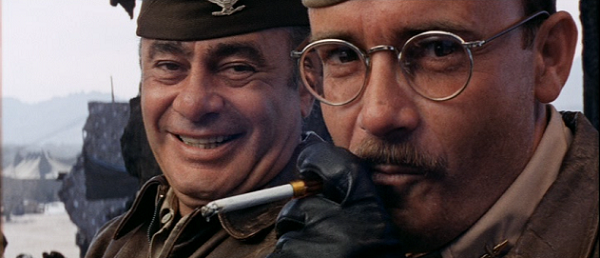
Perhaps it took a humorless, career-crippling George Clooney TV version of Joseph Heller’s novel to make us better appreciate Mike Nichols’ daring, infamously-expensive version of “Catch-22.”
Released at the height of the Vietnam War, suffering in comparison to Robert Altman’s equally anti-war dramedy “M*A*S*H,” seemingly more on a par with with equally cynical action comedy “Kelly’s Heroes,” which has had the benefit of a lot more TV exposure, “Catch” still plays the way it did way back in 1970 — as a pricey, “difficult” satire with a “difficult” shoot as baggage.
But wipe away the “Catch-22 lore,”the people cast and cast-aside, the fact that Nichols wanted the more age-appropriate Al Pacino as Yossarian, the young bombardier/anti-hero. Grapple with the film’s disordered narrative and come to terms with the nightmarish focus of the story — an active-duty combat airman flying through and ranting through what we now call Post Traumatic Stress Syndrome, coupled with survivor’s guilt.
It’s amazing to see now. And considering how our war movies, from “300” to “Midway,” “Greyhound” to “Flyboys” and even at times, “Dunkirk,” are made now — with digital planes and ships and sometimes tanks — they really don’t make’em like this any more.
Nichols made the most of his coastal Mexican location, showing off all 17 WWII vintage B-25s taking off and landing every chance he got. You couldn’t do that today.
And that cast. Alan Arkin makes a fine, perplexed and outraged Yossarian, a sane man trapped in the insanity of war, an actor who never hits a punchline too hard, never takes the character’s exasperation into parody.
“Let me see if I’ve got this straight. In order to be grounded, I’ve got to be crazy. And I must be crazy to keep flying. But if I ask to be grounded, that means I’m not crazy anymore, and I have to keep flying.”
“You got it,” Doc Daneeka (Jack Gilford) tells him. “That’s Catch-22.
“Whoo… That’s some catch, that Catch-22.”
Orson Welles as a grumpy general, Tony Perkins as a put-upon chaplain, Martin Balsam as the murderously vain commanding Col. Cathcart, Buck Henry as his venal sidekick, Col. Corn (screenwriter Henry was never better as an actor), baby-faced Bob Balaban as the always-crashing, always-tinkering, even-tempered Orr, it’s a dazzling corps.
Bob Newhart half-stammering through Major Major Major, a very young Martin Sheen raging as the pilot Dobbs, Art Garfunkel as the innocent co-pilot Nately who falls for an Italian hooker, Charles Grodin as an upper-class twit navigator, a smarmy, befuddlingly upbeat Richard Benjamin (cast, with his wife Paula Prentiss as a nurse Yossarian chases), the famous French star who fled to Hollywood Marcel Dalio is the wizened old Italian who figures Italy has already won the war, since it has surrendered and Americans are still fighting and dying.
And there’s a sea of actors we’d come to recognize on TV (“The Bob Newhart Show” is over-represented) in the years that followed.
Jon Voight stands out just enough as the grinning opportunist Milo Minderbender, a stand-in for every war profiteer you’ve ever read about, working the angles, an impersonal unpatriotic multinational corporation who wins no matter who loses.


Like its two contemporaries, “M*A*S*H” and “Kelly’s Heroes,” it’s a guy’s movie with a dated leering quality about the opposite sex. It’s heavy-handed, betraying Nichols — feeling his oats after “The Graduate” — indulging in some serious “blank check” filmmaking.
And reading over the years of all the people Nichols wanted to cast, or cast and then replaced, you kind of wish he’d moved on from Gilford, a future Oscar nominee who doesn’t bring enough cowardly sniveling to the good doc.
“Catch-22” was popular enough that they did a pilot for a sitcom based on it, as was the case with “M*A*S*H.” Richard Dreyfuss had the lead in TV’s “Catch.”
Over the years, I’ve interviewed half a dozen actors from that all-star cast, and often, without prompting, they’d bring it up. It took half a year of their lives, most of them, and burned itself into their memories, even if it wasn’t the blockbuster Paramount expected it to be.
Watching it again, outside of the academic settings where it turned up in “film as satire” classes and the like, it feels more cinematic than the scruffy, Altmanesque “M*A*S*H,” a movie marred by that stupid screen-time-chewing football game. It’s less fun than the more-watchable “Patton” and even “Kelly’s Heroes” (which is FAR longer).
But as a darker-than-dark comedy about the futility and insanity of war, it towers above its contemporaries in ways that should have scared-off George Clooney. It’s the best film of a seemingly-unfilmmable classic novel we’re ever going to get.

MPAA Rating: R, graphic violence, blood, nudity, profanity
Cast: Alan Arkin, Martin Balsam, Buck Henry, Tony Perkins, Bob Newhart, Paula Prentiss, Richard Benjamin, Marcel Dalio, Bob Balaban, Art Garfunkel, Martin Sheen, Jack Gilford, Peter Bonerz, Norman Fell, Austin Pendleton, Jon Voight and Orson Welles.
Credits: Directed by Mike Nichols, script by Buck Henry, based on the Joseph Heller novel. A Paramount release.
Running time: 2:02

Immerse yourself in any country’s native cinema and you quickly pick up on the same range of quality that everyone, from Hollywood to Pinewood, Bollywood to Nollywood shares.
There’s good, there’s bad, and there’s ugly.
“Maria” is a superficially slick thriller in that universal “female assassin” genre. It’s what happens when you throw Netflix money at a national cinema better known for its energetic, gritty crime pictures —“BuyBust” was a recent example.
There’s little sense of the country’s more traditionally-depicted underworld here. No street life, layers of of a society with a depressingly large underclass. It’s all top-notch fight choreography, well turned-out villains and a villainess, and a pretty heroine who can wear a slit skirt and kick-ass while she’s doing it.
The prologue here is a big give-away, and is emblematic of a ham-fisted script. A ninja-dressed killer invades a fortified mansion, wipes out the guards and faces a test. Will she murder a child and her mother (or nanny)?
So when we cut to domestic scenes of a life that Maria (Cristine Reyes), husband Bert (Guji Lorenzana) and their little girl, Min Min, we already know she has a past, and what that past was.
Her husband is working for a crusading politician, the mob wants that crusader silenced and the mob heir, Kaleb (Germaine de Leon) wants to track down this missing killer everyone assumes is dead.
As with the prologue, this is a blunder. There’s no “discovering” the “dead” killer, “Lily,” is now Maria. That whole business is just botched, another surprise tossed away. Perhaps the many scenes of torture, carried out by the Big Boss, Riccardo (Freddie Webb) and his favorite minion Victor (KC Montero) are meant to distract us from this.
The movie stumbles about, with Boss Riccardo bitching about “Why haven’t you guys silenced/cut off the head” of this politician while Kaleb pursues his vendetta against Lily, whom he has no trouble at all tracking down.


Reyes is dazzling in a fight, and stunt director Sonny Sison stages some impressive brawls for her to punch, kick, slice and shoot her way out of. One, a stunning sequence in which she faces down a long line of murderous minions, “Old Boy” style (a narrow aisle of a warehouse) is particularly impressive.
Far less impressive is the story and the dialogue, in assorted Filipino dialects and English.
“For a dead person, you look hot!” is all too typical. “I want heads cut!”
The best line comes from that most reliable of “killer on the lam” tropes, visiting “an old friend.” That would be mob-connected Mister Greg (Ronnie Lazarro) for “one last favor” (another worn out trope, and line).
“I thought the LAST favor was the last favor?”
The fetishized “Let’s pick out some guns for you” scene, mayhem in a marketplace, the replacement female assassin (Jennifer Lee) who must be faced — been here, done that in pretty much every locale and every language imaginable.
“Maria” may put a fresh face on all of this, and a fresh sheen — mansions and what not. But it quickly turns into a movie we’ve seen too many times before, often done much better.
MPAA Rating: TV-MA, graphic violence, torture, profanity.
Cast: Cristine Reyes, Germaine De Leon, KC Montero, Guji Lorenzana, Jennifer Lee and Ronnie Lazarro
Credits: Directed by Pedring Lopez, script by Yz Carbonell and Rex Lopez. A Netflix release.
Running time: 1:29


