
This one streams Aug. 25. Looks compelling — mental disorders among scientists and gamblers aren’t rare — and maybe annoying. “Dude, get up from the poker table and CURE this already.”
This one streams Aug. 25. Looks compelling — mental disorders among scientists and gamblers aren’t rare — and maybe annoying. “Dude, get up from the poker table and CURE this already.”

What an odd duck of a doc “Big Fur” is. But that just means director Dan Wayne has gotten damned close to his subject.
Alberta, Canada taxidermist, Roy Orbison impersonator and Bigfoot believer Ken Walker is a veritable rural Renaissance man.
Wayne’s film watches Walker, one of the world’s very best at taxidermy — he has the ribbons, trophies and absurdly lifelike menagerie to prove it — as Walker works his magic on his greatest “recreation,” bringing the Bigfoot of Myth, and 53 seconds of film footage to (still) life.
Walker’s work “has never been recognized by ‘the art crowd.'” There aren’t many scientists who’d stake their reputations on saying that “forest people,” “Sasquatch” or “Bigfoot” exist. And Walker confesses that taking on an “animal” for which he has no fur or skeleton to work with, which most don’t think actually exists, makes “people think I have lost my mind.”
But by the time “Big Fur” is done, your opinions on one or two of those three prejudices are sure to have changed.
“Big Fur” takes on the herculean task of rescuing the reputation of taxidermy, which city folk in particular regard as kind of ghoulish. Thank Norman Bates for that, Walker says. “Ever since ‘Psycho,’ taxidermists,” who used to garner a little respect thanks to the craft’s most famous practitioner, John James Audubon, “have been fighting that (murdered and stuffed his mommy) stereotype.”
That’s one of the few places in his movie that director Dan Wayne lets us in on a joke. He plays a little “Psycho” music as Walker carves away at styrofoam body structures, touches up glass eyes or paints the nails of this or that critter.
The rest of this quirky film is played deadpan straight — just a man, his art, his competitive streak, his “understanding” family and his obsession. Big. Foot.

Watching him study, frame-by-frame, the Zapruder Film of Bigfoot believers, the Patterson-Grimlin Film, less than a minute of a hulking, big-hairy-bosomed beast lumbering away and glancing over her shoulder (“Patsy” she is called, after Big Foot “researcher” Patterson) from 1967, you figure “Canadian dude’s been drinking the Kool-aid.”
But the back-and-forth over that movie’s authenticity has never conclusively settled on “hoax” or “the real deal,” although “hoax” still has the upper hand. “Big Fur” throws graphics up that tell us of the thousands of alleged “sightings” over the past 100 years of North American deforestation and population growth.
No, it’s not likely. That “film” has never been replicated, for starters. But as Ken Walker croons into the mike in a spot-on Roy Orbison impression, you concede that “In Dreams” might not be the only place Sasquatch stalks the dwindling forests.
And as Ken’s project nears completion, his fame growing as it does, his story takes a personal turn that’s kind of “on brand” for rural white North America, as well.
But conspiracies, killing critters, country music, and art? He’s got quite the task on his “magic hands,” changing the world’s mind about that last label.
“Taxidermy,” Ken says, regaling another competitor at a convention, “it’s all done by right wingers, who don’t BELIEVE in ‘art,’ and won’t call themselves ‘artists.'”

MPAA Rating: unrated
Cast: Ken Walker, Amy Carter, Ken Walker Sr., George Roof, Colette Walker, Chantelle Walker
Credits: Directed by Dan Wayne, script by George Langworthy. A 1091 release.
Running time:
A Netflix series about the first mission to Mars, with a multinational crew, perilous obstacles and the cost to those back home.
Josh Charles also stars in this Sept. 4 Netflix release.
A throwback B-movie about Tommies trying to make it to the evac zone, where Kenneth Branagh, the Royal Navy and “The Little Ships” could whisk them to safety. Look for “Behind the Line: Escape to Dunkirk” Aug. 17.


“The Pool” is terror at its most primal, a simple Thai thriller that’s complex in its simplicity.
The situation? A guy finds himself trapped in a deep, now-drained and abandoned Olympic sized swimming pool. There is no ladder to climb out on. There is no OSHA in Thailand — apparently.
His girlfriend tumbles in after him, knocking herself out as she does.
A Siamese crocodile tumbles in as well.
The pool has a pool float mattress, a divan (used on an underwater commercial the guy was helping film), a roll of duct tape, a tree limb, and whatever jewelry and clothing they have on them. Will any of that help them escape?
I was thinking writer-director Ping Lumpraploeng (“Dreamaholic”) blundered in telling much of this story in flashback. The opening scene, after all, shows production assistant Day (Theeradej Wongpuapan) bloodied, waking up to that croc clamping down on his leg.
But no, there’s plenty to be said about how Day got to this point (“Six days earlier”) and whether or not he’ll free himself and anybody else in the process.
Suspense comes from the near “discoveries” that pile up, the cell phone, dangling over the pool’s edge by its charger cord, just out of reach, the trained sheepdog Lucky, that Day brought to the commercial shoot, the barbed wire, the locked drain opening, the ticking over of days Day goes without his insulin.
Did I mention he’s diabetic? Sorry.
Girlfriend Koi (Ratnamon Ratchiratham) tumbling in after him just complicates matter. The script hangs Day on the horns of one dilemma after another — what to save, who to save, what injuries to avoid, which to accept to climb out of this death trap.
There isn’t a lot to “The Pool,” but that’s another way of saying there’s no more here than is absolutely necessary, and that includes dialogue. It’s an immersive and visceral movie-watching experience, inviting us to share the hopelessness, forcing us to “work the problem” and second guess the hero as he tries to do the same.
Yeah. It’ll leave you drained.

MPAA Rating: unrated, bloody violence
Cast: Theeradej Wongpuapan, Ratnamon Ratchiratham
Credits: Written and directed by Ping Lumpraploeng. A Shudder release.
Running time: 1:31


I hadn’t seen the low-budget black and white “original” “The Fast and the Furious” since catching it in a college film society way back when.
And eight movies into the Vin Diesel franchise — with “F9” pushed back to next year — I have to say it’s still the most memorable incarnation of the title. The dialogue crackles, the simplicity of it all makes the narrow focus — on just two characters — pop.
The story? Well, you can see why Universal and the guardians of today’s franchise would pretty much abandon that. But it’s still more fun than any 1950s on-the-lam/on-the-track thriller has a right to be.
“Furious” covers an exposition-packed prologue in the opening credits and ends just before we get a dose of “the consequences.” And an awful lot of what comes between is B-movie action and dialogue at its wittiest.
Dorothy Malone (“Man of a Thousand Faces,””The Big Sleep”) is Connie, the bombshell blonde with the Jaguar XK120, the fastest car of its era. She stops into a roadhouse on her way to “The International,” a road course race that would take drivers from California, into Mexico and back. She’s just minding her own business, waiting for waitress Wilma to open a can of pineapple juice, when a busybody with a gun fingers the fellow in a black leather jacket as Frank Webster (John Ireland, of “Red River,” “Spartacus” and co-director here).
Frank is a truck driver wanted for murder. He’s just escaped from custody. He grabs the gun, the dame and her car and we’re off — to Mexico, so he says.
“I like quiet women, stay that way!”
She doesn’t, thank God.
Frank — “You wanna play rough?”
Connie — “I don’t wanna play at ALL…I guess I should be grateful you haven’t murdered me!”
Frank — “Don’t TEMPT me.”
Connie — “I HATE you!”
Frank — “Just hate me…all the way to Mexico!”
Everybody, from the roadhouse to the Esso gas station attendant to the fellow sports car racing drivers they fall in with to dodge the cops sizes Frank up as “not the Jaguar type.”
Snobs.
Some of them get downright mouthy, to his face. But Frank has to take it. He can’t risk calling more attention to himself, can’t blow his last chance to skip to Mexico.
There’s a rough and ready quality to the kidnapper/kidnap victim relationship and a gritty, “Don’t tell the insurance company” air to the racing.
It’s not just rear projection and stunt doubles. Ireland drives, and producer, screenwriter and future B-movie mogul Roger Corman was behind the wheel in one of the other Astin Martins, Austin Healeys, Nash-Healeys, Triumphs, MGs, Allands, Maseratis, Bandinis and Porsches on the track.
Maybe it’s not a great film, but it’s great fun and you can see why, 20 years ago (wow) Universal would choose to revisit the title, the crime milieu and car-craziness of “The Fast and the Furious.” If you’ve never seen the original, now’s the time to catch up, seeing as how Vin and Michelle and D. Johnson et. al. have to cool their heels for a few months more.
MPAA Rating: “approved”
Cast: John Ireland, Dorothy Malone.
Credits: Directed by John Ireland and Edward Sampson, script by Jerome Oldum, Jean Howell and (story by) Roger Corman. An American Releasing Corp. film, now on Tubi.com (free), Amazon, Youtube etc.
Running time: 1:13

Imagine “Ghost” without the potter’s wheel, no Demi-Patrick heat — no Whoopi and no “whoopie.”
That’s “Endless,” a teen romance about love that endures past an untimely death, an entirely tepid affair, thanks to a romance that is more photogenic than passionate.
Alexandra Shipp (“Love, Simon” and “X-Men: Dark Phoenix”) and Nicholas Hamilton of “It” star as the mismatched lovers separated by a car crash.
“We totally didn’t make sense on paper,” she narrates.
Chris is a little older, having barely graduated from high school, with few prospects we can see. Riley’s rich, waiting to hear from Georgetown — on a path to law school.
But but…he has a motorcycle, a leather jacket! And he’s the latest Aussie to bear a faint resemblance to James DEAN.
She doodles graphic novels on the side, but art isn’t where the money is. He…well, we don’t see much of his outside-the-relationship life.
We don’t get much of anything out of the relationship, either — a little kissing in dramatic (Pacific Northwest) settings. And just like that, she’s accepted at the cross-country school, there’s a party, an argument, drinking and a wreck.
Queue “Unchained Melody.” Just kidding. That song is nowhere to be found, but otherwise, basically what we deal with from here on out is “Ghost.”
Yes, death comes abruptly, as it does in real life. But it comes so quickly in the film. Or maybe it just seems that way, because we haven’t had time to commit to the romance, to share Riley’s heartbreak on waking up in the hospital, with Chris in the room, to be told Chris is dead.
Only nobody told him.
“I’m not dead! I’m not dead!” Nobody hears you, dear.
You know what follows, or would if you’ve seen other versions of this sort of story — “Ghost” being the most famous. We get a glimpse of Riley’s grief, and we follow Chris into the afterlife, where he runs into ghosts who are hostile, and a friendly tour guide (DeRon Horton of “Dear White People,” the TV series).
“The one absolute rule of being dead is that you CAN’T contact the living!”
You KNOW that’s the rule these crazy, lovesick kids are going to find a way to break.


Whatever variations on a theme this script offers, none of it works without the ache we’re supposed to feel for those torn apart by sudden death. “Endless” never delivers that.
The one person who makes us feel the tragedy is Chris’s working class mom. Famke Janssen knows how to play that, dissolving into howls of pain, lashing out at the rich girl who reaches out to apologize for the wreck.
Shipp sheds a tear or two, and reacts to the first flashes of the supernatural she experiences from Chris “reaching out” the way we do — with a hair-raising start.
But without seeing that love, and more importantly feeling it, nothing else about the movie matters. “Endless” staggers ever-onward, adding more story and not for one minute making us care.

MPAA Rating: unrated, alcohol abuse, some profanity
Cast: Alexandra Shipp, Nicholas Hamilton, Zoë Belkin, Eddie Ramos and Famke Janssen
Credits: Directed by Scott Speer, script by Andre Case and Oneil Sharma. A Quiver release.
Running time: 1:34


A Broadway bust heads home to Wisconsin, where coaching a little girls’ dance squad in a big national competition just might be her ticket back to New York in “Feel the Beat,” a family-friendly comedy that has its moments.
True, many of those moments are cheesy. But let’s stay upbeat and positive, seeing how few TV-G things Netflix serves up for kids. They lean towards edgier kiddie fare, for the most part. And this? I laughed a few times, was touched here and tjere.
Ballerina petite Sofia Carson (of Disney’s “Descendants” TV movies) stars as April, the small town girl who’s made it to New York, even if she hasn’t quite “made it IN” New York. We meet her just as that dream crashes. One sharp-elbowed New Yorker fighting for a taxi in the rain episode ends her career. She thinks.
Back to Wisconsin it is then, where divorced dad (Enrico Colantoni of “Just Shoot Me” and “Veronica Mars”) is a shoulder to pout on.
April’s little “accident” with a New York dance impresario went viral. But when anybody asks why she’s back, it’s “because I got sick,” Dad says, saving her pride.
The old beau she dumped, via text, when New York beckoned? That would be Nick (Wolfgang Novogratz), and not the Chris Pratt look-alike (Dennis Andres) who coaches the high school football team and has kids in dance class.
“Goooo CHURNERS!”
Cheese is churned, get it?
April finds herself doing a Q & A for the kiddies for her old teacher, Miss Barb’s (Donna Lynn Champlin, a “hoot” as they say in Cheesehead Country) dance studio.
“NEVER make a mistake in front of anyone important” is her bitter advice to girls with dancing dreams.
And that’s when the realizes that this Big Nationwide “DanceDanceDanceDance” contest the tiny tykes are entered in will be judged by the only choreographer in New York — Welly Wong (Rex Lee) — who might give her a chance to restart her career.
Sure, she’ll take over coaching. Sure, she’d be delighted to choreograph and star in a Teacher and Her Students dance as part of it. No prob.
Funny stuff — April transforms into a drill sergeant when she takes over from soft-hearted Miss Barb.
“GROW a pair! Are you dancers, or ‘little GIRLS?'”
“Little GIRLS!”
Uh oh. “Drop and give me TWENTY.”
Arrogant Coach April won’t learn their names — it’s “Eyeglasses” and “Pigtails” and “Fingers,” keep in time!
Wait, “Fingers?” She calls Zuzu (Shaylee Mansfield) that because — get this — she’s DEAF. The other girls learned sign language to get her on the team, and mean old teacher calls her FINGERS. Man. Tough.
There’s amusement in their first competition, where over-sexualized other teams of tweens are twerking up the stage.
As the contests go on, there’s a very funny bit where the jock dads of competing teams get into a trash-talk tizzy in the parking lot — using nothing but dance jargon.
“YOUR girls wouldn’t know a triple time step if OUR girls were dancing it on their sad little faces!”
And the Gay to the Rescue here is old New York pal Deco (Brandon Kyle Goodman, fun).
But the rekindled “love story” is a non-starter, the endless contest levels are tedious, the contrived obstacles to the teacher sticking with the girls and getting them to The Big Game obvious and annoying.
It’s paint-by-numbers screenwriting, and even that wouldn’t be awful if the picture was quicker, lighter on its feet. It’s an 80 minute comedy in a 110 minute package.
Still, an inoffensive (mostly) movie for the whole family, especially ones with little girls? A pretty rare thing.
Close enough will do when your only alternatives are cartoons and the fresh-mouthed brats at Nickelodeon and The Disney Channel.
MPAA Rating: TV-G
Cast: Sofia Carson, Enrico Colantoni, Donna Lynne Champlin, Wolfgang Novogratz, Rex Lee and Brandon Kyle Goodman .
Credits: Directed by Elissa Dawn, script by Michael Armbruster, Shawn Ku. A Netflix release.
Running time: 1:47
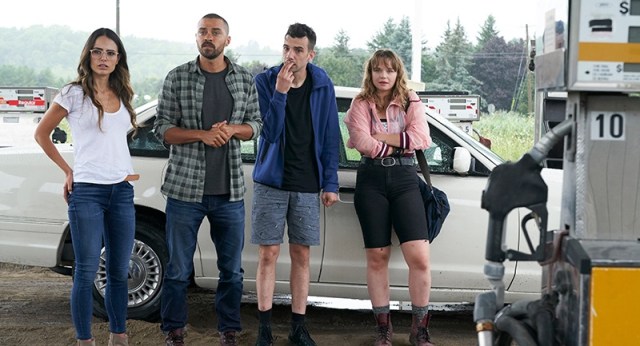
That Jay Baruchel. Such a nice boy. Voice of the “How to Train Your Dragon” Viking, lovable guy who knows “She’s Out of My League.” Canadian. A real mensch.
But let’s leave as much of that behind as possible for our directing debut, shall we?
“Random Acts of Violence” is a serial killer thriller thriller that attempts to be a commentary on such entertainment, a pop psychology analysis of the realities where horror is born, the classic “Pass judgement, but wallow in it at the same time” double-standard.
And that turns out to be too ambitious, grappled with as an afterthought. So pandering slasher film it is, complete with the obligatory nut-with-a-knife — and oh — why not a welding helmet to boot?
Based on a comic book about a comic book author whose horrific “Slasherman” creation seems to be inspiring a new killing spree, all for the writer’ s benefit, “Random” has little that’s creative in the killing, even though there’s a lot of it. It shows us pangs of conscience and regret in that author, and it takes us towards a conclusion that plays like a bloody inevitability.
Todd (Jesse White of “Grey’s Anatomy” and “Cabin in the Woods”) is finishing up his masterpiece, “the number one R-rated comic in the genre,” he says. Slasher comics are a genre. Good to know.
But he’s having a bit of writer’s block on the finale, which he wants good enough to “show the critics” they’ve been wrong about it. No worries. He and Kathy (Jordana Brewster) are headed off for a vacation. Inspiration will surely strike.
Because she’s researching a book on “The I-90 Murders,” the late ’80s killings Todd’s comic was inspired by. They’ll be covering much of the same ground as the killer, and the “hero” of Todd’s comic. Todd’s publisher (Baruchel) and the publisher’s organizer-assistant (“DeGrassi” alumna Niamh Wilson) will come along.
They’ll stop at colorful “no star” motels, question a few locals, unload some comics, do a radio interview and wind up at a convention in New York city.
The Canadian quartet pile into a 35 year old Town Car (Comic books don’t pay.) and brace themselves for the culture shock of the U.S. — “Everybody has guns,” everybody in a pick-up is road-hog aggressive, every store clerk is rude.
And that radio interview? It’s an ambush, a confrontation driven by a host who knew somebody murdered by “The I-90 Killer,” and doesn’t like the glib “heroic” take on a mass murderer Todd has conjured up.
But that’s where the one person who calls in changes the nature of their trip. A static crackled voice recites numbers, “One, twelve, eighteen.” What’s he mean? Driving by a scene of carnage, staged at roadside, Todd and his “huxter” publisher pal Ezra get a clue. It’s a scene out Todd’s grisly comics. And there will be others. Why?
“I’ve drawn, like, a thousand kills!”


Everything that follows feels perfunctory, although the shock of the moments of violence is undeniable. Flashbacks to Todd’s childhood make us wonder just what demons he was channeling when he cooked up the comic. And no, telling the cops about all this is no help at all, unless judgmental contempt for Todd’s “creation” is helpful.
The artful folding of comic book animation into the proceedings works. The road trip structure is time-proven, although A) two lane roads are NOT “I-90,” and B) outside of LA, NOBODY calls interstates “The I-90.”
The odd pointless scene and debate is mixed in with the spiraling mayhem that they find themselves driving into.
And the scene when they first witness a violent act carried out right in front of them is laughably illogical, irrational and self-preservation inept, almost a parody of such “What are you DOING?” moments.
Don’t be fooled by the flashbacks and the brooding (Williams is adequate in the part, nothing more). And don’t let the animated trappings and “dark” tone convince you it’s beyond genre.
It isn’t. It’s as random as its title suggests, a genre flick that doesn’t do much more than stumble and angst-out from one killing to the next.
MPAA Rating: unrated, graphic, over-the-top gory violence, drug abuse, profanity
Cast: Jesse Williams, Jordana Brewster, Niamh Wilson, Simon Northwood and Jay Baruchel.
Credits: Directed by Jay Baruchel, script by Jay Baruchel and Jesse Chabot, based on the comic book. An Elevation Pictures release.
Running time: 1:31


There was a time, children, when movie stars were truly larger than life, when deals could be made from hungover breakfast meetings at Cannes and when the movies that emerged from that “system” were as appealing as afterbirth, and about as marketable.
In the glorious last years of that “process,” Great Names such as Sellers and O’Toole, Sutherland and Burton waged an unofficial war to see who could make the most “unreleased” or “unreleasable” debacles.
Indie cinema was barely a thing, Hollywood hadn’t figured out the new “blockbuster” business model and thus the only thing anybody figured was bankable was the star, the “name” that would-be financiers recognized. We’ve seen versions of this outdated hustle when CBS Films, STX and others started up.
“Get me JENNIFER LOPEZ!”
“Foxtrot,” or “The Far Side of Paradise,” came just after Lina Wertmüller’s “Swept Away,” and one can hear the Spanish-accented, booze-fueled/judgement-impaired pitch just in its premise.
Romanian royals dash off to a remote, deserted isle just before World War II starts, a “paradise” where they and their kind can dine, drink and dance the “Foxtrot” while the peasants cope with the world burning down around them back home.
Human nature being what it is, cruelty, stupidity, sexual jealousy and violence are what they get instead.
Peter O’Toole is the Romanian count who masterminds this extended sojourn. Charlotte Rampling is his regal, scheming wife, but not his first wife. Max Von Sydow is the Swedish military man who schooled the Count, way back when, and now makes the logistics of this dubious enterprise work.
And Jorge Luke is Eusebio, the immaculately attired and gloved butler who oversees the drinks, the meals and whatever else is needed in the lavishly tented “paradise” they set up for themselves.
No, none of this seems feasible or adds up logistically. But that’s not the point.
In my mind, the pitch to the stars that won them over was a Mediterranean working vacation — somewhere in the Italian isles. But no, this was filmed on the rocky Pacific coast of Mexico.
Other guests arrive, the wildlife on the island is slaughtered for sport, “accidents” happen and “marooned” enters the conversation.
“Looks like we’re staying here the rest of our lives.”
That’s when the murderous mischief really begins.
Rampling is gorgeous and mysterious, O’Toole somehow gives us nothing and Von Sydow is competent, and little more, all of them acting out a repellent story that offers little and no one to connect with.
Mexican director Arturo Ripstein is still with us, and still doesn’t have a credit that’s broken through, internationally. Rampling still works, The late Von Sydow made too many great films for this one to matter at all and the late and great O’Toole, after his “My Favorite Year” comeback, had a nice Third Act run of performances that led to an honorary Oscar.
But “Foxtrot?” O’Toole’s character, recoiling at one of the home movies the swells sit down to watch over port and cigars, gives the best review.
“But I BURNT that film!”

MPAA Rating: R, violence, nudity, sex
Cast: Peter O’Toole, Charlotte Rampling, Max Von Sydow and Jorge Luke.
Credits: Directed by Arturo Riptsein, script by Arturo Ripstein, José Emilio Pacheco and H.A.L. Craig. A New World release on Tubi, Amazon, etc.
Running time: 1:31


