



Movie Review: An Orphan discovers what it means to be “The Devil’s Child”

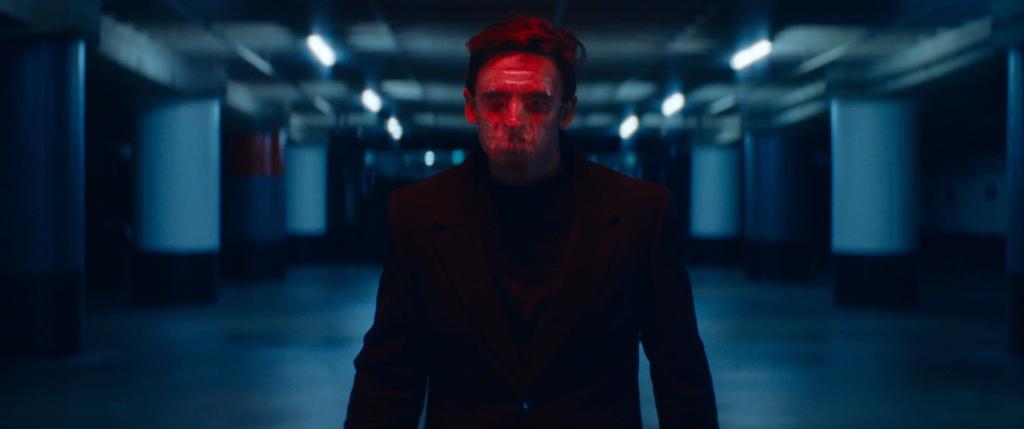
On a gloomy, fog-enshrouded night a decaying mansion is glimpsed in the darkness. It is where Nurse Cherry’s new assignment is. She will take care of the very old, quite-catatonic master of the house.

Little does she suspect, as servant/chauffeur Dwayne takes her bag out of the ancient British limo, that this place, this job and this “arrangement” is going to bring back the demons of her orphaned childhood along with hints of the dark Halliwell family history haunting these halls.

But we suspect. Because we can’t miss that opening scene where Cherry had “weirdo” scrawled on her forehead by the cruelest orphans there. Because the cadaverous old man (Germán Naranjo) looks like the Living Dead, or the Undead.

Because we’ve seen his imperious daughter (Fiona Horsey) show us the whites of her eyes — and only the whites.

It takes a very VERY long time for anything to “happen” in Colombian writer-director David Bohorquez’s “The Devils Child.” Somebody is yanked out of the frame at roughly the one-hour mark.

Apparently, Bohorquez needed the hour that precedes that almost-scary moment to bore us to death.

Still, it’s an oddly-disorienting horror tale. The accents are distractingly hard to place. Cherry’s is plainly Spanish, Dwayne (Marvens Passioano) is explained away as “island” (Caribbean).

Miss Naomi, the owner’s daughter, has a reasonably-convincing North American accent, as do Cherry’s friends-since-orphanhood. I found myself lost in trying to set this story in some sort of geographic reality — Louisiana without the drawl? That’s a pointless exercise, but the film is so dull that’s where the mind wanders.

Cherry takes the job, accepts the order to keep “the curtains drawn” and the lamps down low in the old man’s room. She explores, and stumbles into visions of children wandering the halls.

She dances with Dwayne and imagines she’s tripping the light fantastic with patriarch Philip in his platinum-blond youth. And she has nightmares. None of which produces anything remotely frightening.

“It’s not real, it’s all in your HEAD” she chants in the manner of 4,321 horror heroines before her.

The accents are worth fixating on because the actors labor through their line readings like they’ve been sentenced to “Hooked on Phonics.” It makes a couple of the players come off as rank amateurs. But if you want your movie, titled “Diavlo” in Colombia, to earn a North American release, this is a price you pay.

Plot elements are introduced — Philip was once “a highly-respected psychic.” — and forgotten. Characters go missing or go mad.

And nothing resolves itself in a way that makes the least bit of sense. Nothing.

MPA Rating: unrated, horror violence, drug use

Cast: Maria Camila Perez, Marvens Passiano, Fiona Horsey, Francisca Tevez and Germán Naranjo.

Scripted and directed by David Bohorquez. A Vertical release.

Running time: 1:28

Posted in Reviews, previews, profiles and movie news | Comments Off on Movie Review: An Orphan discovers what it means to be “The Devil’s Child”

Classic Film Review: Claude Rains is “The Man Who Watched Trains Go By” (1952)

Here’s an oddity on the resume of the wonderful Hollywood character actor Claude Rains — a Technicolor star vehicle, shot partly on location in Amsterdam and Paris in the early ’50s when Rains was in his 60s.

“The Man Who Watched Trains Go By,” released as “The Paris Express” in the US, was adapted and directed by the esteemed British stage director Harold French, who made 20 or so films, none of them particularly distinguished or highly-regarded today.

The performances are interesting, and it’s especially novel to see the 60something Rains on a bicycle, clambering out of windows and bolting under railcars. Sixty back then was the “new” 75.

The plot is the “quiet little old man falls for a femme fatale and steals” trope of Edward G. Robinson’s “The Woman in the Window” and other pictures of the day. There’s a curiously dated and sentimental sympathy for him that isn’t properly set up, leaving the whole entirely too haphazard to be the compact, dark noirish morality tale it’s meant to be.

Kees Popinga is a conservative, servile man of habits. He’s worked for De Koster & Son, a small firm where he’s chief clerk (bookkeeper) for 18 years. He puts in his days with quiet efficiency, and comes home to his wife, teen daughter, tween son and cigar every night.

He’s fond of the local chess club, even though he’s not very good. And he’s downright meek around his imperious boss (Herbert Lom) and utterly unable to convince the man to take on an old acquaintance whose firm went bankrupt, through no fault of his own.

His firm has “a reputation for honesty and integrity,” de Koster, who inherited the three hundred year old enterprise from his father, huffs. And, as an afterthought, he adds “and morality.”

His clerk “knows more about my firm than I do myself,” but what de Koster doesn’t see is the quiet desperation in Popinga’s thrift and routine. He knows every passing train’s destination, its ETA and whether its late arriving in their small city of Groningen. It’s implied, but only later overtly introduced, that he longs to get on such trains and travel.

The arrival of a Paris detective (Marius Goring) who wants to see their books is the first sign of trouble. Then there’s young woman (Märta Torén) Popinga spies his boss kissing and putting on the Paris train. When he stumbles across de Koster burning ledger books, the game’s up. The fool’s embezzled his company into ruin over the woman and there’s nothing for it but “death before dishonor.”

It’s only when his briefcase pops open that Popinga realizes his employer, who has stolen from him personally (he’s an investor), has looted the safe and is fleeing town, planning on faking his death as he does.

Popinga’s rage means the death by drowning in a canal might not be faked after all. And that briefcase means Popinga can realize his unspoken and barely implied dream and escape his life in Groningen. He’s off to Paris, but is he cunning enough to get away with it?

I can’t speak to the qualities of Georges Simenon’s novel, but the film adaptation has a lot of plot problems that pretty much leap off the screen. The first we learn of Popinga’s discontent is when he shoves his boss into that canal. All that longing to “escape” and “travel” is seriously under-motivated.

Kees Popinga is naive enough to approach a hooker (Anouk Aimée) for help finding a “no passports required” hotel in Paris, and Dutch cheap when it comes to “rewarding” her (indirectly leading to his downfall).

While it’s established that the man is no chess master and can be quite gullible, that doesn’t explain his decision to look up the boss’s mistress when he gets to Paris, to fall into her clutches, hiding out in a dumpy auto repair garage apartment with her sinister “real” boyfriend (Ferdy Mayne).

Rains, so wonderful in chewy supporting roles from “Casablanca” and “Notorious” to “Lawrence of Arabia,” has a bit more trouble hiding his Edwardian theater melodramatic excesses in this performance. Popinga’s character journey seems abrupt and over-the-top, from meek and subservient to wild-eyed with…jealousy, greed, fear of discovery?

And then there’s the kid gloves treatment of the detective, warning and tracking Popinga at the same time, trying to keep him from “crossing a line” we’ve already seen him cross. Or are we supposed to have forgotten that, no matter how much he “has it coming,” Kees killed his boss?

Still, the post-war locations, mixed with British soundstages, are striking and captured in all their glory. And “The Man Who Watched Trains Go By” remains a Technicolor novelty in showing us a favorite supporting player from Hollywood’s Golden Age given a rare leading role, even if he isn’t quite up to carrying the picture with the same panache and cynicism he wore that French policemen’s cap with in “Casablanca.”

MPA Rating: Approved, smoking, violence

Cast: Claude Rains, Märta Torén, Herbert Lom, Marius Goring and Anouk Aimée

Credits: Scripted and directed by Harold French, based on a novel by Georges Simenon. An Eros Films release, streaming on Amazon, Tubi and other platforms.

Running time: 1:22

Posted in Reviews, previews, profiles and movie news | Comments Off on Classic Film Review: Claude Rains is “The Man Who Watched Trains Go By” (1952)

Globes in Jeopardy? Celeb PR Firms are still irked at the Hollywood Foreign Press

The people who represent the stars who agree to show up to the HFPA’s assorted events, including the Golden Globes, say the band aid NBC endorsed that the HFPA introduced yesterday does not go far enough.

With #TimesUp and others pushing the HFPA to turn less racially monochromatic, less corrupt and more “transparent” — the latest effort to make this connected, grandfathered in membership and its operation more professional — this is yet another warning shot over the bow. Will they go back to the drawing board, and will NBC get behind that pressure? Or they just riding this ok it and expecting Short Attention Span Nation to forget all about it?

This year’s miniscule viewership has a whiff of “headed to streaming only,” and NBC should be withholding cash and the promise of a Globes broadcast to make this happen. Will they?

Scott Feinberg’s THR story is below.

https://twitter.com/ScottFeinberg/status/1390767339625275393?s=09

Posted in Reviews, previews, profiles and movie news | Comments Off on Globes in Jeopardy? Celeb PR Firms are still irked at the Hollywood Foreign Press

Documentary Review — “Knots: A Forced Marriage Story”

“Knots: A Forced Marriage Story” is a documentary that, on its surface, sounds like something from a more primitive place and time.

More than one woman appearing in Kate Ryan Brewer’s film — legislator, activist or victim — marvels at the idea that “forced child marriages” are not something relegated to the less developed corners of the world, but that it’s happening “right here” and right now, with some 27 U.S. states still not having a minimum age requirement for girls getting married on the books.

And here the “leader of the civilized world” is, a global punchline to a crude joke about Appalachia or Utah or the ultra Orthodox corners of Borough Park, Crown Heights or Williamsburg, Brooklyn.

Archaic laws that allow parents to deliver their children to a “mate” of their or their subculture’s choice, or even ordain that their statutory rape victim child be forced to marry their rapist, are on the books or allow such things to happen, thousands of times a year, via loopholes in those laws.

The stories told are damning, deflating and compelling, the statistics alarming and the villains as obvious as your nearest “fundamentalist” this or “ultra-conservative” that.

Brewer’s film touches on many variations of this “inhuman” practice — a girl “handcuffed” to force her to marry her rapist, “grooming” that goes on, in and out of religious practices, religions distorted into cultish sects that add this extra element of “control” to their hold on women.

But the film focuses on three stories, women from patriarchal fundamentalist religious groups who talk of their lives, the terror, despair and isolation of their plight, the desperation that led them to find a way to escape and the outrage and sympathy that turned them into activists to stop the practice and seal those loopholes.

Nina is a Michigander whose parents turned increasingly “conservative” religiously, and started “grooming” her for the day when her father would find her a mate and order her to marry him.

It hits her, when this arranged union takes place, that “my body’s not my own any longer. It belongs to him.”

Sara is a Californian whose Muslim father fell in with a sect that eventually caused her mother to flee. But when Sara found her first boyfriend ever, in her mid teens, Mom sent her off to stay with her father, who secretly married her off to a 28 year-old. She was 15, and when the actual “civil” union took place — legally — no one brought up the fact that she was pregnant via statutory rape in Nevada, where her father and his co-religionists took her.

And Fraidy is a Jewish Brooklynite who describes the ultra Orthodox “brainwashing” that went on in her world, almost from birth — with Halloween treated as a night when “the Goyim” put on masks and “came to get us.”

Her loveless arranged marriage arrived abruptly and without her consent.

“I wasn’t a party to my marriage to my husband. I was ‘given’ to him.”

It’s all kind of revolting, learning that these cruel vestiges of the ancient patriarchy exist in a time when we think of women as emancipated people of agency able to choose their own destinies, priorities and lives.

“Education” is a worry of all these sects, “control” is their end game. To a one, these women got out and started speaking out, with Fraidy Reiss becoming a well-known advocate for rescuing girls crying for help and all of them active in changing laws to end this nonsense.

We see what Virginia had to go through to address this problem, the nakedly Neanderthal counter-arguments offered on the floor of the General Assembly by a Republican fighting the bill that allowed teens “emancipation”

We see similar legislation vetoed by then-Governor Chris Christie in New Jersey.

Brewer’s film — decorated with metaphorical images of a young dancer entwined in a knottier and knottier web of red twine — hints at the “whys,” and suggests the “hows” of getting rid of this practice.

But we can read between the lines. Not even things as fundamental to human rights as this are easy in these Divided States. And until every law is changed or Federal mandates supersede them, men will be dragging their daughters or would-be mates to places where yet another “choice” is still only left in their hands, and not women’s.

MPA Rating: unrated, adult subject matter

Cast: Nina Van Harn, Sara Tasneem, Fraidy Reiss

Credits: Scripted and directed by Kate Ryan Brewer. A Global Digital release.

Running time: 1:16

Posted in Reviews, previews, profiles and movie news | Comments Off on Documentary Review — “Knots: A Forced Marriage Story”

Movie Review: EveryDaddy was “Kung Fu Fighting” — “The Paper Tigers”

Well, isn’t this just adorable?


“The Paper Tigers” is a martial arts action comedy filled with punch-ups, knock-outs, insults and one-liners. Well-acted, with actors who know how to throw a kick and land a punch — and a punchline — stuntman and editor turned writer-director Quoc Bao Tran has made a debut feature that tells a tired “avenge our master’s death” tale with real comic flair.

In the “Karate Kid” ’80s, the three star students of Sifu Cheung (Roger Yuan) dominated their corner of American martial arts. Danny “Eight Hands,” Hing and Jim — seen in vintage videos — mixed it up, won tourneys and were constantly beating down white boy challenger Carter.

They were “The Three Tigers,” not mere students but “disciples” destined to take over Cheung’s dojo. But when the old man is killed by an unseen master, those days are decades past. Even Danny “Eight Hands,” whose fists were so furious they blurred and looked like he had extra appendages, has mellowed into a post-divorce minivan.

Danny (Alain Uy of “The Passage” and “True Detective”) has snow on the roof and little in the way of muscle mass. He’s all about “walking away” from trouble, something he imparts to his son, who stays with him on weekends. A confrontation in a parking lot opens him up to an Asian slur.

“Can’t you PARK?”

“Can’t park. Can’t drive. Can’t help it.”

But when his fellow “Tiger” Hing (Ron Yuan of “Mulan” and “Marco Polo”) shows up, he’s shamed into joining him for the funeral. Running into the their old nemesis Carter (Matthew Page of “Whiskey Tango Foxtrot” and TV’s “Enter the Dojo”) sets the tone for “Paper Tigers.”

To Danny — “You look skinny. You sick?”

To Hing — “You look like a fat, Asian Mister Rogers!”

The two “Tigers” are wheezing and limping and out of shape. But the hint that their Sifu might have been killed and not died of a heart attack forces them to track down their estranged third Tiger Jim (Mykel Shannon Jenkins of TV’s “The Rich and the Ruthless”). He runs his own school, has branched out into Brazilian jiu-jitsu, so at least he’s in shape.

As they slowly (pace and “urgency” are a real problem with the movie) get on with hunting for answers about what “really happened” to their beloved teacher, at least Jim won’t let down the side as they get into “knock-out” contests with assorted “punks” and rivals as a way of discovering the truth.

Damned convenient, these pauses for brawls.

The fights have a grand cotillion formality to them — bows and flexes as every fighter takes his position.

The jokes are of a “Kung Fu Panda” vs. “Kung Fu Sanford” thing.

Tran has the most fun with Yuan’s character — whose toupee makes for quite the martial arts dust-up sight gag — and with Page’s “more Chinese than you” cultural appropriating doofus.

“If you asked me…” “Which I DIDN’T.” “If I were YOU…” “Which you are NOT.

Carter is forever trotting out “As the Chinese say,” and then offering some bit of sage advice that might have come from a fortune cookie — and delivering it in CHINESE.

The humor moves the picture along, which truthfully starts VERY slowly thanks to an overlong “Tigers in the ’80s” prologue. But Tran’s screenplay problem-solving is first rate, foreshadowing via a trip to the gym how they might find out how killed their Sifu.

“Find the one that hits the hardest.” That won’t be a visual clue. “Listen” for how the blows sound when they land.

Clever.

The same goes for the movie itself. These “Paper Tigers” cover mostly familiar ground, but do it with rusty moans and groans of pain, and with laughs — some of them damned adorable.

MPA Rating: PG-13 for some strong language, offensive slurs, and violence

Cast: Alan Uy, Mykel Shannon Jenkins, Ron Yuan, Roger Yuan, Raymond Ma, Andy Le and Matthew Page

Credits: Scripted and directed by Quoc Bao Tran. A Well Go USA release.

Running time: 1:48

Posted in Reviews, previews, profiles and movie news | Comments Off on Movie Review: EveryDaddy was “Kung Fu Fighting” — “The Paper Tigers”

Reddit Investors “rescue” AMC Cinemas, and the CEO is down with that

Good piece from The Hollywood Reporter how online directed group buying is propping up AMC’s stock price, keeping it an attractive investment and a company worth loaning money so that it will survive the pandemic.

It’s kind of a GameStop scenario, where fans of the game store brought them back from the dead by buying and boosting their stock price, and clobbered a lot of Wall Street types who gambled that they’d go under.

Who is shorting AMC? They have looked doomed for the past year, do it wouldn’t be the dumbest bet. SOMEbody has to be losing, with a few million Reddit “Wall Street Bets” investors buying up the stock.

Adam Arons, the CEO, is on board with this fan takeover. The users of the company’s theaters own it? Win win, I say. As there’s a Diane Fossey “Gorillas in the Mist” charity that also benefits from this investor activism, it’s got a righteous side, totally beyond the “save the theaters” and “Screw the short sellers.”

Still not my favorite film chain, but they keep a lot of smaller older theaters going and thus help prop up the movie going habit.

They were the first major theater chain to pull its newspaper advertising, further crippling newspapers and killing the movie reviewing profession (and eroding the movie going habit in the public’s mind further as well). When I called them on it, they sent a form letter snidely suggesting that newspapers continue publishing their showtimes, for free, “as a public service.”

So I won’t shed any tears if they go down. But here’s the link to the THR report.

https://www.hollywoodreporter.com/business/business-news/amc-reddit-wallstreetbets-gorilla-fund-1234949784/amp/?__twitter_impression=true

Posted in Reviews, previews, profiles and movie news | Comments Off on Reddit Investors “rescue” AMC Cinemas, and the CEO is down with that

Movie Review: A grim satire of Europe gone to the “Undergods”

“Undergods” is a sci-fi fantasy of a dark and dystopian Europe, where “family” and feeling have broken down and the Putinesque rule of an uncaring State and its predatory oligarchs have numbed the people and normalized the awful.

Chino Moya’s film is designed to summon up the Good Ol’Days of Dystopia. It “feels” like “Delicatessen” without the laughs or “Blade Runner” without a plot.

The film has a buy-in reminiscent of what Andre Malraux said about Marxism, a willingness to “feel” proletarian. Dystopian sci-fi sometimes puts “feeling” the darkness — literal, and in tone — above other considerations, and plenty of fans go for that.

“Undergods” has a gloomy post-lapsarian Soviet look, downtrodden players cast for their ability to dress down and look homely — Eastern European sci-fi as envisioned by Mike Leigh.

All well and good, as far as that goes. But this is right on the edge of incoherent.

The madrileño Moya, making his feature film directing debut, uses something like the “Tales of (E.T.A.) Hoffmann” as his organizing principle. The German Poe’s horror/fantasy stories are referenced — a character is reading him — for a reason. The interlocking episodes of the film are grim and related in Hoffman/Brothers Grimm story-telling form.

A father tells his little girl about a rich, unscrupulous “merchant” (Eric Godon) who screws over the wrong inventor (Jan Bijvoet), who then kidnaps the merchant’s daughter (Tanya Reynolds).

A couple of “bring out your dead” body-haulers (veteran British character actor Johann Myers of “The Lost City of Z,” “Bank Job,” and Géza Röhrig of “Resistance” and “Son of Saul”) tell each other stories that tie into the bodies they pick up off the street. Not everyone in their “load” is “dead.”

“Sell the big one for meat!”

Down the rabbit hole we go into a grey alternative reality where industrial wasteland bleeds into urban ruin, where a new neighbor (Ned Dennehy) gets locked out of his apartment, feeds paranoia as he threatens to break up the marriage of the couple (Hayley Carmichael, Michael Gould) who took him in.

Human “meat” marketing shows up, hard against a visit to a suspiciously efficient “Star Sugarless Gum” factory.

Is Star Sugarless made from “PEE-pul?”

The stories are “entropy” writ large, with subtexts about the breakup of the family, the collapse of institutions with only their imposing and impersonal architecture and a scattered, demoralized populace left behind, carrying on in this New Normal.

That’s an arresting backdrop. And I like the Kafkaesque vibe of it all.

But there’s “cryptic” and “vague” and then “incoherent to everyone else” and unfortunately, Moya sets up shop at that end of the spectrum.

MPA Rating: unrated

Cast: Johann Myers, Géza Röhrig, Michael Gould, Hayley Carmichael, Eric Godon, Tanya Reynolds, Jan Bijvoet, Kate Dickie and Burn Gormley.

Credits: Scripted and directed by Chino Moya. A Gravitas Venture release.

Running time: 1:32

Posted in Reviews, previews, profiles and movie news | Comments Off on Movie Review: A grim satire of Europe gone to the “Undergods”

Classic Film Review: “That Uncertain Feeling” (1941) has That Lubitsch Touch

Berliner Ernst Lubitsch was a one-man-argument against the idea “Germans have no sense of humor” in the troubled 1930s and war-torn 1940s.

As an expat in Hollywood, he directed some of the enduring comedies of his day, sophisticated farces with barely a hint of “screwball” — the dominant style of those years — about them. Comedies generally don’t age well, but “Ninotchka,””The Shop Around the Corner,” “Design for Living” and “To Be or Not to Be” play so well today that if more of Hollywood was versed in its history, more of them would be remade today.

“That Uncertain Feeling,” based on a 19th century French play (“Divorçons”) first filmed by Lubitsch nearly 20 years before in Berlin, isn’t regarded as one of his or screenwriter Charles Ogden Stewart’s (“Kitty Foyle,” “The Philadelphia Story”) very best.

It’s posh, witty and bolts out of the gate only to sag in its middle acts before rallying for a fine finish. The settings are lush, luxe and limited, with just enough doors for slamming — only they never are. Because everyone’s too cultured for that. The dialogue is droll in the extreme.

“She certainly had a couple of interesting angles.”

“I didn’t notice them.”

And the cast? Merle Oberon was better known for dramas (“The Dark Angel”), costume epics (“The Scarlet Pimpernel”) and the like. Melvyn Douglas (“Ninotchka”) did the best work of his youth with Lubitsch. And stage-turned-screen actor Burgess Meredith had done some comedy, but was famous for “Of Mice and Men” by the time this UA production came along.

Oberon plays a Park Avenue sophisticate whose six year marriage to a wealthy insurer (Douglas) has turned brittle. Her dissatisfaction manifests itself in hiccup attacks. Or so it would seem. There’s nothing for it, her prattling pals insist, but to see a shrink — Dr. Vengard (Alan Mowbray).

“Most people know nothing about themselves. Nothing. Their own real personality is a complete stranger to them. Now, what I’m trying to do is to introduce you to your inner-self. I want you to get acquainted with yourself. Wouldn’t you like to meet you? Don’t you want to get to know yourself?”

“No. You see, I’m a little shy.”

The good doctor is the first to suggest that she’s not happy, that her boorish other half, who supports her in style but works too much and rarely takes in what she tells him, is to blame.

And the doctor’s office is where she might meet a solution to her problem. Sebastian (Meredith) is a pianist in what they used to call “long haired music” — the classics. He’s a misanthrope, a snob who knows art and knows, more than anything else, what he doesn’t like — which is most anything and anyone.

“Fooey,” he says to this decor, that delicacy and most people.

 “I’m against Communism, Capitalism, Fascism, Nazism. I’m against everything and everybody. I hate my fellow man and he hates me.”

Naturally, she ends up chatting with him, hanging out as a sort of pity and eventually inviting him to a dinner party gauche striver Larry is throwing for Hungarian businessfolk planning a merger and shopping for insurance.

The party, featuring comic character actor Sig Ruman, who worked with the Marx Brothers and Jack Benny (in Lubitsch’s “To Be or Not to Be”) and was comic relief in “Stalag 17,” is fun, and derailed by the egotistical Sebastian.

Larry starts to realize that he’s losing his wife to this lout, and despairs/schemes to turn things around in a game of brinkmanship with the cad and unhappy wife that gets his lawyer (Harry Davenport) and the lawyer’s secretary (Eve Arden) involved with punches to be thrown and papers to be served.

The picture still plays, almost despite itself. The post-dinner party scheming is nonsensical and cavalier and — audiences of the day must have surmised — ridiculously expensive. That is one rich insurance salesman.

Grimly-dated groaners range from “That’s mighty white of you” to an argument over a seemingly necessary slap Larry must deliver to his faithless wife for this divorce thing to pass muster in the New York courts.

Oberon holds her own, Douglas does most of the heavy-lifting and Meredith opened up a career of comic possibilities with this turn. Arden, playing an early version of the eye-rolling snarky speaker of common sense roles that she’d play all the way through “Grease,” just kills.

It’s always a delight to stumble into a comedy this dated that still delivers laughs, a tribute to a screenwriter who was Hollywood’s on-call “Noel Coward” for much of the ’30s and ’40s, to a cast that can rattle off clever banter with aplomb and a director whose “touch” was in the banter, the timing, the performances and the European sophistication and cosmopolitan milieu and supporting casts which lifted even thinner fare such as this.

Lesser Lubitsch still has “The Lubitsch Touch.”

Perhaps the biggest laugh of his career was the fact that Hollywood never nominated him for the Best Director Oscar for his very best films, and only honored him with a lifetime achievement award the year of his death.

MPA Rating: Approved, smoking, comic violence, drinking, innuendo

Cast: Merle Oberon, Melvyn Douglas, Burgess Meredith, Eve Arden, Sig Ruman, Alan Mowbray and Harry Davenport.

Credits: Directed by Ernst Lubitsch, script by Donald Ogden Stewart and Walter Reisch, based on a play by Victorien Sardou and Emile DeNajac and earlier German film by Lubitsch. Originally a United Artists release, restored and on Tubi, Google, Amazon and other streaming platforms.

Running time: 1:24

Posted in Reviews, previews, profiles and movie news | Comments Off on Classic Film Review: “That Uncertain Feeling” (1941) has That Lubitsch Touch

Movie Review: Ritchie and Statham take on a vengeance thriller — “Wrath of Man”

For their fourth collaboration, Jason Statham and director Guy Ritchie adapt a French thriller into a straight-up Hollywood-style blood-and-bullets vengeance tale.

“Wrath of Man” thus becomes Ritchie’s most American film, totally free of the Cockney sass and mordant, morbid wit of the movies that launched both director and star back in Blighty — “Lock, Stock and Two Smoking Barrels” and “Snatch.”

He embraces the harsh light of Los Angeles, the open spaces and hair trigger gunplay of America for a brutal and blood-spattered remake of “Le Convoyeur,” a 2004 French thriller (sometimes found on Netflix) about “cash trucks” and the men who rob them.

Statham plays a guy whose assorted aliases often include the name “Hill.” But as he undergoes a day of testing for his new job — guarding cash trucks for Fortico armored car delivery company.

“The limey” may rub new colleagues (Josh Hartnett among them) the wrong way. They see him as a “dark horse,” hard to read but someone to be wary of. But he impresses his trainer/partner (Holt McCallany) and his boss (Eddie Marsan). And as the company just lost a couple of drivers in a meticulously-planned robbery that turned bloody, they’re just grateful to have him around.

The first time he’s tested is a very bad day for the bad guys (singer Post Malone among them). The “dark horse” starts to smell like a “psychopath.” Who IS this guy?

We flash back to see H’s previous life on the other side of this “predator/prey” equation. He had a son. Emphasis on “had.” There’s a mysterious military-grade gang (Jeffrey Donovan and Scott Eastwood, et al) that aren’t be to be trifled with.

And of course there’s a Fed (Andy Garcia, almost stealing the movie) who knows things, who says “Let the painter paint” of his bald, British quarry. He’s the sort who might look the other way is one man’s revenge serves his higher purposes.

“Do your worst. Just be mindful, I can look ‘confused’ only so long.”

Ritchie eschews most of the jokiness his gangster movies are famous for in search of a more American look and feel here. This is Howard Hawks meets William Friedkin (“To Live and Die in LA”), a man’s world of manly men “built for combat, not daytime TV.”

Yes, there’s entirely too much of that macho blather. And Ritchie’s search for an epic climax kind of denies us of the vintage Statham coup de grace that have become the Olympian turned husky-voiced action star’s trademark.

But the casting sparkles, with Marsan, McCallany, Donovan and Irish actress Niamh Algar (of TV’s “The Virtues” and “The Last Right” making strong impressions.

Garcia and Statham are “on the nose” casting at its finest.

“Wrath of Man” passes muster for its mayhem and mise en scene, a good-looking but unfussy film that may not work its flashbacks in as gracefully as you’d like, breaks into “chapters” that do nothing for its flow, yet makes its violence and vengeance as grimly gripping and visceral as any Ritchie had put on the screen.

MPA Rating: R for strong violence throughout, pervasive language, and some sexual references

Cast: Jason Statham, Scott Eastwood, Josh Hartnett, Jeffrey Donovan, Holt McCallany, Niamh Algar, Babs Olusanmokun, Post Malone and Andy Garcia

Credits: Directed by Guy Ritchie, script by Guy Ritchie, Marn Davies and Ivan Atkinson, based on the French film “Le Convoyeur (Cash Truck).” An MGM/Miramax release.

Running time: 1:58

Posted in Reviews, previews, profiles and movie news | Comments Off on Movie Review: Ritchie and Statham take on a vengeance thriller — “Wrath of Man”

Movie Preview: One last preview for “A Quiet Place Part II”

Let’s give Coach K — my nickname for Krasinski, you can ask him — a little screen time in the “How we got here” part of this sequel with prequel elements.

Posted in Reviews, previews, profiles and movie news | Comments Off on Movie Preview: One last preview for “A Quiet Place Part II”