Movie Review: Horror fan stuck among serial killers, all in “Vicious Fun”

It’s hard to think of a movie, short or feature-length, a TV show or a play that, setting out to ridicule the critic profession, hasn’t landed a few sucker punches and body blows.

Jon Lovitz, paunchy and animated for TV, always reviewing movies in T-shirts studios give out to advertise their movies, Bob Balaban’s owlish, self-serious impersonation of Stephen Faber in M. Night’s dog, “Lady in the Water” — on the money and I might add, “Ouch.”

If you want to see criticism at its most ridiculous, Tom Stoppard’s comic play “The Real Inspector Hound” delivers the death blows — smug, glib, not-so-secretly-imagining themselves in the “hero’s” role, crushing on the leading lady. That’s a bullseye.

Alas, the horror fanboy opining for a self-published horror ‘zine (it’s 1983) in “Vicious Fun” isn’t in their league. The most recognizable and amusing trait this guy (Evan Marsh) trots out is the certitude that he can lecture a Joe Dante look-alike about “what he’s doing wrong.” That, and his Incel status.

Joel is a classic “guy who needs a chloroform rag and panel van to get any action” type. “A touch, a touch, I do confess,” as the Bard put it. Again, “Ouch.”

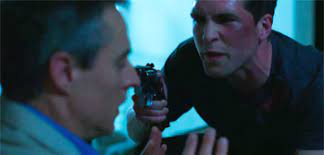
Jealousy of his “friend zone” roommate’s (Alexa Rose Steele) latest date sends Joel on a stalk with Mr. Camaro and Members Only jacket (Ari Millen), then on a bender. Which is how he wakes up in a closed Chinese restaurant that’s playing host to a self-help support group. They confuse Joel for somebody else, so he ad libs his way in.

Turns out this group, led by Zachary, is supporting each other in their serial killing hobby. Sure, we knew that the moment we saw Zachary was played by edgy/obnoxious funnyman David Koechner, but “on the nose” casting can pay dividends.

Joel trots out his dream serial killer profile, “a taxi driver,” which the group of “types” (Amber Goldfarb,  Sean Baek, Robert Maillet, Julian Richings) buys into.

Until, that is, “Bob” (Millen) shows up and does what any half-sentient horror screenwriter might do with the whole “perfect serial killer” idea — shreds it.

Joel is trapped in a room of seriously accomplished serial killers. Is he smart enough to reason, fight or scheme his way out?

Remember. He’s a “critic.” Rim. Shot.

The killers’ various MO’s — this one kills on “the third date,” that one hunts for remote cabins or summer camps “filled with sorority girls,” and those are the least icky — are amusingly on-genre. Millen and Goldfarb are the standouts in the cast, like Koechner, just the right amount of “over-the-top” to work as characters who are equal parts frightening and camp.

The assorted deaths in this long, dark night of a horror fan’s soul are well-handled, with some of the fights suspenseful enough to work. Director Cody Calahan (“The Oak Room,” “Let Her Out”) has some fun with the gore.

But actual laughs? Not really. A few smirks is all the “Fun” “Vicious” manages.

Our lead strikes the right tone, but seems to lack the spark required of a comic straight man. And his function, as a surrogate for the horror fan in a wish-fulfillment fantasy, is somewhat muddled.

So what we have here is a tolerably efficient horror title — not scary, not that suspenseful, just gory — that fails to deliver on the promise that casting that rascal Koechner makes. Not bad, but not exactly good, either.

MPA Rating: unrated, graphic violence

Cast:  Evan Marsh, Amber Goldfarb, Ari Millen, Sean Baek, Robert Maillet, Julian Richings and David Koechner.

Credits: Directed by Cody Calahan, script by James Villeneuve. A Shudder release.

Running time: 1:41

Posted in Reviews, previews, profiles and movie news | Comments Off on Movie Review: Horror fan stuck among serial killers, all in “Vicious Fun”

Netflixable? “Silver Skates” is a lovely bore set in Tsarist Russia

Let’s coin a new phrase, one any movie lover will instantly “get” thanks to the state of cinema in the Netflix/Amazon/Hulu/Disney+ era.

What’s a movie we’d describe as “streaming length?” It’s one that could stand editing, but run on and on because there’s no studio exec saying “You’re overdoing it,” no cinema chain enforcing efforts to maximize the number of showings a day, because moviegoers aren’t avoiding or getting up and leaving tedious, under-edited, over-indulged “director’s cut” films before the credits roll.

“Silver Skates” is a lush Tsarist melodrama with Dickensian touches and a PBS Dickensian running time. It staggers along, drunk on costumes, sets and vodka, a 90 minute formulaic historical romance skating and stumbling through St. Petersburg snow in a 137 minute gift wrap.

It’s “The Nutcracker” without sugar plum fairies, “Doctor Zhivago” on skates, “Reds” without genuine Reds, a perfectly passable but utterly plodding period piece romance.

The forbidden love crosses classes, here, a young delivery skater (Fedor Fedotov), forced to join a gang of artful skating dodgers (pickpockets) falls for a proto-feminist daughter of the aristocracy (Sonya Priss).

Matvey (Fedotov) needs cash to send his tubercular lamplighter father to Baden Baden for the cure. Thus, he takes up with “rob from the aristocracy and bourgeoisie” pickpocket gang led by Alex (Yuriy Borisov).

“THEY’RE the ones we punish!” (in Russian, with subtitles, or dubbed into English).

Alisa (Priss) is a “modern” woman, waiting for the new century (the 20th) to begin, hoping to get her ultra-conservative aristocratic father (Aleksey Gubskov) to allow her to go to college and study science. Not bloody likely.

“The rot set in when we stopped flogging our kids!”

And there’s also this social climber/Army officer (Kirill Zaytsev) who has eyes for Alisa and an idea for how to combat skating pickpockets — skating soldiers with truncheons.

It’s a very Russian film, soft-selling its proto-communism, its feminism and its decadence.

“Oh? Is patriotism back in fashion?”

“This century will be even better than the last! Hurrah!”

I can imagine fighting the urge to check my cell phone for the time, messages, tweets and Words with Friends as this tedious tale unfolded in a theater. Very rude, so fight the urge I would.

But streaming? You walk away, take a beer, bathroom or borscht break, come back to it and nah, you haven’t missed much. Not when you know where it’s going.

MPA Rating: TV-MA, violence

Cast: Fedor Fedotov, Sonya Priss, Yuriy Borisov, Kirill Zaytsev, Aleksey Guskov, Cathy Belton

Credits: Directed by  Mikhail Lokshin, script by Roman Kantor. A Netflix release.

Running time: 2:17

Posted in Reviews, previews, profiles and movie news | 2 Comments

Classic Film Review: A WWII escape via “The Passage”

Nothing in all your or my years of watching movies prepared me for the utter glee Malcolm McDowell expresses the moment of his “big reveal” in the 1979 WWII action pic, “The Passage.”

As an SS sadist chasing a runaway scientist and his family, he’s as tickled showing off his swastika-bedecked jock strap as we are at seeing it.

Sure, he was playing the latest variation of his Madman Malcolm roles of the ’70s, which started with “A Clockwork Orange.” But he was also having a laugh. He knew, they all had to know, that by the time this one rolled around, director J. Lee Thompson was a long way from “The Guns of Navarone” and a lot closer to bad “Planet of the Apes” sequels, Charles Bronson slaughterfests and garbage like “The Greek Tycoon” and “White Buffalo.”

“The Passage” also stars Oscar winners Anthony Quinn and Patricia Neal, three time Oscar nominee James Mason, horror legend and Mr. “Should Have Been Given an Honorary Oscar” Christopher Lee, and as a Nazi bit player with no lines — future Oscar winner Jim Broadbent.

And if you’ve never heard of it, you’re not alone. It’s a loopy, long-in-the-tooth formula film about smuggling that outspoken scientist (Mason), his wife (Neal) and two adult children (Kay Lenz of “The Great Scout & Cathouse Thursday,” and Paul Clemens) from Occupied France into “neutral” fascist Spain.

McDowell tackles his part with the sort of “give’em their money’s worth” villainy that would become a trademark in later films such as “Blue Thunder.” But everybody else is earnest, if a bit old to be engaged in the bravado we see on display here.

Quinn was in his mid-60s, playing “The Basque” shepherd who apparently established his heroic bonafides during the Spanish Civil War just a couple of years before. He keeps his sheep and his dogs in the same one-room farmhouse, high in the snowy Pyrenees in the north of Spain, and it takes a lot of money for a French Resistance organizer (Bond villain, “Ronin” rescuer and “Jackal” hunter Michael Lonsdale) to get him to leave it.

The Basque takes on the job, gripes about the unwieldy, unathletic and feeble family (a post-stroke Neal was a high-mileage 53 when this came out) he must hike up and over the mountains, and does that derring do that Anthony Quinn had been doing since the 1930s to save them.

“They will all die,” he complains, time and again.

“One hears the most terrible things about the Basques,” the daughter wonders.

“They’re all true,” he grouses.

The Basque must outwit and ambush Gestapo thugs, Wehrmacht regulars and that nasty SS goon on their trail. A train will blow up, a partnership with The Gypsy (Lee) will prove fraught and people will be captured, tortured and murdered — sacrifices will be made, willingly and unwillingly.

And McDowell? He’ll do a lot of that murdering, and raping and torturing. A kitchen cooking lesson is carried out in which he wears his Iron Cross on his chef’s apron.

“You French have NO interest in other people’s cooking!”

It’s a bad bordering on terrible movie, but the action is handled well enough, the French village and Pyrenees locations are stunning. Quinn always gave good value even as he walked the fine line between Larger than Life and Mexican jamon. Mason soldiers through it and Neal has a couple of decent moments.

McDowell? He wears the leather, black hat and the cigarette holder as if he’s sure he’ll start a new fashion trend, at least in camp cinema circles.

MPA Rating: R, violence, sexual assault, nudity

Cast: Anthony Quinn, Malcolm McDowell, James Mason, Patricia Neal, Michael Lonsdale, Christopher Lee and Jim Broadbent.

Credits: Directed by J. Lee Thompson, script by  Bruce Nicolaysen, based on his novel. An MGM release.

Running time: 1:38

Posted in Reviews, previews, profiles and movie news | Comments Off on Classic Film Review: A WWII escape via “The Passage”

Movie Review: Canadian teen wants to keep her secret, and the baby she sees as “Les Notres (Our Own)”

A reminder to parents who might consider checking out the suspenseful Canadian drama “Les Notres” in a cinema. It’s rude to throw things at the screen, and not great manners to shout at it. But variations of “Oh COME on!” are a perfectly understandable response to the outrage depicted in Jeanne Leblanc’s film.

A girl (Emilie Bierre) who lost her father in a tragic accident years before is pregnant. Her harried and often furious widowed-mother (Marianne Farley) is pleading and demanding answers. Magalie snaps at her to “calm down” (in French with English subtitles).

“You don’t get to TELL me to ‘calm down,’” mother Isabelle barks. But that’s where she leaves it. “I don’t want to talk about it” and “I don’t KNOW” who the father is and “Leave me ALONE” and Magalie stomps off to check in on her social media and swap messages with the babydaddy.

Isabelle just…takes it. And Mags? She is thirteen years old.

Not sure how they do things in Quebec, but here in America we take AWAY cell phones over such offenses. Well, we, we ASK for them to be handed over, at least.

“Les Notres” explores the circle of suspicion, the small town of Saint Adeline’s feeble attempts at social shaming and lets us see, as babydaddy puts it, “The situation is a little complicated, you know?”

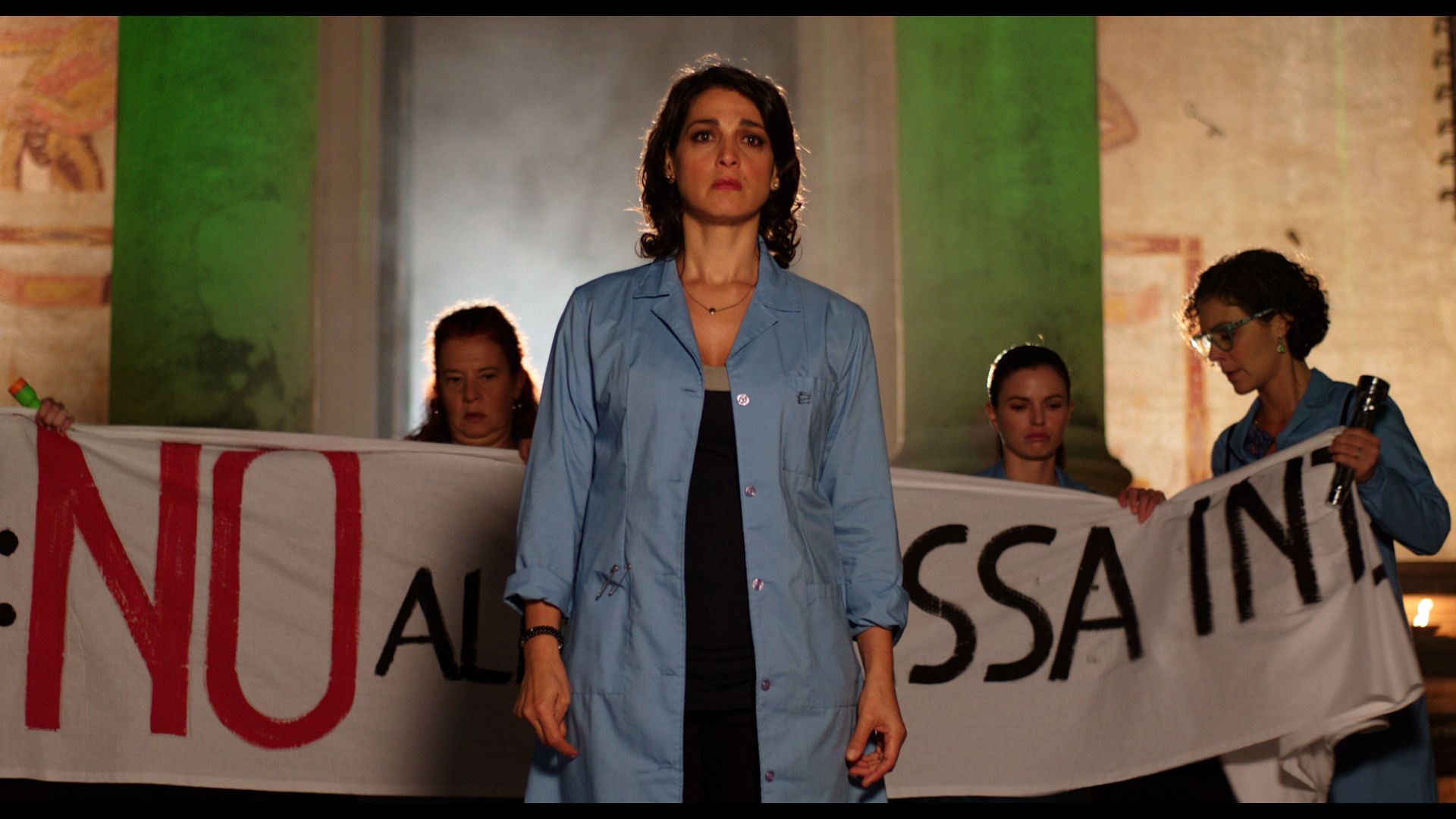
There’s a social worker wanting to know “Did someone hurt you?” Isabelle is outraged at the question. The Central American teen the next door neighbors adopted seems sweet on Mags. That puts Isabelle’s close friendship with the ever-supportive Chantal (Judith Baribeau, who co-wrote the script).

As we’re figure out who did what and how it happened, we can’t help but lean into “Les Notres,” waiting for the mushroom cloud explosion whose shock waves could ripple from house to house, class to class, if and when this ugly secret gets out.

Leblanc wisely focuses on the three women at the heart of the story, and builds suspense in as to which one will give away the game or which one will figure out the mystery, and how.

A good thriller will make you impatient for that resolution, and Leblanc, a veteran second-unit director (“On the Road,” “X-Men Apocalypse”) making her second feature (“Isla Blanca” was the first) keeps us impatient.

Hell, she all but invites us to hurl popcorn and deprecations at the screen. We’re seeing some pretty lax, bend-over-backwards parenting here. And no, the fact Mags’ daddy died doesn’t explain why mom doesn’t rein this wayward barely-a-teen in. At all.

Chantal’s kid-gloves handling of her adoptive son (Léon Diconca Pelletier) is similarly maddening. The fact that he’s the target of taunting and racist abuse at school over this just compounds his misery and makes his mother’s passivity that much more vexing.

But the kids, Bierre and Pelletier, make this scenario come off. Bierre is the very picture of the hard-to-handle, sullen teen — still every bit the child, stuck in a situation that she is entirely too young to have much of any responsibility for. The power imbalance is alarming, and suggestions she’s just now learning about “consequences,” as one of the mothers offers, can seem laughable. She’s lost, but she’s done some of the math, too. Lives will be disrupted far and wide if she does any version of “the right thing.”

It’s not a script that stands up to a lot of scrutiny. What, nobody thinks to serve up a prenatal DNA test?

Give Leblanc credit, though. Any time you make a movie with well-played characters who compel the audience to want to shout at the screen, you’ve accomplished something.

MPA Rating: unrated, explicit sex, sexual situations involving an underage girl

Cast: Emilie Bierre, Marianne Farley, Judith Baribeau 

Credits: Directed by Jeanne Leblanc, script by Judith Baribeau, Jeanne Leblanc. An Oscilloscope Labs release.

Running time: 1:43

Posted in Reviews, previews, profiles and movie news | Comments Off on Movie Review: Canadian teen wants to keep her secret, and the baby she sees as “Les Notres (Our Own)”

Movie Review: We take bites out of “Gaia,” eventually she bites back

Gaia” is a South African trapped-in-the-forest thriller that trips up expectations more than enough to keep us interested.

It’s an eco-horror tale where who and what we root for and against are flipped and flipped again as the story tales hold.

And it’s icky in ways that would make many a creature feature green with envy.

Monique Rockman and Anthony Oseyemi play forest rangers, canoeing into wilderness so wild it inspires Gabi to note “There was a time when the whole world looked like this.”

They’re checking wildlife cameras, and she’s running a drone, perhaps keeping an eye out for poachers. The mud-camouflaged face that’s the last image she sees before her drone is done in should tip her, or at least her boss Winston off.

But now. “I’ll get it,” and before you can say “She’s going to get it, all right,” they’re separated and the story has changed point of view. Two Kate Moss-cadaverous wild-men in loin clothes gather grubs, fiddle with mushroom spores and set snares.

That’s what nails Gabi. Next thing we know she’s in their hut, perhaps “rescued,” possibly “in their clutches.”

Winston? He’s even more at sea in the woods than she is, and gets himself clumsily, panicky lost in a flash.

What will become of our intrepid rangers? And do these Afrikaans-speaking primitives (Carel Nel, Alex van Dyk) mean them harm? That the elder of the two (Nel) wonders “Who sent you?” and the younger gripes that “You broke our trap” isn’t encouraging. Speaking in riddles doesn’t help, either.

“These days, men will seek death and will not find it,” (in Afrikaans with English subtitles).

Jaco Bouwer’s film is a thriller of tumbled flashlight-lit chases in the inky darkness, of fungal closeups and fleshy injuries, noises in the dark and glimpses of a threat that is nobody’s idea of “human.”

It’s more creepy than terrifying, more thought-provoking than we initially expect, although perhaps not as “deep” as the filmmakers’ intended.

The action doesn’t quite sell it on its own, and even the mystery of it all is given away by the title. But Brouwer & Co., in immersing us in a piece of Africa both familiar and alien (a non-tropical “jungle”), in fuzzying up the “threat” and indulging in that never-to-be-underestimated “ick” factor pull this off.

MPA Rating: R for some violence and bloody images, sexual content, nudity and language 

Cast: Monique Rockman, Carel Nel, Alex van Dyk and Anthony Oseyemi

Credits: Jaco Bouwer, script by Tertius Kapp. A Neon release.

Running time: 1:36

Posted in Reviews, previews, profiles and movie news | Comments Off on Movie Review: We take bites out of “Gaia,” eventually she bites back

Netflixable? Kevin Hart copes with single “Fatherhood”

Kevin Hart waters down his ill-tempered, bug-eyed “little man with a foul mouth” shtick for “Fatherhood,” a perfectly-pleasant if predictable and right-on-the-cusp-of-maudlin single parent dramedy.

Hey, that’s what happens when you team any edgy (OK, “edge-adjacent”) leading man with Paul Weitz, Mr. “About a Boy” and “Grandma” and “Down to Earth.” You want to hit that “family” film sweet spot, you do what you must, right?

Hart plays Matt Longelin, a somewhat self-absorbed daddy-to-be who faux-gripes about his wife’s need for a Caesarian interfering with his “fantasy league draft night.”

The tone of “Fatherhood” is set in stone in the first scenes, Matt standing before a funeral, muttering “This sucks” to start his wife’s eulogy. The film will be sentimental, a near tear-jerker at times, especially when we see that wife (Deborah Ayorinde) go into cardiac arrest.

If you were wondering if Hart could play grief, wonder no more. It’s a wrenching scene, with Matt’s distraught mother-in-law (Earth Mother Alfre Woodard) wailing off camera.

But what they’re looking for here is lighter than that, and even though it’s a struggle getting there, Hart, with R-rated vocal support from Lil Rel Howery (as the best friend) and PG-13 fatherly quips from the boss (Paul Reiser doing Paul Reiser), pulls it off.

Everybody bucks Matt up after his loss, now with an infant to raise on his own. But when he’s out of earshot, it’s “He’s not ready for this.”

Woodard stands-out as a no-nonsense, almost-supportive mother-in-law who insists he move “back to Minnesota,” which Matt refuses to do. His boss (Reiser) sympathetically says “take as much time as you want” but drops little nuggets about “college tuition” costs and “there’s this thing called ‘a baby sitter,'” whenever the overwhelmed single father brings his problems to work.

Howery, a comic jolt of caffeine in any movie he’s cast in, scores by flirting with both grandmas at the same time.

“I can’t help it if your mamma’s a GILF!”

Throw-away zingers land just often enough to remind us Hart’s a comic, riffing with a nun at his kid’s school about how “nuns got to be so ‘street,'” a bit about “breaking up” with work friends because they tactlessly set him up with a gorgeous animator (DeWanda Wise) with the same name as his late wife.

“I’ve been looking for new white people…”

And the kid (Melody Hurd), once the story’s moved tiny Maddy into pre-school, is an adorable moppet with movie-kid sass.

“Fatherhood,” based on a memoir by a real Matt Longelin, isn’t a stand-out on Hart’s resume. But it’s a nice departure, and without the pressure of creating laughs, he comes off more relaxed and the lighter bits here land easily.

There is virtually nothing here we haven’t seen in a dozen similar movies, particularly that “Kramer vs. Kramer” parenting arc (one parental “indulgence” leads to disaster, etc.). But it’s perfectly watchable, maybe even for the entire family. Just keep a finger on the “mute” button whenever Lil Rel opens his mouth.

MPA Rating: PG-13, some strong language, and suggestive material (diaper jokes)

Cast: Kevin Hart, Melody Hurd, Lil Rel Howery, Paul Reiser, DeWanda Wise, Deborah Ayorinde, Anthony Carrigan and Alfre Woodard

Credits: Directed by Paul Weitz, script by Dana Stevens and Paul Weitz, based on the memoir by Matt Logelin. A Sony-Columbia/Netflix release.

Running time: 1:51

Posted in Reviews, previews, profiles and movie news | Comments Off on Netflixable? Kevin Hart copes with single “Fatherhood”

Movie Review: A Pandemic “Lord of the Flies” — “School’s Out Forever”

Say what you like about “Lord of the Flies” and its many, many screen (and literary) imitations over the decades. That story, about the savagery barely civilized out of our young, even and especially the “well born” among them, still plays.

“School’s Out Forever,” based on a Scott K. Andrews novel, may seem a cheesy “Toy Soldiers” variation set in an English boarding school. Throw in a little accidental topicality — civilization breaks down during a pandemic — and some blunt statements on violence, guns and mob mentality, and it’s a lot closer to “Lord of the Flies” than any teens-fight-back action dramedy.

When the contagion breaks out, Lee (Oscar Kennedy) has just been kicked out of Saint Marks School for Boys for playing one cruel prank too many. His mate and co-prankster “Mac” (Liam Lau Fernandez) may have escaped consequences, but Lee’s sent home just in time for the great die-off.

Mercifully, the dead stay dead here. No “28 Days Later” or “Walking Dead,” thank you very much. But a call from his Mum, estranged from his father, tells Lee that he can’t count on holing up at home. No, “Go back to St. Marks,” his mother says. She’ll fetch him there.

The vacant streets and empty stores outside might show a world that’s collapsed. But even though the headmaster (Anthony Head) has died, there is a semblance of order. Mr. Bates (Alex Macqueen) keeps the surviving kids and their matron/nurse (Jasmine Blackborow) organized and looking ahead.

Lee’s return means he can re-team with Mac. Who better to facilitate post-apocalyptic survival than two born anarchists, these amoral pranksters?

But the outside village, Worham, is getting organized under the rule of the gun. And the boys’ “Get medicine, be the heroes” quest in the school van goes awry. Now the armed outside world, led by Georgina (Samantha Bond) is gathering at the gates. Big decisions must be made concerning self-defense, self-preservation and the moral or immoral decisions that undergird them.

Who should be in charge? What steps can be taken? What can they do to wriggle out of the ugly dilemmas they face?

Visual effects specialist turned writer-director Oliver Milburn (“The Harsh Light of Day” was his directing debut) does well by the action beats and manages to keep some ugly choices that mark this coming-of-age tale intact.

Mac, to the manner born, has the decisiveness that we sometimes confuse for “born to lead.” He and Lee are equally young, rash in their decisions, barely considering consequences of their actions. But Mac, merely by taking action and assuming the part, takes on the leadership of the contagion-immune kids. Right. Firearms training it is!

Lee has been slow to recognize what his headmaster lectured him about as he expelled him from the school. “We don’t indulge children. We build men!” Now, though, he’s starting to get it.

Blackborow’s matron is the conscience of the story, but more than one adult demonstrates that compassion is something you acquire with age. Can the student body survive under that ethos?

It’s not every seemingly-empty-headed action film that questions whether ugly times beg for ends-justify-the-means thinking, deployed by everyone from Winston Churchill to Donald Rumsfeld and Dick Cheney.

Milburn doesn’t develop the supporting schoolkid characters enough to show that “Lord of the Flies” radicalization/indoctrination in the stark terms the picture needs. The coda seems unnecessary and there are moments when every action screenplay takes leave of common sense.That “You have 24 hours” to make a decision crutch may be the stupidest thing any movie like this trots out.

But screen newcomer Fernandez, British TV veteran Kennedy, Bond (Moneypenny in “Goldeneye”), Blackborow (“Shadow and Bone”) and Macqueen (“All is True”) give this punchy, lightweight parable the emotional heft to come off.

MPA Rating: unrated, graphic violence, alcohol and drug abuse, profanity

Cast: Oscar Kennedy, Liam Lau Fernandez, Jasmine Blackborow, Alex Macqueen, Samantha Bond and Anthony Head.

Credits: Scripted and directed by Oliver Milburn, based on a Scott K. Andrews novel. A Central City Media release.

Running time: 1:45

Posted in Reviews, previews, profiles and movie news | Comments Off on Movie Review: A Pandemic “Lord of the Flies” — “School’s Out Forever”

Classic Film Review: A star of early Chinese cinema recaptured — “Center Stage”(1991)

The stately, intimate and pictorially perfect “Center Stage” was Hong Kong filmmaker Stanley Kwan’s “Citizen Kane” styled experiment in screen biography.

He set out to tell the tragic story of a legend of early Chinese cinema, a starlet whose beauty was said to rival Garbo’s, but who took her own life because of a personal scandal when she was 24. Kwan, who went on to make “Hold You Tight” and “Red Rose White Rose,” uses monochromatic archival interviews (some “aged”) with those who knew Ruan Ling-yu, staged black and white interviews with assorted film folk of the Hong Kong of 1991, commenting on Ruan’s “lost” films and her career, and long flashbacks to the late silent era and early sound cinema of 1929 into the ’30s as we see Ruan’s acting style, her commitment to her roles, her personal life and her tragedy.

Maggie Cheung, of “2046,” “Hero” and “In the Mood for Love,” plays herself, longing to make her mark but not end up like Ruan, and she plays the screen legend in the long, lush flashbacks.

She’s paired with Tony Leung (Stanley Kwan’s “Showtime,” “Lost in Beijing”) in the back-and-forth of commenting on the star of the past, and portraying Ruan’s paramour and escort to the poshest nightspots of Jazz Age China.

We visit film sets to see Ruan work, get a dose of the politics on and off the set back then (She worked just as Japan was trying out the aggression that led up to World War II — occupying Manchuria.) and sit in on planning sessions for a possible film biography of this “lost” legend of pre-war Chinese cinema.

For all the potential that scenario presents, cinema-as-it-was-then, “inventing” a new reality in screen acting. Kwan’s approach is so quiet, intimate and slow that the whole affair — outside of the chatty and realistic table read and banter of the present day moments — feels like a lacquered-over still-life.

Seeing immaculate recreations of silent and early-sound film sets, soundstages with skylights instead of artificial light, is all well and good. But just because what was on screen was silent that doesn’t mean the footage was the product of dead quiet on the set.

Directors would have on-set musicians to set a mood, whisper or call out directions to alter the performance as it was happening. There’s no “life” to these moments in Kwan’s vision.

Cheung is far more interesting in the flashbacks — crawling in the snow by herself after hours to rehearse what her character will “feel” in the next day’s scene, dancing and night clubbing — than as “herself” in the present day footage.

The contrast between the lively banter of the present day filmmakers and the generally funereal past — gorgeous, artfully lit and shot it may be — points to why Kwan never broke through in the international cinema, turns up on no lists of “Great Hong Kong Directors” and is little known outside of cinephile circles.

Cheung won Berlin Film Fest honors when “Center Stage” came out back in 1991, but the film didn’t make her the star Gong Li became after “Ju Dou” (1990) and later films with Zhang Yimou.

So I’ll say what other critics who have endorsed this picture in various releases over the years will not. It’s a lovely stiff, more artful in the attempt than in execution.

MPA Rating: unrated

Cast: Maggie Cheung, Tony Leung, Han Chin, Lily Li, Carina Lau, Cecilia Yip, Lawrence Ng and Stanley Kwan

Credits: Directed by Stanley Kwan, script by Yau Dai an Ping. A Film Movement release.

Running time: 1:54

Posted in Reviews, previews, profiles and movie news | Comments Off on Classic Film Review: A star of early Chinese cinema recaptured — “Center Stage”(1991)

Bingeworthy? Rose Byrne gets “Physical” in this ’80s exercise/body-issue dramedy

The Hollywood shorthand we remember as “high concept,” a “pitch” you could squeeze into a single sentence, reached its zenith in the 1980s. As SOME of us never gave it up, let’s trot it out to describe Apple’s new ’80s exercise/politics/body-issues series “Physical.”

It’s Jennifer Lawrence’s “Joy” meets “Nurse Jackie,” a tale of a woman with big personal problems and secrets and a really “big idea” that comes to her, gradually but forming up early in the series’ first season.

Rose Byrne’s a droll, had-enough housewife feminist at the center of it, and she makes it an easy series to fall into. And series creator Annie Weisman’s plot — she produced TV’s “About a Boy” — takes a lot of turns before taking you where you figure it’s going.

Byrne (“Bridesmaids,””Neighbors”) plays Sheila Rubin, a San Diego suburbanite who married the activist/idealist who lit her romantic fire at UC-Berkeley at the end of the ’60s. But in 1986, she’s a self-loathing housewife with the big poufy poodle-curls and wafer thin build that whispers “eating disorder.” And politics professor Danny (Rory Scovel of “Robbie” and “I Feel Pretty”) hasn’t grown up. He still has an eye for cute coeds, a taste for weed and activist/schmactivist, he’s got very “traditional/conventional” man’s ability to under-estimate his wife.

Rose’s self-judgment hits her hard with every mirror she stares into — “wrinkles and zits” and spandex leotards, a “disco sex kitten look at YOUR age?”

Her endless cricitisms rain on her psyche in voice-over criticism that includes the words “pig” and “monster” and “idiot,” and they’re not limited to her. She judges her lump of a husband, the other mothers dropping off kids at their “co-op” private preschool, pretty much everybody she meets. But she almost always finds a way to top their critiques with those aimed at herself.

Because when she’s at her most fragile, and most obsessed with her looks, she snaps. That’s when she raids their savings account. That’s when she loads up at the drive-through window of her favorite burger joint. And that’s when she checks into a cheap (ish) motel to strip, binge and then purge. Oh yes, she’s that messed up.

But as Danny’s career goes off the rails and he delusionally decides to run for office on a rein-in-development platform, Sheila finds herself a new outlet for her body image mania. She ducks into Body by Bunny, an aerobics class run by a grumpier-than-perky Lebanese-American pixie (Della Saba).

The series is about Sheila’s juggling act, the secrets she keeps from those around her, especially her husband, their increasingly perilous finances and Danny’s swelling ego, fed partly by his even-more-sexist Berkeley classmate and now campaign manager (Geoffrey Arend). Anti-social Sheila has to help get signatures on petitions, raise money from their “betters” and scheme to get a career out of this new craze, aerobics.

The characters are a fairly unpleasant lot, giving this the tinge of “cringeworthy TV.” Byrne makes Sheila irritatingly vain — “You’re still skinnier and prettier” than a dinner guest, she thinks. But she’s haunted by her perceived physical failings.

Getting pushed around by an increasingly dead-weight husband make us root for her. Getting mixed up with “Bunny” of “Body by Bunny” and Bunny’s surfer/videographer boyfriend, contemptuous yet pitying her plump, rich and depressed neighbor (Dierdre Friel), fretting over this “Mormon moralist” developer (Paul Sparks) who is devouring their suburban town and plowing under the environment as he does, but who also seems tempted by Sheila’s Olivia Newton-John physique.

The show’s got the ’80s soundtrack, and a whiff of ’80s fashions and sort of leftover ’70s morality. Scovel’s Danny wears early ’70s sideburns (guys tend to stick with the last look they had when they were single). And the “limited series” drip drip drip storytelling style hints that the drama may peak right at the end of the ten episode run, as the early episodes are more soapy than seriously dramatic.

But Byrne makes it worth a watch, and once you’re in, it isn’t just nostalgia that keeps you coming back for more.

MPA Rating: TV-MA, drug use, sexual situations, profanity

Cast: Rose Byrne, Rory Scovel, Dierdre Friel, Della Saba, Paul Sparks and Geoffrey Arend

Credits: Created by Annie Weisman, An Apple TV+ release.

Running time: 10 episodes @ :25-:35 minutes each

Posted in Reviews, previews, profiles and movie news | Comments Off on Bingeworthy? Rose Byrne gets “Physical” in this ’80s exercise/body-issue dramedy

Movie Review: Hunting for laughs and meaning singing “Songs for a Sloth”

A decent gimmick and half an idea for a movie surrounding it bedevil “Songs for a Sloth,” a coping-with-loss comedy that — pardon me — just hangs there.

There are entirely too many “slowly” jokes to squander on a single review, even a comedy with promise that’s left twisting in the wind.

A father has died, and go-getter son Maxwell (Richard Hollman) isn’t taking it well. Manically digging around Dad’s backyard, looking for the bones for a long-dead dog because “It was Dad’s last wish” is just the start of it.

Slacker son Barney (Brian McCarthy) isn’t all that worked-up over it. He’s not that worked-up for anything. Drifting daughter Jenna (Ava Eisenson) was out of touch and didn’t even make it to the funeral, or the reading of the will. She wasn’t there to hear that their father died broke after pouring his money into a fund to create a habitat for the North American sloth.

Don’t bother looking that up. There hasn’t been a North American variety in this planetary epoch.

In fact, even though he drained his accounts and took out a “reverse mortgage,” which means they’re losing his house, too (Tom Selleck’s nose just keeps growing and growing.), the family needs $10,000 just to get this habitat up and running.

Maxwell, losing ground at work, where he scripts industrial videos for Big Pharma, is nonplussed. Barney shrugs. Jenna, when she shows up, isn’t much more motivated.

But Maxwell has seen a sloth, THE sloth, the one their dad obsessed over. And it (a puppet) talks in Jack McBrayer’s voice.

Wassup? Wanna hear an idea for a short story?”

Maxwell breaks out his old guitar and knocks off a “Don’t Let Me Die” song. He enlists Barney to help him get a video of it up online. Even Jenna will have to pitch in if they’re to raise the necessary cash to make their father’s dream come true.

There’s a dopey idea in the “A.L.F.” ballpark in play here, which the movie makes little use of.

We get “the metaphor,” that the son who had to sell out to make something of himself is up against two indulged and slothful siblings who won’t let him hear the end of it, and seem allergic to hard work and doing it quicky.

One of the videos they concoct is cute, but too much of what we see here is Barney’s pitch for “Sad Max: Boring Road.” The movie has almost no laughs and little energy is expended in attempting to get it to come off.

Hollman sings and plays guitar, but he isn’t given any funny way of reacting to the talking sloth and isn’t all that interesting bickering with his do-nothing siblings.

MPA Rating: unrated, squeaky clean

Cast:  Richard Hollman, Brian McCarthy, Ava Eisenson and the voice of Jack McBrayer.

Credits: Directed by Bradley Hasse, script by Bradley Hasse, Richard Hollman. A Gravitas Ventures release.

Running time: 1:25

Posted in Reviews, previews, profiles and movie news | Comments Off on Movie Review: Hunting for laughs and meaning singing “Songs for a Sloth”