You’ve got to meet this dopey desert slasher picture on its own terms.
You have to be ready to laugh at the archetypes/stereotypes, the one-liners, the D-movie bravado.
“Why don’t you step out of there and fight me LIKE A WOMAN?”
And of course you’ve got to get the oral sex while driving pun in the title. Because “Road Head” isn’t just about decapitations in the desert southwest.
They all come looking for the wonders of “Isola Lake,” even though the sign pointing to it dates from the ’50s and the “road” is that in name only.
That’s where the first couple we see decide to tempt driving fate with a little under-the-seat-belt distraction. That’s when we hear the sound of heads being sliced-off, mercifully off-camera.
Enter gay Santa Monican couple Bryan (Clayton Farris) and Alex (Damian Joseph Quinn) and their just-got-over-a-breakup friend Stephanie (Elizabeth Grullon). They, too, have been misled by the “lake” in the place’s name. And they, too, must face The Executioner (Adam Nemet), clad in chain mail and feathers and wielding a broadsword.
At least these three have bitchy put-downs at their ready command for “that Medieval Faire reject” and his “toy sword from a nerd convention.” No, they will not go gentle into that beheaded night.
Grullon’s Stephanie is the stand-out here, snide and given to under-reactions when the worst happens, but rallying to fierceness when the chips are down.
More amusing than militant Alex figures he can compliment his way out of a jam. “I love your outfit!”
There’s a chase, a pause for an anti-patriarchy, control-my-own body rant and more bloody almost-funny violence than you can shake a blood squib at.
And if it all didn’t end a lot more unpleasantly than it begins — sometimes “tripping up expectations” beheads your movie, kids — this might be a fun genre dive, a “Rubber” or “House of 1000 Corpses” with less carnage and more comedy.
MPA Rating: unrated, graphic violence, sexual situations, pot use and profanity
Cast: Elizabeth Grullon, Damian Joseph Quinn, Clayton Farris, Clay Acker, Adam Nemet
Credits: Directed by David Del Rio, script by Justin Xavier. A Terror Films release.
Bulky, tattooed goons beat up “foreigners” and show up at protests, snapping cell-phone photos, sneering, intimidating, just hoping to start a riot.
And the protesters have reason to wonder if the sometimes-passive cops aren’t on the thugs’ side.
Chanting “We are PEACEful, what are YOU?” doesn’t seem to help.
So some of them take to donning black hoodies and masks, “escalating” things in a fraught, divided country at a perilous moment.
“And Tomorrow the Entire World” is a footsoldiers’ eye view of a Big Picture movement, a thriller set against the clash of anti-fascists against fascists in a country more sensitive than most about just what rule-by-thuggery right wing authoritarianism leads to. This German story, when it works, is fraught with the tension young people there recognize as the stakes in this struggle.
In a part of the world that has safeguards against the “slow motion coup” of racist voter suppression of violent, dogmatic and cultish minority political movements, the right resorts to more direct violence to get its authoritarian way.
And as an opening title (voiced-over, as well) reminds viewers, their constitution underscores the right and duty to “resist those in society who seek to abolish the constitutional order.”
That is the group P81’s guiding principle. And that’s why Luisa, played by Mala Emde, has talked her law school pal Batte (Luisa-Céline Gaffron) into introducing her to them. They’re a small commune, united in their politics, their youth and their passion, showing up to confront fascist rallies and lend their support to other groups protesting the Reich-minded right, which never really went away after a World War was fought to exterminate it.
Luisa’s motives are unclear, but her sense of acceptable risk is in an instant. At a rally where skinheads start attacking protesters, she saves Batte from an assault by taking her assailant’s dropped phone.
He gives chase and assaults her, and only the intervention of Alfa (Noah Saavedra) saves her. She is attracted to the dashing king of “escalation,” and smart enough to insist that they dig into this phone and figure out what the other side is planning.
We can’t say that’s when Luisa’s radicalization begins, because plainly she’s already there. The early clues about her background transcend the “bored rich girl” (from the country) stereotype, and make her mystery all the more fascinating.
What is it about her baronial dad, their weekend hunting club events and her family’s politics and/or history that brought her here?
And will she be the cliche we suspect her to be, falling for the hunky anarchist who upsets the apple cart of “peaceful” P81 with vandalism, ambush assaults and the like?
Emde, who has played Anne Frank on German TV, makes a compelling tour guide into this world of planned protests and counter-protests, of disguises and escape routes to get past road blocks so that P81’s outliers can stymie the racists’ plans which Luisa’s stolen cell phone has given them access to.
You may find yourself, here and there, yelling at the damned TV, “Stupid stupid STUPID move” at some misjudgment in the making. But co-writer and director Julia von Heinz trips up expectations and delivers surprises, even if the film’s energy and forward momentum flag in the second act.
One thing the filmmaker has no control over is how Netflix cast the English-speakers to dub the German dialogue into English. The Nazis sound like folk-music singing hippies, or high school guidance counselors.
Thank heavens the film reverts to the original German for their actual anti-Semitic, foreigner “exterminating” sing-alongs. Even the Germans know theirs is a language that sounds angry, villainous and oppressive. So do the Proud Boys and assorted American Nazi groups, which adopt German phrases in addition to Nazi German iconography to inspire the faithful.
Other parts of the world might not have codified and institutionalized the right-left conflict to the degree that Europe in general and Germany in particular have (“right wing” and “left wing” are 19th century French inventions). But “And Tomorrow the Entire World” achieves a kind of universality in its messaging, its warnings about “escalation” and the historical consequences of shying away from that escalation.
People who have been brainwashed into “anti-fa is the REAL threat” won’t like it. But then again, they’ve never bothered to look up the what the “fa” part stands for.
MPA Rating: TV-MA, violence, drug abuse, sex
Cast: Mala Emde, Noah Saavedra, Tonio Schneider, Luisa-Céline Gaffron and Andreas Lust
Credits: Directed by Julia von Heinz, script by John Quester and Julia von Heinz. A Netflix release.
Running time: 1:51
Posted inReviews, previews, profiles and movie news|Comments Off on Netflixable? “And Tomorrow the Entire World” takes us into anti-fascism, and what they’re fighting against
This version of the true story of Sir James Brooke, who explored Borneo and then set up his own kingdom there, stars Jonathan Rhys Meyers, Dominic Monaghan and opens June 21. https://youtu.be/ycgW26bzjq0
“Censor” is a horror satire about one of those intrepid, iron-stomached bureaucrats of the British Board of Film Classification, a woman who brings a zeal “to protect people” to her job in Margaret Thatcher’s Britain.
It’s the mid-80s, and the Fleet Street press and the public are in an uproar over the invasion of “video nasties,” extreme horror that was making its way around the censors, into stores and into the hands of children and the criminally suggestible.
Enid Baines sees herself as the last line of defense against a sea of sadistic blood and gore, movies that the public is sure are leading to imitation by the nation’s most heinous criminals.
Niamh Algar, of “Calm With Horses” and “Wrath of Man,” plays the censor her colleagues label “Little Miss Perfect.” She takes notes, watches and rewatches scenes, pushes back against the permissive posh (Nicholas Burns) they usually pair her with, a snob who dismisses this disemboweling or that rape as “nothing” or worse yet, “art.”
Enid is a loner, pretty enough to constantly be hit on by men, including the creepy producer Doug Smart (Michael Smiley, wonderfully oily) who’s always trying to “get a 15” (approval for watching by ages 15-and-up) rating for the sordid B-movies he puts out. Enid is immune to everyone’s charms.
Because Enid is focused on the work, driven by a trauma of childhood to treat her job with a missionary’s zeal. We learn about that at pretty much the same time that it all goes wrong. There’s a gruesome crime and the press ties it to a movie that Enid “let in” (with edits).
Somehow, they know not-quite-anonymous censor approved this particular “nasty,” so the harassing phone calls and scrums with the pushy press at her door begin.
That stress is the perfect thing to plunge her into an obsession over a horror actress (Sophia La Porta) who looks too familiar, whose movies seems to echo the great tragedy of Enid’s guilt-ridden childhood.
The Irish Algar is at her most buttoned-down here, hiding the “pretty” with “prim” and not wholly succeeding. She’s got standards — insisting, like Hitchcock, that “somethings should be left to the imagination.”
Eye gougings and rapes, axe murders and “tug of war over his intestines” are but some of the lines Enid draws in the sand.
But Algar, as she’s proven in film and on TV (“Raised by Wolves,” “Pure” and “The Virtues”), is adept at both overtly demonstrating a character’s edge and baggage, or leaving the merest suggestion of it in her performance.
“Censor” is a slight and obvious slasher film whose satiric points are both slapped-down and endorsed. Maybe violent cinema is twisting our heroine just as she worries it is twisting the public.
But the stern star and fascinating if limited peek into the world of ratings, even in a period piece set in a more conservative time, makes “Censor” a horror title well worth a look, “video nasties” included.
MPA Rating: unrated, graphic horror violence
Cast: Niamh Algar, Michael Smiley, Clare Perkins, Sophia La Porta and Adrian Schiller
Credits: Directed by Prano Bailey-Bond, script by Prano Bailey-Bond and Anthony Fletcher. A Magnolia/Magnet release.
It takes a while, a good overlong while, for the Thai thriller “Ghost Lab” to get going. But man, once it’s on its feet, saddle up for a fun ride. Hair raising moments, touches of pathos, gonzo violence, decent effects and the occasional laugh.
Director and co-writer Paween Purijitpanya flirts with “Flatliners” and “Ghost” in this Around the World with Netflix tale of two surgical residents at a Thai hospital who resolve to prove “that ghosts are real.”
Wee and Gla have been close friends since med school. Wee ((Thanapob Leeratanakajorn) is the sad, nerdy and serious one, doting over his dying, hospitalized mother. Gla (Paris Intarakomalyas) is the handsome practical joker, always pranking Wee with fake “ghost” frights.”
But Gla has a secret. He’s been “researching” ghosts ever since childhood, when he was sure he saw his dad shortly after his father’s death. He’s traveled to Asia’s great haunts, even that cursed “Suicide Forest” in Japan. He’s interviewed scores of people with ghost sighting stories.
Although he hasn’t seen one since the night he saw his father, Gla is sure they can “prove ghosts are real.” Wee, facing his mother’s impending death, signs on and the two of them — young men of science — start working the problem.
First question, “How can ghosts be real?” Physics isn’t much help. Are ghosts “photons” or “energy?”
But as they question how ghosts manifest themselves, why they would and to whom, they figure they can “group” ghosts and perhaps make some progress.
Wouldn’t you know it, right after swapping jokes with nurses about a corpse that came in, burnt to a crisp, Wee and Gla see the victim (digital, creaky stop-motion) manifest itself in the dark of the break room.
There’s CCTV video from all around the hospital showing filing cabinets opening, chairs sliding across the floor and wheelchairs navigating empty hallways. There’s lots of death in hospitals. The ghost-hunting duo figure they’re onto something, especially when they stumble into a “dance of the wheelchairs” in one gloomy corner of the basement.
How to get ghosts to manifest themselves in ways that allow others to see, audiences to be convinced and science to accept a research paper? Their “solutions” to that quandary take up the latter half of the film.
The hair-raising moments come in underlit scenes of empty with objects moving under their own power. The pathos comes from death and loss as these callous “cutters” face the limits of their callousness, and make ridiculous leaps to “prove” their point.
And the laughs burst out of the blasts of profanity at each gobsmacked “Eureka” moment of discovery.
The dialogue is largely corny, and the “Ghost” moments, meant to tug at the heartstrings, are few. As I said, we spend the lumbering first act and part of the second hearing “I think I was born to prove to the world that ghosts exist,” and the like.
But after that patience-testing/bar-lowering first half, I was quite impressed by the second. Sure, it’s a mixed-bag, sentimental and soft even as the story contrives to put the friends at odds, with deadly consequences. But “Ghost Lab” has flashes of style and wit that suggest we’ll be hearing more from this filmmaker, and that it could be fun.
MPA Rating: TV-MA, violence, profanity, suicide
Cast: Thanapob Leeratanakajorn, Paris Intarakomalyas and Nuttanicha Dungwattanawa
Credits: Directed by Paween Purijitpanya script by Paween Purijitpanya, Vasudhorn Piyaromna, Tossaphon Riantong. A Netflix release.
Ok, who hasn’t dreamed dark thoughts about some social media troll who’s made disgusting, cruel or hateful comments about something you’ve said, shared or posted?
No one, right? There’s something very satisfying about the thought that some thinks-he-or-she-is-anonymous online troll realizing, with shock, that they aren’t protected from their ugly, sometimes violent opinions by “anonymity” just before they catch a bellyful of shotgun pellets.
Just me? Never mind. If you make your living opinion writing, it’s a hazard of the trade, just as much as the always trolling trolls.
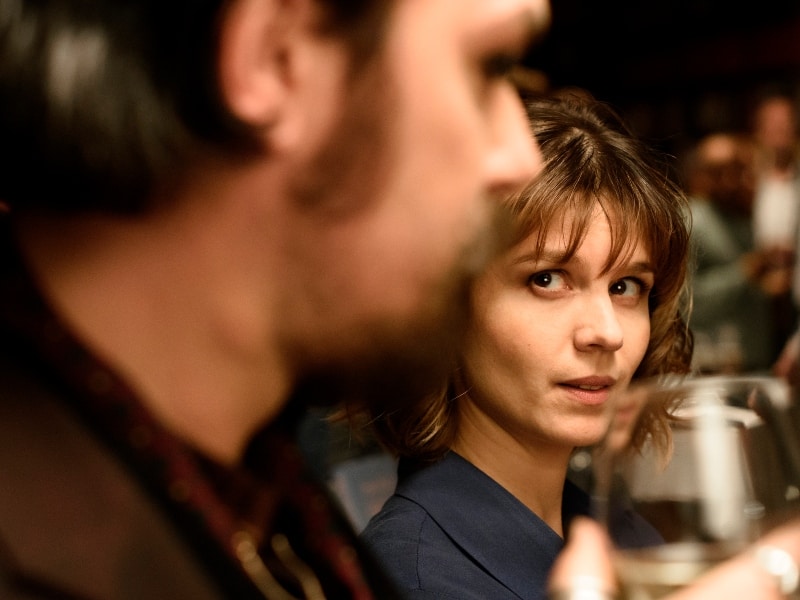
“The Columnist” is a sick and twisted journalist’s revenge fantasy from Holland, a tale of an embattled opinion writer (Katja Herbers) who ignores the advice that many share and few are willing to stick to.
“Don’t read the comments,” (in Dutch, with English subtitles). “NEVER read the comments.
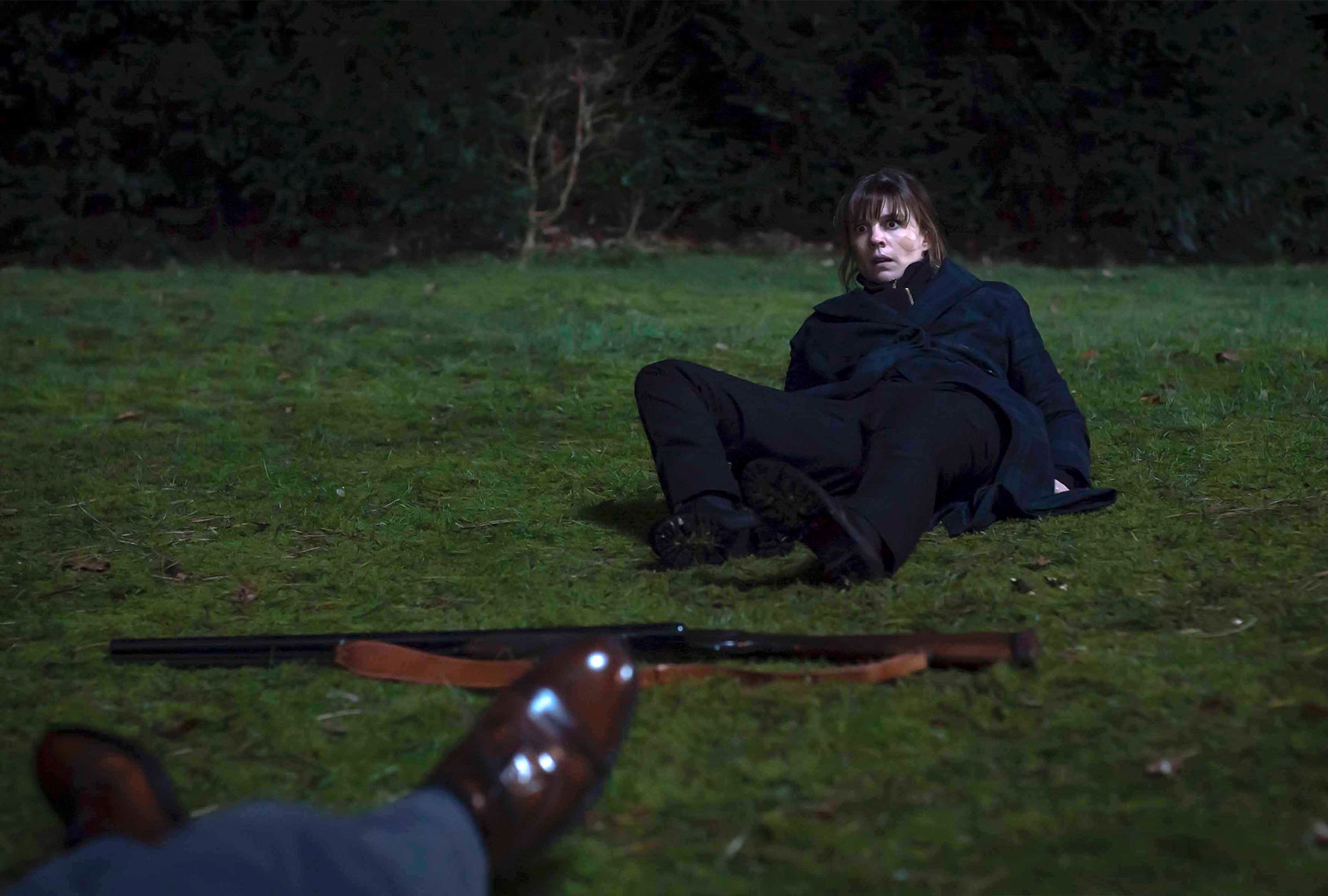
She lies awake at night over the hate mail. And after say, 470-too-many “Nazi” and “whore” and “pedophile” and worse shots, she identifies such a troll and knocks him off the roof, a troll who will troll no more.
Is this DARK? Oh my stars and garters, yes.
Herbers, of “Westworld,” plays Femke Boot, a single mom who drives a Prius, but like many of her environmentally-aware countrymen, prefers a bike. She takes stands in her newspaper, “Volksrant,” and takes the hits.
Only they don’t roll off her back. Femke goes on TV to plead, “Look, can’t we just have different opinions and be nice about it?” As if that was ever the case.
Her debater that night is a horror writer whose pen name is Steven Dood (“Steven Death”), an eye-linered, Satanic-goateed success at what Femke herself can’t get a grip on. She has a book deal and first-time-novelist “writer’s block.”
Her ways of shedding that and getting a start on her book? Sleep with Steven Dood, starting a relationship with him. And she starts taking out the SOBs who fill up the comments on anything she writes with the Dutch word that — in English — rhymes with “runt.”
An extra wrinkle? Her teen daughter (Claire Poro) is a journalist at her school newspaper fighting a profane (and funny) war over “free speech” with the school headmaster (Harry van Rijthoven). As Femke, who makes her living exercising her right to free speech, either ambushes or directly confronts and then kills her online tormenters for exercising their version of the same thing, she’s trying to support her kid and ignore her own hypocrisy.
“They’re only words,” the kid shrugs. “Words can still hurt,” murderess mom rationalizes.
The script here limits the pre-murder accusations and debates that Femke gets into with her attackers, choosing instead to leap right into the revenge killings. That robs the film of any gravitas and of much of its political subtext. She’s a woman writing on things that seem to enrage men, some of whom have Trump photos on their Facebook pages. But we don’t really see translated versions of the writing that sets them off.
Nor are those hateful comments, sampled generously on the screen, translated from Dutch. That’s a big blunder, even if we kind of get the gist.
I was reminded of the dark Canadian comedy “The Last Supper,” one of Ron Perlman’s finest films. In that, “liberals” decide to trap and execute the Rush Limbaugh of their nightmares, a corrosive conservative talk show host played by Perlman. That film managed to make the hypocrisy of non-violent people taking violent action over someone swaying public opinion against them by exercising his free speech both more amusing and dispiriting, in terms of abandoning one’s core principles.
“The Columnist” isn’t that subtle and doesn’t manage that finesse.
Still, Herbers makes a fine Fury, rarely second-guessing her “solution” to this outrage and injustice that’s keeping her up at night. And if you’ve ever been tempted to get even with some online tormentor with more than wit and the English language as a blunt instrument, here’s a movie that’ll help convince you otherwise.
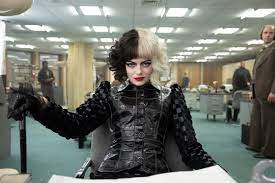
Here’s what we know so far. Thursday night, “A Quiet Place II” did over three times the business that “Cruella” did.
As of end of the evening Friday, “A Quiet Place Part II” has tallied $19.3 million. “Cruella” started Saturday with $7.7 million in sales.
Both are on a boatload of screens. A TON. Over 3700 for “Quiet Place,” with “Cruella” a couple of hundred less.
“Cruella” is also showing on Disney+, which considering its pace and length, is the best place to watch it. So Disney will be declaring it a hit no matter what.
This “official” start to summer is a lot closer to resembling other summer opening weekends. Figure “Cruella” to finish Monday with just over $20 million, “A Quiet Place II” over $40. Box Office Pro is saying as much as $60 over four days. Are people that “over” the pandemic that this many will show up? I’m thinking maybe $45-50 would be the top end.
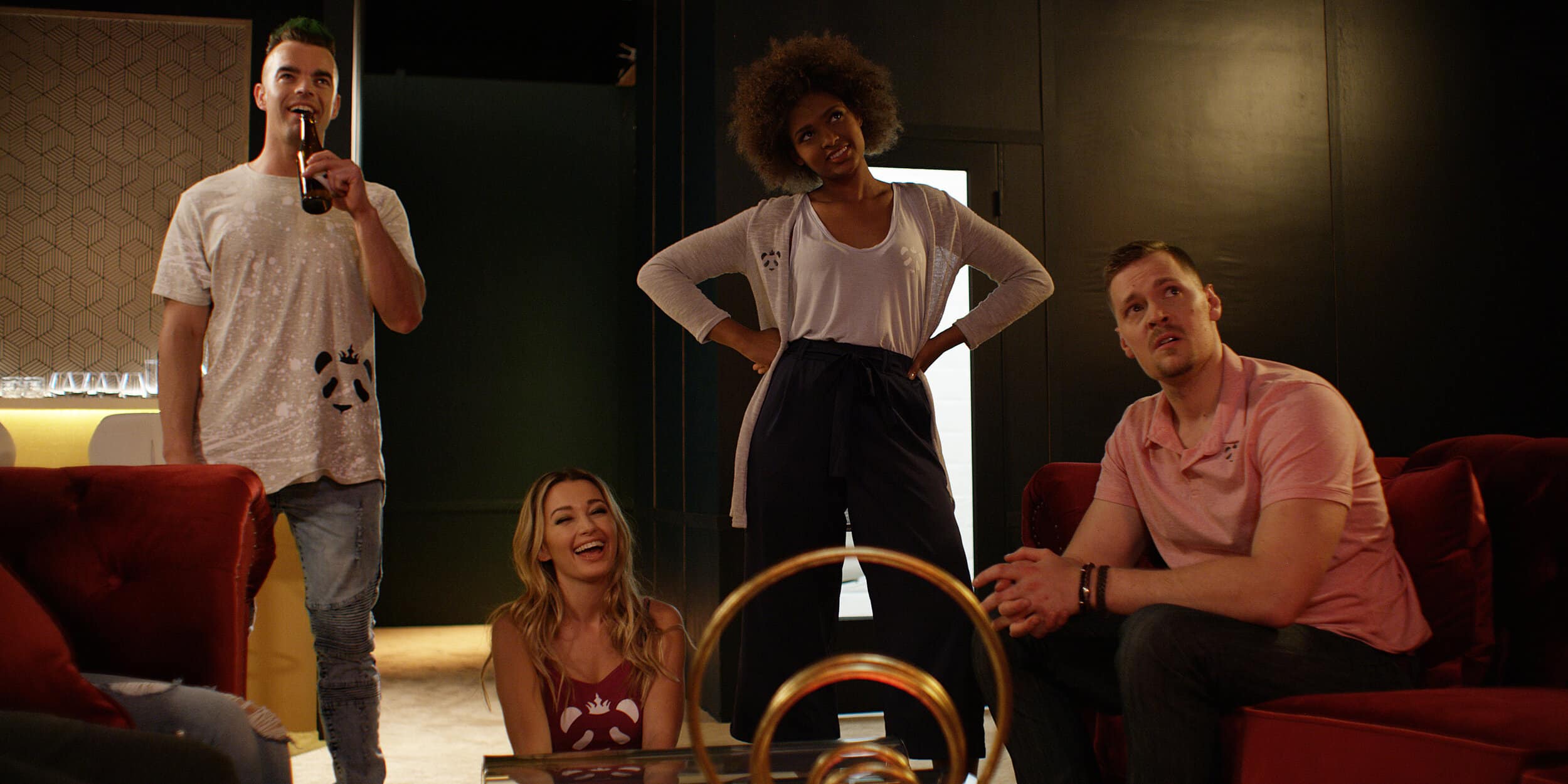
What would horror screenwriters do without murderously sadistic millionaires? They’re so very handy when you’re trying to concoct a means for putting say, eight reality TV and streaming show stars in a “Funhouse” where online viewers can revel in them slaughtering each other.
Actor turned writer-director Jason Lee Williams (“The Evil in Us”) tries on that tired trope as the “brains” and bucks behind “Furcas’ Funhouse” in his foot-dragging variation on the “And then there were none” theme.
It’s a not-quite-soulless slaughterhouse thriller with dull deaths, drab staging and funereal pacing. So even the visceral promise of its premise fails to pay off.
Valter Skarsgård, Khamisa Wilsher, Gigi Saul Guerrero, Christopher Gerard, Karolina Benefield, Amanda Howells, Mathias Retamal and Dayleigh Nelson portray assorted “personalities” recruited for this show that almost celebrates the golden age of “fame whores.”
One’s an MMA fighter on the ropes, another is a ruthless celeb gossip blogger, one’s an Instagram bombshell, another’s a reality bachelorette, and so on.
They all wake up, drugged, in a remote, sealed-off mansion filled with cameras where they will fraternize, “confess” their true feelings to viewers in a booth and “compete” for a $5 million prize. They all had agents who arranged this, so they have no idea what “only one of you will be with us to collect the $5 million prize.”
Still, “It was in your contract.”
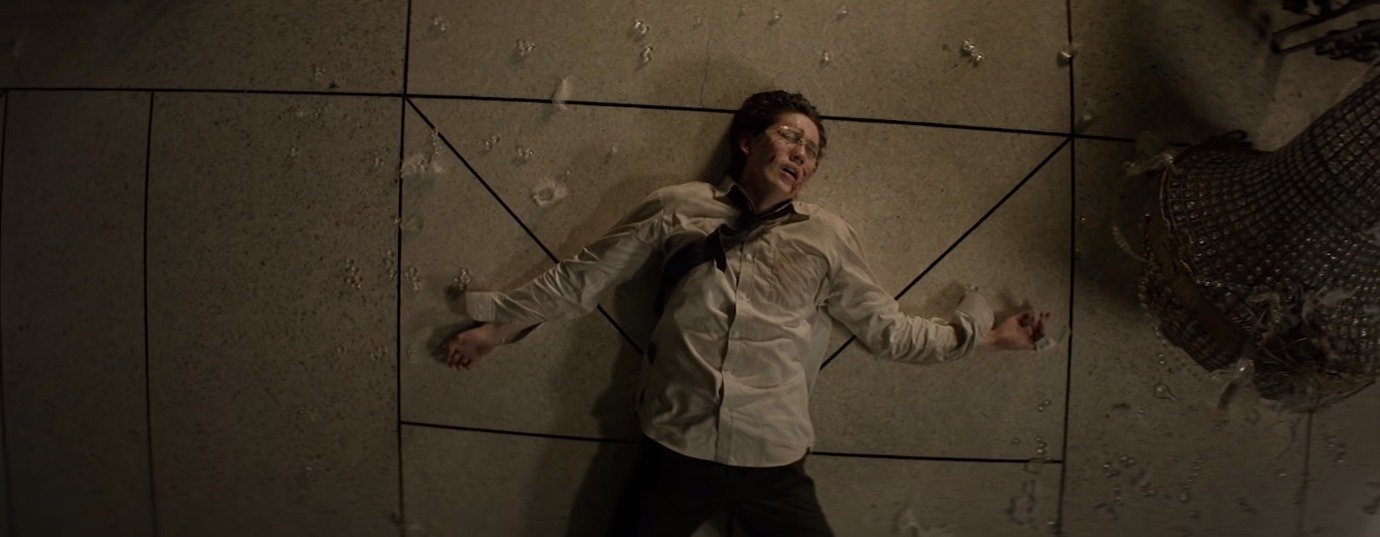
Our oligarch (Aussie Jerome Velinsky of “The Evil in Us”) loves Beethoven and appears to his contestants as a CGI talking panda, serving up exposition, endless “rules” and “competitions” (“Pinata Party” involves beating somebody to death while blindfolded and not realizing you’re doing it), insults about each of the eight’s backstory and popularity polls results from online viewers telling us who gets to fight to the death, or face torture and and execution.
There’s TV “coverage” that looks little like real cable TV, a flippant, “This must be fake” youtube “reviewer (Bradley Duffy) snarking away about the show, shots of slack-jawed viewers of all ages gulping down this latest serving of “the Kardashianization of humanity,” and an ever-shrinking populace of “Funhouse” contestants, who don’t resist this dehumanizing murder-for-entertainment, unless you count whining about it as “resistance.”
“We had a DEAL!”
And there’s the “outside” search, by police, for where this mass murder is being staged, as drably-handled as everything else.
The surprises don’t amount to anything that improves our appreciation of what’s happening, although a couple of the players — Gerard’s MMA fighter “Tombstone,” and Wilsher’s utterly out-of-her-depth “Bride to Be” star in a kill-or-be-killed “game” — stand out.
There’s an audience for this sort of crap — bloody hackings, dismemberments, sex and (female) nudity. But even fans will be put off by the moronic “sermons” by the pontificating rich guy/panda and the “Moonlight Sonata” pace of a no-fun-allowed “Funhouse.”















 Movie Nation