
Michael Keaton is the guy out to…stop her?
Aug 20.
Reviews are embargoed until 7pm Thursday, so stay tuned.
Michael Keaton is the guy out to…stop her?
Aug 20.
Reviews are embargoed until 7pm Thursday, so stay tuned.

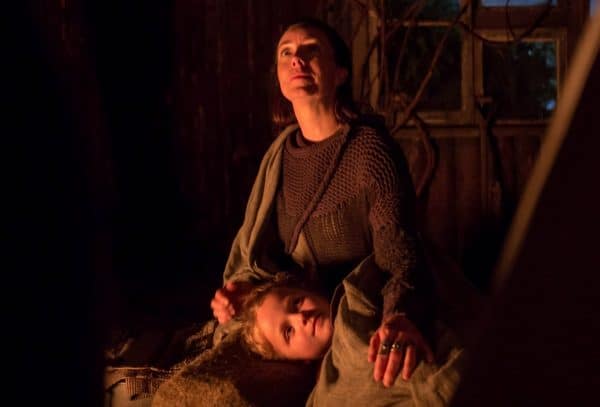
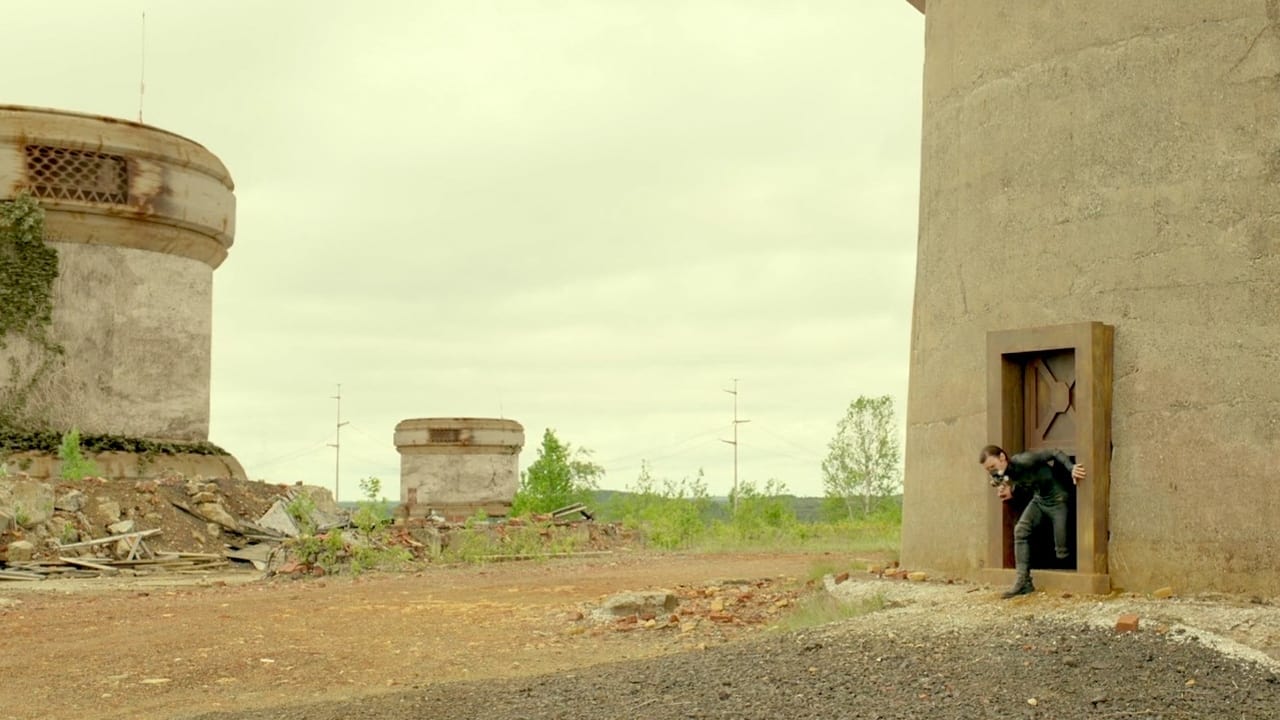

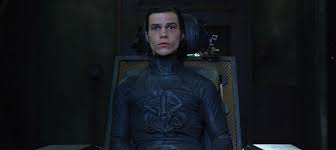
There isn’t much to “2149: The Aftermath,” another entry in the dreaded, cinema-consuming “YA-sci-fi” genre. What’s here is perfectly, if a tad blandly, realized. It’s just that not enough happens.
Editor turned director and co-writer Benjamin Duffield serves up a new version of the post-apocalyptic dystopia, limited in perspective and scope, but myopic, faintly paranoid and competently acted.
An older man tells us this story in voice over, about the days, nights and years when he life in a “sanctuary pod,” cubicle-sized self-contained apartments where people like him stayed in the same chair all day, eating meals, playing games, sending texts to his mom in a separate pod and working — remote control operating front-end loaders for the mining that produces the minerals needed to make sanctuary pods more efficient.
Darwin (Nick Krause) has been in his pod nine years, since “the greatest war of all” killed most of humanity and made the Earth uninhabitable. Any distractions and a disembodied voice barks “Continue working, CONTINUE WORKING NOW.” It’s not like he can afford to not do the job that keeps his air flowing his meals coming and and push-button supersuit (he can shower inside it and never take it off) operating.
But one distraction jolts him. He sees a dog. That’s not enough to get him out of his chair. But a power outage that starts a verbal countdown of his breathable O2 supply does.
“The purification will go off in 15 minutes…Goodbye, Darwin.”
Capitalism. Can’t beat it. But you can figure out it’s been riding that old trope, “the world isn’t as poisonous as they’ve been saying.”
Darwin stands up for the first time in years, wanders outside, and wouldn’t you know it, finds a “family” living in the woods, beyond the reach of the “police cruiser” drones. Molly Parker is the “mother,” but blonde teen Dara (Juliette Gosselin) takes a special interest in this “dweller.”
Can young love blossom amid the gloom? Who or what might stand in the way?
A clever touch, thanks to thought-to-type commands on his computer, Darwin has forgotten how to speak. The other kids in the family have to mimic a keyboard and interpret his “speech.”
The “police cruisers” look suspiciously like assorted specialty conduit-bending tools, or droid soldiers from the “Star Wars” universe.
The threat is “generic,” the “family” lives and entertains itself in “Little House on the Prairie” no-tech fashion, and the passion is dispassionate. The plot is strictly low-stakes, with the characters’ emotions matching that.
Krause (“White Rabbit,” “The Descendants”) makes a sort of Edward Scissorhands impression, which doesn’t give us enough to connect with. Parker is credible, as always. And the Canadian Gosselin (“Kiss Me Like a Lover”) has a moment or two. Actually, just one.
Credit Duffield for making this dystopia feel labor-exploitation lived-in, gutted and depopulated, and the “pod” is pretty impressive.
But the movie with those settings needed some action, man, or a lot more than this.

MPA Rating: unrated
Cast: Nick Krause, Molly Parker, Juliette Gosselin, Jordyn Negri, Daniel DiVenere, and Cassidy Marlene Jaggard.
Credits: Directed by Benjamin Duffield, script by Benjamin Duffield, Robert Higden. A 4Digital Media release.
Running time: 1:17
June 18, we find out.
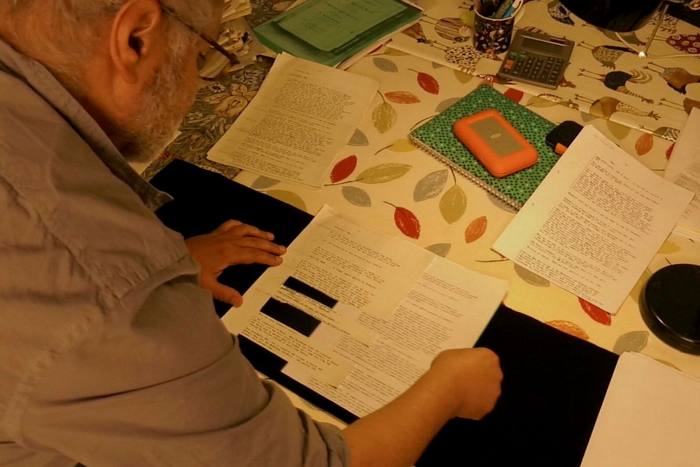


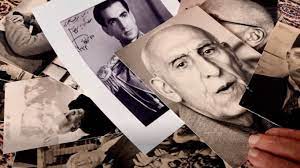
Scholarship, my advisor in graduate school always reminded us, is a wall you build brick by solitary brick. You add your bricks to those assembled before you and hope the subject is important enough that the next scholar to come along will raise the edifice a little higher than you managed.
Documentary films aren’t usually assembled the same way or looked at as primary scholarship. But the movie “Coup 53,” about the MI-6 and CIA-sponsored Iranian coup of 1953, brings to light startling evidence of Britain’s primary role in the planning of it, something the United Kingdom has been united in denying for nearly 70 years.
As seen in the film, this coup — which eventually saw the Shah of Iran installed as supreme leader with dictatorial powers — was a desperate move engineered by a crumbling British empire clinging to oil fields and a showpiece refinery lost when a democratically elected Iranian government nationalized them.
After a somewhat self-promoting opening that includes a sample of his TED talk about this subject and revealing his personal connections to the story, director Taghi Amirani paints a brief, worshipful picture of Mohammad Mosaddegh, the prime minister who insisted that Iran’s resources were Iran’s to exploit, and no longer the property of the British.
“He was the closest Iran came to have its own Mahatma Gandhi!”
A privileged, well-educated member of the lesser nobility, others in the film describe Mosaddegh as “eccentric” (He was as fond of pajamas, and bedside meetings, as Hugh Hefner.), both a social democrat and a “a feudal warlord” who tolerated Iran’s communists only because they were the only organized political party in the peculiar “Persian Empire” vestiges of a British protectorate.
And in 1953, Churchill and his Conservative government, with a little urging from the company that would change its name to British Petroleum after the coup, plotted with the Shah to depose Mosaddegh in an event still recalled with vehement bitterness in Iran.
Making what is largely a documentary about making a documentary, filmmakers Amirani and editor and co-writer Walter Murch use Ali Charmi’s striking animation to recreate the coup itself, and events leading up to it. And they do a splendid job of showing us lots of “bricks” pulled together by others who came before them in building the most complete account of this coup, how it happened and who planned it, and its implications for the history of the Middle East.
The Iranian born and British educated Amirani spent nearly 10 years working on “Coup 53.” As the film shows, there is a whole subculture of Iranian expats who have kept the memory of this outrage alive, preserving archives, newspaper accounts, interviewing on camera survivors, combatants and plotters. Their exhaustive work is generously offered and generously added to the wall Amirani and Murch are building.
Several historians who have written books on the coup and this fateful moment in Middle East/Western relations appear and ponder the “What ifs” of a “regime change” — plotted by Allen Dulles of the CIA, with Eisenhower’s approval, and Churchill’s MI6 — the ways it altered the history of the region forever and shaped American ideas of how “easy” regime change could be.
Most importantly for the makers of “Coup 53” was the research done for a British documentary TV series in the ’80s that interviewed most of the surviving British protagonists about this “chapter” in British history. “End of Empire” (1985) adds significantly to the “meat” of Amirani and Murch’s new film, which samples interviews from many of those involved who have since died.
And then there’s that fellow who didn’t appear on camera, not that ITV/Granada Television will admit, anyway. Norman Darbyshire was a British intelligence officer, not quite 30 years old when he “arranged” the coup. In 1985, Darbyshire wasn’t shy about speaking his mind and spilling the beans, no matter what denials his government continued and continues to make about the 1953 coup.
The “twist” that Amirani makes the most of here is the fact that no video or audio of Darbyshire’s keystone interview exists. There’s just a transcript.
A lot of “Coup 53” is spent showing us the efforts the filmmakers went to in trying to confirm this happened. When they’re satisfied they have, they convince actor Ralph Fiennes — perfect, of course — to “play” Darbyshire in a recreation of this interview, cynically talking about British racism, callous high-handedness and the many ways Pounds Sterling greased the wheels for removing a popularly elected leader from a budding democracy because it was bad for (future) BP.
The sea of talking heads appearing here tend to dull the senses in between flashes of animated action and a Darbyshire interview made as le Carré chilling, officious and suspenseful as Fiennes could manage. After a brisk opening act, the film tends to bog down until we get to the third act’s bloody nitty gritty of the coup. “Coup 53” could stand to shed some minutes.
Some of the claims of “censorship” and have been disavowed by the original production company, some of the “revelations” debunked, with Amirani criticized for sensationalizing the way the transcript of an interview not used in “End of Empire” was “leaked” to journalists and then to Amirani. I’m willing to buy into his claims of “censorship,” but others got hold of his “big revelation,” which was publicized 35 years ago, even if he didn’t know it.
The film was yanked from distribution for a bit over clearance rights (money) to those archived ITV interviews.
“Coup 53” is still a lively treatment of important history, adding bricks to the wall of what scholars know about Iran, Britain and the U.S. (with Israeli involvement, training the Shah’s dreaded secret police) at that time, what happened and how. Now it’s up to other scholars to take up the story and make their additions to it.

MPA Rating: unrated, depictions of violence
Cast: Taghi Amirani, Malcolm Byrne, Alison Rooper, and Ralph Fiennes.
Credits: Directed by Taghi Amirani, script by Taghi Amirani and Walter Murch. An Amirani Media release.
Running time: 1:59

“Los Hermanos” is an engaging musical documentary about two Cuban brothers, star musicians, separated by the 62 year-old embargo the United States has imposed, to no positive effect, on the island nation.
Ilmar, the older brother, took up the violin as a child, and in the last years of the Cold War, went to the Soviet Union with his mother so that he could further his classical music studies as a young teen. He never moved back and eventually settled in New York and helped found The Harlem Quartet chamber music ensemble.
Aldo, six years younger, took up the piano in a country whose development and economy have remained stagnant for decades But he became a star jazz composer and musician, a teacher married to successful orchestral conductor, Daiana, all thanks to family and government support for classically trained musicians.
Although they stayed in touch and managed to meet, with extreme difficulty, here and there. It wasn’t until the Obama Administration started to thaw the relationship with Cuba that they could work together. The film charts this collaboration, which climaxed with a North American concert tour, sometimes playing as a duet, often with Aldo joining the Harlem Quartet for compositions of his or his brother’s creation.
But what happened after Obama left the White House of course changed all that.
The sons of a famous (in Cuba) composer, they were “condemned to be musicians,” their father Guido says with a laugh. Ilmar jokes about how he was “tricked” into taking up the violin when his father returned from an Eastern European tour with a junior-sized violin.
“Next thing I know, there’s some Russian in our apartment yelling at me,” Ilmar says with a laugh, remembering that first teacher in 1980s Havana.
The film skips back and forth, between New York and Havana, going on tour, filling in their history, charting each aspiring performer’s rise through competitions (Aldo studied in London for a bit) and noting, as many have before them, the economic disparity between lives in the US and those in Cuba.

“Los Hermanos” is at its best in showing us the difficult logistics of life in Havana. They were born into a performing arts family. But while musician mom had a Steinway, heaven help them all when it breaks and the embargo makes any fix impossible.
“There are only two (suitable) grand pianos in all of Cuba,” Aldo shrugs (mostly in Spanish with English subtitles, although he speaks English and the film is mostly in English). If he wants to play a concert, that takes a lot of planning and scheduling.
Government support for the arts peaked during the Soviet years, but the lingering embargo, with its travel restrictions, mean that artists who want real success and financial security have to travel abroad, travel that doesn’t include their most lucrative market — the United States.
The siblings make a congenial pair as they play their way into middle age. The joyous moments come on stage or in group meals in Havana, where every utensil turns into an instrument since every dinner guest is a musician.
It’s an “interview” heavy documentary, traveling and chatting with the brothers, having them tell their stories and explain their history. “Los Hermanos” turns somewhat more intimate thanks to fly-on-the-wall moments, watching Aldo teach a young concert pianist on one of the two serviceable grand pianos, this one in an empty concert hall.
The bittersweet sets in over the separation, the ordeal just getting permission to travel and the limitations put on that travel by a 1959 embargo that outlived Castro even if it never forced the country to give up its communist dictatorship.
Through it all, you can’t help but get the feeling that like slowly-decaying corners of Havana, we’re looking at the end times for decrepitude. Someday, we’re going to look back on all this arbitrary political pandering to the far right Cuban expats and the politicians who curry their favor as one of the colossal blunders in American political history.
With a little luck we’ll look back and laugh about it, maybe as heartily as Ilmar and Aldo do when they join a Chautauqua, New York outdoor concert that climaxes with an orchestra performing Tchaikovsky’s “1812 Overture.” The audience, including “Los Hermanos,” give it that big finish its famous for by blowing up and popping paper bags to simulate the cannon fire in the finale.
MPA Rating: unrated
Cast: Aldo López-Gavilán, Ilmar Gavilán, Daiana Garcia and Guido López-Gavilán
Credits: Directed by Marcia Jarmel, Ken Schneider. A First Run release.
Running time: 1:24
Dev Patel, Alicoa Vikander, Joel Edgerton, Sarita Choudhury, Sea Harris and Barry Keoghan star in the retelling of the story of “Sir Gawain and The Green Knight.”
Fantastical. July 30.
This one comes out May 18, for those who can’t what to see what “when things get worse” looks like.
Tommy Flanagan and Sean Patrick Flannery star in this latest spin on “the fight game,” which comes out May 21.
This dramedy with magical realism and environmental subtexts opens June 15 and looks like a winner.
Not a lot of movies about guys visited by talking sloths in their dreams and taking on a family quest to save sloth habitat out there.
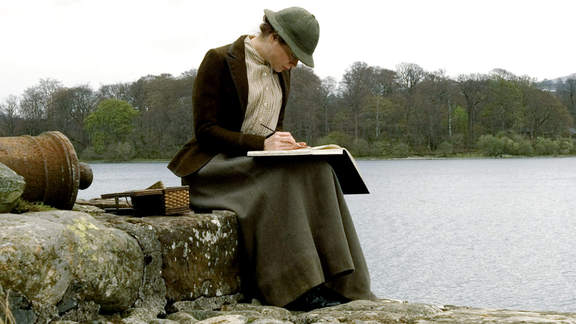

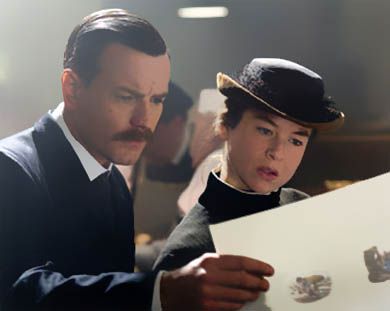

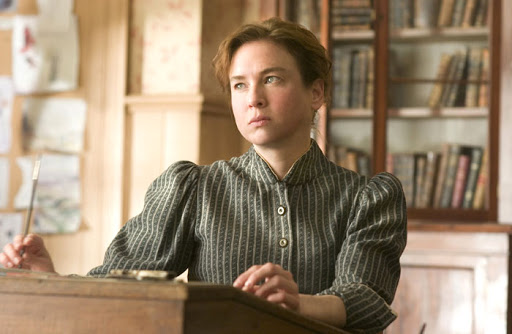
I won’t say I was in a tiny minority of reviewers who praised the charms of “Miss Potter” when it came out in late 2006-early 2007. But I was a bit of an outlier in being swept away by its beauty, delicacy and melancholy romance.
Spruced up as a holiday season Weinstein Co. Oscar contender, the company’s money troubles and a general “over it” attitude about bullying Oscar campaigner and future #MeToo supervillain Harvey Weinstein and even its Oscar-winning star, Renee Zellweger, doomed it with critics and audiences alike.
Period pieces like this reek of “privilege,” which was mentioned in a few reviews years before that condemnation took over the culture.
But looking at it anew, I still connected with its many virtues, the innate sweetness of the characters and the approach — a genteel English “spinster” born into wealth whose perfectly-realized drawings come to animated life, in her mind, as her “friends” which she turns into books that all but invented “children’s literature.
Here’s what I wrote about it upon release. “With “Miss Potter,” Renee Zellweger has won back that precious thing that stardom rips away and the tabloids won’t let you reclaim: her charm.”
There was a lot going on in her post-“Cold Mountain”/”Bridget Jones” life back then, all of it overwhelming a perfectly weightless meringue of a movie. And in the years since, plastic surgery and an Oscar winning “comeback” (“Judy”) haven’t restored any of the appeal she could claim at the turn of the millennium.
But “Miss Potter” feels like a movie most of us swung at and “missed.”
These days, it plays as quaint and gloriously dated, an echo of a time when flawlessly-realized recreations of Edenic England were something worth striving for and films investors could be talked into. Zellweger and co-star Ewan McGregor can’t erase the years or the tabloid interest in their respective lives, but this movie can.
“Miss Potter” catches up with 32 year-old Beatrix in the early years of the last century, confident enough to take her “little book for children” — drawings and all — around to publishers who still weren’t used to dealing with women and could feign little interest in kid lit.
But a small publishing house run by brothers Harold and Fruing Warne (Anton Lesser and “Pride & Prejudice” alumnus David Bamber) fight the urge to dismiss her and take on this “Peter Rabbit” tale. It’ll give their nuisance, idle brother Norman (McGregor) something to do that won’t cost the family its fortune.
That amuses and pleases her father (the great Scot Bill Paterson) if not her snooty, socially-climbing mother (Barbara Flynn).
And when Beatrix meets the boyish but enthusiastic Norman, sparks fly as they find common ground in creating a book that combines art, fancy, whimsy and thrift, one that most every family can afford.
As smitten as the two plainly are as they cook up the publishing phenomenon of the age, Beatrix’s true swept-off-her-feet moment comes when she meets Norman’s equally spinsterish sister, given a pent-up exuberance by Emily Watson.
“I must warn you, Miss Potter, I am more than prepared to like you!”
There are sparks there, too. But any hint of that sort of sexual tension remains that, a “hint.” This is about Beatrix breaking through in a man’s world, becoming a wealthy woman in her own right, showing just what someone born into wealth and comfort can accomplish with every advantage and the free time to polish a craft and create art.
The tension in this quite old-fashioned bio-pic is provided by her unpleasable mother, who never got over her inability to marry her off.
“My mother and I have come to an understanding. We’ve agreed not understand each other.”
At least her indulgent father gets it.
“Our daughter is famous, Helen. You’re the only person who doesn’t know it.”
Her parents are only united when it comes to opposition to her marrying “a tradesman,” who happens to be charming, sweet on her and the main reason she’s rich enough to start shopping for farms in the Lake District.
No expense was spared in taking the production to that part of Cumbria where the Potters summered and which provided Beatrix with much of her inspiration for her stories of ever-so-English tiny creatures of the forests and fields.
The scenery here — they filmed in Scotland and the Isle of Man, as well as London and Cumbria — makes “Miss Potter” the best travel advertisement for the north of England ever put on film.
And the performances are almost unfailingly sweet, romantic with a heavy dose of Edwardian decorum and repression.
I may have been a bit over-the-top in my effusive praise for this in 2006. But if you’re still “over” Zellweger and McGregor, perhaps getting over being “over” them is in order. “Miss Potter” remains the perfect place to start.

MPA Rating: PG for brief mild language
Cast: Renee Zellweger, Ewan McGregor, Emily Watson, Barbara Flynn and Bill Paterson
Credits: Directed by Chris Noonan, script by Richard Maltby Jr. A Weinstein Co release (now streaming via Lionsgate on assorted services
Running time: 1:28


