
Netflixable? Quaid, Gonzales and “orphans” fish for a “Blue Miracle”

Dennis Quaid plays a crusty, rummy old salt forced to help kids win a cash-prize fishiny tourney so that they can save their orphanage in “Blue Miracle,” a “true” tale of Cabo San Lucas.

OK, “true-ish.”

Cute? Certainly. Cloying? Sometimes. I mean, come on. Orphans.

Faith-based? Kind of. A little boy has taken the advice that he should nail his prayers above a door if he wants them to come true. You know what that means.

But stars Jimmy Gonzalez, Quaid and others give fair value and director Julio Quintana (“The Vessel”) manages a mystical moment or two and a sentimental moment or three. And it finishes really well. Really well.

So it may not be a prize-winner, but it’s not exactly chum, either.

Gonzales, finding a sweet variation of his “Mayans M.C.” TV biker thug, plays a guy who has rechanneled a wayward youth, married and runs a private orphanage in Cabo. Wife Becca (Fernanda Urrejola) helps “Papa Omar” preside over the unruly boys of Casa Hogar (“House Home?”)

But the bank is knocking at the door, a hurricane floods the place and they’re in the hole. A lot.

The annual Bisbee’s Black and Blue Fishing Tourney could be their salvation. But only after the wily director of the tourney (Bruce McGill) enters them to get past-winner and drunken, half-broke has-been Capt. Wade off his back about “waiving the entry fee.” Team Casa Hogar it is.

Wade to Papa Omar — “You and your three least annoying orphans” should show up, board his battered boat, “Knot Enough,” at dawn. And away we go.

The kids are a collection of “types” with names to match. Hollywood, Wiki (the smart one) and the new guy, the thief, the one who calls himself “Moco” (“booger”) are Casa Hogar’s last hope.

Complications? Wade has a sad, obsessed past. Omar has issues with being at sea, with fishing with a father figure. He has nightmares about just that. And the kids? What’re the chances any of them can swim?

There’s a lot of sass, back-talk and wisecracking, none of it all that funny. But they all really want to win this thing for Tweety (Steve Gutierrez), who took Omar’s suggestion about writing down prayers and nailing them above the doorway so literally that he’s sure they’re going to boat the biggest marlin of them all.

A single decent twist and a pleasant lump-in-the-throat finale are what you get for your time, here. Not much, but not a lot of family friendly movies do better. And not bad for a movie about a rich man’s “trophy fish” sport. Let’s hope they didn’t waste any blue marlins making this.

MPA Rating: TV-14

Cast: Jimmy Gonzales, Dennis Quaid, Fernanda Urrejola, Miguel Angel Garcia, Nathan Arenas, Dana Wheeler-Nicholson and Bruce McGill.

Credits: Directed by Julio Quintana, script by Chris Dowling, Julio Quintana. A Netflix release.

Running time: 1:35

Posted in Reviews, previews, profiles and movie news | 1 Comment

Movie Review: Red Hook families drift into a changing neighborhood via “Good Funk”

“Good Funk” is an indie drama told in a series of sketches, interconnected lives facing a gentrifying Red Hook (Brooklyn) with despair, frustration and vague hope. There’s not much to it, but like its title, it’s a character study with a groove.

Sameerah Luqmaan-Harris plays Akifah, a single mom struggling to survive on a McDonald’s salary. She who entertains her ten-year-old (Leonay Shepherd) with tales of the child’s absent father. He’s not dead, not that she knows. He didn’t “leave” them.

“I wasn’t in a position to ask questions.”

Their lives and the dynamics of the relationship are upended when they’re evicted. Kolo the kid lets her inner brat out.

William Nadylam and Kalae Nouveau are Terence and Joyce. He’s “an old family friend” of Akifah, an immigrant of means who is just “holding out” for the neighborhood property values to spike as a new “coliseum” is about to change the place. Joyce is a singer, the daughter of a singer, and hasn’t given much thought to kids until they take in Kolo.

And Cedric Cannon and Sandra Reaves-Phillips are Oscar and Eva, an older couple responding to the strain of these “changes,” with mistrust and stress testing their relationship.

A character will melt down, another face accusations that “you’re using again.” Selling an apartment, vacant lot bonfire jams, session work, caring for an elderly mother and police harassment pepper the “plot,” such as it is.

But what writer-director Adam Kritzer was going for is vibe, a melancholy tone, “funk” in its mental health sense.

The performances have a lovely informality, with indie film mainstay Larry Fessenden showing up as a sympathetic McDonald’s colleague and Luqmaan-Harris nicely capturing the deflating depression of struggling with poverty, and being entirely “too good” for that.

Kitzer makes good use of a modest selection of locations, streets, apartments, subway platforms and riverside scenes. The spare plot and limited locations suits the indie nature of it all. Nouveau’s singer Joyce is summoned to a recording session, where the woman wanting her voice uses her real name — Kalae. That’s a retake on a “Hollywood” production.

Like Red Hook itself, “Good Funk” is worth a look, even if you know you’ll need to move on to find something and some place with more excitement in it.

MPA Rating: unrated, adult situations

Cast: Sameerah Luqmaan-Harris, William Nadylam, Kalae Nouveau, Leonay Shepherd, Larry Fessenden, Cedric Cannon and Sandra Reaves-Phillips

Credits: Scripted and directed by Adam Kritzer. A 1091 release.

Running time: 1:14

Posted in Reviews, previews, profiles and movie news | Comments Off on Movie Review: Red Hook families drift into a changing neighborhood via “Good Funk”

Movie Preview: M.Night Shyamalan’s “Old”

Well, none of us are as young as we once were.

This July 23 thriller is about a family that ages rapidly during a summer trip.

Ask anybody about vacations at Disney World.

Posted in Reviews, previews, profiles and movie news | Comments Off on Movie Preview: M.Night Shyamalan’s “Old”

Movie Review: Replacing your own septic? Plan on “Digging to Death”

There’s just enough off-the-wall stuff in Michael P. Blevins’ “Digging to Death” to suggest “horror comedy” might have been the intention here.

I mean, it’s about a newly-divorced guy (veteran bit player Ford Austin) who decides to replace the septic system at his new house by himself, and instead unearths a corpse buried next to a pile of cash.

Austin goes full Bruce Campbell as David, a guy who can’t figure out how to keep the money and deal with the corpse without calling the cops, and goes crazy in the process.

He keeps seeing the corpse (Tom Fitzpatrick) and struggling with it…in his nightmares.

And he’s coming unglued at the office where his passive-aggressive boss (Clint Jung) keeps toying with his deadline to update this “Mind Crash” video game. Yeah, his mind crashes.

He’s just a middle-aged man with a middle-aged muscle car trying to land that mid-level management promotion. Oh, and cope with a divorce, a septic system he can’t get around to fixing, a deadline from his landscaper (Richard Riehle), the stress of knowing he’s breaking the law and a corpse he’s sure is walking around his property at night, muddying his floors.

At every turn, “something huge collides with my already unstable life.” Who hasn’t been there?

Anyway, despite the odd over-the-top reaction, flip-out or what have you, there’s not enough to “Digging to Death” to recommend it. It’s not scary, and not all that amusing.

What this movie could use is more “septic.” Septic is always funny.

MPA Rating: unrated, bloody violence, profanity

Cast: Ford Austin, Tom Fitzpatrick, Rachel Alig and Richard Riehle

Credits: Scripted and directed by  Michael P. Blevins. An Uncork’d release.

Running time: 1:35

Posted in Reviews, previews, profiles and movie news | Comments Off on Movie Review: Replacing your own septic? Plan on “Digging to Death”

Movie Preview: June 25, Beware the “Werewolves Within”

A little horror from IFC Midnight? Why yes, thank you.

Posted in Reviews, previews, profiles and movie news | Comments Off on Movie Preview: June 25, Beware the “Werewolves Within”

Movie Review: To build or not to build a WWII battleship hinges on “The Great War of Archimedes”

“The Great War of Archimedes” is World War II history with a twist — several twists.

It’s about mathematics, an “Imitation Game” and “Fat Man and Little Boy” tale of a lone genius whose calculations, estimating the “real” cost of the world’s biggest-ever battleship, could change the course of history.

“Archimedes” is also Japanese, and it’s speculative fiction, based on a manga (comic book) that ponders a fascinating “What if.” As in “What if Japan’s decision to build the super-battleship Yamato was a big reason the country was so eager to swagger into war” with countries (the U.S. and Britain) that were sure to out-produce, outnumber and overwhelm them in the end?

As our hero here, the “once in a century” mathematical mind named Tadashi Kai (Masaki Suda) puts it more than once in the film, “Numbers never lie.”

He’s a headstrong, on-the-spectrum and OCD genius who was kicked out of Tokyo University, but whose way with numbers, formulae and “measuring” and extrapolating make him THE guy Admiral Yamamoto (Hiroshi Tachi) calls on to debunk a bogus cost estimate for the ship pitched by its designer, Admiral Hirayama (Min Tanaka).

It’s 1933, and Japan, out of the League of Nations and increasingly a rogue state to the rest of the world thanks to its invasion of Manchuria and increasingly militaristic belligerence, must decide how to replace an obsolete battleship.

Yamato says (in Japanese, with English subtitles) “Forget battleships,” they’ll be “useless” in “the next war.” He and Admiral Nagano (Jun Kunimura) lobby hard for a new aircraft carrier.

But the Old Guard of the Imperial Navy, led by Admiral Shimada (Isao Hashizume) want to sink the taxpayers’ yen in this “beautiful” showpiece battleship — fast, heavily-armed and armored. Airplanes? Those two-winged (still) fragile little things? They couldn’t touch it.

When Kai gets the pep talk that alters his anti-patriotic mindset (he’s anxious to emigrate to America), how the hubris this ship gives the navy and the naive public could lead to war, he sets out to figure out the true cost of the ship, which any novice can tell would cost quite a bit more than its designer claims.

The quest becomes a thriller as navy factions smear Kai, his not-quite-girlfriend (Minami Hamabe) and stonewall the newly-appointed Lt. Commander and his aide (Tasuku Emoto) at every turn as they scramble to gather the data they need to make an informed estimate when everything about this unnamed “monster” of a warship is “classified top secret.”

There’s a deadline, of course, which gives “The Great War of Archimedes” (named for the great ancient Greek mathematician) a “ticking clock,” counting down the fate of our heroes and the world.

Writer-director Takashi Yamazaki (“The Fighter Pilot”) makes this mad dash for military math suspenseful and pretty entertaining. Kai’s fetishized measuring tape — When we meet him, he’s measuring a the faces “etc.” of a bevy of geishas. — comes in handy as he dashes from ships to shipyards, doors slamming in his face as he keeps jotting down numbers — length, beam (width), number of rivets per metric foot of steel.

Yamazaki also makes the debates in the naval committee tense and riveting. Lots and lots of that particularly Japanese brand of bellowing, harrumphing and taking umbrage.

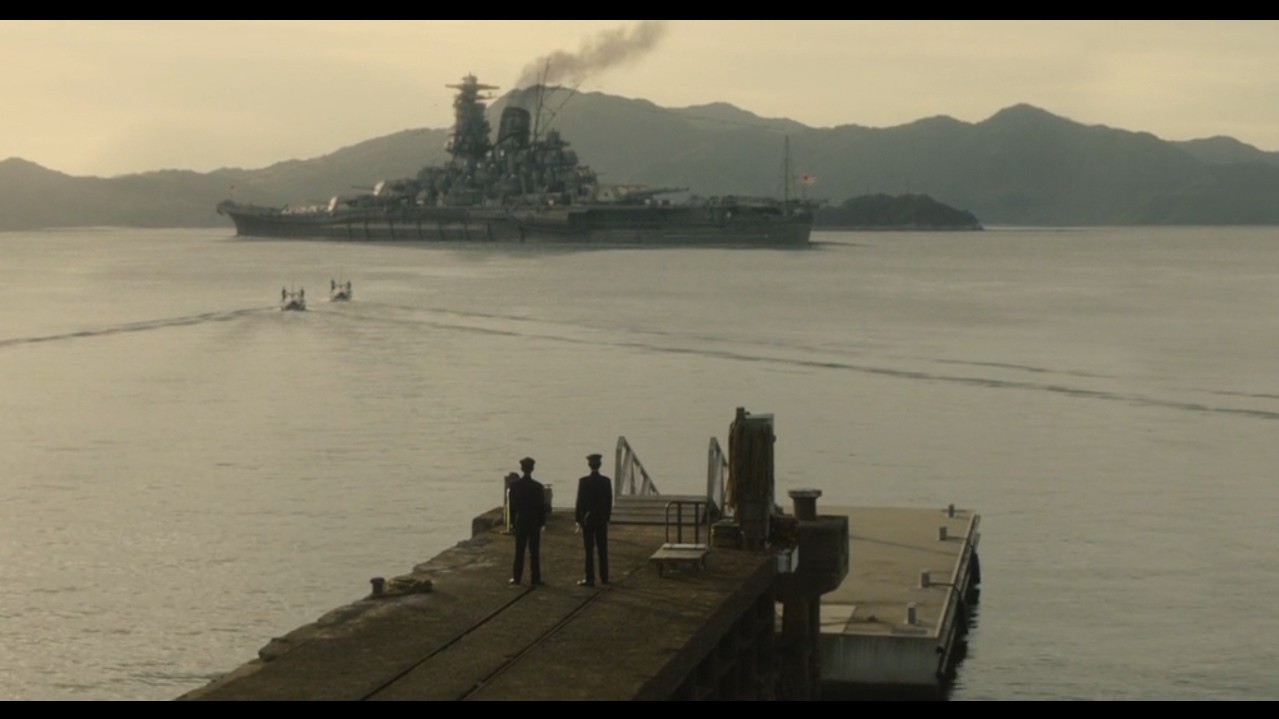
The film opens with an impressive digital recreation of the April 1945 sortie that sank the Yamato, a beautifully-rendered battleship assaulted by a swarm of U.S. Navy Helldiver dive bombers and Avenger torpedo bombers. It’s brilliantly detailed — screaming gun crews blazing away and dying, the ship taking hit after hit after hit, finally rolling over and sinking as a sea of extras drown or burn to death.

If anything, the movie understates how difficult the “Yamato Class” battleships (there were two) were to sink.

There’s also a shakedown cruise scene set on an early Japanese carrier, launching biplanes and other scenes set on battleships not at war.

This isn’t a conventional war movie, more of a superficial gloss of “How we blundered into war” tale, complete with Japanese revisionist scrubbing of how their “advance into China” (a bloody, territory and resource-coveting invasion) history.

But it’s a very entertaining and offbeat spin on Japan’s pre-WWII history and the national mood at the time, and an intriguing if somewhat far-fetched “what if” about the country’s long, delusional journey into World War II.

MPA Rating: unrated, violence

Cast: Masaki Suda, Hiroshi Tachi, Minami Hamabe, Tasuku Emoto, Min Tanaka, Isao Hashizume

Credits: Scripted and directed by Takashi Yamazaki, based on the manga by Norifusa Mita. A Well Go USA release.

Running time: 2:09

Posted in Reviews, previews, profiles and movie news | Comments Off on Movie Review: To build or not to build a WWII battleship hinges on “The Great War of Archimedes”

Documentary Review: Celebrating a pioneer who made lesbian magazines “Ahead of the Curve”

“Ahead of the Curve” tells us the story of Frances “Franco” Stevens and her founding of the glossy magazine “Curve,” which started life as “Denueve” in 1991.

A slick, sexy, hip and politically assertive magazine of the “Cosmo/Vanity Fair/GQ” school, “Denueve” stood out for having “A Lesbian Magazine” bannered across the cover top on each and every issue. As Jen Rainin’s film makes clear, it wasn’t cashing in on “Lesbian chic,” the movement that blew up in the culture and spawned TV’s “The L-Word.”

“Deneuve” invented Lesbian Chic.

The film follows Franco, who now uses a wheelchair and hasn’t owned the magazine — which changed its name to “Curve” in the late ’90s — for years, just as “Curve” is facing a future where she and others have to ask and answer the question, “Is a lesbian magazine still needed?”

Rainin and her interview-subject struggle in trying to encapsulate the cultural moment, where “lesbian” is hotly debated within “the community,” the subject of TED talks and endless reconfigurations of the semantics and language of gender — LGBTQ vs. TERFs (trans excluding radical feminists), “lesbian” as opposed to “queer.” It’s a turf war that may seem confusing from inside the community, but can be positively maddening to many outside it.

One thing the film does really well is track the creation myth of “Deneuve,” how Stevens, having left a marriage after discovering her sexuality, moved to The Mission and plunged into the life, realized there was a need for a magazine that was gay and not male-dominated like “The Advocate” or later, “Out.”

“If you want something, you need to be the one to take action.”

Stevens tells the story of signing up for a bunch of credit cards, taking cash advances from all of them and then literally “gambling” on herself, her Big Idea and her future by betting on horse races to raise the cash to get through the early issues.

A boost from people with the right mailing lists, and “Deneuve” blew up, a Lesbian-oriented magazine with activists, authors and “celesbians (lesbian celebrities like Melissa Etheridge and Lea DeLaria) on the cover. Yes, they had to mail it out in “Manilla envelopes” to their readers, to protect them. Because violence against homosexuals was quite prevalent in the culture of the “Don’t Ask, Don’t Tell,” “Defense of Marriage Act” ’90s.

“Deneuve” “gave the community the gift of connection,” one interviewee asserts. And others, some moved to tears, recall the first issue that they saw “someone who looks like me” on the cover of a magazine which told them “I’m not alone.”

One thing the film does very poorly is take the wrong side, and give weight to the disingenuous claims of Stevens and others about the name “Deneuve,” letting them assert “homophobia” when the French screen star Catherine Deneuve, who played a few ground-breaking lesbian characters on the screen, sued them for using her name.

Like no one saw THAT coming.

But “Ahead of the Curve” does a decent job of summarizing a forty year blur in gay history and Stevens’ role in it as a spokeswoman for her sexuality and community on TV in the ’90s — “Power Dykes,” on the next “Geraldo!” — a pioneering publisher and a leader in the culture’s breathtaking shift in attitudes on sexuality, marriage and gender identity.

MPA Rating: unrated, nudity, profanity

Cast: Franco Stevens, Lea DeLaria, Melissa Etheridge, Denice Frohman, Jewelle Gomez, Kate Kendall

Credits: Scripted and directed by Jen Rainin. A Wolfe release.

Running time: 1:38

Posted in Reviews, previews, profiles and movie news | Comments Off on Documentary Review: Celebrating a pioneer who made lesbian magazines “Ahead of the Curve”

Netflixable? Brazilian hustlers try to land laughs as they “Get the Grift”

Today’s “Around the world with Netflix” adventure is a half-amusing, somewhat brash and certainly chatty, loud and in-your-face Brazilian con-man comedy.

“Get the Grift” or “Os Salafrários” is sprinkled with lively moments that translate across cultures, characters and a plot familiar to anyone who’s ever seen a screen comedy and little bits of social commentary about “corrupt” Brazil and the ways the grifting can sway the gullible.

Subtle? Um, no. Not in the least.

The story is winded and a bit over-familiar, and the dialogue lacks much in the way of “zingers,” but perhaps the subtitling lets the film down in that regard. It’s in Brazilian Portuguese with English subtitles, for non native speakers. But “in-your-face” energy makes up for a lot in comedy, and our loud, mugging, stars (Marcus Majella, Samantha Schmütz) deliver that in buckets.

Clóvis (Majella) grew up with “a lot of families,” thanks to his wandering-eye Pop and the various women the kid got handed off to over the years. He’s grown up to be a hustler, a confidence man extraordinaire, with his biggest gift for grift coming from a paintbrush. He’s an art forger.

We meet the adult Clóvis as he’s passing off his latest “masterpiece” to a Senator, who refuses to let his aide haggle down the price with the plump, man-bunned talkaholic. The buyer wants what he wants, and maybe the money he’s playing with isn’t his, Clóvis figures.

Lohane (Schmütz) is the toothy, grinning step-sister whose only goal in life was to become a “micro-entrepreneur.” She grills burgers and chatters the ears off customers from her food-trailer, until the day she falls for the fake “inspectors” who threaten to close her down without bribes. She’s broke, and then her trailer is impounded by the “real” inspectors.

Clóvis, who lives by a sort of “never pay for anything you can con somebody out of” motto, is in a similar fix. You cross the wrong people, your apartment gets looted and the police are on your tail.

Did I mention him bragging that “I managed to sell Christ! ‘Christ the REDEEMER,'” the most famous statue in all of Brazil. Yeah, you’d have to be a special kind of stupid to fall for that.

Still, he “obtains” a car and Lohane begs a lift as they scamper off to a remote resort town to lay low.

Except that “laying low” isn’t in Clóvis’ playbook. He hustles up a hotel room, enlists Lohane in a check forging scheme, and so on and so forth.

“Why not just rob a bank?” she wants to know. He is offended.

“A scammer, a grifter. It’s different from being a ‘gangster.'” I mean, come on.

Clóvis is brilliant at enlisting passersby, strangers and other customers in his causes, downloading a blizzard of blather and BS that convinces bank customers in the lobby to chant and shout down suspicious clerks — “Cash that check! Cash that Check!

He’s always got an eye for the next angle. He falls in mud and “s–t?” That’s how he’ll get a “refund” from the hotel that he conned into letting them check in without the “deposit” going through. He’ll roll around on the furniture in the lobby, wipe his body on the walls, etc. Blackmail at its simplest.

The picture that emerges of Brazil through all this is of a corrupt, lawless place where everybody hustles, every employee has seen such hustles and only a few have the wherewithal to resist. And even those can be bullied by a mob that takes the hustler’s side.

“It’s every man for himself,” Clóvis is always telling Lohane, who is a quick-enough study. Watch the way she contorts herself to get the perfect “selfie” in a dive-tour shop, a shot that includes the check the model/customer at the counter is writing at that very moment.

“Get the Grift” also has these little interludes, bits of Brazilian and con-artist history Clóvis narrates, like the guy who “sold the Eiffel Tower to a scrap dealer” story.

There’s a “Grease” sing-along, an auction to disrupt, and every time our hustlers get ahead, a calamity takes it all away from them so they have to start over, preying on the less hip as they do.

The physical shtick is limited (more Lohane’s thing) and the cons barely creative enough to hold our interest.

Still, I appreciate the stars’ antic energy even as they’re wearing out their welcome, and quickly.

MPA Rating: TV-14, profanity

Cast: Marcus Majella, Samantha Schmütz

Credits: Directed by Pedro Antônio Paes, script by Fil Braz. A Netflix release.

Running time: 1:35

Posted in Reviews, previews, profiles and movie news | Comments Off on Netflixable? Brazilian hustlers try to land laughs as they “Get the Grift”

Movie Review: Cruel, well-cast, perfectly-clad “Cruella” is comatose

The “Maleficent” inspired “Cruella” begins with a murder and settles, eventually, into a tale of revenge.

Starring two Oscar winners, each dazzlingly on her game and laboring to make a fun night out of this back-engineered take on how Cruella DeVil came to be a fashion statement and came to favor fashions made from Dalmatian hides, it’s a film that shows how great casting and design can only take you so far.

Despite the presence of Emma Stone in the title role and Empress Emma Thompson as her “Devil Wears Dalmatian” boss and mentor, few of its two hours and fourteen minutes of exquisite sets and costumes and perfectly-coiffed and modulated performances ever show the spark of life.

It’s too polished to be “a dog,” too charmless to produce laughs.

We have to wonder if “laughs” were ever the point of director Craig Gillespie (“I, Tonya”) and the screenwriters. In a sequel the world wasn’t begging for and of a character who was perfectly delicious without a “back story,” that “What is the point?” question lingers in the air when somebody other than a studio “suit” should have answered it on Day One.

Maybe asking who the audience was to be would have helped, too. It’s not-quite “Harley Quinn” or “Joker” nasty, not “Maleficent” bittersweet or funny.

Bathed in venomous voice-over by Stone’s anti-heroine, we’re told “I’m dead” before we see how the child then-named Estella became an orphan at a fashion gala hosted by the imperious designer, The Baroness (Thompson).

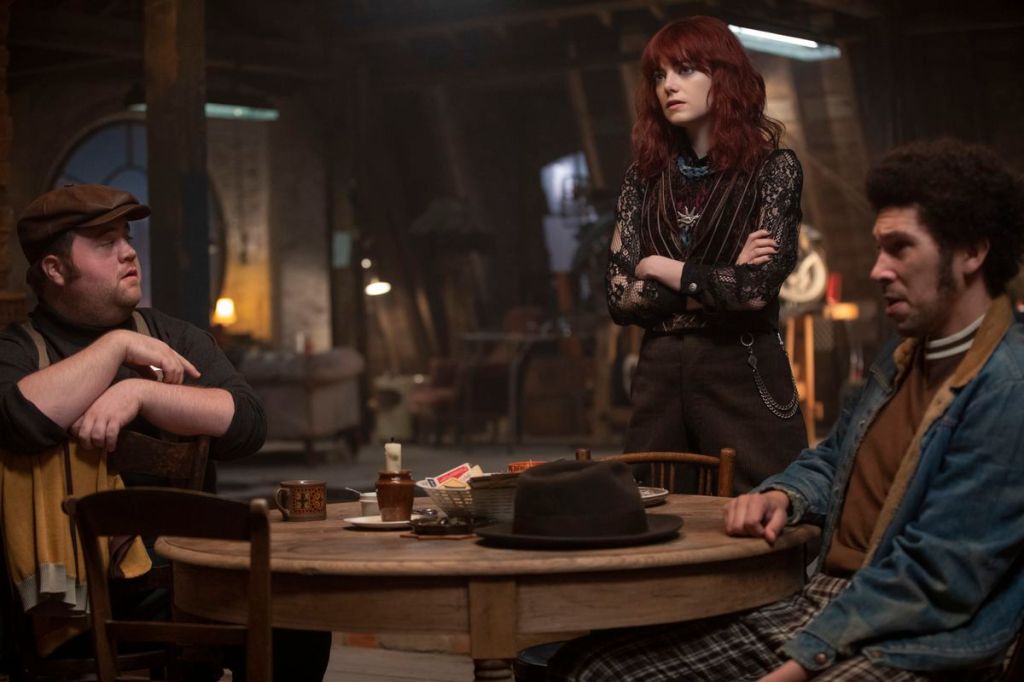
We’re treated to an Artful Dodger/”Oliver Twist” childhood in the Mod London of the ’60s, before con artist, mistress of disguise Estella and her two adoptive pals turned henchmen about-to-become “minions” (Joel Fry and from Paul Walter Hauser) set their sights on bigger prey.

Not at first, of course. Estella, hiding her shock of half-white hair under wigs and dyes, aspires to a career in design. And despite a very low-on-the-ladder start, it looks like she might get her way, studying at the feet of the mistress of “‘Normal’ is the cruelest insult of all.”

Estella becomes a confidante, the talent behind the “genuis” of House of Baroness.

But something will set Estella off, bring out her inner “Cruella” and make her the attention-stealing underground bete noir of the Baroness in 1970s London.

There are dogs — some real, some digital (Seriously, Disney?). There are other accomplices — John McCrea is the fabulous boutique owner who assists Estella/Cruella, Mark Strong is “the valet” long in the Baroness’s employ.

Hauser, from director Gillespie’s “I, Tonya,” slings a Cockney accent and is gifted with the one running “gag,” a con-man/hustler/pickpocket who’s always asking “What’s the angle?” even when Estella thinks she can leave that life behind thanks to the design fame and success, just around the corner. She’s grateful for the chance.

“Gratitude is for losers,” Boss Baroness warns.

If you’ve ever read a review here, you know I sprinkle pieces like this with funny lines from a funny film. There pretty much aren’t any in the Dana Fox/Tony McNamara script. Perhaps Disney could have let Oscar-winning screenwriter Thompson take a pass at this.

What is here is one stunning fashion moment after another, one vast Black and White Ball or gala opening for The Fall Line.

What’s also here is another “Forrest Gump” overkill soundtrack, an endless stream of pop song rights purchased and deployed to try and liven this moribund movie up. Blondie, The Clash, hell, here’s Tina Turner’s cover of Led Zeppelin’s “Whole Lotta Love.”

That, alas, is what’s missing from “Cruella” — love. Not romance or anything of that sort, but poignant appeal for a girl who saw her mother murdered or actors in love with their roles and what they get to do with them.

There is never a moment I didn’t wholly buy into the Two Emmas and their delicious on-screen rivalry. But there isn’t a moment where you lean back, laugh and revel at what glorious fun this is, when it plainly could have been and should have been.

MPA Rating: PG-13, some violence and thematic elements.

Cast: Emma Stone, Emma Thompson, Joel Fry, Paul Walter Hauser, John McCrea and Mark Strong.


Credits: Director by Craig Gillespie, script by Dana Fox and Tony McNamara, based on the Dodie Smith novel “101 Dalmatians.” A Walt Disney release.

Running time: 2:14

Posted in Reviews, previews, profiles and movie news | Comments Off on Movie Review: Cruel, well-cast, perfectly-clad “Cruella” is comatose

Netflixable? A rich man’s murder, a detective’s cancer, a lot of places to park “The Soul (Ji hun)”

“The Soul” is a murder mystery wrapped in medical sci-fi, with a tragic, prosecutor-dying-of-cancer romance/pregnant cop-wife melodrama thrown in for good measure.

It offers up a lot to chew on, but a lot left undigested as well, all served up in a “thriller” that doesn’t really deliver and a mystery that isn’t exactly solved.

A Taiwanese industrialist is ritualistically murdered, with pentangle-like symbols scrawled on walls and doors in his mansion and a vajra club found in his MUCH younger second wife’s (Anke Sun) unconscious hand.

The scene is grisly enough to almost make the first police on the scene faint.

An investigating prosecutor (Chen Chang) gets more bad news from his oncologist, but decides — with his wife (Janine Chun-Ning Chang) pregnant and his next course of treatment promising to be a long shot, to go back to work.

But Liang doesn’t tell his wife, Ah-Bao, of his plans. That’s a problem, because she’s on the job a bit longer during her pregnancy. And she’s a detective who works with him, co-investigators digging into a very convoluted case, interrogating the same suspects.

Whatever is going on with Li-Yan, the widow of the dead man, the house’s extensive closed circuit TV cameras will reveal, right? Only they muddy the waters. Maybe she did it. Something supernatural might be involved.

Or perhaps the dead man’s estranged son and deranged heir (Hui-Min Lin) did it. His body covered in tattoos and his mind warped by the death of his mother, he’s into the same bizarre satanic religion she espoused. He’s got to be the likeliest suspect.

But the story was never going to be that neat and direct. The dead man’s medical company had financed RNA cancer-fighting research, which extended his life until he was clubbed to death. The doctor behind it is sketchy and secretive and played by an actor named “Christopher Lee,” for Pete’s Sake (Christopher Ming-Shun Lee).

This transfer of genetic material experiment, might it pass “souls” from person to person, in addition to removing cancer risks from their DNA/RNA?

There’s a lot of watching sometimes bizarre video recordings, interrogating this or that suspect or maid, and dealing with the manic, over-the-top acting kid, who seems to have motive in addition to an apparently murderous religious fanaticism.

Is the 20 year-old replacement wife in on all this, or merely a pawn?

Meanwhile, the cop/prosecutor couple is having weepy debates about what lies just ahead for them without a miracle, medical or otherwise.

Native Mandarin speakers may get more from this Around the World with Netflix mystery than I did. I found the acting either comically broad or frustratingly under-played.

There’s a little bit of metaphysical debate, about the “living” having to “carry on” with their grief and regrets, while “the dead just get to walk away.”

Perhaps the English subtitles are missing some nuance with that “walking dead” translation.

The forensics are feeble, the couple of blasts of action horrific enough, but the science fiction entirely too clinical and close to current science to generate much interest. And the whiff of supernaturalism is just that, only a whiff.

As ambitious, twisty and soulful as “The Soul” sets out to be, I found it left me cold. And as a whodunit, it’s a little confusing and a tad boring. Not exactly a recipe for a “riveting” 130 minutes of viewing.

MPA Rating: TV-MA, graphic violence, nudity

Cast: Chen Chang, Janine Chun-Ning Chang, Anke Sun, Christopher Ming-Shun Lee and Hui-Min Lin

Credits: Scripted and directed by Wei-hao Cheng, based on a novel by  Jiang Bo. A Netflix release.

Running time: 2:10

Posted in Reviews, previews, profiles and movie news | Comments Off on Netflixable? A rich man’s murder, a detective’s cancer, a lot of places to park “The Soul (Ji hun)”