
Aug.6, Viola and Idris and Cena and Margot and…Pete Davidson?
Aw hell naw.
Aug.6, Viola and Idris and Cena and Margot and…Pete Davidson?
Aw hell naw.

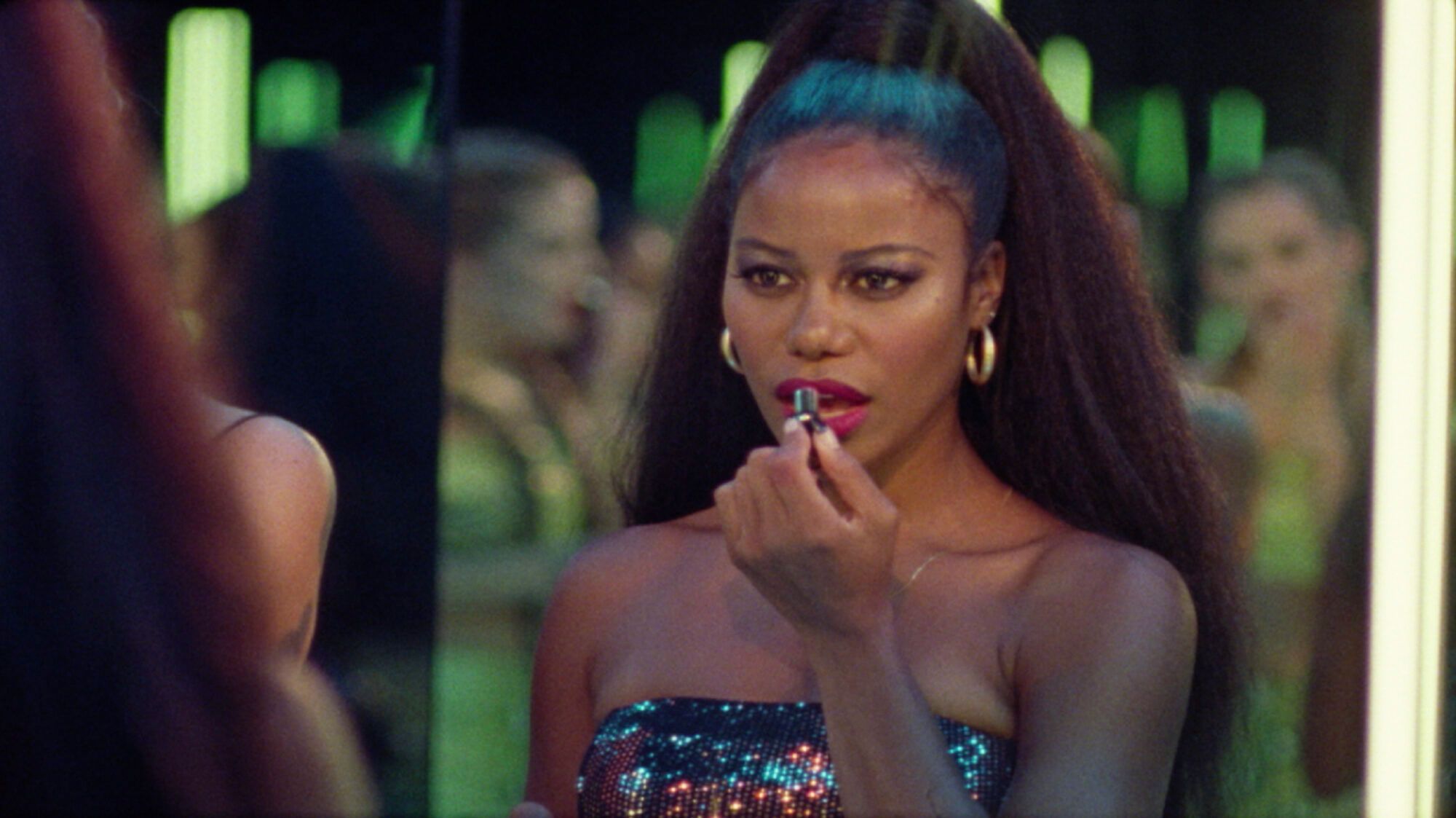

There’s cultural homage, and the much-reviled “cultural appropriation.” And then there’s whatever the hell it is that Riley Keough, Elvis Presley’s granddaughter, puts on and pulls off in “Zola,” a hilariously dark and dirty road comedy built on a stripper’s “my hand to God this happened” tweets.
Janicza Bravo’s film is a Taylour Paige (the “younger woman” in “Ma Rainey’s Black Bottom”) star vehicle. And she gives it her savvy, sassy, side-eye best as the title character, a Midwestern waitress who gets mixed up with wild child Stefani (Keough) only to tell us the story of how “me and this b—h here fell out“.”
But that drawling, fronting, teasing and “street” sounding Stefani is her own kind of racial riffing, culture appropriating, personal space invading, over-sharing, gum-snapping Queen of Bad Decisions. She’s the perfect foil for no-nonsense Zola’s account of a road trip/”ho’ trip” from Hell.
Because that was Stefani’s doing, what Stefani set up and where Stefani lures Zola, from that first “You dance?” question at the themed restaurant where Zola waitresses, to that farewell drive back over the Sunshine Skyway across Tampa Bay.
It’s “Spring Breakers” with strippers, alleged adults who’re supposed to know better. But Stefani’s sucked Zola in over her head, and over her own childish, dimwitted head as well.
They’re hauled 20 hours down the highway (from Detroit, in the “true” story) to Tampa where a “dancer” can pull in “5Gs a night!”
If you don’t know Tampa as Strip Club Hell, you haven’t been paying attention to why every sports league in America’s Sporting Industrial Complex wants to hold its championships there.
Stefani’s going with her boyfriend, nerdy wannabe-B-Boy Derrek (Nicholas Braun) and the guy (Colman Domingo) who owns the Mercedes SUV, whose name Zola narrates that she doesn’t learn “for two mother (youknowwhatting) days.”
Looking for explanations of this whole…situation? So is Zola.
He “takes care of me” Stefanie euphemizes about the unnamed Mercedes driver. “Stripper translation,” Zola snaps in narration, “He her PIMP.”
There’s a lot of translation, and a lot y’all watching this are just supposed to figure out for yourselves as a weekend for some quick “dancing” cash turns towards an even older profession. Zola, who sexed-up her live-in boyfriend (Ari’el Stachel) so he wouldn’t pout about this “ho’trip”, has to take a hard “pass” on “private dances” and much worse from the charming unnamed SUV dude who turns off the smarmy African American charm and switches on the Jamaican psycho pimp in a heartbeat.
Stefani may think nothing of servicing a Who’s Who of unattractive Tampa rednecks, genitally-deformed “customers.” But Zola?
“No shade. No shame. You do YOU,” but uh-uh. Zola ain’t HAVING that.
Bravo (“Lemon”), who adapted the tweets and the magazine article about them that made them famous, holds a mirror up to downmarket, down-and-dirty American culture in her second feature film, after doing mostly TV — episodes of “Mrs. America” and “Dear White People” and “Divorce.”
The Sunshine State is decorated with strip clubs, Confederate flags and a lot of unseemly things that have little to do with Disney World.
And in Paige, she’s cast an exemplar of “stripper as athlete,” and an adorably deadpan slow-burn reactor to all that is “messy” about Stefani, this situation she finds herself “trapped” in and the Florida and America where all this goes on. It’s not all “money/ti—es” selfies, oh no. There is much that Paige’s Zola is moved to give a side-eye to.
Keough’s Stefani is exhausting, crude, gross and nasty, prattling on in her idea of African American street argot about “dooky-ass” this and “nappy-ass” that. And just for good measure, we see “her” version of the unfolding fiasco, laughable lies, but then again, what’s it say about Zola that she dove into this trip with this foul-mouthed flake she just met?
The soundtrack is peppered with phone-alert “pings” and hip hop road trip sing-alongs (“Hannah Montana” by Migos). There’s a backstage at the strip club prayer that will give you religion.
“Lord, send us NI—S…with culture…and GOOD credit!”
And if it wears you out, just as Harmony Korine’s “Spring Breakers” made you long for spring break to end, that’s kind of on the money, too.
There’s only so much dirty, lowdown Tampa anybody can stand.

MPA Rating: R, for strong sexual content and language throughout, graphic nudity and violence including a sexual assault.
Cast: Taylour Paige, Riley Keough, Colman Domingo, Nicholas Braun, Ari’el Stachel
Credits: Directed by Janicza Bravo, script by Janicza Bravo, Jeremy O. Harris, based on tweets by A’Ziah King and a magazine article by David Kushner. An A-24 release.
Running time: 1:27

Their eyes lock across a crowded Dakar bar. ‘s She is an exotic Senegalese beauty, he a fit professional athlete from Belgium.
But Fae (Fatou N’Diaye) has something to reveal to the Belgian (Vincent Rottiers) and his brother (Paul Bartel). She is a sex worker, a prostitute, a “whore,” a word we hear bandied about in “Angel (Un Ange),” a tragic Belgian/Senegalese romance about two ships that collide in the night.
“It’s not the end of the world,” he notes (in French with English subtitles), after a moment’s thought. What does he do for a living? He’s a professional cyclist, training and drugging his body “for the fans.” Thierry declares that Fae is no different from him. “We’re all whores.”
“Angel” is a self-consciously arty fever dream about their affair, their very different “but not that different” lives, and that word. We hear “putain” in French and Senegalese and ponder what it means today, and what it might mean to a beautiful woman who prefers to see herself “as a gazelle,” but accepts it. Fae has no other obvious means of supporting herself in a Muslim country where she is harshly judged but tolerated. She can’t come into his hotel without her sex worker “health card.
Thierry and brother Serge have come to Senegal to escape prying eyes, to live it up, await that next contract, hopefully with the team Thierry made his name with.
It’s not a movie about characters with hope, not until they’ve come together. She is trapped, avoiding getting that health card as it puts in writing what she does for a living. That’s not who she is.
Thierry talks about his dreams, and the film takes us into them. Some are nightmares, others mere flashbacks — of trauma, accidents, suicide attempts and doom. Thierry has been a star, but his little bump of coke before boarding the flight tells us that the elaborate blood doping gear he’s somehow gotten into Senegal isn’t his only encounter with controlled substances.
Serge? He’s the crude, on-the-make enabler, carrying drugs for his brother, tempting him with questions about sex with “an African woman.” Serge is white colonialist “privilege,” here to basically let Thierry as a character off the hook in that regard. Thierry is the one who sees “no difference” between himself and Fae, racially, personally or professionally.
Through their night together, Fae finds herself thinking beyond “tourist girl” status, this life where she and her colleagues have sex with foreigners “who are older than we will ever be,” who takes care of her body every bit as carefully as Thierry, because while he is doing it “for the fans,” her diet, attire, braids and make-up are “for me, but also for you.”
And impulsive “wired” Thierry? He’s babbling on extravagantly and oh-so-romantically. She might be his escape, their future might be “together.”

The writer-director Koen Mortier takes great pains to emphasize that “Angel” is a work of “fact mixed with fiction,” in an opening title. That’s understandable, seeing how it’s not-that-loosely based on a up and down life of a real Belgian cyclist.
Mortier uses a fluid sense of time and narrative — events lapse into flashbacks without warning — and the effect is quite dreamlike, with harsh intrusions of reality.
If there’s anything we know about cocaine users, it’s that elation is always followed by a bottoming out, that paranoia often accompanies that, and that there’s little an addict won’t do to instantly “fix” that feeling.
So Rottiers (“Renoir,” “Pompei”) veers from reflective to manic in this performance. His character’s nickname in the cycling world may be nicknamed “The Angel,” but it is N’Diaye’s Fae who is the otherworldly presence, here. Earthy and practical, exotic, fatalistic and ever-rationalizing, N’Daiye (“Metamorphoses”) turns Fae into a cypher, someone we can project a vast variety of values and character traits on.
Because that’s what sex workers do, sell a fantasy.
The cryptic storytelling style makes “Angel” test your patience. But I think it works, a tragic story given a wish-fulfillment fantasy underpinning, and a film that doesn’t flinch from letting harsh reality show its face. That’s the thing about dreams. They never last past the moment we open our eyes.

MPA Rating: unrated, violence, nudity
Cast: Vincent Rottiers, Fatou N’Diaye, Paul Bartel
Credits: Scripted and directed by Koen Mortier, based on a book by Dimitri Verhulst. An Oration release.
Running time: 1:47
Jeepers creepers, this open August 27.

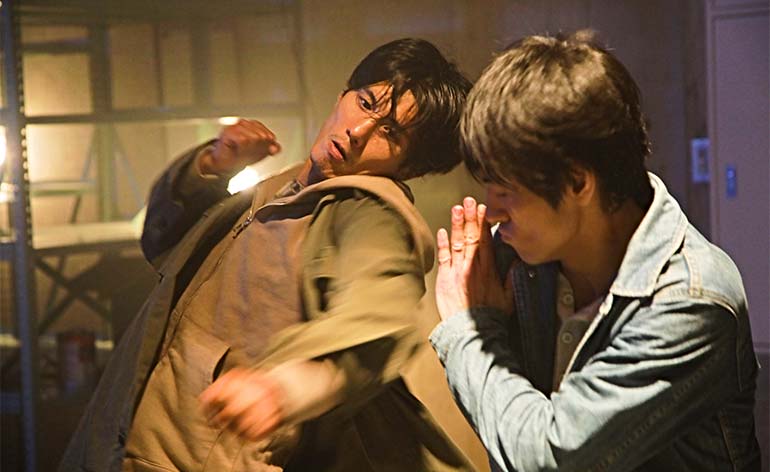
When it’s done well, you realize why they call it “fight choreography.”
In the Japanese mystery-thriller “Hydra” (Sorry, Marvel fans.) the brawls mimic the rest of the movie. There’s no talking, rarely even grunts of exertion. Everything happens breathlessly fast, so much so that there’s a do-si-do dance to the life-or-death struggle.
Naohiro Kawamoto choreographed the fights in this minimalist, archetypal underworld collision of cops, mob assassins and vigilantes.
We hear the “whoosh WHOOSH” of arms and legs in fabric, heavy breaths and the muffled “thump” of blows landing. None of this exaggerated post-production “POW, BAM SNAP” stuff here. A knife or a screwdriver pierces flesh with a soft, metallic “shtuck shtuck.”
There’s not much else to focus on in this 77 minute movie, which opens with ten dialogue-free minutes of a cop being killed in a men’s room, the baseball-capped young killer (Satoshi Kibe) making his exit, the “cleaner” (Takashi Nishina) showing up with his aluminum suitcase to dismember the body, take it home, and further whack it to pieces to feed to his tank of carnivorous fish.
Have I sold you on this, yet?
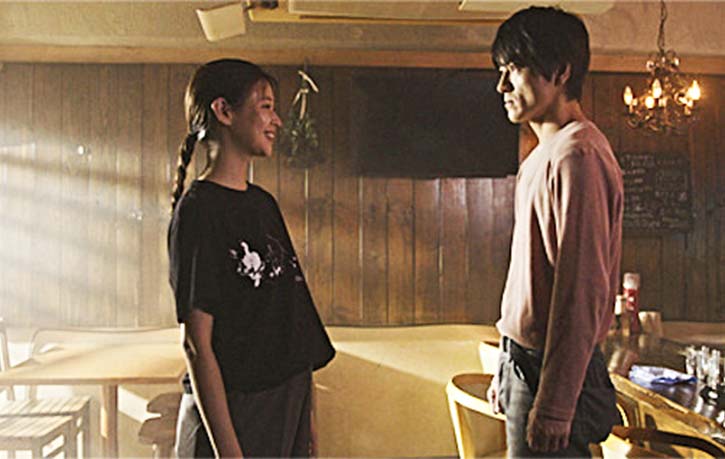
The story takes its allegorical title from a tiny Tokyo pub, where young Rina (Miu) presides, flirtatious Kenta (Tasuku Nagase) is the waiter and stern, silent Takashi (Masanori Mimoto) smokes and broods and cooks back in the kitchen.
But he’s not just “mysterious,” not merely a “quiet old fart.” He remembers customers, sizes up what they need to eat right now (hangovers call for tandoori chicken), cooks and does everything else, it seems, by memory.
And if we know about Japanese cinema semiotics, we can tell he’s a badass just from that familiar unruly mop of hair. Anime to action films, always beware of the dude too busy get a cut or a comb. Takashi can handle himself.
Jiro Kaneko’s script sets up a laughably arch back story that ties Takashi to this job in this place, and an “organization” called “Tokyo Life Group Ltd” that does these “purges.” That’s what they call them.
“We kill people,” the leader (I didn’t catch his name, but I think that’s Tomorowo Taguchi‘s character) intones, in Japanese with English subtitles, to his former go-to-guy, Takashi. “But some people deserve to die.”
Tokyo Life Group has a real jones for corrupt, murderous, date-rapist cops. But the cops might fight back. And if they’re really worried, they’re inclined to hire assassins of their own.
Mimoto (“Alien vs. Ninja”) makes a fine “strong, silent and competent” type. His Takashi doesn’t wear his skills openly, so he’s always getting the drop on the bad guys who come after him or those close to him.
“Who the hell ARE you?” villains inevitably ask, those who have time to utter anything before it’s game on.
The story doesn’t carry “Hydra,” and the characters are so confined to “types” that they’re rarely more than that. But the fight sequences sell it, to those who are on the market for that sort of thing. This B-movie is “So You Think You Can Dance?” for martial arts brawlers, nothing more.

MPA Rating: unrated, violence, sometimes graphic
Cast: Masanori Mimoto, Miu, Takashi Nishiona, Takaya Aoyagi, Tasuko Nagase, Satoshe Kibe and Kazunori Yajima
Credits: Directed by Kensuke Sonomura, script by Jiro Kaneko. A Well Go USA release.
Running time: 1:17
The horror comedy “Werewolves Within” didn’t quite do the trick for me. But it’s a great example of how hitting the right tone can keep you watching, even if the “horror” isn’t all that and not nearly enough jokes land.
Screenwriter Mishna Wolff, director Josh Ruben and a collection of generally funny actors from “Veep,” “30 Rock” and “The Unicorn” wring out some of the possibilities of a tale of people trapped in a snowed-in lodge while under assault by werewolves. Yes, they were adapting a video game.
But while they get the tone right and the “types” are filled with comic possibilities, they lean on that hoary murder mystery “gather the suspects by the fire” gimmick at their own peril.
And if there’s one thing that really doesn’t work here, it’s “Are the werewolves outside, or in here with us?” gimmick.
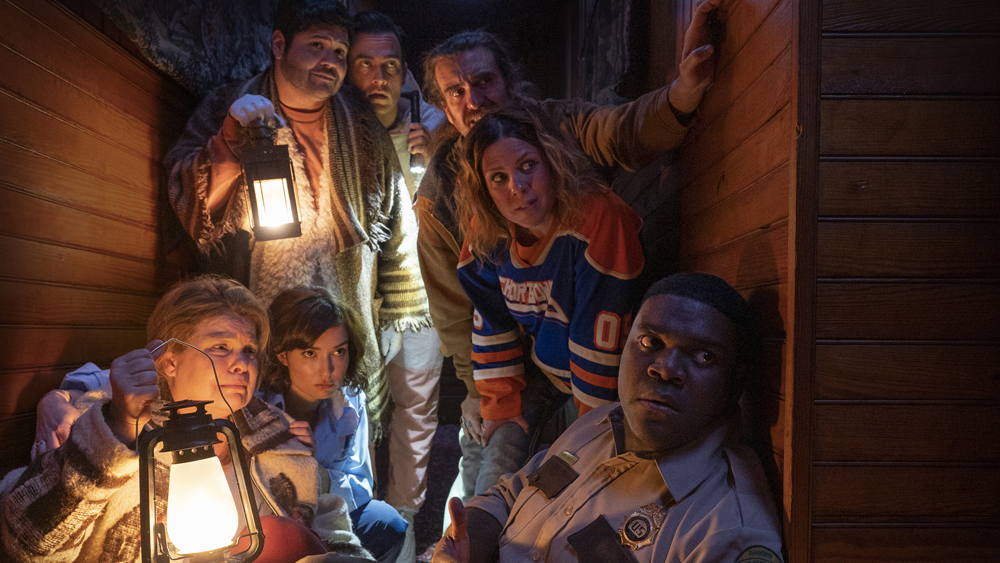
Sam Richardson plays the new Forest Service Ranger in Beaverfield, Vermont. But the town is sharply divided over some rich oil man’s (Wayne Duvall) planned pipeline. It’s become a political bone of contention that has even the seemingly “nice” people there at each other’s throats. And on the day Finn Wheeler arrives, a blizzard is blowing in.
“This is Us” alumna Milana Vayntrub is Cecily, the bantering, on-the-make new postmistress who is Finn’s guide to “the freak show” that is the town. Stoners, wingnuts, at least one of them a bit pervy, a mountain man survivalist (Glenn Fleshler), a rich gay couple (Cheyenne Jackson and Harvey Guillén), and so on. Colorful? A little bit.
There’s a visiting scientist (Rebecca Henderson) “here to stop the pipeline.” And Michaela Watkins stands out as the loopy, small-dog loving gift-shop flake. Uh, don’t get too attached to the dog.
“I don’t mean to be rude, but your dog only barked at Jews….” “And BROWN people.”
Too soon, rich gays. Too soon.
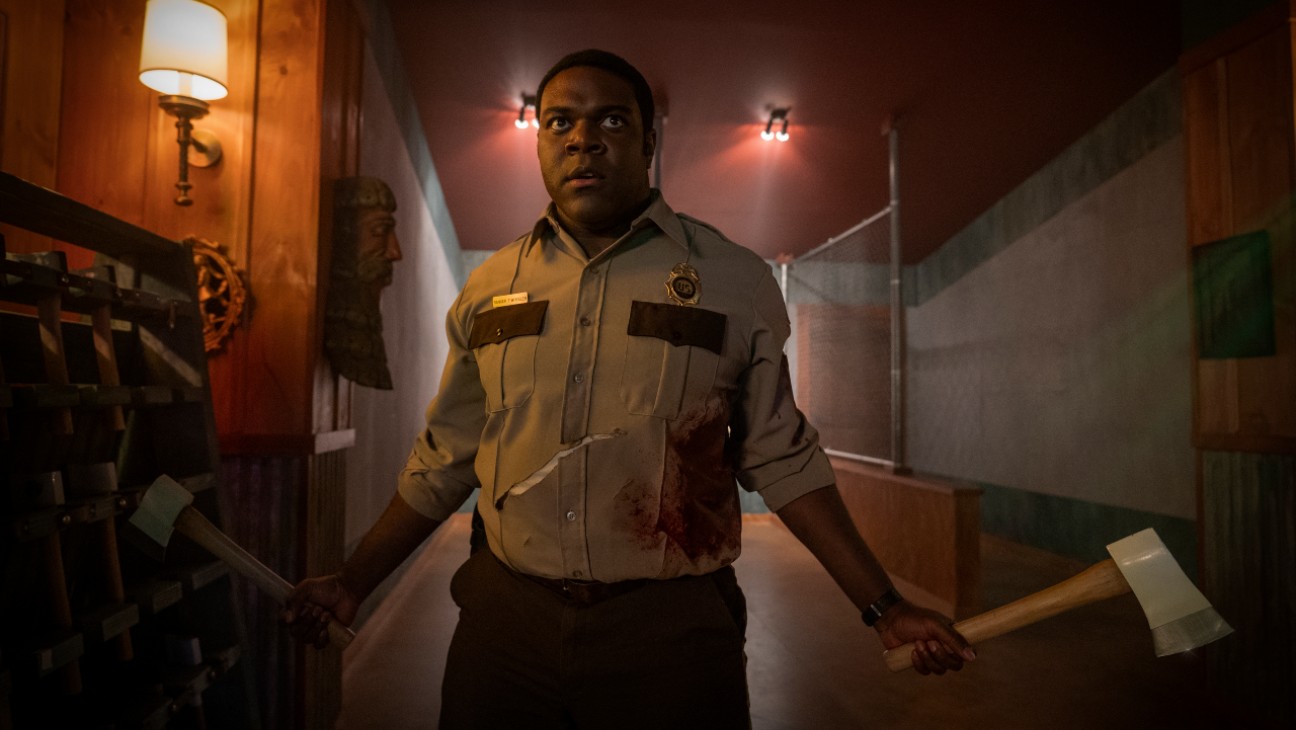
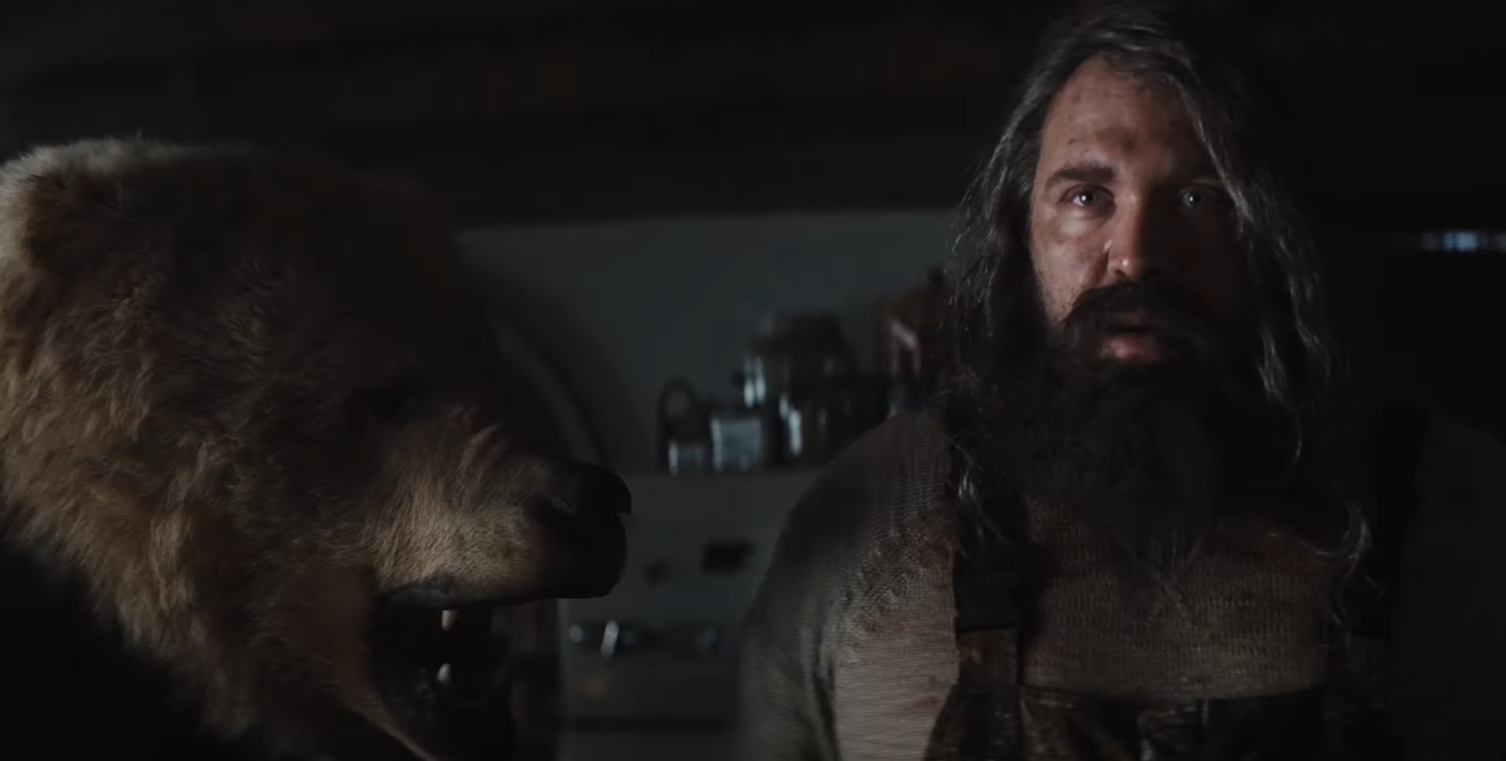
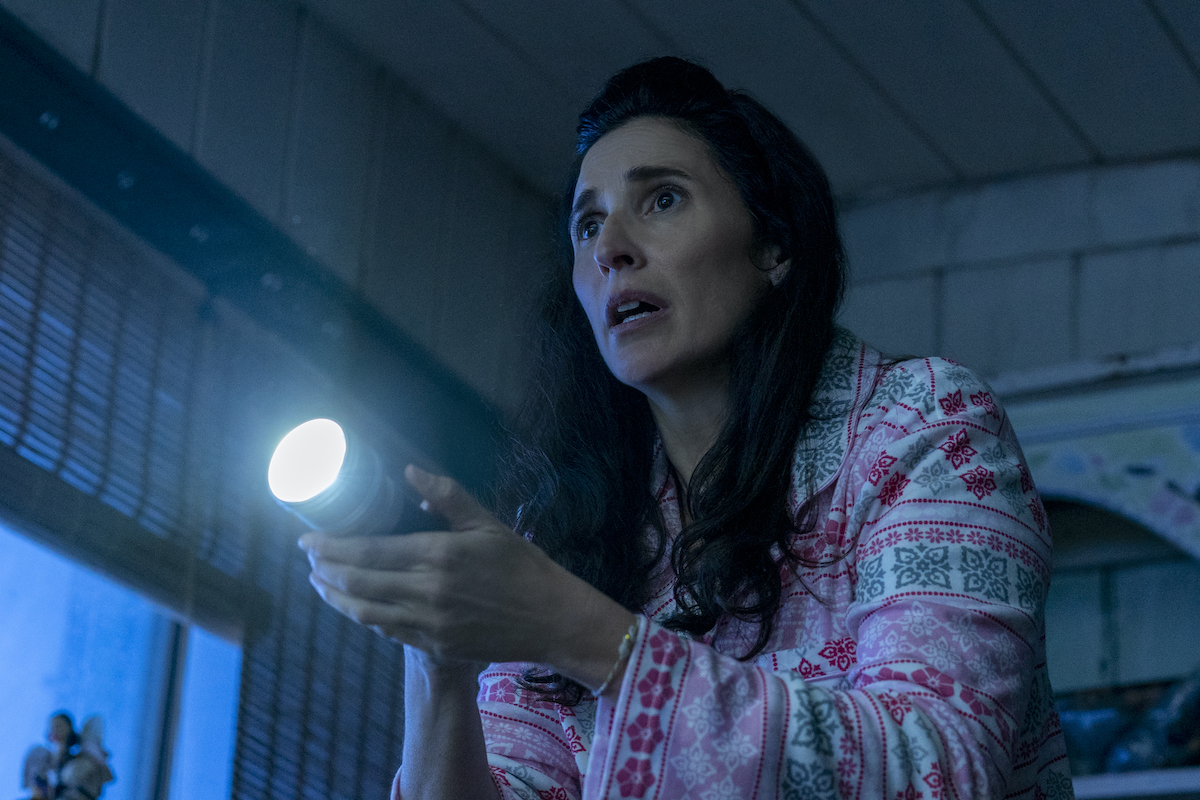
Director Ruben keeps the dialogue exchanges snappy, makes the attacks lightning quick, and plays around with comically quick entrances and exits. But “quick” doesn’t lead to “brisk,” in this comedy’s case. The pacing is off.
There’s zero urgency in their dilemma. Richardson’s ranger isn’t just slow on the uptake, he’s slow reacting.
A few lines score — “What IS this? Dumbass Island?” “Oh don’t tell me we’ve got a Mexican standoff!” “Baby, don’t say ‘MEXICAN.’ Just ‘standoff!“
But too many don’t. And as it turns out, the most potent line could be trotted out as the best possible review for this near miss. Which I will…trot out.
“I feel like I’m at one of those dinner theater murder things. I’m having a horrible time and I can’t go home.”
MPA Rating: R for some bloody violence, sexual references and language throughout
Cast: Sam Richardson, Milana Vayntrub, George Basil, Catherine Curtin, Cheyenne Jackson, Michael Chernus, Harvey Guillén, Wayne Duvall and Michaela Watkins.
Credits: Directed by Josh Ruben, script by Mishna Wolff. An IFC Midnight release.
Running time: 1:36
A24 got a star to give us all a quick primer on the Medieval poem that inspired “The Green Knight,” which is now a major motion picture coming our way in a month.
There’s a competence that borders on professionalism in some of the settings, camera placement and whatnot in “Bad Detectives,” a murder mystery that started life as “Year of the Detectives.”
That was to be a play on Chinese zodiac year animal labels, which is about as sophisticated and/or clever as this stiff gets.
Miscast and weighed down with amateurish performances, laughably illogical and inept screenplay, a “mystery” only in its publicist’s delusions, this is the surest way to make your life 72 minutes shorter with nothing to show for it.
Freya Tingley and Dralla Aierken play two former friends, granddaughters of LA private eyes who died in a mysterious double tumble off the roof of the building they co-owned and which housed their agency. Two granddad detectives on a roof in the dark.
The script doesn’t find a clever way to interest the granddaughters, Army vet Nic (Tingley) and “office job” Ping Liu (Aierken), in “finding out the truth.” They just are. They had a falling out sometime ago, and they both team up on this “case” and compete every chance they get, as if they were the same tweens they used to be.
Real estate in “hurried foreclosure,” an inscrutable Guanyin statue, a “shadow emperor” running things in the old neighborhood, an “I’m sorry it had to end like this” here, a “Break it and I break you” threat there.
The leads have no chemistry, fail utterly to animate their lines in any way that doesn’t like like a “bot,” play dress-up once and are still slightly less embarrassing than some (not all) of the supporting cast.
This wasn’t worth releasing, but here it is.

MPA Rating: unrated, violence, profanity
Cast: Freya Tingley, Dralla Aierken, Stephen A. Chang, Jim Meskimen, Ping Wu and Paul Rae
Credits: Directed by Presley Paras, script by Chris Johnson. A Mutiny release.
Running time: 1:12
The GI Joe character origin story opens July 23. Lukewarm on the franchise, but anything with samurai swords…


Writer-director Michihito Fujii puts the “sag” back in “saga” with his soapy, melodramatic mob movie “A Family,” originally-titled “Yakuza and the Family.”
It has plenty of the sorts of characters and plot elements you expect when you hear a film described as a Yakuza movie. Lots of Japanese mobsters, laughing too loud, bellowing threats even louder — whole torso tattoos, knives and clubs and the occasional firearm wielded without pity, turf wars with bloody violence, “old men” being told “Your time is finished.”
These are tropes of mob movies, from Sicily to the Jersey Shore, Odessa to Little Odessa to Osaka.
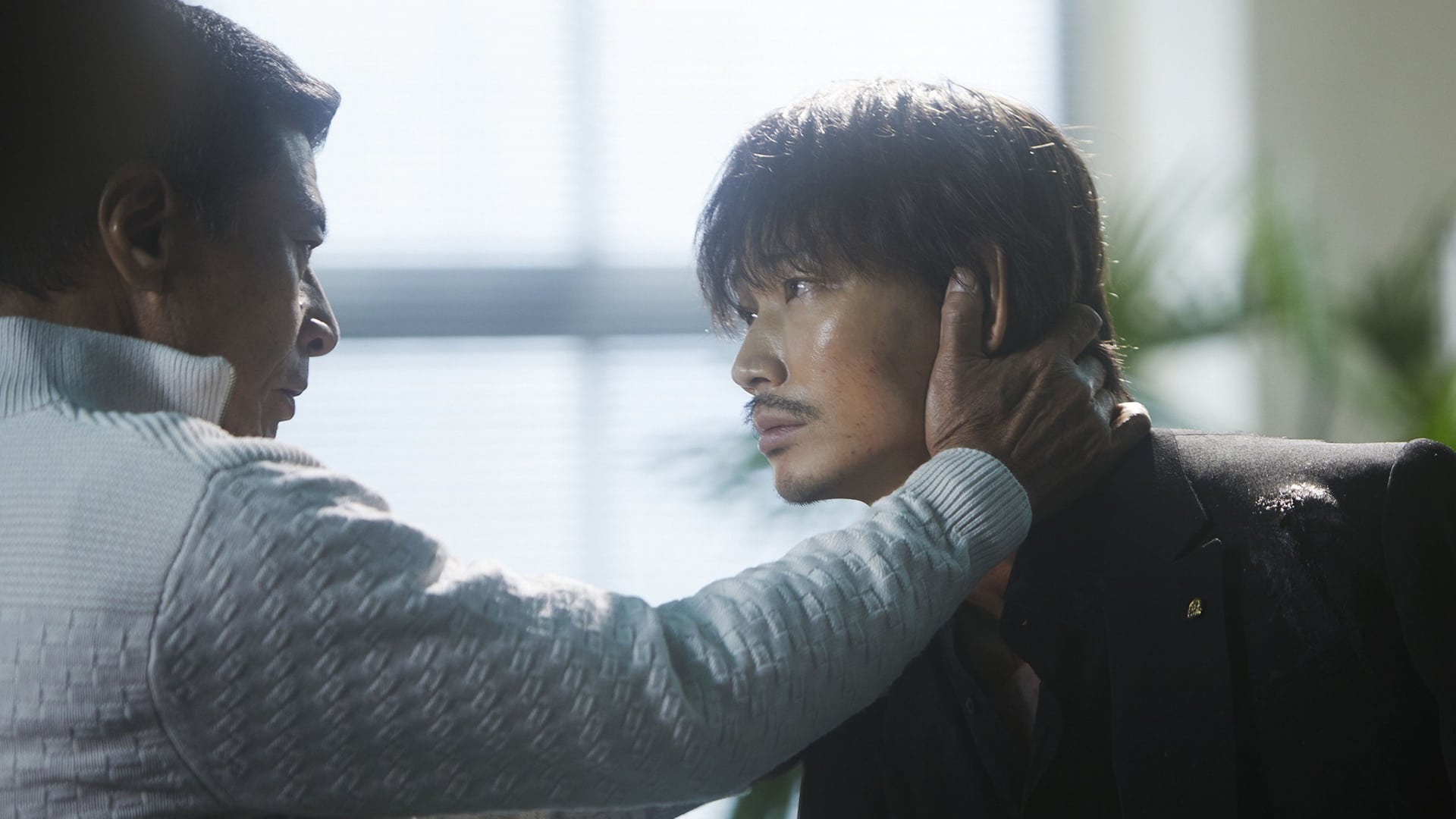
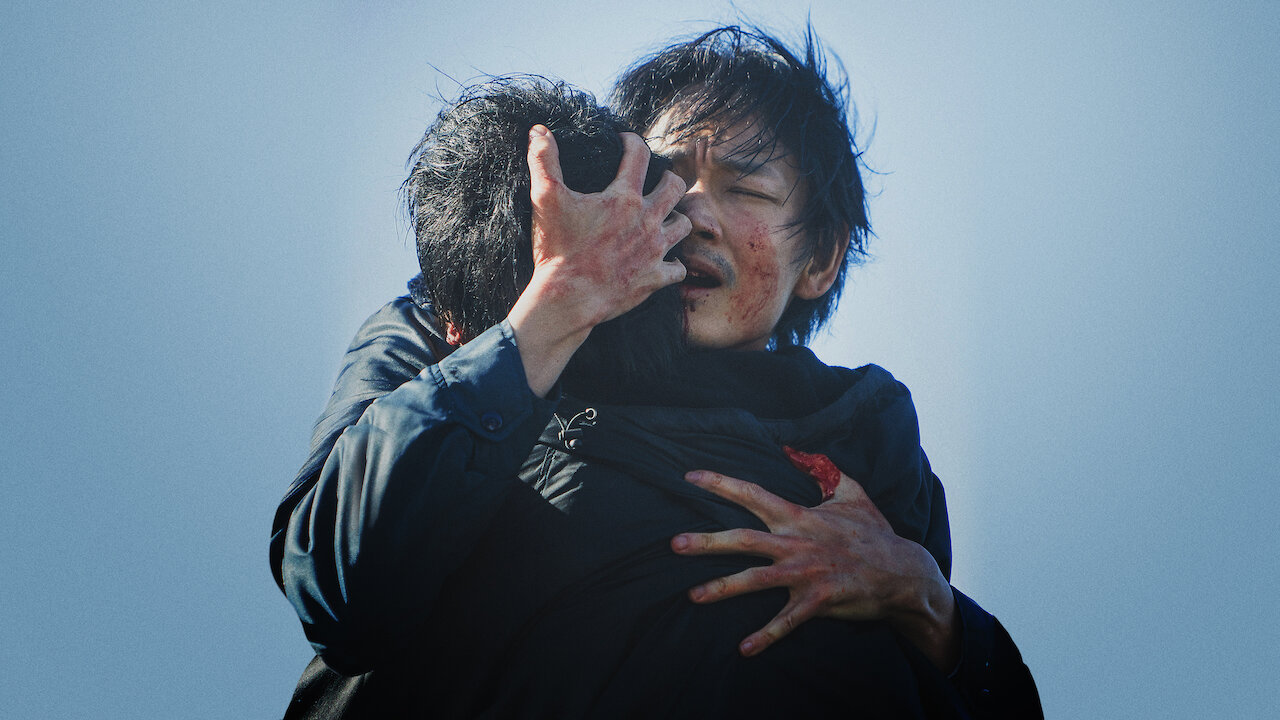
But here, they’re mostly in the first act. “A Family” then takes a shot at showing the trap of “the life,” the price of this loyalty you give to someone, a boss, who may or may not be a blood relative. The picture has little momentum even as its forward motion takes us through the rise and fall of a young gangster, born into “the business” even if he wasn’t born into this particular family.
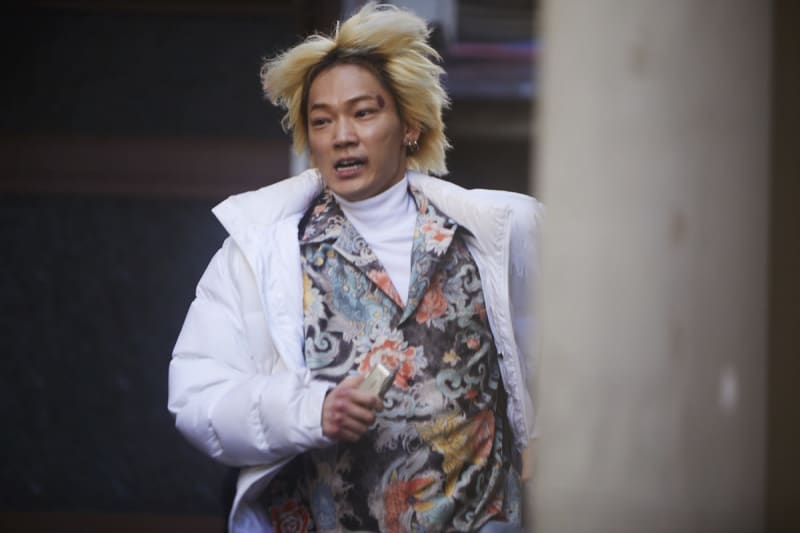
Gô Ayano is “Lil Ken,” Kenji Yamamoto, and we meet him after his father’s death. “Lil Ken” is his most flattering nickname. “Yamamoto’s brat” is another.
He’s a blond mop-topped motor-scooter punk when we meet him in 1999, a fashion statement in white jeans, shirt and North Face jacket. He’s got boys he runs around with, but the mob life isn’t for him, rejecting his father’s business, as it were.
An impulse robbery of a low-level drug dealer changes that. A moment of bravado, interrupting a hit on mob boss Shibasaki (veteran character actor Hirosihi Tachi, who was Admiral Yamamoto in “The Great War of Archimedes”), cements that change.
When the rival Kyoyo-tai clan takes out him and his boys for stealing their drugs, covering Lil Ken and his all-white ensemble in his own blood, a business card from Shibasaki is what saves his life.
“A Family” follows Lil Ken from his “drink from the family cup” initiation, into mob intrigues some years later and finally takes us to 2019, where he’s now an ex-con, trying to rejoin a society that won’t let yakuza have legit jobs, rent apartments or sign up for bank accounts.
There’s a woman, a “hostess girl” (Machiko Ono) from one of the gang’s clubs, and a relationship that starts with bullying and somehow softens into 20 Questions — “Why do yakuza wear sunglasses at night?”
And there’s a kid, warned as a toddler so that he won’t “turn out like us,” but who (Hayato Isomura) pops back into Lil Ken’s life like a 2019 version of himself (Tommy jacket instead of NorthFace).
The acting is quite good, with Ayano (of “The Promised Land” and the recent “Humunculous”) a charismatic lead. The mob brawls and chases early on are visceral enough to pull you in.
But Ono lets the air out of the balloon of even the action sequences entirely too quickly. The “family” material is less interesting, the “relationship” perfunctory and even acts of vengeance seem rushed so that we can get back to the boring stuff.
Which unfortunately eats up most of the 136 minute run time of “A Family.”
MPA Rating: TV-MA, graphic violence, sex, nudity, smoking
Cast: Gô Ayano, Hiroshi Tachi, Machiko Ono, Yukiya Kitamura and Kosuke Toyohara
Credits: Scripted and directed by Michihito Fujii. A Netflix release.
Running time: 2:16

 Movie Nation