
High tech horror from beyond the grave, August 20.
High tech horror from beyond the grave, August 20.
Stunts and pranks and injuries for laughs return October 22.
Paramount uhhhh, raises the bar?
The Police, Stevie Wonder, Elton John, Earth, Wind and Fire, The Stones, Dire Straits and Jimmy Buffett singing “I don’t know where I’m a gonna go when the Volcano blow” are among those who made music in Beatles Svengali George Martin’s Montserrat Air Studio, before the volcano blew and buried it all.
This August 17 release looks intriguing, from a rock history standpoint.
Zazie Beetz, Benedict Wong, Tony Hale, Arianna Ortiz and Bill Skarsgaard are among the stars of this provocative, atmospheric fantasy.
This one opens July 30.

The other night I was channel surfing and stumbled across a Chinese-made World War II film from 2018. “Air Strike” was a Sino-Japanese War thriller about daring Chinese aviators battling the aerial hordes of Japanese bombers that laid waste to China’s cities for a couple of years before The Flying Tigers and Pearl Harbor brought allies to China’s aid, and changed the focus of combat to the South Pacific (mostly).
It’s a terrible movie, ahistorical and unexciting, with token high-priced American talent such as Bruce Willis and Oscar winner Adrien Brody (The “New” Nicolas Cage?) in supporting roles.
The worst thing about “Air Strike” is the CGI air to air combat, animated air raids and dog fights. We first started to see this “make an aviation movie cheaper” with Scorsese’s “The Aviator,” with the cut-rate WWI Lafayette Escadrille romance “Flyboys,” and the George Lucas-produced “Red Tails.”
After “Midway,” I got the feeling that the digital animation was getting better, more convincing. Not in “Air Strike.” “Cheesy” doesn’t do cheese justice.
But such abortive efforts inevitably increase my respect for the films that used real period aircraft, or slightly-safer modernized (better engines) replicas and real stunt pilots. These reached a kind of zenith in the ’60s, when fast photo-helicopters and sophisticated filmmaking made the aviation part of war films such as “The Blue Max” and “Aces High” (WWI) and “The Battle of Britain” vivid and convincing.
The most impressive of all, in that regard, has to be the 1965 “all star cast” comedy “Those Magnificent Men in Their Flying Machines.” It might have been the “best picture” pic of the New York Film Critics Circle back then (Judas Priest!), and considered one of the “500 best screen comedies” by some entity or another, but the “comedy” part of it seems to have faded with the intervening decades.
It’s not very funny.
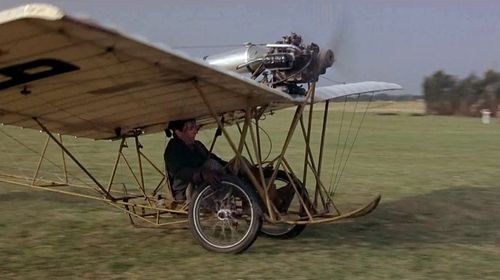
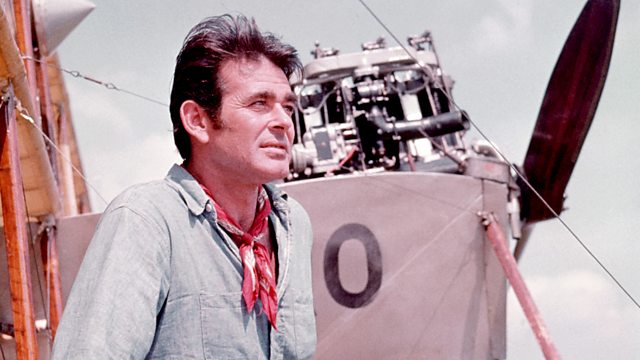
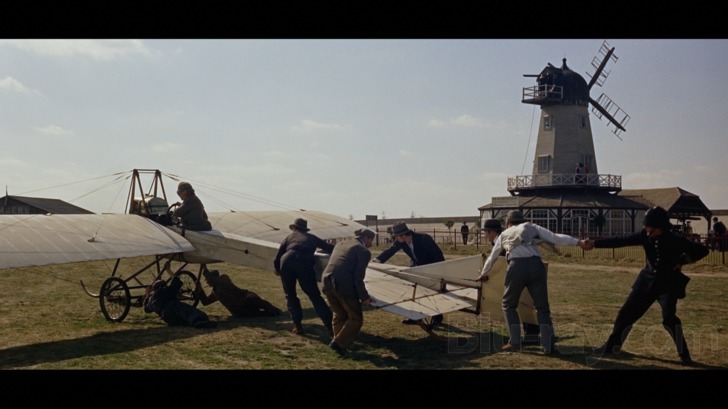
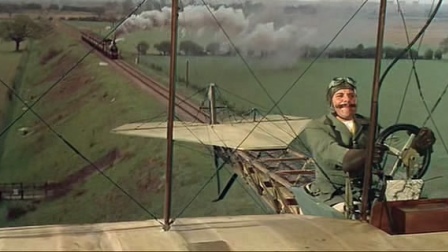
But the aircraft — a couple of vintage ones, and a lot of recreated versions of aircraft actually flying in 1910 — grow more impressive by the year.
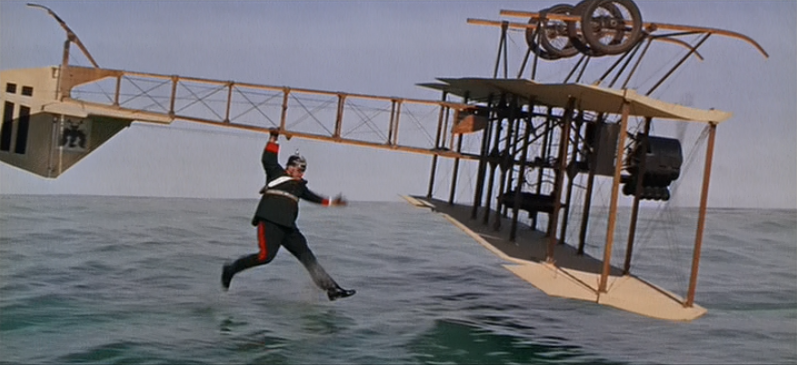
Here is a version (top left) of the Alberto Santos Dumont “Demoiselle,” the most famous monoplane of the era, here flown by the French entrant (Jean-Pierre Cassel) in the movie’s London to Paris air race.
There is the Roe IV British triplane, the vehicle the villain (Terry-Thomas, blast him, lower left) flies. There’s a Wright Flyer (Stuart Whitman‘s Arizona barn-stormer flies this) and a Bristol Boxkite and Blackburn “Type D” (Gordon Jackson‘s Scots pilot’s “kite”), and a Philips Multiplane, Passat Ornithopter, Lee-Richards Annular Biplane, Vickers 22 Monoplane, an Avro, a Dixon Nipper, and an Eardley Billing Tractor biplane (upside down with the Very German Gert Fröbe (his stunt double) dangling from it.
They spent the money to rent a couple of survivor planes and built 18 replicas, repowered with Rolls Royce engines (most of them) and actually had pilots fly the darned things. Some of those planes, authentic and replicas, still fly today.
And even though there are process shots and tricks to put stars at the stick, or crowd the screen with planes (in a couple of cases), it’s still amazing to see almost 60 years after “Those Magnificent Men” were filmed.
The plot — a jingoistic British newspaper publisher (Robert Morley) stages a race from London to Paris (with one stopover) as a stunt and a means of gathering global aviators and all the different types of aeroplanes then in the air — is perfunctory.
The characters are stock “foreign” types — the Italian (Alberto Sordi) whose wife looks like Sophia Loren (and dresses like her) and their large Italian brood, the lascivious Frenchman (Cassel, later of “The Discrete Charm of the Bourgeoisie”) who flirts with a succession of identical women from different countries, the (dubbed) Japanese pilot (Yûjirô Ishihara) who is more English than the English, the harrumphing German (Fröbe, aka “Auric Goldfinger”), the broke American “cowboy” (Whitman) and the prim, proper English officer, played by James Fox almost 20 years before he took “A Passage to India.”
Some of the slapstick still works, most of it playing around the airfield’s “sewage pond” crash zone and with those stock European “types.” But there’s little amusing in the airplane crazy publisher’s daughter (Sarah Miles) pursued by the American and her British fiance or in Benny Hill’s aerodrome firefighter.
That gap-toothed bounder Terry-Thomas remains a walking, bug-eyed sight gag all these decades later. But he has to be. There’s little funny for him to do. Just another posh toff picking on the hired help, one among many in his long career.
I gave up looking for what amused me as a kid and found myself marveling over how this sort of propeller or that style of airframe ever got off the ground. But they did, and this relic of a comedy provides magnificent proof of that, and the nerve it took to try and fly them, then or now.
It’s worth seeing today as a means of shaming any filmmaker who doesn’t ride her or his CGI animators harder to get more convincing footage, flying scenes that look like the real thing, as seen in “Those Magnificent Men in Their Flying Machines.”

Cast: Stuart Whitman, Sarah Miles, Gert Fröbe, James Fox, Alberto Sordi, Karl Michael Vogler, Jean-Pierre Cassel, Sam Wanamaker, Benny Hill, Yûjirô Ishihara, Robert Morley and Terry-Thomas.
Credits: Directed by Ken Annakin, script by Jack Davies and Ken Annakin. A 20th Century Fox release.
Running time: 2:18
There’s probably an “overcoming every obstacle” story behind the five credited directors and six credited writers who made “Deep” in their native Thailand during the COVID pandemic.
And whatever it was — maintaining “protocols,” filming during lockdown, filmmakers getting sick and being replaced — it’s almost certainly more interesting than what they managed to get on the screen.
Glib summary — it’s a tepid Thai “Flatliners.” Good looking young medical students get wrapped up in a deadly experiment not wholly unrelated to their studies. Take a collection of “types” — a med student drowning in debt, a cute online “influencer,” a video game nerd, a grinning son secretly grieving his dead mother — and take away their sleep. That’s the premise.
“Deep” winds up a somewhat lifeless enterprise that manages a suspenseful moment or two almost in spite of itself.
Jane (Panisara Rikulsurakan) and sister June (Warisara Jitpreedasakul) are sibling rivals, living with their grandmother and behind on her mortgage. Jane is badgered about “not quitting” her studies by her closest professor (Dujdao Vadhanapakorn).
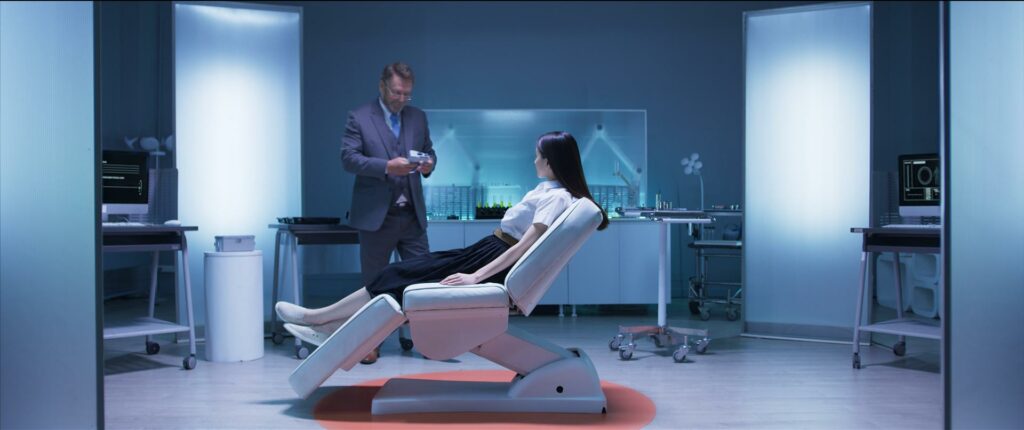
That’s how she becomes a well-paid test subject for this German researcher (Kim Waddoup) who is digging into the chemistry of what makes us sleep, and what might prevent us from staying up forever. This “Qratonin” bears looking into, extracting and maybe synthesizing.
For a lot of money, Jane agrees to have a chip implanted that will leech Qratonin out of her system. She’ll wear a monitoring watch, stay awake — something she’s used to doing — and when she hits “0 percent” of that stuff in her system, the chip will be removed.
This is how she meets others wearing the big black watch. Win (Kay Lertsittichai) is the always-smiling classmate who’s sweet on her, Cin (Supanaree Sutavijitvong) is a pageboy haircut influencer pixie, and Peach (Krit Jeerapattananuwong) is the socially-awkward gamenerd who all but stalks her.
They have the chips implanted in their necks, stark orders to not fall asleep (“Or your heart might stop.”) and starker orders to not talk about what they’re doing.
Which is exactly what they do. The compare notes, hang around and bond, “professional insomniacs” who become Team “Non Non,” a Thai-French mashup that means “No sleep.”
As they progress through the “levels” of sleep deprivation, hallucinations, paranoia and their various OCD manias, phobias and the like become major league problems.
As the movie has opened with a student standing on a balcony at Sirindara University, ready to jump to his death, we know the stakes. We stay with the film to see who will sleep and who will die.


The little bits of melodrama that play out as back story — sibling rivalry, demands on an influencer’s time and person, etc. — don’t do much to hold our interest.’
The story is as drab as the laughably simple names — June, Jane, Win, Cin and Peach? What is this, a first draft? And yes, Westerners can count the insane number of letters and syllables that make up real Thai names and exhale, “THANK you for shortening that.”
Little montages showing what the kids do with their newfound riches — bling and boob jobs are on the list — add nothing.
The fact that these are medical students could have raised the stakes beyond the personal, and beyond freaking out when dissecting cadavers. Secretive sleep-deprivation study gets patients killed because their young docs are dozing off mid-diagnosis would have been a promising line of attack.
But no, all these directors and all these screenwriters, and this is what they came up with.
“We stay up, and we stay alive!”

MPA Rating: TV-MA, violence, some profanity
Cast: Panisara Rikulsurakan, Supanaree Sutavijitvong, Kay Lertsittichai, Jeerapattananuwong, Dujdao Vadhanapakorn, Kim Waddoup and Warisara Jitpreedasakul
Credits: Directed by Sita Likitvanichkul, Jetarin Ratanaserikiat, Apirak Samudkidpisan, Thanabodee Uawithya and Adirek Wattaleela, scripted by Sita Likitvanichkul, Kittitat Nokngam, Jetarin Ratanaserikiat, Apirak Samudkidpisan, Wisit Sasanatieng and Thanabodee Uawithya . A Netflix release.
Running time: 1:41
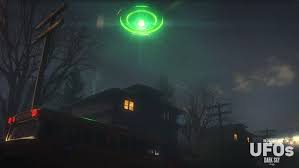
In his wry, goofy and prescient radio series “The Hitchhiker’s Guide to the Galaxy” — later turned into books, a TV series and a feature film — author Douglas Adams wrote of “Teasers.”
“‘Teasers’ are usually rich kids with nothing to do. They cruise around looking for planets which haven’t made interstellar contact yet and buzz them… They find some isolated spot with very few people around, then land right by some poor unsuspecting soul, who no one’s ever going to believe, and then strut up and down in front of ‘em wearing silly antennae on their head and making “beep, beep” noises. Rather childish really.”
If you take the UFO hunting documentary “On the Trail of UFOs: Dark Sky” the least bit seriously, think of it as a celebration of “teasers.” Because if there’s a corner of America that would make most people roll their eyes as a font for “the unexplained” and UFOs, it might be “wild, wonderful West Virginia.” If you’re an alien “rich kid” who wants to do flybys and landings and “visitations” in a place where few will take the eyewitnesses seriously, the Appalachian heartlands would have to be awfully attractive.
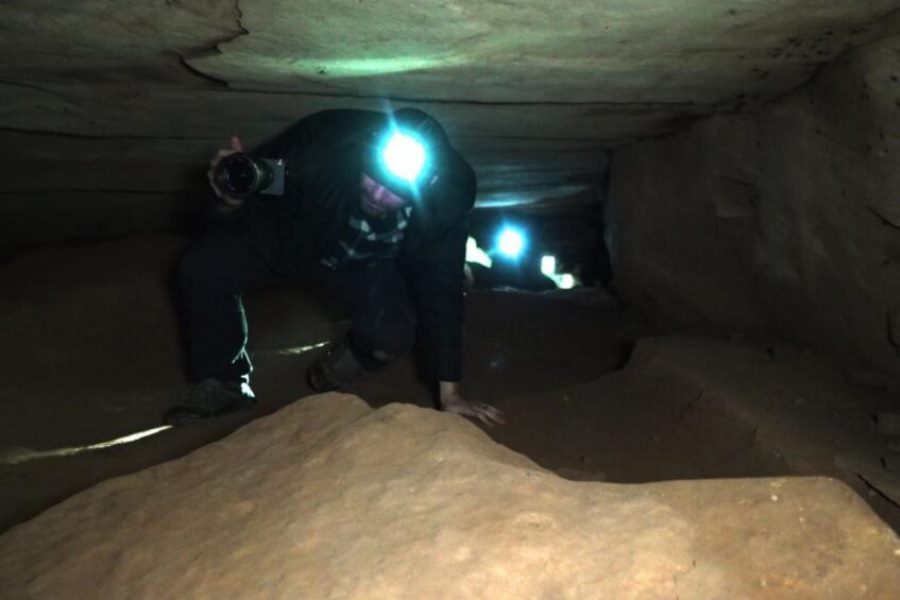
Ohio filmmaker Seth Breedlove, who’s made movies about Mothman, “The Flatwoods Monster” and a TV series with the same title, “On the Trail of UFOs” (Is this merely a re-editing of that?), and his Vegas-based hostess/star, Shannon Legro, trek all over West Virginia, “collecting stories,” cataloging the state’s colorful history with “the unexplained.”
The extremely credulous pair visit many folks who relate “episodes of high strangeness” — often from their own youth. More often they speak with other local “collectors” of stories relating this or that second or third or fourth-hand tale, some covered by local newspapers in the 1950s and ’60s.
The eyewitnesses are generally straightforward, if relying on very old memories of something they saw and didn’t understand at this or that time. The local “experts” are a more breathless lot, pondering “lights in the sky” through the lens of conspiracies — “secret military bases” and connections to coal mines or chemical plants, and the arrival of the first “documented” encounter with “Men in Black,” perhaps a chap who called himself “Indrid Cold” who might have been trying to get witnesses to keep quiet about what they claimed they saw.
A funny sidebar. Lowell Cunningham, who created the comic book “Men in Black,” is also from Appalachia — Tennessee — and told me the story of how a friend introduced this urban legend to him while he was in college in Knoxville. Black SUVs near campus? “That’s what the ‘Men in Black’ would drive,” the friend told him. Odd to think of Will Smith and Tommy Lee Jones as Appalachian lore.
Funnier sidebar — Did Douglas Adams ever visit West Virginia? Is his “lying on my back in the Austrian Alps” staring at the sky “inspiration” for the radio series and all that it spawned a fib? Because a lot of what pops up in this documentary, the yarns spun by the gullible (“You wanna talk about a BOMBSHELL” to the credulous, has a familiar Adams ring to it.
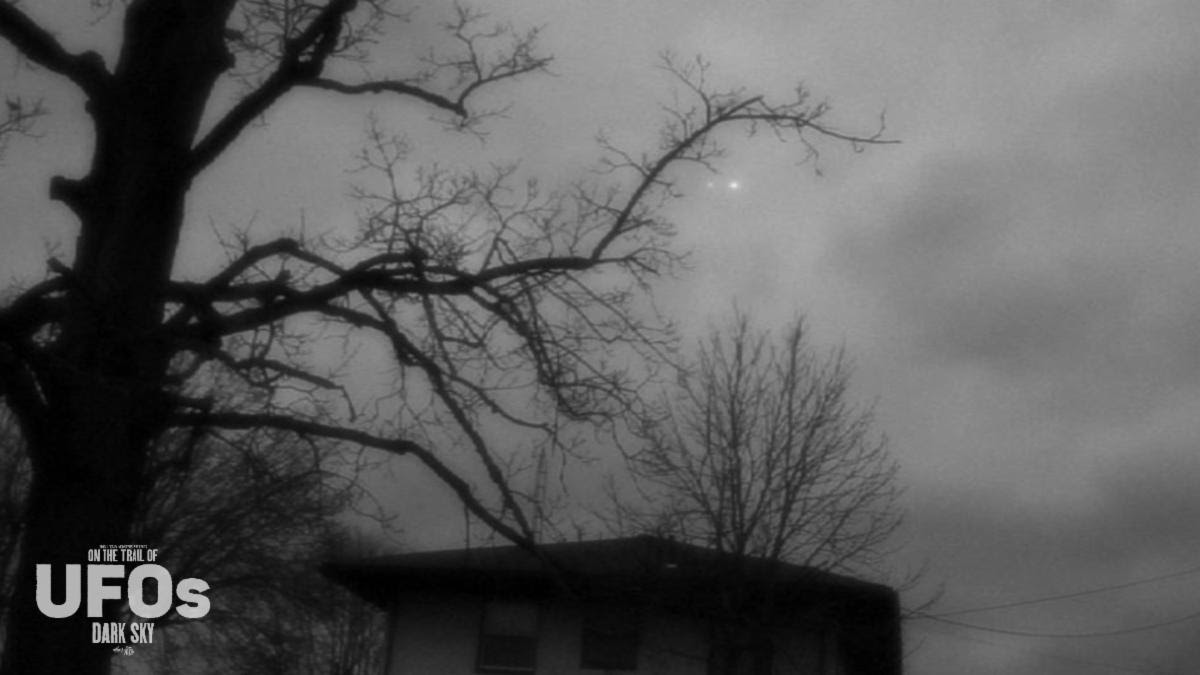
“Hollow Earth,” alien visitors in “haz-mat suits” before anybody knew what they were called, military secrets, “The Grafton Monster,” “The Green Monster,” “Bashful Billy,” Point Pleasant’s “Mothman,” “The Flatwoods Monster” and its associated museum, “On the Trail of UFOs” covers a lot of ground and even points its own camera at the dark sky with some fellow enthusiasts and gets images that will convince…nobody.
The most credible material here might be the samples of 1950s “flying saucer mania” movies, connecting all this to Atomic Age zeitgeist in perhaps the most paranoid corner of a pretty paranoid country.
The most interesting interviewee is the late West Virginia folklorist, storyteller and paranormal buff Susan Sheppard, who relates the lore matter-of-factly, noting how “stories are told and retold” in that part of the world, where population density is thin, economic and educational opportunities are more limited but yarn spinning is an Irish and Scotch-Irish birthright.
With the military adding to the chorus of “There’s something out there,” documentaries like this are flying out of the editing (or re-editing) bays of anyone who has “collected” stories the way these two have. Breedlove and his star, with her sing-songy, new-to-this-practice narration and deadpan softball questioning of this or that witness, aren’t the most polished to uncap a lens on this subject. Not by a long shot.
But that’s almost an asset. If you’re saying, on camera, “I’ve finally seen something that I can’t identify,” that kind of hype, after swallowing every under-sourced story fed you for the first hour of “On the Trail of UFOs,” has its own naive charm. The poor dear.
Because these folks, in front of and behind the camera, are why “teasers” haven’t touched down at JPL, MIT or Cheyenne Mountain. Not yet, anyway.

MPA Rating: unrated, profanity
Cast: Shannon Legro, Seth Breedlove, Susan Sheppard, many others
Credits: Directed by Seth Breedlove. A 1091 release.
Running time: 1:25
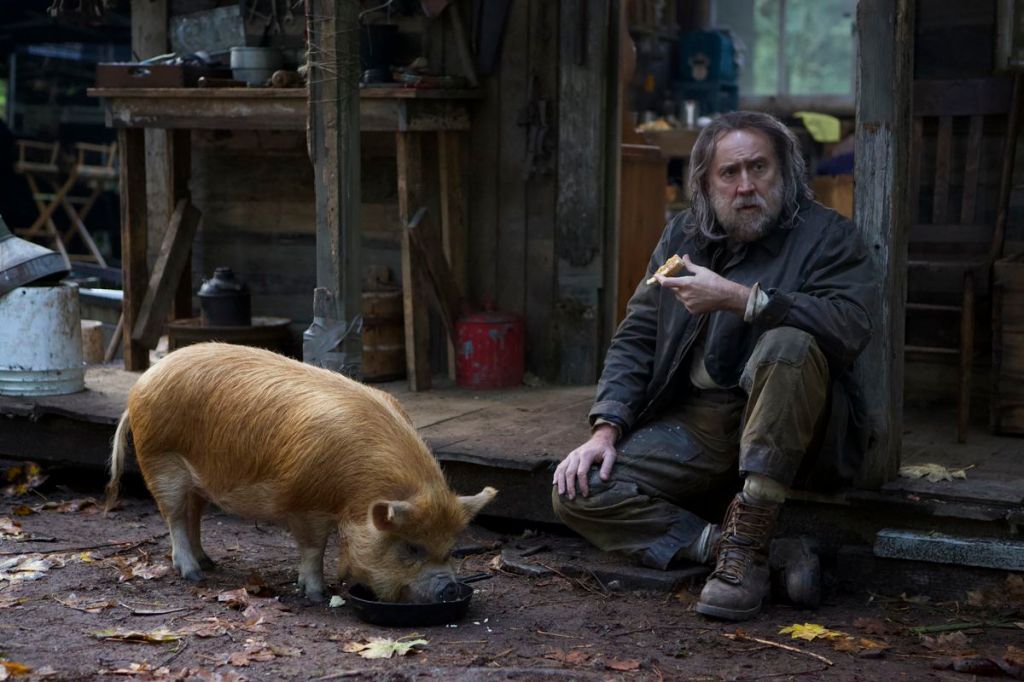
Submitted for your approval — one loner, a hermit of the Pacific Northwest who spends his days and nights with an unnamed “Pig,” with whom he hunts truffles for sale to the swanky eateries of Portlandia.
He and the pig are America’s “Truffle Hunters,” and the hermit’s devotion to the prize porker/sniffer rivals that of the men who love the dogs who do the fungi sniffing in the European forests in that documentary.
Like the French dog owners of the hit documentary, Oregon’s “Robin” (Nicolas Cage) doesn’t take it well when his “Pig”is stolen.
But there’s another connection which the savvy viewer will pick up on in this film. Why did the filmmaker cast Adam Arkin, son of Oscar winner Alan Arkin, as the rich gourmand who has designs, perhaps, on cornering the market for truffles through nefarious means?


Well, perhaps that filmmaker saw Arkin’s glorious comic turn in the ’80s TV comedy “Northern Exposure.” Who was “Adam,” in that quirky series?
He was a hermit, a phantom of the forests near Cicely, Alaska. He had a bad temper and a desire to disconnect from the Human Race.
Adam was a walking, talking, erudite clear and present danger, a threat owing to his “CIA” ties. He could kill a man with a spoon.
Why a spoon? Because erudite misanthrope Adam had ties to the “other CIA,” too — the Culinary Institute of America- America’s premiere cooking school.
“Pig” is basically a soulful revisiting of Adam and his quixotic quest to be left alone and cook gourmet food and become a “legend of the forest” who was once a legend at CIA — the cooking school.
Virtually everybody reviewing “Pig” has pointed out the “John Wick with a Pig” expectations the movie lures you in with, only to upend those as Robin turns out to be both menacing and zen in his serenity, Messianic in his willingness to suffer and his simple devotion to a beloved companion.
“Adam,” on the other hand, would have been a great candidate to “Go John Wick” on those who stole his pig. His threats would have been palpable and oh so colorful. He’d have dispatched many a pignapper, probably using just a spoon.
Saving that for the sequel?

How mad are you allowed to get at a schizophrenic?
That’s the premise driving “Broken Diamonds,” a dramedy that may start “crazy cute,” but which doesn’t back away from the ugly truths about mental illness.
“Your sister didn’t ruin your life, her illness did,” a therapist lectures Scott Weaver (Ben Platt of the “Pitch Perfect” movies).
“Same thing.”
We meet Scott at his going away party at the restaurant where he’s quit his job. He’s packed his place, has a “For Sale” sign in his Mazda and makes daily calls trying to locate where his long-ago-ordered passport is.
He’s moving to Paris, he tells everyone. He’s going to be a writer.
That’s when he gets a call. His father’s died, Dad’s second wife tells him.
“Pick up your sister on the way.”
He does. But Cindy (Lola Kirke of “American Woman,” “Mozart in the Jungle” and “American Made”) won’t get out of the car, won’t look upon the corpse or talk to Dad’s widow (Yvette Nicole Brown).
Scott collects a few effects, takes the deed to the house he and his sister inherited and drops his older sister off at the mental hospital that’s been her home for a pretty long time.
Cindy’s bubbly, a tad manic and full of ideas about having Dad’s ashes “turned into a diamond,” totally a thing. “If I gave it to you, would you pawn me?”
Scott? He’s focused on getting out the door and out of the country. Naturally, that’s when he gets the second call. His sister’s “issues” at her hospital have gotten out of hand. She’s evicted. There’s another place that will have room for her…in two weeks.
Before he’s gotten her home she’s thoughtlessly damaged the car he’s desperate to sell. Before he can get a bead on getting a quick sale of their father’s house, she’s set his apartment on fire, torching the passport she just signed for on delivery. He finds her staring at the lamp she’s ignited.
“Did you not know if this was real?”
Counting the pills in her various prescriptions, he may get the answer he doesn’t want.
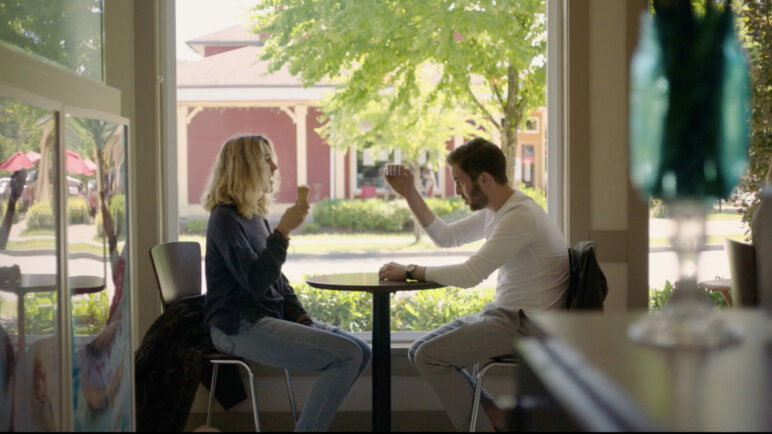
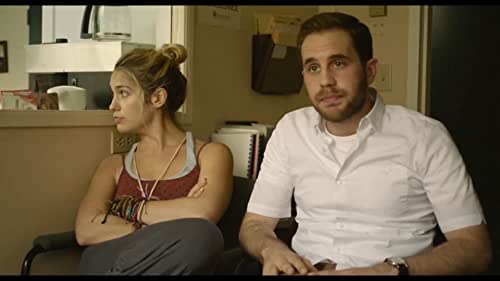
Kirke plays Cindy as mercurial and cute — but a walking collection of triggers whose delusions include going to the party of a high school friend (Debs Howard) who became an actress, to “finding a job” to live independently — to living independently.
Scott, “guilt tripped” by her therapist (Catherine Lough Haggquist) indulges her, but Cindy can’t fake sanity long enough to get through a job interview.
“I can’t stay here, no no no no no no…”
Irrationality is the rule.
Most of our sympathies are directed at Scott, with flashbacks showing just a hint of the horror Cindy experienced, and of growing up in a house where one child has taken ill and sucked up all the stability and happiness as she did. But Scott’s either developed a martyr complex or simply decided he deserves to run away, and Platt makes these diagnoses understandable, defensible and still not very attractive.
There’s an honesty to Steve Waverly’s script that makes its light moments irritating, its darker ones heartbreaking. A soulful, broken-hearted soundtrack (songs by Julia-Jean Baptiste, Strong Asian Mothers, Nathan Reich and Mia Dyson) underscores the sadness of it all, a life lost, lives around it shattered.
We immerse ourselves in the story and hope for the best even as we expect the worst. All we really know by the end is what Scott’s journey is designed to teach him. He’s allowed to get mad at Cindy. He just has to get over such furies quickly and realize it’s the illness he hates.

MPA Rating: PG-13 for thematic elements and a crude gesture
Cast: Ben Platt, Lola Kirke, Debs Howard, Yvette Nicole Brown
Credits: Directed by Peter Sattler, script by Steve Waverly. A FilmRise release.
Running time: 1:30
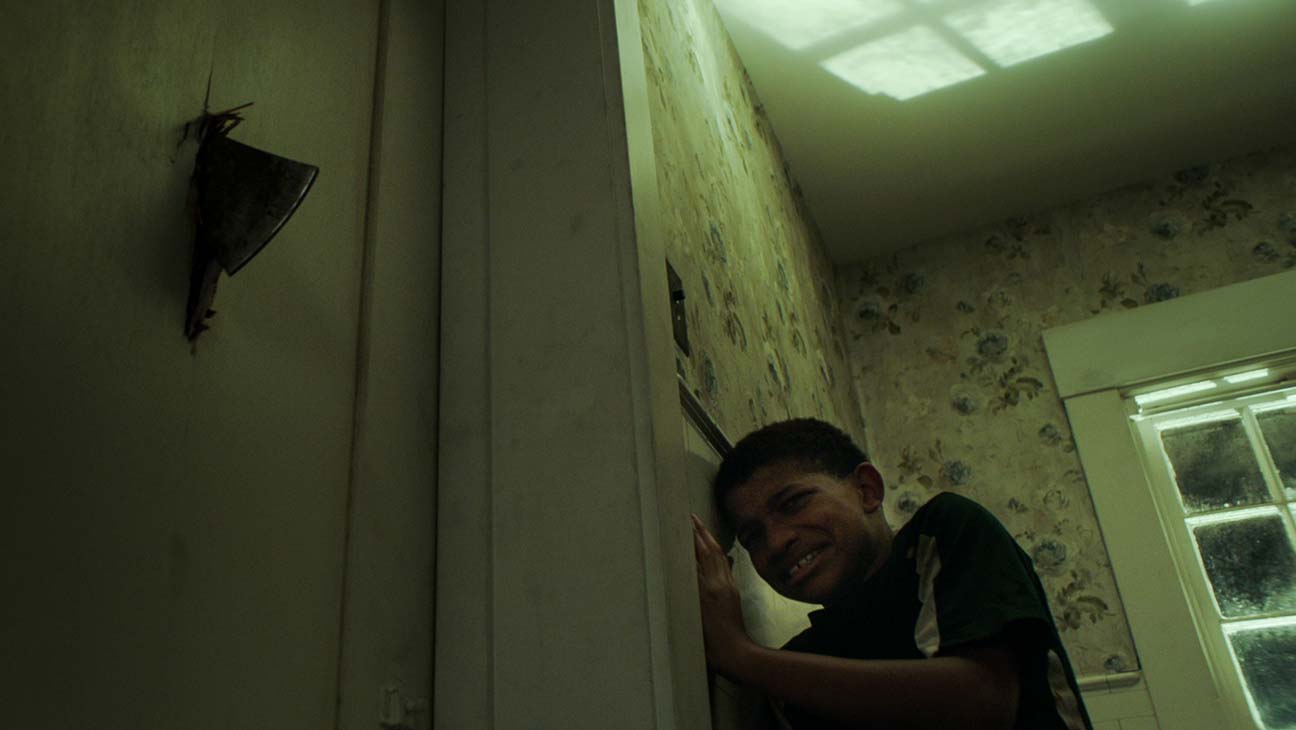
“The Boy Behind the Door” is a lean, reasonably tight B-movie thriller about two kidnapped Little Leaguers and how they respond to their plight.
It’s sentimental yet nervy, kind of predictable and a tad slow-footed. But it gets to you in all the right ways and in all the right places.
Bobby (Lonnie Chavis) and Kevin (Ezra Dewey) are best buds, “friends till the end” they promise, who long to escape their corner of South Dakota.
Instead, they’re clubbed unconscious and kidnapped on their way to Little League. Kevin is yanked out of the car trunk, screaming and crying. Bobby is locked-in and left behind. Which gives him time to weep and scream and then reason and kick his way out.
But making his escape, his conscience and the sound of Kevin’s cries drag him back. He will slip into the house and free his friend, come what may. His first communication with his shackled pal has good news and bad. Their tormenter “is gone.”
“What about the OTHER one?”
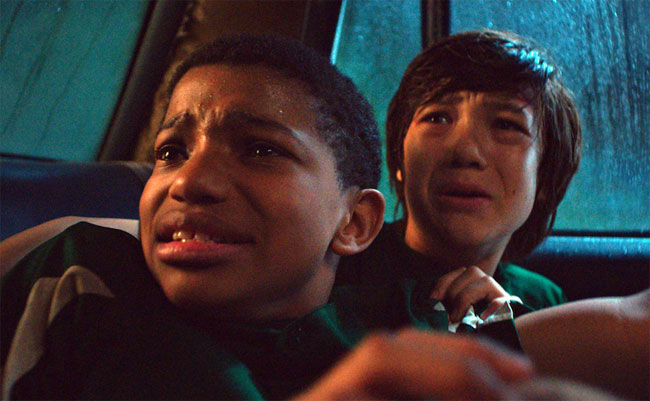
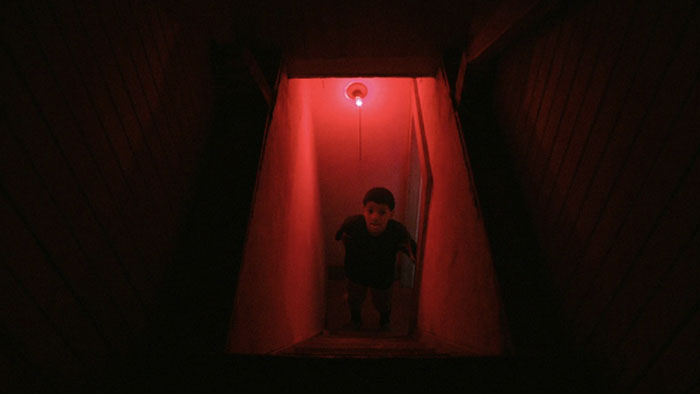
Movies like this are filmmaker and film character problem-solving exercises. The kidnapper dialogue may be banal and empty — “You don’t have to hide from me. I just wanna TALK.”
What matters is the possible solutions Bobby and Kevin see to their plight. Can I use this? What if I try that?
The stumbling blocks are stronger, murderous adults, the remoteness of their location, old fashioned locks, the mystery of “land lines” and manual transmission cars, and newfangled gadgets meant to entrap or disable.
The young players do a decent job of suggesting the terror their perilous situation makes them feel. The villains are villainous in some of the usual ways.
Co-writers/directors David Charbonier and Justin Powell may slow-walk some of the between-fights action. Victims are always getting the drop on their tormentors and leaving the job unfinished, leaving a weapon behind, not getting out when the getting’s good.
But that’s part of the fun.
MPA Rating: unrated, graphic violence
Cast: Lonnie Chavis, Ezra Dewey
Credits: Scripted and directed by David Charbonier and Justin Powell. A Shudder release.
Running time: 1:28

 Movie Nation