“Munich: The Edge of War” is a moderately suspenseful piece of historical revisionism, a thriller that dangles an intriguing “What if” in its fresh take on the shameful Munich Agreement, which delayed but did not prevent World War II.
Handsomely-mounted and well-acted, never quite lapsing into melodrama if never quite breaking from formula, it’s too narrow in focus and too shallow a gloss on the subject to placate historians. But it’s worth taking in just for its novel views of Neville Chamberlain and Adolf Hitler and the accord that became historical shorthand for “appeasement.”
The story begins, as any tale of World War and Cold War intrigues must, at Oxford in the early ’30s, and climaxes at the actual Munich conference, where Britain and France signed over a corner of Czechoslovakia to forestall a threatened German invasion in 1938.
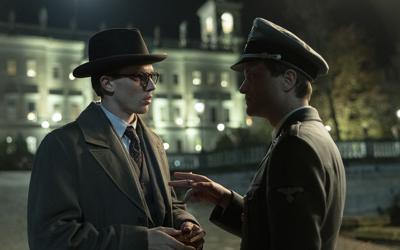
George MacKay (“1917”) is Hugh Legat, who graduates from Oxford to join the foreign service and become one of the private secretaries of Conservative Prime Minister Neville Chamberlain, given gravitas, wariness and a much deeper voice by casting Jeremy Irons in the role.
Jannis Niewöhner (“Je Suis Karl”) is Paul von Hartmann, the idealistic classmate who drunkenly extolls the promise of “The New Germany” in 1932, but who finds himself alarmed enough to have joined “deep state” resisters to “this madman” by 1938, He works as a translator in the foreign ministry, someone a bit over-awed when he finally meets Hitler (Ulrich Matthes) in the crisis leading up to the conference.
Legat has worn the “distant” label von Hartmann gave him at university, which puts his marriage (Jessica Brown Findlay) on thin ice long before he gets the “one’s family has to take a back seat” lecture from his Foreign Office boss as the crisis begins.
Von Hartmann’s idealism has been replaced by vain “hope” and promises that the German Army will intervene if Hitler pushes them into war just 20 years after the last one ruined Germany. “Hope,” von Hartmann now believes, is futile, this notion that “somebody (else) will do something” to prevent a catastrophe.
It’s a remark that stings today, magnified by the historical distance, resonant in other crises. It’s more seriously addressed here than in the glib “The King’s Man,” this idea that history might be changed and this or that ideal or state can be saved by one rash act, an assassination when all the “debates” and political maneuvering has failed. “Munich” reminds us that changing history like that takes more than desperation and “wishing someone” would do it, and that when the chips are down, few are capable of it.
A “falling out” between the two college friends must be ignored as back-channel word travels to Hugh that Paul might be reaching out with some information that could sway Chamberlain into acting differently. If only both of them can get to Munich.
The tropes of such “What if” tales, indeed of espionage movies in general, are clearly spelled out in the Robert Harris novel this is based on. German director Chrisian Schwochow (“Je Suis Karl”) and screenwriter Ben Power (TV’s “The Hollow Crown”) don’t avoid them, but make them land lightly enough.
The leads are quite good, even if their characters are thinly-developed and the big moments of suspense and action few and far between.
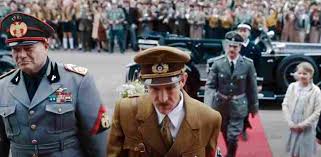
What’s fascinating to anyone casually acquainted with this era and this particular event is how the principal figures in it are portrayed. “Downfall” veteran Matthes makes his Hitler a precursor to the “final days” Hitler Bruno Ganz gave us in that landmark film. There’s a hint of paranoia, a seething distrust of “educated” members of the German gentry like von Hartmann. But the politician is very much in evidence in this Hitler, a sober valuing of any new face that might give him something beyond the moronic “yes men” he has surrounded himself with.
He is dangerous, sinister even in revealing what we’d call today his “superpower” — “I read people” (these passages are in German with English subtitles). Hitler can’t decide if he wants to frighten or charm von Hartmann, and he’s obsessed with how his actions play in the press, at home or abroad.
Irons’ Chamberlain is fixated on public opinion, a man “too old to have fought” in the Great War, confiding every now and then with Legat, who was “too young” to have served. Chamberlain’s narrow focus — preventing a repeat of the mass slaughter of just 20 years before — seems rational and understandable. History has shifted from the simplistic “appeasement” label for the give-away Chamberlain signed at Munich, with the phrase “he bought us time” to prepare for the coming conflagration.
“The Edge of War” bends over backwards even further, making Chamberlain aware of how history will treat him, aware that he is “playing poker with a gangster.”
“As long as war has not begun, there is hope that it may be prevented!”
All that’s interesting enough to the armchair historian. But the stumbling block of many a “What if” story from World War II is easily evident in “The Edge of War.” For all the talk of the inevitable worst case scenario, the stakes feel awfully low. The narrow focus mean we see the graffiti on storefronts and humiliations and “Emigrate to Jerusalem” taunts aimed at Germany’s Jews.
Just a scene or two suggest the alarm in Britain about the consequences of failed talks — barrage balloons inflating to rise over London, gas mask public service announcements painted onto sidewalks, Hugh’s little boy trying his on as his wife resists being evacuated.
Legat’s functionary is the only one who bemoans the fact that the Czechs are the only ones not given a seat at the table that decides their fate.
Consequences are something for the near future, not September of 1938. That renders “The Edge of War” somewhat bloodless.
The film still manages to be a beautifully-detailed recreation of a well-worn piece of history, most thought-provoking in its novel approach to the motivations and intent of those involved.
Rating: PG-13 for some strong language, thematic elements, smoking and brief violence
Cast: George MacKay, Jannis Niewöhner, Jessica Brown Findlay, Sandra Hüller, Ulrich Matthes and Jeremy Irons
Credits: Directed by Christian Schwochow, scripted by Ben Power, based on the novel by Robert Harris. A Netflix release.
Running time: 2:09


















 Movie Nation