A phrase that become a Twitter trend during the Trump Era pops to mind when watching “Within the Whirlwind” and recalling what the Russians under Stalin did to their own people to placate the paranoia of a megalomaniac.
“The cruelty’s the point.”
A story about the vast purges of “intellectuals” and anybody smart enough to recognize a diminutive despot in the making, the first of the millions sent to Soviet gulags in one flimsy “legal” pretext after another, this unjustly ignored Marleen Gorris (“Antonia’s Line”) gem contains perhaps the finest performance of Emily Watson‘s career.
Never heard of the movie or her performance in it (in 2009)? Talk about “snubbed.”
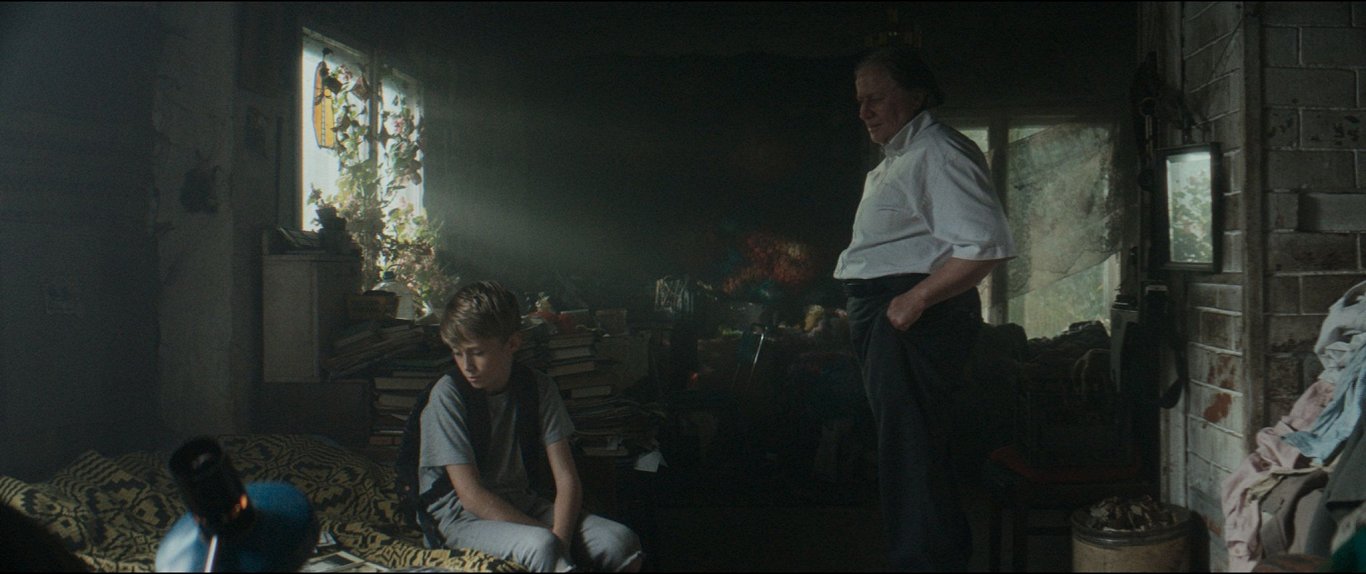
Watson (“The Theory of Everything,” “A Royal Night Out,” “Chernobyl”) plays Evgenia Ginzburg, a passionate teacher of Russian literature and poetry at Kazan University when we meet her, a lady with vast reservoirs of memory for the works of Pushkin and the other greats of the Russian canon.
A mother of two boys, married to the university newspaper editor (Benjamin Sadler), she is also a Communist Party member in good standing, and a true believer. Any bit of unsettling news husband Pavel passes on from Moscow gets a considered look, and an unworried response from Evgenia.
“I don’t know, but I’m sure they know what they’re doing.”
Pavel is weighing facts and seeing signs as he tosses her latest “story” on the Party’s sanctioned food and manufacturing production figures in the bin.
Sure enough, they see a respected colleague (Pierce Quigley) abruptly arrested in front of them, hauled away for his possible association with Stalin’s biggest boogeyman, the Red intellectual Leon Trotsky. Everybody had best distance themselves from their “Trotskyite” friend, and quick.
When Pavel lets his wife know he’s apologized to local Party bosses for her “association,” Evgenia is livid. Soviet rewriting of history, something we’re seeing in America as I type this, is in full swing. Evgenia’s “crime” is that she didn’t “suspect” Yevlov, the colleague, that she didn’t rat out this Party endorsed friend before anybody knew Stalin’s goons were going to accuse him.
The idealistic Evgenia won’t repeat this act of contrition in front of the myopic, officious apparatchik who has a confession for her to sign. She figures she has rights. She has people she can appeal to.
She lacked “political vigilance” about the already rewritten history of this Yevlov’s rise? She’ll show them.
But damned if the smirking goon from the capital Beylin (Ian Hart) doesn’t take an instant disliking to this “arrogant” and smart member of the “elite.” Appeals and assurances from others disappear as she’s put on trial, where she outlawyers the ignorant mugs assigned to judge her. “Tell me, who am I suppose to have ‘terrorized?'”
That, or course, seals her fate. Ten years in a camp it is. That’ll teach her to be smarter, to have ideals, to insult deplorable men with authority.
Evgenia finds herself torn from her family, renounced by her save-my-own-skin husband, denounced by comrades she tried to help and stuffed in a cattle car with scores of other freezing, starving women on her way to Siberia.
Much of Gorris’s film is standard Gulag/concentration camp horror — the brutal labor conditions of a lumber camp, the subfreezing weather, the “400 grams of bread a day” diet, the rape culture of the callous, hair-trigger guards.
Evgenia lives, cut off from home, desperate for any word of Kazan from strangers from other camps she stumbles into. She keeps her own and others’ spirits up by telling stories from literature and reciting poems from memory in the barracks. She loses the last shred of “The investigators made a mistake” idealism that many shared when they first boarded that train.
As women walk off into the woods to die, or starve and give up, the cynicism of the history-altering state settles in among them all. How did you end up here?
“That was a long time ago,” is their mantra. “And it never happened, anyway.”
Watson doesn’t oversell the “pluck” of Ginzburg, whose memoir this is based on. She portrays the woman as smart, logical and naive, someone who figures reason, truth and the law will protect her.
She shows us the exterior ordeal and interior suffering of a woman who figures she has to survive this sentence (as if the Party is bound to keep its promise about the length of political prison sentences) for her children. She has to try and protect her sanity and her dignity, resisting the sex-for-food come-ons of the monsters who guard them.
Watson lets us see the layer of callouses and scabs that crust over this woman’s once hopeful heart. It’s a magnificent performance.
Hart makes a perfectly vile impression as the kommissar who makes it his business to put this Jewish academic in her place. And Ulrich Tukur shines as a (pre-war) doctor of German descent, imprisoned because of his lineage, but necessary to the camp and thus tolerated as he treats his patients with compassion and firmly defends them from being worked and starved to death.
“Within the Whirlwind” doesn’t break much new ground in historical terms or its depiction of the Reign of Terror that the purges were, or in its assessment of how quickly people succumb to inhumanity — in how they treat others, in how they think of themselves.
But it’s a hidden gem, one of Gorris’s best and a high water mark for an actress nominated for Oscars for “Hilary and Jackie” and “Breaking the Waves,” and an Emmy nominee for “Chernobyl.”
Rating: unrated, violence, including rape
Cast: Emily Watson, Agata Buzek, Ulrrich Tukur, Pierce Quigley and Ian Hart.
Credits:Directed by Marleen Gorris, scripted by Nancy Larson, based on the memoir by Eugenia Ginzburg. A Corinth Films release.
Some movies are slow. Some manage a kind of languid torpor. And there’s “Help,” which might be described as “inert.”
It’s a disastrously undramatic debut feature from writer-director and bit “character” in the film Blake Ridder, who is also distributing it.
It takes forever for something — ANYthing — to happen. And when that something does, it’s no help. This corpse just lies there, a trio of attractive actors in an odd “menage” thriller variation filled with what’s meant to be menace, but which is merely a collection of awkward pauses, mostly the product of the most inept editing this side of student cinema competitions.
A pointless prologue lets us see leading lady Grace (Emily Redpath) get dumped by a callous American beau — via phone. Grace, a forensics researcher, decides a pop-in visit on her friend Liv (Sarah Alexandra Marks) is in order. It’s her man Ed’s (Louis James) birthday.
They chat, awkwardly. Grace is imposing, but there’s no being rude. They are, after all, British. She settles in for a weekend into what appears to be a perfectly passable relationship. But thanks to her forensics background, Grace can’t but notice blood stains here and there.
And then there’s the on-the-spectrum oddball neighbor (Ridder) who greeted Grace’s arrival with a warning.
“It’s bad.”
Anyway, Grace sits and they all catch up. At some point, somebody says “I think it’s time you met Polly.” That’s odd, and we’re invited to ponder the idea that Grace is somehow unstuck in time, that the movie’s events are unfolding out of order.
Because, you and I know we saw Grace come into the house when no one answered the door. And she chatted and coo’d at the cute little Jack Russell, whom she called “Polly” by name. They’ve met.
But no. That appears to be simple editing incompetence. And nobody told the writer-director about it to fix it. That’s never a good sign.
It’s kind of all downhill from there, with revelations that will surprise no one, violence and schemes and escalations that are nothing the least bit interesting.
Not to get any meaner than I’ve been up to now, but there’s a reason this dog is self-distributed. And the word “delusional” explains it.
Rating: unrated, sexual situations
Cast: Emily Redpath, Louis James, Sarah Alexandra Marks, Blake Ridder
Credits: Scripted and directed by Blake Ridder. A Ridder release.
There aren’t a lot of music clubs that have made the journey from “THE place to be” to “an Institution” with more grace than Ronnie Scott’s, the Frith Street landmark in Soho, London.
“Ronnie’s” is a gloriously musical celebration of the club where everyone from Dizzy to Sonny, Chet to Miles, Sarah and Ella to Carmen and Cleo held forth.
Oliver Murray’s documentary gives us the history of the club via the biography of its namesake and co-founder, British sax player, jazz mainstay longtime MC at the club, which as the film was shot, was passing through its 60th year.
What the Blue Note and the Village Vanguard are to New York, Ronnie Scott’s has been to London, which is exactly what Ronnie Scott himself had in mind when and his fellow musician and manager Pete King had in mind when they opened the place in a tiny basement space back in 1959.
Scott, already a star of British music at the time, conceived this “club designed for musicians,” an “ideal setting for jazz to be played in,” after helping break the union musician barrier that kept Brits from performing in clubs in America and Americans from making much musical noise in Britain.
He visited The Down Beat and the Three Deuces in New York and with the much more business minded fellow sax man King, set out to make it happen.
In archival interviews with Ronnie and Pete, and voice-over testimonials from everyone from Quincy Jones and Sonny Rollins to fan and popularizer Michael Parkinson, the British TV chat show host, we learn all about the partnership, the struggles and a dream that came true — being able to introduce (often with a little stand-up comedy) the greatest names of jazz’s Be Bop gilded age, and then hear them, sometimes sit in and at the very least catch every note played from the club’s stage from his backstage office.
And the music sampled here, from other films, TV programs and the like, is pristine, with every performer at something like her or his very best. Oscar Peterson works up a serious sweat, Chet Baker plays with Van Morrison (1985) as the Irishman sings “Send in the Clowns,” Ella Fitzgerald dazzles and Sonny Rollins, Ben Webster, Dizzy Gillespie and Roland Kirk blow the roof off the joint.
Murray fills the screen not just with their performances, but with reams of street life footage from the London and New York of the late ’50s into the ’70s.
Colorful tales about the mobster, “Italian” Albert Dimes, the “godfather” who enabled Scott and King to score their bigger, upgraded location, moving from a Gerrard St. basement to a swank Frith Street showroom, and Jimi Hendrix coming to jam with Eric Burdon and War in what would be his last performance pepper the picture.
Musicians talk about the improvisations one describes as “looking for transcendence,” about how difficult it is to achieve it, and how that drove Scott himself to fame, glory and eventually depression.
The club always booked with an ear for jazz as a “big tent,” encompassing much more than just “trad” and swing and big band and the like.
And the fact that, as the film points out, it continues today, outliving its founders and thriving as a music fan’s bucket list totem, turns the film from not just a history lesson and musical memoir. It’s a call to action.
See this film about the legendary London jazz club. Note exactly where it is. Make your travel plans accordingly.
Rating: unrated, a little profanity, smoking, drugs mentioned
Cast: Ronnie Scott, Barbara Jay, Cleo Lane, Roland Kirk, Mel Brooks, Nina Simone, Oscar Peterson, John Dankforth, Sonny Rollins, Michael Parkinson and Quincy Jones.
Credits: Scripted and directed by Oliver Murray. A Greenwich release.
“The Privilege” is a too-predictable German mashup of a couple of horror genres and several paranoid thrillers, all underscored by the big idea in Jordan Peele’s “Get Out.”
Hey kids, your elders are taking away your future, and not just with economics and environmental dimwittedness. Think “succubi.”
Finn (Max Schimmelpfennig of “Dark”) is a haunted teen who is still dealing with the childhood trauma we witness in the opening scene. He saw his older sister die after a mad sprint and drive into the night with her shouting (in German with subtitles, or dubbed), “We can’t let it GET us!”
He’s still under a doctor’s (Nadeshda Brennicke) care, still medicated, still watched warily by his parents (Lise Risom Olsen, Roman Knizka). He sees things — flashbacks, and what might be hallucinations. Whatever “it” was ten years before, he sensed it just as surely as his dead sister did.
“You all think I’m crazy, right?”
Maybe his gay BFF Lena (Lean van Acken) believes him. Maybe his crush Samira (Tijan Marei) would, if he ever got up the nerve to ask her out.
But his parents? Was that them he say carrying out some sort of ritual involving his twin sister Sophie (Milena Tscharntke)?
“What? What are you talking about?” Is it all in his head? Does he know gasbeleuchtung is the German word for “gaslighting?”
We do. Well, maybe not the German word thing. But pretty much every other plot point and action beat in “The Privilege” — as in “You’re part of a most privileged generation, you know.” — we see coming from 22 kilometers off.
The science class about “fungi,” the Russian “experts” in hallucinogens, the DIY “exorcism,” all of it seems cut and pasted from a dozen other pictures.
Even the dialogue has a stultifying over-familiarity, from “We can’t let it GET us” to “You all think I’m crazy” to “Take this, bitches!”
The leads are game enough, with van Acken having the “fun role” and Schimmelpfennig forced to do the suffering, investigating and heavy-lifting. Nobody else makes much of an impression beyond the tropes and archetypes they were hired to be.
The definition of movie “comfort food” is filling your film diet with the undemanding and overfamiliar. “Privilege” is cinematic sauerbraten. But if that’s your thing, “Guten appetit!”
Rating: TV-MA, violence, drug abuse, sexual situations
Cast: Max Schimmelpfennig, Lea van Acken, Tijan Marei, Milena Tscharntke, Lise Risom Olsen, Roman Knizka and Nadeshda Brennicke.
Credits: Directed by Felix Fuchssteiner and Katharina Schöde, scripted by Felix Fuchssteiner, Sebastian Niemann, Katharina Schöde and Eckhard Vollmar A Netflix release.
The movies tend to oversimplify the countless crimes committed against Europe by Nazi Germany. That label “Nazi” has become screen shorthand for “We don’t need to know how or why, that alone explains it.”
In “Calm at Sea,” German filmmaker Volker Schlöndorff (“The Tin Drum,” the first film version of “The Handmaid’s Tale”) digs into one pivotal incident to show us the bureaucratic chain of command, the weighing of consequences, the attempts to shift, duck or share blame of an infamous turning point incident in newly-occupied France.
The story of how communist zealots, intent on replicating Russia’s October Revolution in “independent thinking” France, shoot the German officer in charge of the Nantes district, triggering a rash over-reaction from Hitler himself, makes for a grim history lesson and fascinating psychological/sociological study. It’s a logistics-and-paperwork-heavy period piece, not a thriller like the similar and superior “Anthropoid” (about an equally famous Czech assassination). But it makes the viewer look at state sanctioned massacres and how they happen in a new way.
The focal point is young Guy Môquet (Léo-Paul Salmain), a teenager being held in a coastal detention facility run by the French, largely on behalf of their German masters. He runs footraces for the prize of a bar of soap, attends classes and flirts with the fair Odette (Victoire Du Bois) through the fence at the neighboring women’s camp.
He recites poetry to her, compares her to Lenin’s wife (he’s a leftist, son of a communist) and she laughs at “What a child” he is (in French, with English subtitles).
Young Guy and everybody else at this camp figures they’ll serve their time — for political activities, or pickpocketing — and go home. It’s 1941, France has been under German and Vichy control for a year, and the “real” German army is busy invading the Soviet Union.
But the eager hit squad that takes out Lt. Holtz in Nantes is about to change that. They underestimate the reliability of their pistols (another officer escapes), and these Party Members in good standing wholly underestimate the German response. Hitler hears of it, and we start to see his dismaying orders ripple through the “1000 officers” in charge of France, the German chain of command.
Général Otto von Stülpnagel (André Jung) fumes that “I am a soldier, NOT a butcher!” (in German, with English subtitles). His underlings kvetch about appearances, how this will “play” all over France, legalities and the French psyche. As if von Stülpnagel doesn’t know they can’t rule France without “collaborators.” The “individualistic” French are sure to flip out. “We are NOT in POLAND,” he rages, to no avail.
A French police prefect (Sébastien Accart) is ordered to come up with a list of 150 names — communists, Gaullists, and “see if there are any Jews.” He, and then his bosses in Vichy, insist that the Germans use the rule of law, or that at least they be forced to do the selecting, deciding who lives and dies. “No women,” he is told. Kids? Why not?
This will eventually reach the camp, where the defiantly French communists in the barracks insist they have a “right to music” (a smuggled in radio), and carry on with a modicum of defiance even when warning notices spring up around town, Germans show up to order their French guards into action, “selecting,” and the wheels of mass murder are set in motion.
Schlöndorff attempts to create a ticking clock, showing the “hour” or two everyone involved has to set things in motion, or else. He shows us the debates within the trio of assassins about whether or not to turn themselves in, the barracks debate over what might be done and if their deaths with have that October Revolution galvanizing effect of making them martyrs. And we see the German conscripts, green and young occupation troops, struggling to flirt with or at least fraternize with the locals, exchanging “You ever shoot a man?” worries and suffering awful attacks of conscience when that “duty” is hurriedly thrust upon them.
Their field officers served in Poland and scream at their charges to man up and be German soldiers. The viewer is allowed to infer that mass shootings are part of the job.
And the urbane writer and general staff officer Ernst Jünger (Ulrich Matthes) takes it all in, writes it all down and hides his distaste for the buck-passing, inhumane order-following he sees, and tries to defend his own part in this with a French opera singer (Arielle Dombasle) he’s trying to seduce.
“I prefer the role of witness,” he shrugs. His writings and reports are a major source for the screenplay, as are the journals of the various French men, and the letters the condemned were allowed to write wives, sweethearts and family.
“Calm at Sea” is an orderly, unrushed and almost “calm” film of progression through the steps of this war crime in the making. There are meetings, meetings and more meetings, with the Germans conferring with the French gendarmes and trying not to make it look like they’re giving them orders when they’re telling them to select, separate out and inform the prisoners who will be shot if the “real” suspects aren’t fingered by the populace, or fail to turn themselves in.
The field officers know the drill, but struggle to keep their conscripts in line and bucked up for the “orders” at hand. Some of the infantry can’t keep them from weeping or throwing up.
The victims are a whole range of defiances, from numbed with shock to spitting at their French collaborator guards to “Vive la France, vive la liberte, vive la Revolution!”
But for a film about an infamous war crime, the entire affair is too bloodless, literally and figuratively. The acting is good, but almost every performance is dry and dry-eyed. The murders are awful, but the emotional impact is muted thanks to the film’s drift away from the martyred Guy Môquet, still celebrated in France but really just a kid who misread the times and placed himself in harm’s way.
For all that, “Calm at Sea” is still a fascinating deep dive into the psychology, bureaucracy and endless miscalculations — especially by the murderous Germans — that led to a massacre that became a policy that stiffened a lot more of the French to find ways to resist the barbaric soldiers as butchers watching over them.
Rating: unrated, violence
Cast: Léo-Paul Salmain, Marc Barbé, Ulrich Matthes, Sébastien Accart, André Jung, Victoire Du Bois, Arielle Dombasle
Credits: Scripted and directed by Volker Schlöndorff. A Corinth release.
When you set your romance against the most aesthetically pleasing watersport of them all — kite surfing — you’d better make sure the melodramatic story is fun, tortured, twisty and/or steamy enough to keep folks from wondering, “When’re they going to show more kite surfing?”
The Polish film “Into the Wind (Pod Wiatr)” manages nothing of the sort. A summer romance set in the resort town of Hel on the Baltic Sea, it’s a semi-conscious bore whenever we aren’t watching kite surfing — which is most of the time.
Ania has come here with her Dad (Marcin Perchuc), his new wife and their toddler. Dad’s a doctor, and Ania’s heading to med school. She’ll take over for him at his clinic someday, he figures. They’re meeting old family friends, and their lawyer-to-be son Kuba (Sebastian Kuba) is part of everybody’s “plans” for Ania (Sonia Mietielica) as well.
But expressionless Ania has watched the VW Vanagon loaded with loud, wild-haired kite surfers that passed them on the road. And she’s had about enough of Daddy’s “plans.”
The set-up suggests a cute “Nobody kite-surfs Baby in a corner” romance, something light and sexy and athletic and very photogenic, with kite-surfing taking the place of dancing.
No, what the filmmakers have in mind here is far duller — parents fooling around, Ania’s haunted past, utterly predictable “obstacles” to surfer-hunk Michal’s (Jakub Sasak) love connection with the pretty, unsmiling rich girl who comes to him for lessons.
Mietielica is almost expressionless in this movie, which could be her attempt to play deflated, grief-stricken and morose. There’s never a light moment in her performance. One can read more into it as there’s a sex scene almost as joyless as everything else in “Into the Wind.” Perhaps she was so bothered by the jarring, slo-motion seduction – nudity-included, hers — that she couldn’t summon up much of a smile about anything else.
That scene plays as both somewhat tender and exploitative, seeing how PG or PG-13 everything is leading up to it and following it.
But at least the kite surfing is as athletic and striking as you’d hope. Who knew there was surfing of any sort on the Baltic?
Rating: TV-MA, nudity, sex, drug use
Cast: Sonia Mietielica, Jakub Sasak, Marcin Perchuc, Sebastian Dela, Waleria Gorobets, with Bitimania and Wojciech Gassowski
Credits: Kristoffer Rus, scripted by Julian Kijowski. A Netflix release.