Classic Film Review: Ang Lee’s debut, the charming “Pushing Hands” (1991) is restored

The great Taiwanese-American Ang Lee made a most auspicious if little-seen feature directing debut with “Pushing Hands,” a sentimental dramedy about an old tai chi master whose move to New York goes anything but smoothly.

After a decade of making short films and picking up experience on other’s sets (Spike Lee’s “Joe’s Bed-Stuy Barbershop: We Cut Heads”), he broke out at age 37, launching a career that has included Oscar winners (“Crouching Tiger, Hidden Dragon,” “Brokeback Mountain,” “Sense and Sensibility”), action pics (“Gemini Man”) and even a comic book movie (“Hulk”).

But his first three films — “Pushing Hands (Tui Shou”), “The Wedding Banquet” and “Eat Drink Man Woman,” — his so-called “Father Knows Best” Trilogy, not only announced his arrival but gave mainstream American culture a peek at Chinese-American culture and a renewed taste for Chinese cuisine. Lee painted vivid portraits of Chinese Confucianism clashing with Americanism, often under the same fractious roof.

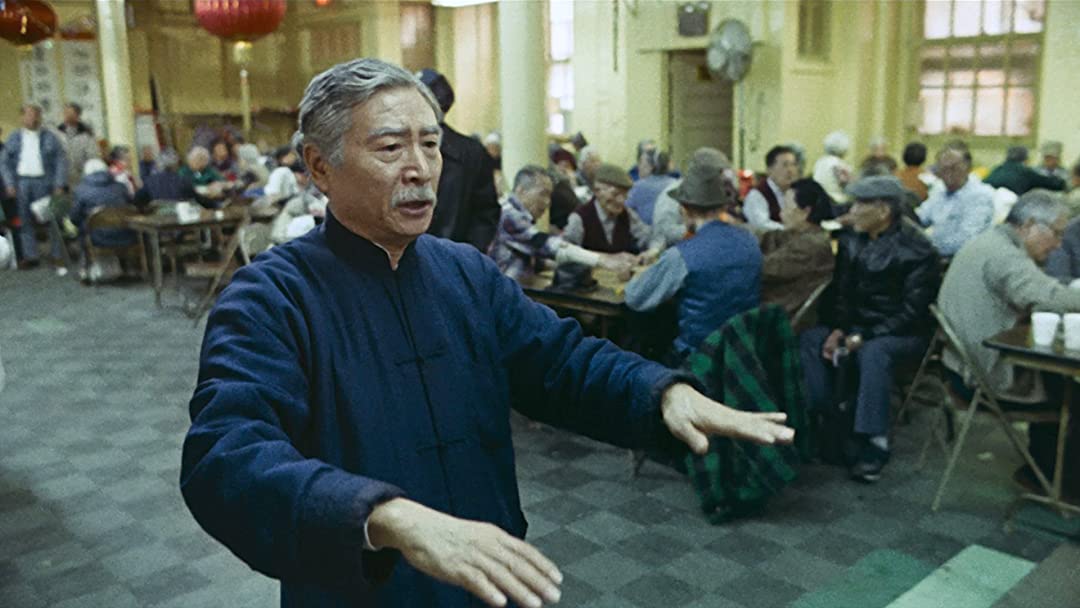
Chu (Sihung Lung) has only been in the States a short while, but he’s managed to start teaching tai chi classes at a local suburban New York Chinese community center, and he’s thoroughly gotten under the skin of his daughter-in-law. Martha (Deb Snyder) just published a book and is pounding away at a new one, only to have the constant distraction of “The Master” practicing his martial arts, or bored and watching crummy martials arts movies or Chinese operas his son (Bozhao Wang) rents for him.

No, headphones don’t stop him from singing along.

Perhaps what the long-widowed Beijing expat needs is a lady friend. The spunky and quick-witted widow Mrs. Chen (Lai Wang), who teaches cooking classes at that same community center, might fill that bill.

Whatever is going on there, things at home are reaching a boiling point. His college educated-son and daughter-in-law are raising their little boy to be bilingual and appreciate both cultures. But they’re soft.

“In America, you’re so nice to kids,” he grumbles in Mandarin (subtitled). Because no way is he putting the effort into English at age 70. He grouses about “this American woman” his son is married to “eating only vegetables,” passes on bits of yin and yang wisdom to deaf ears, whips out a little accupressure and when he gets the chance, shows off his mad martial arts skills to Mrs. Chen in class.

Maybe their adult children should set them up?

Lee’s ever-so-patient storytelling style is introduced to film lovers with “Pushing Hands,” lulling us into the teeth-grinding routine that’s wearing down this family before delivering that cute martial arts “showing off” turn, developing the characters and the conflicts further before dropping a farcical action finale that is played so seriously you don’t feel it’s out of step with anything that’s come before.

Star Sihung Lung transcends stereotypes to become the quintessential “ancient Chinese secret,” a man ably representating an old culture transplanted in a new one. He was in all the films of the “Father Knows Best” trilogy, and in Lee’s romantic martial arts blockbuster “Crouching Tiger, Hidden Dragon.”

Newly-restored and re-released in some theaters and on Film Movement+, this 1991 gem will have you remembering how big a deal Lee became as a filmmaker, and hankering for take-out (Lee has a lot of eating scenes in his early films — a LOT).

As Lee has spent his recent years making indifferent mainstream films such as “Gemini Man,” “Taking Woodstock” and “Billy Lynn’s Long Halftime Walk,” one can’t help but wish he takes this occasion to look back on his earliest days and recalls some other story about the Chinese diaspora that only he could tell. His two Oscars mean that a lot more people would notice this time around.

Rating: unrated, some violence

Cast: Sihung Lung, Deb Snyder, Lai Wang, Bozhao Wang and Fanny De Luz

Credits: Directed by Ang Lee, scripted by Ang Lee and James Schamus. A Film Movement release.

Running time: 1:45

Posted in Reviews, previews, profiles and movie news | Comments Off on Classic Film Review: Ang Lee’s debut, the charming “Pushing Hands” (1991) is restored

Netflixable? Gorgeous singles look for love in the stunning scenery of Peru, “Without Saying Goodbye”

The set-up for this “Around the World with Netflix” presentation is every bit as simple as that headline.

A gorgeous workaholic Spanish architect (Maxi Iglesias) is sent to Cuzco, Peru, to pick a spot, secure property and build a “seven star hotel” with a grand view of the Andes.

The vivacious and stunning niece (Stephanie Cayo) of the owner of a hilltop hostel in the city tries to keep that from happening, and from falling in love with the handsome “prince” from Madrid.

Without Saying Goodbye (Hasta que nos volvamos a encontrar),” aka “Backpackers,” is a somewhat colorless romance set in some of the most stunning scenery on Earth. Perhaps the writer-director, Bruno Ascenzo, realized this. Just when you’re wondering if this inane “meet cute” (ish), easy seduction/quick break-up over that Big Hotel is going to go 96 minutes without showing us much, he sends our mismatched pair on a five day hike up to Machu Picchu.

Yes, we remember, there’s a reason Machu Picchu is at the top most people’s bucket lists.

Salvador the star architect flies in and spies our Peruvian temptress dancing with the fun folks at the Tupananchiskama Hotel — and really, you’d have no way of knowing if I misspelled that — historic and quaint and run by “Tinder” trolling Aunt Licci (Wendy Ramos).

Salvador keeps his eye on her, she reciprocates. And it’s not until the morning after that “You want to build an eyesore” like other hotels he’s had a hand in over in Dubai, that he’s a “modern day Francisco Pizarro,” a conquistador come to exploit the locals for Spanish gold.

She is the free spirit the “poor little rich boy” (in Spanish with subtitles, or dubbed) never was. She is in the moment, he is in the boardroom, on a conference call, or at the drafting table sketching out blueprints.

And she has no sooner declared “I would never be with someone like you” than we know it’s not “Game on,” but “Game over.”

But that scenery — hot springs, stunning vistas, the glories of Machu Picchu and a seaside finale near Nazca — offers some compensation for the cute nothing that this movie is. Not enough, but some.

Rating: TV-MA, sexual situations, alcohol, profanity

Cast: Stephanie Cayo, Maxi Iglesias

Credits: Scripted and directed by Bruno Ascenzo. A Netflix release.

Running time: 1:36

Posted in Reviews, previews, profiles and movie news | Comments Off on Netflixable? Gorgeous singles look for love in the stunning scenery of Peru, “Without Saying Goodbye”

Movie Review: Down and out, dreaming of a life “Topside”

Think of “Topside” as a subterranean “Beasts of the Southern Wild.” A child, growing up isolated, knowing only her immediate surroundings and her sometimes-absent parent, lets us see this “mole people” existence through her wide, unblinking eyes.

Co-writers/directors Celine Held and Logan George take us into the bowels of New York city for a tale of clinging, paranoid motherly love and a five year old child’s first experience of the world above. It’s a moving, harrowing film that hangs on a beatifically transparent performance by screen newcomer Zhaila Farmer.

As “Little,” she’s a child who has only the vaguest notion of what “stars” are.

“Stars don’t come down this far, baby,” her mother (co-writer/director Held) has to tell her. It may be dark where they are. But that’s far below ground in an abandoned subway tunnel, so deep you have to climb up to get to the tunnels where trains still run.

We see Little wander amongst the homeless squatters who have set up housekeeping, cadged electricity for phone chargers and the portable video player Little stares at when she isn’t petting the caged dogs or acclimated cats that others keep as pets, when she isn’t looking for something to eat/

Mom dotes on her and enfolds her in affection when she’s there. But she’s not around much. She’s “Topside,” looking for a fix or begging, bargaining for sex work to earn the cash for a fix.

Nikki tells Little that she’s “trying to find a place for you and me up top,” but she’s waiting until Little’s wings have sprouted. What she means is she’s trying to get around them being discovered by the system.

Neighbor John (Fatlip), who takes enough interest in the kid to make us wonder if he’s her father, feeds Little and berates Nikki at every turn — her begging for drugs, her neglect of the child, who “needs to be in school.” As we’re seeing most of this from Little’s point-of-view, we mostly hear these arguments, at least at first. Little’s is a world of sound and darkness.

But “the system” is closing in around them. Authorities are about to re-open this tunnel, and she sees their flashlights and hears their walkie talkies. Eventually, they’re going to find and evict them.

George and Held give us a child’s sense of wonder, and terror at the unknown, when Little comes to the surface. And they stare, unblinking, at the “homeless by choice” subculture — disturbed, addicted, paranoid people who might duck into a soup kitchen but duck back out if anybody asks them anything about themselves.

Held’s performance as an addled addict helpless to focus on anyone other than herself is gripping. Nikki’s struggle tells us that she’s aware of how she’s failing, but clumsily hellbent on improving their situation unless that means she has to deal with authorities who will take her kid.

Farmer is a radiant presence, our eyes and ears experiencing this alien world and a sheltered child’s way of looking at what to us might be familiar but to a kid could be potentially terrifying — trains, crowded subway cars, a cacophony of chatter, PA announcements and thundering machinery. The chaotic streets above are even noisier, with the added shock of bright light.

“Topside” ably covers the basics of homelessness — public restroom clean-ups, hand sanitizer “baths,” hunting for a phone charger (Even the homeless have iPhones in the movies, a tone-deaf blunder I see again and again.), the nameless sense of “community.

And by putting us in the child and mother’s shoes, the film becomes a thriller, full of fear, anxiety and desperation. We fret over what might happen to Little, what fresh horror awaits Nikki and what dangers a careless but adoring mother will next expose her five year-old to.

Rating: unrated, drug abuse setting, implied sex work, profanity

Cast: Zhaila Farmer, Celine Held, Fatlip, Jared Abrahamson

Credits: Scripted and directed by Celine Held and Logan George. A Vertical release.

Running time: 1:30

Posted in Reviews, previews, profiles and movie news | Comments Off on Movie Review: Down and out, dreaming of a life “Topside”

The Brahman III — “Temporarily Closed”

Alas, the last cinema in sleepy Okeechobee, Fla

Posted in Reviews, previews, profiles and movie news | Comments Off on The Brahman III — “Temporarily Closed”

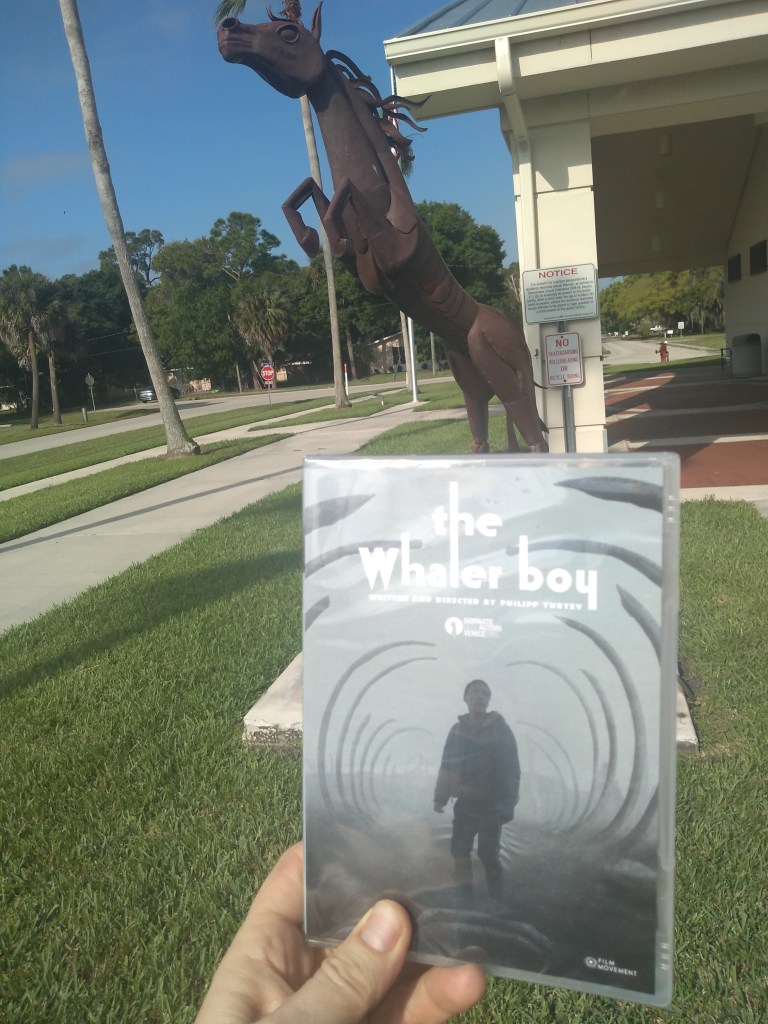
Today’s DVD donation? “The Whaler Boy” comes to Florida cattle country — Okeechobee

I reviewed this gem about a little seen culture above the Arctic Circle a few months back.

Will the good folks in the great rural expanse of Okeechobee County, next the lake that bears that name, and smack in the savannahs of the spine of Florida, cattle country, get a kick out of a little Inuit life and lust? Let’s hope so.

The library is right behind the long-closed Brahman III cineplex, the Last Picture Show in town. The more DVDs.they have to lend out the better.

MovieNation, spreading fine cinema like Appleseeds, all over the rural southeast, one movie and one public library at a time.

Posted in Reviews, previews, profiles and movie news | Comments Off on Today’s DVD donation? “The Whaler Boy” comes to Florida cattle country — Okeechobee

Series Preview: Josh Brolin is the patriarch in this “Yellowstone” meets “Stranger Things” mystery — “Outer Range”

A seriously intense and cryptic trailer is a pretty good selling for this Amazon Prime series, which premieres April 15.

Brolin, Imogen Poots, Lili Taylor, Isabel Arraiza and Will Paxton star in “Outer Range,” created by a first-time screenwriter.

Looks quite disturbing.

Posted in Reviews, previews, profiles and movie news | Comments Off on Series Preview: Josh Brolin is the patriarch in this “Yellowstone” meets “Stranger Things” mystery — “Outer Range”

Classic Film Review: A Masterpiece that’s not just Newman’s Own — “The Hustler” (1961)

When I was a kid I lived next door to a respectable middle class gent who ran the local pool hall in the small town where I grew up. His family made great neighbors, but I remember getting a warning, here and there, about not going to the pool hall where — it was implied — all manner of adult stuff went down.

Perhaps my parents were alarmed at Professor Harold Hill’s deprecations about “trouble with a capital ‘T’ that rhymes with ‘P’ and that stands for ‘pool'” in “Music Man.”

But the pool hall was right next door to the town bakery. And when I hit my tweens, I’d drop by for an eclair on my afternoon paper route.

Yes, way back in the olden days, kids, there were small town bakeries and pool halls, and there were such things as viable afternoon newspapers for factory workers to read after getting off from first shift or getting ready to go on second shift.

After the first time I saw “The Hustler” on TV, I could no longer resist and ducked into the pool hall a few times, just to soak up the atmosphere and see if Fast Eddie Felson or his equivalent was passing through. We had a pool table at my house, and any pointers a kid could pick up might keep his friends from mopping the floor with him on his own table.

I’m pretty sure my neighbor never gave me away, although I never stayed long enough to get a much-deserved “Run along, kid.” Every small southern town fancied itself another “Mayberry” back then. Pool halls were no place for kids. All I remember about it was how quiet and faintly depressing it was. Granted, I was stepping in during late afternoon and not later hours. But I remember thinking “‘The Hustler’ got the ‘quiet’ right.”

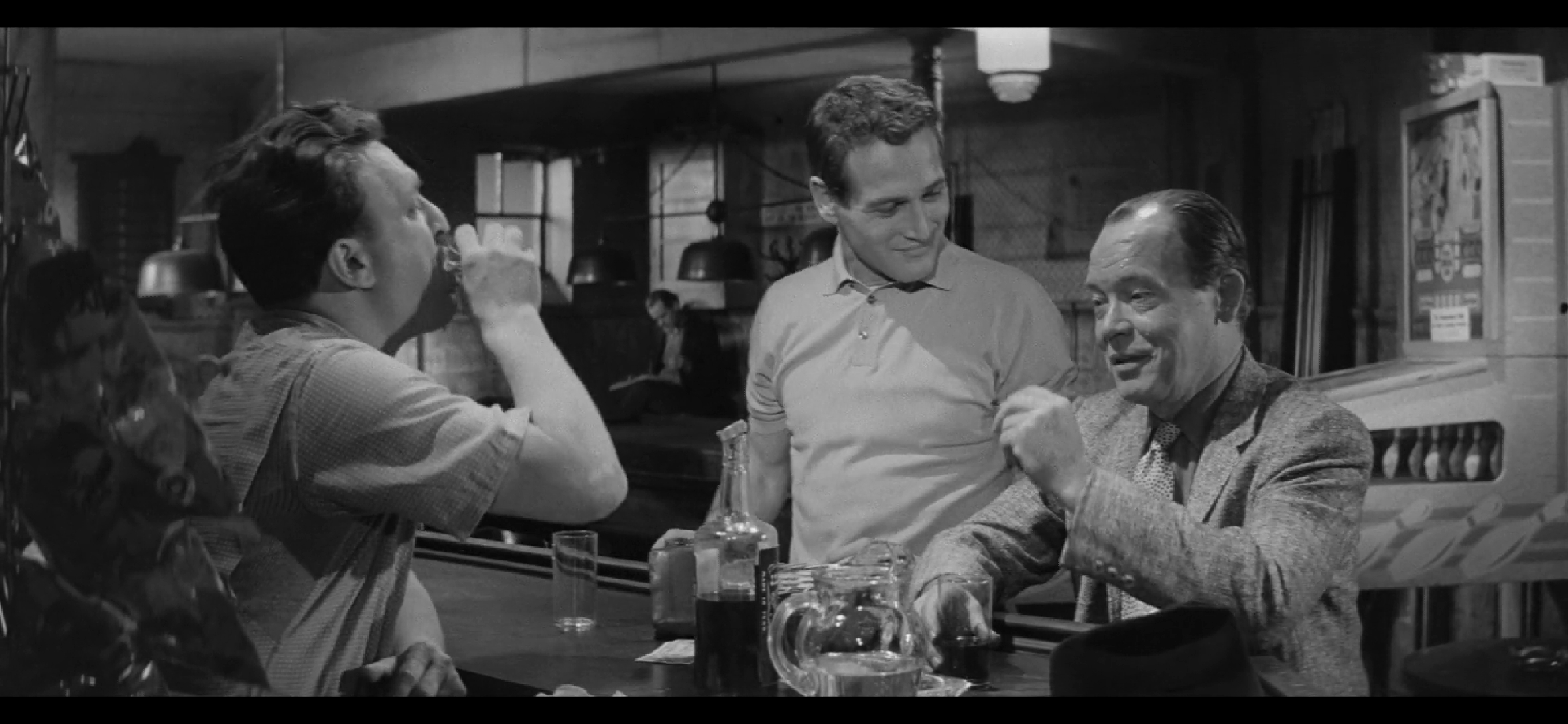
Something about this movie pulls me back in every time I spy it channel surfing. It’s the down and out noir milieu of the halls, the gritty “kitchen sink” settings outside of the smokey poolrooms where Fast Eddie (Paul Newman)– a “real high class con man” according to his enthusiastic first manager “partner” (Myron McCormick of “No Time for Sergeants”), “a born loser” according to his second (George C. Scott, cynicism on the half shell) — plies his trade.

 “I don’t think there’s a pool player alive shoots better pool than I saw you shoot the other night at Ames. You got talent.

“So I got talent. So what beat me?”

Character.

Robert Rossen’s film is a patient, leisurely down and out tale, an overlong alcoholic haze of a hustle that captures a cocky young pool shark’s comeuppance. The story arc is the familiar tumble from the self-confident peak to the gutter, and the slow crawl back to redemption. The film’s length is largely due to the games within it, chiefly the epic game of “straight pool” against Jackie Gleason, as self-described “legend” Minnesota Fats, that opens the picture.

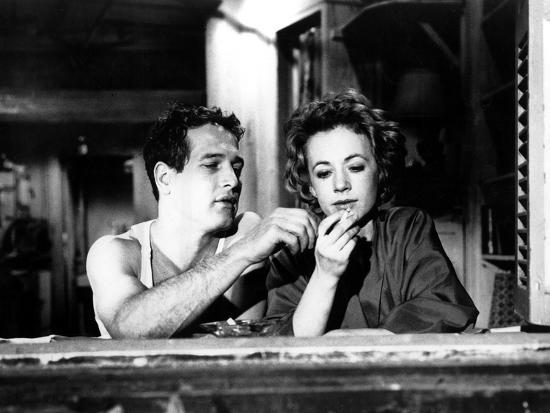
Rossen (“All the King’s Men”) messes with structure with that lengthy, show-stopping opening act. And then he has his “hero” sink and sink further, grabbing hold of a dissolute, disabled drunk (Piper Laurie, in her finest screen performance) on the way down.

The script is grand soliloquies in an unsentimental street argot that has nothing to do with “Guys and Dolls.” The seedy production design and dense, shadowy cinematography were honored with Academy Awards back in 1962, and remain the film’s signature to this day.

“Hustler” was nominated for nine Oscars, and is probably the first time Paul Newman deserved to win, as he was nominated along with Laurie, Gleason and Scott, and Rossen as director and co-writer and best picture-nominated producer. It didn’t help that the film came out the same year as “West Side Story,” “Breakfast at Tiffanies” or “Judgement at Nuremberg,” which won Maximillian Schell the best actor trophy.

That’s all right. Newman turned in decades of great performances after “Hustler.” And when he returned to Fast Eddie for the sequel, he finally was honored with a richly-deserved Best Actor Oscar.

For years after that 1986 film, I preferred the sex appeal, pop and pizzaz of “The Color of Money,” Martin Scorsese’s shot at a classic sequel, at working with Paul Newman and catching Tom Cruise, Mary Elizabeth Mastrantonio, Forest Whitaker and John Turturro on the rise. Eddie, the seasoned “manager” and sometime liquor distributor is the one who lectures a new “kid” (Cruise) about “character,” this time.

But for all the gloomy living-color grit that the great Scorsese served up in his faster-paced ’80s follow-up, there’s something absolutely timeless about Rossen’s picture. “The Hustler” feels like a black and white memory, a time capsule for a world that felt artificially recreated in “The Color of Money.”

By 1986, my small town pool hall, like some of those depicted in “The Hustler,” was long gone. The “real Minnesota Fats,” whom you could catch every now and then on “Wide World of Sports,” had mercifully hustled off into the sunset. Rod Stewart’s “Maggie May” dream of “borrow my daddy’s cue” to “make a living outta playing pool” was gone. Arcades had taken over, and were inherently less menacing, more infantile if just as alluring as billiards parlors had once been.

“The Hustler” isn’t just a memory, it’s a memory of a dream — a seedy and sinister movie of smoke, booze, lies and the consequences of the con, a relic of a less frazzled, pre-“first person shooter” age.

“It’s quiet.”

“Yeah, like a church. Church of the good hustler.”

Rating: unrated, adult situations, smoking, alcohol abuse

Cast: Paul Newman, Piper Laurie, Jackie Gleason, George C. Scott, Myron McCormick, Michael Constantine, Murray Hamilton and Vincent Gardenia.

Credits: Directed by Robert Rossen, scripted by Sidney Carroll and Robert Rossen, based on the novel by Walter Tevis. A 20th Century Fox release.

Running time: 2:14

Posted in Reviews, previews, profiles and movie news | Comments Off on Classic Film Review: A Masterpiece that’s not just Newman’s Own — “The Hustler” (1961)

Movie Preview: A Mother and child from New York’s bottom dream of life “Topside”

This March 25 was a film festival darling and now earns a commerical release March 25.

Posted in Reviews, previews, profiles and movie news | Comments Off on Movie Preview: A Mother and child from New York’s bottom dream of life “Topside”

Netflixable? Noomi is back in Sweden on a dangerous war mission — “Black Crab”

“Girl With the Dragon Tattoo” made Noomi Rapace one of the unlikeliest action heroines the screen has ever produced. She’s tiny –5’4″ — and when she cinches up a belt around her puffy polar jacket in her latest action thriller, “Black Crab,” she shrinks even more.

But there’s no questioning her fight scene/firefight/f-up-the-bad-guys bonafides at this stage. It’s impossible to pick just one film where we totally buy into this diminutive dynamo kicking ass and emptying clips.

“Black Crab” is a standard-issue “suicide mission” combat team picture. Call it “Guns of Navarone” on skates or “The Dirty Swedish Half Dozen,” this Adam Berg thriller, based on a Jerker (Stop LAUGHing) Virdborg novel hews to the traditions and tropes of the genre and is only really surprising in how they botch the anticlimactic ending.

There’s talk on the radio of a “civil war,” which mother Caroline Edh (Rapace) tries to distract her tween daughter Vanja (Stella Marcimain Klintberg) from as they drive out of the city.

But the war is upon them in a flash as they’re stopped, the kid is spirited away and Mom is abducted and stuffed back into camo.

Some time later, whatever is going on has devastated Sweden with “The North” gaining the upper hand in whatever pan-Scandinavian conflict (Instigated by Russia?) has turned Ole against Olaf.

Edh is summoned to meet a fatalistic commander (David Dencik), who mutters a poem about this “time without mercy” (in Swedish with subtitles, or dubbed) as he addresses this team he’s assembled. “The war is lost” unless these folks can get these cannisters to a lab behind enemy lines.

Bombs? Computer viruses? Biological ones? Nobody’s told. All of them (Jakob Oftebro, Dar Salim, Ardalan Esmaili, Aliette Opheim, Erik Enge) have been selected for their soldiering skills, and their relationship to Sweden’s winter pastime. They can all skate.

With the “archipelago” thinly iced over, they can skate over 100 kilometers, island-hopping as they do, and make their delivery to a military facility and “save the day.”

As we’ve seen the mass hangings, the trigger-happiness of the conscripts and their pitiless way of dismissing the starving refugees that this conflict has created, we’re allowed to wonder if “the good guys” here might be anybody worth fighting for. Carolina Edh bristles at the mission until she’s told where her daughter is. Do this and you can see her again.

The film’s obstacles include the usual power struggles within the group, a chain of command that includes people who can skate but know nothing of the terrain, close contact with the enemy, etc.

There are falls through the ice, helicopter gunships tracking them through the dark and snowsuit-clad warriors from “the North” dogging their every step or glide on those long distance track-race skates.

Music video and commercial director Berg stages decent firefights for our warriors on their quest in his debut feature. And the production design team creates a convincing snowy apocalypse for them to pass through, from frozen ferries and ice-entombed victims of the war to the Bond film finale where the film’s climax and anti-climax are set.

The soldiers are an unglamorous lot, with no hint of the swagger Hollywood bestows on such commandos. They’ve bought into the propaganda, some let their personal concerns trump their mission and all develop a sort of instant mistrust that seems right for a group of strangers in an endless conflict hurled into a job that all but ends their chances of getting out of this war alive.

But “Black Crab” — the name of their mission, its password and a description of what they’re doing, sidestepping the lines to get to their destination — seriously missteps when it throws in a drawn-out epilogue when a tidier film would have covered the same ground with the same results at the end of the quest narrative.

The anti-climax is an afterthought and it doesn’t play worth a damn.

Noomi is good, the supporting “types” perfectly serviceable, the look — that killer image of combat team skating into the darkness from their base as it is being bombed to bits — arresting. But that ending? It’s a bust.

Rating: TV-MA, violence and lots of it

Cast: Noomi Rapace, Jakob Oftebro, Dar Salim, Ardalan Esmaili, Aliette Opheim, Erik Enge and David Dencik

Credits: Directed by Adam Berg, scripted by Adam Berg and Pelle Rådström, based on a novel by Jerker Virdborg. A Netflix release.

Running time: 1:54

Posted in Reviews, previews, profiles and movie news | Comments Off on Netflixable? Noomi is back in Sweden on a dangerous war mission — “Black Crab”

Movie Review: Racism and Witchcraft are undergrad tests at this college — “Master”

Mood and message are paramount in Amazon Studios’ “Master,” a tale of institutional racism masquerading as a horror-on-campus thriller, instead of the other way around.

First-time writer-director Mariama Diallo goes for a “Get Out” parable, wound up in the ingrained racism of brick and ivy academia. And if her reach exceeds her grasp, it’s still a thought provoking drama that doesn’t quite cut it as a thriller.

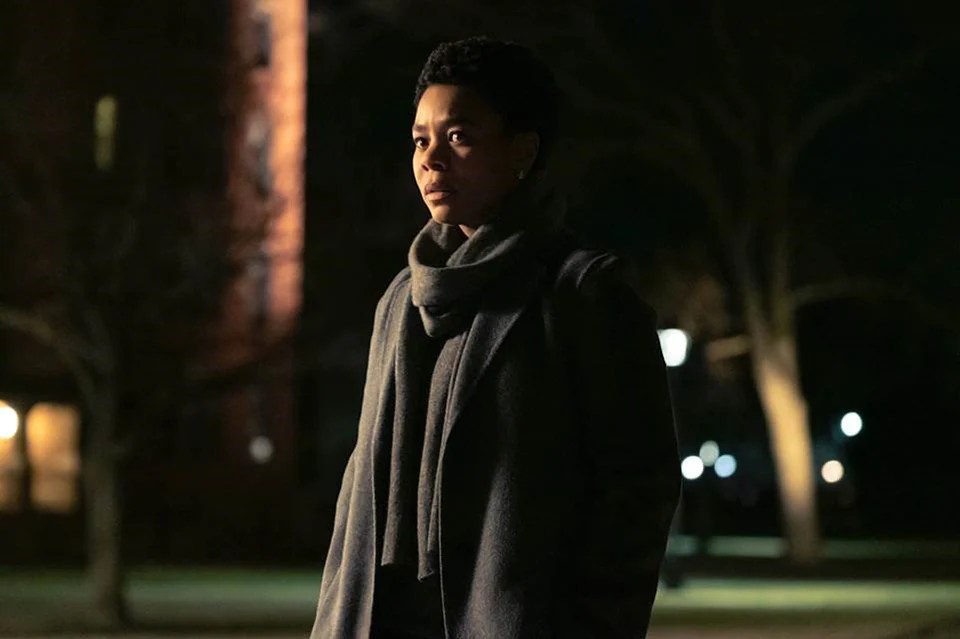
Reginal Hall (“Girl’s Trip”) is Gail Bishop, the first African American house “Master” at storied Ancaster College. She’s a tenured professor climbing that last rung on the college’s ladder, not merely teaching classes but presiding over, guiding and advising the young ladies of Belleville Hall.

One of those coeds is Jasmine (Zoe Renee, graduating from TV’s “The Quad”), a wide-eyed African American freshman over-achiever from the West Coast.

Jasmine arrives to the news — perhaps just a form of hazing — that she and her roommate (Talia Ryder) are bunked in a haunted room. Somebody there died. There’s this tradition of a “witch trial” victim who roams the campus, picking “one freshman every fall” to be dragged by her “to Hell.”

“You’re gonna have to try a lot harder than that to scare me.”

But Jasmine and we can see that surface acceptance might be the best she can hope for from the skinny, partying fashion statements (Anna van Patten, Ella Hunt, Noa Fisher) of roomie Amelia’s circle.

Her first test academically comes from an American lit professor (Amber Grey) striving for tenure, who wears her hair in statement-braids and sees everything through the lens of race. Her bond to the “first Black master” at the college is of an “us sisters are an endangered species on this campus” variety.

All of the women are struggling to “belong” and fit-in, with Amber coping with youthful uncertainty about her mores — “never have I ever” games, alcohol-soaked parties, privileged come-ons from the college hunk (Will Hoffman) — if not her academics.

If Jasmine doesn’t think there’s a “race” angle in Nathaniel Hawthorne’s “The Scarlet Letter,” “it’s not there,” no matter what her professor insists.

Gail finds herself the minefield as her colleagues — Talia Balsam plays the department chair, Bruce Altman a tenured liberal college who must have grown up never knowing any Black folks — pick thei words carefully around her, struggling to avoid saying the wrong thing. They can’t help but treat her as a “token” in their ranks.

And both Gail and Jasmine are spooked by apparitions, spectral shadows and random encounters with the very old Puritan-dressed (Mennonites?) community outside the exclusive college’s hallowed walls. Jasmine is particularly rattled as her sleep disorders give her vivid nightmares and make her wonder just how supportive that roommate and those classmates are.

Diallo introduces a lot of ideas, which she wrestles with for long stretches until she recalls that this is supposed to be a horror movie. Thus we get another Jasmine nightmare, another creepy walk or jog in the dark with Gail.

There are moments that play as alarming, but the players make it a reach to believe that any of these women seem all that scared by what is happening or what they think is happening to them.

Everybody’s much more concerned with what this story is “saying.” Situations, shot selection, characters and those playing them easily get across the idea that each feels “targeted” on this campus — a furtive scowl from the otherwise-outgoing dining hall matron, the dream-or-not-a-dream admission from Amelia that “I hate you” that Jasmine is sure she heard.

Snatches of dialogue like that become Diallo’s somewhat arbitrary, self-conscious and pointless “chapter” titles on this stroll through college rites of passage and supposed chills.

Everything here is borrowed from scores of other movies — the witching hour at “3:33 am,” the research into the libraries old newspapers and school archives to figure out the earlier victims of “this witch” or whatever is going on here.

At some point, blunt statements of what this is all about and a “stolen from the headlines” cultural appropriation accusation are shoehorned in. But “Master” never shakes the feeling that we’re seeing a collection of tropes and ideas that never come together in a coherent narrative.

The “message” comes through loud and clear, but the film feels like an assignment.
“Film us a ‘Get Out’ in academia, and be sure to cover X, Y and Z”. As a filmmaker Diallo never lets us forget she’s checking off boxes on her class essay’s list of required topics and tropes.

Rating: Rated R for language and some drug use.

Cast Regina Hall, Zoe Renee, Talia Ryder, Anna van Patten, Noa Fisher, Talia Balsam, Bruce Altman and Amber Grey.

Credits: Scripted and directed by Mariama Diallo. An Amazon Studios release on Amazon Prime.

Running time: 1:38

Posted in Reviews, previews, profiles and movie news | Comments Off on Movie Review: Racism and Witchcraft are undergrad tests at this college — “Master”