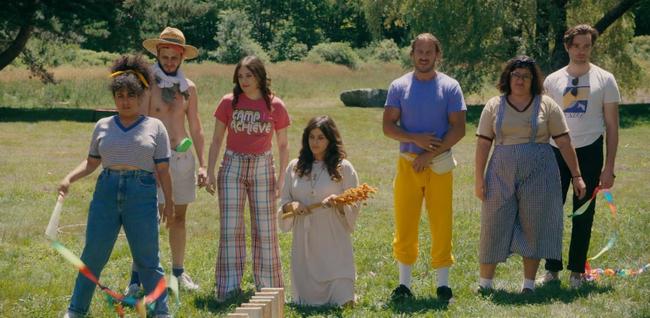
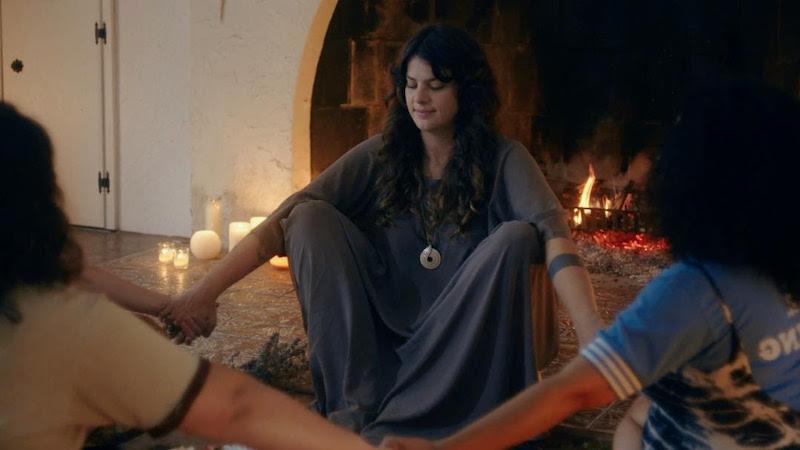
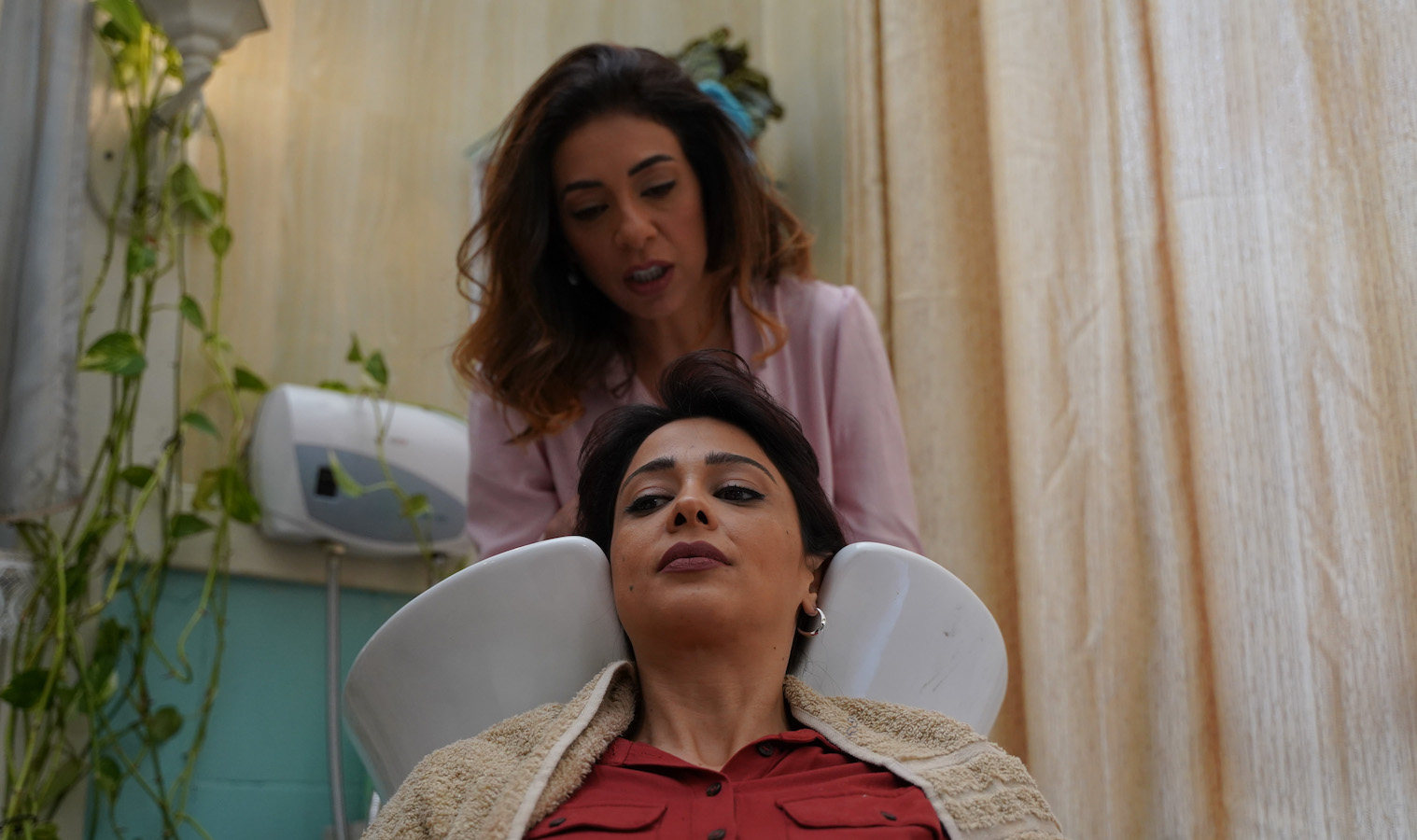
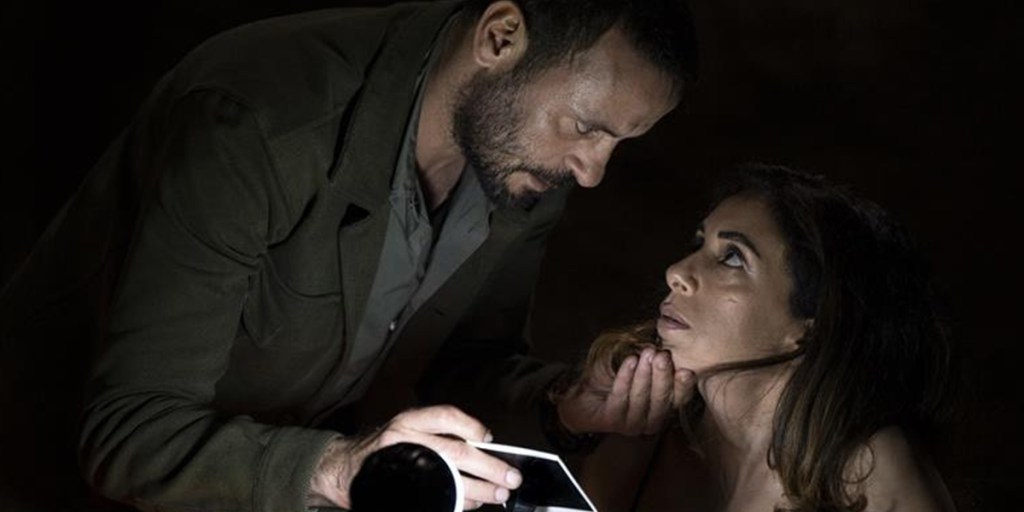
This one looks t’be a wee hoot.
Style and stabbing and is that one of “The Commitments” waving her scissors and accent around?
“Deadly Cuts” comes our way March 11.
This one looks t’be a wee hoot.
Style and stabbing and is that one of “The Commitments” waving her scissors and accent around?
“Deadly Cuts” comes our way March 11.


Filmmakers don’t get brownie points for sticking close to formula when tackling a genre picture. But if they did, Kim Farrant could collect hers for “The Weekend Away,” a solid if generally predictable and melodramatic “bad things come to those who vacation” thriller.
“Weekend” is a Leighton Meester star vehicle based on Sarah Alderson’s scripted adaptation of her novel. Our “Gossip Girl” veteran plays an American expat unhappily-married and living in London, a new mother who could use a few days off.
Her just-divorced hellcat pal Kate (Christina Wolfe) thus summons Beth to a Croatian getaway. A little girl-bonding, sight-seeing and dressing up to paint the town red…or as red as Beth, who is still breast-feeding, will allow. But Kate, determined to “find the limit” on her ex’s credit card, won’t hear of it.
One black-out blur of a night later, Beth wakes up to find Kate missing, blood on the floor, Kate’s locked phone left behind and Croatian cops (Amar Bukvic, Iva Mihalić) who’re 50 Shades Disinterested in this “case.”
Beth has to put off the husband back home (Luke Norris), ignore “that’s just like Kate” cracks from her friend’s ex (Parth Thakerar) and the dismissals of the cops, and rely on the Syrian refugee taxi driver (Ziad Bakri) who picked her up at the airport to help her retrace that night and what might have happened to “my best friend.”
The plot serves up a smorgasbord of possibilities and suspects — exes and “escorts,” creeper hotelier and entirely-too-careless cop. Meester isn’t particularly good at selling the “Maybe Beth did it” angle, thanks to the heat of the “I could never DO that” protests she manages.
Our leading lady summons up just enough paranoia to pull off a convincing breakdown under grief, despair and dismay.
But too much of “The Weekend Away” plays like a walk-through before the AD actually yells “ACTION.” The chases, fights and get-aways have a half-speed quality, as if everybody’s scared of getting hurt or working up too much of a sweat before Take Two.
This is most obvious in Meester, whose Beth doesn’t show the strain or effort it would take to get away here or to entrap a “suspect” there.
She’s always made a likeable if somewhat low-heat lead, and she leans a little too hard into this “exhausted new mom” back story to let this movie get up to speed and give us a sense of rising stakes.
The plot works its way past red herrings and into anti-climaxes, never quite drowning in melodrama, but coming damned close, time and again.
That makes for a “Weekend” that gets away from one and all, rather than delivering the roundhouse punch surprises the genre cries out for and the formula demands.
Rating: TV-MA, violence, drugs
Cast: Leighton Meester, Christina Wolfe, Ziad Bakri, Amar Bukvic, Iva Mihalić and Luke Norris
Credits: Directed by Kim Farrant, scripted by Sarah Alderson, based on her novel. A Netflix release.
Running time: 1:31


The advertising standee dominated a hallway of my favorite cineplex for what seemed like years and years.
“The Accidental Husband” was an Uma Thurman rom-com — her last shot at that genre — co-starring Jeffrey Dean Morgan, taking one more stab at mimicking that Gerard Butler “action” and “rom-com” career model. It co-starred Mister Rom-Com and future Oscar winner Colin Firth, and Isabella Rossellini, Sam Shepard and even “2001” survivor Keir Dullea.
And the reason that larger-than-life stand-up poster blocked a big chunk of the crown jewel in the Regal Cinemas chain for so long is that everything that could go wrong with a movie post-production did. Well, aside from the finished negative being destroyed in a fire, I guess.
Producing dilettante Bob Yari put this multi-writer project, directed by to-the-manner-born actor turned director Griffin Dunne into production, and was set to release it under his own start-up banner when all went bust. It showed up in Britain and sat in cinema limbo in the US until going straight to video. A few people reviewed it in 2009-10, and it dropped out of sight.
It’s worth holding an inquest over because what we see on the screen isn’t excruciating, even if there is a cringeworthy quality to the very idea of it and indeed to Dunne’s entire woebegone career behind the camera.
The premise seems borrowed from a Dolly Parton comedy of the last century — “Straight Talk.” Thurman plays a glib New York radio “advice” hostess, the author of “R.E.A.L. Love,” a self-help book titled for the facile “test” everybody should apply to a potential mate before saying “I do.”
Is that partner “Respectable,” “Adult,” “Loving,” etc. Yeah, it’s kind of sexist, but women are her audience, so OK.
Dr. Emma turns that “test” on caller Sofia (Justina Machado), who is about to marry NYC fireman Patrick (Morgan), prompting Sofia to bail and her hunky, handsome and possibly even “respectable,” “adult” and “loving” fiance has to hear this on the radio on his way home from a soccer match.
A few tipsy nights later, he’s talked the hacker-son of the extended Indian clan that runs the restaurant he lives upstairs from (Sarita Choudhury and Ajay Naidu among them) into getting even with the famous love guru by inventing a digital marriage…to him. She’s engaged to her publisher, quite-a-catch Richard (Firth). Here’s a rude surprise for them when they try to secure a wedding license.
Dr. Emma, not suspecting a thing, has to track down and charm this pool-playing pubfly to sign and notarize a phonebook worth of papers annulling the “marriage” so that she can happily-ever-after with Quite a Catch Richard. Naturally, blue collar hunk Patrick isn’t going to sign anything until he’s made her suffer, and perhaps taught her a lesson.
With such an elaborate — if icky — “meet cute,” could “love” be in the offing, somewhere between the beer-and-shots meetup, the wedding cake tasting and her first exposure to his Indian friends?
What strikes me, catching up to “Husband” all these years later, is the level of commitment of the cast.
Start-up studios always spend too much money hiring stars nobody else is beating a door down to cast filming scripts most studios have already passed on. Jennifer Lopez is usually the first name they think of.
And Griffin Dunne’s unblemished record behind the camera — he went on to make “Movie 43” — points to a studio being run by people who had no idea what they were doing.
But Thurman throws herself at this New York-filmed extravaganza as if the state was coming to take her kids if it wasn’t a hit. She’s borderline manic, relentlessly upbeat in scene after scene, be it shooting pool and doing shots with Morgan’s Patrick or embodying romantic sophistication with Firth.
Seeing her give her all to the pratfalls and play drunk like “Pulp Fiction” was just a warm-up is a wonder to behold.
Morgan amps up the charm, as if guessing this might be his only shot at jumping from TV to mainstream movie success. He got three good shots, actually — “The Losers,” “Watchmen” and this. Thank heaven for “The Walking Dead,” right JDM?
Firth is Firth, Rossellini charms as the beaming, giggling wife of a German corporate raider (Dullea) about to take over Richard’s publishing house, and Shepard, of all people, manages an offhanded, lighthearted ease as Emma’s ever-tomcatting Dad, a guy who’s been judged by his daughter enough to relish her little predicament, but not too much.
“Don’t keep your husbands waiting.”
Movies like “Accidental Husband” remind me of why I rarely blame the players when a rom-com goes wrong. Thurman gives her all to fake chemistry with these two, and both co-stars give as good as they get, and it’s never quite enough to come off.
The script is crap, the direction lackluster, and an awful lot of cash is left on the table in this poker-game of a comedy. There were more laughs to be played for in the radio hostess side of things, more giggles in the WASP fireman’s connection to the Indian family that’s all but adopted him, more broad humor in the Richard-Emma connection and rift.
The script doesn’t find them and Dunne doesn’t go looking for them on his own.
It wasn’t in the cards for “The Accidental Husband” to be a hit. But in better hands, it might have managed “Respectable,” earnest, “adult” and “loving.” It lives on as an artifact of a big screen career that might have been, or might have been extended, a director who talks a better game than he directs and a distributing studio/vanity project that never was and never should have parted with the cash in the first place.
Rating: PG-13 (Some Sexual Content|Brief Strong Language)
Cast: Uma Thurman, Jeffrey Dean Morgan, Colin Firth, Sam Shepard, Isabella Rossellini and Keir Dullea.
Credits: Directed by Griffin Dunne, scripted by Mimi Hare, Clare Naylor, Bonnie Sikowitz. A Bob Yari release streaming pretty much everywhere.
Running time: 1:30

With teen characters named “God,” “Boston,” “Graham Cracker” and “Squishy” acting irrationally, hedonistically and out-of-control, you can’t help but feel “What nutty screenwriter cooked up this?”
But “Romeo and Juliet Killers” is based on a true story. Populate it with actors — who are by definition more gorgeous than we mere mortals — and you barely have to play up the sordid stuff to get a lurid, over-the-top thriller about an infamous crime “ripped from today’s headlines,” back when headlines were a thing.
Leigha Sinnott plays Tylar Witt, a suburban California teen totally unrestrained by her exasperated single mom (Kelly Sullivan). Screaming obscenities, lashing out and storming-out in whatever tartwear strikes her mercurial mood, Tylar is a master manipulator.
Mom JoAnne can’t even restrain her long enough to make her stay to finish their latest knock-down, drag-out. The cruel kid will scream allegations of abuse loud enough for the neighbors and cops to hear.
As neighbor Val (Alicia Ziegler) is an insurance fraud investigator married to a cop (Darren Dupree Washington), that could be a problem. But Val sees right through this hellion. Her “It’s tough love time” lectures fall on JoAnne’s deaf ears.
Tylar’s reign of errors includes imbibing whatever she can get her hands on and coming on to whoever strikes her fancy. This new guy in her circle, “Boston (Zachary Roozen)?” He’s a little older, edgy and handsome enough to spark her interest.
“Pretty sure he’s gay,” and “as a daffodil,” no less. But he’s a lot more open-minded about that sort of thing than “categorizations” suggest. Besides, with the right gifts from his “bag of goodies,” everybody’s sexual inhibitions vanish.
“Romeo and Juliet Killers” is a somewhat drawn-out account of their torrid affair, his way of charming himself into JoAnne’s life, Val’s growing alarm and the ever-more-fraught confrontations that point the characters towards the label the press gave them that became the movie’s title.
Actress-turned-director Lindsay Hartley tells the story in one broad, obvious stroke after another. This reinforces the feeling that everybody saw this coming save for the mother whose repeated “I’m not STUPID” confrontations suggest that yes, maybe she was.
The film’s third act plays like a long epilogue, as no one involved acts in a rational way once they’ve committed a heinous crime, or sense someone they know has.
There has already been a documentary about the Tylar Witt case and it’s almost certainly been covered by any number of podcasts. But if “true crime” is your thing and you’d like to see all the nudity and sex and insincere “I love yous” that court transcripts teased, have at it.
It ain’t Shakespeare. But “Romeo and Juliet Lovers” gets a dirty “true crime” job done, emphasizing the dirt every laborious step of the way.
Rating: TV-MA, graphic violence, drug abuse, sex, nudity, profanity
Cast: Leigha Sinnott, Zachary Roozen, Kelly Sullivan, Alicia Ziegler and Darren Dupree Washington.
Credits: Directed by Lindsay Hartley, scripted by Peter Hunziker and Cynthia Riddle. A Tubi release.
Running time: 1:46


A lot of movies keep their secrets well enough that they make you wonder, “What the hell is this thing about?” It’s not often that a film frustrates even veteran mass consumers of movies like me with that feeling over an hour into the viewing.
“Ultrasound” is a maddening mystery of multiple but mysteriously interconnected timelines and sets of characters, a movie the revels in its confusion. When it finally starts to reveal its point, you don’t feel rewarded for figuring it all out — because you haven’t. You just feel relieved in an “OK, sure, now I get it” and “Oh, I’m not losing it after all” sense.
It begins with a car accident that wasn’t an “accident.” We’ve seen spiked boobytrap that blew his tires in the rain, and maybe we’re not surprised when the couple who take in the driver, Glen (Vincent Kartheiser of “Mad Men”) seem…off.
Art (Bob Stephenson) is too friendly, too chatty and much older. Meeting his wife (Chelsea Lopez) is jarring, as she seems fragile and trapped. He’s too quick to share his “manic depression.” But she’s over-shared that first. That’s before she lets on that she “married my high school teacher.”
“Pretty f—-d up, huh?”
Glen is put on his guard and on his heels, wrong-footed long before the suggestion that he spend the night with the wife. His outraged protests segue to Glen and Cyndi, deep in discussion, on her marital bed.
There are these jarring jump-cuts, a flash of just a few frames of film jolting Glen to another reality, another take on the situation. There’s a ringing in his ears.
And…SCENE.
Katie (Rainey Qualley of “Ocean’s Eight”) is doing laps in a public pool, fending off the rude attentions of a creeper. She’s pregnant. Or is she? There’s an assignation with the mysterious Alex (Chris Gartin) she’s late for.
Is Cyndi pregnant, too? How does Glen end up in a wheelchair, and what do the folks in lab coats (Breeda Wool, Tunde Adebimpe) have to do with all this?
Cryptic scenes follow other cryptic scenes, conversations seem to reveal much, or nothing of importance. Connections between characters are so flimsy that you wonder if there’s been a mistake in the editing or the processing of first-time feature director Rob Schoeder’s film of Conor Stechschulte’s obscurant screenplay.
We know the title. We hear the ringing tones, and get those David Lynch/John Carpenter subliminal flashes that hint at time, memory or reality being distorted, which sets us up for most anything.
And then the fog clears and a much more recognizable and conventional thriller unfolds.
The marvel here is how long “Ultrasound” keeps us off-balance and lost, how much the filmmakers are willing to test the viewer’s patience and the risks involved in making this sort of movie mystery in the age of streaming. It’s one thing to be trapped in a theater, ticket purchased and thus forced to accept an unfairly challenging movie on its own terms. It’s quite another when the viewer has the option of shouting “EFF this” at whatever home screen they’re experiencing this on and moving on.
“Ultrasound” challenges us to go with our instincts and first impressions no matter what we learn about characters later on, only to upend those impressions on occasion. It puzzles and annoys and maybe even infuriates.
When even the “Ahhh, so that’s what’s going on” isn’t the easy, unearned and spoon-fed reward it seems to be, you know you’ve been tested by a movie that isn’t giving you enough information for that to be a fair game.
Rating: unrated, violence, profanity
Cast: Vincent Kartheiser, Chelsea Lopez, Breeda Wool, Rainey Qualley, Tunde Adebimpe and Bob Stephenson
Credits: Directed by Rob Schroeder, scripted by Conor Stechschulte. A Magnolia/Magnet release.
Running time: 1:43
Sandra Bullock, Aaron Taylor Johnson, Zazie Beetz, Joey King and Logan Lerman are the costars in what could be a fusillade of summer fun, coming July 15.
April 1. Looks ferocious, it does. I was guessing Australia, not because of the accents, but because of the ferocity and the weapons and general savagery.
But no. British to the hilt.

Well it’s not a dog lover’s movie, that’s for sure. Tales that involve but don’t star sled dogs rarely are.
“Against the Ice,” the latest Greenland project from Danish “Game of Thrones” star Nikolaj Coster-Waldau, recreates a little-known piece of Danish survival lore from the golden age of Arctic exploration. It’s about the men who went in search of the remnants of a previous expedition to the northwest coast of Greenland. They had no hope of finding survivors. But they wanted to collect the evidence those earlier explorers gathered to debunk possible American claims (through the dubious “first to the North Pole” claimant, Robert Peary) that Greenland being actually two islands and not one huge Danish one.
Coster-Waldau is married to a Greenlander and did an arresting travel series (“Through Greenland”) on the former Danish colony, today a part of Denmark. Here he takes on the role of Ejnar Mikkelsen, captain of that second effort, in a “true story” account that barely transcends the cliches of the genre.
From the moment we meet Captain Mikkelsen, returning from an unsuccessful search that has cost his subordinate (Gísli Örn Garðarsson) his toes, gruesomely lost to frostbite, to the film’s depiction of endurance through privation, exhaustion, hardship and madness, “Against the Ice” covers too-familiar ice-covered ground in all the most conventional ways.
The crew of the wooden ship sailed into these iced-over-in-winter waters, the Alabama, have grown weary and leery of the obsessed, mission-oriented Mikkelsen. When he announces his plan to return to seek this stone cairn that a surviving letter from the dead explorers says they put up to mark where they left a written account of their findings, “volunteers” don’t exactly line up.
Given the distances involved and the navigation gear at hand, “that’s like walking from Moscow to Rome, looking for stones,” they gripe.
“Sometimes it’s best to not think too much,” is the captain’s ethos. The mission comes first.
Only young ship’s mechanic and engineer Iver Iversen (Joe Cole of “Peaky Blinders” and “Gangs of London”) volunteers for this “adventure.” And straight off, it’s obvious that this “greenhorn” is in over his head.
An ex-navy man, he’s never been to the Artic before, never had to build up his stamina to endure the unendurable. And he’s taken to naming his dogs. The other Danes, like the Inuit of Greenland, regard their sled dogs as tools to be used, worn out and be eaten, if necessary — by the surviving dogs, and by the explorers.
All that will change as Iver and the captain will face the ultimate test — hundreds upon hundreds of miles over hundreds upon hundreds of days, with blizzards and polar bears, falls through the ice and everything else you expect in tales of polar explorers.
The captain has a woman (Heida Reed) he hallucinates and eager Iver has a growing list of missteps that make him question his fitness for the task and the captain’s fading competence.
Pairing a polar newcomer with a grizzled veteran of the Arctic, which really happened, is damned convenient for the screenwriters, one of whom was Coster-Waldau. The “kid” thus has this alien terrain and the history of expeditions there and the importance of this one explained to him by the veteran.
All he has to do is ask the obvious questions he and we think of, “Why do you do it?” to bring up accounts of earlier treks and tests, related not just to the character but to us as viewers.
Coster-Waldau makes this real-life character more stoic than anything else. Even his “losing it” rages seem constrained by a dogmatic sense of duty. Cole doesn’t bring much that’s colorful or fresh to Iversen’s pluck and hero-worship.
Veteran Danish director Peter Flinth (“Beatles” and “Nobel’s Last Will” were his) delivers a film that feels approved by its co-writer and star in terms of thoroughness, but that lumbers as it passes from one waypoint to the next in the standard “alone in the Arctic” narrative.
No, you were never going to make a dog-lover-friendly film out of this. But a brisk pace is a must when you’re covering material many others have covered before.
Rating: TV-MA, violence, profanity
Cast: Nikolaj Coster-Waldau, Joe Cole, Heida Reed, Þorsteinn Bachmann and Charles Dance.
Credits: Directed by Peter Flinth, scripted by Nikolaj Coster-Waldau and Joe Derrick, based on the memoir by Ejnar Mikkelsen. A Netflix release.
Running time: 1:42
What do you follow the introspective look at “identity” that was “Inside/Out” and the reflections on what makes up the “Soul” with, if you’re an intellectually ambitious animation house that’s run out of ways to say “You’ve got a friend in me?”
Why, you take on puberty via a 13 year-old daughter of Chinese-Canadian immigrants living in Toronto during the Golden Age of Boy Bands.
“Turning Red” seems like a stretch, considering the usual audience for Pixar movies skews younger. But they’ve been determined to challenge that notion for years, and maybe they’ve joined Disney in that “audience for life” movies that appeal to “children of all ages” branding thing.
But that um, title…

A good rule of thumb about whether or not to watch a movie from the mid-1930s on into the 1950s is to ask, “Is Basil Rathbone in it?” The vulpine baritone with the steely gaze and plummy line-readings dressed up a lot more than Sherlock Holmes mysteries or Errol Flynn swashbucklers. As villains or ghosts (“A Christmas Carol”), he couldn’t help but class up the joint.
It’s a pity RKO didn’t pay his electric presence its proper due in “Heartbeat,” a Sam Wood-directed Ginger Rogers romance filmed just after the war and set in pre-war Paris. A not-quite-frothy romance that tried to pass off 36 year-old Ginger as “just escaped from reform school,” it paired her up with debonair French expat Jean-Pierre Aumont, whom Hollywood had to regard as a “Well, if you can’t get Paul Henried” choice for much of his time there. They looked that much alike.
But the movie this might have been is in “Heartbeat’s” crackling first scenes. Rogers’ gamine Arlette shows up at a Parisian school run by Professor Aristide, and he’s played with an officious and greedy twinkle by Rathbone.
Professor Aristide is “a respectable gentleman,” smoking jacket-respectable, polished and efficient. He’s headmaster at a boarding school for pickpockets.
“Nimble fingers are the great essential!”
He uses a vast collection of manikins to train the street thieves of Paris, many of whom just arrived from abroad or the provinces, all of them eager to learn. One hilarious bit — one training dummy is wired up like the kids’ game “Operation,” which could practically have been inspired by this movie. Make a blunder picking this dummy’s pocket — lifting his watch or plucking his stick-pin — he lights up.
As you might guess of a “respectable” man who sends his pupils out to pilfer polite society, Aristide’s a stickler for speech.
“How many times do I have to remind you that I will NOT tolerate slang in my classroom?”
Trainee Arlette is valued because she can sell the “It wasn’t ME” protest, upon being caught, better than anybody, and she can pass for honest. But damned if her career and the movie don’t go wrong shortly after she’s sent on her first outing.
Adolphe Menjou plays an ambassador whose pearl stick-pin is just irresistible to Arlette. She plucks it, but he drolly and wordlessly tracks her off the street car, into the cinema, merely snapping his fingers to demand its return.
This ambassador doesn’t turn her in to the authorities. He drags her home, dresses her up, passes her off as a colleague’s “niece” and puts her to work to steal one item off one particular guest at an embassy reception. That guest turns out to be the dashing young bachelor Pierre de Roche (Aumont). And between dancing with him to rob him and dancing with him again to return the purloined timepiece, he is smitten, even if she is just looking for enough money to “buy a husband” for a marriage-in-name-only that will keep her out of reform school.
The complications, the “courtship” snags, the obstacles presented by friends in this posh world de Roche travels in, Arlette’s engagement and a pleasant pause for Ginger to sing a limp little ditty, “Can You Guess?” don’t add up to much of anything, or anything nearly as interesting as a life of petty crime.
The characters in that half of the movie are ably played by familiar faces like Melville Cooper, Mona Harris, Eduardo Cianelli and Henry Stephenson. But there’s no pop to any of these performances or scenes. It’s a nicely-designed but drab “star vehicle” romance with elegant clothes, upper class predicaments and a very cute terrier.
The heartbeat of “Heartbeat” is the school for artful dodgers and its headmaster. He’s got to keep his charges out of trouble and turn them not just into convincing thieves, but credible liars.
“When I lie, everybody knows it,” new recruit Yves (Mikhail Rasumny) laments. “I should go into politics, where it doesn’t matter!”


Wood, whose workmanlike and rarely flashy career included “Goodbye, Mr. Chips,” “Pride of the Yankees,” the grand farce “Casanova Brown” and Rogers’ classic, “Kitty Foyle,” had to see there was a better movie built around the ongoing pickpocket operation and its “Oliver Twist” hold on Arlette.
But RKO, determined to extract maximum value out of Rogers and an accomplished supporting cast — at least some of whom were anxious to get back to Europe now that the war was over, produced a far more star-centered vehicle with a lot less going for it, maintaining Rogers’ profile but not challenging her or the audience with something edgier, grittier and funnier.
Based on a French 1940 romantic drama “Battement de couer,” “Heartbeat” isn’t a bad film, but more of a light and watchable programmer than the prestige picture RKO wanted or the larcenous farce it could have been.
Big names like Menjou have little to do. And every scene that doesn’t have Rathbone booming instructions, scolding his student pickpockets or collecting their “collections” at day’s end is an opportunity lost.
Rating: “approved”
Cast: Ginger Rogers, Basil Rathbone, Jean-Pierre Aumont, Adolphe Menjou, Mona Harris, Melville Cooper and Mikhail Rasumny
Directed by Sam Wood, scripted by Morrie Ryskind, Hans Wilhelm, Max Kolpé and Michel Duran, adapted from the French film “Battement de couer.” An RKO release on Tubi, Amazon, other streamers
Running time: 1:42