
Movie Review: The exquisite simplicity of “Petite Maman”

“Petite Maman” is a memory play for children, a children’s fantasy for grown-ups.

The latest film from Céline Sciamma, who gave us the Oscar-winning “Portrait of a Lady on Fire,” is an understated and distinctly adult look at childhood, death and remembrance. It’s a ghost story spun around a trying time for an eight year-old who loses her grandmother, and whose mother disappears, perhaps to sort out her grief. Nelly is left to deal with this unexpected desertion pretty much by herself, as her father is vague and evasive about what’s going on.

And at that moment, as Nelly searches the woods near the home her mother grew up in, looking for a play “hut” Mom once built, she meets a little girl her age, with her looks and her mother’s name. As Dad clears out his in-laws’ home by himself, Marion becomes a playmate and Nelly’s window into her family, her situation and her future.

Joséphine Sanz and Gabrielle Sanz are the sisters cast as eight year-olds who could be twins to anyone seeing Nelly and Marion together for the first time. They’re in sync, joining in games, collaborating on finishing a hut Marion has already started, play-acting in a murder mystery they outline and then improvise, with Nelly as both the murder victim and the “inspector” grilling Marion, the suspect.

The film’s first scenes have established that Nelly is self-composed and mature beyond her years. She had befriended a number of women in her grandmother’s nursing home, and she kindly bids each goodbye as her mother (Nina Meurisse) stoically packs up her mother’s things.

Mother “Marion” is largely silent about her loss, putting on a brave but emotionally-blank face for her child. Her underreaction to this loss had me wondering if she was staff at the home, or some grief-numbed end-of-life caregiver. But no, this woman just lost her mother.

Going to clean out her parents’ house prompts questions from her little girl, not all of them of the banal how-she-grew-up nature.

“Does it upset you, being here,” Nelly wants to know (in French with English subtitles)?

This stranger Nelly meets doesn’t just look and sound like her. She is also self-sufficient, a “free range” kid whose mother (Margot Abascal) lets her use the stove to heat milk for porridge, play by herself in the woods and take Nelly on an inflatable raft out on the nearby lake with no adult supervision.

Others see Marion, who plainly isn’t a literal “ghost.” But she is someone Nelly, who doesn’t shed any more tears over her granny’s death than her mother, needs to process what’s going on in her life, with her parents and with her own absent mother in particular.

Sciamma tells this quiet, cryptic story with limited dialogue and spare usage of music. The setting is late fall, and the girls’ play can be upbeat and timeless — no wasted hours watching or interacting with a “screen” — but there’s a shadow hanging over it.

“Petite Maman,” whose “Little Mother” title lets us know that this “mystery” isn’t really what the film is about, is so thin on details that it invites the viewer to speculate and ruminate over grief and the losses that go along with the death of a parent — a childhood rendered more distant and disconnected, a future that can feel as unmoored as a kid’s first bad case of separation anxiety.

It’s a slight film, but as befits something as introspective and spooky as this, it’s not delicate or dainty. Nelly, Marion and we come to recognize that there is a psychological burden even when you don’t feel the weight of what you’ve lost, merely its absence.

Rating: PG

Cast: Joséphine Sanz, Gabrielle Sanz, Nina Meurisse, Margot Abascal and Stéphane Varupenne

Credits: Scripted and directed by Céline Sciamma. A Neon release.

Running time: 1:12

Posted in Reviews, previews, profiles and movie news | Comments Off on Movie Review: The exquisite simplicity of “Petite Maman”

Netflixable? “40-Love” stumbles in love and laughs, if not tennis

What a tin-eared foot-fault of a comedy “40-Love” is.

Built around ineptly sketched-in characters not saved by the actors playing them, stumbling through scene after illogical and painfully-unfunny-but-meant-to-be-funny scenes, the number of actual laughs it produces you can count on one hand and the groans it generates will leave you hoarse.

But when you’ve cleverly titled your tennis romance “40-Love,” like other feature films and too many short films to count, it’s kind of all uphill from the start.

It’s about an “on the spectrum” 20something math nerd inexplicably named “Beek” (Jasjit Williams, sort of Josh Peck the Next Generation) who is sure that he has the formula “in my head,” the percentages and geometric angles, to turn a top tier Russian tennis star (Alena Savostikova) nicknamed “the Android of Destruction,” into someone who can beat her nemesis at the Big Tourney.

Fired from his burger-flipping job, conveniently inheriting cash from his similarly mathematical aunt, Beek will trek cross-country to New York where the “American Tennis Championships” are almost sure to feature his obsession, Lois Kuzenkova, against her nemesis “Lourdes” in the finals. He figures he can get close enough to coach Russian Lois to glory.

Yes, she’s Russian, and even before this year, the only Americans rooting for Russians were flirting with treason. No, the tennis tourney isn’t the U.S. Open because they couldn’t swing the rights to use that, and no, that’s not former champ Tracy Austin in the booth calling the match with some dope forced to tell 124 bad “Irish drunk” jokes. Kate Grimes does look like Tracy Austin, though.

That’s kind of how this born-also-ran of a movie was assembled. Director and co-writer Fred Wolf fills the edges of the story with a steady stream of obnoxious, foul-mouthed and ill-tempered characters for quirky Beek to bounce off of.

Tommy Flanagan plays the Russian’s insulting, threatening Russian dad, and yes, his Russian accent’s worse than yours.

There’s also Beek’s lazy jerk younger brother (Charlie Oh), a random ranter at an interstate rest area (who finishes off Beek’s car), the jerk waitress played by a relative (Daughter?) of the director, an unseen hotel room shouter, profane college professor, and on and on.

This running gag only pays off when Patrick Warburton plays the dentist Beek visits after chipping a tooth in that interstate rest area encounter.

“They say dentists have high suicide rates,” the tooth terrorist begins. “I’d have to see data on that.” Warburton’s plummy deadpan makes even creaky lines about pills, carbon monoxide and shotgun as life-ending choices amusing.

There’s also a riff-off delivered by security guards played by Colin Quinn and Steve Schirripa who bust the kid’s balls for driving a tow truck to the tourney, for not knowing anything about tow trucks and for looking like Tom Hanks (“‘Forrest f—-ng Gump’ here,” etc). That sounds improvised and is kind of funny.

But the bulk of the film is a contraption designed to put the obsessed math nerd in that tow truck, on the road, in hotel rooms and in New York with this waitress/aspiring painter (Katerina Tannenbaum) whose father wants to nerd to help him “give her a push” out of the dead-end small town where they live and where Beek breaks down, and into New York and Pace University.

The leads have middling banter — “I look at ‘Starry Night’ and see 2.5 by 3 feet of pure beauty. You look at it and want to rename it 7 square feet of paint!” And there’s little that you could call chemistry, which matters because whatever the math-head’s obsession and however his mission to “save” this Russian tennis automaton turns out, these two traveling companions are fated to be together.

But good luck to them in their future endeavors. And let’s hope this is their last work for Wolf, a former stand-up and “Saturday Night Live” writer who had a hand in “Black Sheep” and assorted Adam Sandler and David Spade comedies, many of them back in the last millennium, some of them hits but all of them awful although not as awful as this.

Rating: TV-MA, profanity aplenty

Cast: Jasjit Williams, Katerina Tannenbaum, Alena Savostikova, Tommy Flanagan, Patrick Warburton, Colin Quinn and Kate Grimes.

Credits: Directed by Fred Wolf, scripted by Fred Wolf and Michael Buechler. A Gravitas Ventures release on Netflix, Mubi, etc.

Running time: 1:38

Posted in Reviews, previews, profiles and movie news | 1 Comment

Movie Preview: Comic Jo Koy brings the Filipino-American giggles to “Easter Sunday”

Tiffany Haddish and Tia Carrere also star in this Koy-engineered August release. They say Lou Diamond Phillips is also in it.

Not getting a “Fabulous Filipino Brothers” indie/working class and funny vibe from this.

More upscale and contrived, as in seriously studio processed — but there are a couple of chuckles in this trailer — OK, one, the Manny Pacquiao joke.

August 3, we’ll know if they’re saving the best laughs for the paying audience.

Posted in Reviews, previews, profiles and movie news | Comments Off on Movie Preview: Comic Jo Koy brings the Filipino-American giggles to “Easter Sunday”

Classic Film Review: Gary Cooper’s transgressive-for-its-time “Return to Paradise” (1953)

Hollywood’s long affair with James A. Michener, the World War II Navy veteran whose “Tales of the South Pacific” launched a Pulitzer-prize winning literary career, began with a sort of proof-of-concept film.

Long before the musical “South Pacific,” United Artists, Gary Cooper, director Mark Robson and a Technicolor film crew decamped to Upolu, Samoa, for a sentimental saga of sin, race and religious fascism set just before and during World War II on a “paradise” that had been spoiled by dictatorial Christian missionaries.

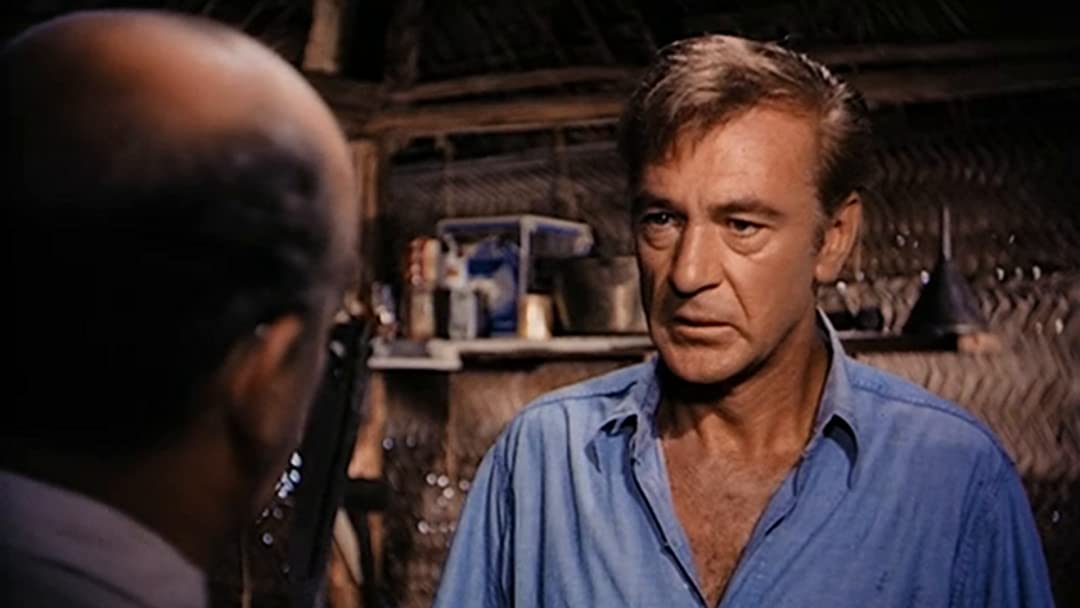
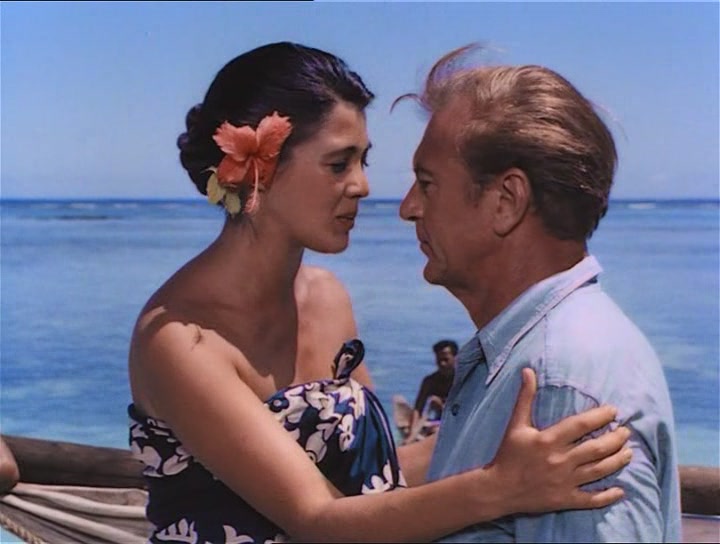
“Return to Paradise” may raise eyebrows today for casting the 50something Cooper as a drifter who washes up on an island where the stereotypical simple happy natives are under the thumb of a martinet of a second generation missionary (Barry Jones). Yes, the star was a bit old to be playing this sort of beach bum/vagabond, and pairing him up with a native girl (Roberta Haynes) half his age has a cringey quality.

But the film, taken from one of the “Return to Paradise” stories of the author of “Tales of the South Pacific,” and later “Hawaii,” packs a lot of code-challenging and societal mores-testing into its 100 or so minutes.

Natives returning to their pre-missionary social norms of skinny dipping and premarital sex, the drifter fathering a child out of wedlock, conservative church authority ridiculed for the Return to Puritanism that it was could be pretty racy stuff pre-“Peyton Place,” and feels closer in tone to pre-code films such as the notorious and oft-adapted “Rain.”

Film buffs may recall that that the race to deflower a virgin “romance” “The Moon is Blue” also came out in 1953, so the stodgy ’50s of lore had more of a blush to them than is commonly accepted.

A young adult schoolteacher (Hans Kruse) narrates the story, his memories of growing up in the early 1930s on Matareva, “an island in chains.”

The autocratic missionary Corbett took over running the church and the island when his father died. Whatever benevolence the original Christian immigrants, his parents, might have displayed has been replaced by a man who figures mandatory church services, curfews, clothing and moral codes are the quickest way to salvation, order and progress.

Which is why he enforces these with club-carrying goons he’s deputized to ensure everybody shows up for his prim fire-and-brimstone sermons.

Morgan (Cooper) is dropped off after hitching a lift from sailors who rescued him from another vessel that foundered. His laconic “I figured I’d try it for a while” view of staying is instantly challenged by Corbett, who is tone-deaf to the hypocrisy of his “White men are not welcome on this island” outrage. “They corrupt their (the natives) morals!”

Morgan isn’t having it, and brushes off the endless provocations of this “two bit Mussolini” and commences to pick a spot to slap up a hut. Just enough of the islanders sympathize with him, and recognize the needed challenge to Christo-fascism that he represents, to back him up.

When Morgan is attacked, the towering American fights back. He hasn’t hoboed for decades without learning how to throw a punch.

And thus the war of wills is joined, and the rebellious island girl Maeva (Haynes, actually 25 when this was filmed) is smitten.

The story’s parameters are set, with only Morgan’s itchy refusal to commit — to the island, long term, to Maeva, even though he sticks around after getting her pregnant — with only the clumsily-inserted coming war to replace the conflict that really drives the piece, the “infidel” Morgan vs. Corbett and his goons.

There’s a pleasant but trite change-of-heart when Morgan returns to the island years later, during World War II, and finds himself trying to protect the virtue of his daughter (Moira Walker) from on-the-make servicemen who can’t help but remind him of himself.

Even a writer as enlightened for his times as Michener couldn’t avoid bits of “white man’s burden” in his story, “Mr. Morgan,” and the movie make no bones about this. The natives have “lost our strength,” and only the manly Morgan can bring back its memory. There’s a patronizing “Lord Jim” in this Kipling-esque view of the white savior helping those simple, happy natives.

But the film’s early acts, with its conflict between totalitarian moral authority and “an infidel,” still play and pop off the screen. Cooper does his best not to show his age, and summon up a little of the “Aw shucks” of “Mr. Deeds Goes to Town” or “Sergeant York” to play this fellow who just wants “to be left alone.”

Whatever forward-thinking values were inculcated in Michener’s source material, the film itself can’t help but lapse into the dated and backward as it drifts into its last acts, the buttoned-down ’50s reasserting themselves after the opening acts’ “pre-code” romp.

Director Robson, best known for his film of Ring Lardner’s “Champion” when he filmed this, went on to make a Korean War drama “The Bridges at Toko-Ri” based on Michener’s novel, and even “Peyton Place” and “Valley of the Dolls.”

Cooper was finishing up a bracing period of his career which included “High Noon.” His short run as a screen patriarch (“Gentle Persuasion”) would be hastened by the abortive “middle aged playboy” turn in “Love in the Afternoon,” which just underscored how he shouldn’t play the guy who “gets the girl” any longer.

Cary Grant learned from Cooper’s mistakes. Eventually.

And “Return to Paradise,” coming after the Broadway musical “South Pacific,” would help sell Hollywood on Michener’s bankability, that he was tapping into the post-war public’s appetite for island stories. His pitch for a series sailing from island to island for “Adventures in Paradise” would come a few years later. Even John Ford’s shambolic but scenic “Donovan’s Reef” spun out an uncredited Michener pitch.

It wasn’t until “Centennial,” Michener’s mainland America epic, that everybody figured out that Mr. Thousand-Page Books was best suited for mini series treatment.

But you can still find the author’s themes, style and devotion to the romance and adventure of his war years in the South Pacific in “Return to Paradise,” a dated picture a little ahead of its time, just like the writer who inspired it.

Rating: “approved,” violence

Cast: Gary Cooper, Roberta Haynes, Barry Jones, Moira Walker, John Hudson, Mamea Matatumua and Hans Kruse.

Credits: Directed by Mark Robson, scripted by Charles Kaufman, based on a story by James Michener. A United Artists release on Tubi, Amazon and other streaming platforms

Running time: 1:29

Posted in Reviews, previews, profiles and movie news | Comments Off on Classic Film Review: Gary Cooper’s transgressive-for-its-time “Return to Paradise” (1953)

Movie Preview: Daniel Radcliffe is “Weird” in “The Al Yankovic Story”

If he didn’t learn to play the accordion as prep I’ll be very disappointed in “The Chosen One.” Very disappointed.

Roku has this fall release, which is great news. EVERYbody’ll see it. Well, those of us who love free (with commercials) teeVee, anyway.

Posted in Reviews, previews, profiles and movie news | Comments Off on Movie Preview: Daniel Radcliffe is “Weird” in “The Al Yankovic Story”

Movie Review: Chinese-Americans find love comes and goes “In a New York Minute”

“In a New York Minute” is a film anthology that tells three loosely-connected stories about the female Chinese-American experience in New York.

It’s a melodrama that traffics in diaspora generalizations that aren’t necessarily the most flattering, and whose messaging and level of connectivity isn’t wholly cleared up in its finale. But it’s an intriguing enough debut feature by director and co-writer Ximan Li that one hopes she gets to film another, even if this one is only now making its way to the public three years after its film festival run.

Amy Chang plays a 40ish New York food critic and editor whose last break-up has landed her in therapy with a disastrous malady for someone in her line of work. She can’t eat. Food triggers her, and the stress of that, her work, her loneliness and her mother’s stereotypical “When are you getting married/having kids?” nagging is pushing her to the edge.

This persistent, annoyingly solicitous colleague (Jae Shin) is giving her the full-court press — cooking “porridge” and broth for her, so under foot that the viewer is on tenterhooks waiting for the accomplished Amy to blow him off with extreme prejudice. She doesn’t.

Angel Li (Yi Liu) is a Chinese actress married to an older, somewhat disinterested non-Asian (Erik Lochtefeld) who gives off a “mail order bride” vibe. The visual prompts of their “loveless” marriage don’t paper over Angel’s mercenary ruthlessness in pursuing her own agenda. Her younger lover/screenwriter (Ludi Lin) is keeping his options open, hitting the clubs for “meetings” every night he can. Angel’s “What if I told you I was pregnant?” speaks volumes, even if she says “Just kidding” afterwards.

She needs a man to support her acting career, and if she was willing to marry some 50something white businessman to get what she wants, what else might she try?

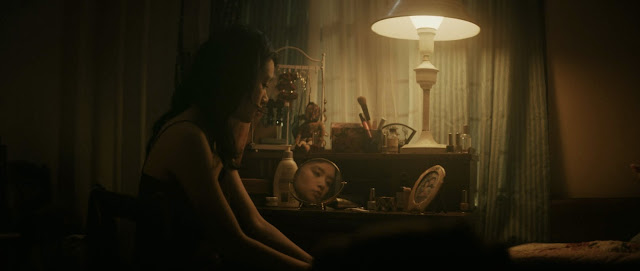
Nina (Celia Au) is a bottle girl, escort and sex worker whose love and main client is heading back to China, forcing her to take stock. She’s living above the family Chinese restaurant, and her money grubbing step-mother (Yan Xi) is making is making her pay for her father’s healthcare, underwrite her bratty step-brother’s education and pay back the small fortune they raised to buy/bribe her way to a visa out of China.

And there’s this down-to-earth food-truck operator Ian (Roger Yeh) whose American dream is his own place (restaurant) can be “our” own place. Her fellow sex-workers may remind her that “Nice guys don’t mix with girls like us.” But Ian’s offer has her dreaming and weighing the pros and cons.

Ximan Li’s first gimmick here is tying these three stories together. Two characters are neighbors, Amy’s magazine is doing “acted” video review/visits of restaurants they write about, which throws her and Angel together and Nina’s father’s restaurant is one of the places where these video reviews are shot.

The overlapping goes further than that, so much so that I had to rewatch portions of “In a New York Minute” just to see who winds up at whose karaoke “bottle” club table, who is ditching whom and just how Angel’s first New York indie movie — she plays a woman jumping off the Brooklyn Bridge, an impossibility, her screenwriter beau notes — fits into all this.

It does, just not all that neatly. Li takes few pains to underline moments and connections that make this tale told with a largely unknown cast to make sense.

And then there’s the second gimmick, Early Pregnancy Tests that the women whip out and brandish as pleas, threats or just revelations to their men. Is that like a New York thing, or more Chinese and Chinese-American?

The performances are gutsy insofar as the men generally come off as feckless and the women as somewhat faithless, not that Li isn’t presenting them as victims — each in her own way.

The muddled climax to the film underscores how frustrating the picture is. “New York Minute” is both intriguing and off-putting, with a couple of seriously unromantic proposals suggesting “arrangements” and “mergers” more than love. The viewer can freely wonder if anybody on the screen is capable of love, and if the film’s contrived “choice” facing its heroines, “love” or “freedom,” is any choice at all, or even if the words mean the same thing in East and West.

Rating: unrated, sexual situations, sex work, profanity, alcohol abuse

Cast: Amy Chang, Yi Liu, Celia Au, Jae Shin, Yan Xi, Ludi Len, Erik Lochtefeld and Roger Yeh.

Credits: Directed by Ximan Li, scripted by Ximan Li, Yilei Zhou. A Gravitas Ventures release

Running time: 1:42

Posted in Reviews, previews, profiles and movie news | Comments Off on Movie Review: Chinese-Americans find love comes and goes “In a New York Minute”

Movie Preview: Nostalgic Game Night goes all bloody and Jumanji when the game is “Gatlopp”

June 16, it’s your turn to “Go to hell.”

Posted in Reviews, previews, profiles and movie news | Comments Off on Movie Preview: Nostalgic Game Night goes all bloody and Jumanji when the game is “Gatlopp”

Netflixable? Premature Blandness, the curse of “40 Years Young”

The Mexican “40 Years Young (Cuarentones)” is a midlife crisis romantic dramedy that’s so slow that I had to check to make sure Netflix wasn’t experiencing screen-freeze.

Its 81 drab minutes pass by like a long, labored comic death rattle.

The cast is cute and seem to possess the light touch whatever they were going for requires. But nothing happens in this movie — nothing funny, nothing that dramatic, nothing particularly romantic. It’s 81 minutes of nada.

An opening scene establishes that Cesar (Erick Elias) and Paolo (Adal Ramones) are partners in a popular Mexico City Italian eatery, L’Allegria, where they’re not just the chefs, they’re the singing, joking, charming floor show. That’s one seriously open kitchen and one potentially entertaining way to connect with customers.

We only see this promising “concept” in one solitary scene.

They’re having money troubles, with Paolo’s two exes and kids back in Italy needing upkeep.

Cesar? Everything’s grand, with sexy wife Amelia (Ximena Gonzalez-Rubio), tween son Enrique (Ricardo Zertuche) and his mother around to see his success. They’re planning a big European vacation.

All it takes is one impending 40th birthday — Cesar’s — to take down the whole house of cards.

Actually, his 40th has little to do with that, even though he’s keenly aware that his father died at 40. He can be childlike forever, right?

“Forty is the new 12, after all.”

Only Cesar is not childish, not upbeat and not even that much fun. Imagine how he’ll be when he brags about his mother’s good health just before she drops dead, when Amelia introduces him to her ex, who’s been in prison for ten years and is probably the father of her son.

Perfect time to get away to sunny, sandy Acapulco, where L’Allegria’s duo will compete in a week-long cook-off with the best chefs in Mexico for “Delicacies” magazine’s $20,000 prize.

Cesar’s marriage is ending, the son he doted on isn’t his, he’s just lost his mother.

Maybe we should be surprised that he doesn’t set off sparks with vacationing Chicagoan Naomi (Gaby Espino) as Paolo is hitting on her BFF Selina (Sonia Couogh). But this is a rom-com, you know. Sparks are supposed to happen.

The central couple doesn’t click, the cooking scenes are abbreviated and practically food-free and the “contest” has little conflict, despite the snobby director of it (Miguel Pizarro) obviously having it in for these “entertainer” chefs.

“Your clients all leave…enchanted,” he hisses (in Spanish or dubbed into English), as if that’s a bad thing.

A trip to a romantic swimming grotto, a potentially romantic snorkeling trip and all we get is the barest glimpse of scenery and maybe a single scene with the potential to amuse or “enchant.”

And it doesn’t.

Rating: TV-MA, for no particular reason

Cast: Erick Elias, Gaby Espino, Adal Ramones,
Ximena Gonzalez-Rubio, Sonio Couoh, Ricardo Zertuche, Antonio Fortier
Miguel Pizarro

Credits: Scripted and directed by Pietro Loprieno. A Netflix release.

Running time: 1:21

Posted in Reviews, previews, profiles and movie news | Comments Off on Netflixable? Premature Blandness, the curse of “40 Years Young”

Movie Preview: Brits are haunted by the “Hollow”

Hard to get a bead on exactly what’s happening in this creepy trailer to a May 17 release.

Haunted place? Haunted people? An older woman with Alzheimer’s is hunted by a horror in Herefordshire.

Always alliterate.

Posted in Reviews, previews, profiles and movie news | Comments Off on Movie Preview: Brits are haunted by the “Hollow”

Documentary Review: Following the foot soldiers of the pandemic at Ground Zero — “Wuhan Wuhan”

It was a city remote enough from the rest of the world’s experience or knowledge of Chinese geography that we couldn’t place it on a map. But Wuhan’s name would enter the consciousness in infamy as a global pandemic burst out of this Hubei Province metropolis. It became a symbol of Chinese failings as a society and secretive totalitarian state.

Filmmaker Yung Chang’s “Wuhan Wuhan” is a documentary filmed by being embedded in the city of 11 million as “ground zero” of this devastating pandemic wrestled with COVID-19 and ordinary people faced up to the fear, the confusion and grim realities of a total lockdown.

Though other films have followed the drama of those earliest days there — “In the Same Breath” and “76 Days” — Chang’s film takes the unusual tack of personalizing the pandemic, and humanizing the first population trapped in it.

The “Wuhan Virus” and “Wuhan” as pejorative insult –American politicians who bungled and politized the pandemic were nicknamed “Wuhan Don” and “Wuhan Ron” — recede as we see put human faces on doctors, an expectant couple and others just coping with this extraordinary event that they didn’t cause any more than we did.

Jumping into the lockdown in Feb. 2020, we meet Yin, a factory worker on furlough who now works as a volunteer delivery driver for medical personnel, doctors and nurses he picks up from their homes or (in the case of those shipped in to help) from hotels to the city’s many hospitals and makeshift overflow wards in civic buildings.

A GoPro camera in his makeshift rideshare captures candid conversations between Yin and assorted unnamed “front line” responders. It’s “hard to see the end of this” right now, one nurse sighs. “The actual number (of infected and dying) is more than we know” right now, another admits.

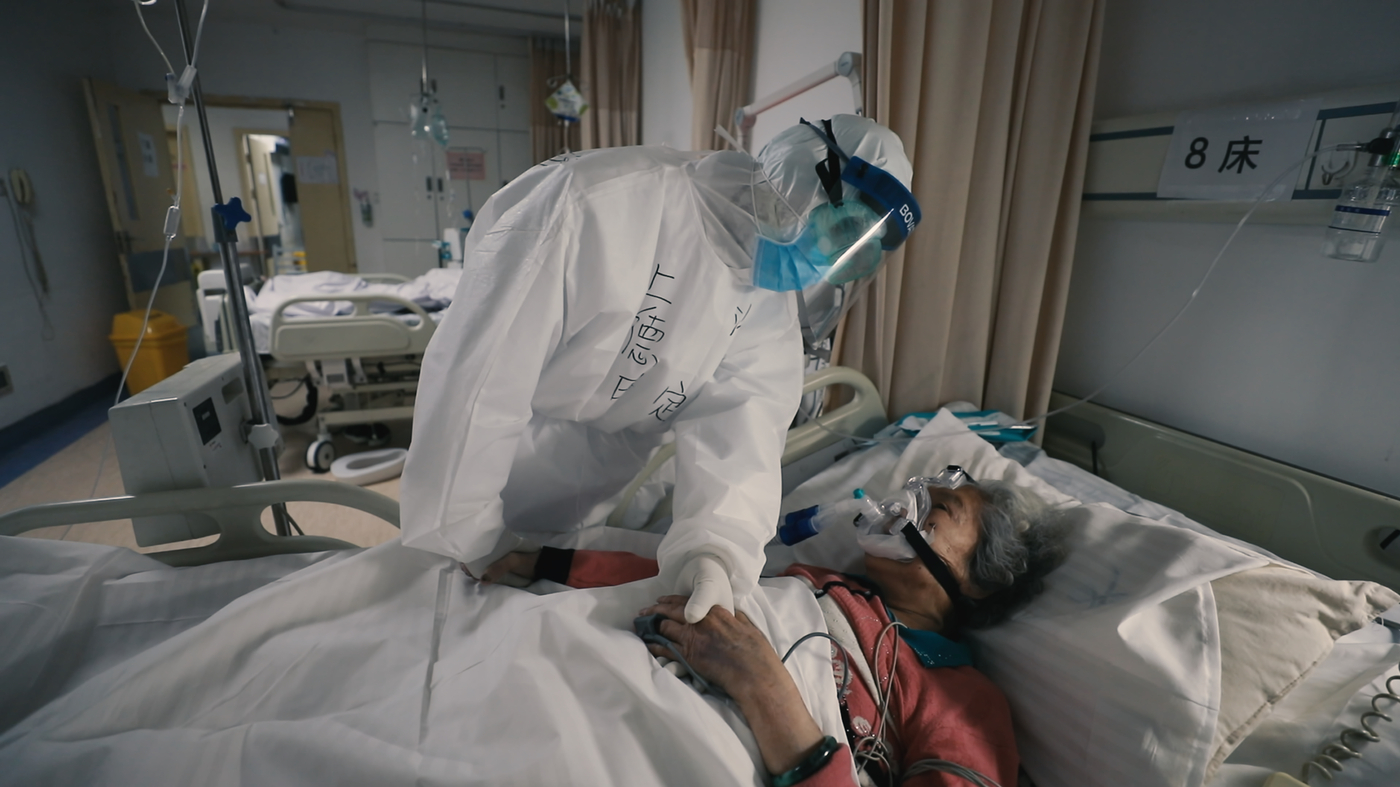
They are as exhausted as the many viral video testimonials that medical professionals in the West posted during their darkest days. But these people, wrapped in Personal Protective Equipment of a more DIY nature until they get to work where they don hospital-provided protection, are speaking out in ways we never hear the People’s Republic allow.

At home, Xi, Yin’s wife, is concerned, eating and craving meat as she is 37 weeks pregnant. She’s about to give birth and as more than one rider tells Yin, “a hospital isn’t safe to be in right now.”

We hear and see government public address vans ride around passing on information and instructions, a chilling bit of “1984” Big Brother-speak about the fact that “the state has implemented number twelve notice,” a lockdown, and that everyone is ordered indoors. “Contact your local committee” if you have questions.

In the hospital, patients gripe and family members advocate for and pitch in to help ensure good care of their children or spouses. An officious nurse calls a rebelling 50ish man’s wife when she’s had enough of his “To HELL with treatment, I’ll just die here!”

The patients, like the hospitals, are numbered — impersonalized. But we see the people behind the bureaucracy.

The ER chief at one hospital, Dr. Zheng, respectfully argues with higher-ups about the quality of Red Cross-donated PPE, and we see the exhausted staff’s work-arounds. Staff members use magic markers to write each other’s names and titles on the disposable plastic outer wear. Custom embroidered scrubs and lab coats and name tags are among the casualties of the emergency.

A patient who has been there a while comes to the filmmaker and gives an impromptu testimonial.

“He is the best doctor here,” she enthuses (in Mandarin with English subtitles). “I only know his voice. I’ve never seen his face.”

Chang’s film doesn’t give us much of an overview, doesn’t investigate or judge, doesn’t dwell on the unsanitary “live” markets where the disease made the jump from animals to humans (the “lab created” myth has been floated and shot down repeatedly in the past two years).

He just lets us see a Wuhan version of what we watched on the nightly news play out in New York at the peak of the pandemic and shows us the faces, the hopes and fears of those coping, at a personal level, with this awful event that’s taken over their lives.

And he lets us hear in Chinese what we’ve heard in English, French, Italian, German and Spanish, a phrase that became global as this contagion tore through humanity in wave after wave.

“This is the new normal now.”

Rating: unrated

Credits: Directed by Yung Chang. A Gravitas Ventures release.

Running time: 1:30

Posted in Reviews, previews, profiles and movie news | Comments Off on Documentary Review: Following the foot soldiers of the pandemic at Ground Zero — “Wuhan Wuhan”