Movie Review: Ashley Benson and Shiloh Fernandez face off over “Private Property”

A beautiful woman alone in her expensive home, a husband always tied up with business, a handsome gardener who sure would like to “cool off” in her inviting pool. And by the way, he’s got this…partner.

Sounds like a porn pitch, right? So tried and true it could be from the ’60s.

“Private Property” wears this odd, out of its era mantle for a good reason. It’s based on a fairly notorious 1960 psychosexual thriller that featured the young character-actor/legend in the making Warren Oates.

Writer-director Chadd Harbold’s attempt to update a film that was salacious for its time manages to maintain some of the menace in that scenario, but he and his cast fail to make the voyeurism and sexual tension that the original film is known for seem anything other than quaint.

In telling the story out of order — “The Day Before,” etc. — this version becomes all about plot twists and back story and less about the lust-triangle dynamic that gave it tension, danger and notoriety in its day.

Ashley Benson of “Spring Breakers” is Kathryn Carlisle, a Laurel Canyon “actress, sort of…trying to be…aspiring.”

Married to a producer (Jay Pharaoh) who makes no effort to further her career as he tends to his, she spends her days in the comfort of luxury. One suspects that she cleans her own house out of guilt, to remind her of the devil’s bargain she made to get this life and how it isn’t working out.

She does her laps in the pool and chats with her Jorge the gardener, alone with her thoughts unless she’s nagging her agent for a role, or recording a sordid confessional scene for a video audition.

But a call tells her Jorge is “no longer” with her service. His replacement (Shiloh Fernandez, last seen in “The Birthday Cake”) seems eager to please. He talks a very good game.

“I want my clientele to treat me as a valued collaborator on their home,” a “landscape architect.”

Kathryn tries to rebuff this over-familiarity. But the handsome stranger does her a solid when he picks the lock to let her back into the house she’s locked herself out of. Next thing we know, he’s asking for a dip in her pool and she agrees.

Her condescending “a regular Renaissance man” crack at his “rapper” ambitions mean she’s blown right by his suggestive “I’m pretty good at most physical stuff” innuendo. But his snappish pride keeps her off balance and eager to mollify.

She doesn’t know this guy isn’t a gardener. She hasn’t guessed that he’s broken in next door. Even after she meets her “new neighbor” (Logan Miller) in the company of her new gardener, she can’t piece together the threat or recognize that she’s been targeted.

Fernandez ably pulls off the “yeah, I’ve been in jail” tough that this guy Duke is supposed to be. In “day before” or “two days before” flashbacks, we totally buy him intimidating a store owner out of drinks and pulling a switchblade on a tech guy (Frank Whaley) driving a vintage Buick Electra convertible.

But their best efforts aside, there’s not enough in the film to make me buy into the whole Duke and Oates — the real-names of the guys stalking Kathryn — dynamic, the prison-hardened lady killer lording over the creepy virginal simpleton under his thumb.

Benson, attired in bikinis, short shorts and the like, is presented as a sexual temptation/object of desire/target. But there’s little chemistry between this lonely, spoiled woman and a guy easy to identify as underclass trouble. Yes, she’s talking bluntly about a sexual encounter in a bar restroom in her opening narration. That’s an audition, right? The walk on the wild side seems not part of her makeup or even a personal fantasy, just something she says to the camera.

Without the heat their rising temperatures are supposed to generate, “Private Property” struggles to find its footing and never escapes the feeling that we’re watching something out of date. Sex or sexual assault, both earn a demure treatment here. Little is done with the class conflict, the “movie business” tie-in is an awkward afterthought.

And in making this all about the plot, “revealed” in flashbacks, when the key weapon is clumsily and obviously foreshadowed in the opening scene makes this “Private Property” fail long before closing.

Rating: Rated R for some violence, language and sexual references

Cast: Ashley Benson, Shiloh Fernandez, Logan Miller, Jay Pharaoh and Frank Whaley.

Credits: Scripted and directed by Chadd Harbold, based on the 1960 film written by Leslie Stevens. A Lionsgate release.

Running time: 1:28

Posted in Reviews, previews, profiles and movie news | Comments Off on Movie Review: Ashley Benson and Shiloh Fernandez face off over “Private Property”

Movie Preview: Punk rock love and violence and…food? “Dining in America”

This Sundance entry has a serious fizz about it. This Red Bandish trailer has three or four good giggles in it. Dining in America ” comes our way May 27.

Posted in Reviews, previews, profiles and movie news | Comments Off on Movie Preview: Punk rock love and violence and…food? “Dining in America”

Movie Preview: A Zoom thriller starring Anthony Hopkins? “Zero Contact”

A doomsday conspiracy thriller with Hopkins directing his “team” to save the day, from beyond the grave?

Not a big name in the supporting cast. But just the sort of movie you can make in a pandemic. Self quarantined.

Could be could good. May 27 we’ll see.

Posted in Reviews, previews, profiles and movie news | Comments Off on Movie Preview: A Zoom thriller starring Anthony Hopkins? “Zero Contact”

Movie Review: Ricci plays a Mother protecting her boy from something “Monstrous”

A somewhat frazzled turn by Christina Ricci and the ambition to try a big third act plot twist are the chief recommendations of “Monstrous,” a 1950s horror tale about a mother trying to save her son from something not wholly unlike the Babadook.

That’s where this Chris Siverston (“I Know Who Killed Me”) thriller seems to be taking us — a child sure there’s a “monster” outside his window, the supernatural allure of this “beautiful lady” he saw in the spooky pond out back, his mother trying to start a new life in a new town with a new job when this “Monstrous” Swamp Thing happens to her kid.

When Laura stops telling Cody (Santino Barnard) it was “just a nightmare,” she finds herself yanked underwater while sitting on the sofa, diving into the pond to pull her kid out, or facing down the monster with a knife.

The creepy bits — water flowing into the house, under doors, menacing mother and child — and the jolts don’t muster up the terror of “The Babadook,” sort of a genre-defining take on this mother-child set-up. But shortly after we give up on that direction ever bearing fruit, that “twist” appears and changes the reality of what’s going on and the meaning of the picture, even as it leaves things less tidy and even less satisfying than the opening acts.

Ricci’s Laura, dolled up in the dirndl dresses of the day — prim and proper and permed — is on the lam with seven year-old-boy Cody. They’ve fled Mesa, Arizona and Laura’s soon-to-be-ex, moving into a remote rented farmhouse in the brownscape that is drought-stricken Southern California.

The ex calls their new number, rattling Laura. Her mother, like other ’50s mothers, doesn’t see the harm. Laura’s moved on and fearful. Still, she’s got a job as a typist for an insurance firm. Cody’s started at a new school.

Then the weirdness begins. The kid is transfixed by the lake, and prone to night terrors. There are water issues in the house that play into the nightmares. The landlord’s assurance that it’s “probably a raccoon” comforts no one.

Quick! Call a Catholic church! But mention “I think we have a demon” and they hang up on you.

Screenwriter Carol Chrest’s (“The Prophet’s Game”) story dithers between the horrific and the unpleasant but mundane. Is Cody being bullied? Will anybody come to his birthday party?

And who is this “beautiful lady” he keeps talking about down at the pond?

Ricci gives us a little paranoia and barely enough panic to engage us in her plight. She’s good, but the performance has an element of “hold something back for the third act” about it.

The film has clues here and there, which don’t really add up to the big upend-the-story turn it takes.

The jeopardy is built-into the situation, but the frights feel low-stakes and simply don’t get the scary job done. And then the movie becomes something else, something not wholly unexpected and something not necessarily more interesting than the stumbling supernatural kid-in-peril tale that “Monstrous” makes us think it is going to be.

Rating: PG-13 for terror, thematic elements and brief violence

Cast: Christina Ricci, Santino Barnard, Don Durrell and Colleen Camp

Credits: Directed by Chris Siverston, scripted by Carol Chrest. A Screen Media release.

Running time: 1:28

Posted in Reviews, previews, profiles and movie news | Comments Off on Movie Review: Ricci plays a Mother protecting her boy from something “Monstrous”

Documentary Review: Can Bruce “Mau” save the world by design?

“Mau” is a documentary about the Canadian thinker, futurist and designer Bruce Mau, a man who wants to make the world realize “your life is a designed life.” And if the design of that life, this profession, that cultural practice or this “system” — labor, transportation, housing, environmental stewardship, government, etc. — isn’t working, there’s no reason to despair.

“We can redesign it. We have the capacity to change the world.”

If that sounds like the world’s most optimistic TED Talk, well that’s a fair label. “Mau” is mostly Mau talking, in fresh interviews and archival news reports, with others in his orbit singing his praises, and a collection of long anecdotes of how he was handed big problems that he was able to synthesize into an idea that might fit on a button.

“Think forever. Design for perpetuity.” “Break through the noise.” “Compete with Beauty.” “Your responsibility (as a designer) is to inspire people.”

Mau, who “designed” his life to get out of an abusive home in the Canadian mining town of Sudbury in northern Ontario and become one of the world’s most influential Big Thinkers, is often tagged as a great communicator, and a “naive utopian.”

But over the decades, if your soft drink company (Coca-Cola) wanted to rethink its business and rebrand itself as “sustainable,” if your government wanted to end the chaotic crowding that occasionally leads to Hajj stampedes and mass death at Mecca, if your country wanted to shed its past and bring back “the ability to dream,” Mister Outside-the-Box has been who you call.

“Cynicism is for others,” he preaches. He’s started a short-term school he named The Institute Without Boundaries.” He tried to get civil war-torn Guatemala to think of itself as “Guate! Amala!” so that the populace could look to the future with hope. And when asked to come up with a “10 year plan” to lessen traffic issues at the most sacred site in Islam, he proposed a “1000 Year Plan” that would get pilgrims into the country, and spread them over a string of redesigned entrances to the city in a way that would alleviate dangerous crowding no matter what mode of transport the future holds.

Mau’s “Massive Change” design show of 2005-6 pushed big ideas at big problems. And his “Massive Action” follow-up, planned for China a couple of years back, would look for ways to empower everyone to make a positive impact on the world’s most alarming problems — climate change and “sustainability” topping that list.

That’s a through line of the film, that Mau’s best pitches — like the ideas of Buckminster Fuller, Asimov and Arthur C. Clarke and others who think about the future — aren’t adopted, and that a lot of these initiatives can look like failures.

Saudi Arabia and the Islamic world bristled at the idea of a Kingdom-hired Canadian having anything to do with Mecca. China canceled the big “Massive Action” exhibition due to a freeze in Chinese-Canadian relations.

The barrel-chested Mau has had health scares forcing him to “redesign” the way he feeds, rests and exercises his body.

But giving up on any of these isn’t in his makeup or his philosophy. When you’re “challenging the old narrative,” there’s going to be pushback. Some people in Guatemala like the never-ending civil strife, or are threatened by any outsider commissioned to do what they can’t.

The idea — win, lose or gradually changing direction, is to focus “net positive design” in life, community, career and climate, to make a start and stick with it.

The film doesn’t do the best job of visualizing Mau’s ideas. We can see what he planned for Mecca, but other concepts and pitches are simply not as cinematic. “Mau” plays like most TED Talks. “Performance” only takes not-quite-concrete concepts so far.

Journalistic cynicism demands that one notice that PET soft drink bottles still cover the planet on land and sea, that the big problems only seem to grow thanks to a culture distracted not just by “Lady Gaga” and the doom-and-gloom evening news that Mau complains about, but by existential threats Mau and this film do not address — the global assault on democracy, the reverse of his “Free Women” platform for “Massive Change” that is happening even in the industrialized West.

But “Mau,” which tells a short version of the designer’s life story and early triumphs, dwells mostly on his ongoing crusade, accentuating the positive. The man insists that as we’ve designed these messes, we can design our way out of them.

Call him a Pollyanna if you like. This might be the hardest time in recent history to hear and listen to someone like him. But “Mau” has the audacity to suggest it could be the perfect time, as well.

Rating: unrated

Cast: Bruce Mau, Paola Antonelli, Bisi Williams, Frank Gehry, Rem Koolhaas, Bjarke Ingels

Credits: Directed by Benjamin Bergmann and Jono Bergmann. A Greenwich Entertainment release.

Running time: 1:17

Posted in Reviews, previews, profiles and movie news | Comments Off on Documentary Review: Can Bruce “Mau” save the world by design?

Netflixable? Revenge thriller “Thar” tries to revive the Old West in Modern India

The thriller “Thar” is a reminder that Sergio Leone’s Westerns can be adapted to any setting, and that nepotism isn’t just a Hollywood thing.

“Thar” is a plodding desert borderland tale of drugs, murder and revenge, decorated with gunplay, gruesome torture and sex. There are horses, sure. But in this 1985 story they’re supplanted mostly by jeeps and motorbikes. The desert setting is the one separating India from Pakistan that gives the film its title.

And we have to label this a “Western” because the police procedural touches in this “case” are a shrugged-off afterthought.

It opens with a furtive night of illicit sex between a young woman about to be married off and the lover she’ll be leaving behind in remote Munabao, passion interrupted when her family is robbed and slaughtered.

No, she can’t identify the attackers.

Then a goatherd is killed outside of Munabao, a town so dry even the weeds have trouble staying alive. But Suva wasn’t just murdered. An ear was sliced off and he was gutted and left hanging from a tree.

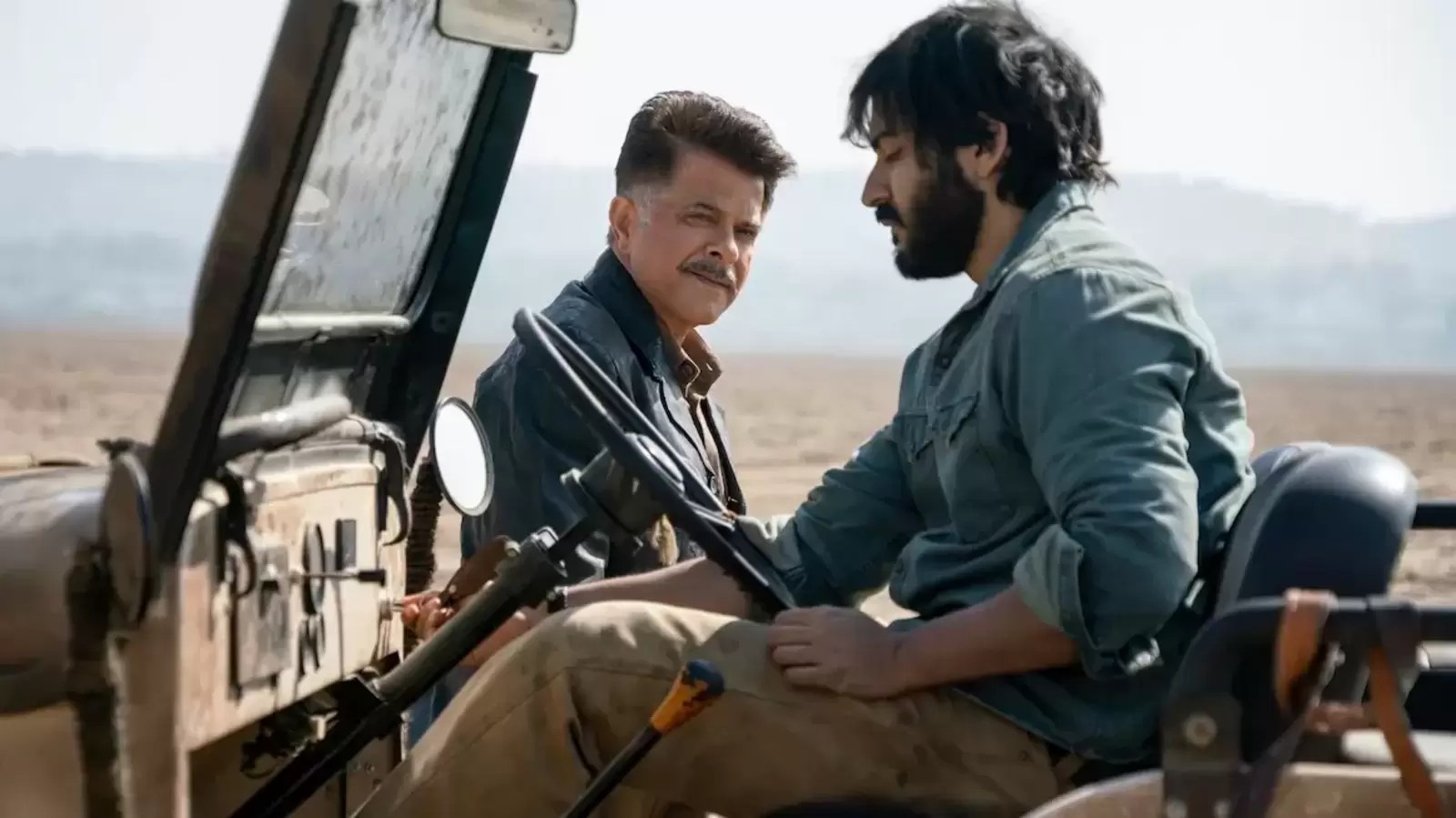
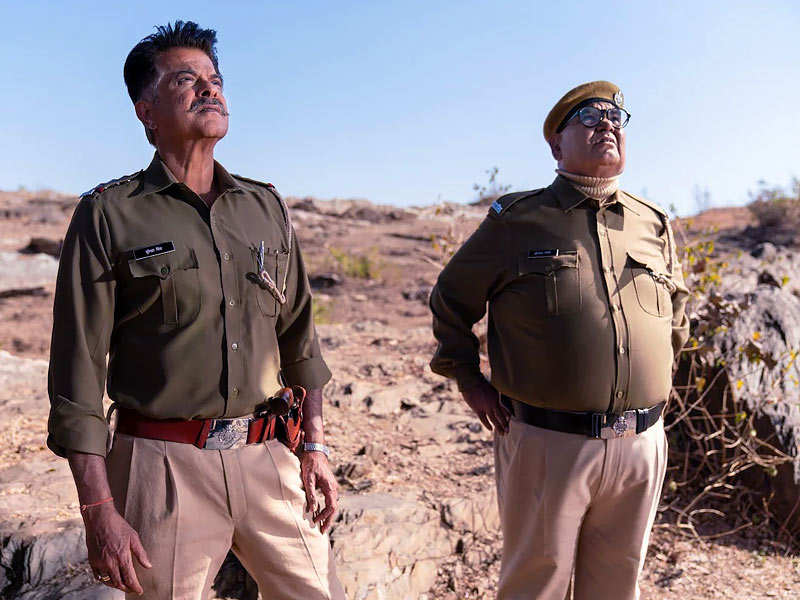
“Someone was sending a message,” the grizzled narrator/police inspector Surekha (Anil Kapoor) mutters (in Hindi, or dubbed into English).

Surekha is about to retire from this sleepy, low-crime posting. But now he and his plump lower-caste lieutenant (Satish Kaushik) have real crimes and government officials who want the perpetrators identified “and everybody killed” to “close the book” on this case.

Just local “dacoits,” Indian bandits settling a score? Drug dealers from across the border in Pakistan? A local feud? And who is this nearly-silent stranger ( Harshvardhan Kapoor, son of Anil), asking around about men he wants to hire for “a job” moving “antiques?” He’s spending a little too much time questioning the wife (Fatima Sana Shaikh) of one of the men he wants, the locals think, seeing as how that husband is out of town.

Somebody “knows” something about some of this, or all of it. But nobody talks.

“A different breed of vulture is circling our Munabao.”

Director and co-writer Raj Singh Chaudhary parks his archetypes in a desert setting, and takes his sweet time pointing this picture towards the obvious conclusions he knows we’ll draw. He doesn’t develop the blind alleys for the slow-footed cops to pursue. We spend little time with the drug lord (Rahul Singh) and the armed horsemen who might be responsible for all this.

No, let’s only focus on the mysterious stranger, his motives and actions. Not that the cops zero in on the guy nobody knows.

The sadistic violence that breaks out from time to time is practically on another timeline. His sidekick may call Detective Inspector Surekha a “genius,” but there’s precious little here to back that up. He has hunches but barely bothers to collect evidence. He leaps to conclusions while missing the obvious.

Kapoor, a chiseled icon of Indian cinema, plays this guy with a glib growl, a ready-to-retire cop “excited” about his job, at long last, blithely ignoring the body count piling up on his watch. Give him Raybans and he could be David Caruso, a cop just waiting for the next opportunity to drop a tasty one-liner, although there aren’t many of those.

His son’s character, Siddharth, is so thinly sketched-in as to barely amount to an archetype. We see his actions, but nothing about the character gives away emotion and begs for our investment in him. The script is much more concerned with filling the third act with his motivations for doing what he’s doing. That doesn’t help Kapoor the younger show us anything other than his smoldering good looks.

The few jeep chases and shootouts are almost on a par with action pictures from anywhere. The gunplay isn’t that convincing and the pacing even in the most exciting moments is leisurely.

And the inclusion of sex scenes show more Western influence on Indian cinema, at least on movies made for Netflix.

But “Thar” never quite gets up the head of steam that a generic thriller whose ending is pre-ordained needs to pass muster. When we know where it’s going, extra effort has to be made to distract us until that moment we get there.

People are disappearing and dying gruesome deaths and there’s zero urgency in the heroes, the villains, the bystanders and officialdom) to do much about it.

And the occasional attempt at creating an iconic Leone-style Western image never overcomes the “shot quick” and “filmed digitally” handicaps that keep the striking settings of “Thar” from taking on the sheen of a “Once Upon a Time in India.”

Rating: TV-MA, torture, gun violence, sex, profanity

Cast: Anil Kapoor, Harshvardhan Kapoor, Fatima Sana Shaikh, Jitendra Joshi and Satish Kaushik

Credits: Directed by Raj Singh Chaudhary,  scripted by Raj Singh Chaudhary and Anurag Kashyap. A Netflix release.

Running time: 1:48

Posted in Reviews, previews, profiles and movie news | Comments Off on Netflixable? Revenge thriller “Thar” tries to revive the Old West in Modern India

Movie Preview: An African dystopian sci fi musical — “Neptune Frost”

Kino Lorber picked this film festival darling up for June 3 release.

Striking and unlike anything else “out there?” Oh yes.

Posted in Reviews, previews, profiles and movie news | Comments Off on Movie Preview: An African dystopian sci fi musical — “Neptune Frost”

Movie Preview: A movie about podcasts, music and “collecting sound” — “Poser”

Posting this again as this intriguing title now has opening dates — June 3 and June 17.

Check it out. Looks and SOUNDS fascinating.

Posted in Reviews, previews, profiles and movie news | Comments Off on Movie Preview: A movie about podcasts, music and “collecting sound” — “Poser”

Movie Review: Fargo and Fargoans are still punchlines in the making-bad-theater farce “Tankhouse

“Tankhouse” is the sort of indie comedy one often encounters in film festivals. Come up with a daffy setting and/or conceit, sign a few “names” (Joey Lauren Adams, Richard Kind and Christopher Lloyd) for bit parts to get it financed. Film it on the cheap in an out-of-the-way place, push it onto the film festival circuit and hope a distributor picks it up.

It’s a farce about acting and pretentious actors set “North of Normal,” aka Fargo, North Dakota, with a script that’s somewhat south of Christopher Guest, whose late, lamented ensemble farces began with a send up of bad small-town theater, “Waiting for Guffman.”

Hit or miss, miss or hit, “Tankhouse” would seem a natural for festivals in Sarasota or Charlottesville, Little Rock or Fargo, seeing as how it’s a comedy revolving around the art deco Fargo Theatre. That’s where “Tankhouse” is slated to premiere tonight, a venue that’s also host to the Fargo Film Festival.

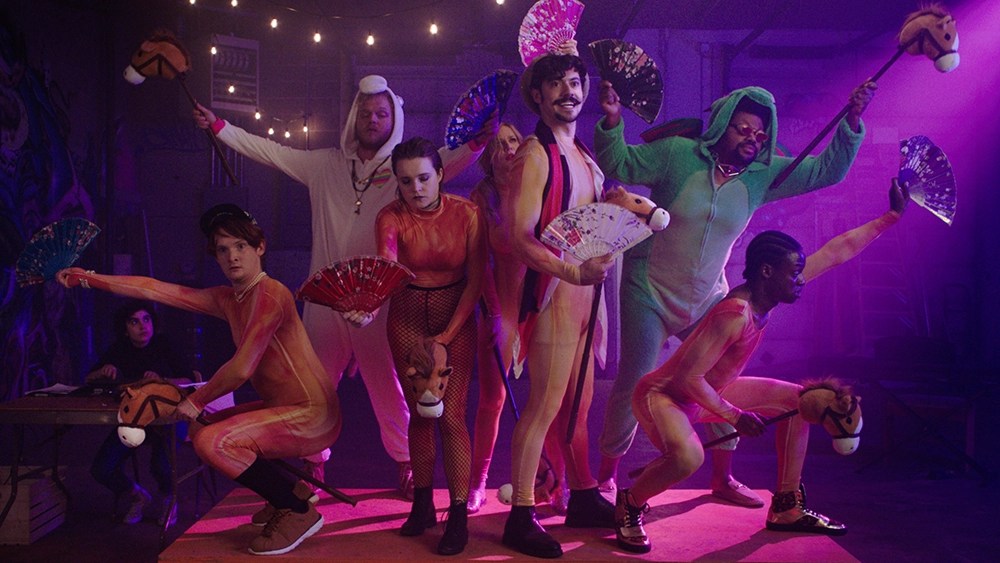
Two little-know stars — Tara Holt and Stephen Friedrich — play struggling New York actors who’d be the last to admit they’re “struggling,” students of the avant garde who practice “immersive theater attack” acting, dragging the audience into their leotarded iambic pentameter nonsense wherever the space allows theater to “happen” — in a large public restroom, on a rooftop.

Tucker Charlemagne (Friedrich), as he bills himself, is director, actor and dramaturg with The Confidential Collective, a troupe associated with the Artist’s Atelier, run by ancient acting teacher Buford (Lloyd). Buford is pretentious, Tucker more so. Sandrene (Holt)? She’s pretentious by association.

An accident during one of their rooftop shows leads to a company coup, and the two stars are kicked out. As her parents (Joey Lauren Adams of “Chasing Amy,” and Andy Buckley) aren’t willing to prop up their pipe dreams any longer, there’s nothing for Sandrene and Tucker but to decamp to Sandrene’s hometown, Fargo, where there’s a competition to select the resident theater company for the famed Fargo Theatre.

They need to recruit a cast from open mike night at the local Sons of Norway lodge. They’ll have to rehearse in the old distillery room, “tankhouse,” out back, where manager (Alas!) Yorick, played by Joe Adler in a thick accent, ferments homemade aquavit, just like they drink and/or refill car batteries with back in Scandinavia.

All they have to do is beat out Sandrene’s old high school drama teacher (Richard Kind) and his Gilbert & Sullivan-loving Red River Players — “Cowards! Conformists!” Tucker labels them — and they’ll have a place to make theater and launching spot for their theater “revolution.”

The players will need to foil dirty tricks by the “sweet” old drama teacher they’re in competition with. They’ll need to master “theater of movement” and the teachings of “Lee” to be competition-ready. But um, who’s “Lee?”

“Lee! Lee STRASBERG! The founder of ‘The Method!'”

“‘The Method?’ Isn’t that what killed that ‘Joker’ guy?”

“YES! That’s how you knew he was doing it CORRECTLY!”

This, perhaps the best dead Heath Ledger joke ever, is the funniest line in “Tankhouse.”

Director and co-writer (with Chlesea Frei) Noam Tomaschoff uses animation, the overly plummy, unironic Master Thespian voice-over narration of Tucker Charlemagne and assorted theatrical “types” and situations to deliver laughs, and frankly not enough of these elements pay off and the picture staggers to a halt just over halfway in.

But “Tankhouse” had possibilities. It’s set in Fargo, even if makes very little comic hay out of the accent or culture shock the city and state still embody. It taps into something theater fans and indie comedy buffs will recognize and instantly puts us on its wavelength. We’ve all run into a “Tucker,” in the cities or in the provinces, “making THEA-tuh” and dreaming dreams.

“This could be our GLOBE! But you know, less flammable!

I saw my first “avant garde” theater in North Dakota, and sipped (and spat out) my first aquavit there. I’ve been to plays staged in storefronts, alleys and on rooftops. And a well-established theater I’ve been to in a small Florida city was set up in an old icehouse and is thus named “The Icehouse.

Like Guest’s “Guffman,” the situations are recognizably real and within-the-realm-of-possibility daft, and the cast is game if not nearly as funny as Guest’s repertory company.

The script, alas, runs out of funny situations too quickly, and without those, funny lines become sparse as “Tankhouse” lurches into the later acts towards its wholly inevitable conclusion.

I dare say more research would have helped the co-writers. Stop by any community theater/Little Theater /experimental commercial or academic “Black Box” theater in North America and you’d hear funnier anecdotes than much of what’s portrayed here.

Parking your leads in front of a sign that says “Welcome to Fargo, North of Normal” isn’t enough, although as the Coen Brothers could attest, Fargo is one of the great city-names-as-punchlines — like Walla Walla, Oshkosh or Okahumpka.

But that’s the thing about punchlines. You can only use them once, and you can’t let them die of loneliness.

Rating: Rated R for some sexual references

Cast: Tara Holt, Stephen Friedrich, Austin Crute, Devere Rogers, Luke Spencer Roberts, Sarah Yarkin, Alex Esola, Nadia Alexander, Rachel Mathews, Joe Adler, Joey Lauren Adams, Richard Kind and Christopher Lloyd.

Credits: Directed by Noam Tomaschoff, scripted by Noam Tomaschoff, Chelsea Frei . A Vertical release.

Running time: 1:33

Posted in Reviews, previews, profiles and movie news | Comments Off on Movie Review: Fargo and Fargoans are still punchlines in the making-bad-theater farce “Tankhouse

Movie Preview: “Avatar: The Way of Water”

If you caught “Doc Strange 2” you saw this in the previews.

Just in case you didn’t.

Posted in Reviews, previews, profiles and movie news | Comments Off on Movie Preview: “Avatar: The Way of Water”