Next screening? Jessie Buckley and Rory Kinnear consider the horrors of…”Men”

Buckley’s a widow persecuted and tormented over her late husband’s suicide in a patriarchal piece of Britannia that feels like the main plank on any “War on Women” party’s political platform.

There or here.

Writer-director Alex Garland broke out with “Ex Machina,” and didn’t lose a lot of ground with “Annihilation.”

“Men” opens Friday.

Posted in Reviews, previews, profiles and movie news | Comments Off on Next screening? Jessie Buckley and Rory Kinnear consider the horrors of…”Men”

Classic Film Review: Robert Redford IS “Jeremiah Johnson” (1972)

Sorry for the dated movie poster-styled headline. But as the silliest Twitter trend of last week was some youngling’s assertion that “I was this minutes old when I found out Robert Redford was ‘Jeremiah Johnson,'” one does feel the need to state the obvious.

That’s Twitter for you, a regular Algonquin Roundtable of wit and deep cinematic wisdom. And you wonder why I put links in all my reviews, defining this or historically identifying that. It’s ridiculous to expect somebody born any time after say Bill Clinton’s inaugural to automatically have absorbed a century of cinema history.

Although, as Redford was clean shaven for two sequences in this 1972 film, and being the biggest star in Hollywood for a stretch of the ’70s, and a leading man pretty much to this very day, let’s just say our tweeter was either being cute and disingenuous or stupid.

“Jeremiah Johnson” came along after the first Earth Day and the birth of the environmental movement and at the tail end of the hippy “back to the land” ethos that took hold in the late ’60s. It’s a 1970s zeitgeist Western easily conflated with the attitudes and mores and movies and TV shows of its time.

There’s respect for Native American culture and customs of a “Little Big Man” variety, even though casting white actors as Indigenous people was very much prevalent. The title character is a soldier who’s turned pacifist, with a desire to leave all that’s “down there” in the States. It wasn’t the first film to venerate the solitary “Mountain Man,” but it was the best. Its success inspired the less hunting/trapping/killing oriented kids’ TV movie and series “The Life and Times of Grizzly Adams” a couple of years later.

And despite some seriously dated 1970s touches — a couple of theme-songish tunes (by Tim McIntire) wafting in and out of a few scenes — it holds up pretty well.

Tough guy screenwriter and later “Conan the Barbarian” director John Milius had a hand in the script, which grafts a bloody short story (“Crow Killer”) of revenge onto the basic structure and plot of a novel about a mountain man’s life in the unpacified West.

The time setting is sometime after the War of 1812 and right up to the Mexican War (1840s), which is referenced. Redford’s title character shows up in uniform at an upriver wharf in the Colorado Territory, loads up supplies and heads off, looking for beaver and such to trap.

 “Ride due west as the sun sets,” a storekeeper advises. “Turn left at the Rocky Mountains.”

Those who love this film, and I count myself among them, tend to remember it in episodes which in my case I have to say turn up out of order, something I realize any time I see it anew.

There’s his first encounter with a Native American. Paints His Shirt Red (Joaquín Martínez) is a stern, noble warrior underwhelmed by the white man’s fishing and trapping skills. Jeremiah memorably comes upon the trapper Del Gue (the wonderful character actor Stefan Gierasch, omnipresent in the ’70s), a bald blowhard buried up to his neck in sand by less friendly tribesmen.

That’s the way Pollack, Milius and co-writer Edward Arnholt structure this, with Pollack casting colorful supporting players for Redford to play straight-man to in many of the scenes.

Character actress and TV regular Allyn Ann McLerie plays the saddest of these, a settler who has gone mad because of the slaughter the Crows have visited upon her family. Redford has his first choice close-up here as he sobers her up, if only for a moment.

“Woman…We have graves to dig.”

But the scene stealer among scene stealers in “Jeremiah Johnson” is that long-blacklisted leftist, Grandpa Walton himself, Will Geer. As the old timer/mentor figure covered in fur and beard and bear-teeth, he is a “grizz” hunter, a collector of fangs, long in the tooth and loud of the mouth when it comes to dealing with this “pilgrim” on his turf.

 “I am Bear Claw Chris Lapp; bloodkin to the grizzer that bit Jim Bridger’s ass! YOU are molesting my hunt!” And “You’re the same dumb pilgrim that I been hearin’ for twenty days, and smellin’ for three!”

Geer is the highlight of the movie, although there are other colorful moments and characters, and plenty of blood-sport and action in the vengeance-packed third act.

Pollack had a deft hand with lighter moments, which made Redford his perfect muse. Watch the way the “pilgrim” falls down most every time he has to fire that .50 caliber rifle at something or someone.

Redford had already fallen in love with Utah thanks to “Butch Cassidy and the Sundance Kid,” and what’s striking about “Jeremiah” all these years later is the epic feeling that what is essentially an intimate and episodic story gets across. Pollack made a BIG movie with stunning scenery, “Doctor Zhivago” depth snow, Indian fighting and a touch of domesticity that — along with the use of the hymn “Shall We Gather at the River” (Redford SINGS!) — feels like a nod to the Western master, John Ford.

All this scenery and sky and seasons and action and reflection, and the the picture still clocks in well under two hours. Suck on that, Marvelettes.

Pollack and Redford would work together often, as you’d expect of a director of romances (“The Way We Were,””Out of Africa”) and a guy he helped make the great matinee idol of his day. They made seven films together, including two that were among Redford’s edgier pictures of his heyday — the spy thriller “Three Days of the Condor” and the even flintier “Jeremiah Johnson.”

For years, Redford was lightly regarded as an actor and you can sense that “lightweight” label, just a tad, and a comfort in sharing scenes with actors given more colorful roles, in this performance. His line readings of the archaic speech may not sound as natural as you’d like. He has “modern Californian” baggage that was hard to shake back then.

But I think it’s among Redford’s most endearing and enduring performances, a sensitive yet heroic figure, a man out of his depth who has to grow and revert to a form of savagery to master it. Who cares if his period-appropriate farewell isn’t the smoothest line reading ever?

“Watch yer topknot,” Bear Claw growls, a hair joke related to avoiding being scalped by the Natives.

“Yep. Watch yourn.”

Rating: GP, the PG of its day — violence.

Cast: Robert Redford, Will Geer, Dell Bolton,
Allyn Ann McLerie, Joaquín Martínez, Josh Albee, Matt Clark and Tanya Tucker.

Credits: Directed by Sydney Pollack, scripted by John Milius and Edward Anhalt, based on a novel by Vardis Fisher and a short story by Raymond W. Thorpe and Robert Bunker. A Warner Brothers release on Amazon, Tubi, Movies! and other streamers.

Running time: 1:48

Posted in Reviews, previews, profiles and movie news | Comments Off on Classic Film Review: Robert Redford IS “Jeremiah Johnson” (1972)

Movie Preview: The “Predator” prequel pitting the alien hunter against Native Americans is coming to Hulu

At one point, this 20th Century release was slated for theatrical, right? Am I misremembering that?

Sure, it’s a no-stars/all action-VFX genre thriller. But cinema fans would show up, I dare say, if we’re not back in the middle of a Southern governor-driven sabotage-rebound of the pandemic. Still, Hulu it is.

Aug. 5.

Posted in Reviews, previews, profiles and movie news | Comments Off on Movie Preview: The “Predator” prequel pitting the alien hunter against Native Americans is coming to Hulu

Netflixable? Lucy Hale flees drug smugglers in the desert, a “Borrego” chased by lobos

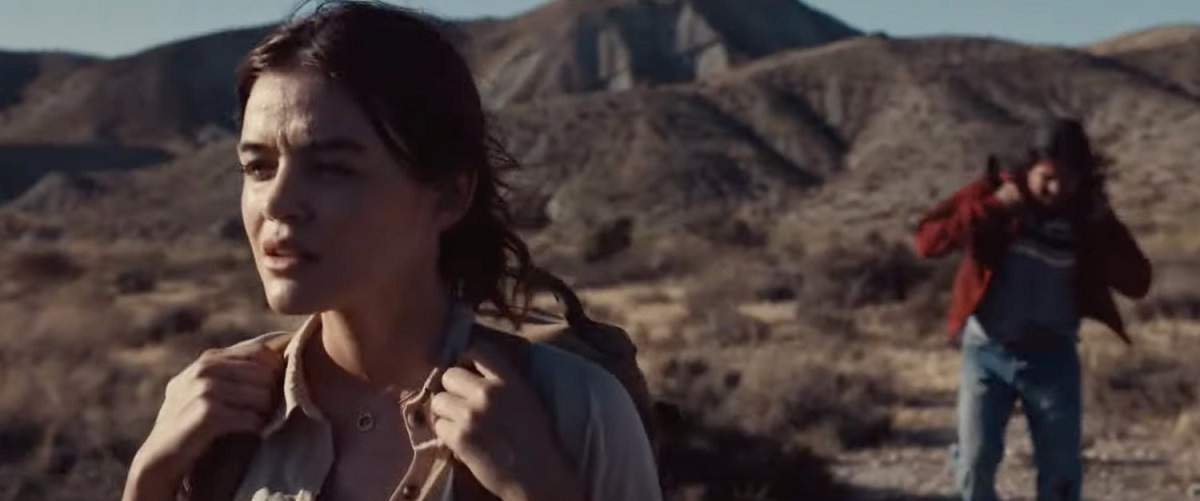
The setting and set-up are reliable, if a bit desert-southwest tried and true. The acting’s tolerable, the action beats good and the finale has a nice kick to it.

Even taking into account the messy pieces of the plot, the “Stockholm Syndrome on the Salton Sea” confessions of our kidnapped heroine and the complication of the sheriff’s teenaged daughter who gets mixed up in botanist-kidnapped-by-Mexican-drug smugglers business, “Borrego” still adds up to a slow if watchable failure.

First time feature writer-director Jesse Harris gets carried away with drug trade sermonizing in the superfluous opening and closing credits, when he should have been whittling this four-point-of-view thriller down to something that hurtles by. But as debuts go, even a slow-footed tale that looks more to “No Country for Old Men” than “Evil Dead” as inspiration, almost earns a pass just on principle.

Hale plays Elly, a lone botanist looking at invasive species in the middle of nowhere in vast San Diego County.

The film’s first “Oh come on” coincidence is when hooky-playing dirt-biker Alex (Olivia Trujillo) runs up on her mid-desert. Naturally, Elly lets her hang around and “help” a bit.

The second big coincidence is when Elly stumbles across an ultra-light airplane crash in the gathering darkness. It’s a drug run, and we’ve already seen the DIY preps the receiver of those drugs (Jorge A. Jimenez) has undertaken (flares) to get the pilot (Leynar Gomez) to the right spot. We’ve also seen what that guy does to pilots who let him down.

And then there’s the third coincidence. Alex is the daughter of the widowed sheriff, Jose (Nicholas Gonzalez), the only law enforcement officer for this vast stretch of borderlands.

The pilot takes Elly hostage and wrecks her 25 year-old Jeep Cherokee. So she’s forced to help him haul the drugs, at gunpoint.

Alex worries about where Elly is, and worries her dad, too. And Guillermo, the trigger-happy goon waiting for his shipment, isn’t taking the fall for another failed delivery. So he’s also searching the desert.

There are escape attempts and random acts of violence, and all of it builds towards a climax that throws a lot of these people and more than a couple of guns together for chases, gunplay and a denouement.

In addition to the “Stockholm Syndrome” bit, there’s some attempt at justification for the villains of the “drug trade’s a trap for everybody” variety.

As you can see above, there are eye-rolling bits you have to ignore to wring a little visceral pleasure out of rooting for Elly to reason, run or fight her way out of this life-or-death fix. But it’s not all bad.

Rating:  R for violence and language

Cast: Lucy Hale, Nicholas Gonzalez, Olivia Trujillo, Leynar Gomez and Jorge A. Jimenez

Credits: Scripted and directed by Jesse Harris. A Saban Films release on Netflix.

Running time: 1:42

Rating:  R for violence and language

Cast: Lucy Hale, Nicholas Gonzalez, Olivia Trujillo, Leynar Gomez and Jorge A. Jimenez

Credits: Scripted and directed by Jesse Harris. A Saban Films release on Netflix.

Running time: 1:42

Posted in Reviews, previews, profiles and movie news | Comments Off on Netflixable? Lucy Hale flees drug smugglers in the desert, a “Borrego” chased by lobos

Movie Preview: The horrors facing and caused by “The Righteous”

June 10, making religion, and black and white cinema, scary again.

Posted in Reviews, previews, profiles and movie news | Comments Off on Movie Preview: The horrors facing and caused by “The Righteous”

Movie Review: Nothing much happens when you’re trapped in a “Spin State”

“Spin State” is a paranoid British thriller about a disturbed private eye who finds himself investigation a scientist who might have some clues about the source of his disturbance.

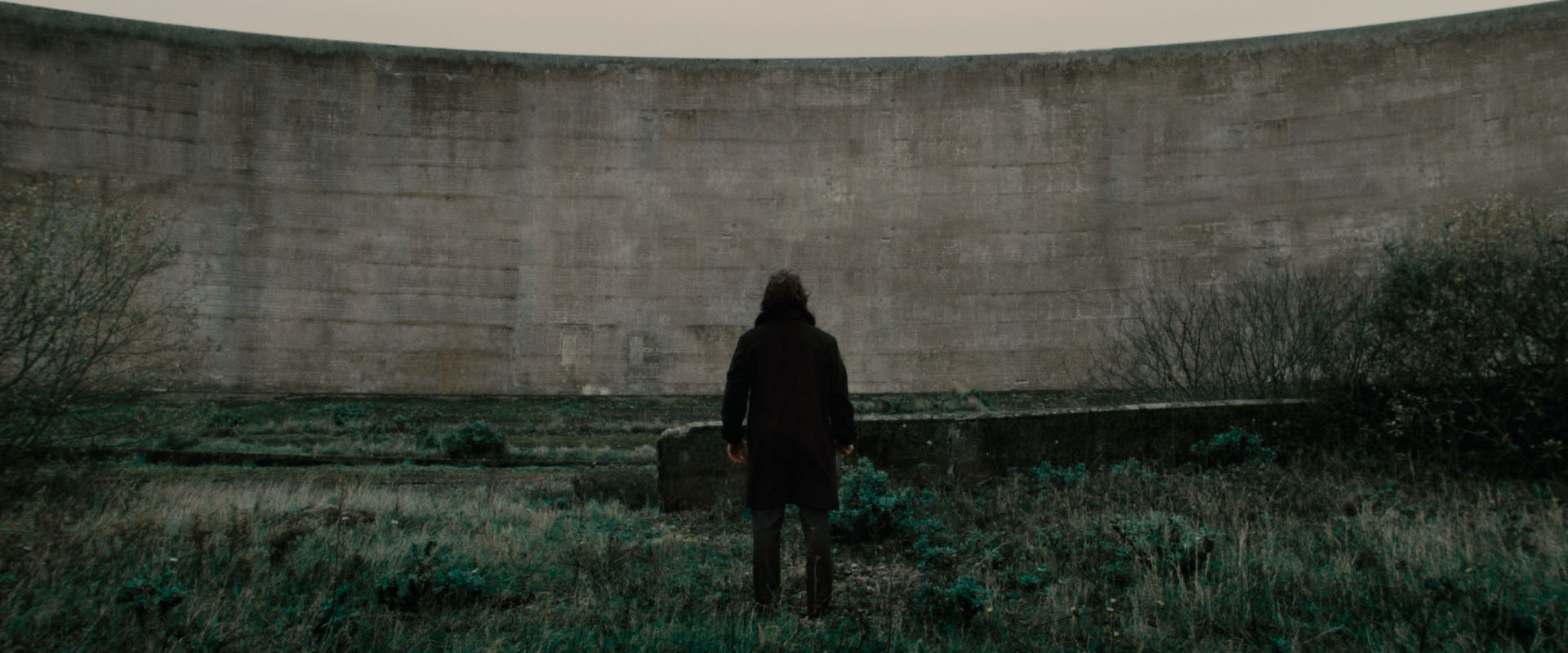
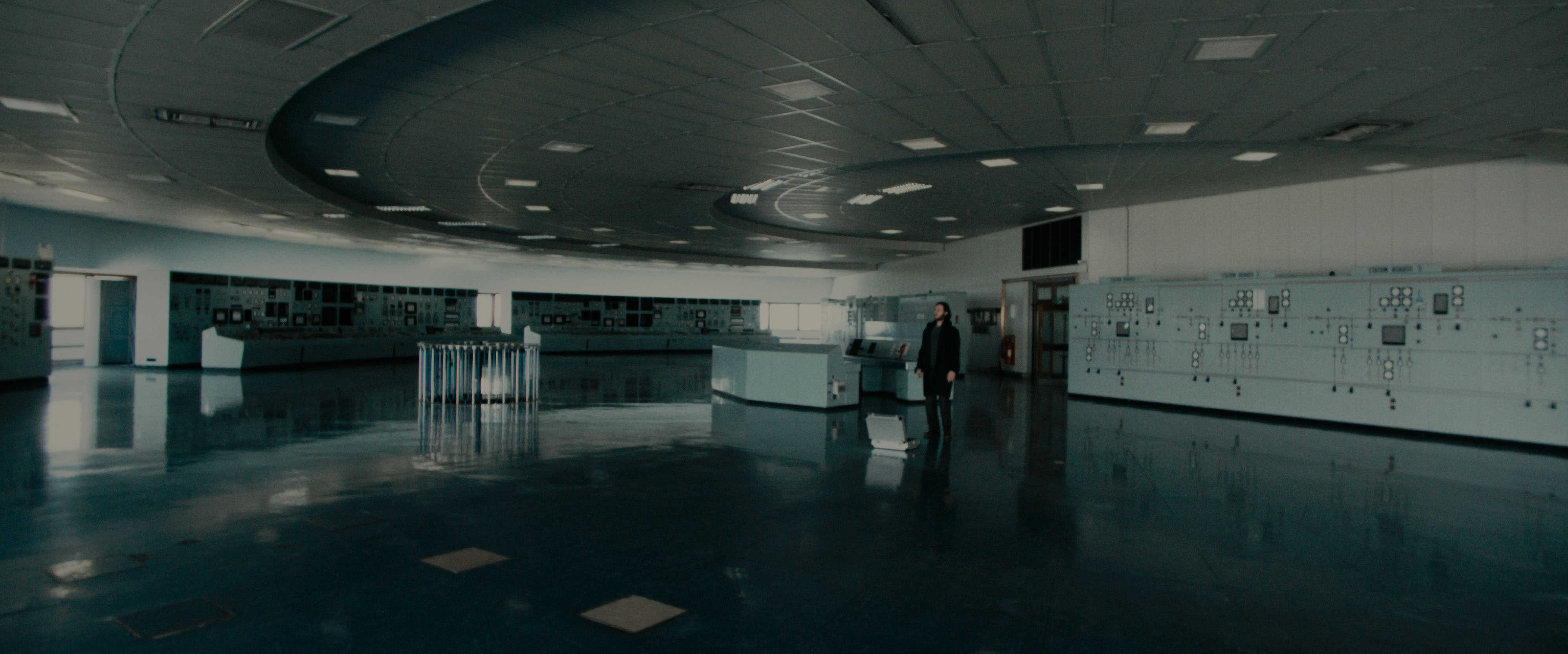
But as we follow Kline (Jamie Robson) as he tails and surveils scientist Hans (Carsten Clemens) who gives lectures on Advanced Spin Statistics, and skulks around assorted vast, abandoned or little used ex-defense department facilities (radar dishes, etc.) toting a conspicuously mysterious metal briefcase, we’re left pondering just how little a thriller can get away with not showing us before we fall asleep.

Sure, there’s “explaining.” The wife of scientist Hans (Seya Sarvan), who hires PI Kline, teaches him about Fibonacci numbers and “super determinism” and time-space-multiverse stuff (not really) as she tries to keep this paranoid, medicated gumshoe engaged and on the case.

If only she and the filmmaker had shown similar concerns for the viewer.

I got a chuckle out of “inconspicuous” Kline trying to blend in while tailing his mark in a noisy, rarish 40 year old Porsche 924. Even paranoid private eyes have got to have that “car with character.”

Of course, Kline has a partner (Will Harrison-Wallace) named “Archer,” because “Marlowe” and “Sam Spade” were a tad too obvious, I suppose. Private eye partners are always getting killed and/or irked at their wayward co-worker.

“You wouldn’t know a friend if he punched you in the mouth!”

The movie has lots of striking settings — pictured above — emphasizing medicated Kline’s solitary state. And it’s loaded with “paranoid” tropes.

“I’m involved in this case for a reason,” Kline mutters, some time after we’ve seen his telltale “Beautiful Mind” wall, covered in maps, newspaper clippings, photographs and the like. Yes, he has a seriously sketchy/pushy “doctor” (Aurora Fearnley) who makes housecalls that seem more about what she can find out than what she can offer to help.

We can chew on the strange symbol tattooed on Kline’s torso, wonder about the big Conspiracy and ponder his back story and what triggered his obsessive state of mind.

Or you can skip that, as I did it for you. That’s my suggestion.

There’s just not enough to this, barely even a hint of violence, and Hans speaks in a Euro-accent that requires subtitles, just one of the ways that a cryptic but not deep indie no-name-cast indie thriller fails to invite the viewer in and makes one wonder how one can get those 94 wasted, overcast and gloomy minutes back.

Rating: PG-13

Cast: Jamie Robson, Seya Sarvan, Aurora Fernley, Will Harrison-Wallace

Credits: Scripted and directed by Ross A. Wilson. A Random Media release.

Running time: 1:34

Posted in Reviews, previews, profiles and movie news | Comments Off on Movie Review: Nothing much happens when you’re trapped in a “Spin State”

BOX OFFICE: “Dr. Strange” prescribed another $61, “Firestarter” flames out at $3.8

A steep falloff didn’t mean the utter collapse of “Doctor Strange in the Multiverse of Madness.” A $61 million weekend shows just how much you can get with a whopping 67% falloff, if the opening weekend is big enough.

“Firestarter” is showing on Peacock TV and still managed to earn $3.8 million in theaters. That’s the way to spin that. Stephen King remake, on TV and 325000 patrons still showed up.

That wasn’t anywhere near the $6 “The Bad Guys” took in on its latest weekend, or the $4 million “Sonic 2” rang up.

“Everything Everywhere All At Once” is still taking it in, another $3.3 million as it climbs toward what I figure will be $70 or so when it finishes its run. It will clear the $50 million mark next week.

“Family Camp” opened wide and no one cared. $1 million.

Posted in Reviews, previews, profiles and movie news | Comments Off on BOX OFFICE: “Dr. Strange” prescribed another $61, “Firestarter” flames out at $3.8

Movie Review: Doesn’t take much cash to film a “Ninja Badass”

“Ninja Badass” is a no-budget novelty, a midnight movie splatter comedy that kind of picks up where “The Foot Fist Way” left off.

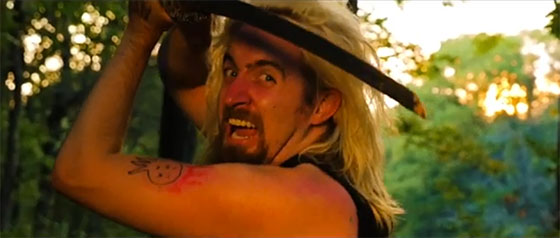
Writer-director and star Ryan Harrison mashes up kung fu sorcery — no character in it can keep the idea that “Ninjas are from Japan” straight — and Hoosier redneck rubery with sometimes amusing results.

It’s audaciously raunchy, reaching for laughs with genital mutilation and puppies in food processors, where every explosion and effect is cheaper than the one that preceded it because it wears its cheap cheesiness like a homemade aluminum foil badge of honor.

Harrison is the guy who did the visual effects for “The Revenant” — no, not the Leo-wins-an-Oscar “Revenant,” but the cheesy horror title that preceded it into theaters. He knows intentionally obvious and stupid effects — a Matchbox car set fire, a “baby” that’s actually a doll with video of an infant’s face for a head — are damned funny to a viewer in the right (altered) frame of mind.

Harrison stars as a slacker/doofus ex-con living in his mom’s ancient single-wide, whose walls are covered in log cabin wallpaper cuz’ that’s how they roll in rural Indiana, the Mississippi of the Midwest.

Rex has no job, no notion of work. But he’s inspired by these gonzo TV ads inviting people to join the Ninja VIP Super Club run by this nut who calls himself Big Twitty (Darrell Francis).

Big Twitty promises to teach students the basics of being a ninja — “Sneakin’, spinnin’ and KILLIN’!”

Rex is hooked, and maybe he can talk his camo-clad dumbass pal Kano (Mitch Schlagel) to join up, too.

But a random visit to a pet store (even the sets look DIY) in search of python eggs shows Rex and Kano the REAL Big Twitty. He charges in with his stumblebum ninjas, trashes the place, stuffs all the puppies in a garbage sack and kidnaps the “hot babe” clerk (Lisa Schnellbacher) whom Rex crushes on in the most unrequited way imaginable.

Big Twitty and his gang beats the hell out of anybody they encounter — with the BAG OF PUPPIES, mind you — and take what they want. Because when the cops show up (in a Chevy Bolt), they just yank out a bazooka and blow up the crime scene. They’re in Big Twitty’s thrall.

There’s nothing for it but for Rex and maybe Kano to train with this “Asian” geezer in camo (Steven C. Rose) who shows up to confront Big Twitty and his “evil ninja cannibal death cult,” and gets his arm yanked off for his trouble. Haskell can teach them to be Ninja Badasses, so Rex “can save that girl, she’ll fall in love with me and we’ll have sex” and Big Twitty’s reign of Terre Haute terror can be stopped.

The sight gags rain on this picture like a plague of locusts. Haskell’s ninja super power makes his arm grow back — slowly. It’s a tentacular stalk with a doll-baby’s hand on the end, and Harrison films this arm from a shoulder’s eye view to emphasize how silly it looks slapping Rex and Kano around, reaching for doorbells and the like.

We also see fights from the knife-blade’s point of view, or in lurching slo-mo to emphasize how much time Big Twitty has to see the “camouflaged” Haskell coming so’s he can yank off the old fart’s arm.

Haskell takes a break in mid-training session (paid for in egg rolls) to sing a song with a series of green-screen backgrounds turning it into a music video.

The composer of the tune, the filmmakers want us to know, wrote ditties for Joe Exotic on that crazy tiger collector/abuser Netflix series. It’s a credit — like hoping you mistake which “Revenant” Harrison did effects for — that’s its own ignominious laugh.

But making a midnight movie and setting out to make a midnight movie are often two different enterprises. Expecting people to laugh at every intentionally obvious effect gets old, as do the wackadoodle, strained “out there” performances.

The film I kept thinking of during the long pauses between anything seriously funny was the equally cheap/hilariously cheesy “Psycho Goreman,” which was almost as mean, but broader and funnier, start to finish.

“Tucker & Dale vs. Evil” ran into a lot of the same problems as “Ninja.” The hick humor wears thin and the few almost-funny lines beg for vamping and over-the-cop camp from the performers, which they only rarely render in entertaining tones.

Harrison relies too much of his small-town-metal-band hairdo and occasional burst of energy to put Rex over, with a little Will Ferrell “let’s show me naked again” for shock value.

I’ll admit I was probably too sober watching this to appreciate its finer points — or ignore how much the picture slows down in the middle acts.

But for me, “Ninja Badass” runs out of gas at about the “half-assed” point.

Rating: unrated, gory violence, sex, nudity, profanity

Cast: Ryan Harrison, Tatiana Ortiz, Mitch Schlagel, Steven C. Rose, Lisa Schnellbacher and Darrell Francis,

Credits: Scripted, directed and produced by Ryan Harrison. A Film Movement release.

Running time: 1:43

Posted in Reviews, previews, profiles and movie news | 1 Comment

Movie Preview: Life After College is a test that you can “Cha Cha Real Smooth” — apparently.

A “party starter” played by a chap named Cooper Raiff finds love…Dakota Johnson?

There’s a moony swooning period piece quality to it. Leslie Mann plays the too-understanding mom waiting for sonny boy to grow up and get a real job.

“Sitting” for someone with special needs?

June 17, Apple TV it is.

Posted in Reviews, previews, profiles and movie news | Comments Off on Movie Preview: Life After College is a test that you can “Cha Cha Real Smooth” — apparently.

Documentary Review — “Echoes of the Empire: Beyond Genghis Khan” looks at historic and modern Mongolia

The filmmakers who gave us the Southeast Asia/Then and Now documentaries “They Call It Myanmar” and “Angkor Awakens” move north for their latest film.

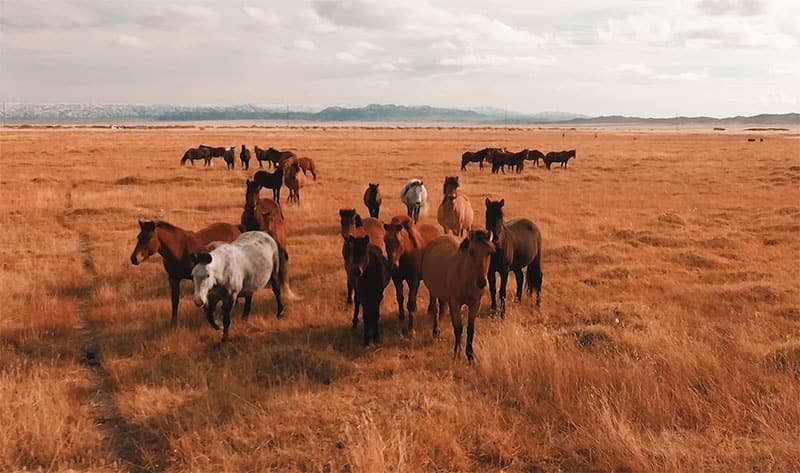
“Echoes of the Empire: Beyond Genghis Khan” gives us a summary of Mongolian history and samples modern Mongolian culture as it takes us to a little-visited piece of Central Asia, a land of forest, desert and steppes surrounded by Russia to the north and China to the south, but influenced most these days by South Korea and the West.

Director Robert H. Lieberman and screenwriter/researcher Deborah C. Hoard introduce us to academics and authors, journalists and other “outside” experts, and to Mongolian politicians, academics, activists, a poet, a painter and a comedian to give us a beyond-just-a-travelogue look at the young republic and its youthful — and as suggested by the film — hopeful population where historically, the women are still much better educated than the men.

A stat not on screen — the average age of today’s Mongolian is 28 years or so. Ageing China to the south has a median age of 38, and Russia 39. No wonder we see Lakers jerseys and kids break dancing in the squares of Ulaanbataar. No self-respecting Mongol bothers to learn Russian any more.

The anchor interview here is with Jack Weatherford, author of “Genghis Khan and the Making of the Modern World.” Using his words and snippets of animation, we’re given a quick overview of the life of history’s greatest conqueror, and hear Weatherford and others speak about the Mongol Empire’s creation of global trade, not just following the long-established Silk Road from East as far West as Poland, but interconnecting markets from the Artic Circle as far South as the Indus River.

Weatherford speaks of the first Khan’s “law of religious tolerance” and “laws against the kidnapping of women,” rules put in place to keep the peace in cities and lands he conquered, as he didn’t have enough troops to form an army of occupation for the Middle East, Russia, the many lands of China and beyond.

I remember reading Weatherford’s book with curiosity about one touchy subject, one I first noticed avoided in a Metropolitan Museum of Art exhibit on the Art of the Mongols, nomadic people who didn’t create anything that wasn’t portable, and whose music — as explained here — is more animal-imitating plainsong than anything written down.

In “Echoes,” a biologist gives us that oft-repeated fun fact about Mongol genetic markers spread across all the lands they conquered 800 years ago. Some “20 million men” carry this “genetic marker” in the world today. Even the National Geographic tiptoes around how this happened with this insanely disingenuous headline — “Genghis Khan Was a Prolific Lover, DNA Data Implies.”

It was rape, kids. Rape. Mongols raped and pillaged. It’s what they did. If one goes to Monticello, one doesn’t hear and read about what a “prolific lover” Thomas Jefferson and other males of his family might have been. Giving the Mongol Horde a pass on this heinous part of their genocidal conquests is as hilarious as suggesting their “gifts” to civilization were anything more than an accidental byproduct.

They didn’t build or create. They conquered and took. Weatherford breaks down the tribal herding practices that Temunjin/Genghis Khan adapted to cavalry warfare, and how effective it was at destroying armies, cities and conquering much of an entire continent. But the “echoes” of the “empire” weren’t just the scattered net positives emphasized here.

China and India and the Middle East were invaded, crushed and set back 150 years, and ended up falling far behind Europe as a result, losing huge chunks of their territory to Europe later in the bargain. Passing that sort of information on may not fit the tone of “Making of the Modern World” or this light, picturesque, surface gloss/inside-the-culture documentary.

But avoiding it in the historic part of your film suggests that maybe you’d be best off avoiding the subject, if it makes you uncomfortable. De-emphasize “the greatest conqueror” and play up the “We were never taught about Temunjin in school” thanks to Soviet influence. Just show how a historically nomadic people are evolving and facing a future that will be, unlike thousands of years of their past, radically different from anything their ancestors took from the world, or brought to it.

Rating: unrated

Cast: G. Mend Ooyo, D. Goreltuv, Jack Weatherford, many others

Credits: Directed by Robert H. Lieberman, scripted by Deborah C. Hoard. A Journeyman Films release.

Running time: 1:13

Posted in Reviews, previews, profiles and movie news | Comments Off on Documentary Review — “Echoes of the Empire: Beyond Genghis Khan” looks at historic and modern Mongolia