
Totally down with this as a concept.
June 7.
Totally down with this as a concept.
June 7.





Perhaps the best representation of the tediously-over-titled latest installment in the “Ghost in the Shell” media vortex –– “Ghost in the Shell: SAC_2045 Sustainable War” — is that hideously over-loaded title itself, translated from “Kôkaku kidôtai SAC_2045 Jizoku kanô sensô.”
Three directors, six credited screenwriters, vividly-animated characters with rigidly immobile faces, exteriors that have some of the most realistic CGI “sunshine” ever coupled with generally dull and dark eye-straining interiors, endless low-stakes action buried under endless exposition masquerading as dialogue from an infantry battalion of “characters” — some of them kewpie-doll voiced robots — one hardly knows where to begin.
How about at the end? This two hour movie never, for one second, lets your forget that it’s “content” — manufactured, formulaic piffle with a fixed set-price/run-time that’s been filled with material that feels more like something generated by an algorithm than anything humans put any heart and soul into.
With manga, TV series, video games and the occasional movie assembly-lined into existence over the past three decades, it’s damned near impossible to drop in and out of “Ghost in the Shell,” film by film. You don’t so much absorb the blizzard of words, the sea of characters and ever-deepening pile of backstory and exposition as let it wash over you. It’s a little like having your brain buried in sand.
The big idea here is that the “Ghost” mercenary team — with many members, vehicles and a robot or two — are treated as pawns by competing billionaire-run global conglomerates which came up with the concept of “sustainable war,” manufactured conflict designed for maximum profits, only to turn civilization into a few fortified citadels, cities and billionaire compounds separated by a near-wasteland on its way to “Mad Max” status.
“Even Japan’s dangerous now,” the ex-detective/ex-“Ghost” team member Togusa mutters.
One billionaire has been nicknamed “The Good One Percenter.” Random remarks reveal where this or that mercenary or “amateur” gang came from — ex-college athletes “bankrupted by student loans” created one.
Chases, chases and more chases end in fights, with characters chattering away to each other in future combatspeak that resembles telepathy because nobody’s lips move…much.
I guess adding that to the “content” would’ve cost too much. The entire affair looks pricey but cut-rate at the same time, like a Tesla… The Budweiser product placement does nothing to dispel that.
If you’re way down the rabbit hole of “Ghost,” you will almost certainly get more out of this than the rest of us. I guess my question, repeated too often when I dip back into this franchise, is “Why would anyone bother?”

Cast: Cherami Leigh, Michael McCarty, Dave Wittenberg, Laura Post, Keith Silverstein, Roger Craig Smith, many others
Credits: Directed by Shinji Aramaki, Michihito Fujii and Kenji Kamiyama, scripted by Ryô Higaki, Harumi Doki, Kenji Kamiyama, Daisuke Ohigashi, Kurasumi Sunayama and Dai Satô, created by Shirow Masamune. A Netflix release.
Running time: 2:00

Jonathan Rhys-Myers at his most evil, Dennis Hopper fully amped-up and Robert Carlyle in all his “Trainspotting” rage — that’s Kyle Gallner in “Dinner in America.”
Gallner and Emily Skeggs made the oddest and most adorable couple, a warm and fuzzy Sid & Nancy, in this rude and raw dog punks-in-love romance.
The title comes from a song by this underground punk band — PSYOPS — that both members of our mismatched couple dig — her as a fangirl, him as their raging, ski-masked and mysterious lead singer.
Writer-director Adam Carter Rehmeir’s film is a movie in three dysfunctional family-dinner acts. It takes a while to get going, but Gallner sets the tone from the start.
Kicked out of a drug study at a college lab, Simon is pissed, and invited to dinner by a sexually available fellow test subject. Before his hostess, the girl’s trashy mom (Lea Thompson, a hoot), can make a pass at him, before he half-trashes their house and sets fire to their shrubbery (he’s a “pyro”), Simon has to drop a few unfiltered remarks on one and all as he’s enjoying a turkey dinner parked in front of a TV tuned to football. He has to challenge the jock-obsessed patriarch (Nick Chinlund).
“What’s your name again?” “Bill.” “Do you hate me, Bill?”
Simon’s a rebel without a cause or a place to crash. His pyromania has the cops looking for somebody just like him — they only have a sketch on the “Wanted” posters. And his band is selling out, going “eyeliner punk” in search of their big break at a prestigious local dive. Only he can keep them together.
Patty (Skeggs) is the dullish pet store custodian whose high school graduation didn’t stop the relentless bullying by girls, jocks, anybody who takes a dislike to her dull, lumpy looks and minimum wage job attire.
Events throw Simon into the path of Patty, leading to a second awkward dinner (Mary Lynn Rajskub and Pat Healy play her “take it down a notch” parents) and Simon’s demonstration of his ability to lie on the fly.
His parents are missionaries in Tanzania, he says. He was there with them, building churches, for years. He’s looking for a place stay. And yes, he’ll say the dinner blessing. That’s the best place to burn Patty’s confrontational and bratty adopted brother (Griffin Gluck) a new one. Because the jerk teen doesn’t know he’s adopted.
Rehmeier’s film really finds its footing as the teasing, taunting and rude rude rude Simon is shocked that this wallflower in oversized glasses is into his band. Not that he tells her who he is. Not that he lets her know that her Polaroid sex-shot fan letters have been landing in his backpack.
Gallner (“Scream,” “The Finest Hours”) is hilariously obnoxious, dropping slurs and F-bombs like he’s afraid they’ll fall out of punk fashion, a blast of fury, spit and tough talk that he may or may not be able to back up. Pairing him with bullying misogynists or “Bill,” the racist host of that first dinner, is the only way to make the homophobic Simon halfway palatable.
Skeggs, of “The Miseducation of Cameron Post,” dresses down and acts “slow” to make Patty a young woman everybody underestimates. The story’s upbeat arc has Simon soften into her champion and Patty come out of her shell as she sticks up for her almost indefensible punk beau, and sings her disaffected and hip poetry in front of his music.
Rehmeier gives this conventionally unconventional romance some surprises and twists, upending expectations early on and never letting “Dinner in America” settle into “predictable.”
And his stars throw themselves into this as if there are “And the Oscar goes to” stakes involved, which there most certainly are not.
Seriously, what could be more punk rock than that?

Cast: Kyle Gallner, Emily Skeggs, Griffin Gluck, Pat Healy, Mary Lynn Rajskub and Lea Thompson
Credits: Scripted and directed by Adam Carter Rehmeier. A Best & Final release.
Running time: 1:46
Olga Kurylenko and John Malkovich also starting this June 3 release about the hunt for cops who witnessed an assassination attempt.
Most Ukrainian combat pictures are set during the Crimean invasion a few years back.
Based on “a true story,” this Well Go release comes our way July 1.

A politician on the rebound after a failed campaign gets to ponder what might have been when his high school girlfriend returns from a 20 year space journey in “The Time Capsule.” It’s a downbeat, wistful and entirely-too-quiet romantic drama that could use a little more romance and a lot more drama in a story that downplays the science fiction, and most everything else.
It’s about young love interrupted, put on pause and revisited thanks to “time dilation.”
“Desperate Housewives” and “With Love” alumnus Todd Grinell plays a Senate candidate whose campaign imploded in an unguarded, profane blast of public enthusiasm for schools in front of school kids. Now he and his ambitious-enough-for-them-both wife (KaDee Strickland of TV’s “Shut Eye” and “Private Practice”) are headed to his family’s old lake house down South.
Our first tip that this is “somewhere else in time” is at the rental car agency. “Self-driving” is an option. Cell phones have holographic projectors. And that “old” lake house is a modernist McMansion, “modern” by 1970s standards.
Former Congressman Jack barely has time to reminisce over a digital photo album of his high school girlfriend when BOOM — there she is in the supermarket. Elise (Brianna Hildebrand of “Deadpool”) still looks 18. She took a trip far away “to the colony.” She came back. Cryo-sleep was involved.
Now Jack’s 40 and Elise is, well a bit mature for her age but still a kid.
“Who cares that you look like some creepy old dude” in her presence, his old pal (Baron Vaughn) blurts, in a tipsy moment? Well, he does, and we dare say his hard-driving have-a-baby-it’ll-help-the-next-campaign wife.
And we as viewers do, as well. Which makes the very premise of “The Time Capsule” more icky than romantic or nostalgic.
The “big ideas” wrestled with here are the stuff of many a high school reunion dramedy. “Most people don’t get to see how everybody turned out” before they themselves “turn out,” wife-Maggie notes.
Elise “can’t relate to people I used to know because they all think I’m just a child.”
And Jack, when he isn’t mooning over Elise or indulging her and his arrested-development pal Patrice (Vaughn) by hitting their old night club (Elise gets carded), can’t help but act a little fatherly and sage to the teenager on his arm.
“As you get older, disappointments add up.”
Icky moments aside — and cast and crew work hard to avoid them– nothing that’s wrestled with here wouldn’t have fit in a “Twilight Zone” episode — the 30 minute version.
There’s little chemistry between the leads, the dialogue has a drab, lifeless Lifetime Original Movie quality and the sci-fi elements are limited to mundane layman’s-eye-view takes on space travel and a dash of the technology that’s replaced fireworks — “artificial meteor showers.”
The political stuff, in which Jack questions his commitment and the phoniness of his image because Elise reminds him of his more outspoken, passionate youth, is mildly interesting at most.
It all adds up to a blasé sci-fi variation of “If I knew then what I know now,” so blasé that it dares to trot out that moth-eaten old expression in an attempt at third act profundity.

Rating: unrated, profanity, alcohol and cannabis abuse.
Cast: Todd Grinell, Brianna Hildebrand, KaDee Strickland, Baron Vaughn, Nelson Padilla and Ravi Patel
Credits: Directed by Erwann Marshall, scripted by Erwann Marshall, Chad Fifer. A FilmRise release.
Running time: 1:43


Sorry for the dated movie poster-styled headline. But as the silliest Twitter trend of last week was some youngling’s assertion that “I was this minutes old when I found out Robert Redford was ‘Jeremiah Johnson,'” one does feel the need to state the obvious.
That’s Twitter for you, a regular Algonquin Roundtable of wit and deep cinematic wisdom. And you wonder why I put links in all my reviews, defining this or historically identifying that. It’s ridiculous to expect somebody born any time after say Bill Clinton’s inaugural to automatically have absorbed a century of cinema history.
Although, as Redford was clean shaven for two sequences in this 1972 film, and being the biggest star in Hollywood for a stretch of the ’70s, and a leading man pretty much to this very day, let’s just say our tweeter was either being cute and disingenuous or stupid.
“Jeremiah Johnson” came along after the first Earth Day and the birth of the environmental movement and at the tail end of the hippy “back to the land” ethos that took hold in the late ’60s. It’s a 1970s zeitgeist Western easily conflated with the counterculture attitudes and mores and movies and TV shows of its time.
There’s respect for Native American culture and customs of a “Little Big Man” variety, even though casting white actors as Indigenous people was very much prevalent. The title character is a soldier who’s turned pacifist, with a desire to leave all that’s “down there” in the States. It wasn’t the first film to venerate the solitary “Mountain Man,” but it was the best. Its success inspired the less hunting/trapping/killing oriented kids’ TV movie and series “The Life and Times of Grizzly Adams” a couple of years later.
And despite some seriously dated 1970s touches — a couple of theme-songish tunes (by Tim McIntire) wafting in and out of a few scenes — it holds up pretty well.
Tough guy screenwriter and later “Conan the Barbarian” director John Milius had a hand in the script, which grafts a bloody short story (“Crow Killer”) of revenge onto the basic structure and plot of a novel about a mountain man’s life in the unpacified West.
The time setting is sometime after the War of 1812 and right up to the Mexican War (1840s), which is referenced. Redford’s title character shows up in uniform at an upriver wharf in the Colorado Territory, loads up supplies and heads off, looking for beaver and such to trap.
“Ride due west as the sun sets,” a storekeeper advises. “Turn left at the Rocky Mountains.”
Those who love this film, and I count myself among them, tend to remember it in episodes which in my case I have to say turn up out of order, something I realize any time I see it anew.
There’s his first encounter with a Native American. Paints His Shirt Red (Joaquín Martínez) is a stern, noble warrior underwhelmed by the white man’s fishing and trapping skills. Jeremiah memorably comes upon the trapper Del Gue (the wonderful character actor Stefan Gierasch, omnipresent in the ’70s), a bald blowhard buried up to his neck in sand by less friendly tribesmen.
That’s the way Pollack, Milius and co-writer Edward Arnholt structure this, with Pollack casting colorful supporting players for Redford to play straight-man to in many of the scenes.
Character actress and TV regular Allyn Ann McLerie plays the saddest of these, a settler who has gone mad because of the slaughter the Crows have visited upon her family. Redford has his first choice close-up here as he sobers her up, if only for a moment.
“Woman…We have graves to dig.”
But the scene stealer among scene stealers in “Jeremiah Johnson” is that long-blacklisted leftist, Grandpa Walton himself, Will Geer. As the old timer/mentor figure covered in fur and beard and bear-teeth, he is a “grizz” hunter, a collector of fangs, long in the tooth and loud of the mouth when it comes to dealing with this “pilgrim” on his turf.
“I am Bear Claw Chris Lapp; bloodkin to the grizzer that bit Jim Bridger’s ass! YOU are molesting my hunt!” And “You’re the same dumb pilgrim that I been hearin’ for twenty days, and smellin’ for three!”
Geer is the highlight of the movie, although there are other colorful moments and characters, and plenty of blood-sport and action in the vengeance-packed third act.
Pollack had a deft hand with lighter moments, which made Redford his perfect muse. Watch the way the “pilgrim” falls down most every time he has to fire that .50 caliber rifle at something or someone.
Redford had already fallen in love with Utah thanks to “Butch Cassidy and the Sundance Kid,” and what’s striking about “Jeremiah” all these years later is the epic feeling that what is essentially an intimate and episodic story gets across. Pollack made a BIG movie with stunning scenery, “Doctor Zhivago” depth snow, Indian fighting and a touch of domesticity that — along with the use of the hymn “Shall We Gather at the River” (Redford SINGS!) — feels like a nod to the Western master, John Ford.
All this scenery and sky and seasons and action and reflection, and the the picture still clocks in well under two hours. Suck on that, Marvelettes.
Pollack and Redford would work together often, as you’d expect of a director of romances (“The Way We Were,””Out of Africa”) and a guy he helped make the great matinee idol of his day. They made seven films together, including two that were among Redford’s edgier pictures of his heyday — the spy thriller “Three Days of the Condor” and the even flintier “Jeremiah Johnson.”
For years, Redford was lightly regarded as an actor and you can sense that “lightweight” label, just a tad, and a comfort in sharing scenes with actors given more colorful roles, in this performance. His line readings of the archaic speech may not sound as natural as you’d like. He has “modern Californian” baggage that was hard to shake back then.
But I think it’s among Redford’s most endearing and enduring performances, a sensitive yet heroic figure, a man out of his depth who has to grow and revert to a form of savagery to master it. Who cares if his period-appropriate farewell isn’t the smoothest line reading ever?
“Watch yer topknot,” Bear Claw growls, a hair joke related to avoiding being scalped by the Natives.
“Yep. Watch yourn.”
Rating: GP, the PG of its day — violence.
Cast: Robert Redford, Will Geer, Dell Bolton,
Allyn Ann McLerie, Joaquín Martínez, Josh Albee, Matt Clark and Tanya Tucker.
Credits: Directed by Sydney Pollack, scripted by John Milius and Edward Anhalt, based on a novel by Vardis Fisher and a short story by Raymond W. Thorpe and Robert Bunker. A Warner Brothers release on Amazon, Tubi, Movies! and other streamers.
Running time: 1:48
At one point, this 20th Century release was slated for theatrical, right? Am I misremembering that?
Sure, it’s a no-stars/all action-VFX genre thriller. But cinema fans would show up, I dare say, if we’re not back in the middle of a Southern governor-driven sabotage-rebound of the pandemic. Still, Hulu it is.
Aug. 5.
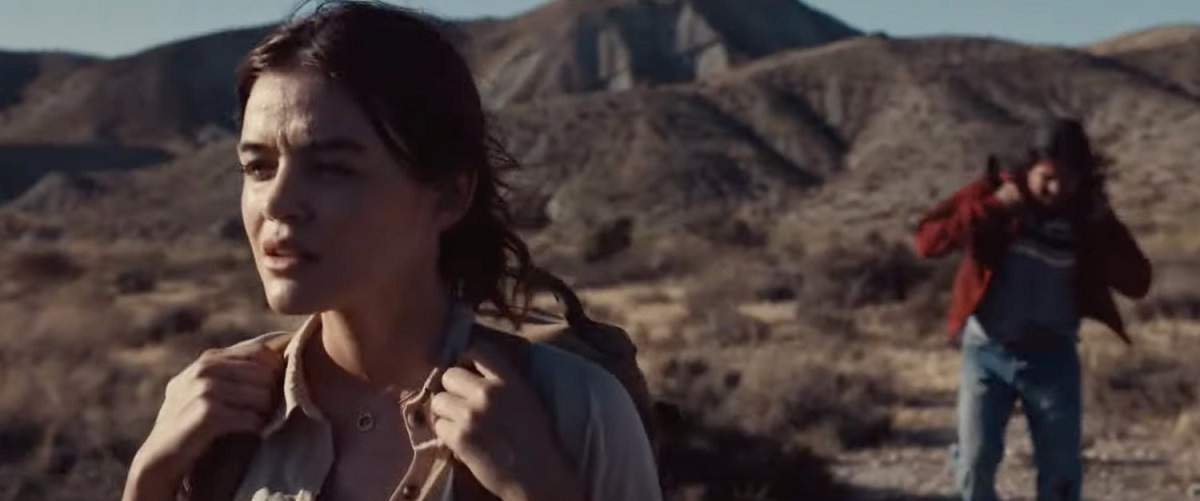
The setting and set-up are reliable, if a bit desert-southwest tried and true. The acting’s tolerable, the action beats good and the finale has a nice kick to it.
Even taking into account the messy pieces of the plot, the “Stockholm Syndrome on the Salton Sea” confessions of our kidnapped heroine and the complication of the sheriff’s teenaged daughter who gets mixed up in botanist-kidnapped-by-Mexican-drug smugglers business, “Borrego” still adds up to a slow if watchable failure.
First time feature writer-director Jesse Harris gets carried away with drug trade sermonizing in the superfluous opening and closing credits, when he should have been whittling this four-point-of-view thriller down to something that hurtles by. But as debuts go, even a slow-footed tale that looks more to “No Country for Old Men” than “Evil Dead” as inspiration, almost earns a pass just on principle.
Hale plays Elly, a lone botanist looking at invasive species in the middle of nowhere in vast San Diego County.
The film’s first “Oh come on” coincidence is when hooky-playing dirt-biker Alex (Olivia Trujillo) runs up on her mid-desert. Naturally, Elly lets her hang around and “help” a bit.
The second big coincidence is when Elly stumbles across an ultra-light airplane crash in the gathering darkness. It’s a drug run, and we’ve already seen the DIY preps the receiver of those drugs (Jorge A. Jimenez) has undertaken (flares) to get the pilot (Leynar Gomez) to the right spot. We’ve also seen what that guy does to pilots who let him down.
And then there’s the third coincidence. Alex is the daughter of the widowed sheriff, Jose (Nicholas Gonzalez), the only law enforcement officer for this vast stretch of borderlands.
The pilot takes Elly hostage and wrecks her 25 year-old Jeep Cherokee. So she’s forced to help him haul the drugs, at gunpoint.
Alex worries about where Elly is, and worries her dad, too. And Guillermo, the trigger-happy goon waiting for his shipment, isn’t taking the fall for another failed delivery. So he’s also searching the desert.
There are escape attempts and random acts of violence, and all of it builds towards a climax that throws a lot of these people and more than a couple of guns together for chases, gunplay and a denouement.
In addition to the “Stockholm Syndrome” bit, there’s some attempt at justification for the villains of the “drug trade’s a trap for everybody” variety.
As you can see above, there are eye-rolling bits you have to ignore to wring a little visceral pleasure out of rooting for Elly to reason, run or fight her way out of this life-or-death fix. But it’s not all bad.

Rating: R for violence and language
Cast: Lucy Hale, Nicholas Gonzalez, Olivia Trujillo, Leynar Gomez and Jorge A. Jimenez
Credits: Scripted and directed by Jesse Harris. A Saban Films release on Netflix.
Running time: 1:42
Rating: R for violence and language
Cast: Lucy Hale, Nicholas Gonzalez, Olivia Trujillo, Leynar Gomez and Jorge A. Jimenez
Credits: Scripted and directed by Jesse Harris. A Saban Films release on Netflix.
Running time: 1:42
June 10, making religion, and black and white cinema, scary again.

 Movie Nation