
Well Go USA is putting this Sundance pic in theaters — some theaters anyway — June 3.
Looks cute.
Well Go USA is putting this Sundance pic in theaters — some theaters anyway — June 3.
Looks cute.

For everyone who chose not to chance COVID and show up in theaters to make “Jackass Forever” a box-office-boosting hit back in February, I get it.
One could get downright sentimental over the idea that these lovable louts literally saved the cinema, that the “old men” among them had done their doofus duty, pummeled, blown-up, bitten and battered for our entertainment, probably for the last time. But not everybody felt safe going.
And it’s just as understandable that Johnny Knoxville, Jason ‘Wee Man’ Acuña, “Danger” Ehren McGhehey, Steve-O, Chris Pontius, Preston Lacy and the newcomers wouldn’t want all their trials, tests and injuries to have been for naught. Thus, “Jackass 4.5,” a film of reminiscences surrounded by stunts not good enough to make the theatrical release, was assembled for Netflix. I get that, too.
But let’s not kid ourselves. Most of these gags didn’t make the “movie” for a reason. And those that did and are recycled here don’t add up to the same sort of experience “Forever” delivered.
Guys, you already dropped the mike. There’s no coming back on stage and stumbling, kicking it around as you try to pick it up again.
We see 2019 “test footage” where producer Spike Jonze, directed Jeff Tremaine and white-haired, gaunt, bespectacled and 50 year-old Knoxville started shooting to see “if this was still funny” and “if we had a movie” in all of their tomfoolery.
And we’re treated to entire bits that didn’t make the theatrical feature — a jokey electric eel shock stunt with Wee Man dressed as Ben Franklin, subjecting a castmate to jolts via a brass key inserted up the lad’s anus. I think that was “Danger” Ehren on the receiving end of that “prod.” He’s the stand-out in much of what’s seen here, a man they love to abuse and who takes it (mostly) like a good sport.
“Ehren was amazing in ‘Jackass Forever,'” Knoxville notes. “He didn’t MEAN to be.”
There’s “Hot Sauce Enemas,” which is exactly as titled, with the added bonus of popsicles on offer to cool off the nether regions scorched by having sauce piped up four Jackass’s poop-shoots.
It’s easy to see why Knoxville’s disguised stunts — dressed as Old Man Irving Zissman for assorted pranks on hapless recruits who don’t recognize him — were ditched for “Forever.” They aren’t funny enough.
The big finish this time out is mainly all about the build-up of subjecting streetwise Dark Star, father of newbie Jasper and a man who has survived multiple gunshot wounds, to his first ever taste of skydiving. The build-up is OK, the payoff anticlimactic.
That seems all too appropriate for “Jackass 4.5,” a movie with some funny new bits, some new gross bits and a lot of guys (and newcomer Rachel Wolfson) standing around cackling, mostly at stunts we already saw in “Jackass Forever.”

Rating: TV-MA, violence, nudity, nude-violence and ensuing profanity
Cast: Johnny Knoxville, Steve-O, Rachel Wolfson, Chris Pontius, and Eric Andre.
Credits: Directed by Jeff Tremaine. A Paramount picture released on Netflix.
Running time: 1:30
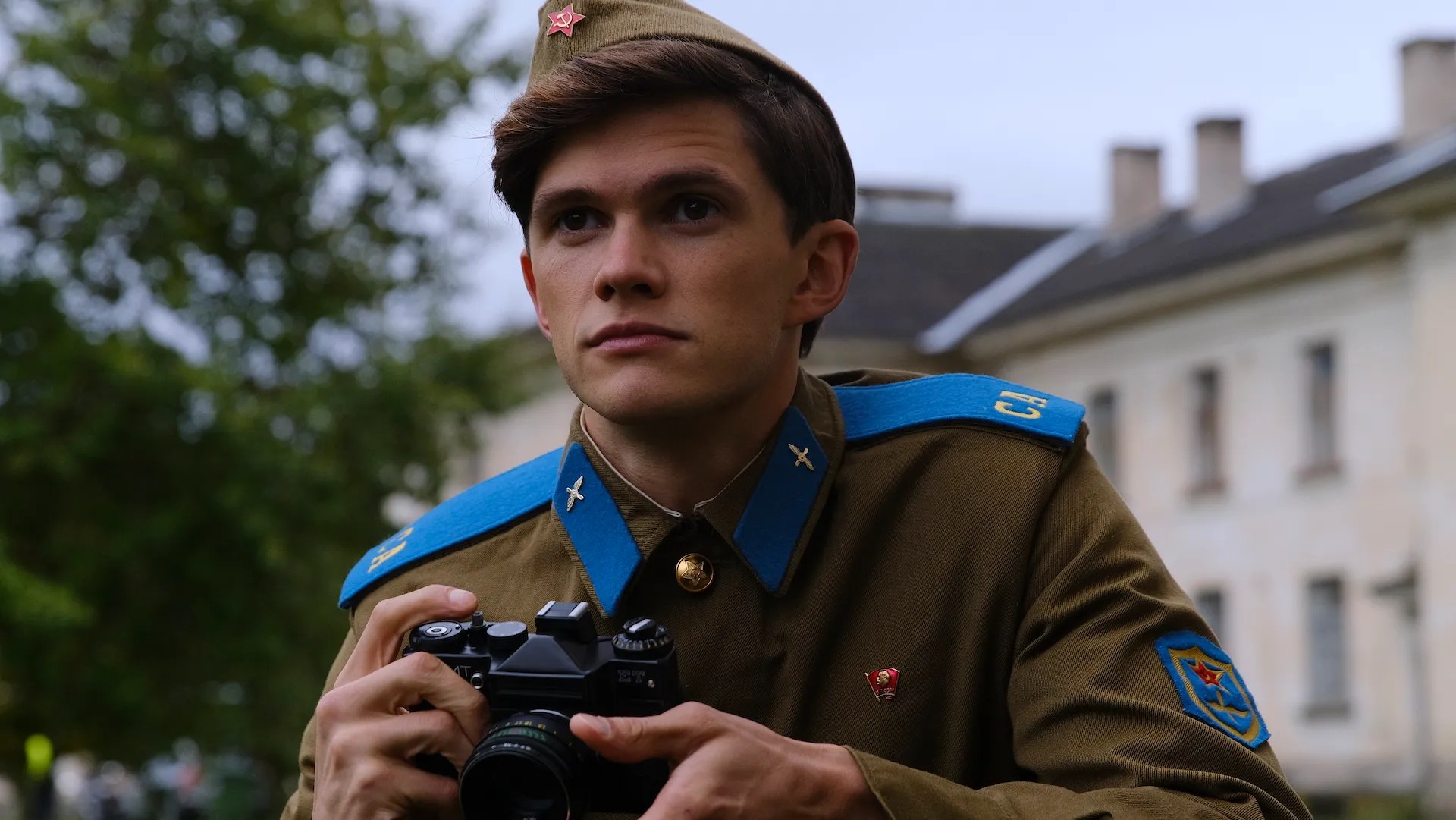

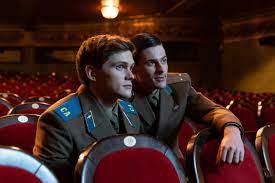
The Cold War Soviet military provides a high-stakes backdrop for “Firebird,” the true story of a gay romance in a place where homosexuality wasn’t merely shunned and shamed, it was forbidden and persecuted.
It’s a policy that returned under the dictator Putin, which makes this period piece timely as well a reminder of a bitter past.
British stage actor and occasional big screen supporting player (“Kingsman,” “Blood on the Crown”) Tom Prior has co-written and produced himself a breakout star vehicle in which he plays a closeted conscript who finds love with a superior officer on an (occupied) Estonian airbase in the late ’70s.
A fighter squadron stationed there is on high alert during a time of rising tensions with NATO. The Soviet Empire is teetering towards the Afghan debacle that brought it down, and the Sukoi jets stationed here are scrambled at the merest hint of a Western provocation or probe of their defenses.
That’s what brings Lt. Roman Matvejev (Ukrainian actor Oleg Zagorodnii) there. He’s a crack pilot.
But what the clerical workers Sergey (Prior) and Luisa (Diana Pozharskaya) notice is his dashing good looks. They may flirt and talk about the future — Sergey’s enlistment is up in weeks, Luisa is studying for admission to medical school — but artistic-minded Sergey has a secret, something the handsome lieutenant picks up on.
Yes, gaydar was one area where the Soviets had absolute parity with the West.
A shared interest — photography — leads to an invitation to a Roman’s dark room. And where there’s darkness and intimate, hands-on instruction, and needless to say — “chemistry” — signals are sent and received.
Sorry, but the early flirtation scenes have a same-sex-romance corniness that invites a little teasing.
Still, this is going on at an airbase, a perilous place to start an affair.
The lieutenant takes the younger private to his first ballet — Stravinsky’s “Firebird.” Even that turns fraught, as there are checkpoints and base patrols to be evaded. We’ve already seen a “Stop or I’ll shoot” encounter with men on guard duty that Sergey, his friend Volodya (Jake Henderson) and Luisa faced, just for taking a late night dip in an on-base lake. Imagine what will happen if two men in uniform are caught in an intimate same-sex moment.
And naturally, there’s a Major (Margus Prangel) who starts to suspect what one, if not the other, is up to.

There’s something a soap operatic about all this — the “sensitive” young man who longs to go to acting school, the cultured, privileged older man, classical music LPs, the “love triangle” that develops and the threats of betrayal.
But there’s a reason romantic cliches became cliches. This is one way love develops, and as the script is taken from the memoirs of actor Sergey Fetisov, there’s only so much criticism that’s warranted about the waypoints of this romance.
It’s just that film adaptations are reductive processes, and in selecting what to include and what to leave out they make “Firebird” predictable, leaning toward the melodramatic.
Prior wrote himself a splendid part, and engagingly underplays young Sergey. Zagorodnii has great presence and a command of English that could stand him in good stead with casting directors, if he survives Russia’s invasion of Ukraine.
Even if the story here is as preordained as the ballet that gives it its title, they’ve made a nicely-detailed reminder of another critical difference between the totalitarian East and the more tolerant West, one that shows us how bad things were and how bad they still are there, and how bad they could be if Russia-loving/emulating politicians in the Free World are allowed to take power.

Rating: R for language and some sexual content
Cast: Tom Prior, Oleg Zagorodnii, Diana Pozharskaya and Margus Prangel
Credits: Directed by Peeter Rebane. scripted by Peeter Rebane and Tom Prior. A Roadside Attractions release on Lionsgate Home Video (June 3).
Running time: 1:47
A little IFC Midnight sci Fi horror for you. Coming soon.
Richard Dreyfuss, Anna Camp and Isaiah Mustafa saddle up — or sit and shoot — in this Western due out June 24.
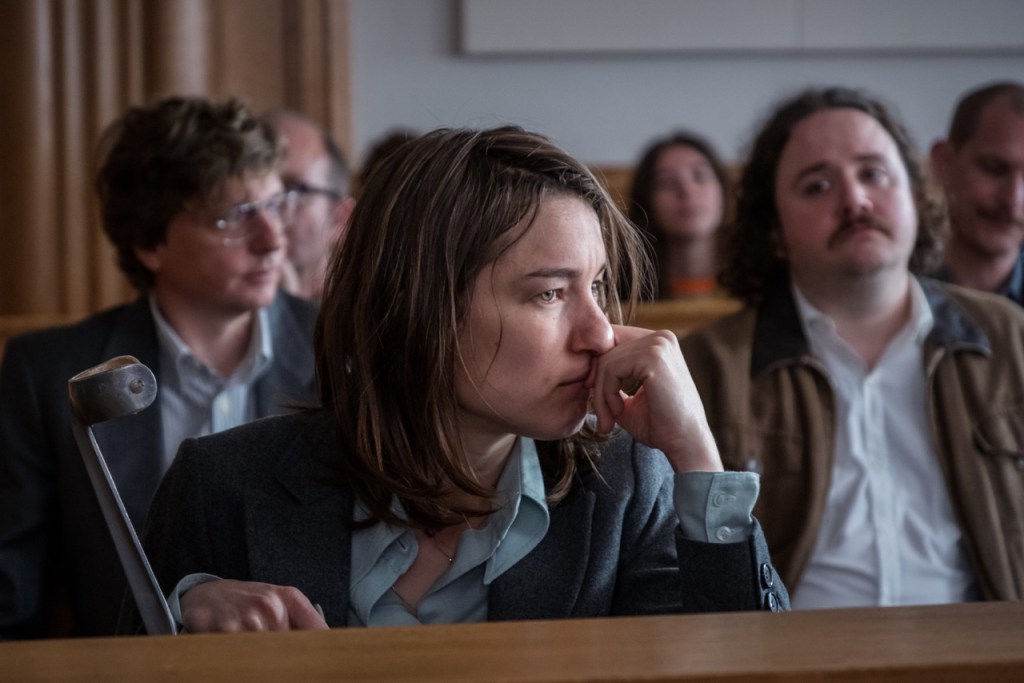
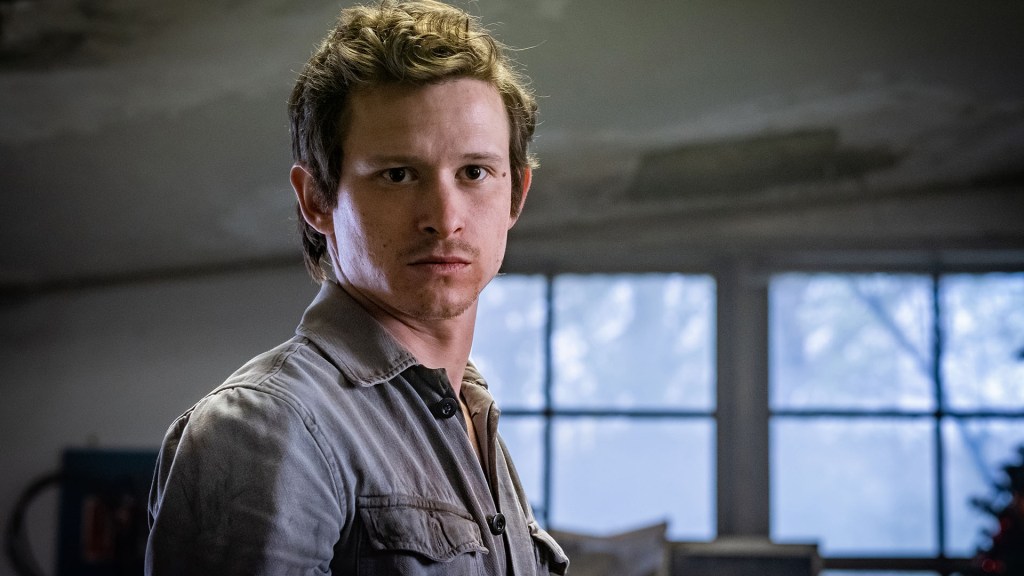
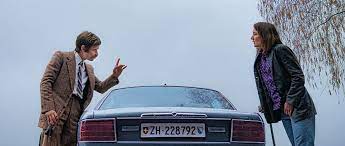
Switzerland’s “Escape King,” a bourgeois-born career criminal who declared “I like to steal my luxury,” and a sickly, crusading leftist lawyer who fell for him would seem an unlikely pair to hang a story about the pursuit of justice, human rights and “freedom” on.
But then, we don’t think of 1980s Switzerland as a “fascist” “prison state,” where rights were trampled in an effort to quash dissent.
Perhaps that’s one reason the Swiss biographical drama “Caged Birds (Bis wir tot sind oder frei)” resonates. This “inspired by true events” account of the many escapes and confinements of Walter Stürm is more about the tireless, health-sapping efforts of activist attorney Barbara Hug to free him, and to end many Swiss prison practices and overturn unjust laws and intrusions on personal liberties in the process.
Swiss director and co-writer Oliver Rihs (“Ready, Steady Ommm!”) takes a serious step into the big time with this gripping saga, a story that begins escape-artist jaunty and occasionally finds its way back there even as the story turns grimmer and the color palette progressively greyer.
It’s a film that rides two fine performances, by Joel Basman and Marie Leuenberger, as the seriously mismatched pair who came to fame through their association and changed Switzerland — by accident, on his part, by dogged determination on hers.
Everybody loves an “escape artist” story (see “The Getaway King” on Netflix), and that’s what Stürm has already become when we meet him. Sure, he can crack a safe and swipe a car. But it’s getting out of Swiss jails that makes him notorious. We see him slip into a police uniform, out a window, swipe a prison van and then swap it for a police car as he makes his getaway.
He pulls this off in the middle of street protests, which are leading to mass arrests and general mistreatment of prisoners by the irate cops. Hug is in court representing one hardcore protester, a German (Jella Haase) who has crossed the border to take to the streets with the Swiss. Hug uses that case to make point after point against an outspokenly authoritarian prosecutor (Anatole Taubman) and generally unsympathetic judge, and she doesn’t let the fact that she’s on a crutch and suffering from kidney failure hold her back, even if that means falling into seizures at the end of a heated diatribe.
Stürm crosses her path on purpose. A wily master of disguise, he approaches her with a big prison file that just happened to be in the van he swiped. No, it can’t be admitted to court as “evidence.” But who needs courts when you can send material to newspapers about abuse, a prison riot cover-up and the like?
Over the course of the film, Stürm will commit crimes, lay low and every now and then reach out to Hug to get him across the border or represent him after he gets caught.
Amusingly, the Swiss keep re-capturing the guy. But their instinct to lock this flight-risk in solitary rubs against Hug and the International Criminal Court’s idea of inhumane treatment. And outside of solitary, the folks known for their famous watches and cheese and chocolate are damned careless with a man who has made them look foolish, time and again.
Hug and Stürm break bread with serious Red Army Faction German terrorists (Bibiana Beglau) and try to keep things professional between themselves. He takes up with that fetching young activist client Heike (Haase), who carries the film’s ongoing debate about the nature of “freedom” into the sexual arena. Hug would rather suffer in silence than “share.”
It’s obvious that the idealists are seeing this veteran thief in a more heroic light than perhaps he sees himself. His idea of “freedom” is a fast car, a safe to crack and another narrow escape, another chance to don a wig and lie on the fly, using his wits to humiliate the hapless police.
An American viewer will note how reluctant the cops are to shoot the guy, but we, Hug and Stürm suspect they have their limits, and that they’d like nothing better than to execute him in the act rather than catch him in the act.
The veteran German actress Leuenberger (“The Divine Order”) gives Hug a temper, a fatalism about her sick-since-childhood health issues and a sad longing when it comes to this colorful man in her life. Hers is a nuanced performance of very human dimensions. We see Hug’s flaws and blind spots, the lines she’s willing to cross, and feel the pain she stoically bears and all but shrugs off as Stürm makes one escape with her romantic rival as his accomplice.
Basman, of “The Awakening of Motti Wolkenbruch,” brings a twinkle to Stürm that, coupled with the thief’s “non violent” approach to crime, must have been part of his “Robin Hood” appeal back in the day. But we see flashes of temper, a hint of darkness and just a touch of mania. He can’t stop, and being born into money, doesn’t really understand “freedom” the way the protesters who adopt him as their champion do. And when challenged, his mood can change in a flash.
Rihs keeps the film focused on these two, through trials and shootings, hunger strikes and seemingly misguided attempts to soften a career criminal’s treatment. We don’t see anything from the point of view of what Hug labeled “the prison state,” even as things take a turn towards darkness as our struggling hero and struggling heroine try to reconcile their agendas with each other and with Hug’s fellow activists.
The resolution lacks that Hollywood moment where somebody gets to wave the flag in triumph or smile with the quiet satisfaction of a battle hard fought and won. That takes little away from “Caged Bird,” which in the end is an artfully-wielded scalpel that peels off the veneer of Switzerland’s reputation, and reminds us that even in the country that holds the headquarters of most of the world’s human rights organizations, people have to fight to keep their rights in courts, in the press and even marching in the streets, from time to time.

Rating: unrated, violence, sex, smoking
Cast: Marie Leuenberger, Joel Basman, Jella Haase, Anatole Taubman, Pascal Ulli, Philipe Graber and Bibiana Beglau
Credits: Directed by Oliver Rihs, scripted by Oliver Keidel, Norbert Maass, Ivan Madeo and Oliver Rihs. A Corinth Films release.
Running time: 1:59
Bale and Taika and Tessa.
Natalie’s back? And golly, Russell Crowe?
Fun fun fun. July 8.


“One Second” is an often loud, generally goofy Egyptian comedy of the High Concept school.
It’s no better and not really any worse than a lot of similar Hollywood farces built on similarly silly concepts. But the novelty of it being Egyptian intrigued me enough to take this “Around the World with Netflix” trip.
The “high concept,” which has to be funny enough and simple enough to be summed up in a sentence, is a that businesswoman finds herself responsible for an unidentified grown man who develops amnesia due to a car accident she helped cause. The hook? He thinks he’s a child, and that she’s his “Mommy.”
Just getting to that takes a bit of screen time and a lot of the energy of Mostafa Hamdy’s script.
First, there’s rushed, nagged Dina (Dina El Sherbiny), late on her way to a big job interview, badgered by her Dad-hating mother (Sawsan Badr).
Self-absorbed Mom won’t let Dina get dressed and out the door without another telephoned tirade about Dina’s father.
“Who else can I vent to?” in Arabic with English subtitles.
“To God,” Dina hisses back. “To GOD!”
The script serves up a string of unfortunate events that coincide to put Dina in the wrong car with the wrong driver at the very worst time. The running gag here is that much what goes wrong is due to a laid-back “service” culture of borderline incompetents who do not pay attention to detail.
Dina’s nosy, Islamic conservative building concierge (Bayoumi Fouad) parked her car without turning off the lights. It won’t start. A busy out-of-town businessman (Mostafa Khater) is stuck in an “unprofessional” ride-share driver’s beater, forced to wait while the boob runs in for a bathroom break. That invites a car-jacker to take over the ride. The businessman is robbed of anything that would ID him, and left to make his way to his appointment in the now-stolen car.
Dina steps into the car, thinking it’s her “Uber.” And their argument over this, neither listening to the other, leads to the wreck.
Glimpses of the writer and director’s view of modern Egypt sneak into much that happens here. The hospital insists that Dina is responsible for this stranger she brought in. The police make her cover herself in a more modest dress (off camera) before their slack-jawed chewing out interrogation over the stolen car. The real thief basically is in custody, but he walks because, again, “incompetence.”
In the best Kafkaesque nightmare, everybody wants to pass the buck. Even callous, officious Dina tries to “ditch” this unwanted “responsibility.” Repeatedly.
Exasperated Dina has to take this bearded adult-but-babbling-like-a-child, back to her apartment. But conservative Mer’i the concierge makes noise about “respectable” and what’s “not allowed” (a divorced woman bringing a man to her flat) and makes threats about who he’ll report her to.
A bribe settles his moral qualms. Bribe after bribe, as it turns out. That’s autocratic theocracy for you, Catholic Supreme Court.
Dina can’t find out who this guy is, and there’s no actual cure for an illness that is “very very rare,” the distracted and dizzy doctor lets her know. Add that to the job interview she missed, her parents’ troubles and her own issues with a possessive and hot-tempered ex.
Her “little boy?” He just wants to play with the five year-old girl next door. “Bride and groom” is her favorite game, it turns out.
That’s as daring this fairly hip contemporary comedy gets. The “kid” wants bedtime stories and cornflakes “the way mommy makes them,” and then abruptly starts hitting the clubs, dancing to Tone and I’s “Dance Monkey,” jamming out to “Seven Nation Army.”
They grow up so fast.
El Sherbiny, Khater and Fouad give this their all — or close to it. A lot of what plays out does so at high volume as everybody involved shouts through every fresh turn of events or new disagreement. But shouting can’t cover for the lack of good jokes that bedevils this picture. A chuckle here and there is all it manages, some of them coming from simple shock.
The whole bearded man playing with a little girl thing is amusing and taken right up to the line of “creepy.” And then the devout Muslim Mer’i makes it worse.
“Let them tie the knot,” he helpfully suggests, “and keep it a secret.”
Yeah. They go there.
“One Second” — all the time it takes for all these lives to be disrupted — plays like a film that started production before the script was finished. Because figuring out a (somewhat) logical way to resolve this that isn’t weird or twisted, and might be funny, proves to be impossible for both the writer and director.
They may have a little surprise to spring on us, but the picture, which never really gets going, has exhausted itself long before that arrives. And then it goes on into more unfunny and illogical minutes after that Big Reveal.
As it turns out, a sputtering anti-climax is about all this movie deserves.

Rating: TV-14, violence, adult situations
Cast: Dina El Sherbiny, Mostafa Khater, Bayoumi Fouad, Sawsan Badr, Ahmad El-Fishawi
Credits: Directed by Akram Fareed, scripted by Mostafa Hamdy. A Netflix release.
Running time: 1:28
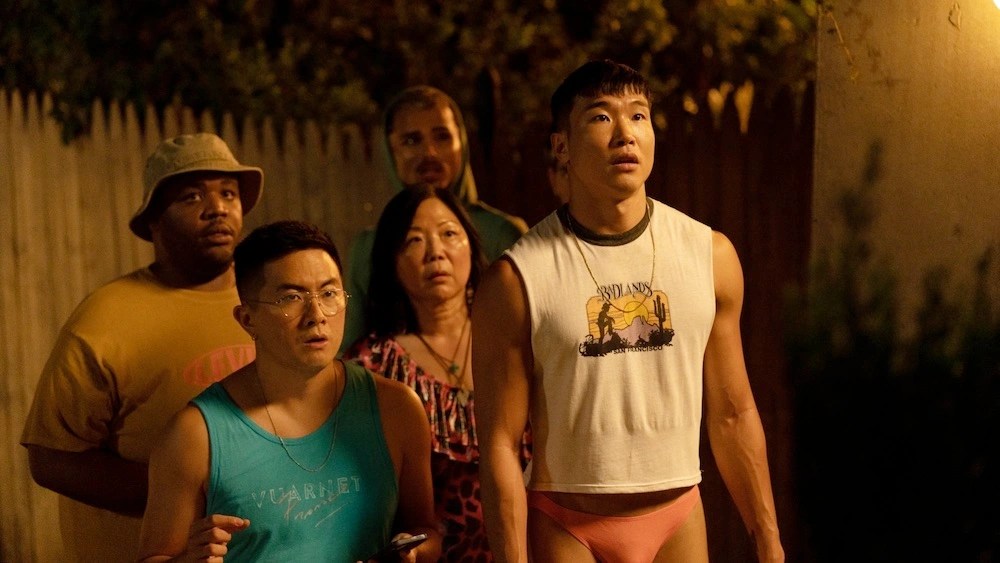
Imagine “Fire Island,” New York’s gay getaway, as a version of Jane Austen’s Bath in the early 19th century — a vacation town where all the right people mix and mingle, court, flirt and perhaps “couple.” That’s what writer and star Joel Kim Booster does for the latest among many films to use that title — and yes, there was even a TV series titled “Fire Island,” too.
Few locations are as evocative of what most everything set on “Fire Island” is about — gay love and the freedom to express it.
Booster plays Noah, sort of Jane Austen’s “Emma” transplanted to “Pride & Prejudice.” Noah is our narrator/guide to this mash-up of Austen themes and characters rendered in bitchy, banana-hammocked, molly-popping strokes on some gay friends’ “last week” at “the Gay Disney World,” as he describes it.
Plainly, Noah’s never visited Disney World in June.
Noah and four friends — Luke (Matt Rogers), Keegan (Tomas Matos), Max (Torian Miller) and Howie (Bowen Yang of “Saturday Night Live”) — gather at the home of their doting lesbian mother figure (Margaret Cho, of course) every year for a reunion/get-away and landlocked “cruise.”
They’re just five gay men, on the make from the minute they board the ferry (Shirts OFF!), ready to brave the “meat rack” of parties, drag/karaoke bars, beaches and sunsets. Erin telling them she has to sell the house she’s long invited these “poor gays” to stay in adds pathos and urgency to their “last summer” together.
As Howie is 30 and “never had a boyfriend,” that becomes Noah/”Emma’s” mission — to get shy, sweet San Francisco Howie some action.
If we’re stealing from Austen, that means Noah will also meet someone. Some suitors — rich and/or handsome — will prove to be unworthy cads, others “rude” and “snobbish” but worthy of a reassessment.
You get the drift. It’s Austen with a lot of “Who’s the ‘bottom,’ here?” jokes.
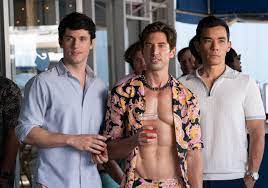

Booster folds in little digs at gay prejudices — a hierarchy that declares “No fats, no femmes, no Asians” — and lip service about not wanting to “conform to this community’s toxic body standards.”
Yeah. Right. Like the shirtless scenes, short-shorts and cut-off Ts don’t show off a sea of sixpacks.
James Scully plays Charlie, the handsome pediatrician Noah sees checking out Howie, turning Noah’s mission into both hooking Howie up and protecting him if he senses a threat from Charlie and his fellow rich snobs.
“These are not OUR people. I was just talking to a guy who thinks Lindsay Graham was in ‘The Parent Trap!'”
“Lindsay Graham in ‘The Parent Trap?’ I’d TOTALLY watch that!”
Conrad Ricamora deftly plays the bookish, aloof stuff Will (Last name “Darcy,” perhaps?) who gets under Noah’s skin as he “protects” Charlie from the lower-class gays in Noah and Howie’s “house.”
It’s all cute enough, campy enough and bawdy enough to pass muster. But when you title your film “Fire Island” you’re not just going where other films and series have gone before. You’re so “on the nose” that nothing we see will surprise.
Paper the picture with voice-over narration that hits the Jane Austen thing right on the head, right from the start, and even more predictability is built in.
That lets us anticipate too much and makes the film’s 105 minutes pass more slowly than you’d like. It “drags,” and not in a fun way.
Even the soundtrack has a banal “Heard that coming a mile off” quality. A cover of Willy Wonka’s “Pure Imagination” introduces us to the hedonistic wonderland of the island, and another cover — of Donna Summer’s gay anthem for “the club’s about to close” — ends it.
But stick around, because there’s a little mystery about what situations will be twisted into Austenesque tropes — “revenge porn,” movie star (cell phone) charades that entail reciting every line Marisa Tomei is famous for in “My Cousin Vinny,” and a dangerously uninhibited night set-off by everybody throwing all their drugs into a grab bag.
Ok, that’s NOT Austeneque. But it is funny enough, and that goes for the whole film
Yang, a stand-out in the current “Saturday Night Live” cast, plays a more toned-down character than any we’ve ever seen, which kind of misuses him. “Outrageous” is his brand. Booster makes a fine leading man, Ricamora is properly infuriating and others occasionally transcend the “types” they’re playing.
Cho is vintage Cho, loud and brash and unfiltered.
The gold standard of this sort of gay reunion romantic dramedy is still “Love! Valour! Compassion,” and Booster’s script only freshens up the situation with nudity, raw language, sex and drugs. The “camp” hasn’t changed in 25 years.
“Fire Island” manages to be just amusing enough to make one forget the other projects with the same title, even if it falls short of being the last word on the place, the scene and the sexual shorthand that title represents.
Rating: R for strong sexual content, language throughout, drug use and some nudity.
Cast: Joel Kim Booster, Bowen Yang, Conrad Ricamora, Matt Rogers, James Scully, Tomas Matos, Torian Miller, Nick Adams, Zane Phillips and Margaret Cho.
Credits: Directed by by Andrew Ahn, scripted by Joel Kim Booster. A Searchlight release.
Running time: 1:45

Mexican star Eugenio Derbez’s Hollywood films lean heavily on “sweet” and “sentimental,” which is some compensation, considering “Instructions Not Included” co-starred an adorable child, “How to be a Latin Lover” underwhelmed and “Overboard” was a dog.
They’re all slow, something that leaps back to mind as his remake of “The Valet” hits the hour mark and one wonders “Well, they’ve run out of entertainment value and this lump has another hour before the closing credits.”
Nevertheless, the script, an adaptation of a French comedy, works in some warm and almost biting commentaries on being Latino and working-poor in the City of Beautiful People, New Money and Extravagance — Los Angeles.
The set-up is that a 50something car valet tumbles into a beautiful starlet and her paramour, and they pay him to pretend to be her new beau to throw the paparazzi, and a jealous spouse, off the scent.
Derbez, sporting a haircut that doesn’t hide “60 not 50,” is paired-up with Samara Weaving (“Ready or Not”), and even having his character, Antonio, say “I’m old enough to be your father” and “Nobody will believe this” doesn’t let the picture’s miscast central premise off the hook.
But if there’s little chemistry, few funny lines and shockingly few attempts at slapstick, the idea here is to make these two very different people connect, relate and share the downsides of his life of struggle and her loveless lack of privacy.
I remember being lukewarm on the 2006 French film this is based on, so it’s not all on Derbez, Weaving, the director and screenwriters. The source material’s thin on laughs. But Derbez seems muzzled by the screenplay, and Weaving has few chances to hit the gonzo notes that made her “Ready or Not” and “Guns Akimbo” turns amusing.
Antonio rides a bicycle to work, lives in a motel that’s gone condo with his mom (Carmen Salinas) and teen son. His wife (Marisol Nichols) has left him, just the latest sign that the world has him under its heel.
Olivia Allan (Weaving) wears disguises, switches cars on her way home and lives under a microscope. Her face is on posters all over town, because her new movie “Earhart” is about to premiere.
The last thing she needs is a scandal — photographed by the paps, sneaking out of a swank hotel where she was canoodling with her married developer side-piece (Max Greenfield).
The “other” guy in those scandal sheet photos, the hapless valet, is their way out. Pay him off, show him off, maybe get him to shave that damned mustache off, and “change the subject” in a single news cycle.
“I’ve dated actors,” she tells the gossip press. “They’re too much work.”
So. A valet it is. Let the wild rumpus start.

The gold in this is in the details scattered around our ill-fated couple.
Antonio finds himself sneaking a drunken Olivia out of a premiere party, through the hotel’s kitchen, where his working class Latin compadres cheers “Viva MEXICO!” He and two valet pals
(Armando Hernández, Carlos Santos) pour her into a pickup and make their getaway.
But hey, let’s stop at the drive-through. She’s still out cold as they split the tab, counting out the ones they get in tips from parking the world’s most expensive cars at work.
The “cute” stuff about her meeting his family and neighbors has no laughs in it. That joke played.
But Antonio gets to tell the fair haired “white girl” how hard it is “being invisible” in a city where Latinos make up much of the work force, serving haughty folk who “never look us in the eye.” A running gag that’s more sad than funny — Antonio is constantly mistaken for a waiter, every where they go.
The comic stuff is kind of tired and bloodless — “What’s she see in him?” penis jokes, faked sex. But the sweet stuff, for the most part, plays. She shows up at his son’s school play — “Midsummer Night’s Dream.” Two rival private eyes (Ravi Patel, John Pirruccello) show up as well and find themselves deconstructing the play during stakeouts.
Derbez remains a likable presence, and that’s the highest praise you can throw at “The Valet” in the feeble hope that it sticks. But even “likeable” wears out its welcome when the story hits the wall at the 60 minute mark, and there aren’t enough jokes to fill a single sitcom episode.

Rating: PG-13 for sexual content, some strong language and brief drug material
Cast: Eugenio Derbez, Samara Weaving, Max Greenfield, Betsy Brandt, Amaury Nolasco and Carmen Salinas.
Credits: Directed byRichard Wong, scripted by Bob Fisher and Rob Greenberg, based on the French film by Francis Veber. A Hulu Original, by Lionsgate
Running time: 2:04

 Movie Nation