
College kids get on the wrong side of an AI system that goes bad — very bad — Sept. 9.
College kids get on the wrong side of an AI system that goes bad — very bad — Sept. 9.

A young career criminal gives his protege — “Emily the Criminal” — a look after she says something that definitely ups the ante and increases the risks of their latest undertaking.
“You’re a very bad influence,” he mutters.
Emily is played by Aubrey Plaza. So talk about “goes without saying.”
The cinema’s favorite “naughty girl” turns “badass woman” in this gritty and bitingly-topical thriller set in LA’s thriving illegal underground economy.
The milieu is the world of stolen credit cards, the thin line that many see and cross to use them and the nerve it takes to walk into a business with fake card and fake ID and walk out with a flatscreen TV, sound system, laptop or automobile.
First-time feature-director John Patton Ford’s slap-in-the-face thriller is about generational angst and generational burdens, watching the star-kissed succeed and live their best lives while you’re trapped under student debt, “entry level” work and a dream that dies a little more with every “your payment was applied to the interest, not the principal” message.
Emily has it worse. We meet her at a job interview where she’s tricked into minimalizing something on her “permanent record,” a college-years assault charge.
We watch her struggle, sharing a dumpy apartment with a young Japanese couple, delivering for a catering company and never getting the graphic artist gig interview with the firm where her gorgeous high school pal (Megalyn Echikunwoke) landed. We see her flinch when Liz shares her “going to Portugal, for work” news. And we pick up on Emily’s kryptonite.
She has two of those, one being a temper and outspoken willingness to call out abusive employers, would-be employers and “internship” hustlers.
“Are you an employee?” one of them barks back. “You’re an INDEPENDENT contractor. It’s not like you’ve got RIGHTS.”
And a night of “just drinks” with Liz reveals Emily’s other handicap. She ends up staggering onto the sidewalk, from liquor to a random guy’s offer of coke, in a flash.
But a colleague texts her a phone number, a “dummy shopping” hustle, offering “$200 in an hour.” That’s how she meets the sketchy Yousef (Theo Rossi, excellent), his ruder and sketchier brother Khalil (Jonathan Avigdori, brooding menace incarnate) aand her introduction to the world of bad credit cards, fake licenses, bad checks and bad people on both sides of almost every transaction.
We hear the rules and guess which ones Emily is fated to break.
“Don’t mess with ATMs, don’t meet customers in your home, don’t go to the same store more than once a week.”
We pick up on how tough and morally “flexible” Emily is. We see her eyes widen as doors seem to open, if only a crack.
Could this be her ticket out — of debt, working poverty, the limited horizons dictated by her “permanent record” past?
Plaza turns off her bug-eyed on-the-make act, and dials down her finely-tuned “bitch you don’t want to cross” for Emily, a fierce creature when she’s cornered, and this world seems dead set on cornering her.
Rossi plays Yousef as cagey — perhaps smitten, perhaps using or “playing” Emily. Is he really a Lebanese guy in an unsavory line of work but idealistically determined to go legit and see his American Dream come true?
And Gina Gershon shows up as an “unpaid internship” employer, the person who uses Millennial “lazy” “spoiled” slurs to justify exploiting people like Emily. Emily both fits the stereotype — “I just want to be free. I just want to experience things, travel” have money without the hazing rituals of grunt work life — and is EveryMillennial’s nightmare, buried under college debt before life even begins.
I love the portrait painted here, of a flawed young woman trapped in a system that seems corrupt wherever you look. The people buying the illicit purchases from her are far bigger crooks and more dangerous, and plenty of those she purchases from are just as sketchy as her and Yousef.
Ford has tapped into resentments deep and wide here, and in Plaza, he’s cast the perfect complaining spokeswoman and one badass broad who isn’t going to take any of this lying down.
“Top Gun” may be the blockbuster of the summer, and “Everything Everywhere All At Once” the movie event of the season. “Emily the Criminal” is the face and voice of not just the summer, but an American generation right now, looking for a break and desperate enough to cross the line if they don’t get it.

Rating: R, violence, brief drug use and “language” (profanity)
Cast: Aubrey Plaza, Theo Rossi, Bernardo Badillo, Megalyn Echikunwoke, Jonathan Avigdori and Gina Gerhson.
Credits: Scripted and directed by John Patton Ford. A Roadside Attractions release.
Running time: 1:34
This little innocent abroad in that most French Canadian of cities and it’s many subcultures is on the festival circuit at the moment.
Here’s who and what we have to look forward to.

“Pahuna: The Little Visitors” is a tiny tots on their own children’s fantasy about barely-school-age Nepalese siblings who take a child’s view of taking care of themselves and their infant brother after they get separated from parents.
Although it begins in violence — because that’s what puts this family from Daalpur on the road, fleeing to the neighboring Indian state of Sikkim — it quickly evolves into a picaresque and just realistic enough “how little imps like this might manage” when stuck, on their own, with a baby.
It’s adorable, the most adorable thing on Netflix right now.
The sounds of gunfire makes everyone back up a few things and flee into the woods. But when the father goes back to “distract” the unnamed bandits, revolutionaries or what have you, it’s natural that the mother would entrust her three kids — Amrita (Ishika Gurung), the oldest (maybe 7 or so), Pranay (Anmoul Limboo), a year younger, and baby Bishal — to her sister as Mom turns back to find her husband.
“Promise me you’ll stay together and look after Bishal,” is her plea. And then she’s gone.
Everybody hikes and camps their way to safety. But as the grownups in their village party debate the merits of crossing into Sikkim, Pranay is the one listening to flaky, rice beer-loving “uncle” Rai (Mahendra Bajgai). That town, Pelling, it has a church! The “monsters” there attack our old gods. And the priests? “They wear long robes, to catch and HIDE children in,” he says (in Nepali with English subtitles)! “They EAT babies!”
Pranay convinces the (slightly) more sensible Amrita of this, and there’s nothing for it but for them to give the grownups the slip and keep their promise to Mom (Manju Chhetri).
They move into an old bus, abandoned in the woods, make a fire, cook and eat and set up housekeeping.
There’s a sad moment of “Wonder if Dad’s OK,” a little wondering of when Mom will find them, and how, and then they’re lightly bickering over who does the dishes and how they’ll get by with the little food and water they have with them.
A snare to catch a bunny? Sure. Wait, we have to kill it to eat it? Maybe not.
The childish problem solving is countered by universal bits of early childhood behavior any parent will recognize. Take a tumble, washing clothes at the waterfall? There’s no sense in crying your eyes out, there. Go back to the bus and bawl, where you’re sure to have an audience.
The baby starts crying inconsolably, and they check his nappy, try and feed him and even rig a hammock to rock him. No dice. And then he breaks wind, “Bishal the Farting Machine” is “cured.”
The cuteness goes into overload as Pranay meets a friendly goatherd (Binod Pradhan) and sweetly talks the old man into a job, grazing his goats, in exchange for milk. Amrita finds out her Nepalese cash won’t buy anything at the store, but a sweet pregnant lady (Banita Lagun) might be talked into giving her chores for “IC” — Indian Currency.
The sweetness hangs over this picturesque picture is as simple as the “we’re all related, after all” tradition of calling even strangers “Auntie” and “Uncle.”
Melodramatic moments aside, we never really fear for anyone’s well-being, and even the menacing, faceless presence of the robed priest, who takes a morning walk near their bus in the woods each AM, is headed for a sweet solution.
Kindness rules the day, kids comforting grownups, grownups looking after kids, making them think charity is something they’re working for.
The story is simple enough to follow without reading the subtitles, but if your kids are too young to read, you’ll have to explain the silly superstitions and translate the fart jokes for them, which is really the best part of parenting, isn’t it?

Rating: TV-PG, fart jokes
Cast: Anmoul Limboo, Ishika Gurung, Banita Lagun, Binod Pradhan
Credits: Directed by Paakhi A. Tyrewala, scripted by
Paakhi A. Tyrewala and Biswas a. Purple Pebbles Production on Netflix
Running time: 1:22
A glum and faintly horrific bit of sci fi coming our way Sept. 30.
Eddie Marsan is the one recognizable face I see here, with Raffiella Chapman as our 13 year old title heroine.
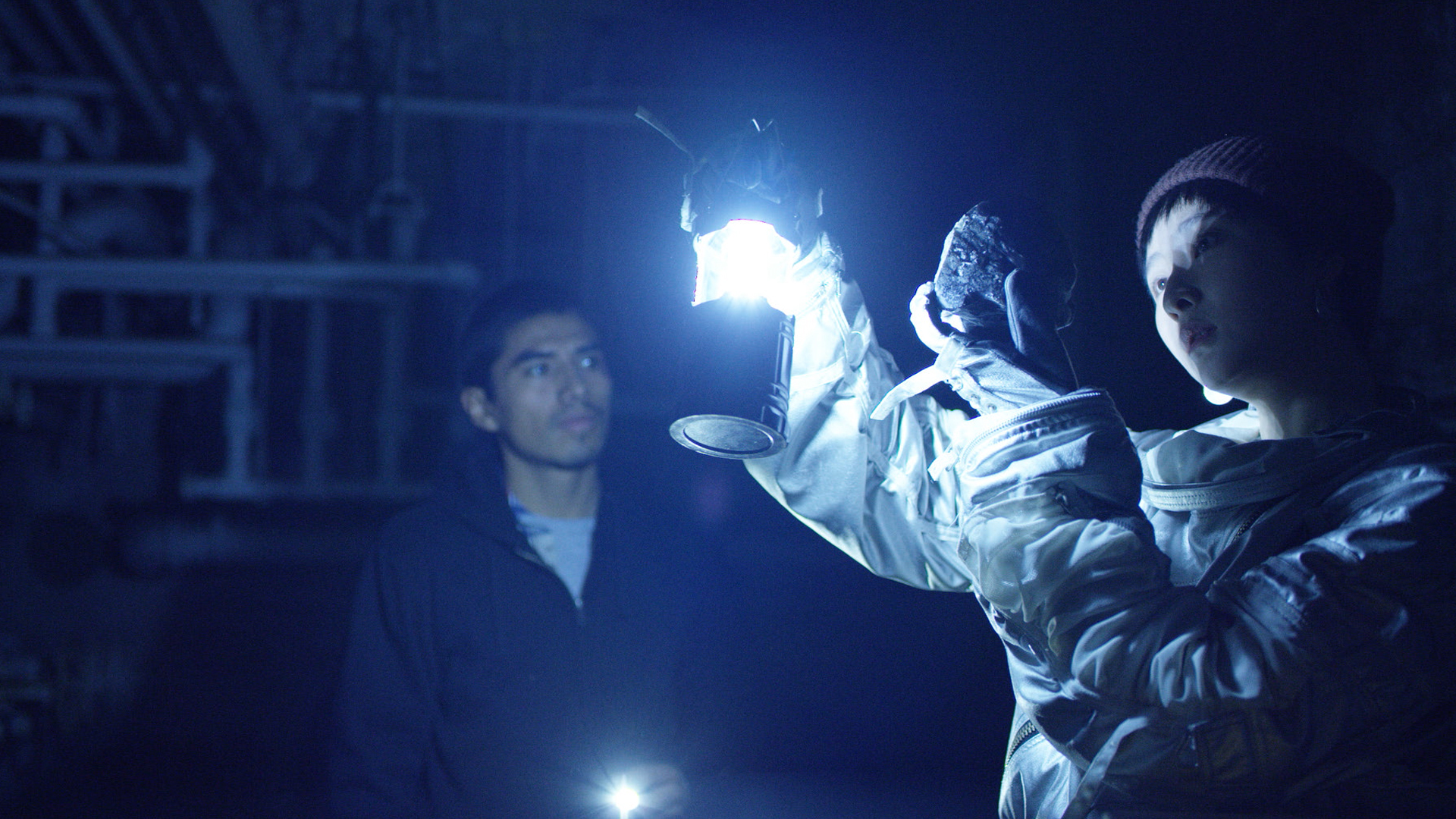
The dreamy sci-fi romance “We Are Living Things” might have been pitched as a “two people who have experienced UFO abductions” “the truth is out there” mystery.
But the abductions depicted here are more mundane and down to Earth. The whole “search for aliens” business turns out to be a lot less interesting than you might hope or expect. The thing is, the filmmakers figured that out, too, and a quiet, somber romance spins out of shared trauma and “belief.”
As a rule, I’m fonder of movies that have a bit more going on. But this odd, moody movie in a minor key has a mesmerizing quality that engages in different ways.
Jorge Antonio Guerrero (“Roma”) is Solomon, an illegal alien with a thing for space aliens. He’s in New York, an undocumented laborer who works and lives, in a open shed out back, a scrapyard. By day he sorts metals and crushes cans, or takes care of building maintenance at the half-ruined flophouse the owners run down the street. By night, he’s out metal detecting, look for magnetic rocks and “evidence.”
A striking Chinese woman (Xingchen Lyu of “Wisdom Tooth”) gets his attention and gives him a deja vu feeling of connection. When he fixes her plumbing in the flop house, he spies UFO photos and a magnetic rock and wonders if she’s a kindred spirit.
He stalks Chuyao to her day job in a manicure shop, and her after hours work as the “date” of some hustler named Tiger (Zao Wang) who must have been the person who smuggled her into the U.S. She’s as creeped-out as you might expect anyone being stalked to be. But the whole Tiger arrangement seems unsavory and dangerous, and even Solomon abducting her seems almost reasonable.
That’s when she figures out what they have in common, when she sees his DIY electronic efforts to listen in to whatever’s “out there” in space and when she develops feelings for this enterprising immigrant who, like her, has first-hand knowledge of whatever goes on when people say they’ve had “Communion” with beings from flying saucers.
The blessing here is how little the film and its dialogue are concerned with that UFO hook. What’s more interesting is how this out-of-sorts Chinese woman learns to trust this Mexican who proves to us long before he proves to her that he’s got her best interests at heart.
The leads are an intriguing contrast, each getting across a performance that doesn’t really spell out “character” or advance the story all that much. Lyu and Guerrero sell “mysterious” and “romantic” in understated ways.
“We Are Living Things” is more a movie of feelings than plot or explanations of that plot and the characters. And as such, dark as it sometimes gets, it’s a winner. It’s too slight to oversell or hype. But as long as you see it or stream it without expecting “Signs” to pop up and scare you to do death or “E.T.” to phone home, it makes a pleasantly diverting romance with just enough science fiction in it to merit the label.

Rating: unrated, violence, drugs
Cast: Jorge Antonio Guerrero, Xingchen Lyu, Zao Wang and O-Lan Jones.
Credits: Directed by Antonio Tibaldi, scripted by Antonio Tibaldi and Alex Lora. A Juno release.
Running time: 1:36

I see from a quick search of posts here that I published the trailers to “The Informer,” another “undercover in the joint” thriller, but never got around to reviewing it during its brief theatrical run.
Guessing that was because of how similar it is to the Nikolaj Coster-Waldau thriller “Shot Caller,” which I wasn’t nuts about and which came out not that long before it.
But the trade offs in leads — Joel Kinnaman of “Suicide Squad” instead of “Game of Thrones” hunk Coster-Waldau — is more than offset by a sparkling supporting cast, which in “Informer” includes Rosamond Pike, Common, Clive Owen and a pre-fame poodle-haired Ana de Armas. The violence is more visceral even if the plot is loopier, with a third act that’s just “out there.”
The players, the hopeless situation and one killer scene make this the better movie to me. Let me see if I can make my case.
Kinnaman plays an ex-con/informant who is setting up a Polish mob kingpin in New York when things go sideways on the day of the “meet.” Even though Peter Koslow was careful enough to sew in his own “wire,” even though he did his part, listened to his FBI handler (Pike) when she said “Stay cool and we’ll be all right,” and followed protocols, an NYPD cop got killed.
He didn’t kill him, and even though the fact that the cop stumbled into their sting thanks to a bumbling punk relative of “The General” (Eugene Lapinski), Koslow is the one who owes the mob “a debt,” the one who owes the Feds their sting. He’ll just have to arrange that from inside Bale Hill, the prison he’s been sent back to.
Wife Sofia (de Armas) and daughter? Won’t the Feds whisk them away? And the warden, won’t he have our recidivist inmate’s back for his snitching? Not if Pike’s character’s boss (Owen) has any say.
“Burn him.”
And then there’s the NYPD cop (Common) whose undercover drug buyer was murdered. He’s annoyingly relentless, and in ways that seem to benefit neither the Feds nor the Koslows.


The intrigues are breathless and the violence so in your face that it takes a seriously off-key third act to make this one more a mixed bag than it was setting up to be.
Kinnaman’s terrifically poker-faced. He may be playing a combat vet, a “sniper” (lazy-assed screenwriters), but he’s no superman stuck behind bars with his mental; and physical inferiors. Skinny Kinnaman makes us fear for Koslow’s safety and wonder if he has the wits to wriggle out of this death trap.
A killer moment involves a hanging. Other blasts of violence are just as intimate, even as the “How do we get him outta this?” part of three tag-team screenwriting falls to pieces in the finale.
Worth a look? This cast guarantees it, and one adrenalin-rush hanging scene sells it.
Rating: R (Strong Violence|Pervasive Language)
Cast: Joel Kinnaman, Rosamund Pike, Clive Owen, Ana de Armas, Common and Eugene Lapinski.
Credits: Directed by Andrea Di Stefano, scripted by Matthew Cook, Rowan Joff and Andrea Di Stefano. A Vertical release on Netflix.
Running time: 1:53
It just passed “Titanic” on the all time cinema blockbusters list, has been “the movie event” of the year, in terms of box office, and Disney and MGM are putting major releases out on streaming only.

So why not a “fan appreciation weekend” for Tom Cruise’s biggest hit ever? The screens are available.
“Maverick” returns to the biggest theaters in America this weekend, for those with a “need for speed” and a Jones for a big action fix.

Today’s Around the World with Netflix outing is a minimalist, just-nasty-enough burglary-gone-wrong tale from Kenya.
“Nairobby,” the debut feature by writer-director Jennifer Gatero, is a “Reservoir Dogs” style no-budget heist picture in which there are no flashbacks to the actual “heist.” It’s set almost entirely in the aftermath, with accusations, backstabbing, betrayals and threats coming as the robbers try to reason out what went wrong.
Five college kids meet in an abandoned building, most in near-hysterics about who “the guards saw” and why “the alarm went off,” when their inside woman, Tasha (Lorna Lemi) “had the codes,” and what they’re going to do when their sixth member, Nick (Martin Gathoga) shows up, bleeding out from a terrible gash in his leg.
They had big plans, it turns out, to “distribute” their college’s scholarship money which they’re sure their corrupt dean will spend on a new Range Rover. It’s what he (Jack Chage) always does, raise money for “disadvantaged students” like most of them, and then buy himself a new car with the cash.
Vivian (Jeritah Mwake), her beau Yobra (Sanchez Ombasa), beret-clad hothead Oti (Neville Ignatius), med student Kama (Martin Ndichu), Tasha and Nick figured they’d use the money, stashed in the dean’s office, the way the dean said it would be used — for tuition.
But 37 million Kenyan shillings has them thinking other thoughts — of raising this one’s daughter elsewhere, of fleeing to Zanzibar and opening a seafood shack one wants to name “Frying Nemo.”
It’s just that Nick is bleeding out, his dad might be mob connected and med student Kama is as useful as a spoon, when what they need is a hospital.
Romantic entanglements, lies, a hidden pistol and recriminations follow as the clock ticks down on the sirens they hear closing in on them.
“I spread lies the way you spread your legs!” (in Swahili, with a bit of English patois thrown in).
Gatero, who appears on camera as a TV newscaster summing up the robbery, throws a lot of melodramatic manipulations into all this, characters shifting from panic and grief to lusty “love the one you’re with” changes in allegiances in an abrupt flash.
But she’s made a tight, suspenseful thriller peppered with flinty, repetitive, David Mamet-style dialogue, as if these college kids are all film students and know their “Heist” and “Reservoir Dogs” references.
“Nairobby” may not be an instant classic. It’s still a sharp enough opening outing to be worth a look and easily earns that second check Netflix should write to give us more gritty tales from Kenya from this very promising first-time director.
Rating: TV-MA, violence, sex, profanity
Cast: Lorna Lemi, Jeritah Mwake, Neville Ignatius, Sanchez Ombasa, Martin Gathoga, Jack Chage and Martin Ndichu
Credits: Scripted and directed by Jennifer Gatero. A Netflix release.
Running time: 1:17
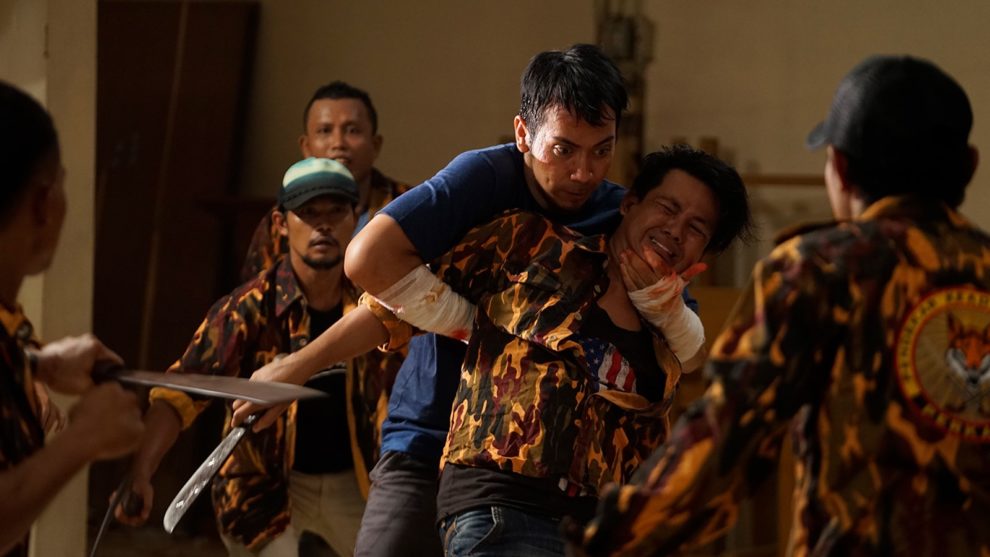
This Indonesian gangland thriller “Preman” has the most badass villain’s henchman ever. His name is Ramon. He speaks French, and refers to himself in the third person.
“Ramon does not like cussing.”
Ramon keeps scissors and other hair care accessories — some of them lethal — in his leather salon holster. Ramon is a killer, and a hairdresser, and you’d better not cuss him or sling gay slurs his way. Because Ramon will CUT a bitch, and remind you that “Ramon’s sexual orientation is none of your business!”
Remember, Ramon is not the hero or anti-hero of this violent quest tale. He’s just a henchman. But when you’re building your movie around a deaf gangster trying to save his headstrong child from murderers, a fellow whose weapon of choice is a “monkey fist,” you’d better have somebody seriously colorful lined up against him.
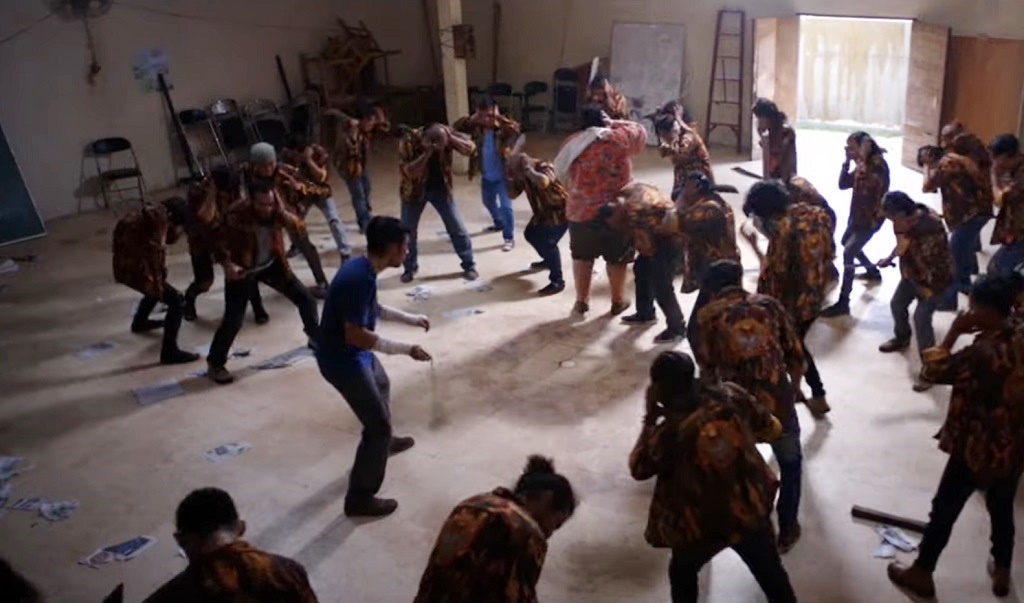
“Preman” is titled “Preman: Silent Fury” for international release to separate it from other Indonesian gangster films. “Preman” are low-rent thugs, enforcers for assorted political or monied interests, the muscle that clears villages wanted for redevelopment or ensures political power in ways the corrupt, ineffectual, outmanned police cannot.
Sandi (Farell Akbar) has grown up in the gang, wearing the officially-provided shirts and pretending to listen to the harangues of the gang boss, Guru (Kiki Narendra), who works for a fat-cat politician. Sandi “pretends” to listen because he lost his hearing in some childhood accident or trauma.
Might his nightmares, which involve tangles with people in fuzzy cartoon animal suits, explain that?
When the gang is ordered to clear the settlement that’s grown up around an orphanage/school for the poor, run by the sage Haji (Egy Fedly), Sandi must take a side. Haji raised him after he went deaf, and Haji insists that Sandi take his son (Muzakki Ramdhan) and seek a better life for the kid.
The movie is about what happens when you don’t take a sage’s advice. Because Haji is threatened, but defiant. And Sandi’s boy Pandu is a tough little kid — bullied but hellbent on fighting back.
“When are you going to teach me to use the ‘monkey fist?'” the kid wants to know.
Dad’s secret weapon in a gang world where guns are rare and machetes, daggers and clubs, some wrapped in barbed wire, are the preferred and much more intimidating weapons of choice, is a ball on a rope.
When the Sandi and Pandu try to save Haji and run afoul of the gang, Guru sends for “The Barber.” Let’s let Ramon, the badass, vested and goateed barber from Jakarta, describe (in Indonesian) what his quarry is carrying.
A Monkey Fist is “a high velocity flail, with a blunt weight on its end, generating impact through centripetal force!”
You go, Ramon!
All Sandi has to do is spin it and whip it and skulls crack, teeth shatter and foes fall to the floor. Of course, it’s not the perfect weapon. If a mob is brave enough to come at him in numbers, or if the fight is in a confined space, he might not have room to whip it, whip it real good.
One of the many cool elements to “Preman” is how many people in Sandi’s life know sign language. Even when he and the multi-lingual dandy Ramon (Revaldo, in a movie-stealing performance) throw down, his foe knows how to sign his threats and trash talk.
The movie’s simple quest structure — a father struggling to get his rebellious, short-tempered child to safety — is somewhat muddied by the “fuzzies” flashbacks, and clumsy third act efforts to over-explain Sandi’s deafness and the ugly personal failing that caused it.
But for a movie with wanton violence and cruelty, with a compromised cop (Gilbert Pattiruhu) forced to watch a gang rape (not shown) as punishment and characters who weep at the loss of loved ones, it’s also darkly funny.
Punctuate an off-camera gang-rape scene with an emasculatingly “comical” confession of sexual dysfunction. Have a guy slur He Who will NOT be Slurred, Ramon, and see what he gets for it.
For all its universal action movie tropes, “Preman” is very much a product of its culture, some of it less palatable to Western eyes. But it’s a dashing writing/directing debut by that cinematic rarity, a sound guy (boom operator to editor) who moved up to directing.
And writer-director Randolph Zaini, playing around with narrative structure and even joking around with the (aspect ratio) frame in a few scenes, announces himself as an Indo-Action (just made that up) filmmaker to watch, another reminder that Hong Kong, Japan, Korea and Thailand aren’t the only places in Asia that could teach Hollywood a thing or two about how to spice up a thriller.

Rating: TV-MA, graphic violence
Cast: Farell Akbar, Emil Kusumo, Kiki Narendra, Muzakki Ramdhan, Gilbert Pattiruhu, Putri Ayudya, Salvita Decorte and Revaldo
Credits: Scripted and directed by Randolph Zaini. A Well Go USA release.
Running time: 1:32

 Movie Nation