
New Orleans at its most demented. Stranger than fiction. But not stranger than science fiction.
Sept. 30.
New Orleans at its most demented. Stranger than fiction. But not stranger than science fiction.
Sept. 30.
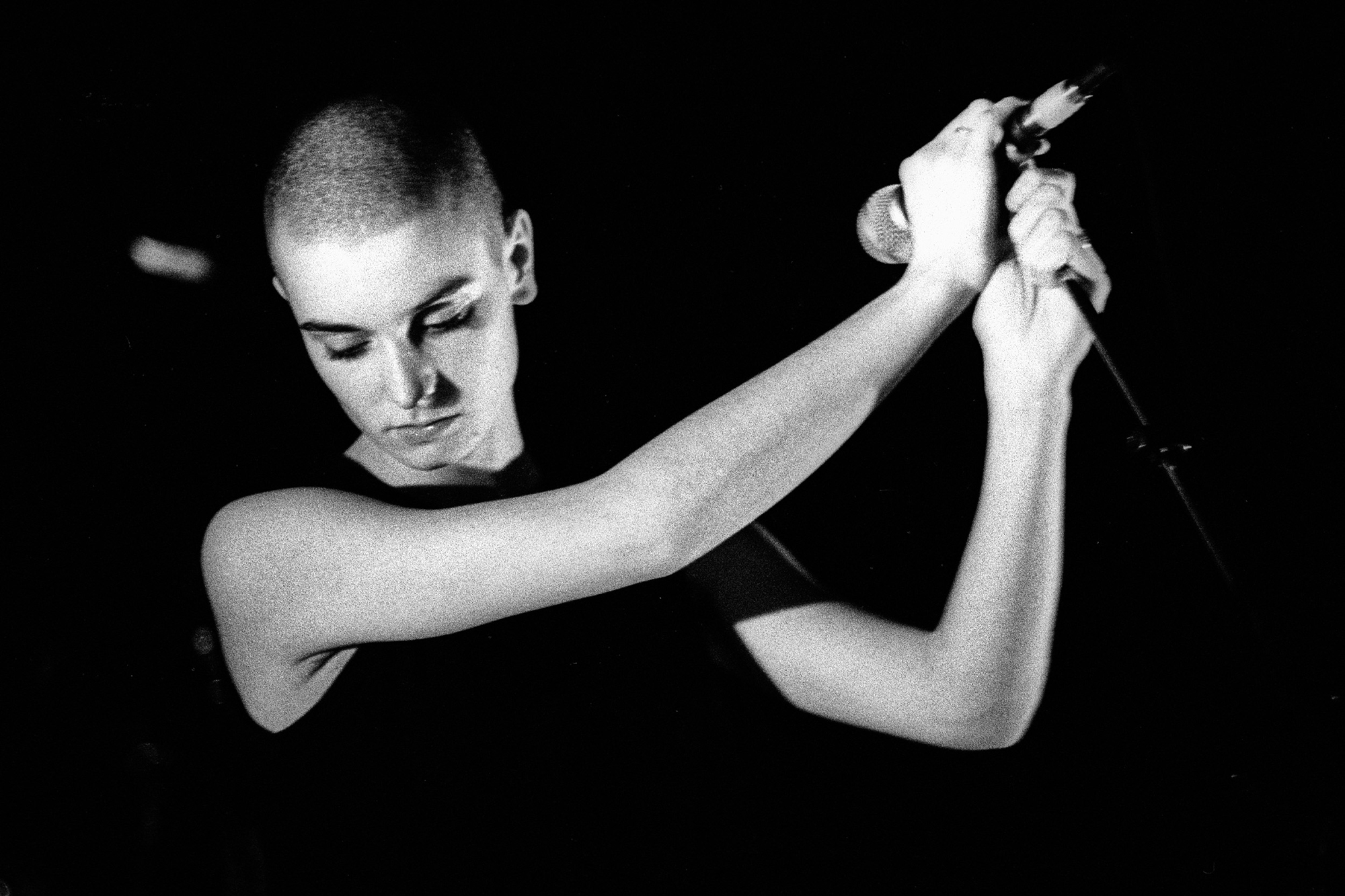
The pop star of the moment stood on a quiet, dimly-lit stage behind lit candles and performed a Bob Marley song, “War,” a cappella. When it was ending, she held up a photo of Pope John Paul. She tore it up, saying “Fight the REAL enemy.” And America, for not the first and certainly not the last time, lost its ever-loving mind.
That infamous piece of “Saturday Night Live” lore — Oct. 3, 1992 — is a centerpiece moment of “Nothing Compares,” Kathryn Ferguson’s bracing, eye-opening, straight-no-chaser documentary appreciation of Sinéad O’Connor. That night is revisited, explained and appreciated in ways it could not be back then, when Joe Pesci was threatening to “give her such a smack” and Catholic advocacy groups led protests against her music and went to war with her career.
Her then-publicist, Elaine Schock, recalls going backstage and telling the already-embattled singer “I can’t get you out of this.” And she remembers O’Connor smiling, “happy” and defiantly saying “You know what? I don’t want you to.”
“Nothing Compares” — its release on Showtime coinciding with the 30th anniversary of that night — hits the highlights of O’Connor’s rise, the abused childhood, the mentally ill mother, the Irish Catholic Church that figured into so many of her stories (she was put “in care” at a Magdalen laundry orphanage) of oppression and physical abuse.
But the perfect “explanation” for O’Connor’s outspokenness — pre-“SNL” she had been demonized for refusing to allow the American National Anthem from being played at her shows (during the Bush I Gulf War) — comes from the artist herself.
From Daniel Corkery and Sean O’Casey to Brendan Behan, there’s “a tradition of Irish artists being agitators,” O’Connor (she goes by Shuhada Sadaqat since converting to Islam) says now. And she’s right. Think of U2’s activism and Van Morrison’s anti-vax protests. They don’t always have to be “right.” They still feel a need to speak out.
That electrifying moment on “Saturday Night Live” was both the latest outrage from the outspoken Irish singer and her latest electrifying moment. Just a couple of years before, her breakthrough single, a cover of Prince’s “Nothing Compares 2 U,” was a minimalist video phenomenon which somehow never overwhelmed a stark, open wound performance of a song that became the world’s biggest hit.
The video’s director John Maybury recalls being shocked at “the connection coming down the camera. It’s not the direction. It’s not the cinematography (he hired a female DP to put O’Connor at ease). It’s entirely her.”
Ferguson interviewed friends, bandmates, an ex-husband, musicians, filmmaker-collaborators, journalists and publicists and O’Connor/Sadaqat herself, always off-camera. Their voices inform the film and the still photos and grainy early performance footage show us the young Sinéad, who always favored very short hair before impulsively shaving it all off when her first record label leaned on her to have an abortion when she and her beau got pregnant. The film skips past some of the trauma she wrote about in her memoir “Rememberings,” and revealed to talk show hostesses like Oprah. The idea seems to be to get her to a triumphant finale, in which we appreciate the things she went through to speak and perform her truth.
Fair enough.
There’s a lot of background and a lot of drama in this film, which reminds us of the soft-spoken way O’Connor came off in early interviews, and the confidence to speak out that grew as she grew up. She was world famous at 21, a singular talent with a voice that would range from a whisper to a keening yelp several octaves higher in an instant, a great beauty seemingly at war with her beauty.
Her sound, her look, her fashion sense and her politics are discussed and marveled at by those interviewed, who see her as a woman decades ahead of her time whom the passage of time has largely validated and exonerated.
“I don’t think that the powers that be were ready for her,” Chuck D says, admiringly. He remembers her showing up at her first Grammys, which Chuck D and Public Enemy were boycotting, with a Public Enemy logo painted on her head in solidarity.
Irish journalist Roisin Ingle looks at Parkland High School gun control activist X. Gonzalez and her shaved head, and singer Billie Eilish going off on stage demanding that politicians “Leave our bodies ALONE,” and sees “little sparks of Sinead.”
And we all know what happened to the Catholic Church when the ugly secrets started getting out, and what happened to Ireland when it shook off the misogynistic theocracy the model-gorgeous singer from Glenageary first started raising hell about over thirty years ago.
The film takes us all the way back to show us the elements that made her a star and lets us appreciate the principles with which she approached her career, right from the start. But “Nothing Compares” also makes us remember that we almost all laughed at the punchline O’Connor became, at the “Saturday Night Live” jokes at her expense, and that perhaps we even embraced the ginned-up outrage aimed at her way back when.
And if this film doesn’t change our minds about her state of mind — that Islamic conversion feels like another straw a sometimes impulsive, often unhappy and unmoored person has grasped — it at least makes us reconsider her rationale, her defiance and her guts.

Rating: unrated, profanity, smoking
Cast: Sinead O’Connor
Credits: Directed by Kathryn Ferguson, scripted by Eleanor Emptage, Kathryn Ferguson and Michael Mallie. A Showtime release (Sept. 30).
Running time: 1:39
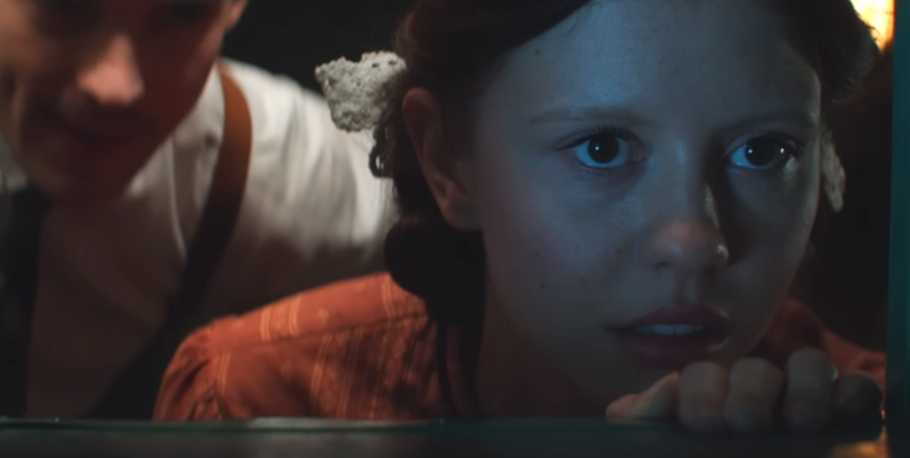
“Pearl” was the aged, sex-obsessed psychopathic matriarch and villain of Ti West’s satiric, social commentary slasher picture “X.” She was played by actress Mia Goth, who also played the libidinous teen whose Texas family farm has been rented by a cut-rate crew anxious to get in on the coming porn picture boom by filming one out in the boondocks, where the locals might not approve and where all manner of farm implements and a gator are handy as their means of “censorship.”
“Pearl” is also the title of the origin story conceived during a COVID break in filming “X,” one dreamed up by the actress who played both roles back then. It’s a speculative piece of cinematic psychology that suggests how such a “monster” — isolated, old, embittered and murderous — might have come to be.
As psychology, it’s no deeper than the epilogue to Hitchcock’s “Psycho,” in which Simon Oakland “explained” how Norman Bates became “Mother,” or the few feeble attempts his shrink makes at analyzing Michael Myers in “Halloween.” It’s glib at best, wrongheaded “horror movie psychology.”
But that’s not really the point, as the idea is to take us back to Pearl’s first killing spree and show us all the creative ways she found to kill those who got in the way of her “dream” way back in 1918, when World War I was winding down, the Spanish Flu was blowing up and the movies were still new.
As young Pearl (Goth) launches into a very long and emotionally miscalculated speech explaining her hopes in life, her first clues that “something is wrong with me” and when she first started killing, I got lost remembering what grim going this whole picture has been.
Pearl’s at home, living with her family, helping out with the farm while her husband Howard is off having an “adventure” in Europe. He’s a doughboy in France, and she can only dream of him via his letters. She’s stuck in BFE, Texas.
Pearl dreams a lot, swirling and dancing to herself in reveries that tell us she wants to be a dancer like the leggy ladies she sees in the movies — leading a chorus line, catching the spotlight. Her stern German mother (Tandi Wright) has no time for this nonsense. Her father (Matthew Sunderland) is catatonic, a burden, not a help on this farm. Pearl needs to pull her weight.
“One day, you’ll never see me again,” is Pearl’s mantra and threat — to her farm animal audience, and to her mother. “I’m special.”
Her only relief is the periodic trip to town, at the local cinema, where she can see newsreels and movies about chorines dancing to their heart’s content in the big city. The dashing, mustachioed projectionist (David Corenswet) takes an interest. Will Pearl be tempted by his sophistication, the allure of “travel,” his after hours come-on of showing her an early “stag film” (“A Free Ride”)?
And there’s another way out, a big dance audition for a regional touring company, to be held at “the church.” Like the movies she watches — which have synced soundtrack sound and not a piano player accompanist — this is an anachronism. But she and her curly-blonde sister-in-law (Emma Jenkins-Purro) can dream of treading the boards, can’t they?
Pearl starts making plans and plotting her exit. Those parents? They just might be in the way.
West delivers some early cinema history sight gags — Pearl riding her bike into town has a hint of Margaret Hamilton’s Wicked Witch on a bike in “The Wizard of Oz” — but very little of this sadistic “dark horror comedy” struck me as the least bit amusing.
Pearl pausing a bike ride to make out with a scarecrow, because that’s how lonely and horny she is? Hilarious.
The social satire of “X” is missing. The commentary on the culture of the day — the war, with women struggling at home while the young men are “Over There,” worries about “germs” and the flu, the easily-shattered dreams that the new entertainment form offered those who lost themselves in the movies, “pictures” or “flickers” of the day — isn’t as focused.
It’s self-indulgent and self-referential, more a humorless counterpoint to “X” than a precursor. Sure, it’s a reminder that porn has been around since the birth of cinema, and that wherever dead-end “provincial” towns can be found, there’s some frustrated Belle longing to escape. And?
“X” was about something. “Pearl,” not quite.
The real intent here is to create a showpiece for Goth as an actress and a writer. The writer scripts this long, tedious and “revealing” third act monologue of Pearl explaining herself, giving us no information we haven’t picked up already. The actress vacantly emoting her way through this “What’s wrong with me?” moment isn’t well served by it, either.

Rating: R for some strong violence, gore, strong sexual content and graphic nudity.
Cast: Mia Goth, David Corenswet, Tandy Wright, Emma Jenkins-Purro, Alastair Sewell and Matthew Sunderland.
Credits: Directed by Ti West, scripted by Mia Goth and Ti West. An A24 release.
Running time: 1:42

Guy tumbles under a damaged parachute, a skydiving blur, and wakes up the in the middle of the desert. He doesn’t know how he got here. He only knows he’s got no cell service.
And then he (Hugo de Souza) meets the more sedentary stoner (Vig Norris) who wakes up in his bathrobe. And then they’re hailed by another stoner (Cameron Dye) who’s even more demented.
This stranger and that one cross their paths. They all speak in the gobbledygook of self-absorbed unself-aware California-ese. Or maybe they’re quoting that song by Lauryn Hill.
“Everything is everything!”
The only food seems to be in the guys’ hallucinations. Their water? Long gone. Days and days pass.
Sounds like hell, right? Or maybe purgatory?
“The 4400!” the bathrobed fellow who decides he seems like a “Craig” declares. He starts laying out the plot to the skydiver and they debate its similarities to their as they aimlessly trek, trying to figure out where they are or even who they are.
So, “The 4400” it is? Nah, it’s even less interesting than that. Call it “Mister Limbo.” No wonder the other stoner wanders off.
Whatever promise there is in this well-worn existentialist premise starts to dissipate once the first guy meets the second, and the attention steadily fades the more characters in search of an exit — or a GPS fix — that they meet on their journey.
On their walks, and at night around a campfire, the skydiver who might be called “Enrico” thanks to the accent that comes and goes and Craig ponder life and God and self-worth and goodness and failings, theirs and others’ in a not-quite-definable accent that comes and goes.
“I went to church,” Craig recalls. “What does that say about me?”
“I tried like hell to do the right thing,” Enrico fruitlessly offers.
There’s nothing more to “Mister Limbo than that. And even a glib faux Pirandello swipe at the meaning of life and the life summation that comes with death should be deeper or at least more engrossing than this.
Rating: unrated, profanity, drug use discussed
Cast: Hugo de Souza, Vig Norris, Cameron Dye, Amy Hoerler, Jennifer Kennedy and Heidi Luo
Credits: Scripted and directed by Robert G. Putka. A Terror Films release.
Running time:

The images are stark, often silent snippets of little-remembered American history. And they offer a fresh view of the burning summers of 1967 and ’68, when American cities erupted in civil rights protests that quickly crossed over into riots.
“Riotsville, USA” isn’t a recycling of the oft-repeated footage of Detroit, Newark, Watts and elsewhere in flames, of troops fanning out across littered streets in front of shattered and torched storefronts. This documentary is built entirely from archival news footage, U.S. government training films and long unseen programming from the pre-PBS Public Broadcast Laboratory related to the unrest and televised efforts to get at and discuss its root causes and possible solutions.
Who can forget the iconic and ugly images of the “police riot” that took place during the 1968 Democratic National Convention in Chicago? What filmmaker Sierra Pettengill shows us instead is the tightly-controlled, sanitized and “disciplined Republican Convention in Miami that preceded it, and how compliant the media were in covering it the way the Republicans wanted.
“We’ve heard about Chicago, ” Charlene Modeste dispassionately narrates. “But we’ve been living through Miami Beach.”
“The Southern Strategy” and Republican race-baiting, a party whose 1968 state delegations were whitewashed, a party whose standard-bearer, Richard Nixon, would make “law & order” a cornerstone of his campaign, and who would cast Maryland Governor Spiro Agnew as his running to appeal to “the George Wallace” vote, all were trotted out in authoritarian lockstep contrast to the soul searching, debate and hand-wringing over the unrest, riots and assassinations of the previous two years.
“Law and order,” NBC anchor David Brinkley would drawl. “Everyone is free to interpret that however he likes.”
The film shows NBC’s coverage of the convention discussing the rioting that went on in nearby Liberty City, but never once cutting away to show disaffected American Americans protesting a convention that refused to meet or even acknowledge them miles away because the GOP had parked their fete on an island only accessible by drawbridges.
“Riotsville” takes its title from two U.S. Army Bases in Va. and Ga. which built fake city streets to train soldiers, National Guard and police forces in how to regain control of riot-torn streets, places to test tactics, weapons, and train helicopter pilots to make low sweeps spewing tear gas, all while Army and civilian brass took in the action — soldiers played the “professional agitator” rioters — from covered observation bleachers.
It’s a dry yet fascinating film that covers a lot of ground between the riots, the creation of the Riotsvilles and the convention where its training was unleashed on first Miami and Miami Beach, and later on Chicago.
There’s flattering TV coverage of the gadgets called “New Weapons Against Crime,” but were mainly modified military gear intended for use against civilians.
We remember the Johnson Administration’s Kerner Commission, a conclave of mostly white elected officials — “the least radical men in America” — who investigated the root causes of the unrest and came to what have been accepted ever since as the right conclusions. America might be splitting into two societies, that a police-backed “Apartheid state” was very much a danger, and that no good would come from suburbia plunging itself into gun culture thanks to the agitated state of a long-oppressed minority.
And most interesting to me, we see a lengthy PBL nationwide televised event that brought police chiefs and civil rights activists, social theorists and others together for a big discussion and debate on what back then was an accepted cause of the riots — “police brutality” — which no police chief or sheriff present would admit even existed.
The larger mission of this film — which is quiet and measured in its presentation, to a fault (“dry”) — is to remind us that over half a century has passed and a lot of those root issues are still open wounds.
One unintentional subtext is to show that despite the racism and myopia of the media of the day — Huntley and Brinkley chuckling off camera as the “demands” of Miami agitators — there’s a shocking maturity to many attempts to grapple with the problem in a televised public forum.
The PBL footage is surprising because it is both well-intentioned, air-clearing and potentially helpful. And we haven’t seen this footage since it was initially broadcast. Whatever their myriad issues with diversity and being tin-eared on the subject of race because they only employed middle aged white them, the limited TV news options at the time took their public service and society-building roles seriously.
Quite the contrast to today, when news organizations are so ratings-and-profits obsessed that they see more value in broadcasting the unnewsworthy ceremonial speech of a British monarch than in carrying an American president’s dire warning against fascist efforts to end American democracy at home.
I dare say the new hopeless tact-to-the-right of CNN means that “Riotsville, USA” won’t turn up there when it hits TV.

Rating: violence
Cast: Narrated by Charlene Modeste.
Credits: Directed by Sierra Pettengill, scripted by Tobi Haslett. A Magnolia release.
Running time:1:31
Vicky Krieps plays an Austrian Empress, Elizabeth, facing “old age” and a loss of beauty…at 40.
Is there any language this woman doesn’t speak?
IFC has this already buzzed contender, an 1877 period piece, coming soon.
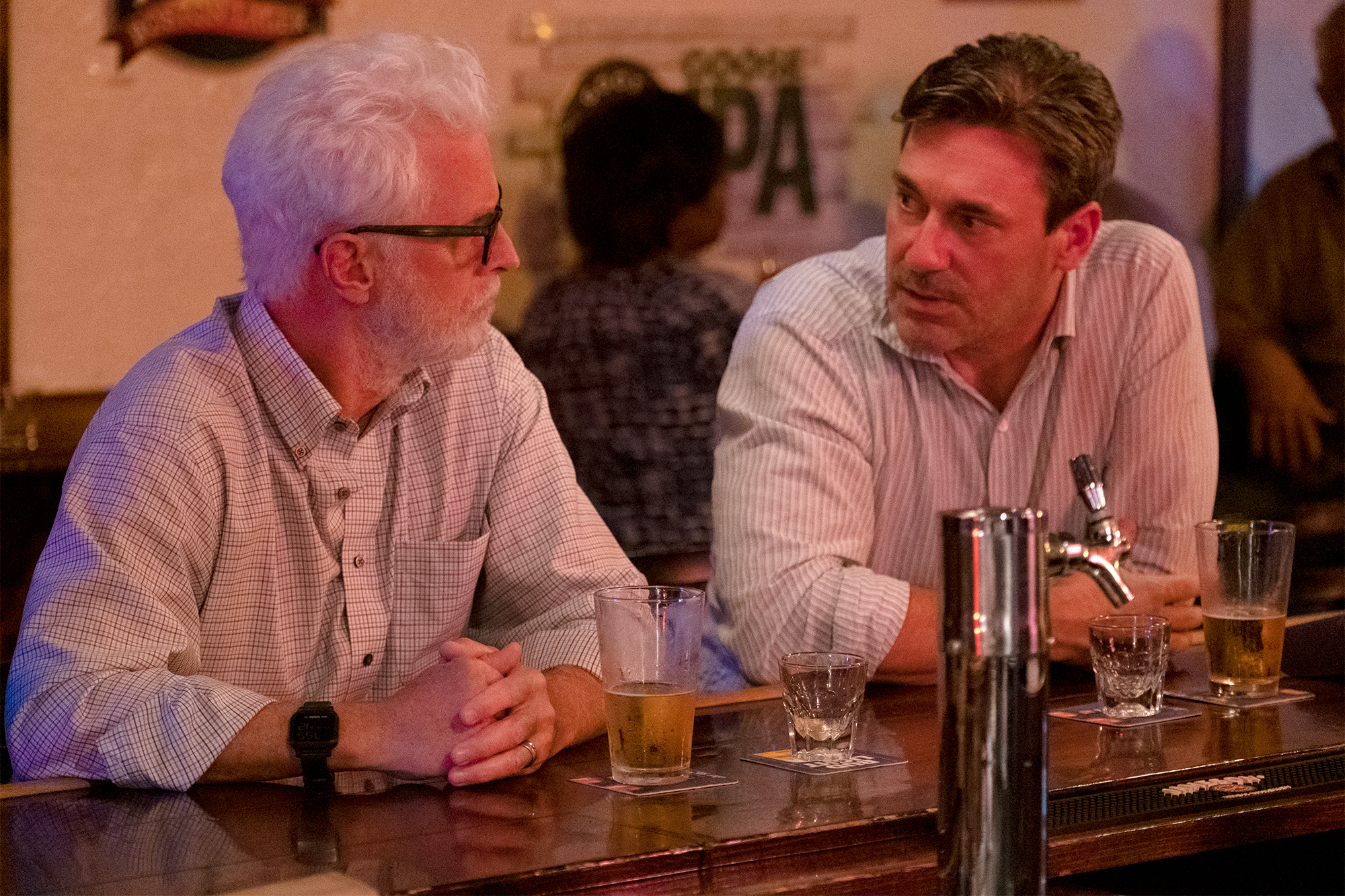
Jon Hamm makes it look too damned easy in “Confess, Fletch,” a LONG awaited reboot of a franchise that gave Chevy Chase more credit than he deserved for its appeal. Hamm never hits the laughs too hard, lies on the fly like he learned it at birth and leans into the working-hard/hardly working Fletch way of “investigating” in a lightweight comedy that has no guffaws, but a steady stream of chuckles from beginning to end.
Gregory McDonald’s “former investigative journalist of some repute,” a wordsmith always-ready with a comeback, a sly slacker who can’t throw a punch, or take one, fits Hamm like the battered and much-loved Lakers hat that he wears everywhere, with sportscoat and sneakers, no matter what the dress code. He’s white and handsome, so he fits in without fitting in. At a snooty yacht club, for instance, whose commodore regales him on some long ago felony that the old gent brushes off as a lark.
“Nothing like a little consequence-free fun for the idle rich.”
“Confess, Fletch” is a caper comedy/murder mystery that concerns stolen paintings, a kidnapped Italian count, a clever frame-up and a Boston cop hellbent — but also in a laid-back way — on pinning a murder on the insufferable Lakers fan disturbing his piece of Celtic Nation.
Greg Mottola’s film follows Fletch all around Beantown, without voice-over narration, without any overt explanation of what he’s cannily plotting out, what Fletch suspects, or when Fletch first gets in over his head. And Hamm sets the tone with his unconcerned, make-myself-a-drink call to the police when the townhouse his rich girlfriend (Lorenza Izzo) has rented for him to track down her family’s missing paintings turns out to have a dead woman in it.
The precinct insists Fletch call 911. Fletch cannot make the effort.
“Can you just tell homicide? It’s at 5 Union Park. They like murders!”
When it becomes obvious that Fletch is the one and only real suspect of “Detective Inspector Monroe,” aka “Slo Mo Monroe” (Roy Wood Jr., superb), our hero has one more thing to add to his “to do” list. Find missing painting or paintings, return one so that rich girlfriend’s dad can be ransomed free of his kidnappers, figure out who the REAL killer is and charming, offhandedly throwing the cops off the trail so that he’s free to dig and plot and banter with his old L.A. newspaper editor (John Slattery, Hamm’s “Mad Men” mate) now struggling to keep a Boston rag from going under.
Hey, “The police are following me around!”
“Oh good. I hope it’s for something serious. I need a pick-me-up!”
Kyle MacLachlan plays a variation of his “How I Met Your Mother” character, a sketchy, patrician art-dealing yachtsman (and germophobe).
Lucy Punch is tagged as a dizzy “lifestyle curator” (interior decorator) for the well-heeled. Marcia Gay Harden slings an Italo-Portuguese goulash accent as the “countess” to the kidnapped count.
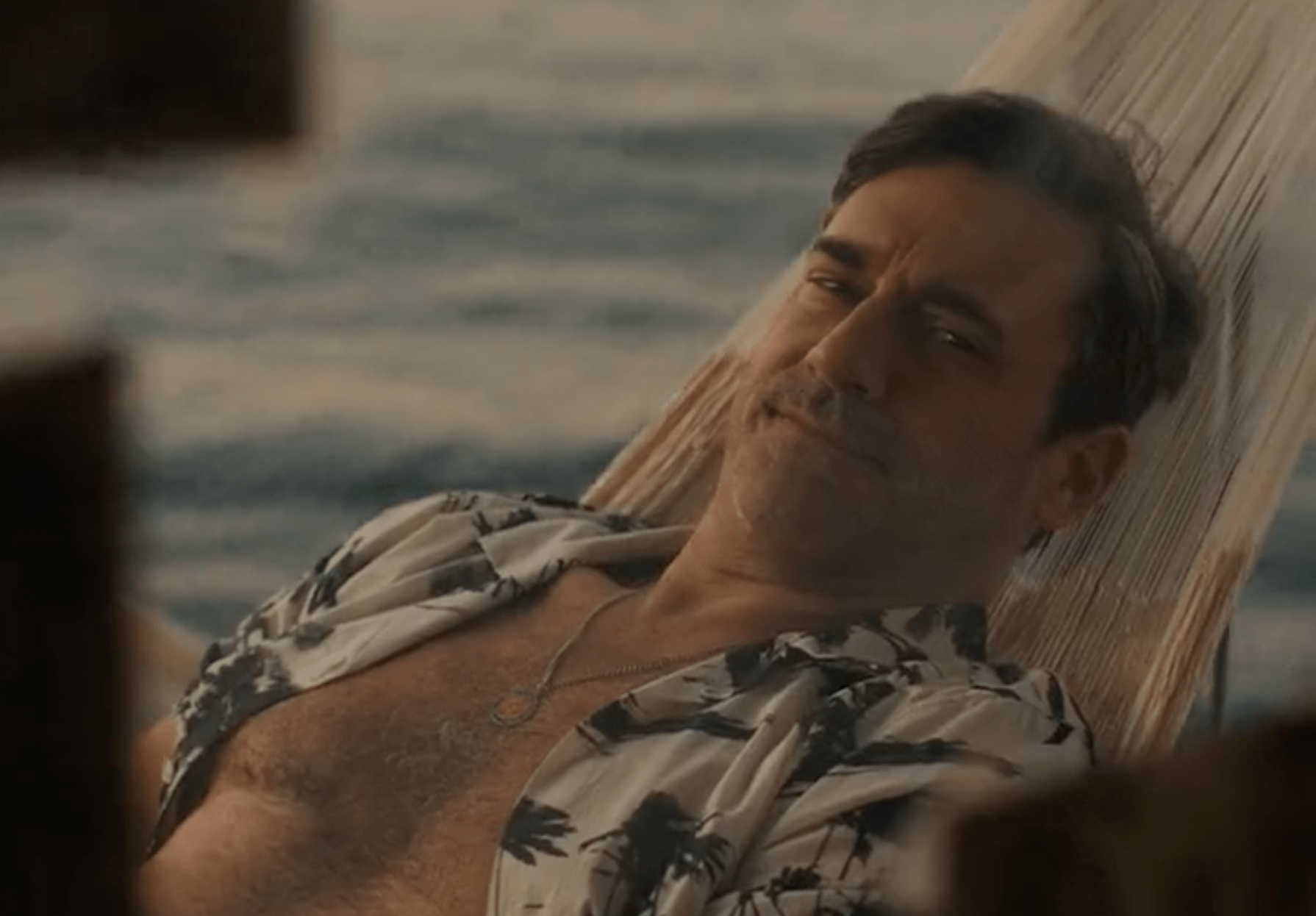
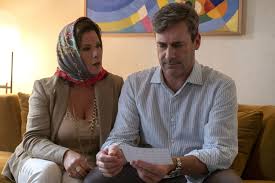
Nobody knocks anything out of the park, but this “Fletch” piles up the singles and doubles, an endless parade of funny lines almost always just thrown away, casually.
“My pen name is Ralph Locke.”
“Sounds made up.”
“It’s…a pen name.”
Words of comfort for the grieving Italian daughter?
“I’m sure the Italian police are working around the clock on his case…or at least near a clock.”
Fletch uses a LOT of ride shares, “FIVE stars” he quips as he gets out of every car.
“Person of interest LEAVING the building,” he announces to the cops as he makes an exit, a muttered “I am an idiot” aside makes Det. Inspector Monroe’s day.
“Finally, a consensus,” Wood’s Monroe half-whispers on our behalf.
“Fletch” was such an attractive character that many have tried to reboot this potential franchise. These aren’t deep mysteries or comic thrillers sure to guarantee an all-star supporting cast, although Harden is an Oscar winner, and MacLachlan, Wood, Punch and Slattery are no slouches.
Is this franchise “renewed” with “Confess, Fletch?” Sure. I could totally see more of these if Hamm is game, but probably directed straight to Paramount+.
Rating: R for language, some sexual content and drug use.
Cast: Jon Hamm, Lorenza Izzo, Roy Wood, Jr., Marcia Gay Harden, Ayden Mayeri, Kyle MacLachlan, and John Slattery
Credits: Directed by Greg Mottola, scripted by Zev Borow and Greg Mottola, based on the Gregory McDonald novel. A Paramount release of a Miramax film.
Running time: 1:38
Feast your eyes on this!
Decadent fun.
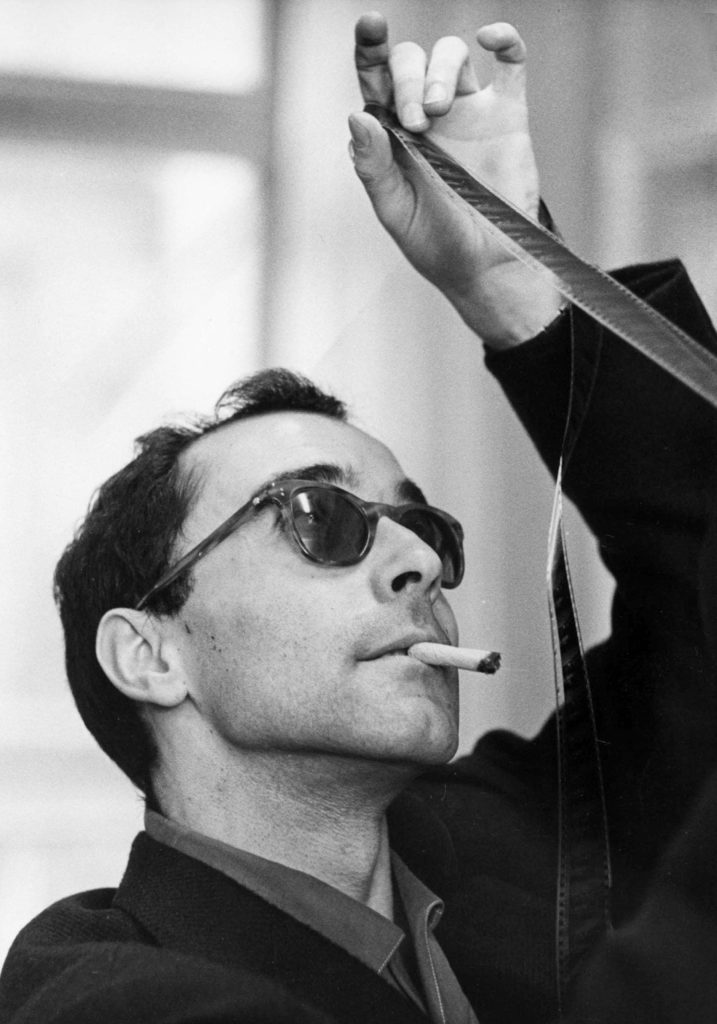
France’s once and forever cinematic “enfant terrible” has died.
The often controversial, always “revolutionary” director of “Breathless” and “Contempt,” “Weekend,” “Alphaville,” “Bande a part,” “Hail Mary” and “Bridges of Sarajevo” was 91, and got “Sarajevo” onto screens at 83.
Godard was in the vanguard of the French New Wave in the ’50s, the cinema’s embodiment of Marxist chic in the ’60s and a provocateur to the very end.
His films weren’t always the easiest to embrace, but he challenged the art form, the cultural and social norms, himself and the viewer almost every time out. I remember the outrage he stirred up with “Hail Mary” back in the ’80s and the way his films turned up as cutting edge examples of experiments in narrative, camera storytelling technique and the like in every film class I ever took.
Fascinating guy. RIP.

With Godard as my witness, I swear I remember Roger Corman’s “The Raven” being more subtle than this. And funnier.
Don’t get me wrong, it’s still amusing — here and there — and a treat for classic horror fans seeing Vincent Price, Boris Karloff and Peter Lorre in the same movie.
The future star of “The Shining” “Wolf” is here, stifling a grin as he got to share scenes with guys whose glories dated back to the silent film era. Jack Nicholson had to play the straight man here, pretty much, saving his loonier turns for “Batman” and “The Witches of Eastwick.”
Indie icon Corman, who gave so many future filmmakers their start, knew that having Vincent Price recite the Edgar Allan Poe poem “The Raven” was practically a movie all by itself (James Mason had narrated a classic animated short, “The Tell-Tale Heart,” a decade before). He had novelist and “Twilight Zone” veteran Richard Matheson vamp up a story that has Price play a sorcerer grieving over his lost “Lenore,” longing for her return when a raven comes tapping, gently rapping at his chamber door.
“Are you some dark-winged messenger from beyond? Shall I ever hold again that radiant maiden whom the angels call Lenore?”
Turns out, the raven talks.
“How the hell should I know? What am I, a fortune teller?”
The raven has clues about what happened to Lenore, and Dr. Erasmus Craven first has to be persuaded to help the bird transform into Peter Lorre, then round up his daughter (Olive Sturgess) and the beautifully chapeau’d son (Nicholson) of Dr. Bedlo (Lorre) to seek answers from the sinister-sounding Dr. Scarabus (Karloff) in his castle.
Lenore’s got to be around this dank dungeon somewhere, you figure.
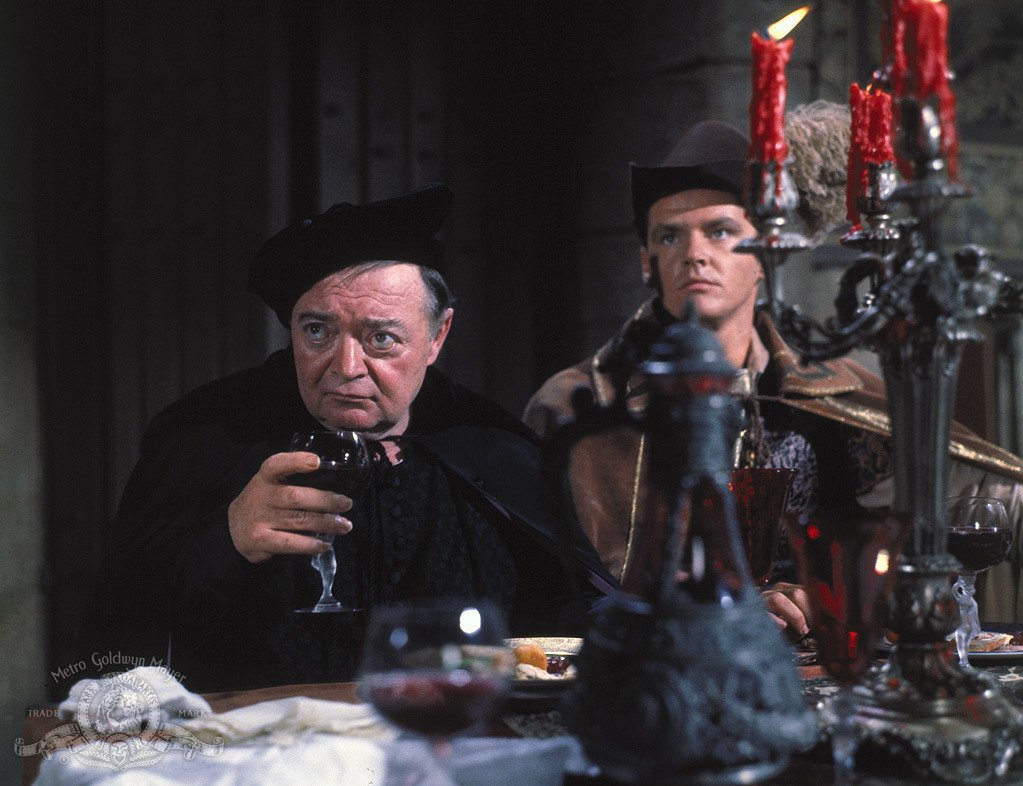
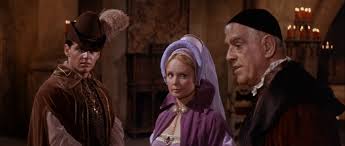
Legend has it that John Waters saw this film as a young Baltimorean and said, “Well, the only word for this is ‘camp.'” True? Who’s to say?
This was one of eight films Corman made from the works of Poe, and it is far and away the silliest. Truth be told, the “Treehouse of Horror” episode of “The Simpsons” that had James Earl Jones reciting the poem while Bart and Homer acted it out was scarier. And funnier.
As a “romp,” this classic isn’t really holding up. Whatever glory it enjoyed in its initial run, its peak era was during the college film society days when tipsy coeds could hoot and holler at its dated jokes and its soundstage bound goofy gloom.
“I am Doctor Bedlo’s son!” Rexford (Jack) declares.
“I am sorry,” Lorre’s Doctor Bedlo apologizes…to Dr. Craven, Rexford, the audience. Who knows?
The effects are adorably cheesy, but the performances are muted. Only Price is truly up to snuff, as Karloff settled into the grandfatherliness that made him the perfect narrator for “How the Grinch Stole Christmas” a couple of years later. Watch the way the camera regards Karloff as he keeps his robe from tripping him as he descends a steep flight of stairs. It’s as if Corman was waiting for something dangerous to happen.
Scary? Not a bit. And camp value only takes it so far, these days.
Even Price was far better in “Tales of Terror” and “The Pit and the Pendulum.” But watch how delighted he is interacting with that real, live bird.
At this stage, if you want to see “The Raven,” make it a Halloween party activity. Watching it cold, and sober and alone robs it of whatever communal glee it once had.

Rating: G, of course
Cast: Vincent Price, Peter Lorre, Boris Karloff, Hazel Court, Olive Sturgess and Jack Nicholson.
Credits: Scripted and directed by Roger Corman. An American International release on Tubi and many other streaming platforms.
Running time: 1:26

 Movie Nation