Documentary Review: Reconsidering a Cultural Colossus — “Louis Armstrong’s Black & Blues”

The great New Orleans trumpeter Wynton Marsalis remembers the times his father Ellis suggested he take another look and listen to the jazz of “Pops,” Louis Armstrong. To Wynton and generations of African Americans who only knew Armstrong through is smiling public persona, not being political, never making waves despite the racism he faced from his first breath to his last, Armstrong was best at “Uncle Tomming,” playing the role that pleased white folks who thought he’d accepted his “place.”

But then his dad pushed recordings at his son and suggested trying to match the man’s trumpet and cornet solos. He couldn’t. And Marsalis the younger heard a bit of Armstrong’s vast archive of private conversation recordings, chats he’d have with friends, contemporaries and folks who’d stop by his house in Corona, Queens, New York. Here was the man the public didn’t hear as much of — defiant, salty, angry and frank, not an icon but a human being. Marsalis was turned around.

“I could not appreciate Louis Armstrong,” he admits in the new documentary, “Louis Armstrong’s Black & Blues.” He does now.

With all that’s been said, reported and written about Louis Armstrong over the decades, it’s shocking how eye and ear-opening Sacha Jenkins’ new documentary about him is, what a revelation and re-assertion of the man and his place in the culture it turns out to be.

Jenkins — who has the civil unrest in LA doc “Burn Motherf—-r Burn,” and films on Rick James and Wu Tang clan in his credits — lets us hear from those candid tapes, and they humanize Armstrong and give this revolutionary figure in music his due as a Black man who was the very first to push through a lot of doors in segregated America, and bore the scars for it.

Anecdotes start with “This ofay motherf—-r” comes up to shake his hand and drops the N-word when he does, or that Hollywood “callboy” (production assistant who fetched talent to the set) disrespected him on the set and got an earful that everyone else heard too, blistering and sometimes hilarious exchanges he’d relate to his friends.

Jenkins reminds us that in a few interviews in his later years — with his friend Orson Welles, who was sitting in for David Frost on his chat show, or Dick Cavett or even Mike Douglas — Armstrong let loose on the abuse and insults and racism he faced throughout his career.

“Uncle Tom?” Not hardly.

Armstrong called out then-President Eisenhower for not doing something about the white unrest in protest against integration in 1950s Little Rock, another piece of Armstrong lore that Jenkins jogs our memory’s with.

And that’s just addressing the “Uncle Tomming” rep that “Satchmo” wore by smiling and being America’s greatest musical goodwill ambassador at a time when “I played 99 million hotels I couldn’t stay at.”

As to the music?

He “hit notes” nobody else could, took over and popularized jazz and made it America’s music and made it matter for decades.

“He totally changed the way people sing,” another e expert weighs in. “Jazz, pop, rock, soul,” country, you name it — the way he attacked a phrase, his role in the invention of scat singing.

Touring and singing duets with white trombonist Jack Teagarden, pretty much mentoring his white copycat, Bing Crosby, crowning his many featured Hollywood appearances by singing with and to Streisand for the finale of “Hello, Dolly,” and topping the damned charts with “What a Wonderful World” well into his last decade of life, there is literally no one who comes close to Armstrong’s impact on music and culture and America’s self-image.

Jenkins has the rapper Nas read from Armstrong’s autobiography, “Satchmo,” and makes ransom-note cut-out word collages into subtitles, doubling the impact of Armstrong’s words (Nas sounds nothing like Armstrong. No one does.).

And the filmmaker taps into decades of personal appearances, a filmed TV concert in black and white, a European tour, chats with Steve Allen and Carson and everybody else who wanted the good vibes that an Armstrong appearance brought their talk and variety show, decades after jazz had fallen from its status as America’s favorite.

He was hilarious, joking about racism, poking prejudices and getting big laughs in the same breath.

The Armstrong of the personal tapes renews our appreciation for Armstrong the TV raconteur. The man was candid at home. “Let’s talk about pot,” he says on a tape. And on TV’s “What’s My Line?” a whole string of riffs on “high” and “higher” went right over the host’s head. Or so it would seem.

Jenkins has made a film that does exactly what Ellis Marsalis wanted his brilliant son to recognize, that we haven’t “appreciated” Louis Armstrong, a multifaceted entertainer whose place within the culture and the racial politics of his day have never been given their due.

In this Golden Age of biographical musical documentaries, the filmmaker who is now working on an Ed Sullivan doc has taken a subject we thought we knew all we needed to know about, and all but re-introduced him to a new age. Well done.

Rating: R for language.

Cast: Louis Armstrong, Lil Armstrong, Lucille Armstrong, Wynton Marsalis, Leonard Feather, Jack Teagarden, Orson Welles, Dick Cavett, Steve Allen, Mike Douglass and David Frost.

Credits: Directed by Sacha Jenkins. An Apple TV+ release.

Running time: 1:45
Posted in Reviews, previews, profiles and movie news | Comments Off on Documentary Review: Reconsidering a Cultural Colossus — “Louis Armstrong’s Black & Blues”

Movie Review: The Creation of an “American Murderer”

“American Murderer” is a workmanlike “true crime” thriller about the hunt for con-man turned accused killer Jason Derek Brown.

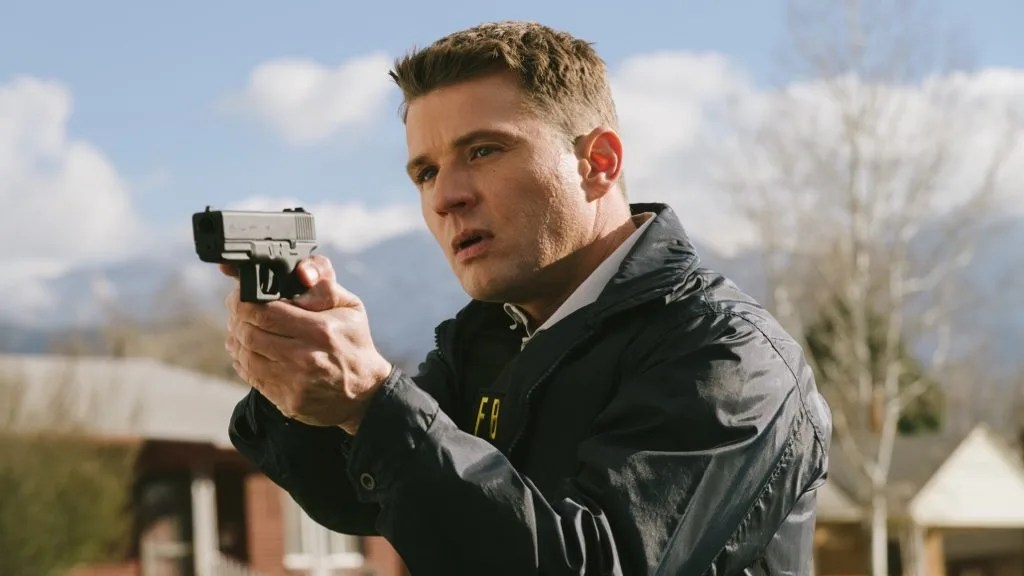
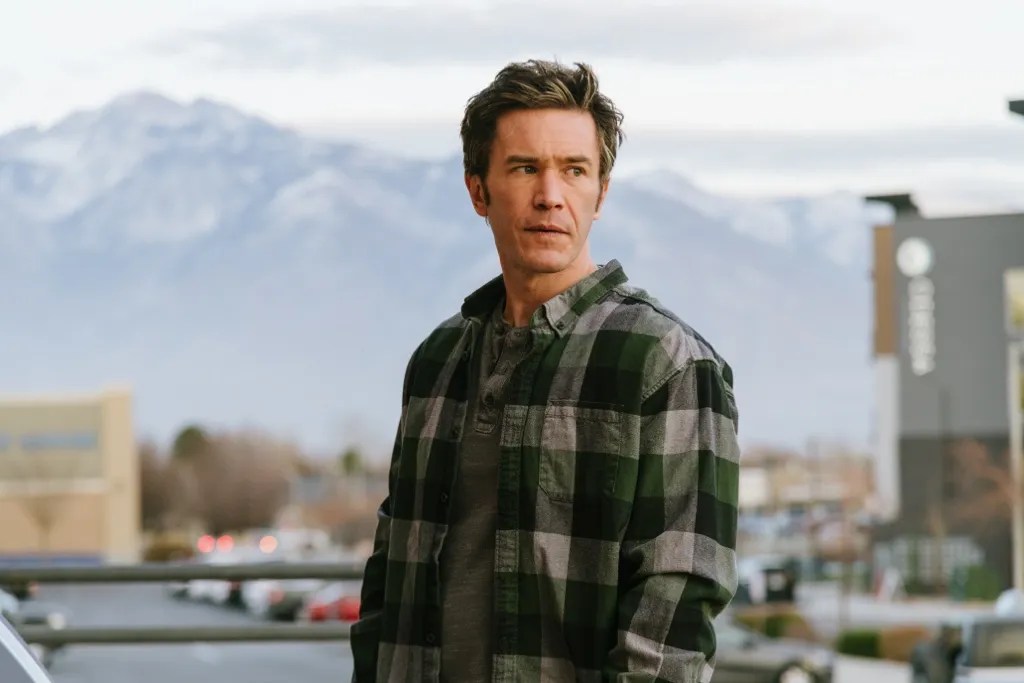
Writer-director Matthew Gentile’s feature debut, following a short film he did on the subject, attracted plenty of talent — with Ryan Phillippe as the FBI agent leading the chase, and Idina Menzel, Jacki Weaver, Paul Schneider, Kevin Corrigan and Moise Arias in support of “Ozark” and “Outer Range” veteran Tom Pelphrey as the lead.

But what was made from that compelling subject and with this impressive cast is a story that lacks excitement, the suspense of a cat-and-mouse tale or anything remotely emotional. It’s a film as dramatically-flat as its desert southwest settings.

We meet Brown as he preps for a “performance” on a November night in 2004. He’s got to get his game face on, get off script and convince a pawn broker to give him lots of cash for a couple of watches he’s hocking. He may roll up in an Escalade, but the hoodie, the sad face and the sad story have to do the heavy lifting.

“My dad gave me” this Rolex, and — tears this time — “my Mom” just passed, and this was her watch, and on and on he goes. Of course he can turn off the waterworks in a flash when the hard bargaining kicks in. The pawn broker doesn’t react to any of this, or the hasty “You got a back door?” at the conclusions of sale. And the broker doesn’t see the cackling Brown does at conning another sucker, and at dodging the guys who follow him into the shop because he owes them and everybody else money.

The FBI is on this case because of what we can figure out from the film’s title, that this con-man, thief and hustler crossed one last line at some point. Phillippe plays the unemotional agent in charge, and the film is a series of flashbacks taken from interviews with people who knew the suspect.

Menzel plays a landlady, single mom and sometime lover, who denies any “intimate relationship.” Schneider is the suspect’s increasingly put-upon and put-out brother, Weaver is the mother who’s decided “You’re some actor, you know that?”

And Shantal VanSanten plays the sister who suggests that their childhood and their sketchy Dad (Corrigan) are the reasons Jason turned out the way he did.

But as we see Brown living it up, over-dressing, buying boats and confidently closing down the strip clubs, two things stand out. Pelphrey is really chewing the scenery in this performance. And there’s an awful lot of interesting detail that would have added color to this generally colorless film, things briefly mentioned and never shown.

Jason grew up Mormon? He was married? Something in him “snapped?” His Dad disappeared? It’s like half the movie is missing.

We’re simply dropped into this cruel hustler’s hustles — hitting family up for money, partying like mad, cozying up to Melanie (Menzel). The storytelling format the filmmaker has chosen seems to want to limit us to only the information the FBI man gleans from those he questions. But that “rule” limiting what he knows and what we know robs the film of anything that could humanize the guy or his victims. And besides, there are places Gentile breaks his own rule.

The narrative begins with a half-interesting transaction and get-away, and choppily jumps backward and forward, leaving so much connective and potentially compelling material out that the film feels incomplete.

Pelphrey’s performance leans towards repellant, and with Phillippe doing a Joe Friday deadpan, we only have the characters surrounding them to grab hold of and identify with.

That points to one last thing Gentile left out, a charismatic and cunning quarry for us to focus on, root against and stick with as this “American Murderer” is pursued through his life of crime.

Credits: R for pervasive language, drug use, some sexual content/nudity and violence.

Cast: Tom Pelphrey, Idina Menzel, Jacki Weaver, Paul Schneider, Shantal VanSanten, Kevin Corrigan, Moises Arias and Ryan Phillippe.

Credits: Scripted and directed by Matthew Gentile. A Saban Films release.

Running time: 1:41

Posted in Reviews, previews, profiles and movie news | Comments Off on Movie Review: The Creation of an “American Murderer”

Movie Preview: “Creed III”

March 23, an ex-con installment in the Never Ending Boxing Story.

Posted in Reviews, previews, profiles and movie news | Comments Off on Movie Preview: “Creed III”

Movie Preview: A donkey’s picaresque journey across Europe — “EO”

This Cannes award winner, a seriocomic odyssey from veteran Polish filmmaker Jerzy Skolimowski, opens in select cities in early December.

Looks lovely.

Posted in Reviews, previews, profiles and movie news | Comments Off on Movie Preview: A donkey’s picaresque journey across Europe — “EO”

Movie Review: The flickering filter of memory — “Aftersun”

The debut feature of Scottish director Charlotte Wells is a meditation on memory, a woman selectively remembering a vacation with her father from twenty years before, sifting for clues about what she might have missed.

“Aftersun” gives us only a couple of glimpses of the grown Sophie (Celia Rowlson-Hall), first in a strobed nightclub-lighting edit in the middle of a piece of home movie footage from that trip, which Dad (Paul Mescal, just seen in “God’s Creatures,” previously in “The Lost Daughter”) recorded on his camcorder. Later, Sophie recreates some of what her father was videoing, as if she’s reached some sort of conclusion about the long Turkish idyll she took with him just after she turned 11, a trip in which he turned 31.

In between, we experience something resembling her incomplete memories of that school break trip, a cute, curious kid (Frankie Corio) who took in some details — how the older kids in the hotel, arcade, pool and beach where they were staying spoke (slang), behaved and flirted — and missed others.

It’s a film of disarming routine focusing on a doting-not-hovering Dad who is plainly making an effort. He’s not with her mother, and not even in the same town anymore. He’s in London, she’s back where he grew up, Edinburgh. He still says “Love you” to Sophie’s mum when she calls to check in on them, which confuses her.

And when Sophie gets the camera, it’s interview time.

“When you were 11, what did you think you’d be doing now?” It’s not a question he answers directly.

She asks him how he broke his wrist (it’s in a cast), as if the adult Sophie has forgotten that detail and needs to remember. She notes his smoking, his solitary moments, his Dad version of tai chi, asks about changes in his work and relationships, and gets distracted by the older kids he lets her hang out with.

Because Dad is distracted, too. Whatever face he’s putting on for this trip, there’s a deflating despair in his unguarded moments. She remembers him being short of cash but not chewing her out for losing her diving goggles. He leaves her on her own more than seems natural today, and in situations that could be potentially dangerous.

Wells set out to tell a story with little in the way of incidents and melodrama, a movie that weaves its spell in observations, snippets of dialogue a child might not have understood then but have resonance for the adult Sophie, experiencing parenting in a same sex relationship at 31.

Overhearing Dad tell a dive boat instructor, who “can’t see myself at 40” doing this job, that he’s “surprised I made it to 30,” was something she might have picked up on, had she not been 11.

The strobing of hotel nightclub lighting becomes a metaphor for memory here, the pixelated edits of old video emblematic of Sophie summoning up snatches of uninformative background noise and the occasional piercing moment of consequence in watching the old videos and casting her memory back to her eleventh year.

Wells tests the viewer by limiting the scope of what we’re seeing, keeping things on a near mesmerizing level by not giving us more big emotions, big revelations or big scenes. It works, although it frankly could have come to the viewer a bit with more of the adult Sophie, letting us see what she’s figuring out. “Aftersun” is unnecessarily obscure and overdoes the whole “understated/unstated” thing.

Mescal gives a subdued performance that draws us in, as we’re forced to focus on him and ponder what insights about this pivotal moment in Sophie’s childhood we might glean from what she remembers of him. Corio is properly unaffecting, showing little hint of the “child wise beyond her years” cliche so common in Hollywood films.

Whatever’s coming, she’s just a kid. How could she have known? Whatever happened, how could she have changed it? That’s the cruel trap of memory, protecting us, then hitting us with revelations long past the point they’d do anybody any good.

Rating: R for some language and brief sexual material.

Cast: Paul Mescal, Frankie Corio and Celia Rowlson-Hall

Credits: Scripted and directed by Charlotte Wells. An A24 release

Running time: 1:40

Posted in Reviews, previews, profiles and movie news | Comments Off on Movie Review: The flickering filter of memory — “Aftersun”

Next screening? Julia & George and the daughter they don’t want married –“Ticket To Paradise”

It’s often hard to gauge whether or not a comedy is going to land judging by the trailer. Cut together as a punchy highlight reel of zingers, pratfalls and eyerolls, most any editor can make any movie with just a few laughs play as a “Greatest Hits” package.

Here’s a scene from this rom-com, which opens Friday. Better indicator of whether old pals George Clooney and Julia Roberts click?

Posted in Reviews, previews, profiles and movie news | Comments Off on Next screening? Julia & George and the daughter they don’t want married –“Ticket To Paradise”

Movie Review: A Dark German Dream of Debates and Morality — “The Last City”

Veteran German documentarian Heinz Emigolz’s “The Last City” is an interlocking series of conversations with actor/characters taking us from Israel and Serbia to Greece, China and Brazil in a quintet of vignettes that seem to have only the loosest connections.

It’s an experiment in narrative, with far-ranging conversations the take in old age, dream interpretation, revisiting one’s personal history by meeting a younger version of oneself, national/racial guilt and morality. The film’s all-one-big-family/all0one-city messaging doesn’t quite come off. And at times, it seems like the sort of movie you get from a series of grant-financed vacations in which you drag actors along.

The acting is varying degrees of stiff, the line readings arch and stilted as not everyone speaks English as a first language, although it’s the language Emigholz (“Streetscapes”) chose to film in. Still, it is unusual enough to be worth a look.

A former filmmaker/now-archaeologist (John Erdman) has a long, philosophical talk with a former psychologist (Jonathan Perel) who might have been his psychologist but is now an Israeli weapons theorist/designer across several archeological digs and street corners in Israel.

“A war can’t be fought within the realm of design” is this conversation’s thesis, near as I can make out. And the psychologist’s rationale for changing careers is “At one point, listening became not enough for me.”

The one-time filmmaker turns nostalgic as he next has an intimate chat with someone meant to be his younger self (played by Young Sun Han).

“That was beautiful, like that scene in a film by (Carl) Dreyer” is all the younger man needs to say to get the older one on the same page. The viewer? Even when we’re told the film in question, it’s seriously unclear as to how that connects them to the 30 year-old man or his 70ish counterpart.

Then the young man is seen wrestling naked with a fellow (Laurean Wagner) who turns out to be a cop, and his brother. That’s OK, the cop can confess to a priest. That’s what his brother happens to be.

“My lover’s my brother.”

Good thing Mom (Dorothy Ko) isn’t flipped out by what’s going on under her roof. She has her own agenda, a lengthy catalog of evidence of Japanese society-wide racism and WWII era sadism that she relates to a woman (Susanne Sachße) whose taped “slanted” eyes and jet-black bowl-cut wig and German accent don’t fool us, but somehow convince the incest brothers’ mother that she’s lecturing someone Japanese. No harm, no foul, right?

“Are we Japanese not the Germans of the Pacific?”

The Chinese woman’s shaming of the disguised German has a goal, an end game in mind, and you can probably guess what that might be.

That segment is by far the most coherent and focused of the various conversations, which are augmented with a car crash, a gruesome dream visualized in ’80s video game graphics and whatever it is the Chinese woman wants the unrepentant, unreformed Japanese to consider as the only “honorable” thing they could do as penance.

Emigholz wrote a lot of words for his actors to say, without getting that close to a clarity of message. Documentarians often go for “natural” under-rehearsed performances when they make the leap to fiction features, and that’s evident here. Many a line-reading sounds metallic, not so much “acted” as read.

Still, you’re not likely to have seen many films that take this approach to “story” and grasp for messages this obvious and yet obscure.

The settings are often striking as “The Last City” never lets you forget you’re dabbling in the avant garde, so it’s got that going for it.

Rating: unrated, graphic violence, sexual situations, profanity

Cast: John Erdman, Dorothy Ko, Susanne Sachße, Jonathan Perel, Young Sun Han, Laurean Wagner.

Credits: Scripted and directed by Heinz Emigholz. A Film Movement+ release.

Running time: 1:40

Posted in Reviews, previews, profiles and movie news | Comments Off on Movie Review: A Dark German Dream of Debates and Morality — “The Last City”

Movie Review: A Japanese Religious movement makes a movie about removing curses via “The Divine Protector: Master Salt Begins”

Let’s resist the urge to judge a new Japanese religious movement with the label we slap on every faith new enough to invite ridicule — “cult.”

Instead, let Happy Science explain itself via a movie it has released, although maybe explaining its philosophy through a comical, campy and patently ridiculous action picture isn’t the smartest move.

It’s about ordinary folks taking pro-active measures to address the problems in their lives.

A schoolgirl (Saya Fukunaga) is haunted, fainting at school with strangulation bruises on her neck?

A young salaryman wants to marry, but is drowning in the pressures of work?

A grandmother falls victim to a COVID-free nursing home scam?

A man is beating his wife?

Must be…DEMONS.

And what do the simple Happy Scientists do when that’s the diagnosis? They draw a pentagram in chalk, write their complaint on paper, and summon “The Divine Protector.”

Merely making this gesture, a sulfurous summons of the ancient soul named Master Salt (Rin Kijima) can be liberating. And entertaining. She has her very own walk-music (in Japanese, with English subtitles).

“She is coming coming COMING…She is here, here HERE.”

No, that doesn’t make her, the religion or the movie seem less ridiculous.

Rin Kijima plays Shioko Kamono, aka “Master Salt,” an eight hundred year old “protector” who can “never fall in love” because her mission is to drag demonic curses to hell (perfect place for phone scammers) and deliver justice.

She speaks in head-slappingly obvious aphorisms. The “three poisons of the mind (dubbed into English)?”

“Greed is desire.” Yeah, we know. “Anger is rage.” You don’t say. “Ignorance is foolishness.”

Oh noooose. THIS movie is “foolishness.”

As with any religion rendered into action cinema form, a little profundity goes a long way. “A selfish mind that keeps seeking what it wants even as the cost of other’s happiness, that’s a curse,” is worth emulating. Just be leery of any anti-materialist “faith” that wants you to transfer that material wealth its way.

“The Divine Protector” opens with a visit to a shrine in the shadow of Mount Fuji, and as the schoolgirls are tested, we keep seeing them in religion class, a not-too-subtle way of connecting Happy Science to Buddhism and Shintoism.

There’s a lot here anybody who’s had a comparative religion course will recognize — a plea for selflessness, self-reflection, non-violence and being considerate of others. But what makes “The Divine Protector” flirt with being campy fun is the scary lady’s walk-on music. Justice is on its way, we figure.

“She is coming, coming COMING.”

And the way this two hour walk on the cultish side is structured — the dubbed insipid dialogue and the song, in Japanese, turning up again and again — makes one wonder Happy Science’s stance on alcohol.

Because I know a movie with a built-in drinking game when I see one. And hell’s bells, “Master Salt Begins” implies there’ll be a sequel.

Rating:  PG-13 for thematic content and some violence

Cast: Rin Kijima, Saya Fukunaga, Donpei Tsuchihira

Credits: Directed by Hiroshi Akabane, scripted by Sayaka Okawa. A Happy Science release.

Running time: 2:01

Posted in Reviews, previews, profiles and movie news | Comments Off on Movie Review: A Japanese Religious movement makes a movie about removing curses via “The Divine Protector: Master Salt Begins”

Documentary Review: Celebrating “Mr. Disney (World),” “Billy Flanigan: The Happiest Man on Earth”

Next time you’re in Orlando, Planet Earth’s Vacationland, drop the name “Billy Flanigan.” Just don’t try to find somebody with anything bad to say about him. That’s an exercise in futility that would eat up your whole visit.

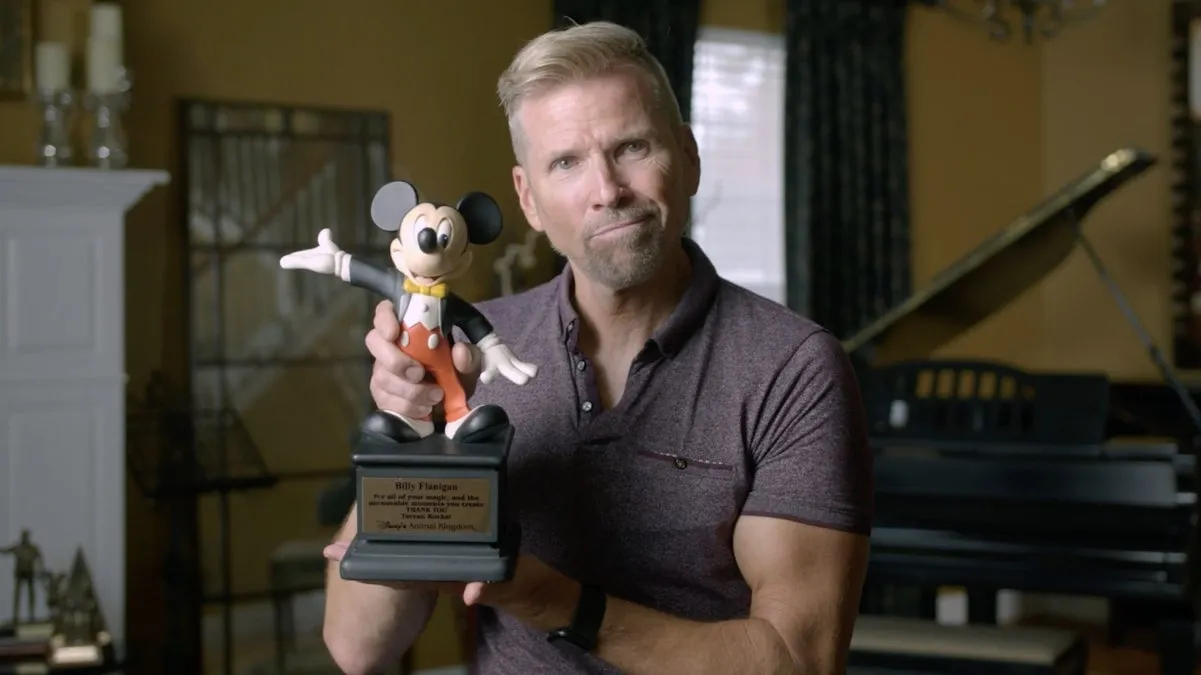
“Mr. Disney,” “The Happiest Man on Earth,” Flanigan is the embodiment, the exemplar of live entertainment at Walt Disney World — an ebullient song and dance man whose smile has been his signature for over 40 years of musical revues at the Park that Walt Built.

“Billy Flanigan: The Happiest Man on Earth” is a documentary celebration of a 60something who’s been lauded by People Magazine and the subject of scores of TV feature stories, locally and globally. Cullen Douglas’s film digs into the magic that is Billy, expanding on what turned out to be Flanigan’s Finest Hour — his morale-boosting bike-rides to deliver singing, dancing “Billy Flanigrams” to every isolated, locked-down “cast member” of the park he could think of during the COVID lockdown.

Using Disney-flavored graphics, a long interview with Billy and lots and lots of his fellow Disney World cast members, relatives and friends, and sampling generously from a one-man “Dear Diary” show Flanigan’s performed locally, Cullem gives us an almost relentlessly upbeat portrait of the performer behind Disney World’s most celebrated smile.

He’s so adored that his friends even laugh through the cliched spotlight-craving foibles endemic to song-and-dance folk. “He’s a legend here,” sure. But “Billy will tell you how great he is.” There are amusing showbiz stories of auditions or rehearsals where he’d be the last to figure out that the performer playing Nemo or his Dad Marlin or Dory were the headliners of a revue based “Finding Nemo,” and not whoever Billy was cast to play.

“But...I’m the star, always the star,” this colleague or that one giggles. “I wondered if he’s being serious, or just being kitschy.” On no. Yes, he “shines a light on others” in every show he’s in, but “He gets a nosebleed if he’s not” center stage, center of attention.

I mean, how else are you gonna get a “Mousecar” for being the most magical Magic Kingdom performer of them all?

Flanigan talks of his bullied childhood, discovering his true passions and finding his tribe in college. The once-married workaholic father of four who always had “The Wizard of Oz” playing at home when he wasn’t performing or rehearsing, Flanigan heard the “You’re married, to a woman?” remarks over the years, before falling in love with a man and coming out — at 45. He weeps over the “hurt” he caused and the wife he left “alone.”

The film shows how Flanigan’s positivity was most severely tested by the COVID shutdown, and the layoffs (something Disney periodically does as a cost-cutting move) of live performers. And it ends before Florida’s homophobic governor went to war with Disney Corp and Walt Disney World, so don’t expect anything in the way of “edge” to this generally fluffy profile, which plays like an unusually long, slick surface-gloss of a TV news feature story.

But “Happiest Man” gets at what makes Flanigan the perfect brand ambassador for the theme park, the “Happiest Place on Earth” that’s smart enough to employ “The Happiest Man on Earth” for decade after decade, a guy who isn’t shy about going above and beyond to “bring the magic” to everyone who visits, every single day.

Rating: unrated, PGish

Cast: Billy Flanigan, and a whole lot of people who love him

Credits: Scripted and directed by Cullen Douglas. A Good Deeds Entertainment release.

Running time: 1:24

Posted in Reviews, previews, profiles and movie news | Comments Off on Documentary Review: Celebrating “Mr. Disney (World),” “Billy Flanigan: The Happiest Man on Earth”

Documentary Preview: “God Forbid” details the dirt in the Falwell/Trump/Evangelical Sex Scandal

Nov. 1, this film from the director of “Cocains

e Cowboys” comes to Hulu.

The pool boy, the rich and entitled rich religious hustlers, the New York con artist, all here. And Tom Arnold. Remember how he helped expose this?

Posted in Reviews, previews, profiles and movie news | Comments Off on Documentary Preview: “God Forbid” details the dirt in the Falwell/Trump/Evangelical Sex Scandal