I remember reviewing this one, but I had to look it up before passing it on to a public library that I either pass, visit or stop to do some writing in. came out early last summer. And while I didn’t warm to a Greek tale of a daughter coming home to Athens to care for her aged, inform father, we can all identify with some of what’s depicted, if not now then soon enough.
“Moon 66 Questions” came out early last summer. And while I didn’t warm to a Greek tale of a daughter coming home to Athens to care for her aged, inform father, we can all identify with some of what’s depicted, if not now then soon enough.
MovieNation, spreading quality international cinema over the Southeast, one DVD, one public library at a time.
Remember to donate yours to your local library, fighting the good fight and beating back the darkness of ignorance and censorship for 200 years, and maybe a little while longer.
A couple of things stick in the memory about “Oklahoma Crude,” a downbeat Western “action comedy” (lots of shooting and blowing stuff up) from the cinema’s filmmaker of conscience, director and producer Stanley Kramer.
The “boomer” theme music by Henry Mancini was one of the most borrowed instrumentals of the ’70s, used in commercials, TV football highlights shows and the ads for other films. I dare say you recognize it, too.
Neither the stars nor the director are well known for their comedies.
And watching “Oklahoma Crude” anew, you can’t help but remember that movies often had offbeat or even downbeat endings in the Hollywood that “Jaws” and “Star Wars” changed forever, that was the pre “Jaws” cinema of the 1970s.
The director of “On the Beach” and “The Defiant Ones” had a late ’60s/early ’70s run of comedies — not all of them with the pointed messaging of “Guess Who’s Coming to Dinner.”
As a kid, I’d tune into the WWII comedy “The Secret of Santa Vittoria” (1969) starring Anthony Quinn, Anna Magnani and Virna Lisa. Italians hiding their stash of wine from the Germans, what’s not to love? I adored Quinn and all the scenery-chewing, larger-than-life actors of that era, including George C. Scott, whose comic turn in “The Flim-Flan Man” (1967) wasn’t great, but he seemed to be having a grand ol’time in a kind of “The Sting Goes to Mayberry” farce. Great car chase, and old confidence man Scott was in his pre-Oscar glory.
Leading lady Faye Dunaway’s comic years would come years later. Neither she nor Scott was particularly light-hearted in this fin de siecle oil fields Western set in 1913. But it’s a generally entertaining curiosity from an era when John Wayne’s Westerns were also about the end of the era (“The Shootist”) and TV Westerns had evolved into “modern” detective shows (“Hec Ramsey”).
Dunaway’s a defiant single woman guarding her drill derrick from all comers in those wildcatting days. If the “message” director Kramer had one in this film, it was about predatory Big Oil and Big Capitalism, crushing the small guy or gal and getting to write history as the heroes of their own villainy.
There’s a bit of what happens in “There Will Be Blood” in this story as trigger-happy Lena empties her Winchester into anybody who approaches her hilltop cabin and drilling rig, even shooting at her feckless father (Sir John Mills). With Big Oil having hired the same murderous son of a bitch that Big Cattle hired in “Shane” (Jack Palance), we see her point. She’s got a right to be nervous.
Dad trolls the hobo jungle where the unemployed roughnecks camp and hires the only man who’ll take the job and the challenge. Mase is a drunk who’d really rather be making his way to Mexico…for a bender. But he needs to eat, so they acquire him cheap firearms and Lena — a loner with no use for men or women save as employees — reluctantly accepts his presence.
Palance is a bowler-hatted menace here, a dapper thug of the type many a coal field of the era would recognize — a man of violence who hires others to join him in crushing the little guy — unionized miners or independent oil prospectors. They didn’t call the bosses of these goons “Robber Barons” for nothing.
What ensues is an infuriating series of provocations and brutal assaults. There is no “getting even,” Mase assures her. But as she’s hellbent on having her well and her revenge, what can he do?
What’s striking seeing this film again after many years is the cavalier level of violence. There are deaths, but the ones early on are mostly off-camera.
Mase, Lena and her father counter attack with rifles and dynamite (the Western movie’s “deus ex machina” courtesy of Alfred Nobel). The scene is epic mayhem, with bombs blowing up villains and shotguns peppering their bums with bird shot. But when you’re firing a Winchester repeating rifle, you’re playing for keeps. There’s no point in trying to keep a body count, as Kramer is intent on keeping it all on a sort of PG-rated good clean fun level.
That’s kind of nuts. As glib as the films of Bruce Willis and others have been about wanton slaughter, “Oklahoma Crude” ventilates or blows up scores, who then get picked up in a pre-triage/emergency room era and dragged off to recover and fight another day.
The chemistry between Scott and Dunaway isn’t necessarily sexual. Not with him wondering if “Maybe you’re the kind who prefers women?” But you have to figure as close as they come to buying it and as much as they depend on each other in matters of life or death, riches or poverty, something might happen.
Scott virtually never played a romantic lead.
The film’s ’70s finale seemed less downbeat then than now, when we’ve come to expect “The Hollywood Ending” almost every time out. But there’s a whiff of “Sierra Madre” in it, grudging respect between bloody foes, because when it’s all said and done, business is business.
That’s Kramer’s message, I think. That buying into getting rich thing is a disease, like gold fever. And with oil, somedays you’re Jett Rink in “Giant,” some days you’re Jed Clampett, and some days you’ve just got yourself a very deep hole.
Kramer’s career wound down in the ’70s, with him dabbling in Vietnam and its aftermath on TV and the big screen, dropping out of the business with a priest/nun murder drama, “The Runner Stumbles,” which did nothing for his reputation and did Dick Van Dyke no favors either.
“Crude” is the operative word for this one. It’s a choppy film with a great sense of its place and time and fine action beats. Anything with this cast is always going to be watchable. But it’s not quite a comedy, not really an action comedy. And the oily Big Eat the Small message is muddled even now. Think of how this must have played during the Arab Oil Embargo, when it came out?
With “There Will Be Blood” still fresh in our minds, I’d say it’s worth checking out just to see George C. Scott chew a little scenery, Dunaway as a fiery brunette and Palance in his pre-lovable Oscar years, one of the greatest sadistic villains the screen Western ever had, even in a West that was drawing to a close by the time “Oklahoma Crude” was a commodities market label of value.
Rating: PG, violence, off color humor
Cast: Faye Dunaway, George C. Scott, John Mills and Jack Palance.
Credits: Directed by Stanley Kramer, scripted by Marc Norman. A Columbia release on Amazon, Movies! many other streamers.
“Mumblecore” as a movie genre is pretty much gone, but it survives in spirit in a daft little laugher titled “Pretty Problems,” a comedy scripted by its cast and that taps into that relative deprivation thing that the social media era just made worse.
Not that Lindsay (Britt Rentschler) and Jack (Michael Tennant) are social media whores, mind you. They’re kind of muddling along, marriage on auto-pilot, accepting the fourth-choice “careers” that they’re in, the last to figure out the spark has gone out of their sex lives.
Jack’s got a probation officer, we learn from their pillow talk. Lindsay keeps calling him a parole officer, like she or any of us would know the difference. Jack does. But he can’t complain about her never getting this right because we get a quick dose of his listening skills.
Another day, another endless procession of doors slammed in his face as Jack tries to sell solar installations. Lindsay at least can sneak sips of wine that the owner of the designer consignment boutique where she works serves And she gets to wear the clothes as part of the job.
That’s how she meets Cat. This force-of-nature customer has the perfect makeup and highlights and supervised fashion sense of money. She sizes Lindsay up and zeroes right in on her insecurities.
“You look amazing, right? SAY it!”
Cat decides they’re to be best friends. Cat spends a pile of cash to get “Lindz” a fat commission. Cat is determined that Lindz and her hubby should come to a gathering at her and her husband’s place up in Sonoma.
Again, they just met. And Jack, well aware that this is not the life they planned to have together can’t afford to say “No” to his generally disappointed life. Even if he figures this is some sort of “purge” trick and that the rich are luring them out of town to kill them for sport.
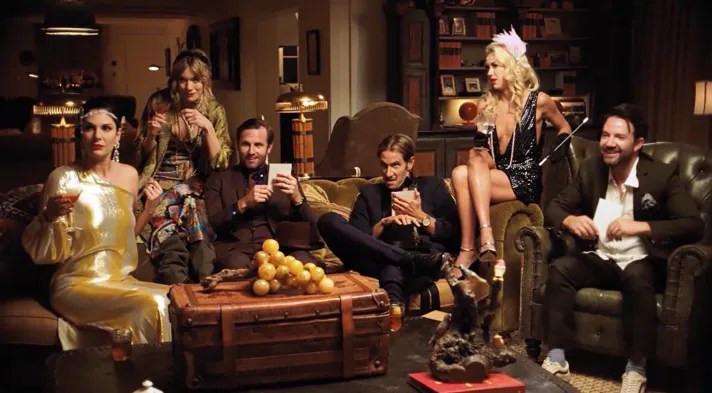
They join catty Cat, her rich husband Matt (Graham Outerbridge) for the weekend. Lindsay and Jack have no idea how bad they have it until they take in everything that the rich and not-really-famous enjoy.
It turns out it’s Cat’s birthday. It turns out, Cat and Matt’s wealthy friend Kerry (Alex Klein) and Carrie (Charlotte Ubben), his latest squeeze, are already there.
And the house, tucked into vineyards and acreage, turns out to be in Healdsburg, not Sonoma. It also has a…look.
“That’s a murder house, a house where murders happen.”
Maybe. But probably not, as the movie is about two have-nots partying with the casually, irresponsibly rich, people who have servants, guest houses and guests “investigated” before they arrive.
Somehow, Matt knows all about Jack, even his favorite beer. But you can’t get it in the U.S. Matt did.
“He bought my favorite brewery.”
A weekend of indiscretions, inappropriate over-sharing, name-dropping, drinking, drugs, throwing around money and throw-away lines ensues.
“I was a trainer at Sea World…quit that when it stopped being cool.”
“Should we smash John Mayer’s guitar?” “John MAYER’s guitar?” “YES, it’s John Mayer’s guitar. He plainly left it because he didn’t want it!”
Kerry’s new girlfriend Carrie is too drunk and gets sick.
“Turn her on her side,” Kerry says, half-assing his gentleman friend responsibilities.
“Oh, that’s nice,” Lindsay says, impressed with his thoughtfulness.
“I just don’t want her throwing up on those hair extensions” which he must have paid for.
Karaoke and pretentious wine tastings, a shaman session, a staged murder mystery dinner and lots of drinking and “microdosing” and lessons on how the monied look after each other gives Jack and Lindsay’s marriage just the sort of beating you’d expect.
“Pretty Problems” isn’t a laugh riot, but it chuckles along on just-bright-enough dialogue writing and Nolan’s loose and louche way with those lines.
“Wink wink, I am sooooo inappropriate!”
Concerns arise and revelations complicate them, because of course they do because nobody here can keep a secret or figure out when to shut up.
No, this isn’t of the “Frances Ha,” “Jeff Who Lives at Home” or “Drinking Buddies” class. But the chatter is funny and the drunken acting-out just amusing enough to make these “Pretty Problems” pretty cute and easy to sit through.
Rating: unrated, drug references, alcohol abuse, profanity
Cast: Britt Rentschler, Michael Tennant, J.J. Nolan, Charlotte Ubben, Graham Outerbridge, Alex Klein
Credits: Directed by Kestrin Pantera, scripted by Michael Tennant, Britt Rentschler and Charlotte Ubben . An IFC release.
If Robert “Sin City” Rodriguez remade the expressionistic classics “M” or “The Third Man,” chances are it’d look a lot like “Hinterland,” an Austrian thriller that recreates post World War I Vienna digitally on green screen soundstages.
Director and co-writer Stefan Ruzowitzky (“The Counterfeiters”) has created a lurid, teeming ancient city of gloom, tilted buildings, narrow streets and striking (canted floors) interiors, the visual embodiment of an empire broken and revived as a republic, a ruling class stripped of its nobility but not power and a world turned upside down.
At times, it’s as if the cast has stepped into an Escher landscape, the perfect setting for a serial killing spree atconnects to the old order and last world war and prefigures, in some ways, the next one.
Murathan Muslu (“7500”) plays Lt. Peter Perg, a scarred and haunted veteran fresh out of two years in a Russian POW camp. He returns to a chaotic city of hustlers, thieves, pimps, anarchists, communists and fascists, where “You can’t talk about the war” (in German with English subtitles) because “people want to forget” what literally just happened.
Hassled by cops, dismissed by civilians, abandoned by their government, which wasn’t running the show when the doddering emperor was around, there’s nothing for it but to give a last salute to his comrades and stagger back to the apartment where he used to live, where his dog recognizes him but his wife and daughter have moved on.
Perg barely has time to wrestle with his nightmares, get his wallet lifted and ponder whether his wife and child want to see him if he tries to track them down when he’s arrested. Somebody is butchering veterans in Vienna, creating gruesome tableaux with the bodies. He seems a likely suspect.
But the “round up the usual suspects” police inspector Victor Renner (Marc Limpach) can’t believe Perg is a suspect, even if there’s a note implicating him on a corpse. No, Perg is an old colleague, a canny detective who joined the army at the outbreak of war and paid a price for it. Still, you’re already here. Let’s get those cuffs off. What’s your take on the crime?
The lady coroner (Liv Lisa Fries), promoted “because all the men went to war,” wants his input, too. She also has history with this once-brilliant sleuth. Only the younger Detective Severin (Max von der Groeben) instinctively mistrusts this traumatized convict, whom the once-noble higher up in charge labels a “Bolshevik” because that’s where Perg was imprisoned.
The script makes some interesting choices — an “Israelite” grifter selling silverware on the street out of special pockets on his overcoat, an anti-Semitic pick-pocket who might be “presenting,” telling his mark something he wants to hear as he lifts Perg’s wallet.
Early on, you wonder if the film is making points about why Austria and Germany went so fascist so fast, with abused soldiers thumped by “bourgeois” status-quo protecting cops and preyed on by those the veterans at least perceived as Jews.
But the monstrous crimes of our serial killer soon shove that subtext into the background as a disrespected Perg becomes the de facto investigator leading this case, behind officialdom’s back.
Muslu has a smoldering Matthias Schoenaerts look — leading-man magnetism and a soldier’s carriage. He’s quite good at playing the guilt and fear of a man who avoids his wife because of what she might tell him. And scars or not, he’s a hunk. We could certainly see why the young coroner interested, or is there something else connecting them?
The acting is as immaculate as the digitally-augmented settings.
The murder mystery seems secondary to “Hinterland,” and as it unravels it seems as if the reason might be that the solution to it is too much in plain sight for the film to dwell on that.
But Ruzowitzky & Co. have created a “Caligari” era Vienna of shadows and shadow-play nightmares, with every sharp angle reflecting a mind that’s lost its balance and a world that’s teetering and tilting and about to go entirely wrong.
Rating: unrated, graphic violence, sex, nudity
Cast: Murathan Muslu, Liv Lisa Fries, Max von der Groeben and Marc Limpach
Credits: Directed by Stefan Ruzowitzky, scripted by Hanno Pinter, Robert Buchschwenter and Stefan Ruzowitzky. A Film Movement+ release.
The school’s halls are decorated with inspirational quotes from Socrates, Aristotle and Elvis. And in class, boys of 8, 9 and 10 raise their hands to be today’s “concept mapper” or be in today’s “Socratic Circle.”
“Question of the day,” their headmaster and philosophy teacher announces, ‘Should you ever take your anger out on someone else?”
The kids ponder the question and the answers vary. A lively debate is facilitated by passing a tiny soccer ball to whoever raises his hand to speak.
Welcome to Holy Cross Boy’s Primary School, Ardoyne, Belfast, Northern Ireland, a place with a bloody history and an uneasy present, but where headmaster Kevin McArevey is the proverbial boat against the current. He teaches kids the Socratic Method, visits their families to get parents involved with employing it to question their children, and gives the kids the tools to “think for themselves” and even question their parents about “the way things have always been” in this troubled part of the world.
“Young Plato” is a classic “fly on the wall” documentary about this working class Catholic school, following kids into class and onto the playground where, by universal law, little boys play and roughhouse and the roughhousing gets out of hand. Victims and bullies are counseled by either the headmaster or the counselor (Jan-Marie Reel). Tears are shed, comfort is offered and occasionally Kevin McArevey is interrupted by “Unchained Melody,” “Jailhouse Rock” or “If I Can Dream” or whatever ring tone by The King he’s using this week.
Because “When Elvis interrupts, it’s ok,” he jokes. From the bobblehead in his car to an office wholly adorned with Elvis clocks, posters etc., the man’s a fanatic. But as he’s a master of the Socratic Method, you can bet your béaláiste he can wholly justify his mania even under the most intense questioning.
Filmmakers Declan McGrath and Neasa Ní Chianáin give us context, snippets of archival news coverage and even classroom-sampled showings of documentaries on “The Troubles.” Small boys debate what they know, what went on before they were born and what still happens, occasionally, today. They’re in an Irish Republican neighborhood, but given a forum and the tools that pointed questioning sharpens, they and we can see this teaching getting through as they grasp both sides and the flawed thinking that leads to violence.
A fight breaks out on the playground, but some kids rush to separate the combatants and others move to comfort those being picked-on. Some of this is forgotten during the COVID lockdown break, but these lessons come back to them when they return to school.
The counseling sessions afterwards often bring kids to tears — sometimes in embarrassment because they have to acknowledge that they know better.
Mr. McArevey may live by the Socratic saying on “The Philosophy Room” wall — “The greatest thing I know is that I know nothing.” But when he’s teaching, Seneca and the Stoics come in handy — “10 ways you can control anger.”
There’s nothing particularly representative about this school, its population and their parents. Aside from the uniforms and the school name, we see more that’s “Irish Republican” than Catholic. Northern Ireland’s source of conflict is as particular and specific as it is universal. And we’re reminded that school can only do so much, as there have been kids expelled for grievous offenses, and a former student’s suicide is cause for reflection and a day’s questioning in The Philosophy Room.
But that’s why “Young Plato” is a guardedly optimistic film, showing us a tiny sample of the Platonic Ideal, a school with a small enough teacher-to-student ratio, with respected, committed and compensated educators working to impart not only the facts of history, geography, math and life. They’re teaching children to reason, debate and think for themselves and take on the responsibilities of citizenship. If the Northern Irish are still learning from the ancient Greeks, maybe the rest of us should give them a listen, too.
Rating: unrated
Cast: Kevin McArevey, Jan-Marie Reel and the teachers, parents and boys of Holy Cross Boy’s Primary SChool, Ardoyne, Belfast
Credits: Directed by Declan McGrath and Neasa Ní Chianáin, scripted by Etienne Essery, Declan McGrath and Neasa Ní Chianáin. A Soilsiu release.
Novelty alone is worth something at the movies. And there’s plenty about “Give Me Five” that makes it a cinematic unicorn.
Comedies from China are rarely imported. A comedy with a whiff of “Back to the Future” about it, with a young man traveling to the past to ensure his parents meet and mate and make him is pretty novel.
And there are all these People’s Republican touches — a company welding contest staged with Party-approved hoopla, strained mockery of Hong Kong Cantonese pronunciations, abortion, dementia and suicide as jokey subplots and an ungrateful son who seems happy his demented, suicidal dad may never wake up from a coma.
“Give Me Five (Ge, ni hao)” is sentimental and silly, romantic and maudlin, dark and somewhat daft. Whatever its initial inspiration and intent, there’s something equal parts amusing and atonally bizarre about the finished product.
A 30ish e-game training academy entrepreneur (Yuan Chang) copes with his widowed, mercurial dad (Xiang Wei), who suffers from Alzheimer’s now but who frankly “never liked me.” Dad’s moods swing from forgetfully pleasant to raging and judgmental. All it takes is a birthday request for cash for his birthday so that son Xiao can marry his longtime girlfriend to bring out Dad’s generosity and his fury.
It’s no wonder Xiao isn’t all that torn up when the old man jumps off a bridge into a river. He furiously tries to shake him out of his coma with “We can’t AFFORD to be hospitalized (in Mandarin with English subtitles)!”
But going through his father’s things back home, the son stumbles across his late mother’s diary, and an odd copper ring. He’s never known how his mother died, and never will as his father has Alzheimer’s. Slipping on the ring changes that.
Xiao Wu finds himself back in the factory gym where he meets his spirited, smart and outspoken Mom, Lu Chunli (Li Ma). Wouldn’t you know it? That’s the day when she was supposed to meet Wu Hongqi, his Dad, leading to them falling in love and marrying and having a boy. Damned if Xiao, magically appearing in the women’s locker room in 1986 — “Wicked rogue!” — didn’t foul that up.
Pulling the ring off, he’s back in the present where he sees her diary entries change. His existence depends on him fixing this interference in time, which will also allow him to get to know the mother he never met and understand the father who “never liked me” and lies in a coma.
The most charming scenes have this stranger who is actually their son struggle to make the match between the boring, charmless engineer and the opinionated go-getter factory worker who has a secret crush on him. One scene has Wu, crushed because his previous girlfriend is cheating with a boorish Hong Kong capitalist (Bing Jia, pretty funny), but unable to figure out this other cutie has eyes for him.
Xiao encourages and coaches her — “Your happiness is my concern.” — and nags him. “Stop being such a LOSER!”
Xiao ends up borrowing a busker’s guitar to serenade them and close the deal.
Another “trip” back has the son seeing his mother heroically take on all challengers in a regional welding competition, complete with Chinese Communist iconography (big red flags, propaganda poster poses), workplace safety issues and selfless devotion to duty.
The script has several engaging episodes that reveal his family’s story to the son, which change his attitudes towards the parent he knows and doesn’t get along with, and the mother who gave him his fighting spirit. Naturally, all this changing history and changing it back goes to his head.
There are laughs and giggles in the wedding Xiao finds himself officiating and the origin story of the rings, including one that triggers all this time travel.
The performances aren’t bad, and it’s easy to see why Li Ma has been a fixture in Chinese comedies for years.
But this sentimental, sweet and romantic voyage crashes into the rocks in the third act with bizarre turns that lean into Chinese self-sacrifice so hard the indoctrination is the least grating thing about it, and all the added supernaturalism in the world can’t rescue it.
Still, if you’ve never seen a Chinese “Back to the Future” inspired dramedy, the sheer novelty of “Give Me Five” should at least pique your curiosity. It certainly piqued mine.
Rating: unrated, Chinese chaste
Cast: Li Ma, Yuan Chang, Xiang Wei, Bing Jia
Credits: Directed by Luan Zhang, scripted by Tianyi Dong. A Well Go USA release.
Running time: 1:51
Posted inReviews, previews, profiles and movie news|Comments Off on Movie Review: A Chinese “Back to the Future” with People’s Republic Twists — “Give Me Five (Gee, ni hao)”
The stunning recreations in “Buried: The 1982 Alpine Meadows Avalanche” put the viewer as close to an actual avalanche as anybody’d ever want to get.
A mountain of snow, preceded by a hurricane-force wind-driven shock wave, chases a snowmobile down a slope and access road. A tsunami of white knocks people and buildings down.
And decades later, those who survived it still weep over the losses, and those responsible for avalanche control struggle with decisions they made and didn’t make in this historic disaster, which flattened much of a ski resort in the high Sierras abutting Lake Tahoe in northeast California.
Jared Drake and Steven Siig follow-up their acclaimed Insane Clown Posse music doc “United States of Insanity” with a surprisingly moving and starkly-beautiful film about the power of nature and the lives shattered by a disaster created by a most extraordinary snow event.
“The worst winter storm in history,” the forecasters called it. The snow piled up over 103 inches in a flash. The winds on the mountaintops cleared 120 miles per hour. White-out conditions were bad enough to close the Alpine Meadows Ski Resort, just one valley over from the onetime Olympic venue at Squaw Valley.
But the young staff on hand was well-versed in avalanche amelioration in a place prone to massive snowslides.
Some 300 spots had been identified as the main origin points for avalanches, staff avalanche forecaster Jim Plehn says. In a pre-laptop era, this “citizen scientist,” then just 27, and the ski patrol there gathered data on snowfall, snowpack and watched the danger spots. They’d drop “bombs,” hand-made explosives on the most vulnerable drifts. They’d ski the ridgelines “ski checking,” starting controlled avalanches by kicking their skis to trigger a slide “so that the big one never builds up.”
“The OSHA (Occupational Safety and Health Administration) thing was not omnipresent like it is now,” one patrol member recalls.
And when all else failed, they had artillery to shell gigantic deep and teetering drifts high up the mountain.
But that March of 1982 blizzard made them feel “like we were standing on top of a monster,” that all their “purging” efforts were in vain. The tinkling sound of the frigid, snow-laced wind, the staggering height of the drifts in the constantly-cleared entrance road, gave more than one staff member the willies.
“I feel like there was a dragon under the snow.”
So Plehn told his boss to close the resort as he and the staff monitored the onslaught and fired artillery into the gloom.
But there were vacationers staying at condos. Some of the athletic 20somethings on staff got antsy. And none of them were prepared for what came and how much and how far the mountain of snow would smash down.
The filmmakers question a lot of folks now in their 60s who not only remember that awful day, but recall it as “the best job I ever had in my life,” being young and outside and on skis in some of the best skiing terrain in North America. They’re older and sober in their assessments of what they did and what they could and could not have foreseen. And many of them break down, or start to, on camera.
“Took us a while to dig him out…but that’s enough of that.”
Drake and Siig knew they’d have plenty of pathos in remembering this tragedy. But they also knew that most of us wouldn’t remember how everything turned out. And they delicately structure their story to deliver uplifting third act moments in addition to letting us see the trauma these memories bring up for those who had to labor through their grief and survivor’s guilt forty years ago, and still do today.
Rating: unrated, profanity
Cast: Jim Plehn, Meredith Watson, Larry Heywood and Lanny Johnson
Credits: Scripted and directed by Jared Drake and Steven Siig. A Greenwich release.















 Movie Nation