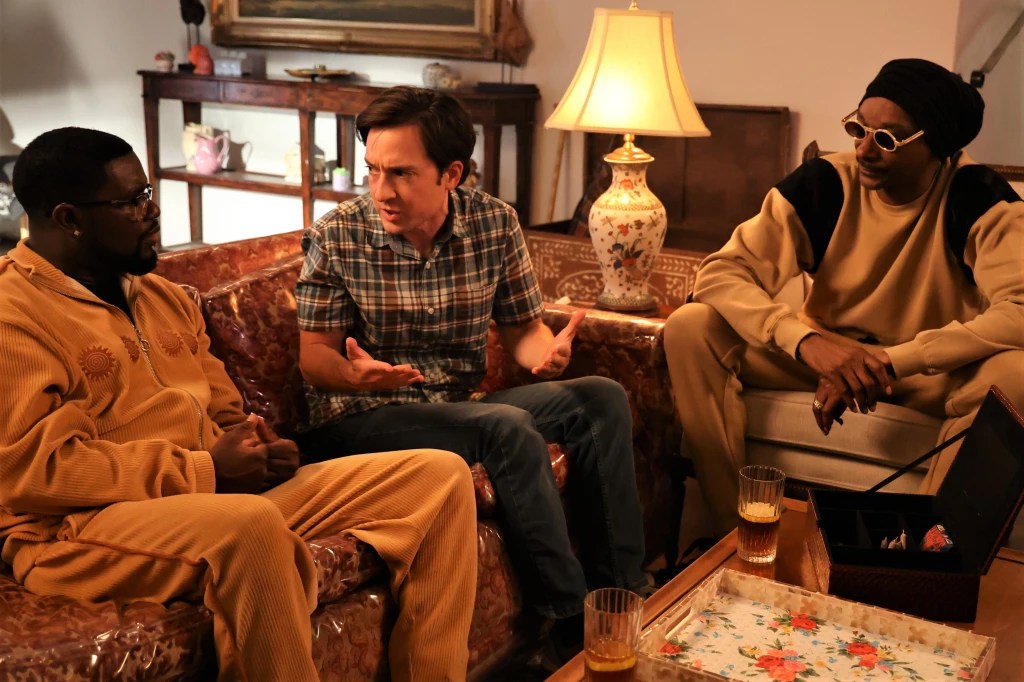
The opening narration to “Bromates” — a lifeless and almost laughless laugher about two jilted-by-their-girlfriends dudes who move in together — raises expectations that the movie never delivers on. Because Snoop Dogg performs it.
He shows up onscreen, as himself, very late in the picture, in a self-mocking turn that’s almost funny. And one cannot help but notice how that’s what the film hasn’t been for all of the preceding 90 minutes — “almost funny.” It rarely even comes close.
Nebbishy Josh Brener, best known as a high-pitched voice actor on a lot of TV animation, is Sid, living his best life as a Texas solar panel salesman, something a prologue suggests he was destined to do even as a kid. He was probably destined to hook up with an “influencer” (Jessica Lowe) who walks all over him, and even cheats with the Bavarian puppeteer who lives next door.
Hollywood’s go-to funny man for “sidekick” roles, Lil Rel Howery ,co-stars here as Jonesie, a horndog whose “testing our new sex swing” bit with a stripper sends his girlfriend packing.
Both single again? They should save some money and move in together. Not as “roommates” or some sort of “Odd Couple,” but as “Bromates.”
Poor Lil Rel has to use the word repeatedly in this lumbering, heavy-handed script that can’t manage a laugh to save it’s arse. “As your bromate…It’s my bromate right,” etc.
When Jonesie gets over his http://www.nearsightedbigbootywomen.com obsession, he and their other childhood pals — gay “Runway Dave” (Brendan Scanell) and anger-management cell-phone store operator Angry Mike (Asif Ali) — stage something like an intervention.
Their “hangover” romp never romps, even though it takes them to a Texas “Redneck Festival,” where Darlene the Ferret Trainer (Taryn Manning) might be the sure thing Sid needs to get out of his funk.
The almost-laughs are sprinkled all over this dog like dandruff — Jonesie noting the generally aged folks who join Sid’s misnamed lost-a-lover grief support group.
“What in the mothballs and All-Bran is going on here?”
A good way for bros to kick back and relax? Drinks in a kiddie ball pit.
“Pedos! Pedos!” the merry but “triggered” children shout.
Runway Dave’s eyes bug out at the portly, hairy men who populate any given redneck revel.
“I’ve died and gone to ‘bear’ heaven!”
Snoop shows up and we almost get a laugh. But that’s far too little and entirely too late to give “Bromates” a chance.
Rating: R for crude and sexual content, language throughout and some drug use.
Cast: Lil Rel Howery, Josh Brener, Brendan Scanell, Asif Ali, Taryn Manning, Jessica Lowe, Rob Riggle, Marla Gibbs and Snoop Dogg as himself.
Credits: Directed by Court Crandall, scripted by Chris Kemper and Court Crandall. A Quiver release.
In terms of the creative process, warts and all, it’d be more authoritative if Disney hadn’t produced its own origin cartoon character story.
But Nov 18, Disney+ serves it up.
Posted inReviews, previews, profiles and movie news|Comments Off on Documentary Preview: Disney makes a film about the Mouse that Made Them — “Mickey: The Story of a Mouse”
Perhaps the pithiest way to describe the new serio-comic “Amsterdam” is “a hot mess.”
Star-studded and stuffed with situations, characters and relationships, it starts with a breathless sprint as it introduces character upon character, scenes and settings on top of settings and real life conspiracies woven into fictional ones. And then the breaths turn rasping and gasping as an added onslaught of words and data are unleashed, a voice-over narration layered on top of everything we’re being exposed to, basically all once.
“‘Amsterdam’…it was there all along.”
It’s all bloody exhausting, and pretty much from the start.
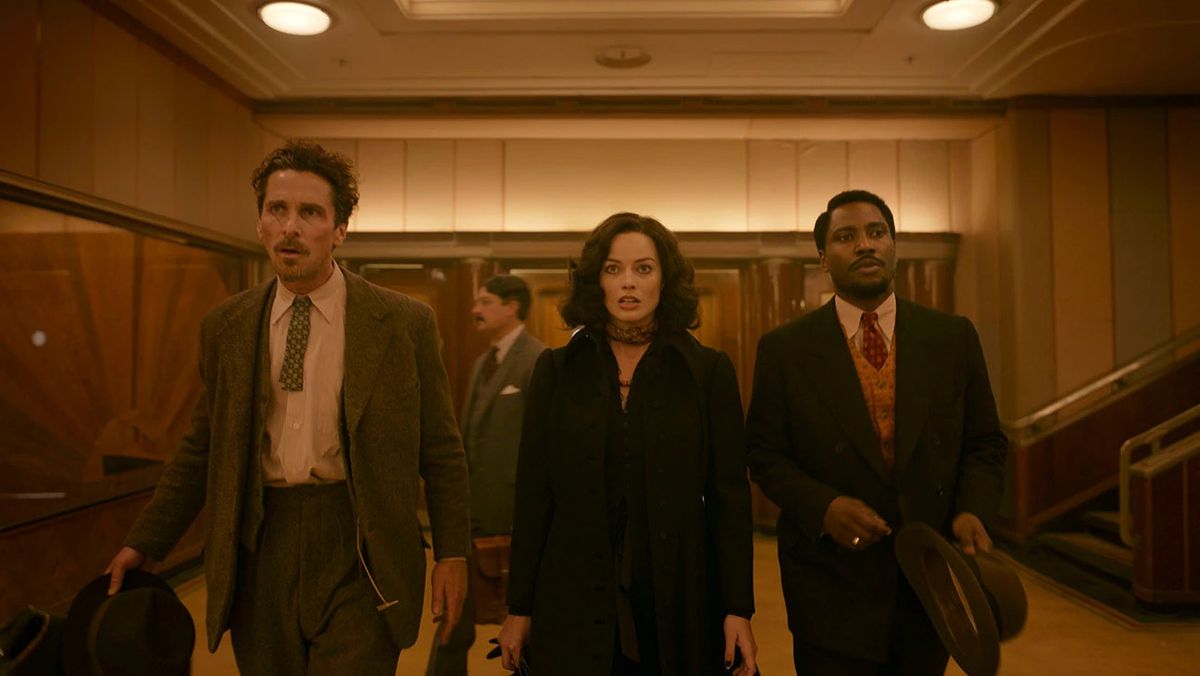
David O. Russell’s historical mystery folds a couple of Oscar winners, a handful of the most beautiful and talented women in cinema and American pop culture and a lot of “This really happened” events into a Big Conspiracy yarn set in the world’s first serious flirtation with fascism, the 1930s, when one World War was just enough of a memory that a lot of people who should’ve known better steered us right into another.
And in America, lightly-bloodied but triumphant, veterans including our three heroes contemplate the pathology of those who returned from Europe but “followed the wrong god home.”
Christian Bale is a doctor who lost his eye as a combat medic with the American Expeditionary Force in the Argonne. He served with an African American corps which included a lawyer (John David Washington) and the lawyer’s trusted and more streetwise friend (Chris Rock).
And when Dr. Berendsen and Harold Woodman, Esq. are mangled like thousands of others in the horrific combat of the war’s final year, a French nurse (Margot Robbie) was the one who removed and collected all the bullets and shrapnel from their bodies, befriended the married doc and became the lover of the lawyer as she turned out to be an American socialite named Valerie, and an aspiring avant garde artist intent on turning the spent metal of the World War into tea sets and such.
The three “made a pact” that they would “look out for each other.” The doctor and the lawyer bring this bond home with them, where Doc experiments with pain killers and other unsanctioned ways to help his fellow veterans, the Harold helps them legally and together they run a veterans charity.
Valerie vanishes. Until, that is, the combat comrades find themselves mixed-up in the mysterious death of their racially and morally enlightened commanding officer (Ed Begley Jr.) and his daughter’s (Taylor Swift) fateful effort to find out who or what conspiratorial entity may have played a hand in it.
“Amsterdam” begins with promise and really hits its stride with an exciting finale built around another World War veteran, a celebrated Marine general played by Robert DeNiro.
But man, do this film’s middle acts wear a body out. Timothy Olyphant plays a fanatical hit-man. There’s a grisly autopsy carried out by a nurse (Zoe Saldana) who has to pass herself off as “Portuguese” for the racist medical establishment to let her do what she does best, a couple of bird watching “businessmen” (Michael Shannon and Mike Myers) who are actually spies who may “call on” our heroic trio at some point, in need of assistance, and the imperious and faintly-sinister relatives of rich girl Valerie (Rami Malek and Anya Taylor-Joy).
As comic as it often tries to be, “Amsterdam” treats us to a bit of 1930s eugenics, and German immigrants (German American Bund) and native born Americans with anti-democratic tendencies.
The cast is almost uniformly impressive, though even they can’t conceal the fact that many scenes and shots seem superfluous to the larger story and not enough of the jokes land.
Washington holds his own with Bale, Robbie and the exquisite comic timing of Chris Rock and Myers.
And one can’t let the presence of Robbie, Saldana, Taylor-Joy and Swift pass unnoticed, as the care with which they’re made up, lit and photographed is a study in how to film gorgeous movie stars — and a singer-songwriter who isn’t much of an actress. Olivia Wilde should call the DP.
The equally-stunning Andrea Riseborough plays the manipulative Anti-Semitic upper class wife that the badly-disfigured doctor tries to come home to. Riseborough steals the movie with just a few scenes and brilliantly-considered gestures, a woman whose family will never “accept” her husband and who has the aura of a wife who’s OK with that and life without the now-damaged spouse she and her imperious father talked into going into combat.
Russell gives Robbie’s Valerie the line about history’s dark passages being a “recurring dream” that the world wakes up to every few decades. That’s the point that he’s getting at here, that we’re teetering on a new dark age with fascists on the rise in Italy, Hungary, Russia, France, Britain, China and America and conspiring to end the Age of Liberal Democracy.
It’s happened before, and it took a “Greatest Generation” to resist it. Now, all it takes is the right media demagogue and the masses are ready to “follow the wrong god home” and right off a cliff.
The racism, white supremacy and amoral, stateless superrich determined to be the only “ruling class” is nothing new, Russell shows us. And neither are the oases which remind people of the possibilities of equality, justice, freedom and free expression. There’s always an “Amsterdam” where we can see the light.
Great message, and damned hopeful. Pity it’s buried in a movie that talks too much, encompasses more than it should and muddies its moral in a convoluted tale with just a smidgen of action and dering do and lots of jokes mixed-in with the forebodings of what happened once happening again.
Russell squandered an “important” story and his access to the best talent and a healthy budget and made something a lot closer to “Joy” and “I Heart Huckabees” than “Three Kings,” or “American Hustle.” He was following “the right god.” He just lost his way more often than not.
Rating: R for brief violence and bloody images.
Cast: Christian Bale, Margot Robbie, John David Washington, Chris Rock, Anya Taylor-Joy, Andrea Riseborough, Michael Shannon, Alessandro Nivola, Rami Malek, Mike Myers, Zoe Saldana, Timothy Olyphant, Taylor Swift and Robert De Niro.
Credits: Scripted and directed by David O. Russell. A 20th Century release.
I never imagined “Lyle, Lyle Crocodile” could be as endearing at this.
And with Gatorade as my witness, I never thought I’d see Oscar winner and former Bond villain Javier Bardem break out his singing voice and dancing shoes to star in it. Jaws will drop, my friends. Mine did.
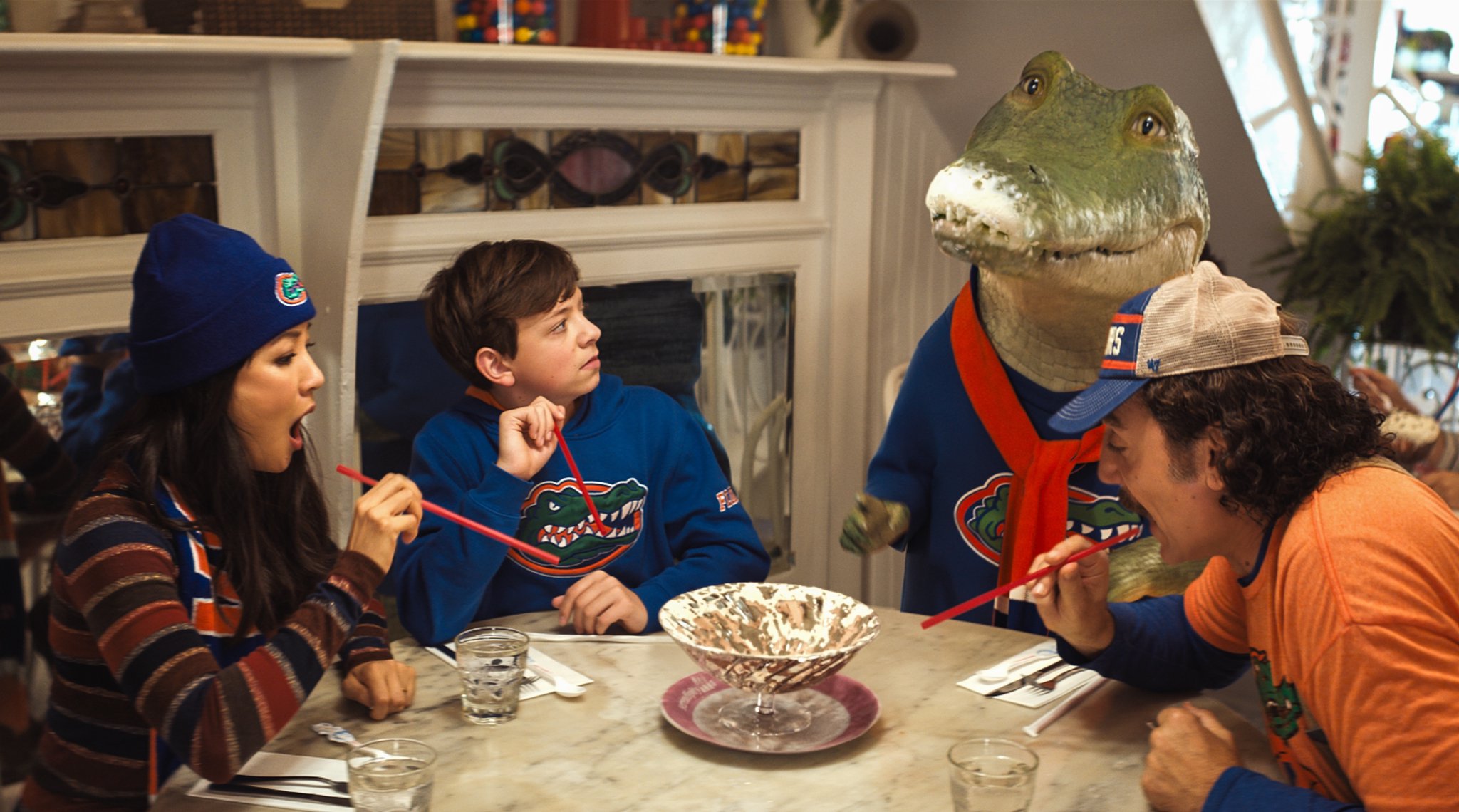
But that’s what happens when you get the “Dear Evan Hansen” songwriters and the guys who made Marvel’s “Hit Monkey” to make a movie that puts animated Lyle into a song and dance setting co-starring Bardem, Constance Wu and Scoot McNairy with singer Shawn Mendes — aka “Justin Timber-lite” — crooning tunes as Lyle.
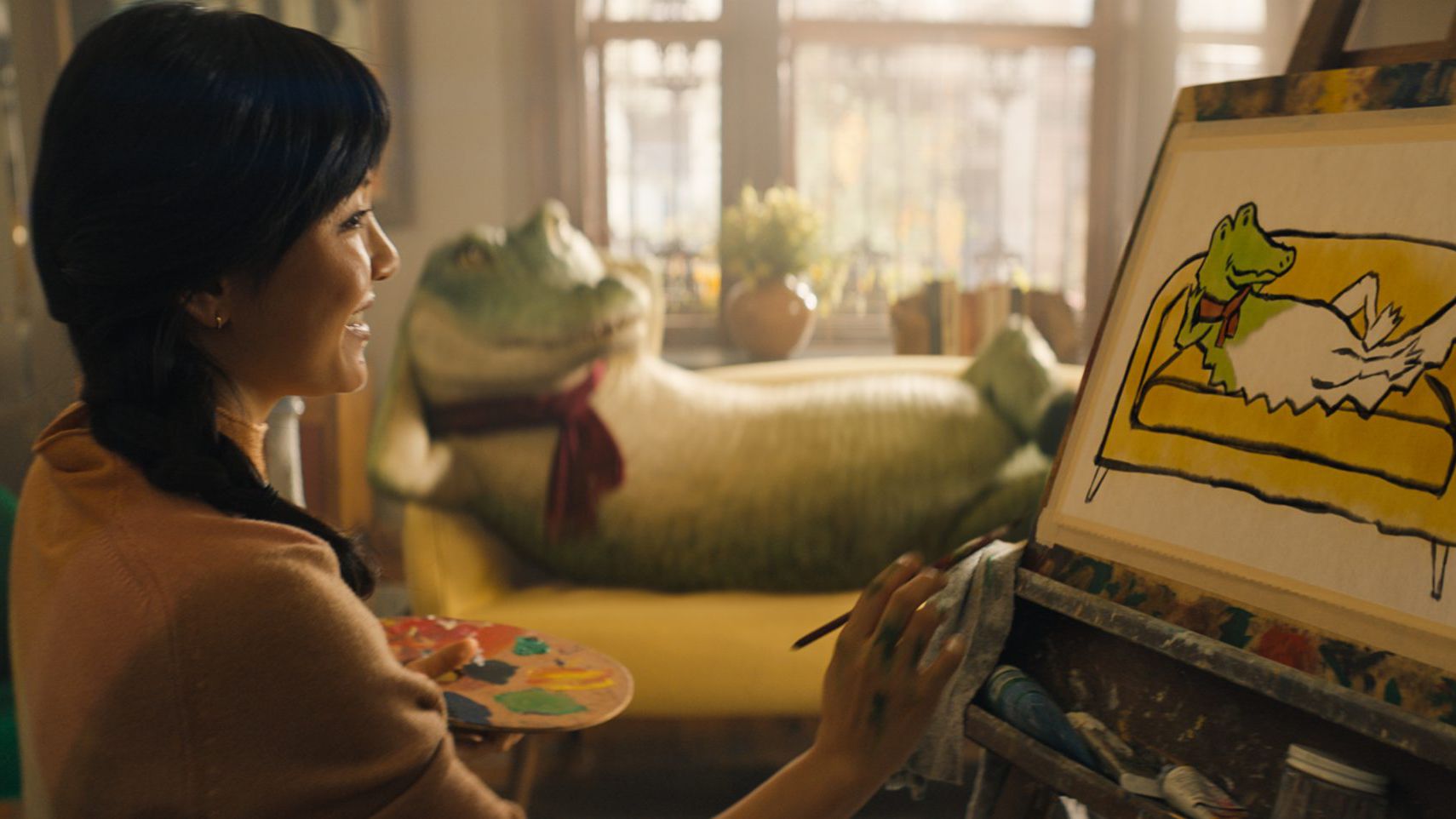
Bernard Waber’s slight but sweet and silly books about a New York family finding a kind, helpful and non-speaking crocodile in the brownstone they just moved into are a natural for a musical. There even was an animated made-for-cable movie a few decades back.
The books are of the picture-book that parents read to children and kids learn to read with variety, so the movie is aimed young. There’s slapstick, a cartoonish villain, simple messaging about how it’s OK to be shy all set to bubbly, upbeat songs.
The “origin story” here will be familiar to most kids and many parents, only dressed up to be a musical. Lyle is discovered by failing showbiz hoofer/hustler Hector P. Valenti (Bardem), a guy desperate to get on the “Show Us What You’ve Got” TV talent program. Looking for an animal to add to his so-far-unsuccessful act, he hears the toddler croc singing in a pet store.
Eureka! He’ll take Lyle home, teach him some numbers, rehearse and they’ll be showstoppers for life. Only Lyle, like a lot of kids, gets stagefright. No novelty act stardom. And taskmaster Hector goes broke on this gamble and has to hit the road to make back what he lost. Lyle is left behind in the brownstone on 88th Street.
That’s where the Primms move — cook-book queen Mom (Wu), math professor Dad (McNairy) and afraid-of-the-big-city son Josh (Winslow Fegley). Josh is the one who figures out something’s making noise in the attic, something green and shoe-leathery, a crocodile whose “pretend to be stuffed” efforts don’t fool the kid.
Next thing he knows, Josh is following the sentient but silent croc as he dumpster dives through all the fine dining establishments in their corner of Manhattan. Friendless Josh has a new pal, a new source of confidence and a new taste for caviar and the finer things in life.
If only their tyrannical neighbor Mr. Grumps (Brett Gelman) wasn’t such a grump about noise. And rules and ordinances. And crocodiles.
The drama is fairly mild, the action cute and slapshticky and the Lyle sight gags aimed at six and unders, so don’t look or listen for great verbal or visual wit.
The tunes are affirming, bubbly and upbeat and as instantly forgettable as the “Dear Evan Hansen” songbook.
And the casting is somewhat uneven. Wu, of “Fresh Off the Boat,” is adorable and charming. And Bardem hurls himself into Hector as if he’s as desperate to make this job pay off as Hector himself would be. He makes the movie.
They get enough out of McNairy’s “Dad,” but I dare say they could have fleshed out other kid characters, and found a more charismatic villain and a way to knock 15 minutes off this sweet nothing of a somewhat slow kiddie movie.
But “endearing” it begins and endearing it ends. Let yourself be charmed and you will be. Your kids and grandkids? They won’t need to make allowances. It’s right up their tin pan alley.
Rating: PG for mild peril and thematic elements
Cast: Javier Bardem, Constance Wu, Winslow Fegley, Scoot McNairy and the singing voice of Shawn Mendes.
Credits: Directed by Josh Gordon and Will Speck, scripted by Will Davies, based on the books by Bernard Waber. A Sony/Columbia release.
“Werewolf by Night” is a Marvel “special” for Disney that helps set up “monsters” in Marvel’s already cluttered superhero universe, a comic book adaptation meant as an homage to the classic monster films of the black and white cinema.
As homages go, this may have the (digital) monochromatic look of the various Frankenstein, Wolf Man or King Kong movies of the ’30s and ’40s. But even the most generous reading of what little is here has to conclude it’s pretty inconsequential stuff. Hardcore fans probably won’t mind that. They never do.
It’s also meant to be light and fun, and it never quite is. Maybe a smirk or two is all it manages.
Gael García Bernal plays Jack Russell (snicker), a monster hunter summoned for a “ceremonial hunt” competition with other monster hunters to see who will take over leadership of their guild, and possess the coveted Bloodstone.
Yes, it glows ruby red in the middle of a black and white 53 minute movie. Such a clever touch.
Other hunters played Leonardo Nam, Eugenie Bondurant and Kirk R. Thatcher are also “on the grounds” seeking weapons to use to hunt an unnamed monster, and each other, to get that stone.
They will punch, kick, swordfight, swing battle axes and shoot crossbows at each other in a contest adjudicated by the previous Bloodstone owner’s widow (Harriet Sansom Harris).
Laura Donnelly of TV’s “The Nevers,” sort of the Irish Krysten Ritter, is Jack’s two-fisted, jaded rival and/or teammate. Love interest? Nah. There’s no time. And this is Marvel, remember?
The jokes are the occasional blurts of profanity in the pre-fight and mid-fight trash talk, some cuddly monster interaction and the mummified one-liner that launches the hunt.
“Good luck. I’ll be rotting for you.”
The look is fog machine gloomy, the effects and makeup excellent and the fights right on the cusp of humdrum.
At this point, Marvel could sell its fans pretty much anything, and the thin charms of “Werewolf by Night” prove that, as well as having a hint of “proof of concept” about it. Marvel could do more in this “universe” in the future, but it’s damned certain they couldn’t do much less.
Bernal’s presence means he took his longtime friend Diego Luna’s call, and the “Andor” star’s advice — “Man, get you some DISNEY money!”
Rating:TV-14, bloody violence, mild profanity
Cast: Gael García Bernal, Laura Donnelly, Harriet Sansom Harris, Leonardo Nam, Eugenie Bondurant, Kirk R. Thatcher
Credits: Directed by Michael Giancchino, scripted by Heather Quinn and Peter Cameron, based on the Marvel comic books. A Marvel Studios/Disney+ release.
Whatever pleasures the best-selling novel “The Storied Life of A.J. Fikry” offered readers are wrung out of it in its enervated adaptation to the big screen.
It mopes along when it isn’t leaving out what seem to be whole passages, transitions, backstory and the like. The action doesn’t flow at all, and relationships have a brittle, abrupt quality.
What’s left is Hallmark Channel mawkish, with halfhearted performances and perfunctory direction. And “Fikry” is Exhibit A about why you don’t let authors adapt their novels. It takes guts to streamline, to know what is cinematic and essential to the story, and to “murder your darlings” with edits.
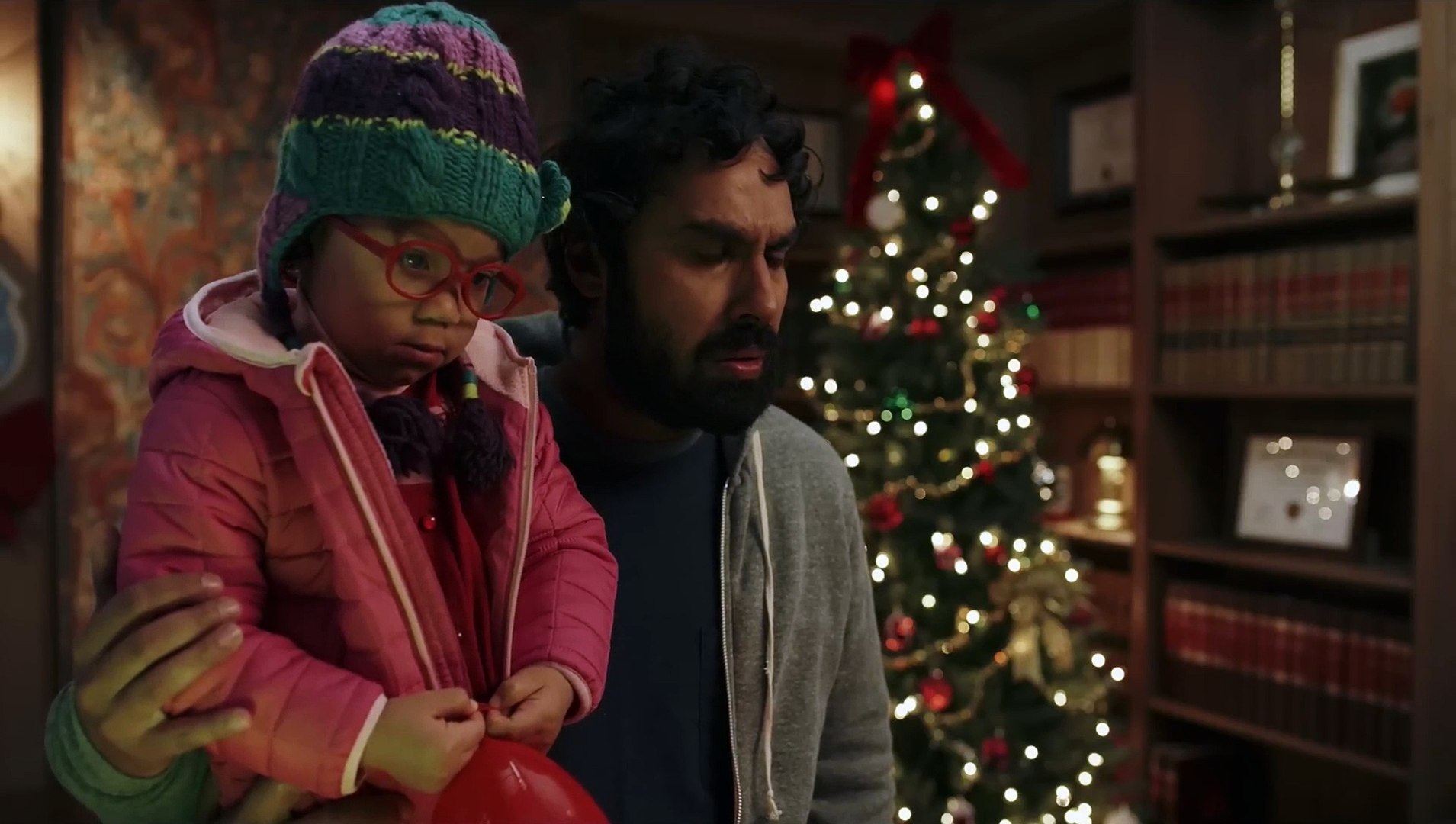
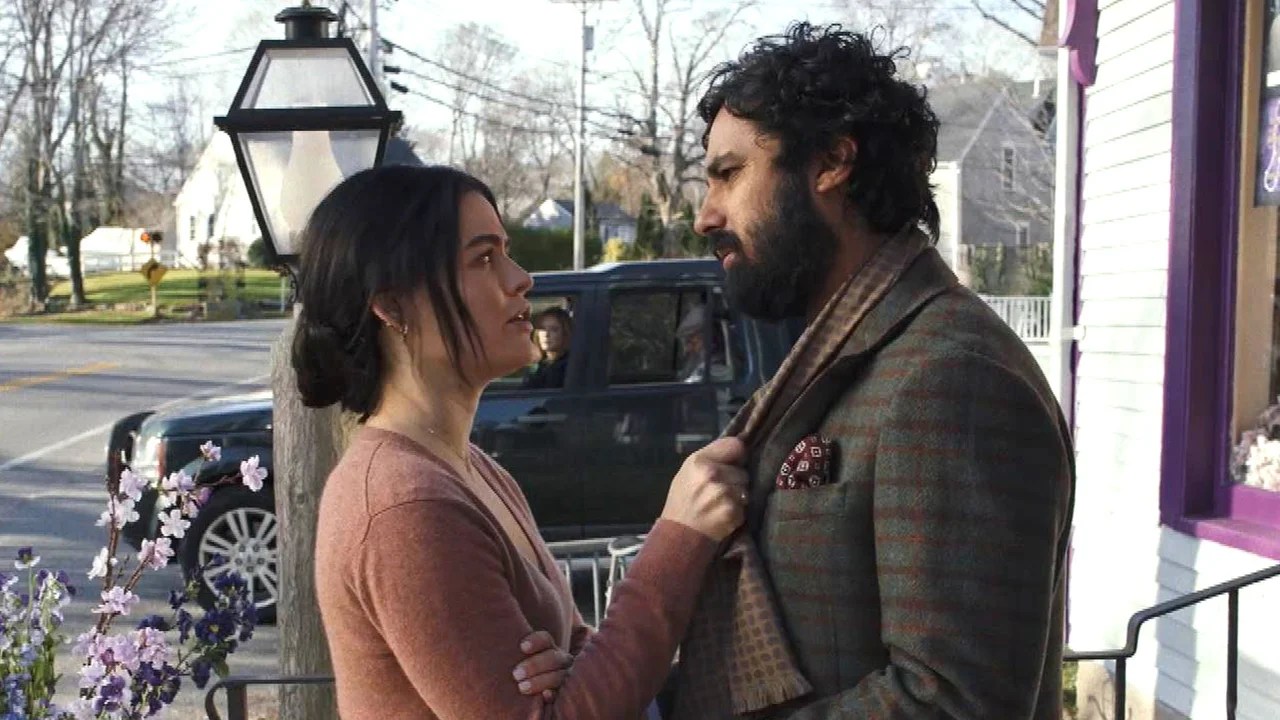
The film version fails utterly to provide a big screen boost to the acting career of Kunal Nayyar, the “Big Bang Theory” alumnus in the title role. He takes an amusing curmudgeon, a bookish loner given to exasperated diatribes about literature because as a bookstore owner he has his opinions, and plays him as if he’s lost the will to live.
While that’s fair, as that is the widowed character’s MO when we meet him, it doesn’t make for anything embraceable. Nayyar plays the guy as no one you’d like to know all the way through the film, when we’re supposed to warm to him as other characters eventually do.
A.J. drinks wine until he’s blackout drunk, insults customers and even the cute publishing rep Amy (Lucy Hale) trying to talk him into highlighting her wares. This little rant should be fun, and it lands like a long-rotten melon dropped from a reasonable height.
“I do not like post-modernism, post-apocalyptic settings, post-mortem narrators or magical realism. I do not like children’s books, especially those with orphans. And I prefer not to clutter my shelves with ‘young adult.’ I am repulsed by ghost-written novels by reality television stars, celebrity picture books, sports memoirs, movie-tied editions.” And his least favorite of all are “slim literary memoirs about little old men whose wives have died of cancer.”
The lesson here is that if you’re a dyspeptic widowed bookstore owner, downloading all this bile — flatly and blandly — to a publishing house representative, she is destined to fall in love with you by the second act.
But first, A.J. has to have an adorable moppet (Charlotte Thanh Theresin) abandoned in the kiddie book stacks of Island Books, his store on remote and fictional Alice Island. Since it’s an island and this is winter, child protective services can’t come fetch her. He’ll have to take care of little Maya. And even though it’s an island, it takes the inept cops (David Arquette is their bookish chief) a while to find the mother, and when they do, she’s a corpse.
A.J. will need help from his former sister-in-law (Christina Hendicks) who lives down the lane with her smug, womanizing author-husband (Scott Foley) if he’s going to be able to take care of a 25 month old.
The idea is that as we follow this story, spanning close to two decades, A.J. softens into someone sweeter as Maya grows up, the cute publishing rep notices and he eventually forgets about the first edition of Edgar Allan Poe’s “Tamerlane and Other Poems” that he sobered up and discovered missing early in the first act.
A lot of what might make that journey appealing is left out of this story.
The film promises simple, sitcom setups and never gets around to the punchlines. We skip and skip over so much that Amy and A.J.’s “romance” never feels romantic, merely curtailed and obligatory in terms of the requirements of the “plot.”
Characters that might have edge have their rough edges rubbed off. Random scenes show us flashbacks or what might be scenes from a novel, or could have really happened to this character or another one.
There are readings from the book that sets our big romance in motion or by the teenaged Maya (Blaire Brown) as part of a short story competition. And they sound like something the poor actors improvised on the spot — trite, dull, cliched and meretricious.
Not enough charm is managed by the Hyannis, Massachusetts settings, and even if it did that wouldn’t save this godawful book report of a screenplay, or the charmless, witless and artless attempt at playing the title role.
Rating: PG-13 for brief strong language, some suggestive material and thematic elements.
Cast: Kunal Nayyar, Lucy Hale, David Arquette, Scott Foley, Blaire Brown, Jordyn McIntosh, Charlotte Thanh Theresin and Christina Hendricks
Credits: Directed by Hans Canosa, scripted by Gabrielle Nevin, based on her novel. A Vertical release.
Pun titles are just the best, right? Harbour and John Leguizamo and Cam Gigandet in a story of Santa stopping an attempted kidnapping by mercenaries. Nice and nuts.
We’ve had plenty of time, thanks to the many scenes that precede it in “Last Flight Home,” to get used to the idea of how Eli Timoner plans to shake off this mortal coil. But a line, casually spoken by his rabbi daughter, still packs a gentle jolt.
“Daddy, on March 3, when you die…”
Documentary filmmaker Ondi Timoner’s latest film — after works on controversial artist Robert Mapplethorpe (“Mapplethorpe), gadfly comic Russell Brand (“Brand: A Second Coming”) and the musical era that the Dandy Warhols came out of (“Dig!”) — is a 100 minute home movie, Watching Daddy Die.
It’s an idealized depiction of what “death with dignity” can look like in a culture where that’s still a rare gift. Timoner, her siblings, nieces and nephews and mother, all talk to and comfort patriarch Eli Timoner as he resolves to make the March of his 92nd year his last one.
Timoner tells his daughter “I’m just waiting to die” when she calls. He tells others, including his future widow, “I just want to be in the ground…Are we gonna end it today?”
They don’t push back. They know he’s been miserable, a very successful man who ran one big and two huge businesses who then spent the last 40 years of his life paralyzed by a stroke, so he’ll need help, which is allowed in California, where he lives. When he says “I want it to end,” his rabbi daughter takes it seriously.
“If you’re saying this is what you want, we’re all behind you.”
“Last Flight Home” is a film of reminiscing phone calls and tearful final farewells, a story of preparations for the end and a celebration of a big life that shrank, and the “shame” the man who lived it felt about that.
It’s sometimes moving and sometimes simply indulgent. Because it takes some effort for anybody to see this privileged exit as something “universal” that could be replicated in their own lives, with their own loved-ones. Timoner’s film can feel like a too-rich-for-my-blood/too-intimate-to-relate-to home movie at its worst, an affectionate tribute and curtain call for a life well-lived at its best.
A phone call from talk show hostess Rachel Maddow? Not something every fan gets when he’s about to end his life.
And it isn’t every clan that gets to hear the “shame” their patriarch carries to his grave, that he didn’t sell some stock when his first hugely succession company went public,” $40 million pissed away,” Eli mutters on his deathbed.
That was for the huge Florida-based roofing concern that he took national, his second great business success.
“Last Flight Home” takes its title from Eli Timoner’s most famous company, Air Florida. When Ondi asks Eli for a list of “people you want to say ‘good-bye to,'” a lot of the Zoom calls are with pilots and other employees of that “world’s fastest growing airline,” a late 1970s phenomenon made possible by airline deregulation.
It also points to a major omission in “Last Flight.” Eli Timoner had his stroke (his wife blames a “neck crack” during a massage) six months after the infamous Air Florida crash into the Potomac in Washington, D.C. in 1982. He was forced out of the airline after the stroke, “disability discrimination” Eli says and his family agrees. But the airline was gone within two years of that brand-killing disaster, and it’s absurd and dishonest to leave out something much more likely to lead to his ouster and for that matter, to his debilitating stroke — stress, and “guilt,” whether warranted or not.
And seeing that left out makes you wonder what other sops to “hagiography” Ondi Timoner made, omitted and embellished?
Any documentary that points to a way out of the agonizing, expensive, life-extending trap of “The American Way of Death” is worth a look. This one, affectionate and atypical, poignant and privileged, grates almost as often as it moves.
It’s not every end-of-life film that makes you envious of the way this family produces, edits and choreographs that finale, seemingly by design.
Rating: unrated, some off-color humor
Cast: Eli Timoner, Ondi Timoner, many others
Credits: Scripted and directed by Ondi Timoner. An MTV Films release.
“The Visitor” is a Southern Gothic horror tale of modest ambitions and equally modest frights and delights. A polished production from Blumhouse TV for Paramount, with Epix TV its ultimate destination (in Dec.), it’s a film that delights in quaint Tennessee Williamsisms applied to a horror formula that treats “Rosemary’s Baby” as its Ur text.
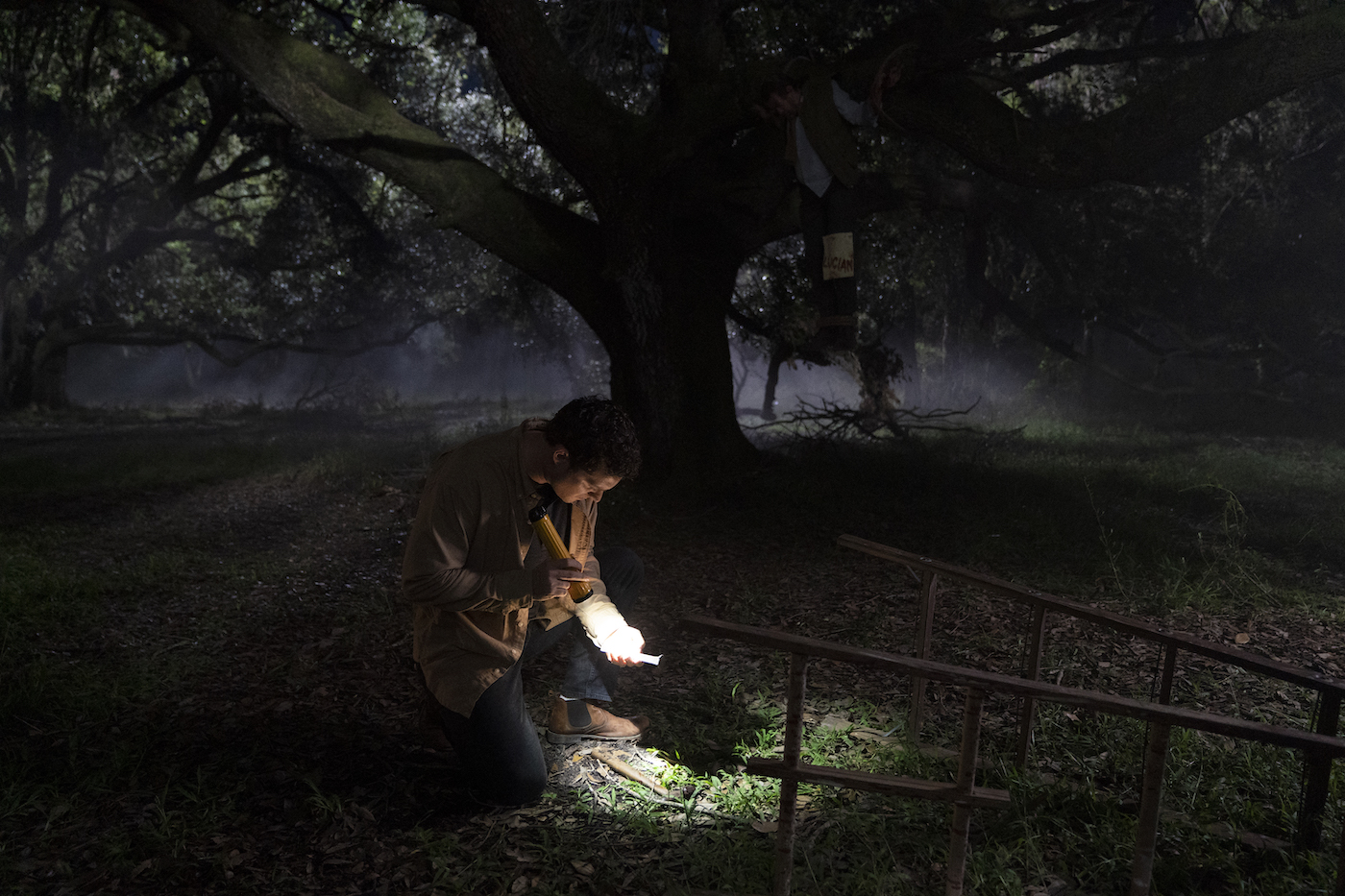
Finn Jones, a “Game of Thrones” alumnus (like every other Brit) and one of the stars of the new “Swimming with Sharks” TV series is Robert Burroughs, a Londoner who moves with his wife back to her ancestral home in the drawling, Spanish moss-bedecked Deep South after the death of her father. The place seems welcoming enough, until Robert starts noticing old paintings and Civil War era photographs with his face in them.
Wife Maya (Australian Jessica McNamee, who was Margaret Court in “The Battle of the Sexes”) is “the prodigal daughter” who returns to sleepy Briar Glen, welcomed by one and all — especially the florid, MO-lasses-accented preacher, Rev. Otis Ellis. He’s played with a growling, tipsy twinkle by Dane Rhodes, who seems to be having more fun than anybody else in this picture.
Maya is settling back in, but Robert is poking around and having nightmares. When a local slips him a note, he starts finding folks — an antiques dealer (Donna Briscoe), a wild-eyed local character (Thomas Francis Murphy) who urge him to “Run back to London and don’t EVER come back!”
He wants “the truth,” but as you might guess, he can’t HANDLE the truth.
As a native Southerner who lost his accent long ago, I always get a kick out of thespians who get off their Delta flight from wherever and start extemporizing like Foghorn Leghorn the moment the assistant director bellows “ACTION.”
“In the town of Briar Glen, suh, you ahhh NEVAH alone!”
Aside from that, there’s not much to grab hold of, here. “The Visitor” fights a losing battle with over-familiarity, sauntering through horror tropes that predate 24 frames-per-second era celluloid.
I’d love to see a five year ban of horrific occurrences punctuated with “It’s only a dream,” “You were just having a nightmare” if the screenwriter’s particularly lazy.
At least no one states anything that obvious in “The Visitor.” That’s small consolation for a movie that has little for genre fans, little star power and not nearly enough drawling drowned in moonshine to turn camp, I do declare.
Rating: unrated, violence, profanity
Cast: Finn Jones, Jessica McNamee, Donna Briscoe, Thomas Francis Murphy and Dane Rhodes.
Credits: Directed by Justin P. Lange, scripted Simon Boyes and Adam Mason. A Blumhouse production, a Paramount release.