This is a Knoxville TV station’s account of the story that is the basis for “Cocaine Bear,” a little archival footage homework before my next screening, Ms. Banks’ stoned bear horror comedy.
Movies filmed in close-up used to be a hallmark of television, then a medium with budgetary and screen-size restraints that begged for what actors came to term “neck up performances.” In the movies, the full-frame face can create an almost overwhelming intimacy whose effect is somewhat spoiled with overexposure.
That’s the way this shot and how it was used — sparingly — traditionally broke down, anyway.
“Of an Age” is a quietly-intense whirlwind Australian romance about a teen ballroom dancer thrown together with a gay grad student in their hunt for one man’s sister, who happens to be the other’s wayward, trainwreck of a dance partner.
The second feature film of Macedonian/Australian filmmaker Goran Stolevski — “You Won’t Be Alone” was his first — it’s a talky, talking heads meeting of the minds love story, a gay couple’s day-long flirtation and hook-up, and its bittersweet memory over a decade later.
Elias Anton is Kol — short for Nikola — whom we meet frantically trying to fit everything into the day of the big ballroom dance finals. Only his partner, impulsive high school classmate Ebony (Hattie Hook) has spent the night before on a bender and is barely sure of where she is when she calls him.
The last person she wants to bring into this is her older brother, Adam (Thom Green). But that’s who picks Kol up, in full dance costume, to hunt down the wayward, half-wasted Ebony via station wagon.
It’s 1999, and Kol manically despairs at everything that the map of Melbourne and that Adam himself tell him, that there’s no way they can rescue her and get them to the finals in any sort of shape to compete. So saving the trainwreck-in-distress it is.
They struggle through this awkward introduction and through the cross-town drive and we learn that Adam loves Argentinian music — tangos — and Spanish linguistics, which is what he’s pursuing for his PhD. And we see, in the tiniest of facial details, each young man’s gaydar go off at the shared taste in music and the connection to somebody else who knows who Jorge Luis Borges is in brawny, beer-soaked Australia.
We learn that Kol is a Bosnian refugee, living with his mother and uncle, that Adam is planning on going abroad to finish his degree. We get a glimpse of each one’s dreams.
When they pickup bleary-eyed Ebony, blitzed and passed out in a phone booth, we see how oblivious she seems, how spoiled she obviously is and how devoted to her Kol remains, despite the self-destructive streak this pretty girl has indulged to derail their plans.
We’re allowed just enough room to wonder if there isn’t some guilt here, that there may be enough to her history with Kol to suggest he’s one thing this pretty young thing wanted but has figured out she cannot have, which is why she was loathe to let him meet her brother.
As the day drags into a nighttime party, Kol and Adam’s connection deepens, but is already taking on a bittersweet afterglow.
The third act is about the two men returning to Australia in 2010 and finding each other again as Ebony, ten years later, has transformed into a stunning if still spoiled brat bride for her wedding.
Stolevski’s dialogue has only a moment of two of flippant and bitchy, complimenting Ebony’s theatricality as pointing her towards becoming “the next Nicole Kidman.”
“She’s trash.”
“I know she’s trash,” but no conversation with an Australian gay man is complete without lots of love for her holiness, Cate Blanchett. That lighter touch is sorely missed in the rest of the picture.
Any toxic masculinity here is limited to Kol’s Bosnian uncle and male relatives, who judge his disinterest in football as all the information they need.
Stolevski keeps his camera close and his story narrowly-focused on Adam and Kol, their chats and gently revealed status — Adam letting drop that his ex “won’t miss his cassettes,” Kol trying not to blurt out “It’s totally OK to be gay.”
The tests of any romance are basically the same, no matter what the sexuality of the lovers. Do we root for them as a couple? Do we feel the blows that each takes, in turn, as that romantic connection deepens and is tested?
Stolevski’s over-reliance on close-ups gives us detailed maps of each man’s dermatology, but tends to wash away the extra impact we’d feel about bigger moments of connection.
We’re meant to see this hook-up, coming at the end of the AIDS era and before Grindr, as something more meaningful than it feels. The age difference isn’t great, the maturity level is, which is why one takes the nature of this affair harder than the other.
If this was a heterosexual coupling, we’d shrug it all off as much ado about little, with the passage of time not really enhancing that cherished memory.
The big emotional moment is not really about them, only it is. And it’s on the dance floor the night of the wedding. Whatever its intent, its main effect is to show us what the preceding movie has lacked, a heartfelt, swooning and romantic love connection between two men “Of an Age” to truly appreciate that for the first time.
Rating: R for language throughout, sexual content and some drug use
Cast: Elias Anton, Thom Green and Hattie Hook
Credits: Scripted and directed by Goran Stolevski. A Focus Features release.
Well, thank heaven “Linoleum” isn’t about Jim Gaffigan, as a frustrated kids’ TV science show host, building a rocket in his garage and launching himself into space. We’ve all seen “The Astronaut Farmer,” after all. And Wallace & Gromit’s “A Grand Day Out.”
Writer-director Colin West’s soulful, sci-fi spin on taking stock of one’s life may be gimmicky. Why have one Jim Gaffigan role when you can offer your star two parts for the same pay? And it may spoil some of its near-magical effect by overdoing and overexplaining in its serene, Star Child finale.
West, who did the recent no-budget horror tale “Double Walker,” takes on nothing less than life itself, its eddies and the backwash that we struggle to understand as it is happening and only really pick up on after this or that phase has passed. And he does it via a sneaky story that’s just realistic enough to trick you into feeling it’s straightforward, when no, that’s not the idea at all.
Gaffigan plays a frustrated 50ish astronomer, once a young scientist of great promise, now condemned to doing a local kids’ TV show, “Above & Beyond,” in suburban Dayton in the Chevy Chevette/Buick Roadmaster era very early 90s.
Even the cars aren’t a reliable indicator of our time setting. The TV show is cathode-ray-tube/DIY effects cheesy, and cute with an early ’70s vibe.
When we meet Cameron (Gaffigan), his smarmy station program director has just taken that show away from him, demoting him to “consultant” on his own quirky creation. A new fellow with more accomplished science and space program achievements has been summoned. And damned if he doesn’t look just like Cameron (Gaffigan again).
Cameron doesn’t quite let this roll off his back. But considering that he narrowly avoided being crushed when this new guy’s T-top Corvette plummeted out of the sky and crashed, he’s willing to mull over a coincidence when it crashes right in front of him.
His wife (Rhea Seehorn) doesn’t believe him, his daughter (Katelyn Nacon) is a tad more credulous. And his younger son sits this one out.
Perhaps the kid realizes the futility of arguing, that this marriage is ending. Mother Erin is taking a job far away, a giant step up from her local “Air & Space Museum” gig. She’s driving out of this dead-end.
Another coincidence arrives in the form of space junk that plummets into their backyard, forcing them to move in with Erin’s sister. But Cameron, at a loss, takes the new neighbor kid’s (Gabriel Rush) suggestion that he could “build your own spacecraft” out of what crashed, and starts to tinker, hammer and work the problem towards doing one “fantastic” thing with his life.
For once, he won’t let “It’s not that simple” stop him. Nor will visions of a strange old lady he keeps seeing.
The fact that his “I like girls” daughter has taken a shine to the new boy and the new kid happens to be the son of the Corvette-driving jerk who is taking over Cameron’s show? More coincidences, and pretty much par for the course with the way Cameron sees life happening to him, without a whole lot of input on his part.
Gaffigan’s been doing movies since the ’90s, and while he plays a fairly diverse selection of characters — robber baron George Westinghouse in “Tesla,” a darker, drug-trafficking Cameron in “American Dreamer” — his sweet spot might be roles that play into his walking, talking “Dad joke” stand-up persona.
Here he’s put upon and easy to empathize with, even as we don’t have a lot of trouble figuring out why Cameron’s wife is leaving.
The film’s sparkling scenes come from the teens, one shunned in school because of her out-of-the-closet preference for girls, the other beaten down by the expectations of his over-achiever father. There’s a whole other movie in their friendship and unlikely connection.
But there’s also a movie in Cameron and Erin’s failing marriage, and one in his relationship with his scientist-dad, who is now in a home suffering from dementia, treated by an in-house physician (Tony Shalhoub) who would prefer to stay in his lane, but maybe wonders himself about these coincidences Cameron keeps bringing up.
“Linoleum” is hard to pin down, as far as genres in which to classify it. I kept thinking of M. Night Shyamalan’s “Signs,” and the hopeful loser-looking-for-his-moment comedy inspired by that, “Jeff, Who Lives at Home.”
I don’t think all of it works. And making a graceful exit counts for something and is the one place where I think West overreaches.
But maybe his on-screen alter ego has it right, even though he knows that this is just a cop out, just an excuse for not really wrestling with that which must be wrestled into some sort of coherent shape.
“It’s not that simple.”
Rating: unrated, a moment of violence, profanity
Cast: Jim Gaffigan, Rhea Seehorn, Katelyn Nacon, Gabriel Rush and Tony Shalhoub
Credits: Scripted and directed by Colin West. A Shout! Factory release.
The Oscar-nominated “The Fabelmans” showed that there’s still an audience for Judd Hirsch leaning into the Old Jewish Man shtick, which makes the indie comedy “iMordecai” marketable.
So here we are and here he is, a very old man in a “Virginia is for Lovers” hat, paired up with his “Taxi” co-star Carol Kane, shaming his son (Sean Astin) for showing up in a Porsche, “a Nazi sh– car,” jackhammering his condo’s bathroom floor because, “Vot, you vant I should use a toothpick?”
Mordecai Samel goes around telling everyone he’s 80, when we’ve already heard him narrate the animated first act of his life story, born in rural Poland in 1933 ( 90 years ago).
Vot, ve can’t do math?
He survived the Russians occupying his village, escaped the Holocaust, married Fela (Kane) and retired to Florida, a former plumber and painter with his “nudnik” new-father son (Astin) nearby, a “schlemiel” who doesn’t know a pipe wrench from channel locks.
But when the kid insists Dad get a new iPhone, all the kvetching in the world can’t save Mordecai from his fate, to become intimate with Siri and “that brainwashing device by Stalin,” as Fela puts it, in his pocket.
It’s not every iPhone-using senior who gets one-on-one lessons on how to used the phone “with no buttons.” But saleslady Nina (Azia Dinea Hale) takes an interest. And as we gather from her volunteering at the local Jewish Community Center, she’s got a keen interest in Holocaust survivors.
Director and co-writer Marvin Samel begins this story with Mordecai relating (animated) family lore that he was born under a Polish apple tree, and bonked on the head at birth. I’d say Samel leaves no low-hanging-fruit unpicked in this undemanding, comfort food comedy, but the truth is, he does.
The picture tends to peter out as we drift away from Mordecai, relating his life story to Nina in animated flashbacks (Remember, he’s a painter, and not just a housepainter.). His son is a Florida cigar maker, hoping to make that big score and sell his company. But his aged Dad has always been his “jinx.”
We get a glimpse of son Marvin’s (there’s a bit of autobiography here) home life — wife (Stephanie J. Block), newborn twins with Dad plainly pushing 50. But there’s not much that’s funny in that story thread, and the comic legend Kane is kind of wasted in a role that shifts into dementia.
“Her mind isn’t working like it used to.”
“So whose is?”
Hirsch’s storied TV career had him mostly playing the straight man, a reactor to assorted madcap friends and colleagues cast opposite him on shows like “Taxi” and “Dear John.” Here, he carries all the comic weight, advising a young cell phone seller on how to earn laughs from the stand-up stage, attempting plumbing fixes, “jinxing” things for his kid and making his dotty wife jealous at all the women trying to “steal you away.”
It’s a fun performance in a poor-to-middling dramedy. If you haven’t seen “The Fabelmans,” you really haven’t seen him pulling out all the stops, which is something to behold.
Rating: unrated, profanity
Cast: Jodd Hirsch, Carol Kane, Azia Dinea Hale, Nick Puga, Stephanie J. Block and Sean Astin.
Credits: Directed by Marvin Samel, scripted by Rudy Gaines, Marvin Samel and Dahlia Heyman. A Femor release.
Hey, if we have “gender reveal parties,” why not a sperm donor party?
March 3, this raunchy empowerment comedy, co-starring Rob Corddry, Bria Henderson, Erinn Hayes and Jerry O’Connell is unleashed upon us all, and as Tracy Morgan likes to say, “SOMEbody’s gonna get pregnant.”
Philippa Soo is getting over that “long lost husband” (Luke Bracey) with Mr. Right (Simu Liu of “Shang Chi and the Legend of the 10 Rings”)…and then the husband comes back from the supposedly dead, but at least lost at sea.
Sounds like a 1963 Doris Day/James Garner/Polly Bergen comedy, “Move Over, Darling.”
“A Sunday Affair” is a soapy love-triangle melodrama bathed in Nigerian affluence. The plotting is obvious, the acting stiff and stagebound and the payoff an eye-roller.
Aside from that…
An opening montage lets us see that Uche and Toyim have been friends since childhood, looking for love and success in greater Lagos, getting cynical about at least one of those goals by their early 20s, still single when they attend the stylish, tony wedding for Uche’s sister in their late 30s.
Uche ( Nse Ikpe-Etim) runs an art gallery, thanks to a little help from a “sugar daddy.”
“I like my men married,” she cracks. “Much less hassle.”
That’s how she hooks up with “Sunday,” aka Akim (Oris Erhuero) at that wedding. Her BFF Toyim (Dakore Egbuson-Akande) catches up with them post-coitus, and lets her bestie and her bestie’s hook-up know that she knows he’s married.
A chance cross-country train ride pairs up “the marrying kind” Toyim with Akim for a long chat, where she buys his pitch that he’s getting divorced from his “American wife.”
Now Toyim is interested. Now she’s forgetting the guy hooked up with her bestie. Now she’s having second thoughts about the reason for that train ride, her trek to a fertility clinic. She’s not waiting on the right man to come along and father her baby.
“Your body, your choice,” Akim says, recycling the hottest pickup line of the past 25 years.
Soon our player is hooking up with both, getting guilted by his brother, and struggling with the decision of whether to divorce and which woman to choose as we wonder which bestie will spill the tea about “this new man in my life” first.
The Nigerian setting is the main novelty in this flatlining melodrama. Posh homes and fancy restaurants, sex in Porsches, this is a Lagos version of Tyler Perry’s Atlanta, aspirational and African, not African-American, with midnight walks on the beach as an added bonus.
Toss in a little cultural sexism and woman-on-woman judgement and you still don’t have enough conflict to spark this script to life. The cast is just good enough to make you notice their wooden readings of wooden dialogue (in English).
But like most Nigerian films one finds when traveling “Around the World with Netflix,” the Nollywood polish at least gives it a gloss that makes “A Sunday Affair” neatly fit in with the other international films on the streaming service, even if the screenwriting and acting isn’t quite up to par.
Rating: TV-MA, sex, nudity, profanity
Cast: Dakore Egbuson-Akande, Nse Ikpe-Etim and Oris Erhuero
Credits: Directed by Walter Taylour, scripted by Darrel Bristow-Bovey. A Netflix release.
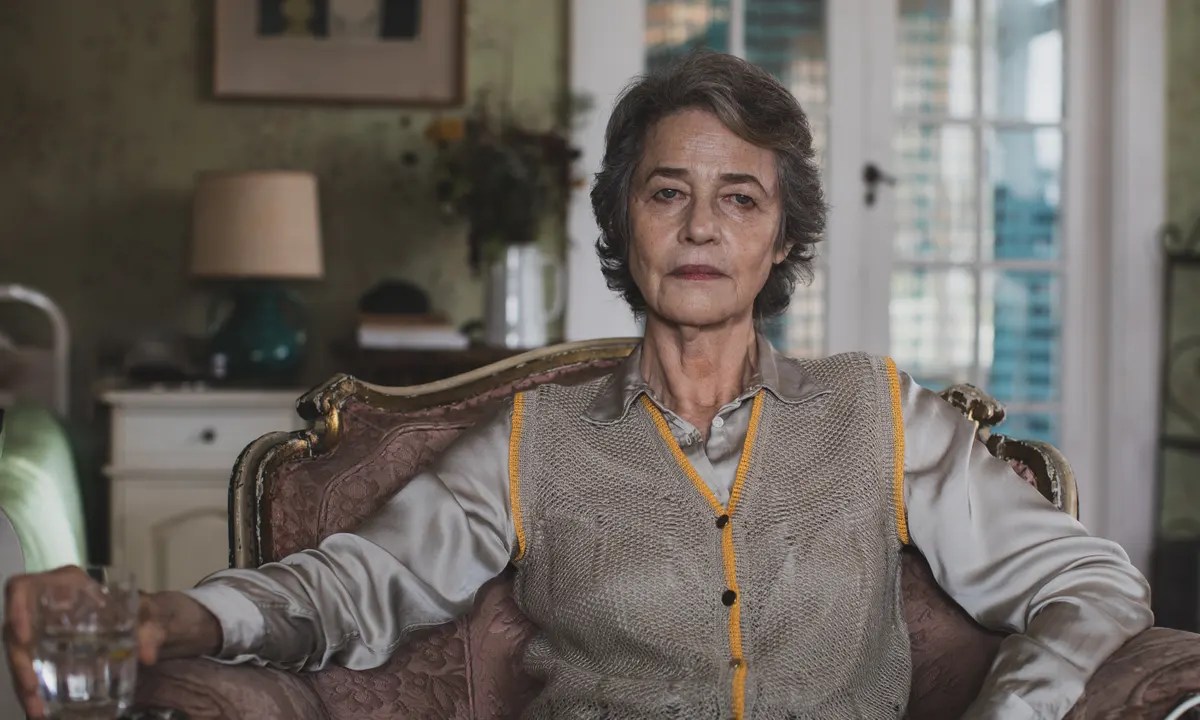
A morose, motherless teen finds out a few things about himself and his gene pool when his alcoholic, dying granny comes to stay with him in “Juniper,” a curtain call drama built around a fine turn by screen legend Charlotte Rampling.
Actor turned writer-director Matthew J. Saville’s debut feature makes for a dry, unemotional blend of dark comedy and co-dependency, scenic but desultory, even when Rampling is at her best.
New Zealand native George Ferrier stars in this Kiwi coming-of-age story about a boarding school kid who comes home to help his widowed father (Marton Csokas) deal with Dad’s English, globe-trotting mother, who is to move in with them.
Granny Ruth isn’t the warmest creature, a brittle conflict photographer who took to gin (giving the film its title) long ago, and expects to maintain her bottle-a-day habit while her broken leg heals. As she is in her 70s, that’s a bit hopeful on her part, and on medical science’s.
Grandson Sam doesn’t know her and doesn’t want to get to know her. He’s never recovered from the loss of his Mom. And Dad can’t wait to find an excuse to flee the country to “settle” Ruth’s affairs back in the U.K. Ruth never even told him who his father was, so he has his reasons.
With Sam motorbiking out into the woods to prep a noose for himself, is there anything Ruth can or will do that can mend this broken child and breaking family?
Rampling, recently seen in “Dune,” “Benedetta” and “Red Sparrow,” a screen fixture since her modeling youth (“Hard Day’s Night,” “Zardoz”), nominated for an Oscar for “45 Years,” should have been nominated for “The Verdict,” sports a salty, imperious presence here, a tough broad who has seen it all, lived it up and isn’t inclined to take any guff, even in her current and perhaps terminal infirm state.
“Do the girls like you?” is her first question of her grandson.
“Which wars?” did she cover is his to her. “Most of them,” she shrugs.
They never quite connect, engaging in their own war of wills instead. She’s also dryly scrapping with her nurse (Edith Poor), who is both a caregiver and drink mixer, and more oddly, a devout Christian who is also a vice-enabler. She fetches an Anglican priest for Ruth.
“I thought you might like to talk.”
“Why did you think that?”
The film’s one real scene of sharp banter and real conflict comes here, Ruth cynically baiting the priest with a bribe, him losing his temper — “You do deals with the Devil, not with God!”
Saville’s story — supposedly borrowed from his own childhood — has few incidents that one would go so far as to describe as “action.” Everything is interior and emotional and approached at arm’s length. We get a load of Sam’s unhappiness and his short temper, even as we wonder what it is that makes him loathe Ruth on sight.
The relationship is a standoff until they meet on Ruth’s irresponsible and not exactly moral terms, and even that doesn’t give the movie the lift we keep waiting for, the meaning it searches for or the heart it generally lacks.
“How I Became a Gangster” trots out every plot device, every trope and every cliche of every gangster picture of the past twenty years and gives them all a coke-flavored Polish accent.
It’s an over-familiar tale buried under an incessant, self-serving and redundant voice-over narration. Our gangster-in-the-making speaks of his “normal” childhood, his lifelong passion for brawling, his “code” and his country for two hours and twenty minutes of movie that never for a minute shakes the “We’ve SEEN all this before” baggage it carries all along the way.
Our “inspired by a true story” begins as a working-class kid gets labeled “a pint-sized hitman” at 10, thanks to his school principal. He steals his dad’s taxi for joyrides and has a “Bronx Tale” epiphany about the mugs with money in The People’s Republic of Poland. From 1977 onwards, through “Solidarity” into the 2000s, our canny, cunning mafioso (Marcin Kowalczyk) punches, shoots, schemes and outsmarts his fellow thugs and the police en route to his lowlife version of “The Good Life.”
The film shows us this tried-and-true (ish) story with visuals, actors performing actions. And our antihero redundantly explains in voice-over what we’re plainly seeing and comments on the arc of his “hero’s journey.”
“The state WAS the mafia,” under the commies, he notes, in Polish or dubbed into English. “The mafia is stronger when the state is weak,” he says of the new democratic Poland.
“Yesterday’s wolves are today’s sheep” he says of his rivals.
He brawls as a release, to keep in practice and to build his “legend.”
He compliments those he beats up — “You were incredible. After this we will always be brothers!”
Not that either part of that is true. It’s just what he says.
We meet the college girl (Natalia Szroeder) he IDs, targets and brutishly takes from others.
And we see how he acquires a protege, the kid called “Walden” (Tomasz Wlosok) after Thoreau’s pond of serenity and self-awareness. He is the most careless compadre this cunning and and careful mob boss takes on, which tells us the kid’s fate long before the film’s finale.
The Tomasz Wlosok screenplay lets our unnamed protagonist pass judgement on those he interacts with, reserving the harshest labels for “rats” like the mob boss who snitches on the rest of Poland’s underworld.
The “code” pitched here is “we stay away from women and children” even as we see women brutalized and reduced to sex work property, and hear of a kid murdered as an eyewitness. “We only steal from the rich” is always meant ironically, as he and his crew steal artwork or hit post office payroll shipments and mostly shoot at each other…for now.
The heists aren’t planned onscreen and are blandly-executed and filmed — sometimes in slow motion — when they come.
Assassinations with silencers, savage beatings and little snippets of lowlife high life decorate the proceedings but add little to the experience we’ve immersed ourselves in.
Kowalczyk — he was in the prehistoric lad-and-his-wolf thriller “Alpha” — is a charismatic villain quite at home with fight choreography.
But his contract must have paid him by the word. That narration would fill a Gniezno phonebook, and it adds nothing to “How I Became a Gangster” except over-explained tedium.
Rating: TV-MA, graphic violence, drug abuse, explicit sex, profanity
Cast: Marcin Kowalczyk, Tomasz Wlosok, Natalia Szroeder
Credits: Directed by Maciej Kawulski, scripted by Tomasz Wlosok. A Netflix release.




















 Movie Nation