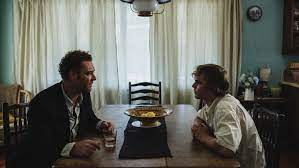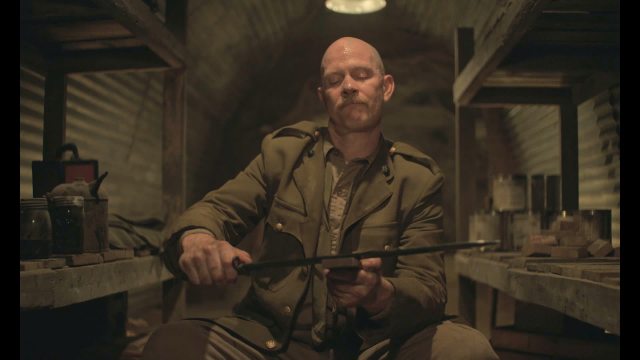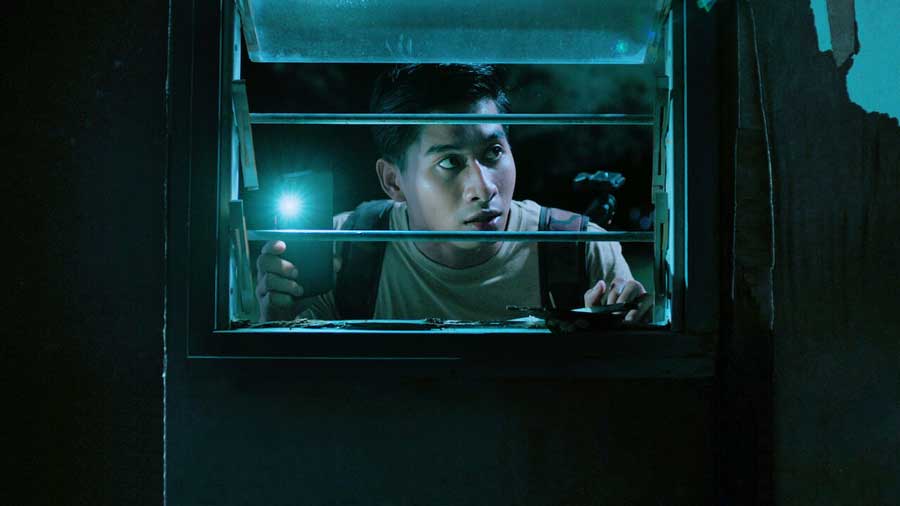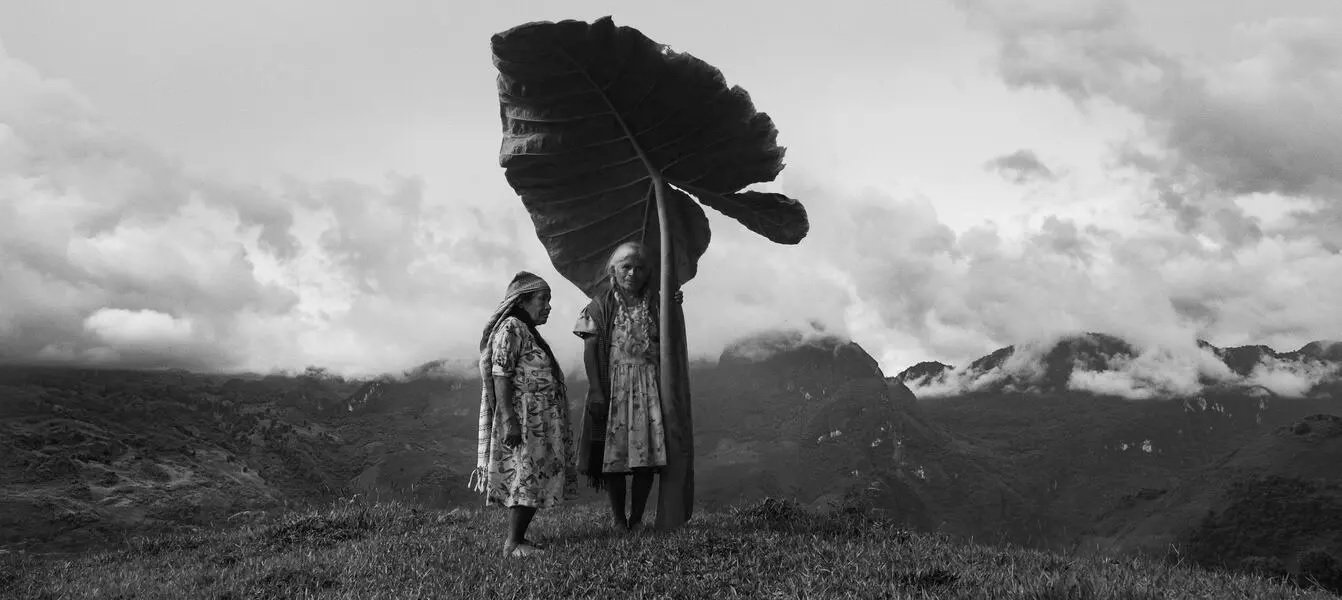
He’s already covered this ground with a pretty good documentary, “More than a Game.” As an aside, the one time I interviewed LBJ was for that film. Interesting story, complicated guy.
“The Chosen One” and the guys who became his B-ball brothers pre-NBA, that’s the story this new film tells.
Now, let’s be frank. LeBron’s teen years weren’t “typical,” and there’s little romantic about being “brothers” in an AAU all-star team — named “Shooting Stars” — instead of a “My old school” sentimental trip through his high school years. It’s prep school for entitled jocks.
The King was ordained and on his way to a throne, and skipped high school hoops and college on his way to taking that crown.
The most common image in “In Viaggio: The Travels of Pope Francis,” is the one represented in two photographs above.
We see the Argentinian pope, born Jorge Mario Bergoglio, in scores of over-the-shoulder shots, filmed from behind as he rides, waves from and stoops to kiss babies from the Popemobile, rolling into the Central African Republican, mobbed by throngs in Mexico and Malta, greeted with a lot more indifference on the streets of Havana.
“What sort of documentary would that add up to,” the wags among you might ask — lots and lots of shots of crowds waving at the pontiff, mixed with samples of his seriously undynamic multi-lingual public speaking? “A pretty boring one” is the answer.
Vatican-approved writer-director Gianfranco Rosi plumbs the archives of this activist pope’s decade of travel, the 53 countries he’s visited — Japan to Brazil, and many points in between. The sequences Rosi chose to include aren’t exactly animated. But then, neither is this Pope.
The popular, humble and soft-spoken Francis — who took his name from St. Francis of Assisi — makes his mark in this film with his choice of subjects. He speaks often of the tragedies accompanying assaults on human migration, the world’s poor and how they bear the burden of unlivable living conditions, putting them at risk in conflict zones and places vulnerable to a changing climate, doomed to drown as they try to cross the Mediterranean, other seas, deserts and war zones.
We see his speech to the College of Cardinals about the Catholic Church’s shameful abusive priests scandals, hear him apologize for this more than once, hear his “Never again” reflection on the Holocaust in Jerusalem and other genocides (Speaking truth-to-power re: Turkey and the Armenians), express sorrow for the fate of Native Americans/First Nations peoples in Canada and fret over the nature of violence, nationalism and militarism and greed.
The result can’t help but be a film that’s never much more than a sketch, a gloss on the guy in the layers of Papal white whose heart and message seem pro humanity in all the most righteous ways, but whose “leading by example” isn’t always the most cinematic.
Rosi can’t make the man a fire and brimstone preacher or even a Pope John Paul II scold, because it just isn’t in him. But he can capture an emotional moment when Francis enters a poor household in a Brazilian favela where he’s about to speak, a meeting where he tries to mend fences with the assorted Orthodox Church patriarchs, and sits mostly-silent with Muslim imam in Iraq, his mere presence in many of these places speaking volumes.
Francis is at his most enthusiastic in Madagascar, lauding the work Father Pedro Opeka, an Argentinian like the Pope himself, and one dedicated to improving the lives of that island nation’s poorest of the poor, those literally living at the largest garbage dump there.
Those moments, and the spooky scene of Francis crossing the empty St. Peter’s Square, going up the steps of the Basilica at twilight to give a speech mid-COVID lockdown, are all that give much life to this pretty but staid and colorless documentary.
One can’t help but think this Pope deserves more than a simple, stale travelogue.
Rating: unrated, scenes of conflict, poverty
Cast: Pope Francis.
Credits: Scripted and directed by Gianfranco Rosi. A Magnolia release.
“The Fist of the Condor” transports the basic elements of your typical Bruce-Lee-in-Hong-Kong era martials arts “epic” to the beaches, biker bars and Andean mountains of Chile, and gives us all the archetypes of the genre speaking Spanish.
This old-fashioned “quest” reteams “Redeemer” director Ernesto Diaz Espinoza and his martial arts muse, Marko Zaror for more wirework, more slo-motion, more training sequences and more “challenge” fights with a series of warrior foes, all of them in pursuit of the Condor fighting “manual,” a book pieced-together from the martial arts of the ancient Incan Empire.
Not that it did the Incans a bit of good.
It’s a film so wrapped up in “homage” that the story never amounts to much more than cut and paste, ahistorical, neo-mystical nonsense. About the only “Dragon” trait they didn’t replicate is the hilariously inept dubbing of the principals into English. This baby is Spanish, all the way.
But while it begins with “Oh BOY” promise and finishes with a half-hearted flourish, the back-story stuffed middle acts (Our bald hero in a bad wig, and our villain in a black feathered condor suit) are tedium itself. And the effort to set this up as a continuing saga leaves it amusingly, obviously and frustratingly incomplete.
Zaror, one of the fiercest figures in “John Wick Chapter 4,” has the vulpine look of a muscle-bound Mark Strong when he’s shaved his head to look like a martial arts monk. We meet “The Warrior” (El Guerrero) on the beach, challenged by a random young buck seeking what our hero does not have, the “Fist of the Condor” manual that helped him master his form of martial arts.
The kid is looking for the wrong guy. Who is the right guy?
“My twin.“
What’s his “Achilles heel?”
“Photophobia.” You can foil the fiercest fighter this side of Donnie Yen with…a mirror and a little blinding sunlight.
Oh. It’s like that, is it? Why yes it is.
Wernher Schurmann (“Too Late to Die Young”) was fight choreographer here, and he stages several positively balletic brawls — pirouettes and jetes, punches thrown and dodged, somersaults by the score.
Our hero is constantly facing foes he has to tell “for the last time, I am NOT the ONE,” in growled Spanish with English subtitles.
He can’t park his motorcycle without getting challenged. But the places he parks are some of the most striking locations for a martial arts genre piece since those Golden Age Honk Kong classics of yore.
One villain wears too much eye shadow, because there’s one in every crowd, and every martial arts film. The training bits include the Wisdom of the East being handed down by Master Wook (Man Soo Yoon)…in Spanish, and the challenges of “The Condor Woman” (Gina Aguad), who takes a back seat to no one when it comes to inscrutable words to live by.
“See not with your eyes, but with your whole body!”
Director Espinoza does a fine job with the action beats and the epic settings. But every time this brief but not brisk genre thriller breaks into a new “Chapter,” aka “Chapter III: The Evil Guest,” he crosses from homage into parody and from master genre filmmaker into somebody whose “Achilles heel” is his screenwriting.
Rating: unrated, violence
Cast: Marko Zaror, Gina Aguad, Eyal Meyer and Man Soo Yoon
Credits: Scripted and directed by Ernesto Díaz Espinoza. A Hi-Yah!/Well Go USA release.
“Colorblind” is a heavy-handed melodrama about race that never overcomes the air of “student film” that its many ways of underscoring its lone metaphor provide.
It’s about a Black artist who suffers from colorblindness, a trait she has passed on to her son. Her life lessons to him include “You don’t want to show anyone your weakness.”
So we’ve got a painter who can’t distinguish most colors — something underscored with visuals seen from her almost-monochromatic point of view — who tries to hide that from those who might buy her canvases, and a child who learns to keep their shared secret.
They face overt racism in the unnamed big city they’ve just moved into, harassment from profiling cops and overt hostility from their new landlord, a retired firefighter who rented to them, sight unseen, and takes an instant dislike to them both.
He’s the sort of retired firefighter who plays romantic classical etudes on his piano and keeps a dead cotton plant as decor, so he can pluck off cotton balls to give our working mom to underscore a racist point.
Watermelon isn’t on-the-nose-enough for him, I guess.
And let’s name our heroine Magdalene because everything else here points to judging someone by appearance through one’s own warped view of the world.
Every lesson Mom (Chantel Riley) has to teach her boy Monet (Trae Maridadi) about race and how to manage their sight limitations and keeping their distance from the bigot upstairs hews to the film’s narrow, broken-record messaging.
Every moment the kid spends with the “Giant” racist makes you wince at its obviousness.
“So, paint can mix, but not people?”
“Well, they can, but they shouldn’t.”
Every misunderstanding is foreshadowed as if a student screenwriter has just learned the term in Screenwriting 201. Every “coincidence” is worth a grimace.
The characters are archetypes, the performances similarly one-dimensional or, in a couple of cases, seriously inexperienced.
“Colorblindness” is the sort of well-intentioned picture on a heavy subject that could make the rounds of little-known film festivals and collect awards, which it has. But if it isn’t a simplistic, ham-fisted student film, it sure as hell plays like one.
Rating: unrated, violence, profanity
Cast: Chantel Riley, Trae Maridadi, Garry Chalk and Mike Dopud
Credits: Directed by Mostafa Keshvari, scripted by Mostafa Keshvari and Selina Williams. An Eldon Road release.
“Johnny” is about one inspiring priest’s efforts to create a Catholic hospice to give Poles facing death a compassionate end of life experience, battling a foul-mouthed archbishop over the idea even as he himself battled the cancer that would kill him.
It’s based on the true story of Father Jan Kaczkowski and his relationship with the troubled ex-con forced to do community service under his charge, Patryk Galewski.
But the debut feature that music video director Daniel Jaroszek serves up is a classic “dry-eyed weeper.” We know what it intends to do, but damned if the only time it really does it is with that Pavlovian emotional footage of the “real” priest and real ex-con that such movies always pack into the closing credits.
Slow-footed, more downbeat than sad and endlessly-narrated in voice-over, first by the drug-dealing mug, then by the priest (in Polish with subtitles, or dubbed into English), it left me as cold as a Warsaw winter.
Dawid Ogrodnik of “Ida” and “Silent Night” is the good father, an earnest “outsider” who takes over a local congregation near Puck, sees the real need in his parish and sets out to fund and build a hospice for the many elderly and the dying.
It’s an earnest performance of a recognizable screen “type,” the “cool” problem-solving priest who ruffles feathers while doing good.
Piotr Trojan plays Patryk, breaking and entering, getting his ass beaten, tossed in prison and after all he’s done, the beneficiary of a “suspended sentence.” It’s obvious, from the start of his narration, how much he admires this priest who (eventually) changed his life.
“He limped where no one walked before,” he says of the priest with the cane, the thicker-than-thick glasses and matter-of-fact determination to do something for his people.
The film flatly skims over the efforts to launch the hospice, drably gets around to Father Jan’s own illness and skips through much of the hard work of evolving that Patryk must undertake to become a decent human being.
Patryk is reluctant to do the work, flippant about the geezers he cares for — indirectly, at first, as a handyman — until he meets someone much younger, entirely too young to be making videos for her little boy’s well-into-the-future 18th birthday.
At least Trojan gets to play a few emotional moments. Ogrodnik’s Father Jan is even-tempered and effortlessly famous and popular for what he’s doing, eventually.
I appreciated the daring of showing an archbishop resorting to longshoreman speech — F-bombs galore — to express his displeasure at this hospice. I missed why this old coot was against the idea. Maybe there’s an explanation, but the flatness of the film buried it in the mundane and people who refuse to be moved or excited by it.
Rating: TV-MA, violence, drug abuse, smoking, profanity
Cast: Dawid Ogrodnik, Piotr Trojan, Marta Stalmierska
Credits: Directed by Daniel Jaroszek, scripted by Maciej Kraszewski. A Netflix release.
Put the French thriller “Rodeo” in enough theaters, and the main thing greeting the next “Fast/Furious” iteration — along with tens of millions at the box office — would be hoots of laughter.
“Rodeo” is an unblinking, gritty and nervous thriller about a young hothead who only comes alive or feels at peace enough to smile when she’s on her bike. It’s a “Gone in 60 Seconds”/”Bicycle Thieves”/”Fast and Furious” mashup with heat and fear and fury and not even the barest hint of sentiment.
There’s novelty in the fact that Julie (Julie Ledru) is a tough-as-nails young woman who knows how to check out any new-to-her motorcycle, assessing the clutch, the brakes and throttle, holding her hand over the exhaust to see if it is “missing.” Details like that make or break a gearhead tale wrapped in a character study like this one.
Julie rages at the world, a Guadalupe-born high-mileage 20something still living at home with her student younger brother and never-seen mother in a housing project.
We meet her mid-rage. Somebody’s stolen her latest bike, and no one can calm her from her fury. When she collects herself, she makes a call, pulls herself together, fills a filched purse with rocks and shows up to test ride another dirt bike.
We see what someone who knows her means when he tells her “S–t sticks to you.” She’s trouble, and troubled.
Julie can manage a disarming smile through her cut-rate dentistry, tame her unruly hair just a smidge and lie without compunction. Julie’s an old hand at test-ride-and-fly thefts.
“I was born with a bike between my legs,” she boasts (in French with English subtitles).
“Rodeo” is about what happens when she finds her “tribe,” the reckless, outlaw, stunt-riding and traffic disrupting “B-Mores.”
Yeah, the name could use some work.
Things go wrong at an impromptu rally/gathering, but “the noobie” keeps her cool.
Next thing we know, she’s in their shop, recruited to help in the “steal, modify and re-sell” side of the allegedly legitimate business they run at the behest of Domino, who directs and controls one and all from his prison cell.
Next thing she knows, she has a wary ally (Yanis Lafki) and a sexist creep nemesis or two, guys in the gang who don’t want her around and aren’t squeamish about how they get their wish.
Director/co-writer Lola Quivoron’s debut feature quivers with indie film energy — on foot, in fights and on bikes. We’re treated to a tribute ride for a fallen comrade, a parade of stunts by riders showing off and the measures taken when “The cops! The cops!” show up (smoke bombs, chaos, and a few bikers get hurt). The film rocks along on lots of hand-held camerawork and close-ups of her unconcerned-with-her-looks heroine.
Ledru, making her big-screen debut, is unaffected naturalism defined. She doesn’t dress down. She takes it to extremes. The dark circles under her eyes have dark circles under them.
Antonia Buresi plays Domino’s wife, trapped in her apartment with an acting-out 4-year-old by a control-freak husband who rules her life with an iron fist, and does it from behind bars.
Buresi co-wrote the script with Quivoron, and they manage to set up expectations and sweep them aside more than once. We think we know what the big action beats will be — conditioned by the early “Fast and Furious” movies — and sometimes, they’re simply checked-off to make way for the next twist.
“Rodeo” is so good it’s almost sure to inspire a Hollywood remake. Catch it in the original French grit, because while we know Zazie Beetz can ride, who knows if they’ll meet her quote?
Rating: unrated, violence, gruesome injuries, drug abuse, profanity
Cast: Julie Ledru, Yannis Lafki, Antonia Buresi, Louis Sotton and Junior Correia
Credits: Directed by Lola Quivoron, scripted by Antonia Buresi and Lola Quivoron. A Music Box release.
Imagine “Weekend at Bernie’s” as a caper comedy directed by John Waters’ Filipina sister.
That’s “Partners in Crime,” a campy Filipino romp filled with drag performers, only because they’re Filipino, they’re of a culturally accepted “third gender,” baklâ.
Watching the film, you never entirely forget who and what the characters and often the folks playing them are. Because “drag” is funny, something humorless American homophobes fail to appreciate. But seeing baklâ accepted in different careers, guises and walks of life lets us move on from the femine-identifying thing and concentrate on what’s important. In this case, that would be, “Are they funny?“
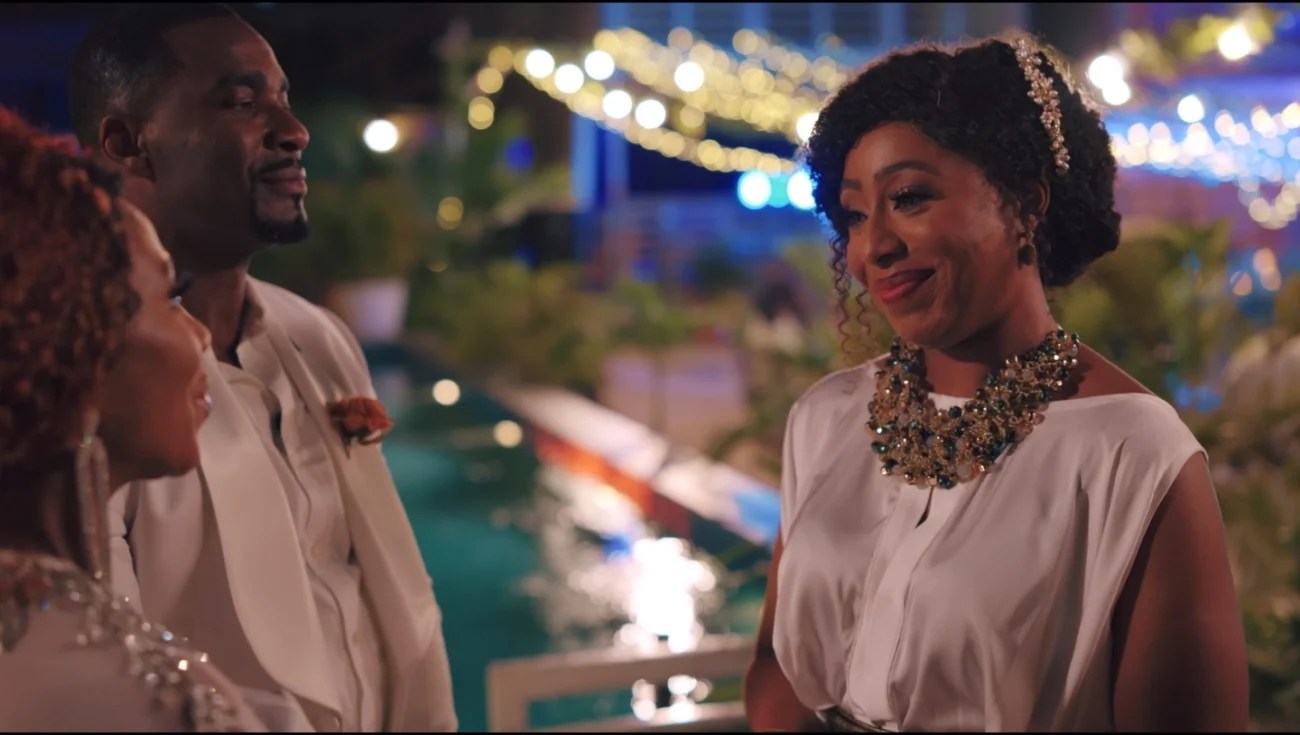
“Crime” is about a popular TV presenter, Jack Cayanan, played by the award-winning and perfect-drag-named Vice Ganda. Campy and over-the top, “Madame” Jack hosts his own game show, which of course calls for production numbers and the like.
But Jack faces a crisis every performer dreads. Years of using and over-using his voice, pitching it towards a more feminine sound, wreck it. His bitchy rivals grab the chance to kvetch about how “haggard” and “old” Jack is looking. But just as he’s losing it all, a bubbly young beauty, Barbara Nicole Rose Albano (Ivana Alawi) comes to his rescue.
Working as a “team,” they relaunch his career as “their” career, making public appearances, hosting contests and the like. “JaBar,” as they bill themselves, are a winning combo. But she’s kind of in love with Jack, and he has to explain the facts of attraction to her, whom he loves as a “friend” and “colleague” and nothing more.
The real test of this team is when the network lady comes a calling with new offer. Jack is back, and time without Barbara, who is enraged at the betrayal.
When the rating-obsessed boss wants a show-stopper interview with the reclusive Don Bill, “the richest man in the Philippines” (in Tagalog and Filipino with English subtitles), who has survived “99 assassination attempts,” Jack resolves to get it. So does Barbara.
With each accepting the help of their baklâ or simply over-the-top female sidekicks, they pose as wait staff for Don Bill’s (Rez Cortez) birthday party.
That’s where death and blackmail and a deadly contest to “find the Don’s ‘coins'” ensues.
Unfortunately, one thing that doesn’t ensue is “hilarity.” A few stretches work up a spirited campy head of steam, and the tale finishes with a flourish. But the movie bogs down in a lot of inane, unamusing chatter and comic bits that don’t quite land.
Yes, the ex-teammates are forced to sneak around Don Bill’s estate hauling his body around as if he’s merely drunk or napping or not particularly talkative today. That delivers some laughs but wears thin.
The comical caper problem solving is inventive exactly once. But for the most part this script struggles to find what should be obviously funny in all this, as the performers, especially Ganda, strain to make the limply-written shtick outrageously amusing by camping it up.
“Partners in Crime” never manages to be more than a hit or miss affair, a one-day “Weekend at Bernie’s” that doesn’t have nearly as much fun with its best sight gag — a corpse — and can’t find enough laughs in that parody of femininity that drag often is to make up for it.
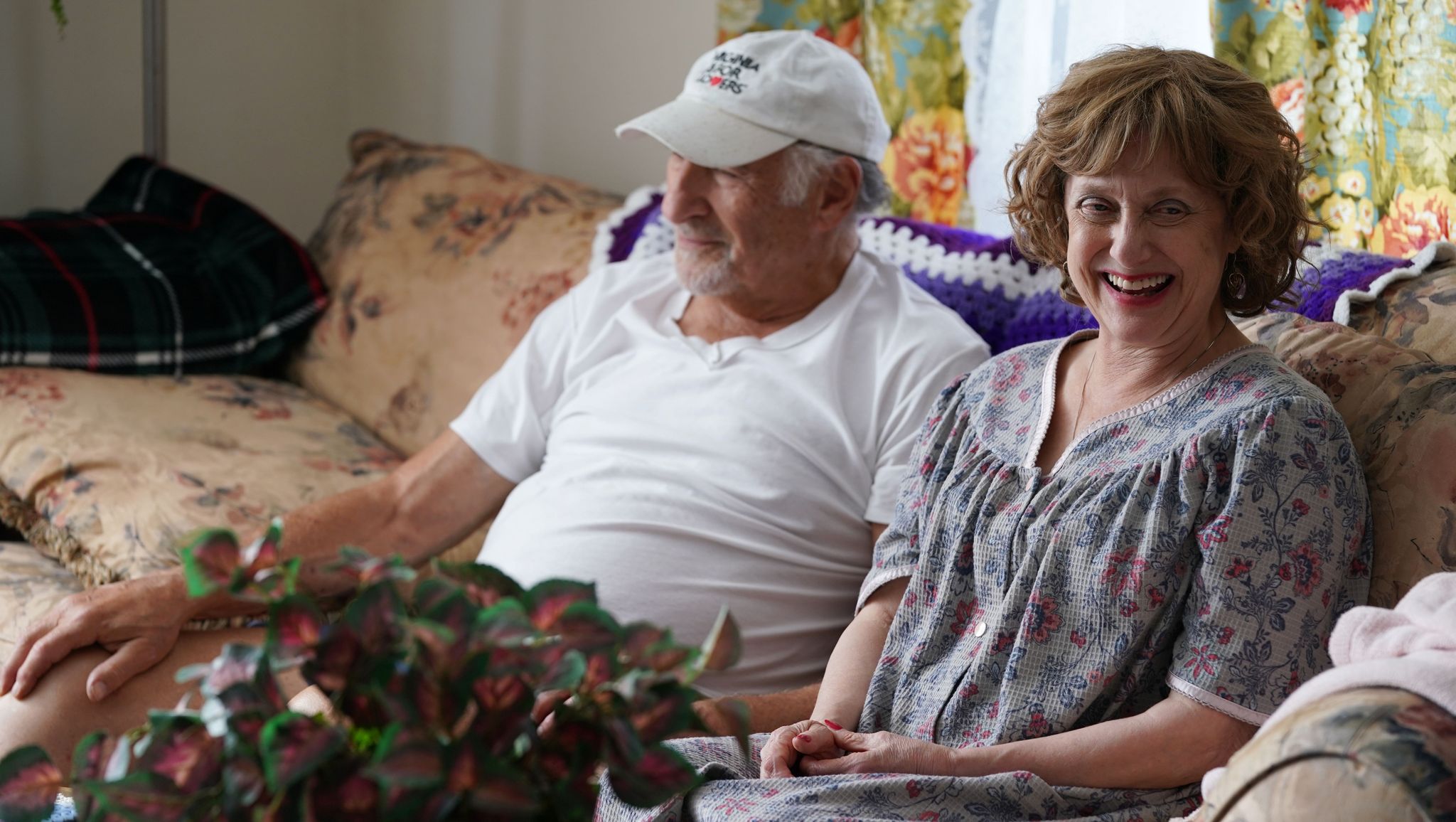
“A Handful of Water” is a feel good immigration tale that doesn’t quite the deliver the feels.
A choppy, untidy narrative, abrupt shifts in temperament and a vague grasp of right, wrong, morality and the law drag this slight, sentimental drama off course.
Jürgen Prochnow plays Konrad, a sad, solitary widower in a suburban semi-detached whose days are a drab routine of loneliness. He’s got a huge tropical fish tank and busybody neighbor and a car he longer drives. And every few days, his daughter (Anja Schiffel) checks in on him and nags him about this adoption ceremony that’s coming up.
She’s married a woman, and the 80something Konrad has had to get used to that. Now, she’s adopting her wife’s children from a previous marriage, so there’s another thing the old grump has to accept.
He’s not big on immigrants and “gypsies.” So, as is the way of such stories — “A Man Called Ove,” “A Man Called Otto” — let’s hurl some into his life.
We meet Thurba, her mother and two brothers just as German authorities are knocking at the door to deport them. Tweenage Thurba (Milena Pribak) bolts. When we hear a cop mutter “We can’t deport them” without all of the children in hand, we’re allowed to wonder if mother and child know that and are gaming the system.
When Thurba visits a couple of her countrymen involved in human trafficking for help and one asks why her mom didn’t “just break her arm” (in Arabic and German with English subtitles), that’s reinforced. You can appreciate and sympathize with the desperation of migrants fleeing violence (they’re from Yemen) and cringe at the ways tolerance and “official” compassion are twisted by those who would manipulate the rules as just another means to their end.
Thurba breaks into Konrad’s house, but the cops aren’t coming because someone stole some of his cookies. When she slips in again, he shoots her in the arm. And hen he tries to throw the shrieking child into the night, she passes out.
Konrad instantly softens. Thurba, freaking out when he locks her in, breaks out and takes longer to make a connection. But eventually she’s back, “helping with the fish” he tells his nosy neighbor. He gradually pieces together their story — her dad died, they were “imprisoned” in Bulgaria on their trek, and they’re just trying to get to the UK, where her uncle lives.
And there’s one more problematic element to this. This isn’t about a German coming to accept someone from another culture and empathize with their plight, welcoming them as neighbors. This is about a German resolving to help these Yemeni refugees reunite in Germany and aid their further travels so that they become Britain’s “problem.”
Konrad’s favorite saying is “Enemy is on the rise,” denoting how things are changing and never will be what they were (his explanation of the phrase). That metaphor is as slippery as the “handful of water” usage in this script. Something got lost in the translation.
The kid is unaffected and believable in the part. And it’s always great to see Prochnow as a leading man, over 40 years since “Das Boot” made him a star.
But “Handful of Water” just reminds us of how slippery the broad issue of human migration is, once you get past the emotional, compassionate points and into the ethics, moral obligations, rights and entitlements of it all.
Rating: unrated, violence
Cast: Jürgen Prochnow, Milena Pribak, Anja Schiffel and Pegah Ferydoni.
Credits: Directed by Jakob Zapf, scripted by Ashu B.A., Marcus Seibert and Jakob Zapf. An IndiePix release.