Movie Review: “Guy Ritchie’s The Covenant” sees a GI try to repay his Debt to his Interpreter

There’s a stately, almost funereal seriousness to Brit director Guy Ritchie’s first combat film.

“The Covenant,” billed as “Guy Ritchie’s The Covenant” so that it isn’t confused with any horror movie titled that, has little of the antic energy and none of the dark, wry fun of the British underworld pictures that made him (“Snatch”) or that characterized his jaunty “Sherlock Holmes” outings with Robert Downey Jr.

But as we settle into this Afghan War story of an American sergeant (Jake Gyllenhaal), his Taliban-arms-and-IED hunting team and his uneasy relationship with their new interpreter (Dar Salim), we see the movie bend away from genre routine. “Covenant” evolves into a tale that travels from mistrust and disrespect towards loyalty and the debts a soldier collects in combat, a “covenant” that eats at this one GI until he can honor it and repay those debts.

Ritchie’s giving us a modern American take on “Gunga Din,” a fictional US military spin on themes from other classic tales of combat valor, the “code” of such men and the psychological cost of survivor’s guilt.

Ritchie makes the violence abrupt yet constantly hanging over the combatants, the fear of betrayal by “allies” palpable and Sgt. John Kinley’s journey one from annoyed tolerance to all-consuming guilt. Kinley cannot forget the way an Afghan like Ahmed (“Game of Thrones” and “Operation Curveball” veteran Dar Salim) risked his life and that of his family to save “Infidels” like Kinley and his men from Ahmed’s own countrymen. The fact that Ahmed was left behind when the promise of a visa to America was part of his deal becomes Kinley’s post-service mission.

The first act sees Kinley’s squad lose two of their own — a combatant and their interpreter. It’s 2018, and their endless search for improvised explosive device factories and Taliban arms caches is deadly detective work, with mistrust of every Afghan — even those in the Army’s employ — a part of the bargain.

Ahmed passes himself off as multi-lingual interpreter, a world-weary and war-weary man perhaps with grudges against the fanatical, murderous Taliban. He says he’s an expert with “engines,” which seems dubious. And when he pokes holes in the intel and the methods of Kinley’s squad, he gets serious “out of your bounds” pushback from the sergeant. That goes on even after Ahmed, who under-translates (leaving out the threats made against him and his family by suspects), proves to be a lot more streetwise than advertised.

Ahmed can read people and read a room, discern a committed killer from a simple everyday countryman with a taste for the pipe.

“I am…a man about town,” he says, by way of explanation.

Ahmed questions decisions, calculates trustworthiness and makes “deductions” that contradict Kinley. Being right all the time makes him a bit of a pain, but gets this team out of more than one jam. Grudging respect comes in baby steps.

The first act of “The Covenant” is about that process, the firefights that result and the ambushes avoided until that one mission “too far” arrives, as it inevitably does. A second act lets us see Ahmed resigned acceptance of an impossible task, a noble act which Kinley will not allow to go unrewarded.

And the third act takes us into the extreme measures that Kinley is willing to take to repay that heavy debt he carries.

The lead performances are all top drawer, with Salim excelling at letting us see the wheels turn even as Ahmed hides most of his cards, giving them up only slowly. Emily Beecham is terrific as the wife and mother “back home” who doesn’t question her husband’s quest. Jonny Lee Miller holds his own as a canny commanding officer who’s learned to look the other way as the need arises.

Spain makes a most scenic substitute for Afghanistan and Ritchie uses the terrain, the technology (occasional digital aircraft) and the situations to maintain tension and suspense in scene after scene.

There’s an expediency to this narrative, one that dispenses with fleshing out most of the supporting characters and back stories and earlier “debts,” that plays around with the conventions of Middle Eastern combat narratives. The firefights are pitiless and realistic even if “the test” of the second act and “the quest” of the third strain credulity.

But the movie’s messaging has a righteous and educational undertone that makes this a worthy addition to the genre. It’s a “Lone Survivor” with better performances and a timeliness that means that the audience that shows up for such a film will be exposed to points of view they might not have considered, that this drawn-out and bitterly-wasteful war had heroes, and not all of them wore a stars and stripes patch on their fatigues.

Rating: R for violence, language throughout and brief drug content

Cast: Jake Gyllenhaal, Dar Salim, Emily Beecham, Jonny Lee Miller, Fariba Sheikhan and Alexander Ludwig.

Credits: Directed by Guy Ritchie, scripted by Ivan Atkinson, Marn Davis and Guy Ritchie. An MGM/STX release.

Running time: 2:01

Posted in Reviews, previews, profiles and movie news | 1 Comment

Movie Review: Shailene and Ben Mendelsohn team up “To Catch a Killer”

Crackling scenes mix with clunkers, clever twists meet cliches and its all a hash when it comes to justifying the “team” set up in this mass shooting spree thriller “To Catch a Killer.”

Whatever its other failings and successes, this film has a script that never manages to justify its central premise, pairing up a somewhat inept and troubled young Baltimore street cop with a senior FBI agent brought to solve a New Year’s Eve mass shooting so cunningly planned that we know it won’t be the shooter’s last act of wanton slaughter.

Shailene Woodley plays Eleanor Falco, a 30ish cop whose New Year’s Eve unruly diner call is interrupted by random murders all over central Baltimore. One of the film’s more chilling sequences is the single shot sniper shootings in a hot tub party, a glass elevator, through windows and picking off people at an outdoor skating rink.

Chaos reigns, and Falco finds herself at one shooting scene as forensics quickly determines where the shots came from via laser-angle tracking. When SWAT and other uniforms pile into the high rise condo that gave the shooter his or her vantage point, it blows up.

Falco is the one with the presence of mind to get her fellow cops to videotape other residents as they’re evacuated. That, and the way she faints in the smokey ruins of that apartment, and yet still eyeballs a possible clue, is all it takes for bossy, territorial Special Agent Lammark (Ben Mendelsohn) to take her in, call her a “BPD liaison” and make her his special project, his extra “eyes” on a tragedy that has drawn the world’s attention even as the mayor and governor and their aides figure out ways to CYA.

“Who IS this?” and “Why is she even HERE?” is only asked once in this Damián Szifron (he also directed) and Jonathan Wakeman screenplay, even as it hangs over every damned scene to follow.

Something in Falco, her attention to detail despite wearing “burnout” all over her face, has Lammark asking “What IS it, Eleanor?” over and over, in meetings, on crime scenes and in a helicopter running them all over the city.

We never get a good answer, despite her occasional clever insight.

Of course the screenplay gives each of them secrets, the insecure “credit” seeking FBI agent and the overwhelmed, squeamish policewoman who is patronized, stereotyped and sometimes listened to as this investigation never quite seems as urgent as any shooting with that high a body count should be.

The Woodley/Mendelsohn teaming works well enough, in terms of chemistry. The supporting cast is a fairly colorless lot, with virtually none of them given a scene or enough good moments/lines to make an impression.

And I have never seen a thriller pair-up people who shouldn’t be paired-up and yet are paired-up anyway managed less gracefully. Even a “job shadowing from the Academy” excuse would have been better than this, or at least given us something to hang onto.

The script does a half-hearted job of paying lip service to the buzzwords and politics surrounding mass shootings, “terrorist” or “maniac,” “gun hoarder,” with ex-military or foreign born idealogue or aggrieved angry white male considered, and dismissed, because they’re looking for a “person,” not an archetype.

“He didn’t come here to die and does not want to be found,” Lammark pep-talks his underlings. “We’re going to disappoint him.”

But as Mendelsohn’s agent grandstands and talks of the “book” he’ll Haberman/Bolton out of this crisis, defends his turf, flips between paranoid and self-pitying, coddles Falco and publicly berates her, the odd engrossing or well-conceived moment pops up and makes us take notice.

Then even that fades into the background as we, one more time, wonder “Why is she even HERE?”

Rating:  R for strong violent content, and(profanity) throughout.

Cast: Shailene Woodley, Ben Mendelsohn, Jovan Adepo, Michael Cram and Ralph Ineson.

Credits: Directed by Damián Szifron, scripted by Damián Szifron and Jonathan Wakeman. A Vertical release.

Running time: 1:58

Posted in Reviews, previews, profiles and movie news | Comments Off on Movie Review: Shailene and Ben Mendelsohn team up “To Catch a Killer”

Today’s DVD donation? “A Handful of Water” comes to rural Florida

I wasn’t nuts about this German drama when I reviewed it, but it’s interesting and well intentioned and stars the great German actor Jurgen Prochnow.

And it’s harmless, something I have to worry about when donating DVDs to public libraries all over the Southeast. With libraries losing funding in fits of rage over the ideas contained in books and films, you don’t want to do more harm than good.

Every vote counts, kids. Every office is ripe for the picking for the ignorant, the hateful and borderline illiterate, especially in “red” state.

Be like MovieNation. Donate those DVDs to your local library.

Posted in Reviews, previews, profiles and movie news | Comments Off on Today’s DVD donation? “A Handful of Water” comes to rural Florida

Movie Review: Radha introduces Mia to a “Blueback” worth saving

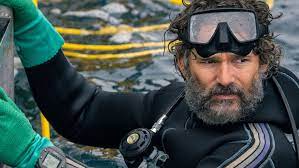
Mesmerizingly beautiful diving footage, a drifting narrative and some solid performances recommend “Blueback,” a sweet but somewhat squishy eco-parable set Down Under and starring native Oz daughter Mia Wasikowska.

It manages to tell the story of a young woman’s lifelong “friendship” with a Western Blue Grouper in the bay where she grows up, and to which she returns as a trained marine biologist trying to save coral reefs and the many species that depend on them to survive, without turning maudlin — no mean feat considering the conventions of the genre.

We meet Abby (Wasikowska) as an adult, diving on the Great Barrier Reef with a fellow researcher (Albert Mwangi), surveying the mass die-off of corals and confiding in the many fish she keeps in tanks on her research vessel.

“It’s not good news, I’m afraid,” she tells those reef fish species samples. “Your home is dying, and I don’t know how to help.”

Before she can figure out a strategy to combat rising sea temperatures and climate-change-linked pollution, she gets more bad news. Mum has had a stroke.

Traveling back to the other side of Australia to help her mother (Liz Alexander), who has lost her ability to speak, Abby rummages through her childhood drawings and her memories to try and engage her mother on a subject they both love — “our bay.”

Radha Mitchell plays Mum Dora in flashbacks from back then, a plucky and brave widowed mother who helps Abby (Ariel Donoghue) celebrate her eighth birthday by motoring into the bay and making her snorkel down to fetch the wedding ring Mom drops over the side.

“I can’t Mum, it’s too far” won’t cut it. She’s a “big girl now,” and Mom’s all about prepping her for life and passing on her love of the sea to her.

That giant fish that scares Abby when they’re free-diving for abalone? There’s nothing for it but to go back down and “meet” it.

It’s a giant grouper — curious, friendly (and not shy about stealing her abalone) and wholly settled in their bay.

“The only way to keep him safe,” Mum counsels, “is to keep him secret.”

The threat to that is the rapacious developer (Erik Thomson) who seems to figure looting the fish and crustaceans in the bay is the best way to get his planned mass development approved by the local council.

Dora, a sort of self-appointed warden of this stretch of coast and water, learns to protest and fight back, and she passes on that spirit to Abby, something the daughter brings up as part of her effort to get Mum talking again.

Eric Bana is a charming rogue of a local fisherman Mum was constantly hassling to protect the resource during Abby’s youth. And as Abby ages into her teens (played by Isla Fogg), she learns more about this corner of the world on land and sea from her Aboriginal schoolmate and first crush Briggs (Pedrea Jackson).

Briggs (Clarence Ryan) is still around when Abby comes home to care for her mother, and her mother’s pet project, “our bay.”

Writer-director Robert Connolly (“The Dry” was his, not bad) introduces a lot of story elements and possible directionsin which to take this tale. But “Blueback” seems incomplete, as if Connolly (adapting a Tim Winton book) couldn’t figure out which path to take. There’s so much concern for not becoming “cloying” that “Blueback” never amounts to what it might have.

He had the cast — Mitchell is great, Wasikowska as good as ever and Bana as colorful as you’d hope. He had the lovely diving footage and a grand grouper effect. But “Blueback” doesn’t so much reach a dramatic climax as half-heartedly conclude, with a lot of heart yet lacking a satisfying resolution to the narrative.

Rating: PG, mild peril

Cast: Mia Wasikowska, Radha Mitchell, Ariel Donoghue, Clarence Ryan, Erik Thomson and Eric Bana

Credits: Scripted and directed by Robert Connolly, based on the book by Tim Winton. A HanWay/Quiver release.

Running time: 1:42

Posted in Reviews, previews, profiles and movie news | Comments Off on Movie Review: Radha introduces Mia to a “Blueback” worth saving

Movie Review: A Portuguese Adventurer/Explorer tells his tale, and tries to get the World to Believe Him — “Pilgrimage”

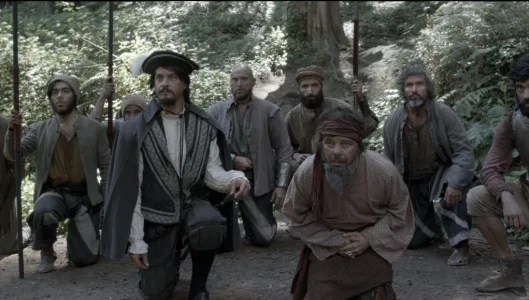
Fernão Mendes Pinto was a 16th century Portuguese explorer, adventurer, memoirist and fabulist whose life reads like a conflation of the quests of Cabeza de Vaca or Marco Polo and the picaresque invented misadventures of Baron Munchausen or Harry Flashman.

He sailed from Portugal to become one of the first Europeans to experience Japan, with colorful stops at kingdoms, islands and royal courts from Africa to India, Malaca to Siam (Thailand) and China along the way.

He was shipwrecked and taken hostage repeatedly, found himself in battles with the expansionist Turks and caught up in court intrigues and international diplomacy, far and wide. His very motivation for the trip was, this son of the working poor said, sleeping with the wrong woman at court in Lisbon.

And the punchline to his life is that while some of what he claimed jibes with the historical record, enough of it seems invented to make it all colorfully and fantastically dubious.

You visited the court of Prestor John to help press the case for an alliance against the Turks? Sure.

Portugeuse writer-director João Botelho (“A Corte do Norte”) had the makings of a playful or darkly comic odyssey in tackling this biography or tall tale. He made a good-looking if modestly-budgeted film that takes in exotic sights and avoids the expensive business of staging sea battles and grand palace pageants.

But in trying to immerse us in these utterly alien worlds an under-schooled European encountered on multiple continents, Botelho leaves the viewer almost as much as sea as his hero.

At times, it’s frustrating just to figure out where in the hell Pinto, stoically played by Cláudio da Silva, is, much less who the hell he’s talking to, negotiating with or bedding.

The story is framed in Pinto’s efforts to publish the tales he dictates to his wife (Catarina Wallenstein) and their transfixed and amazed daughters.

“There is no money” for his book, he says (in Portuguese with English subtitles). He fears its because no one believes him.

Setting off as a young man, supposedly under a cloud and fearing his murder at the hands of a jealous husband, he sails East on a Caravel bound for the then-new Portuguese trading colony of Goa. The Turks covet India and are on the march in Africa and the Middle East.

His crew seizes a Turkish ship, and cruelly execute a Greek galley slave who converted to Islam to save his life. They themselves are defeated and waylaid more than once over the course of their decades-long travels.

Visits to Ethiopia and India, Malacca and onwards, cargoes of cloves and spices or cotton are bought and traded or stolen as they’re taken prisoner repeatedly, “captured 13 times,” Pinto declares, “sold into slavery 17 times.”

Botelho seems as perplexed at where to physically and historically place our hero as Pinto himself must have been, hunting a pirate here, losing a cargo there, kidnapped and marched off by this regime or that one.

The later acts are plainly near the end of voyage, in China — where he and his Greek chorus (singing their narration to the story, a GREAT touch) crew are jailed for looting the hanging coffins and shrines along the Yangtze River — or Japan, where their European firearms using the Far East’s invention, gunpowder, get him into trouble, not for the first or last time.

This explorer wasn’t the first European to arrive at many of these places, and he’s conveniently provided with a shipmate known only as “The Interpreter” (Cassiano Carneiro), who speaks every dialect they encounter, a multi-multi-lingual survivor of all their trials — including literal trials in China and Japan.

Pinto doesn’t bed a woman in every port, but he comes close. And not all the sex, it is implied, was consensual.

There isn’t a minute of screentime where we aren’t in this journey with Pinto, on that beautiful caravel or ashore, stumbling through meetings with potentates and poobahs.

But it’s impossible to shake the feeling that “Pilgrimage,” which takes its title from the book that was eventually published, is more a collection of missed opportunities than a tale for the ages. It’s never comical enough to be picaresque, never quite eye-popping enough to feel epic, not moral enough to be a parable, with much of the violence skipped over for budgetary reasons.

Our filmmaker may take pains to show us a couple of screen titles that give the dates of the voyage 1537-1558, but does almost nothing to identify where he is at any given time.

And why keep talking about Antonio de Faria if you’re never going to show him? A lot of the characters who are on screen aren’t indentified and dileneated nearly well enough, and yet the name you hear over and over again, along with the mythic “Prestor John,” is Faria’s.

Some of this might be attributed to biting off a bigger tale than one could afford to tell, some to not making up one’s mind about this braggart whose nickname was “Minto,” liar, and whose credulous book was only published decades after his death.

As “Pilgrimage” checks off a lot of boxes of movies I tend to like — historical, nautical, “first Western contact” — I was more willing than the average viewer to give myself over to Botelho’s tale. But I found the film, now streamable and on DVD, more frustating than informative or fun.

Rating: unrated, violence, nudity

Cast: Cláudio da Silva, Cassiano Carneiro, Minda Mandala, Catarina Wallenstein, Jani Zhao, Elton Lee

Credits: Scripted and directed by João Botelho, based on the book by Fernão Mendes Pinto. An IndiePix release.

Running time: 1:48

Posted in Reviews, previews, profiles and movie news | Comments Off on Movie Review: A Portuguese Adventurer/Explorer tells his tale, and tries to get the World to Believe Him — “Pilgrimage”

Classic Film Review: Ready for a remake? “White Men Can’t Jump” (1992)

It wasn’t the news that 20th Century Studios is bringing a straight-to-Hulu remake starring those household names Sinqua Walls and Jack Harlow next month that had me settle in and rewatch “White Men Can’t Jump” last night.

It was the anemic attempt to tell the story of Nat “Sweetwater” Clifton that had me craving a basketball movie starring and co-starring guys who can really play that made that call. There’s all this material listed in “trivia” on the IMDb page for the 1992 “White Men” that details the toughest thing to get right in a sports movie. Ron Shelton was the best ever at making sports pics — “Tin Cup,” “Bull Durham,” “White Men Can’t Jump.” He developed an ethos, apparently after working with actor-not-a-pitcher Tim Robbins in “Bull Durham.”

 “You’ve got to be able to play.”

He cast two guys who proved to have chemistry that went beyond this movie. Woody Harrelson and Wesley Snipes clicked, Woody could really play and the athletic, motor-mouthed marvel Snipes could showboat well enough to fake it (Wesley Can’t Shoot) and the movie that they made is classic Shelton –scruffy and sporty and romantic and fated to celebrate the lovable, badly-flawed losers Shelton built his sports pics around.

Harrelson plays Billy Hoyle, a hoops hustler new to this corner of LA. Snipes is Sidney Deane, the trash-talking would-be king of whatever rec dept. courts he’s holding forth on.

“Oh man shut your anorexic malnutrition tapeworm-having overdose on Dick Gregory Bahamian diet-drinking ass up. Leave me alone!”

And that’s how he talks to his friends. This new goofy white guy? “Brady Bunch” is the nicest and only G-rated thing he can say about him. Until, that is, he underestimates Billy in a pick-up game.

Both of these guys are using basketball for the street-bets income — Sidney as one of several gigs/hustles keeping his wife (Tyra Ferrell, regal and imposing) and baby housed and fed, Billy as the main means of support for himself and his aspiring “Jeopardy” contestant girlfriend Gloria (Rosie Perez, playing a sweeter verrsion of the spitfires she played during those years).

Billy and Gloria are on the lam from underworld “collectors.” Rhonda and Sidney are desperate to move out of an unsafe apartment and st

The men’s story arcs are from dislike and mistrust to collaboration, with a betrayal and other stumbles along the way. The women in their lives have their own agendas, and own uneasy peace. That’s a great touch.

Other than that, “White Men Can’t Jump” is basically just a “big game/big tourney” sports formula movie, all building towards an outdoor court 2-on-2 tournament with big — but not life-changing — money waiting the winners.

There’s a whiff of “Great White Hope” wish fulfillment fantasy about the film, which dates it.

But the comedy still plays, the caffeine-jag patter on the court, the deluge of insults, the hustler and the “chump” as hustler.

“You can put a cat in an oven, but that don’t make it a biscuit.”

And the basketball is glorious, beautifully, kinetically shot, putting us on the court, scrambling to make a cut so that Sidney has an open man to hit, that Billy doesn’t let his “can’t jump” “chump” handicap hold them back.

The remake’s trailer shows little of the charisma, chemistry and hoops savvy of the original. But this “classic” isn’t an untouchable masterpiece. There’s remake room in the material, beefing up Sidney’s role and maybe even telling the story mostly from his point of view.

No, Shelton apparently isn’t involved in the remake, and he sued Fox over withheld profit sharing from the original. Sued and won, I might add. Perhaps they got the remake rights as part of the settlement.

But if those guys “can’t play,” I can tell you right now it’s “game over” before this new “Can’t Jump” starts.

Rating:  R for language and sexuality

Cast: Wesley Snipes, Woody Harrelson, Rosie Perez, Tyra Ferrell, Kadeem Hardison and Cylk Cozart.

Credits: Scripted and directed by Ron Shelton. A 20th Century Fox release on Amazon and other streaming platforms.

Running time: 1:55

Posted in Reviews, previews, profiles and movie news | Comments Off on Classic Film Review: Ready for a remake? “White Men Can’t Jump” (1992)

Movie Review: What’s the Deal with “Nefarious?”

“Nefarious” is a simple two-hander about a psychological/theological debate between a condemned mass murderer who says he’s possessed by a demon and the atheist psychologist sent to determine if he’s sane enough to execute.

If the dialogue is compelling, the stakes are interesting and the performances engage, movies built on one-on-one conversations can work. But this isn’t “Before Sunrise” or “My Dinner with Andre” or “The Interview” or “Malcolm & Marie,” or a movie adapted from a polished and successful play of the “‘night Mother” or “Frankie and Johnny and the ‘Claire de Lune'” variety.

These two cardboard characters in this crucible, grinding away at their disagreement is just boring.

C-movie staple Sean Patrick Flanery plays the “possessed” man as a whimpering stutterer who becomes a manic blinking “servant” of “My Master” who pontificates as he spits out dog whistles about “the movies” and “the media” and judgements about how that feeds humanity’s eagerness to give itself over to “evil.” Our serial killer works for The Evil One.

“‘He’ made you in His image, WE remade you in ours.”

The condemned Edward Wayne Brady, whose name adheres to the “Wayne/Lee/Ray” rule, weeps at not being in control the few times the demon lets “him” speak. The demon claims his real name is an “ancient Phoenecian” word the multi-degree psychotherapist James (Jordan Belfi, look at all the movies he’s been in that no one has bothered to review) could “never pronounce.”

But the Latin version of that Phoenician name translates as “Nefarious.” Our “demon” likes his Latin.

“Edward” doesn’t want to die. But Blinking Beelzebub is just waiting for “The Sizzle,” “a little barbecue,” that frying feeling a fellow gets in the electric chair, which is his chosen method of execution here in Godfearing Oklahoma.

“I don’t like needles” is the film’s sole funny line.

He proceeds to launch into measured, level-voiced monologues that explain why he arranged for this shrink to replace the earlier state appointed doctor, whom we’ve seen commit suicide, which “Nefarious” caused. He drones and blinks on about how he knows everything about head-doctor James and how he wants him to publish his manifesto, a self-penned book on evil and why folks should give themselves over to it.

“Death doesn’t scare me, James. Because I can’t die!”

The movie becomes a battle of wills as our combatants talk talk talk in circles around “belief” and “evil” and the prophecy that James “will have committed three murders” before this day-of-execution evaluation is done.

“I didn’t think this was a fight.”

“That’s why you’re losing!”

That is the entire “point” here, if indeed you can say this movie has one. But there’s no “debate,” just an all-knowing “evil” laying out ultra-conservative Christian doctrine, straw man arguments, occasionally quoting scripture (not much) as he spits out his disdain for humanity, “The Enemy” (God) and “The Carpenter” (you know who).

It’s from the guys who scripted the “God’s Not Dead” movies, one of the angrier faith-based movies of recent vintage, which suggests its testy testimonial tone and its quality.

A chaplain is introduced and abruptly dismissed and hot button far right issues are trotted out in their marching order — abortion, capital punishment, death with dignity stripped of any euphemistic sugar-coating.

It occured to me while watching that I was listening to a screenwritten version of that classic put-down invented for the ex-Congressman aptly-named for a reptilian amphibian. Mr Nefarious is “a stupid person’s idea of what a smart person sounds like.” The acting class 101 blinking just doubles down on that.

The only thing not covered in this Christo-fascist manifesto of a movie is “guns.” But that’s covered in a trailer to a “They’re a’comin’ fer our GUNS” 2024 release, “The Last Patriot,” attached to screenings of “Nefarious.”

It fails as horror and as a laughably-loaded discourse on religion, values and the one subject it might have rigorously addressed, capital punishment. Because it’s much easier to be smug and deal your screen written cards from a stacked deck than it is to admit that your “debate” is lame brained cowardice because you can’t allow smarter people to offer the rubes who buy into this alternative ideas.

“Nefarious” tips its hand early, as our academically-endorsed psychotherapist drives through crowds of pro and con death penalty protesters at the prison. He’s listening to a talk show whose false prophet/pro execution host is baying for death penalty blood in the unmistakable tones of a certain cherubic Goldline Bullion hustler and peddler of white fear and under-educated outrage.

Wait, Glenn Beck’s still around? I had no… But yes, the flip-flopping fascist is on the radio, and ready for his third act on screen endorsement of this talk-you-to-death tripe. SOMEbody’s going to be on his video podcast for the finale.

Golly, in Oklahoma, even the medically-educated follow Glenn Beck!

The acting ranges from adequate to laughable, and the direction cannot overcome the atonal screech of the screenwriting.

Still, as old Abe Lincoln once said, “People who like this sort of thing might find it the sort of thing they like,” which explains the FBI Jan. 6 watch list audience I viewed “Nefarious” with in suburban Florida. The only reviewers endorsing it are “fellow travelers.”

The sentient, the sane and the non-cynical may find it as awful as I did.

Rating: R (Disturbing Violent Content)

Cast: Sean Patrick Flanery, Jordan Belfi, Tom Ohmer and Glenn Beck.

Credits: Scripted and directed by Cary Solomon, Chuck Konzelman. An SDG (Soli Deo Gloria Releasing)/Believe Entertainment release.

Running time: 1:38

Posted in Reviews, previews, profiles and movie news | Comments Off on Movie Review: What’s the Deal with “Nefarious?”

Movie Preview: Christoph Waltz and Sam Neill join forces for a fantasy, “The Portable Door”

Sophie Wilde and Patrick Gibson are the youngsters on hand for this slick looking period piece about magic and manipulation, based on the Tom Holt novel.

Miranda Otto is also here for good measure.

Posted in Reviews, previews, profiles and movie news | Comments Off on Movie Preview: Christoph Waltz and Sam Neill join forces for a fantasy, “The Portable Door”

Movie Review: Remembering the Early NBA, and a Globetrotter who Became a New York Knick — “Sweetwater”

One of the cardinal rules of any sports film is that the actors portraying players need to be convincing in that sport, and the that filmmaker must know how to storyboard, block and edit surfing or soccer, golf, baseball, football or basketball into a convincing facsimile of how the game is played.

“Sweetwater,” a drama about one of the players who helped integrate the National Basketball Association in 1950, puts what look like rec league teams on the various courts — a bunch of Dad-bod white guys — and expects us to accept them as the pioneers and first gen stars of the newly-formed NBA.

The early Harlem Globetrotters, a team the NBA dared to play (and lose to) in those segregated formative years, come off a little better — sort of “Eight Men Out” (two-thirds-speed) basketball clowns on their way to becoming the first global ambassadors for hoops.

But in recreating the literal barn-storming nature of America’s fourth or fifth favorite sport of the day, composer turned writer-director Martin Guigui shows no feel for the game or the medium he’s depicting it in in a cumbersome, clunky film that suggests “last kid picked to play” bonafides, or lack thereof.

Screen newcomer Everett Osborne plays Nat “Sweetwater” Clifton, a star Globetrotter picked to be the guy who integrated the NBA in the late ’40s, a World War II veteran who faced racism within the league heirarchy and from fans as he sought to break “the color barrier” in the infant (two stuggling leagues merged and became the NBA in 1949) pro basketball association.

That’s the way the story presents it, anyway. The first Black player signed was someone else, as was the first Black player to take to the court.

The film is framed within a sports reporter (Jim Caviezel) stumbling into a Chicago cab in 1990, and hearing Sweetwater’s story from the man himself — who spent his post-NBA years as a cabbie, marveling at Michael Jordan and remembering his place within the league’s history.

The flashback yarn that Sweetwater spins takes us back to the bus-riding, segregation-hampered early Harlem Globetrotters, scraping by on owner, coach and bus-driver Abe Sapperstein’s (Kevin Pollack) meager payouts, playing assorted local teams in gyms and barns in states where the ‘Trotters couldn’t get a restaurant meal or a hotel room for the night.

But the Globetrotters turned a corner when they played and beat the new pro-league’s best, the Minneapolis Lakers, in Feb. of 1948. Sapperstein sees it as skills and racial equality validation, and as the game that will “make” his team’s reputation and turn it into a global operation, which indeed it did.

NBA figures like New York Knicks coach Joe Lapchick (Jeremy Piven), his boss, Madison Square Garden chief Ned Irish (Cary Elwes) and perhaps even NBA commissioner Maurice Podoloff (Oscar winner Richard Dreyfuss) could see “the future” in this more entertaining, improvisational, individual skill sets (“Black”) style and an integrated league.

Like the Ben Affleck movie “Air,” this is a true (ish) story about a pivotal moment in NBA history, when the league is in jeopardy and a Black star is seen as its salvation.

But as most of America is segregated in the late ’40s, and even rural New Yorkers (Eric Roberts plays a filling station-owning racist) could be relied on to drop the N-word to assert their supremacy. This was never going to be easy.

One interesting thing this script does is keep the racism off the court. Maybe the refs whistled down Sweetwater — named for his taste for sugary beverages growing up in Arkansas — for something that the movie says hadn’t been named “dunks” yet. But the white and Black players seemed to have no issue with integrating the game.

What little conflict there is in the script comes from Sweetwater’s pay beefs with cheapskate owner Sapperstein, who isn’t so bothered by that that he won’t drop a “Nuremberg” reference to any racist who insults his players, and the arduous arguments about integration held in league meetings, with only the Fort Wayne, Indiana owner/coach really going all-in on the racism thing.

The bigger shortcoming is how the film, like the games it painfully recreates, stumbles along at half-speed.

“Sweetwater” has interesting history to teach us, but it does so in a flat narrative that lacks pace or much in the way of charismatic sparks. “Race,” the recent Jesse Owens movie, and “42,” about Jackie Robinson, were similarly-themed and just as old-fashioned but boasted big budgets and bigger names among the supporting players. And formulaic as they were, their scripts had a bit more heart and spark.

“Sweetwater” had promise in conception, but that promise disappeared in the screenwriting long before the screenwriter directed his own script into a near coma.

Rating: PG-13 for some racial slurs, violence and smoking

Cast: Everett Osborne, Jeremy Piven, Cary Elwes, Eric Robert, Jim Caviezel and Richard Dreyfus

Credits: Scripted and directed by Martin Guigui . A Briarcliffe release.

Running time: 1:54

Posted in Reviews, previews, profiles and movie news | Comments Off on Movie Review: Remembering the Early NBA, and a Globetrotter who Became a New York Knick — “Sweetwater”

Movie Preview: A Charlie Day/Ray Liotta/Kate Beckinsale All-Star comedy destined to go straight to HBO — “Fool’s Paradise”

Look at all the famous faces and voices in this farce about a mental patient “dead ringer” for an actor who has to navigate making a movie and the fame that comes with that “Fool’s Paradise” of a life.

Day directed, with Jason Bateman, Kate, the late Ray, Jason Sudeikis, Ken Jeong and more than a few others in support.

My review of “Fool’s Paradise” is at this link.

Posted in Reviews, previews, profiles and movie news | Comments Off on Movie Preview: A Charlie Day/Ray Liotta/Kate Beckinsale All-Star comedy destined to go straight to HBO — “Fool’s Paradise”